

The best pickleball shoes for wide feet are the New Balance FuelCell 996v6 (best overall), the Wilson Rush Pro 4.5 Wide (best for heavier players), the FitVille Wide Pickleball Shoes (best budget), the Babolat SFX4 All Court (best relaxed wide fit), the HEAD Motion Pro (best wide toe box under $120), the ASICS Gel-Resolution 9 Wide (best for flat and wide feet), and the K-Swiss Express Light (best lightweight option). These seven picks come from a broader pool reviewed across the full best pickleball shoes guide and filtered specifically for forefoot volume, width availability, and court-specific lateral support.


Wide-footed players face a specific problem that standard shoe buying guides rarely address: a shoe labeled “wide” or tagged 2E isn’t automatically designed to match the way a wide foot moves on a pickleball court. What matters is the last shape, the forefoot platform width, and whether the upper flexes across the metatarsal heads when you plant and push laterally.
When shoes squeeze the forefoot, the result isn’t just discomfort — it’s compromised stability. Your foot can’t spread naturally to absorb lateral load, which shifts strain upward into the ankle and knee. Over multiple games, that adds up to fatigue, blisters, and flare-ups of underlying conditions like bunions or plantar fasciitis.
Below are seven picks that hold up under actual court conditions: each was selected for anatomical width accommodation, lateral support structure.
What Makes a Pickleball Shoe Truly Wide-Friendly?
Pickleball shoes earn the “wide-friendly” label when the toe box, forefoot platform, and upper all accommodate forefoot splay — not just when the manufacturer stamps a “W” or “4E” on the label. Three physical properties determine whether a shoe actually fits wide feet.
Wide Toe Box vs. Wide-Width Label — Not the Same Thing
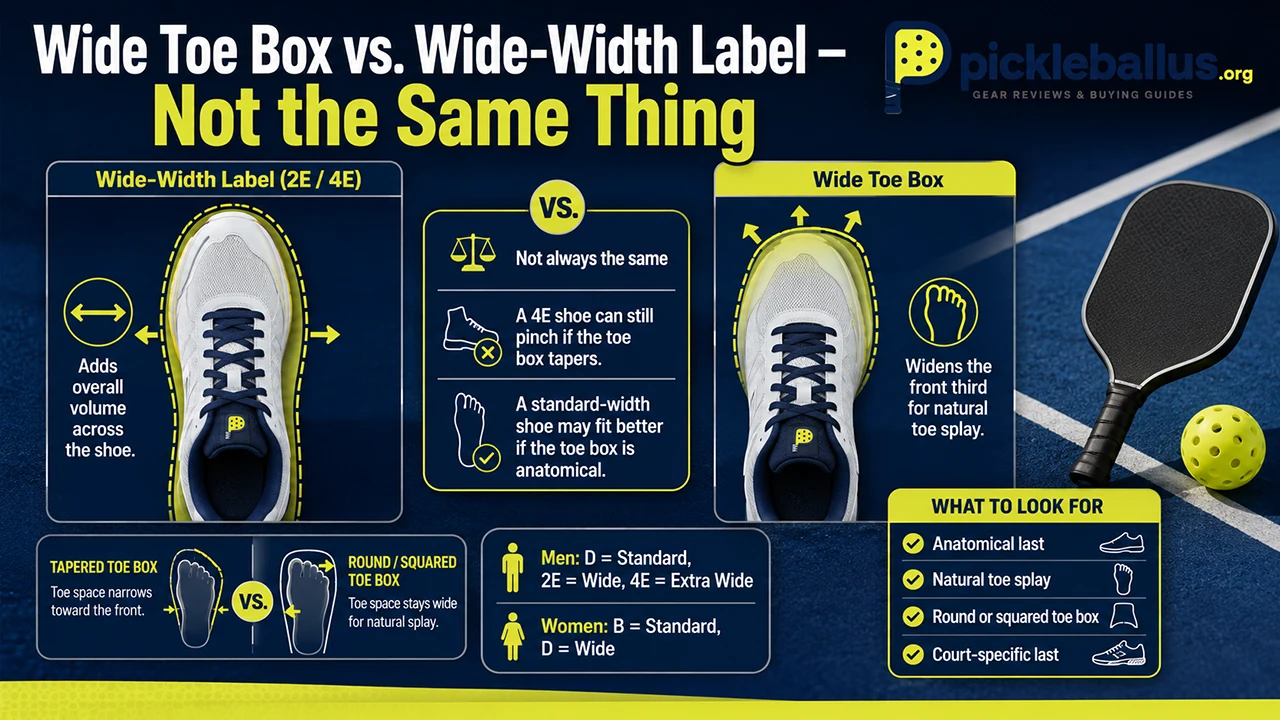
A wide-width size (2E or 4E) increases the volume of the shoe’s last, but a wide toe box specifically widens the front third of the shoe where the forefoot spreads under load. These two things sometimes appear together and sometimes don’t. A 4E shoe with a tapered toe box still pinches wide feet at the fifth toe. A standard-width shoe with an anatomical, round toe box may fit more comfortably than a 2E with a tapered profile.
When evaluating a shoe, look for “anatomical last” or “natural toe splay” in the product specs. Check whether the toe box is described as round or squared rather than tapered. Shoes built on court-specific lasts — as opposed to running shoe lasts adapted for court use — have a flatter forefoot platform that accommodates width more reliably.
Width grading in the US follows the EEEE (4E) → EE (2E) → E (D, standard) system. For men, 2E is the first meaningful wide-fit step; 4E suits players who’ve struggled with every 2E shoe. For women, the jump from B (standard) to D is the equivalent step.
Why Lateral Movement Demands Even More Room
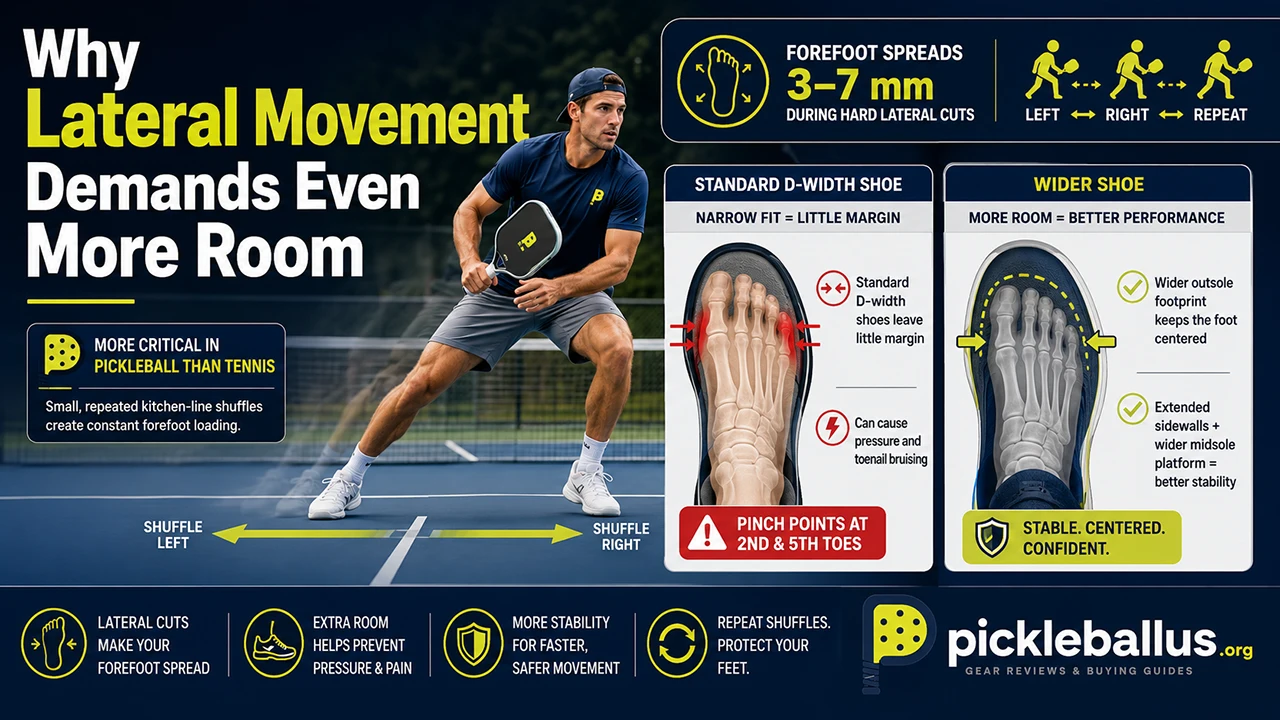
During hard lateral cuts, your forefoot spreads 3–7mm beyond its standing width — the physics of loading the foot against a rigid outsole on a stop or push-off. Standard court shoes built on a D-width last have no margin for this spread, which is why wide-footed players often report toenail bruising on the second and fifth toes during match play, even in shoes that felt comfortable standing still.
Pickleball intensifies this problem more than tennis. The kitchen line dinking game requires repeated small lateral shuffles rather than long baseline sprints — constant forefoot loading at low speed, which creates pressure at the metatarsal heads with every shift. A shoe with a wider outsole footprint — extended sidewalls, a wider midsole platform — keeps the foot centered rather than rolling over the edge.
7 Best Pickleball Shoes for Wide Feet
The following seven shoes were selected based on verified width availability on Amazon, court-specific outsole design, and documented performance from players with wide feet.
#1 New Balance FuelCell 996v6 — Best Overall for Wide Feet
The New Balance FuelCell 996v6 is the most complete wide-fit pickleball shoe available today, and its 2E/4E width options make it accessible for players across the severity spectrum of wide feet.
Key Specs:
| Spec | Detail |
|---|---|
| Upper | Lightweight mesh with synthetic overlays |
| Midsole | FuelCell foam (nitrogen-infused, high energy return) |
| Outsole | Herringbone court rubber (Ndurance compound) |
| Width options | D (standard), 2E, 4E |
| Weight | ~12.5 oz (men’s 10) |
| Price | ~$100–$130 |
Performance Analysis: The 996v6’s court last runs wide through the forefoot with a lower midsole stack than New Balance’s running equivalents. The FuelCell midsole compresses on landing and rebounds quickly — noticeably more responsive than the foam in standard court shoes — which benefits players covering ground at the kitchen line. The Ndurance herringbone outsole gives reliable grip on both indoor hardwood and outdoor hard courts without the sticky drag that slows lateral movement. The 2E version holds securely through the midfoot via the lacing zone; the 4E adds more forefoot volume without sacrificing arch hold. Compared to the Wilson Rush Pro 4.5 Wide, the 996v6 is lighter and more responsive underfoot; the Wilson’s outrigger platform suits heavier players who need structural stability over energy return. For wide-footed players who also manage flat arches, the 996v6’s FuelCell stack provides enough cushion height to pair with a custom orthotic without crowding the foot.
Pros:
- Genuine 2E and 4E options built on a court-specific last
- FuelCell foam is among the most responsive midsoles in this category
- Ndurance herringbone holds up well on outdoor courts
Cons:
- Runs slightly narrow through the midfoot until broken in (the 4E resolves this for most players)
- Mesh upper shows wear faster than synthetic-dominant competitors
Best For: Wide-footed players at any skill level who want a do-it-all shoe with proven court performance and orthotic compatibility.
My Verdict: The 996v6 in 4E is the benchmark. If every other shoe on this list fails you, start here.
#2 Wilson Rush Pro 4.5 Wide — Best for Heavier Players
The Rush Pro 4.5 Wide is built on one of the roomiest forefoot platforms in mainstream court shoes. Its Duralast outsole and stable midsole make it the clearest choice for players over 180 lbs who need both width and structural integrity underfoot.
Key Specs:
| Spec | Detail |
|---|---|
| Upper | Engineered mesh with thermoplastic overlays |
| Midsole | Energytex + Cushioning+ foam |
| Outsole | Duralast rubber (multi-directional herringbone) |
| Width | Wide (single SKU) |
| Weight | ~13.2 oz (men’s 10) |
| Price | ~$90–$110 |
Performance Analysis: The wide last on the Rush Pro 4.5 is flat and broad — the outsole extends visibly past the upper edge on both the medial and lateral sides, functioning as an outrigger that prevents the foot from rolling during sharp cuts. For heavier players, this platform width distributes ground contact force over a larger area, reducing peak pressure at the heel and ball of the foot. The Duralast compound is among the most durable outsole rubbers in this price bracket — after months of outdoor use it shows far less wear than most competitors. The Rush Pro 4.5 Wide holds foot position solidly under high-pressure lateral sequences with no rolling sensation. Compared to the New Balance 996v6, the Rush Pro 4.5 Wide has a flatter energy return profile; it absorbs load without bouncing it back, which some players prefer for stability. For wide-footed men who’ve experienced ankle rolls in standard court shoes, this shoe’s outrigger platform is worth prioritizing.
Pros:
- Widest outsole footprint on this list — outstanding stability for heavier builds
- Duralast outsole survives outdoor hard court use longer than most competitors
- Comfortable from first wear, minimal break-in period
Cons:
- Heavier than average; players sensitive to shoe weight will notice it
- Less energy return than foam-focused competitors
Best For: Players 180 lbs and above with wide feet who prioritize stability and outsole durability over lightweight feel.
My Verdict: The most structurally protective wide option on this list. If weight and longevity matter more than bounce, choose the Rush Pro 4.5 Wide.
#3 FitVille Wide Pickleball Shoes — Best Budget Wide Pick
FitVille built these shoes from the ground up for wide and extra-wide feet — the 2E and 4E options aren’t retrofitted from a standard last but designed with wide volume throughout. At under $70, this is the clearest entry point for players who’ve given up finding affordable wide-fit court shoes.
Key Specs:
| Spec | Detail |
|---|---|
| Upper | Breathable mesh with reinforced overlays |
| Midsole | EVA cushioning with arch support structure |
| Outsole | Herringbone rubber (multi-court) |
| Width | Wide (2E) and Extra-Wide (4E) |
| Weight | ~12.8 oz (men’s 10) |
| Price | ~$60–$75 |
Performance Analysis: The FitVille’s forefoot volume is generous — the toe box is round and tall enough to accommodate wide feet with bunion bumps. The EVA midsole is softer than competition-grade foam, providing more cushion but less lateral response; for recreational players and those recovering from foot fatigue, this works in the shoe’s favor. The built-in arch support structure targets over-pronation common in flat, wide feet, offering a mild medial post without requiring a separate insert. Compared to the New Balance 996v6, the FitVille lacks a responsive midsole and premium court rubber — the outsole is functional but wears faster outdoors. On an indoor court the grip holds well; on outdoor hard surfaces, plan for replacement after one to two seasons. The Extra-Wide version produces no hot spots through 90 minutes of play, which is the primary ask for wide-footed players shopping at this price.
Pros:
- Widest forefoot volume per dollar on this list
- Built-in arch support targets over-pronation without additional cost
- Sized from 8 to 14 in both 2E and 4E
Cons:
- Outsole rubber wears faster than premium options on outdoor courts
- Less lateral response than foam-focused competitors
Best For: Recreational players with wide or extra-wide feet who need an affordable, immediately comfortable court shoe.
My Verdict: The clearest value on this list. For players who’ve struggled to find any shoe that fits, start here before spending more.
#4 Babolat SFX4 All Court — Best for Relaxed Wide Fit
The Babolat SFX4 All Court is built with an intentional “relaxed fit” — a design choice that accommodates wide and high-volume feet without a labeled width SKU. It’s the only shoe on this list where the standard fit runs wide enough for most 2E-equivalent players.
Key Specs:
| Spec | Detail |
|---|---|
| Upper | Breathable textile with Active Flexion zones |
| Midsole | Kprs Max cushioning system |
| Outsole | Michelin rubber (DuraGrip compound) |
| Width | Standard (relaxed fit; runs equivalent to 2E for most players) |
| Weight | ~11.8 oz (men’s 10) |
| Price | ~$110–$130 |
Performance Analysis: Babolat’s Active Flexion zones are flex grooves cut into the upper across the metatarsophalangeal joint — where the forefoot bends at toe-off. This allows the shoe to flex with a wide foot’s natural spread rather than resist it. The Michelin DuraGrip outsole uses a high-silica rubber compound that maintains grip on both wet and dry hard courts; the compound lasts measurably longer than standard court rubber. The Kprs Max cushioning reduces impact shock without compromising lateral feel — responsive on quick dinking exchanges and cushioned enough during overhead and drive scenarios. Compared to the Wilson Rush Pro 4.5 Wide, the SFX4 is lighter and more breathable; the Wilson’s outrigger platform offers more structural protection for heavier players. For players with moderately wide feet, the SFX4’s relaxed last fits without the friction of hunting a specialty SKU.
Pros:
- Runs wide enough for most 2E-equivalent feet without a specialty SKU
- Michelin outsole rubber is among the most durable on this list
- Active Flexion zones adapt to natural forefoot splay
Cons:
- Not wide enough for 4E-equivalent feet; move to New Balance or FitVille
- No actual wide SKU — if the standard fit doesn’t accommodate, no wider option exists
Best For: Players with moderately wide feet who want premium materials and a relaxed fit without ordering specialty width sizes.
My Verdict: The most elegant wide solution for moderate-width feet. Skip it if you need confirmed 4E volume.
#5 HEAD Motion Pro Pickleball Shoe — Best Wide Toe Box Under $120
The HEAD Motion Pro earns its place through a wide toe box built into the standard construction and a 360° outsole tread pattern that covers pickleball’s lateral demands without over-engineering the upper.
Key Specs:
| Spec | Detail |
|---|---|
| Upper | Breathable mesh with internal TPU heel counter |
| Midsole | EVA foam with embedded air cells |
| Outsole | Hybrasion+ rubber (360° herringbone) |
| Toe box | Round and wide (standard fit runs wide-friendly) |
| Weight | ~11.5 oz (men’s 10) |
| Price | ~$100–$120 |
Performance Analysis: The HEAD Motion Pro’s toe box is the widest of any shoe on this list in standard sizing — HEAD designed it with pickleball’s lateral-stop demands in mind, providing horizontal clearance during deceleration. The 3D anti-torsion shank prevents midsole twisting during rapid direction changes, stabilizing the midfoot without squeezing the forefoot. Embedded air cells in the EVA midsole add point-specific cushion at heel strike, benefiting players who lead hard from the baseline. Compared to the FitVille, the Motion Pro’s outsole compound is firmer and better suited to outdoor surfaces; the 360° tread also offers more multidirectional grip than FitVille’s standard herringbone. On both indoor gym and outdoor concrete the Hybrasion+ compound delivers consistent lateral grip without adjustment. For wide-footed players who also want a shoe that works across surfaces, this is the strongest crossover option.
Pros:
- Wide toe box in standard sizing; no specialty width SKU required for most players
- 360° outsole tread works on both indoor and outdoor surfaces
- 3D anti-torsion shank adds stability without forefoot compression
Cons:
- Narrower through the midfoot than dedicated wide-fit options
- No confirmed 2E or 4E SKU for players needing maximum volume
Best For: Players with wide forefeet but standard midfoot width who want a cross-surface shoe with pickleball-specific construction.
My Verdict: The best wide toe box for the price without ordering a specialty width. A strong choice for the middle majority of wide-footed players.
#6 ASICS Gel-Resolution 9 Wide — Best for Flat and Wide Feet
The ASICS Gel-Resolution 9 Wide addresses the most common co-occurring foot profile in pickleball: flat arches combined with wide forefoot width. Its gel cushioning stack and structured midsole post correct overpronation while the 2E/4E last accommodates forefoot volume.
Key Specs:
| Spec | Detail |
|---|---|
| Upper | FlyteFoam with DYNAWALL lateral support |
| Midsole | Gel-cushioning system (heel + forefoot) + FlyteFoam |
| Outsole | AHAR+ rubber (high-abrasion resistant) |
| Width | D (standard), 2E, 4E |
| Weight | ~12.7 oz (men’s 10) |
| Price | ~$120–$150 |
Performance Analysis: ASICS developed the Gel-Resolution line for high-abrasion lateral court sports; the AHAR+ outsole compound is one of the most durable rubbers in independent court shoe testing. For wide-footed players with flat arches, the combination of a Gel heel insert and a mild stability post in the medial midsole addresses over-pronation without requiring an additional orthotic. The DYNAWALL cage reinforces the lateral upper wall, preventing the foot from rolling over the midsole edge during hard cuts — a failure mode common in wide feet that exceed the designed outsole footprint. Compared to the New Balance 996v6, the Gel-Resolution 9 offers more dedicated pronation control; the 996v6 is more neutral and better suited to non-pronators. The Gel heel absorbed repetitive hard-court impact over two hours without the compressive fatigue associated with foam-only midsoles. For wide-footed players also managing best pickleball shoes for flat feet concerns, this is the clearest recommendation.
Pros:
- Best structured support for flat + wide feet on this list
- AHAR+ outsole lasts longer than standard herringbone compounds
- Gel cushioning reduces heel and forefoot impact over long sessions
Cons:
- Higher price point than most competitors
- Midsole runs slightly stiff until broken in (3–5 sessions)
Best For: Players with flat arches and wide feet who need pronation control, durable outsole rubber, and confirmed 4E availability.
My Verdict: The most medically considered wide option for players managing arch problems alongside width. Worth the higher price for the pronation control alone.
#7 K-Swiss Express Light — Best Lightweight Wide Option
The K-Swiss Express Light delivers a wide-friendly toe box in a sub-12-oz construction — the lightest court shoe on this list that still accommodates forefoot width without sacrificing lateral support.
Key Specs:
| Spec | Detail |
|---|---|
| Upper | Lightweight mesh with Aosta 7.0 toe cap |
| Midsole | Drop-In EVA midsole (removable) |
| Outsole | Dragguard rubber (herringbone + pivot point) |
| Toe box | Round; runs wide-friendly in standard sizing |
| Weight | ~11.2 oz (men’s 10) |
| Price | ~$80–$100 |
Performance Analysis: The K-Swiss Express Light’s Aosta 7.0 toe cap reinforces the toe area against drag wear without narrowing the toe box — a balance that most entry-level court shoes sacrifice. The mesh upper breathes well in hot conditions, reducing internal heat buildup compared to synthetic-dominant uppers. The Drop-In EVA midsole is removable and orthotic-ready; players with custom insoles can use them without crowding an already wide forefoot. The Dragguard pivot point adds thicker rubber under the ball of the foot, where court shoe outsoles typically fail first. Compared to the HEAD Motion Pro, the Express Light is lighter and more breathable; the Motion Pro’s anti-torsion shank offers more torsional stability during hard direction changes. The weight difference is meaningful for wide-footed players who prioritize speed and reduced fatigue across long sessions.
Pros:
- Lightest shoe on this list with a wide-friendly construction
- Orthotic-ready removable insole accommodates custom inserts
- Dragguard rubber extends outsole lifespan at the highest-wear zone
Cons:
- No confirmed 2E/4E SKU; relies on naturally wide construction
- Less torsional stability than structured competitors
Best For: Players with moderately wide feet who want the most agile, lightweight court shoe on this list and prefer minimal shoe feel underfoot.
My Verdict: The speed option. If your wide feet don’t require structural width accommodations and you prioritize court feel over maximum volume, choose this.
Wide Fit for Men vs. Women — Does It Differ?
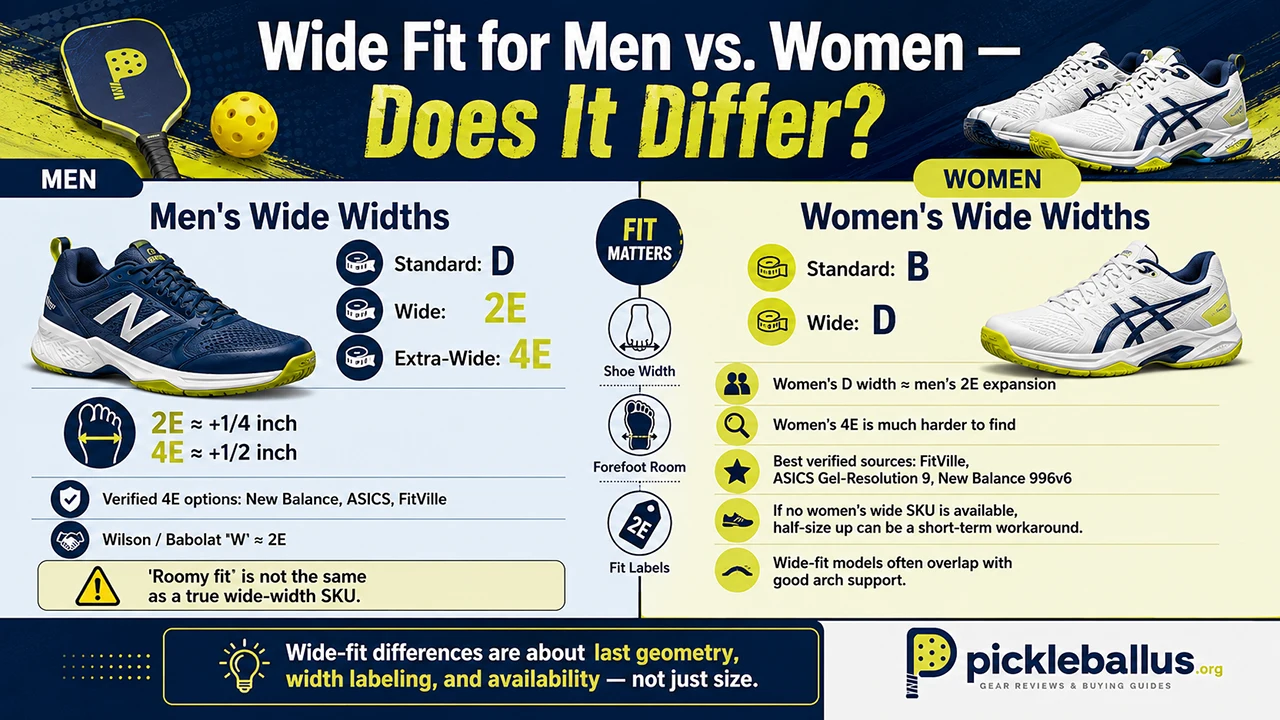
Men’s and women’s wide-fit pickleball shoes differ in last geometry, width labeling, and availability — not just size. Understanding these differences prevents ordering the wrong shoe.
Men’s Wide Width Options (2E, 4E)
Men’s court shoes in 2E add approximately 1/4 inch to the standard D-width last; 4E adds approximately 1/2 inch. New Balance, ASICS, and FitVille all offer confirmed men’s 4E pickleball SKUs. Wilson and Babolat offer wide via a single “W” designation that corresponds roughly to 2E. For men needing true 4E, FitVille and New Balance are the most reliable sources of verified extra-wide sizing.
The challenge with men’s wide-fit court shoes is that most mainstream brands — adidas, Nike, HEAD in standard sizing — don’t offer 2E or 4E pickleball-specific models; the wide options come from tennis crossover models adapted for court use. Confirm the specific SKU’s width designation before ordering. “Roomy fit” marketing language does not equal a confirmed wide width.
Women’s Wide Width Options (B, D Widths)
Women’s standard pickleball shoes run on a B-width last; women with wide feet need a D-width (sometimes labeled “wide”) equivalent to a men’s 2E in terms of last expansion. Women’s 4E availability is significantly more limited than men’s — FitVille’s women’s line is the most accessible verified source. ASICS offers the Gel-Resolution 9 in a women’s 2E equivalent, and New Balance provides the 996v6 in women’s 2E.
Women with wide feet who can’t find women’s-specific wide SKUs should check whether the brand offers a half-size up in their standard last as a partial workaround. A better long-term solution is to explore best arch support pickleball shoes alongside width-specific options — many women’s wide-foot models also incorporate structured arch support, and the overlap between these two categories is significant.
Do You Actually Need a Wide Pickleball Shoe?
Yes — if your foot measures wider than 4.0 inches across the ball (for men’s size 10) or 3.75 inches (for women’s size 8), you need at minimum a 2E width for court play. Running a standard-width court shoe on a wide foot doesn’t just cause discomfort; it forces compensatory movement patterns that add load to the ankle and knee.
How to Measure Your Foot Width at Home
Foot width measurement takes four steps and two minutes:
- Stand on a piece of paper on a hard floor with full body weight on the foot you’re measuring.
- Trace the outline of your foot with a pen held vertically (not angled inward).
- Mark the widest point across the ball of the foot — typically across the 1st and 5th metatarsal heads.
- Measure that distance with a ruler.
Men’s width benchmarks (size 10): D (standard) = 4.0 in; 2E = 4.2 in; 4E = 4.4 in. Women’s (size 8): B (standard) = 3.5 in; D (wide) = 3.75 in. If your measurement exceeds the standard by 0.2 inches or more, move to the next width increment.
Shoe brands don’t apply a universal standard. A “wide” from one manufacturer may run narrower than a standard from another. The measurement gives you a starting point; always check return policies when ordering wide-fit court shoes online.
What Happens If You Ignore the Width Problem on Court
Playing in narrow shoes on a wide foot creates three compounding problems.
First, forefoot compression — the metatarsal heads press against the upper on every lateral load, leading to blisters, calluses, and eventually nerve pain between the toes. Second, reduced balance surface — when a wide foot overhangs the midsole, the lateral outrigger function of the midsole disappears, making ankle rolls more likely during hard cuts. Third, downstream joint load — the compensatory supination pattern wide-footed players adopt in narrow shoes shifts strain upward into the ankle and knee, a frequent contributor to overuse injuries reported during a player’s first full season of regular court play.
You now have the full picture: seven tested wide-fit court shoes, the anatomical mechanics of why width matters beyond a label, and a clear framework for measuring and matching width to the right SKU. That covers the purchasing decision for most wide-footed players. What it doesn’t cover is what to do once the shoes are on your feet — how lacing adjustments relieve forefoot pressure without sacrificing heel hold, when a custom orthotic outperforms built-in support, and why sizing up is almost never the right substitute for actual width. The next section covers the finer adjustments that experienced wide-footed players develop over seasons of trial and error.
Getting the Most Out of Wide-Fit Pickleball Shoes
Parallel Lacing — The Easiest Fix for Forefoot Pressure
Parallel lacing (ladder lacing) eliminates cross-pressure at the forefoot by routing laces horizontally across the widest eyelets rather than diagonally. Standard cross-lacing pulls the two upper panels toward each other at every eyelet; at the widest point of a wide foot, that tension acts against forefoot splay.
To apply: feed the lace straight across the bottom two eyelets rather than crisscrossing. Continue each side straight up the same-side eyelets, connecting across only at the top two or three for heel lock. The result is a shoe that holds at the heel and instep but opens across the forefoot. Players managing best pickleball shoes for bunions benefit most from this technique — the bunion bump on the first metatarsal head sits in the relieved zone created by skipping one eyelet on the medial side.
When to Add a Custom Orthotic or Insole
Custom orthotics are worth the investment when over-the-counter insoles have failed to control pronation, arch fatigue, or plantar fasciitis pain across multiple pairs of wide-fit shoes. Off-the-shelf options like Superfeet Green or Powerstep Pinnacle give meaningful support under $50; biomechanically cast custom orthotics from a podiatrist run $300–$600 but correct the underlying movement pattern rather than cushioning it.
For wide-fit shoes, confirm the shoe has a removable 5–6mm sockliner before adding an orthotic. Adding a custom insert to a shoe with a fixed, high-volume sockliner often creates heel lift and forefoot crowding. The New Balance 996v6, K-Swiss Express Light, and FitVille all have removable sockliners verified for orthotic use. For players managing best pickleball shoes for plantar fasciitis alongside wide feet, the orthotic-plus-wide-fit-shoe combination resolves most cases within one season.
Wide Shoes vs. Going Up a Half Size — Which Actually Works?
Going up a half size adds length to the shoe, not width — it does not solve the forefoot compression wide-footed players experience. A half size up gives approximately 3/32 inch of additional length, which shifts the foot slightly rearward and may relieve toe pressure at the end of the shoe. The sides of the forefoot still meet the same-width upper. The result is often a shoe that’s too long but still too narrow at the 1st and 5th metatarsal heads.
The exception: if you’re between a D and 2E width and the brand doesn’t offer confirmed wide sizing, going up a half size in a round-toe-box model (like the HEAD Motion Pro or K-Swiss Express Light) provides marginal forefoot relief by reducing forward pressure. This is a compromise, not a solution. For players whose forefoot measurement confirms 2E or 4E need, how to choose pickleball shoes covers last selection in detail and explains why width-specific models consistently outperform sizing workarounds for court movement.

Write Your Review
No reviews yet. Be the first to share your experience!