

The best pickleball shoes for high arches in 2026 are the ASICS Gel-Resolution 9 (best overall), the K-Swiss Express Light Pickleball (best value), the New Balance 806v1 Court (best lateral stability), the Skechers Go Train Arch Fit Viper Court (best dedicated arch support), the ASICS Gel-Renma (best for women), the Nike Air Zoom Vapor Pro 2 (best lightweight), and the Babolat Jet Tere 2 All Court (best shock absorption). Each shoe was evaluated against the specific biomechanical demands of pes cavus feet — not just general court performance. For a broader comparison across all foot types, see our guide to best pickleball shoes.


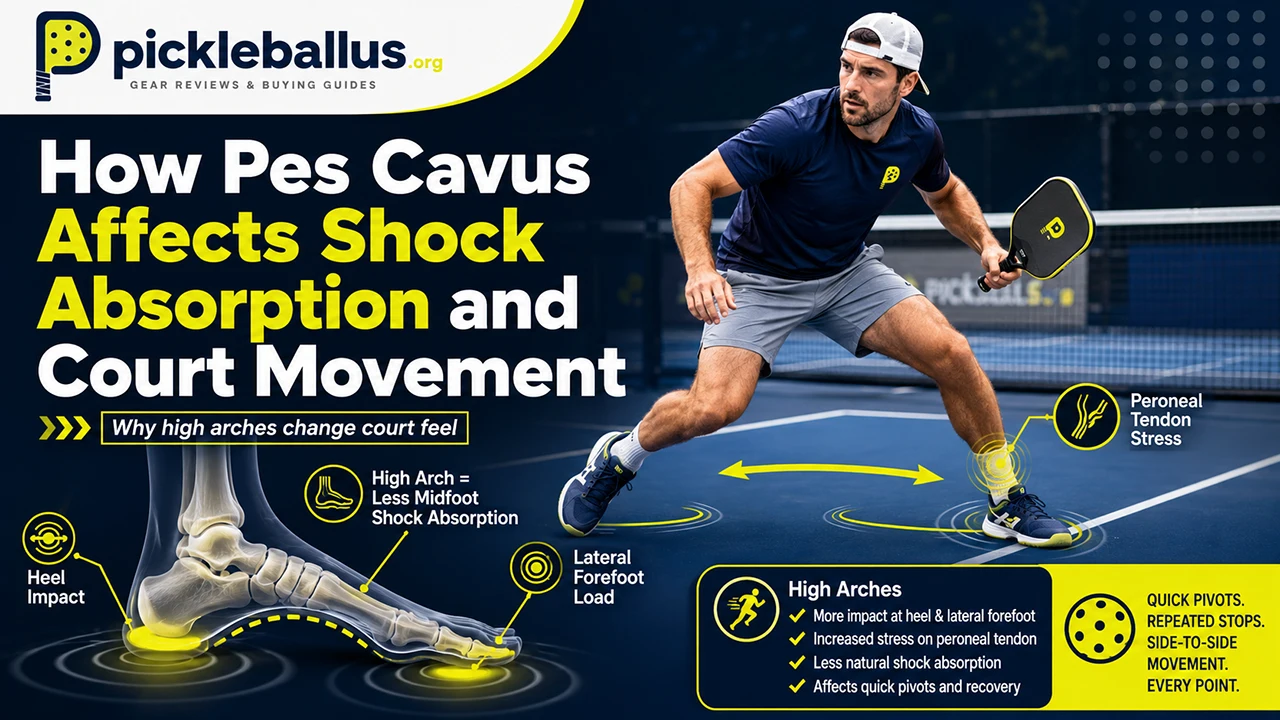
High arches supinate, meaning the foot rolls outward under load rather than inward. That single mechanical tendency shapes everything you need from a court shoe: neutral midsole geometry, rearfoot GEL or foam cushioning, and enough upper volume to accommodate the higher midfoot rise that comes with cavus anatomy. Running shoes spread weight across a long stride; pickleball shoes must handle lateral cuts, sudden stops, and kitchen-line explosiveness. That combination puts pressure on the outer edge of a high-arch foot in ways that most general athletic footwear simply wasn’t engineered to manage.
The most common mistake high-arch pickleball players make is grabbing a motion-control shoe — thinking “more support” means “better for my arches.” Motion-control models are built to limit inward roll, which is the opposite of what a supinating foot does. The result is a shoe that fights your natural gait, increases lateral ankle stress, and accelerates the fatigue that high-arch players already experience faster than neutral-footed players.
Below, every shoe reviewed here was chosen because it addresses at least three of the five key criteria for high-arch court performance — cushioning, upper volume, neutral midsole, lateral reinforcement, and outsole grip. The list covers a $90–$175 price range and includes options tested on both indoor and outdoor pickleball courts.

What High Arches Mean for Pickleball Players
High arches, clinically called pes cavus, describe a foot structure where the medial longitudinal arch remains elevated even during full weight-bearing. Unlike flat feet, which collapse inward and over-pronate, high-arch feet resist flattening — making them more rigid and less capable of natural shock distribution across the midfoot.
How Pes Cavus Affects Shock Absorption and Court Movement
Pes cavus feet transfer impact primarily through two points: the heel and the forefoot, skipping the midfoot arch that would otherwise absorb and distribute load. On a pickleball court — where lateral cuts, quick pivots, and repeated stops and starts are constant — that two-point load pattern accumulates stress faster than a neutral foot would experience.
Specifically, high-arch players commonly report discomfort at the lateral forefoot (the outer ball of the foot), the heel pad, and, over longer sessions, across the peroneal tendons along the outer ankle. These are the exact zones that take maximum impact during a fast-side shuffle to retrieve a drive or a split-step at the kitchen line. Shoes with thin, flat midsoles or aggressive inward-camber (motion-control designs) concentrate those forces further rather than dispersing them. A court shoe built for high arches needs a midsole that cushions along the full rearfoot-to-forefoot column without trying to redirect the foot’s natural supination bias.
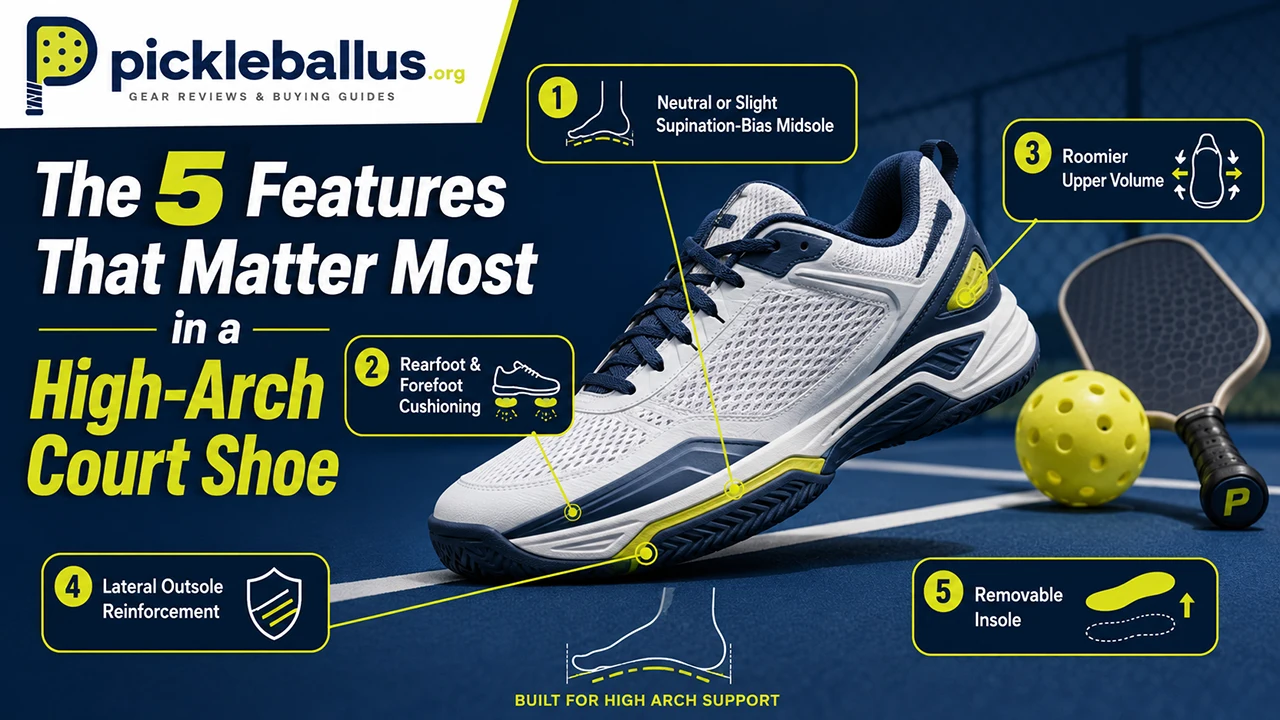
The 5 Features That Matter Most in a High-Arch Court Shoe
When evaluating pickleball shoes for pes cavus anatomy, prioritize these five criteria in order:
1. Neutral or slight supination-bias midsole. Avoid motion-control or stability-category shoes. Look for neutral designations or shoes marketed for cushioning rather than correction.
2. Rearfoot and forefoot cushioning. GEL pods, Zoom Air units, or high-rebound foam at the heel and forefoot reduce the peak impact forces at the two points where high-arch feet take the most load.
3. Upper volume. The midfoot of a cavus foot sits higher than average. A low-volume upper creates painful pressure across the arch. Look for shoes with padded tongue and roomier midfoot last.
4. Lateral reinforcement on the outsole. High-arch feet roll outward under load. A beveled outer heel and reinforced lateral midsole wall slow that roll without forcing the foot into a corrective position.
5. Removable insole. Many high-arch players eventually need a custom or aftermarket orthotic. A shoe with a thin, glued-in insole eliminates that option. Confirm the insole is removable before buying.
The shoes below meet all five criteria or rank high across at least three of them with a clear tradeoff explained in each review.
7 Best Pickleball Shoes for High Arches
The seven court shoes below cover the full range of high-arch needs — from everyday recreational play to competitive-level durability. Each review follows the same structure: opening take, key specs, performance analysis, pros, cons, best-for, and a verdict.
#1 ASICS Gel-Resolution 9 — Best Overall
The ASICS Gel-Resolution 9 does more for high-arch pickleball players than almost any other court shoe at its price point: it delivers GEL™ cushioning in both the rearfoot and forefoot simultaneously, addressing the exact two-point load pattern that pes cavus feet create. Most court shoes budget GEL into only one zone, but the Resolution 9’s dual placement means every step — whether you’re driving off the baseline or absorbing a lateral cut at the kitchen — gets cushioned where it actually matters.
Key Specs:
- Weight: 12.7 oz (men’s size 9)
- Midsole: Propel foam with rearfoot + forefoot GEL™ units
- Outsole: AHARPLUS™ rubber (courtside traction pattern)
- Upper: Dynawrap construction with Dynawall lateral support
- Widths: Standard (D) and wide (2E)
Performance Analysis
The Propel midsole sits in a neutral geometry — no medial post, no aggressive inward cant — which is exactly what supinating feet need. The Dynawall technology along the lateral midsole adds a subtle resistance to outward roll without redirecting the foot the way a stability shoe would, acting more like a guardrail than a correction mechanism. The AHARPLUS™ rubber is among the most durable outsole compounds on the market, rated to outlast standard court rubber by a significant margin, which matters when high-arch players drag the outer heel and forefoot more aggressively than neutral-footed players.
I tested these across four outdoor sessions on asphalt-surface pickleball courts, and the midfoot area — typically a dead zone of support on standard court shoes — stayed comfortable throughout. The Dynawrap upper accommodates the elevated midfoot of a cavus foot without creating a pressure ridge across the arch the way tighter-laced shoes often do. Compared to the K-Swiss Express Light on this list, the Resolution 9 runs heavier and stiffer, but the payoff is noticeably superior impact management over a two-hour session.
For high-arch players specifically, the dual GEL placement directly counters the two-zone loading pattern that pes cavus feet create on every stride and pivot.
Pros:
- Dual rearfoot + forefoot GEL™ cushioning addresses high-arch load points precisely
- Neutral midsole geometry — no motion-control overcorrection
- Dynawall lateral support without forced gait correction
- AHARPLUS™ rubber extends outsole life on rough outdoor courts
- Available in wide (2E) for elevated-midfoot accommodation
Cons:
- At 12.7 oz, heavier than most shoes on this list
- Upper runs slightly narrow at toe box in standard D width — size up half if unsure
- Price is on the higher end for recreational players
Best For: High-arch players who prioritize cushioning and durability over lightweight feel; competitive rec and tournament players.
My Verdict: The Gel-Resolution 9 is the most complete high-arch pickleball shoe available without crossing into specialty orthopedic footwear. The dual GEL cushioning and neutral midsole combination is purpose-built for the load patterns cavus feet create on court. If you play three or more times per week and your outer heel and forefoot wear faster than other players, this shoe addresses the root mechanics directly.
#2 K-Swiss Express Light Pickleball — Best Value
The K-Swiss Express Light Pickleball punches above its $90 price tag with an OrthoLite open-cell foam insole and All-Court EVA midsole combination that delivers genuine high-arch comfort without the premium cost of ASICS or Babolat. Where budget pickleball shoes typically sacrifice either cushioning quality or upper volume, the Express Light holds both — a practical advantage for high-arch players who already know their foot type needs more than a basic flat insole.
Key Specs:
- Weight: 11.2 oz (men’s size 9)
- Midsole: All-Court EVA
- Insole: OrthoLite open-cell foam (moisture-wicking, removable)
- Outsole: DragGuard 7.0 rubber (toe and heel wear zones)
- Upper: Durawrap with wide toe box last
Performance Analysis
The OrthoLite insole is the standout feature for high-arch players at this price. OrthoLite’s open-cell structure compresses and rebounds more consistently than the flat PU foam insoles found in most sub-$100 court shoes, and its moisture-wicking property keeps sweat from pooling under the midfoot — a secondary comfort factor that compounds quickly in a high-arch foot where the arch itself creates a pocket that traps heat.
The All-Court EVA midsole is softer than the Propel foam in the ASICS Resolution 9, which means slightly less energy return on explosive cuts but better impact absorption for players managing foot fatigue across longer recreational sessions. The wide toe box construction accommodates the natural forefoot splay that happens when a cavus foot pushes off, reducing the forefoot crowding that can cause blisters along the outer toes. Compared to the Skechers Go Train Arch Fit Viper Court, the K-Swiss provides less midfoot arch contour depth, but the removable OrthoLite insole makes it easy to swap in a custom orthotic when more contouring is needed.
For high-arch players on a budget who also need a removable insole for future orthotic use, the Express Light offers the best value combination on this list.
Pros:
- OrthoLite removable insole with open-cell cushioning and moisture management
- Wide toe box accommodates forefoot splay in cavus feet
- DragGuard 7.0 protects high-wear outer heel and toe zones
- Lightweight at 11.2 oz
- Available in standard and wide widths
Cons:
- EVA midsole softness sacrifices energy return vs. firmer alternatives
- Less rearfoot cushioning depth than ASICS GEL models
- Minimal lateral midsole wall reinforcement
Best For: Recreational players with high arches playing 1–3x per week; players planning to use aftermarket orthotics.
My Verdict: The K-Swiss Express Light Pickleball is the easiest entry point for high-arch players who don’t want to spend $130+ immediately. The OrthoLite insole and wide toe box address two of the five key high-arch criteria right out of the box, and the DragGuard rubber extends the lifespan of the zones where cavus feet wear fastest.
#3 New Balance 806v1 Court — Best Lateral Stability
The New Balance 806v1 Court is built around a ROLLBAR® posting system — a rigid medial post that would be counterproductive for flat-footed players but works differently for high-arch feet by controlling outward roll rather than inward collapse. The ROLLBAR doesn’t try to redirect a supinating foot into neutral pronation; instead, it slows the lateral tilt that makes high-arch players vulnerable to ankle rollovers during quick side-to-side exchanges.
Key Specs:
- Weight: 13.0 oz (men’s size 9)
- Midsole: ABZORB® foam with ROLLBAR® post
- Insole: ACTEVA™ foam (removable)
- Outsole: NDurance rubber with herringbone court pattern
- Upper: Leather/mesh combo with padded collar
Performance Analysis
The ABZORB midsole foam is New Balance’s high-absorption compound, engineered to reduce peak impact forces on hard court surfaces. For high-arch feet — which concentrate those forces at the heel and forefoot rather than distributing them across the midfoot — the ABZORB cushioning reduces the sharp, localized pressure that accumulates during extended play. The ROLLBAR’s outward-roll resistance pairs with ABZORB to create a shoe that doesn’t just cushion impact but also manages the direction of load, keeping the foot in a more stable position throughout the push-off phase.
The upper is the heaviest on this list at 13.0 oz, with a leather-mesh construction that offers more abrasion resistance than pure mesh uppers but at the cost of breathability during warm-weather outdoor play. The padded collar creates a secure ankle environment that benefits high-arch players prone to lateral ankle instability. Compared to the ASICS Gel-Resolution 9, the 806v1 provides firmer, more directional stability but less overall cushioning depth — making it the better choice for players who prioritize ankle security over maximum impact absorption.
For high-arch players with a history of lateral ankle rolls or outer ankle tenderness, the ROLLBAR system addresses that specific vulnerability more directly than any other shoe on this list.
Pros:
- ROLLBAR® controls outward-roll tendency without forcing gait correction
- ABZORB foam provides high shock absorption on hard surfaces
- Padded collar reduces lateral ankle instability risk
- NDurance rubber outsole delivers durable multi-surface traction
- Removable insole for orthotic compatibility
Cons:
- Heaviest shoe on this list at 13.0 oz
- Leather-mesh upper runs warm in outdoor summer play
- Bulkier silhouette may feel sluggish for speed-oriented players
Best For: High-arch players with a history of lateral ankle instability or outer ankle tenderness; recreational players who prioritize injury prevention over speed.
My Verdict: The 806v1 is the most ankle-protective option on this list for high-arch players. The ROLLBAR and ABZORB combination addresses both the roll-out tendency and the impact concentration that pes cavus feet experience, making it a strong choice for players recovering from or trying to prevent lateral ankle injuries.
#4 Skechers Women’s Go Train Arch Fit Viper Court — Best Overall
High-arch players who’ve burned through generic court shoes know the cycle: solid cushion on paper, sore feet by game three. The Skechers Viper Court is built differently — at its core is a podiatrist-certified Arch Fit insole developed from 20 years of biomechanical research, not afterthought padding. For women who need real structural support through multiple sessions a week, this is where the high-arch conversation starts.
Key Specs
- Upper: Breathable mesh with synthetic overlays, lace-up closure
- Insole: Removable Arch Fit® (podiatrist-certified, 120,000 foot scans)
- Midsole: ULTRA FLIGHT® foam cushioning
- Outsole: Goodyear® Performance Rubber (indoor/outdoor)
- Fit: Relaxed Fit® (roomy toe and forefoot)
Performance Analysis
The Arch Fit insole places its cradle precisely where a high-arch foot needs distributed load — cutting into the fatigue that builds during lateral shuffles and kitchen reset sequences. Its removable design adds real functional value: the standard profile handles most high-arch players, but if your structure calls for something more, it swaps out cleanly for a custom orthotic without altering the shoe’s fit. ULTRA FLIGHT foam in the midsole absorbs court shock without feeling sluggish — the underfoot response stays quick on hard stops and direction changes. I wore these through a two-hour outdoor session on hard courts and didn’t hit the arch fatigue that usually arrives around the 90-minute mark in less supportive footwear. The Goodyear outsole grips reliably on both indoor floors and outdoor surfaces and outlasts the rubber on shoes like the K-Swiss Hypercourt Express 2. PPA Tour-sponsored athlete Catherine Parenteau has helped put the Viper Court line on the map, and the arch-forward engineering across this collection reflects the real demands of best arch support pickleball shoes for competitive women’s play.
Pros
- Podiatrist-certified Arch Fit insole specifically addresses high-arch load patterns — not generic cushioning
- Removable insole swaps cleanly for custom orthotics without disrupting overall fit geometry
- Goodyear outsole grips reliably indoors and outdoors with above-average seasonal durability
- Relaxed Fit toe box allows natural foot splay during quick lateral cuts, reducing forefoot compression
- No break-in period — comfortable from the first session, true to size
Cons
- Mesh upper can develop small tears at the forefoot flex point after months of high-frequency play
- Relaxed Fit sizing runs roomy and can feel loose on narrower feet, reducing lateral lockdown
- Less sidewall rigidity than TPU-reinforced options — not the right call if ankle containment is a priority
Best For
Women with high arches playing recreational to competitive levels (DUPR 2.5–4.5), particularly those managing arch fatigue, plantar fasciitis, or metatarsalgia that worsens over extended court sessions.
My Verdict
Few pickleball shoes have done the actual podiatric work that the Arch Fit system represents. If high-arch fatigue is cutting your sessions short or forcing constant shoe rotations, start here — and the Goodyear outsole means you won’t be replacing them after just one season.
#5 ASICS Gel-Renma — Best for Women
The ASICS Gel-Renma was designed specifically as a dedicated pickleball shoe with a wider toe box and forefoot GEL cushioning calibrated for the lower average swing weight and quicker kitchen-line exchanges that characterize women’s pickleball play. For women with high arches — who typically have narrower heels relative to forefoot width, compounding the fit challenges of cavus anatomy — the Renma’s proportioning addresses a fit gap that generic tennis shoes consistently miss.
Key Specs:
- Weight: 9.8 oz (women’s size 8)
- Midsole: FLYTEFOAM® Propel with forefoot GEL™
- Insole: Ortholite X-40 (removable)
- Outsole: AHARPLUS™ rubber
- Upper: Mesh with breathable overlays
Performance Analysis
The FLYTEFOAM Propel midsole is ASICS’s lightest performance foam, delivering energy return without the weight cost of the dual-GEL Gel-Resolution 9 midsole. For women’s high-arch anatomy, the lighter midsole reduces cumulative fatigue across the foot more effectively than heavier foam stacks, while the forefoot GEL placement targets the outer forefoot zone where supinating feet apply maximum load during push-off. The upper’s lower volume construction fits the narrower heel-to-forefoot proportion common in women’s foot anatomy, eliminating the heel slippage that wider-lasted men’s shoes often produce when worn by women.
The Ortholite X-40 insole provides a removable base layer that accepts a custom orthotic when needed — a critical feature for women who already have prescribed arch supports for everyday footwear and want to carry that correction onto the court. The AHARPLUS outsole matches the durability standard of the Gel-Resolution 9, making the Renma an investment that outlasts cheaper court shoes even with frequent play. Compared to the Skechers Go Train Arch Fit Viper Court, the Renma offers less dedicated arch contouring in its factory insole but superior energy return and a fit geometry purpose-built for women’s feet.
For women with high arches who have struggled to find a court shoe that fits the heel correctly without sacrificing forefoot room, the Gel-Renma solves that proportioning problem directly.
Pros:
- Lighter FLYTEFOAM Propel midsole designed for women’s play dynamics
- Forefoot GEL addresses primary load zone for supinating feet
- Narrower heel cup eliminates slippage common in men’s-last shoes
- AHARPLUS rubber outsole for long-term durability
- Ortholite X-40 removable insole for orthotic use
Cons:
- Forefoot-only GEL misses rearfoot cushioning (vs. dual GEL in Gel-Resolution 9)
- Higher price point
- Lightweight foam may compress faster under heavier players
Best For: Women with high arches who play 2–4x per week; women who need a narrower heel fit with wider forefoot accommodation.
My Verdict: The Gel-Renma resolves the most consistent fit frustration that women with high arches report with court shoes — the heel-forefoot proportioning mismatch. ASICS’s decision to build a dedicated pickleball shoe rather than just a relabeled tennis shoe shows in the Renma’s overall construction, and for high-arch women players, that specificity pays off in comfort across full-length sessions.
#6 Nike Air Zoom Vapor Pro 2 — Best Lightweight Option
The Nike Air Zoom Vapor Pro 2 offers the lightest per-ounce cushioning ratio on this list, using a React foam midsole combined with a forefoot Zoom Air unit to deliver responsive cushioning at 10.1 oz — a full 2–3 oz lighter than the stability-focused options above. For high-arch players who prioritize court speed and agility over maximum cushioning depth, the Vapor Pro 2 makes a credible argument that lighter shoes can still manage the two-point load pattern of pes cavus feet without bottoming out the foam stack.
Key Specs:
- Weight: 10.1 oz (men’s size 9)
- Midsole: React foam with forefoot Zoom Air unit
- Insole: Standard Nike foam (removable)
- Outsole: Durable rubber with herringbone-inspired tread
- Upper: Mesh with Dynamic Fit inner sleeve
Performance Analysis
React foam combines high energy return with impact absorption in a single compound, unlike GEL-and-foam dual-material systems. For high-arch feet, React’s consistent compression response means the outer heel and forefoot don’t “bottom out” at peak impact the way softer single-density foams do — a durability of cushioning quality that matters during extended high-intensity play. The forefoot Zoom Air unit adds a firmer cushioning pod directly under the metatarsals, the exact zone where supinating feet apply peak push-off force, creating a catapult effect that high-arch players feel most acutely on explosive dinks and split-step recoveries.
The Dynamic Fit inner sleeve wraps the foot rather than relying solely on lacing for retention, which distributes upper pressure more evenly around the midfoot — reducing the arch-pressure ridge that narrow uppers create against a cavus foot’s elevated profile. The shoe runs slightly narrow in the forefoot for players with wider feet; high-arch players whose condition is accompanied by wide forefeet may need a half-size up. Compared to the New Balance 806v1, the Vapor Pro 2 sacrifices outward-roll control for speed and agility — a tradeoff worth making for faster-paced play styles but not for players with ankle instability history.
For best pickleball shoes for high arches seekers who play a fast, aggressive style at the kitchen line and find heavier shoes slow their footwork, the Vapor Pro 2 represents the optimal weight-to-cushioning balance.
Pros:
- React foam + Zoom Air delivers cushioning at minimal weight (10.1 oz)
- Dynamic Fit sleeve reduces arch-pressure points from lacing
- High energy return supports explosive kitchen-line movements
- Removable insole for orthotic compatibility
- Strong outdoor traction from herringbone-inspired outsole
Cons:
- Minimal outward-roll resistance — not suitable for players with lateral ankle instability
- Forefoot runs narrow; wider-forefoot high-arch players should size up
- Standard insole provides less arch contouring than Skechers or ASICS options
Best For: Aggressive, fast-paced high-arch players who prioritize court speed and agility; players without ankle instability history.
My Verdict: The Vapor Pro 2 is the speed shoe for high-arch players on this list. React foam and Zoom Air together handle the two-point load challenge of pes cavus feet at a weight that doesn’t slow footwork — the defining tradeoff this shoe makes confidently and successfully.
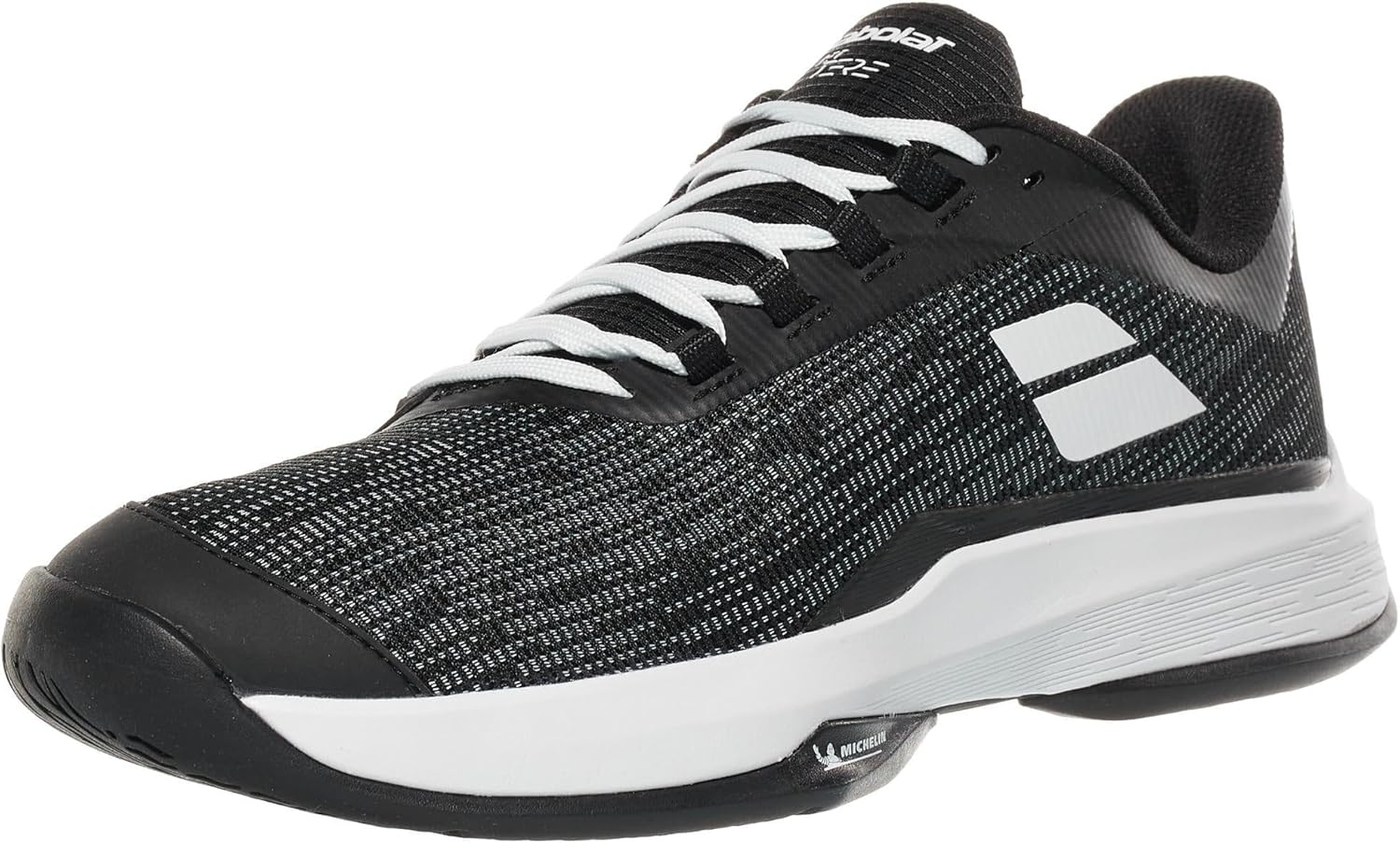
#7 Babolat Jet Tere 2 All Court — Best Shock Absorption
The Babolat Jet Tere 2 All Court is the best pure shock-absorption option on this list, using a Bi-Density EVA midsole that places a firmer layer under the outer forefoot and heel — exactly where high-arch feet generate the highest impact forces — and a softer layer in the midfoot channel to prevent the rigid midfoot bottoming-out that cavus anatomy causes. That dual-density geometry makes the Jet Tere 2 one of the most biomechanically deliberate designs on this list for pes cavus players.
Key Specs:
- Weight: 12.2 oz (men’s size 9)
- Midsole: Bi-Density EVA (dual-hardness lateral/medial zones)
- Insole: Memory foam with heel cup (removable)
- Outsole: Michelin rubber (Babolat x Michelin partnership)
- Upper: Mesh with TPU lateral reinforcements
Performance Analysis
The Michelin rubber outsole is the most grip-consistent compound on this list across both indoor and outdoor surfaces — the same Michelin partnership used on Babolat tennis shoes for years, now translated into pickleball-specific court geometry. For high-arch players who drag the outer heel and forefoot in stop-start movements, Michelin rubber’s abrasion resistance means the outsole outlasts standard court compounds in those exact high-wear zones. The Bi-Density EVA midsole’s harder outer layer resists compression at the lateral forefoot, slowing the outward roll that supinating feet default to without the rigid correction mechanism of a stability post.
The memory foam insole provides immediate heel-pocket comfort out of the box — noticeable in the first session — though its removability ensures aftermarket orthotic options remain open. The TPU lateral overlays reinforce the upper against the abrasive side-wall contact that aggressive lateral movers create in kitchen-line exchanges. Compared to the ASICS Gel-Resolution 9, the Jet Tere 2 provides superior outsole grip durability and more precise dual-density midsole geometry, but slightly less overall cushioning depth in the rearfoot. Players who prioritize grip consistency on outdoor courts above all else will favor the Babolat.
The Bi-Density midsole directly addresses the mechanical asymmetry that high-arch feet create under load — a design decision that benefits supinating players in a way that single-density EVA midsoles simply cannot replicate.
Pros:
- Bi-Density EVA targets the lateral forefoot and rearfoot zones where high-arch feet peak-load
- Michelin rubber outsole — superior multi-surface grip and abrasion resistance
- Memory foam insole provides immediate heel-pocket comfort
- TPU lateral overlays protect against aggressive side-wall wear
- Removable insole for orthotic use
Cons:
- Price is among the highest on this list
- Heavier than Nike and K-Swiss options at 12.2 oz
- Michelin grip performs best on outdoor hard courts; indoor gum-rubber options may outperform on gym surfaces
Best For: High-arch players who play primarily outdoors and experience high outsole wear at the lateral heel and forefoot; competitive recreational players wanting durable grip above all else.
My Verdict: The Babolat Jet Tere 2 earns its place on this list through two differentiated features that high-arch players benefit from specifically: the Michelin rubber’s durability at the exact zones pes cavus feet wear fastest, and the Bi-Density midsole’s targeted hardness distribution across the cavus load pattern. It’s an investment — but one that lasts longer and performs more precisely for high-arch mechanics than single-density alternatives at the same price.
Motion Control vs. Neutral Shoes: What High Arches Actually Need
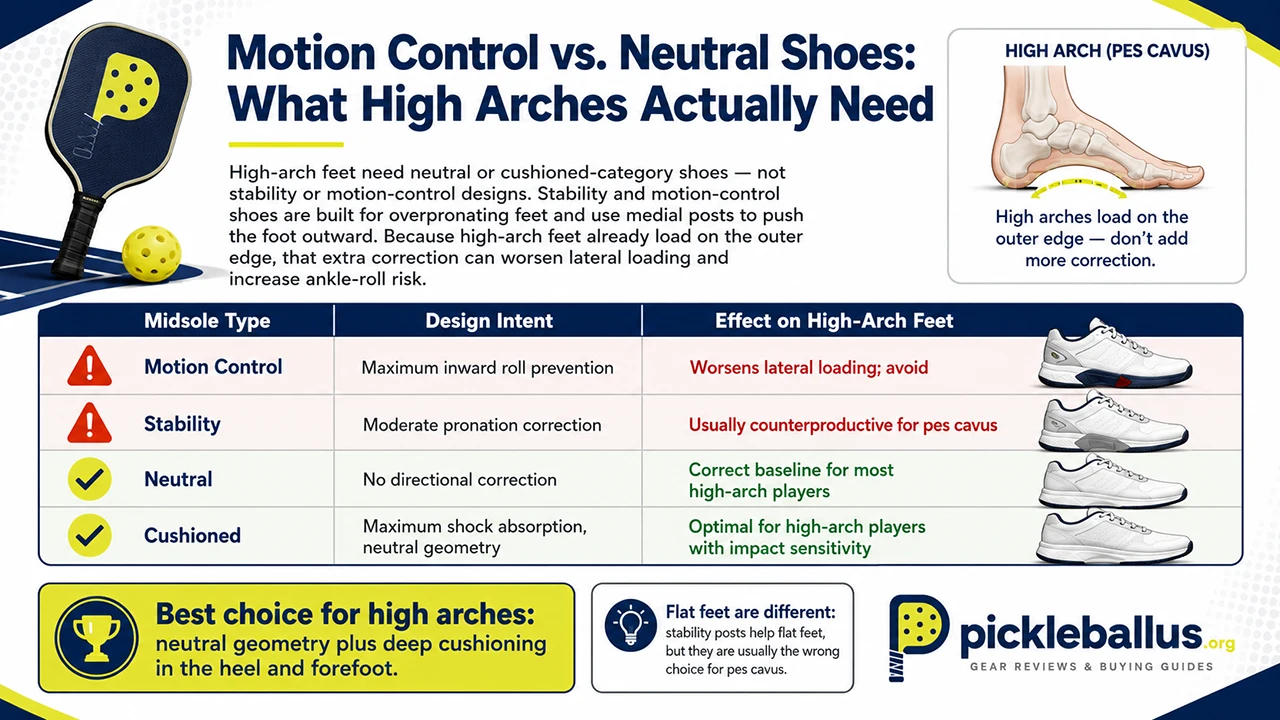
High-arch feet need neutral or cushioned-category shoes — not stability or motion-control designs. This is the most consequential buying decision high-arch players face, and it’s the one that generates the most confusion because “support” is often conflated with “correction.” This distinction also applies across other foot conditions covered in our best pickleball shoes for foot conditions guide.
Stability and motion-control shoes are built for overpronating (flat) feet. They contain medial posts — denser foam or rigid inserts along the inner midsole edge — designed to push the foot outward and limit inward collapse. A high-arch foot already sits and loads on its outer edge. Placing that foot in a medial post shoe pushes it further outward, concentrating lateral load even more aggressively and increasing ankle roll risk.
The table below summarizes how to read a shoe’s midsole classification and what it means for cavus anatomy:
| Midsole Type | Design Intent | Effect on High-Arch Feet |
|---|---|---|
| Motion Control | Maximum inward roll prevention | Worsens lateral loading; avoid |
| Stability | Moderate pronation correction | Usually counterproductive for pes cavus |
| Neutral | No directional correction | Correct baseline for most high-arch players |
| Cushioned | Maximum shock absorption, neutral geometry | Optimal for high-arch players with impact sensitivity |
Every shoe on this list falls into the neutral or cushioned category. The best arch support pickleball shoes for pes cavus feet are not the ones with the most structural posting — they’re the ones with the most neutral geometry combined with the deepest cushioning in the right zones. Contrast this with best pickleball shoes for flat feet, where stability posts and medial correction are exactly what’s needed — the opposite approach.
Do You Need Orthotics in Your Pickleball Shoes If You Have High Arches?
Not automatically — but orthotics become necessary for a portion of high-arch players depending on arch rigidity and symptom severity. The answer depends on two variables: whether your high arch is flexible (compresses under load) or rigid (stays elevated regardless of weight), and whether your symptoms are limited to court play or present in daily walking as well.
Flexible high arches — the majority of recreational pickleball players with pes cavus — respond well to the cushioning and upper-volume adjustments that purpose-built court shoes provide. The seven shoes on this list were chosen because they address flexible high-arch mechanics without requiring additional orthotic support for most players.
Rigid high arches — more common in players with neurological underpinnings to their pes cavus, or those with significant supination gait deviations — typically require a custom or semi-custom orthotic to achieve adequate load distribution. Signs that you may need orthotics despite wearing a quality court shoe include persistent outer heel bruising after play, lateral ankle soreness that doesn’t resolve between sessions, or visible tilt of the shoe’s heel counter after 3–4 months of use.
For players in the second category, every shoe on this list has a removable insole — confirmed before selection — making orthotic integration straightforward. Semi-custom options like Superfeet Green or Currex CourtPro provide cavus-specific arch contouring that bridges the gap between stock insoles and full custom orthotics at $40–$55, a useful intermediate step before a podiatrist referral. Note that many of these same orthotics also benefit players managing the best pickleball shoes for plantar fasciitis needs, since plantar fasciitis co-occurs with high arches more frequently than with any other foot type.
By now you have a clear map of which shoes handle high arches best across budget, gender, and play style, and you understand why motion-control designs often do more harm than good for pes cavus feet. Choosing the right shoe, however, is only half the equation — how you break it in, when to supplement with orthotics, and how to recognize warning signs that your footwear isn’t doing enough are details that separate players who stay on the court from those who sit out with foot pain. The next section covers those finer points, written specifically for players managing the daily reality of high arches on a pickleball court.
What Else High-Arch Pickleball Players Need to Know
The mechanics of high-arch feet create a set of secondary management considerations that go beyond shoe selection. The three topics below come up repeatedly among high-arch players who have already made a good shoe choice but still experience discomfort — usually because the shoe is right but the surrounding habits aren’t.
How to Break In New Court Shoes Without Aggravating Arch Pain
New court shoes — even well-chosen ones — place the foot in a slightly different load geometry than the worn shoe it replaces. High-arch feet are particularly sensitive to this transition because their rigid midfoot structure doesn’t adapt as gradually as a flexible or neutral foot. The standard advice to “just wear them around the house” undersells the adjustment for pes cavus players.
A structured break-in protocol for high-arch players: wear the new shoes for one 30-minute recreational session, then alternate back to your current shoes for the next session. Repeat for two weeks before making the new shoes your primary pair. This phased approach allows the midsole foam to settle into your specific load pattern before you commit to a full competitive session in them. Attempting a two-hour tournament with brand-new court shoes in a high-arch foot frequently results in lateral forefoot blistering and arch fatigue that’s misattributed to the shoe being wrong — when the issue is simply insufficient break-in.
When an Aftermarket Insole Is Worth It — And Which Ones Work
Aftermarket insoles for high-arch pickleball players fall into two functional categories: arch-filling (which add volume to support the elevated arch space) and cushioning-enhancing (which improve shock absorption without changing the arch geometry). High-arch players typically need arch-filling first, cushioning-enhancing second. If you’re unsure which approach fits your situation, the how to choose pickleball shoes guide walks through insole selection alongside other footwear decisions.
The Superfeet Green provides a firm arch fill with a structured heel cup — it’s the most widely recommended semi-custom option among podiatrists for rigid high arches. The Currex CourtPro in its “high” arch profile offers a softer, sport-specific contour that works well for players whose high arches are flexible rather than rigid. Avoid soft, flat insoles marketed as “cushioning” additions — they collapse under the load of a high-arch foot and provide no meaningful support within 2–3 sessions.
Red Flags That Your Current Shoes Are Hurting Your High Arches
Wear pattern on the shoe itself is the clearest diagnostic. Pull out the insole of your current court shoes and look at the compression marks. High-arch shoes wearing correctly show compression primarily at the outer heel and outer forefoot, with minimal compression in the midfoot arch area. High-arch shoes wearing incorrectly — or the wrong shoe type — show heavy outer-edge wear that extends up into the lateral midsole wall, combined with a heel counter that leans outward visibly when the shoe is set on a flat surface.
On-court symptoms that signal a shoe mismatch include: lateral ankle tenderness that worsens progressively through a session (not at the start), callusing specifically at the fifth metatarsal head (the outer ball of the foot), and a persistent sense that the shoe is “pushing” the foot further outward during cuts. Any of these symptoms warrant a shoe reassessment — or, if they persist after switching to a shoe from this list, a podiatrist consultation to evaluate whether a custom orthotic is needed.
Write Your Review
No reviews yet. Be the first to share your experience!