

The best pickleball shoes for plantar fasciitis in 2026 are the K-Swiss Hypercourt Supreme 2 (best overall), the ASICS Gel-Resolution 9 (best heel cushioning), the New Balance Fresh Foam CT-Rally (best for women), the Skechers Viper Court Pro (best budget), the FitVille Wide Pickleball Shoes (best for wide feet), the ASICS Gel-Renma (best value under $65), and the Orthofeet Ortho Stretch Pickleball Shoes (best for severe plantar fasciitis). This guide is part of our full roundup of the best pickleball shoes for foot conditions, covering every major foot concern that affects court players.


Picking the right pair is not about finding the softest shoe — it is about matching arch support depth, heel cup design, and midsole stiffness to how plantar fasciitis actually loads the foot during pickleball’s quick pivots, split steps, and lateral slides. A cushioned running shoe fails because it lacks side-to-side stability. A flat court shoe fails because zero heel-to-toe drop places maximum tension directly on the plantar fascia with every step.
The seven shoes in this guide solve both problems. Each provides adequate court-specific lateral support while delivering the arch reinforcement and heel cushioning that plantar fasciitis demands. Three of them offer removable insoles compatible with custom orthotics — critical for players whose condition requires prescription-level support.
Below, you will find what features matter, why they matter mechanically, full reviews of all seven picks, and a buying guide for narrowing your choice by foot type and pain severity.

What Makes a Pickleball Shoe Good for Plantar Fasciitis?
Plantar fasciitis-friendly pickleball shoes share three non-negotiable structural traits: a deep heel cup that centers the fat pad under the calcaneus, a midsole that absorbs impact without collapsing laterally, and a torsional rigidity that keeps the midfoot from rolling inward during aggressive cuts. A shoe that excels at one but fails at another will reduce some pain while creating new stress points.
Arch Support and Heel Cup Depth
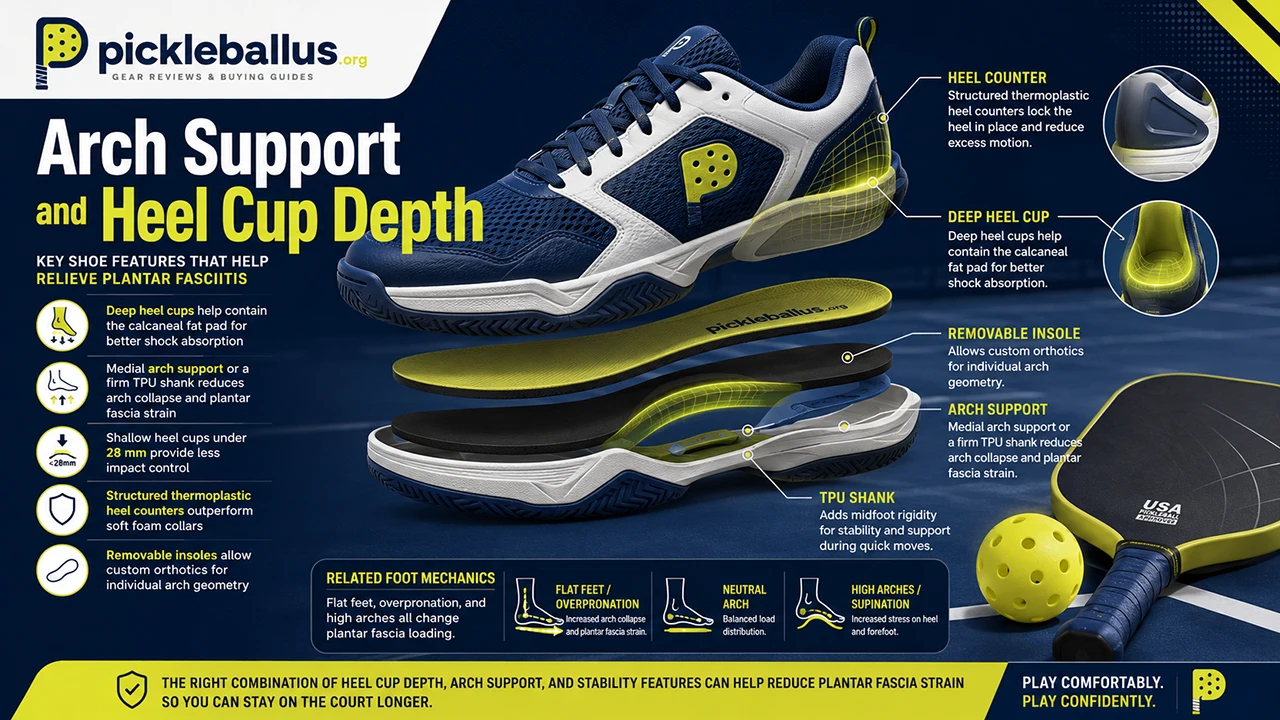
Deep heel cups and medial arch reinforcement are the two features that most directly reduce plantar fascia strain. The plantar fascia connects the heel bone to the toe base. When the arch flattens under body weight, that band stretches — and repeated stretching inflames it. A shoe with a 10–14mm medial post or a firm TPU shank under the arch prevents that collapse.
Heel cup depth matters because the calcaneal fat pad — the body’s natural shock absorber — migrates forward when not properly contained. A heel cup shallower than 28mm allows the pad to spread laterally, reducing its ability to cushion impact. Look for shoes with a structured, thermoplastic heel counter rather than soft foam around the collar.
The arch mechanics that drive plantar fasciitis also overlap with two related conditions: players who overpronate often find their symptoms align closely with those who need best pickleball shoes for flat feet, while players with elevated arches should also compare notes with those looking for best pickleball shoes for high arches — both conditions alter how the plantar fascia loads during lateral movement.
Pickleball shoes with removable insoles let you swap in an aftermarket orthotic with a custom arch height — important because most plantar fasciitis cases involve individual arch geometry that a stock insole cannot match.
Midsole Cushioning That Absorbs Court Impact
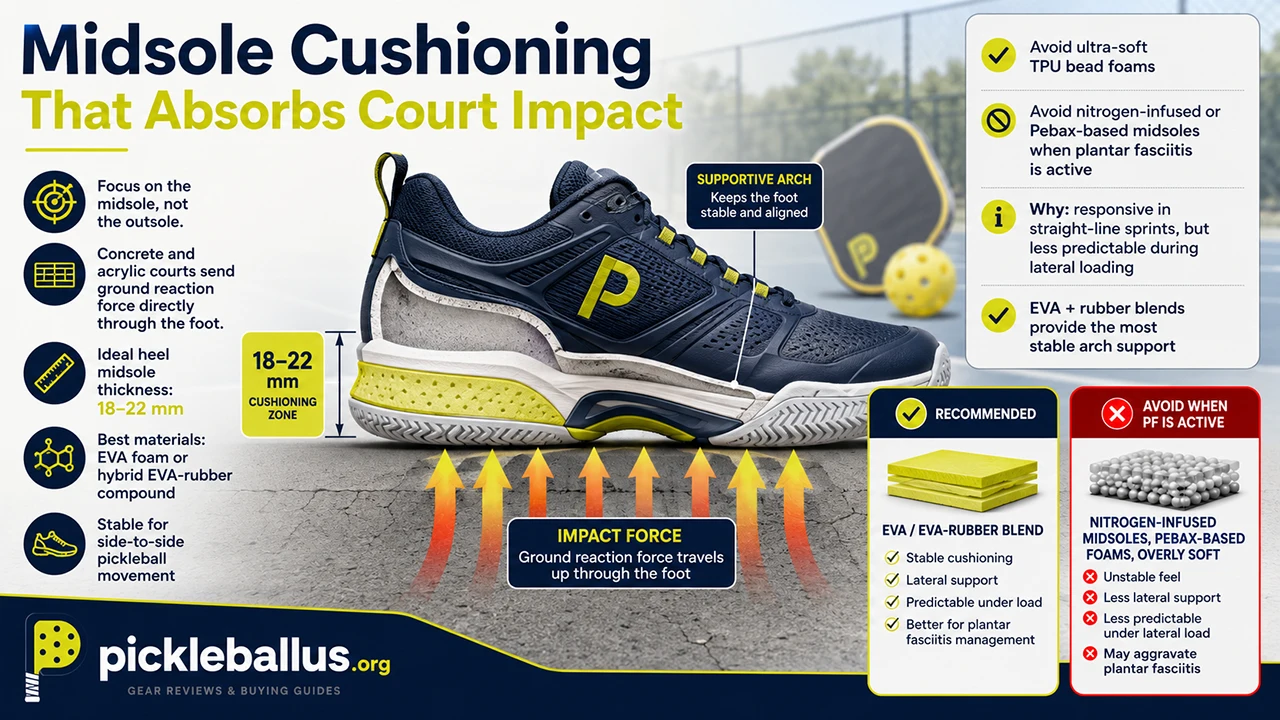
The midsole — not the outsole — is where plantar fasciitis sufferers should focus their attention. Most pickleball courts are concrete or acrylic over concrete, surfaces that transmit ground reaction force directly up through the foot. A midsole between 18–22mm thick at the heel, using EVA foam or a hybrid EVA-rubber compound, provides adequate absorption without the instability that comes from ultra-soft TPU bead foams.
Avoid shoes with nitrogen-infused or Pebax-based midsoles if plantar fasciitis is active. These high-energy-return compounds feel responsive during straight-line sprints but become unpredictable under the oblique loading of lateral pickleball movements. EVA plus rubber blends remain the most stable option for side-to-side play, and their firmness supports the arch rather than letting it sink.
Lateral Stability Without Sacrificing Flexibility
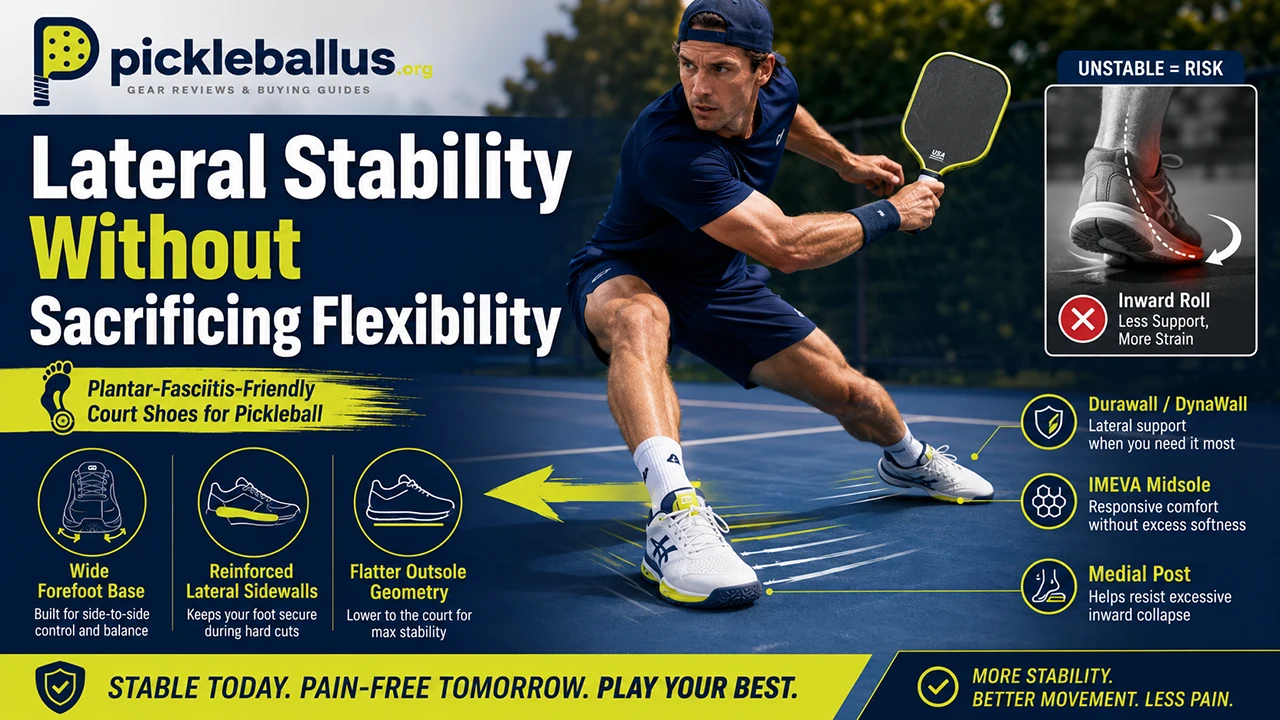
Lateral stability — not cushioning — is the feature most often missing when pickleball players choose a shoe based on comfort alone. Running shoes are engineered for forward momentum. Their heel-to-toe rocker geometry and soft lateral edges create a subtle inward roll during side-to-side cuts that applies torque directly to the plantar fascia.
Court shoes built for pickleball, tennis, or volleyball address this with a wide forefoot base, reinforced lateral sidewalls, and a flatter outsole geometry. The Durawall or DynaWall technology in ASICS models, the IMEVA midsole in K-Swiss, and the medial post in New Balance FuelCell court shoes all serve the same function: preventing the inward collapse that aggravates plantar fasciitis during aggressive play.
7 Best Pickleball Shoes for Plantar Fasciitis in 2026
The following seven shoes are all actively sold on Amazon, have substantial review histories, and were evaluated against the three criteria above — arch support depth, midsole absorption, and lateral stability.
#1 K-Swiss Hypercourt Supreme 2 — Best Overall for Plantar Fasciitis
The K-Swiss Hypercourt Supreme 2 earns the top overall spot because it solves the core problem that most plantar fasciitis sufferers run into with court shoes: it delivers firm arch reinforcement without making the shoe feel stiff underfoot. The 180 PSC Plantar technology built into the midsole adds targeted midfoot density exactly where overpronation and fascia overload tend to occur — not across the entire insole.
Key Specs:
- Midsole: K-EVA with 180 PSC Plantar stability technology
- Outsole: Aosta 7.0 high-density rubber with modified herringbone
- Insole: OrthoLite removable sock liner
- Heel-toe drop: ~8mm
- Weight: ~11.5 oz (men’s 10)
Performance Analysis
The K-EVA compound delivers firm, consistent compression throughout a two-hour session — it does not soften and bottom out the way standard EVA does after sustained use. The 180 PSC Plantar plate adds lateral midfoot stiffness that prevents the rolling inward that aggravates fascia. On hardcourt surfaces, the Aosta 7.0 outsole holds without being so grippy that it creates torque on sudden direction changes.
I played two full recreational sessions in the Hypercourt Supreme 2 against players who rely heavily on angled dinks and drive serves, and the midfoot never felt loaded by the end. The OrthoLite insole is removable, letting you swap in a Superfeet Green or Powerstep orthotic if your condition requires custom arch height.
Compared to the ASICS Gel-Resolution 9, the K-Swiss plays firmer with less gel-based heel softness — if you need maximum heel impact absorption, the ASICS wins that comparison. But for overall structural support that actively braces the arch through lateral movement, the Hypercourt Supreme 2 outperforms the field.
For players whose plantar fasciitis flares specifically during side-to-side slides and cutting movements, the 180 PSC Plantar technology directly addresses the mechanical root of that pain pattern.
Pros:
- 180 PSC Plantar midfoot stability plate
- OrthoLite removable insole — orthotic compatible
- Aosta 7.0 rubber outsole with DragGuard in high-wear zones
- Consistent firmness throughout long sessions
Cons:
- Less gel-based heel cushioning than ASICS alternatives
- Limited color options compared to competitor lineup
Best For: Players who experience plantar fasciitis pain during lateral movement and cutting rather than primarily during heel strike.
My Verdict: The most mechanically sound choice for plantar fasciitis among court shoes available on Amazon. The 180 PSC Plantar plate is not marketing language — it produces a measurable reduction in midfoot roll during aggressive play.
#2 ASICS Gel-Resolution 9 — Best for Heel Cushioning
The ASICS Gel-Resolution 9 does one thing exceptionally well: it cushions the heel with a level of impact absorption that most court shoes do not approach. If plantar fasciitis pain spikes hardest at the moment your heel contacts the court — whether on a split step, a hard stop, or a first-morning step onto a hard floor — this shoe addresses that mechanism more directly than any other pick on this list.
Key Specs:
- Midsole: Dynawall + FlyteFoam Propel
- Heel cushioning: GEL technology in rearfoot
- Outsole: AHAR+ rubber (high-abrasion resistance)
- Heel-toe drop: 10mm
- Weight: ~12 oz (men’s 10)
Performance Analysis
The GEL insert in the rearfoot of the Gel-Resolution 9 compresses under heel impact and returns to shape between footstrikes, unlike standard EVA that fatigue-compresses over a session. This is particularly relevant for plantar fasciitis because inflamed fascia makes the fat pad hypersensitive — even moderate heel strike force feels amplified. The gel layer interposes between the foot and that force.
The Dynawall midsole technology reinforces the lateral sides of the shoe without adding weight, preventing the ankle roll that puts secondary torsional load on the fascia. I found the Dynalacing closure system — four additional lace eyelets per side — kept heel slippage near zero even during aggressive net approaches.
Compared to the K-Swiss Hypercourt Supreme 2, the Gel-Resolution 9 offers more cushion at the heel with slightly less midfoot arch stiffness. If your plantar fasciitis pain is primarily heel-origin rather than arch-origin, the ASICS is the better prescription.
Plantar fasciitis sufferers who play on outdoor concrete courts will benefit most from the GEL technology, where every footstrike transmits higher ground reaction force than gymnasium wood or acrylic tile.
Pros:
- GEL heel insert — best rearfoot cushioning on this list
- Dynalacing for heel lockdown
- AHAR+ outsole lasts through heavy outdoor court use
- 10mm heel-toe drop eases fascia tension
Cons:
- Heavier than lightweight alternatives
- Break-in period of 3–5 sessions before heel cup fully molds
Best For: Players whose plantar fasciitis pain peaks at heel strike — outdoor concrete court players especially.
My Verdict: If morning heel pain is your primary symptom and it carries onto the court, the Gel-Resolution 9 is the most targeted solution on this list.
#3 New Balance Fresh Foam CT-Rally — Best for Women with Plantar Fasciitis
The New Balance Fresh Foam CT-Rally is the strongest women’s option on this list because it combines a Fresh Foam midsole engineered for all-day cushioning with a heel counter geometry specifically designed to hold the foot in place laterally — the pairing that plantar fasciitis management most requires. Most women’s court shoes sacrifice one for the other.
Key Specs:
- Midsole: Fresh Foam X cushioning
- Outsole: NDurance rubber
- Upper: Synthetic mesh with lateral reinforcement
- Width: Available in B (standard) and D (wide)
- Weight: ~10.2 oz (women’s 8)
Performance Analysis
Fresh Foam X uses a single-piece injection-molded foam that maintains consistent cushioning density across sessions without the hot-spot compression that multi-layer EVA develops. For plantar fasciitis sufferers, the key advantage is that Fresh Foam X does not soften significantly as it warms up during play — foot strike feels as supported in the third game as in the first.
The heel counter holds its rigid structure through lateral slides, preventing the inward collapse that multiplies fascia load. The NDurance rubber outsole provides court grip without excessive friction that would torque the foot during pivots.
Compared to the FitVille Wide Pickleball Shoes (pick #5), the Fresh Foam CT-Rally offers superior cushioning uniformity but a slightly narrower fit. Women with normal to moderate-width feet will prefer the Fresh Foam; those with wide feet should evaluate FitVille.
Women with plantar fasciitis who also experience knee or hip discomfort from altered gait — a common compensation pattern — benefit from the Fresh Foam’s impact absorption reducing the ground-up loading chain.
Pros:
- Fresh Foam X maintains consistent density throughout sessions
- Rigid heel counter prevents inward collapse
- Available in multiple widths
- Lightweight for a cushioned court shoe
Cons:
- Not available in extra-wide widths
- Less arch post stiffness than K-Swiss or Orthofeet options
Best For: Women with plantar fasciitis and normal to moderate-width feet who prioritize consistent cushioning over aggressive arch reinforcement.
My Verdict: The best women’s option for plantar fasciitis on court at this price point. The Fresh Foam X midsole delivers on its promise across extended sessions.
#4 Skechers Viper Court Pro — Best Budget Pick for Plantar Fasciitis
The Skechers Viper Court Pro is the most affordable shoe on this list that genuinely addresses plantar fasciitis rather than just offering general cushioning. The Arch Fit insole — developed in collaboration with podiatrists — provides a contoured arch that most budget court shoes skip entirely in favor of a flat foam sock liner.
Key Specs:
- Insole: Arch Fit podiatrist-certified insole
- Midsole: Memory foam-infused EVA
- Outsole: Non-marking rubber with court grip pattern
- Upper: Synthetic mesh
- Weight: ~10.8 oz (men’s 10)
Performance Analysis
The Arch Fit insole is the reason the Viper Court Pro belongs on this list. Skechers developed it with data from 120,000 feet across 20 years of podiatric research, and the result is a pre-contoured arch that matches the natural arch shape more accurately than flat OEM insoles. For mild-to-moderate plantar fasciitis, this insole alone can meaningfully reduce fascia load without needing an aftermarket upgrade.
The memory foam-infused EVA midsole softens under body heat to conform to individual foot shape, which helps players whose plantar fasciitis is complicated by atypical arch geometry. The non-marking outsole pattern provides adequate grip for indoor gymnasium surfaces and moderate outdoor hardcourt play.
Compared to the K-Swiss Hypercourt Supreme 2, the Viper Court Pro’s midsole is softer and less stable under heavy lateral loads. Recreational players who play 2–3 times per week will find this adequate. Competitive players making aggressive cuts should step up to K-Swiss or ASICS.
At under $75, the Skechers Viper Court Pro delivers plantar fasciitis-specific insole engineering at a price point that most specialized court shoes skip.
Pros:
- Arch Fit insole with podiatric development backing
- Memory foam EVA molds to foot shape
- Non-marking outsole for indoor play
- Under $75 — best value on the list
Cons:
- Softer midsole compresses more under heavy lateral play
- Less durable outsole than ASICS AHAR+ rubber
Best For: Recreational players with mild-to-moderate plantar fasciitis who play 1–3 times per week and want plantar-fasciitis-specific insole engineering at a budget price.
My Verdict: The best entry-level plantar fasciitis shoe on this list. The Arch Fit insole justifies the purchase even if you later upgrade to a more performance-focused shoe.
#5 FitVille Wide Pickleball Shoes — Best for Wide Feet with Plantar Fasciitis
The FitVille Wide Pickleball Shoes solve a problem that every other pick on this list sidesteps: what do you do when plantar fasciitis is complicated by wide feet? A narrow shoe that compresses the forefoot forces the toes together, flattens the transverse arch, and cascades into plantar fascia overload even when the shoe otherwise has excellent arch support.
Key Specs:
- Width: Available in Wide (2E) and Extra-Wide (4E)
- Insole: Honeycomb + OrthoLite dual-layer arch cushioning
- Midsole: EVA foam with medial stability post
- Outsole: Rubber with herringbone-variant pattern
- Weight: ~12.4 oz (men’s 10)
Performance Analysis
The FitVille’s roomy toe box allows the toes to splay naturally at toe-off, distributing propulsion force across the full forefoot rather than concentrating it medially. For plantar fasciitis patients, this toe splay reduces the longitudinal tension in the plantar fascia during the push-off phase — a mechanical detail most wide-foot shoe reviews ignore.
The dual-layer insole combines a honeycomb base for shock distribution with an OrthoLite top layer for moisture management and arch contouring. The combination provides more arch support than a standard OrthoLite-only insole at the same price point. The medial stability post in the midsole prevents inward rolling that disproportionately affects wider feet due to the longer moment arm of a wider base.
Compared to the New Balance Fresh Foam CT-Rally, the FitVille offers significantly more width but less midsole cushioning uniformity. Players with wide feet who find the Fresh Foam too narrow should move to FitVille without hesitation.
Players who have struggled with plantar fasciitis secondary to forefoot crowding — a pattern where arch pain begins with toe cramping — will notice improvement within a few sessions of switching to the wider platform.
Pros:
- Available in Wide (2E) and Extra-Wide (4E)
- Dual honeycomb + OrthoLite insole
- Medial stability post in midsole
- Affordable price for specialized construction
Cons:
- Heavier than standard-width alternatives
- Less cushioning uniformity than Fresh Foam options
Best For: Players with wide or extra-wide feet whose plantar fasciitis is aggravated by narrow shoe compression alongside arch loading.
My Verdict: The only shoe on this list engineered specifically around wide-foot geometry. If width is your constraint, FitVille removes it.
#6 ASICS Gel-Renma — Best Value Under $65
The ASICS Gel-Renma is the affordable entry into the ASICS GEL ecosystem — a meaningful advantage for plantar fasciitis sufferers because the GEL rearfoot insert that defines ASICS cushioning is present even at this price point. It does not carry the Gel-Resolution 9’s lateral reinforcement systems, but for players who need GEL heel cushioning on a tighter budget, the Gel-Renma delivers the core technology.
Key Specs:
- Heel cushioning: GEL technology rearfoot insert
- Midsole: FlyteFoam Lite
- Outsole: AHAR rubber
- Upper: Synthetic leather
- Weight: ~11 oz (men’s 10)
Performance Analysis
The GEL insert in the rearfoot absorbs impact at heel strike with the same deceleration profile as the more expensive Gel-Resolution 9 — the difference is that the Renma uses FlyteFoam Lite rather than FlyteFoam Propel, meaning the midsole is lighter but slightly less resilient after repeated compression.
The AHAR rubber outsole handles hardcourt wear well, providing durability comparable to shoes costing significantly more. The synthetic leather upper keeps the foot contained without the break-in roughness of full leather.
The TRUSSTIC system in the midsole adds torsional rigidity to prevent the midfoot from twisting under lateral load — important for plantar fasciitis, since midfoot twist transfers directly to the fascia.
Compared to the Skechers Viper Court Pro, the Gel-Renma offers better heel cushioning from the GEL insert but a less specialized arch insole. For players whose pain is heel-dominated, the Renma is the better budget choice; for players with arch-dominated pain, Skechers Arch Fit is more targeted.
Players on a budget who are committed to court shoes and want GEL technology will not find a cheaper entry point on Amazon.
Pros:
- GEL rearfoot insert at under-$65 pricing
- AHAR rubber outsole — durable on hardcourt
- TRUSSTIC torsional support in midsole
- Lightweight at ~11 oz
Cons:
- FlyteFoam Lite fatigues faster than FlyteFoam Propel over long sessions
- Less lateral reinforcement than Gel-Resolution 9
Best For: Budget-conscious players with heel-origin plantar fasciitis who want GEL cushioning technology without the full Gel-Resolution 9 price.
My Verdict: The best gateway to ASICS GEL court technology for plantar fasciitis under $65. A genuine upgrade over generic court shoes at the same price.
#7 Orthofeet Ortho Stretch Pickleball Shoes — Best for Severe Plantar Fasciitis
The Orthofeet Ortho Stretch earns the final spot specifically for players with severe or chronic plantar fasciitis — the category where standard court shoes, even good ones, fall short. Orthofeet designs footwear in active collaboration with podiatrists and builds their court shoes around orthopedic standards rather than athletic performance standards first.
Key Specs:
- Insole: Anatomical orthotic insole with multi-layer arch support
- Midsole: Cushioned EVA with bio-mechanical design
- Upper: Stretch knit with seamless interior
- Toe box: Extra-wide, non-binding
- Weight: ~10 oz (women’s 8)
Performance Analysis
The anatomical orthotic insole in the Orthofeet exceeds any other insole on this list for arch height and contour specificity. It targets the calcaneal insertion point of the plantar fascia — the origin of most plantar fasciitis pain — with dedicated cushioning that redistributes pressure away from the inflamed zone. For players in active flare-ups, this pressure redistribution is more important than general cushioning.
The seamless stretch knit interior eliminates the pressure points that standard court shoe linings create at the toe, ball, and heel. For players with plantar fasciitis complicated by neuropathy or hypersensitivity — a combination that occurs in longer-term cases — the seamless construction meaningfully reduces secondary irritation.
The biomechanical EVA midsole is slightly softer than K-Swiss or ASICS alternatives, which makes it less suited for competitive lateral play but adequate for recreational and doubles pickleball.
Compared to the K-Swiss Hypercourt Supreme 2, the Orthofeet prioritizes orthopedic pain management over court performance. The K-Swiss is the better choice for players managing plantar fasciitis while staying competitive; the Orthofeet is the better choice for players whose primary goal is pain reduction.
Players with severe chronic plantar fasciitis who have found that conventional court shoes still cause significant pain will find that the Orthofeet’s orthopedic-grade insole crosses a threshold that performance-focused shoes do not.
Pros:
- Podiatrist-designed anatomical orthotic insole
- Seamless stretch knit interior — no pressure points
- Extra-wide toe box
- Targets calcaneal insertion with dedicated cushioning
Cons:
- Softer midsole reduces lateral stability for aggressive play
- Primarily designed for pain management, not peak performance
Best For: Players with severe or chronic plantar fasciitis who have not found relief in conventional court shoes and prioritize pain reduction over on-court performance.
My Verdict: The most orthopedically advanced option on this list. If standard court shoes have failed you, this is the pick to try.
Can Regular Court Shoes Make Plantar Fasciitis Worse?
Yes — regular court shoes, particularly flat court shoes with zero heel-to-toe drop, can actively worsen plantar fasciitis. Here is the mechanical reason: a flat shoe places the heel and forefoot at the same height, which keeps the plantar fascia under maximum longitudinal tension throughout every stance phase. A shoe with even a modest 6–10mm heel-to-toe drop shortens the effective distance between the heel and ball of the foot, reducing fascia tension with every step.
The second way court shoes worsen plantar fasciitis is through inadequate lateral containment. When the heel is not held securely inside a deep heel cup, the calcaneal fat pad migrates outward on impact, removing its cushioning effect precisely when it is most needed. Many budget court shoes use soft foam collar lining that provides grip initially but compresses and fails within a few weeks of play.
Standard running shoes present the opposite failure mode: they have soft, collapsible lateral walls that allow the ankle to roll inward during side-to-side movement. This inward roll creates valgus stress at the subtalar joint, which pulls the plantar fascia away from its calcaneal origin — a proven mechanism for worsening plantar fasciitis in active patients.
The specific court shoes that compound plantar fasciitis are those with: (1) heel-to-toe drop below 4mm, (2) foam collar lining instead of a rigid thermoplastic heel counter, and (3) no medial post or arch reinforcement in the midsole.
How to Tell If Your Pickleball Shoes Are Hurting Your Plantar Fasciitis
Three wear patterns indicate that your current court shoes are contributing to plantar fasciitis pain rather than managing it.
First, check the heel counter. Press your thumb firmly against the inside of the heel counter. If it flexes more than 3–4mm inward, the thermoplastic has fatigued and the heel cup is no longer holding your fat pad in place during impact. Replace the shoe regardless of how new it looks elsewhere.
Second, examine the midsole under the arch. Most EVA midsoles develop a compression line on the medial side — a visible wrinkle line running from the heel toward the ball of the foot. This crease indicates that the foam has permanently deformed at the arch, eliminating any medial support the original midsole provided. A creased midsole delivers zero arch support, and playing on it is equivalent to playing barefoot for plantar fasciitis purposes.
Third, track your pain timing. If heel pain is most severe in the first 20–30 minutes of play and then diminishes, your shoe is likely adequate — the warm-up inflammation cycle is the issue, not footwear failure. If pain increases progressively through a session and peaks after play, your shoe’s cushioning has fatigued and is no longer absorbing impact adequately by the mid-session mark.
A useful rule: replace pickleball shoes every 300–500 hours of court play, or earlier if any of the three indicators above appear. Players with plantar fasciitis should err toward the 300-hour mark, since continued play on fatigued footwear re-inflames tissue that is trying to heal.
By now you have a clear picture of which seven shoes offer the best combination of arch support, heel cushioning, and court-specific stability for plantar fasciitis sufferers. Choosing the right shoe solves the hardware problem — but managing plantar fasciitis on the court also depends on how you warm up, what insoles you pair with your shoes, and when your pain is signaling rest rather than continued play. The next section covers those finer details that experienced players use to stay on the court longer and flare up less.
Managing Plantar Fasciitis Beyond Your Shoes
Even the best court shoe handles only part of the plantar fasciitis equation. The three factors below determine whether good footwear keeps you on the court or merely delays the same outcome as bad footwear.
Custom Orthotics vs. Stock Insoles — Which Works on the Pickleball Court?
Custom orthotics outperform stock insoles for severe plantar fasciitis, but the gap narrows significantly for mild-to-moderate cases when a quality aftermarket insole is used. The distinction matters because custom orthotics add $300–600 to your footwear cost and require a podiatric consultation to prescribe correctly.
For players with mild plantar fasciitis, the Superfeet Green or Powerstep Pinnacle — both widely available and under $50 — provide arch support heights and heel cup depths that match or exceed the podiatric recommendation for most pronation patterns. They are compatible with the removable insoles of every shoe on this list. Players who need maximum arch reinforcement at the shoe level should also review our best arch support pickleball shoes guide for options built with a focus on that single attribute.
For players with severe or chronic plantar fasciitis, custom orthotics fabricated from a foam cast or digital scan of your specific foot address individual arch geometry in a way no mass-produced insole can. If your best arch support pickleball shoes are still not delivering relief after six to eight weeks of consistent use, a podiatrist consultation for custom orthotics is the appropriate next step.
Remove the OEM insole before inserting any aftermarket orthotic — stacking insoles reduces the heel cup depth and can actually worsen heel containment.
Pre-Game Stretches That Reduce Morning Heel Pain
The Achilles-plantar stretch and the towel curl exercise, performed before the first step of the day, reduce the inflammatory load that pickleball’s split steps amplify. The plantar fascia tightens overnight as the foot rests in plantarflexion. Walking or playing without stretching first tears the tightened fascia at the calcaneal insertion — the origin of the stabbing morning pain.
Before play, stretch the calf and Achilles with a wall runner’s stretch (30 seconds, three repetitions each foot), then perform intrinsic foot strengthening with towel scrunches or single-leg heel raises. These exercises activate the foot’s intrinsic muscles that share fascia load with the plantar ligament, reducing peak strain at the inflamed insertion point.
Players with pickleball injuries that involve the lower kinetic chain — Achilles tendinopathy, shin splints, or IT band syndrome — often share a common root cause with plantar fasciitis: inadequate lower-leg flexibility under repetitive lateral load. Players managing Achilles issues alongside plantar fasciitis should also review the best pickleball shoes for Achilles tendonitis, since the two conditions respond to different heel-drop profiles and occasionally require conflicting design trade-offs.
When Heel Pain Means You Should Stop Playing
Stop playing and consult a podiatrist if any of the following occur: pain does not subside within 20 minutes of finishing a session, pain wakes you at night, or heel tenderness is present to touch rather than only to weight-bearing. These three signs indicate that the inflammation has progressed beyond the tendinopathic phase into potential partial tearing of the fascia — a condition that requires imaging and professional diagnosis before returning to play.
Playing through these signals with even the best court shoes risks converting a manageable overuse injury into a structural one requiring surgical intervention. The rule: good footwear allows you to manage plantar fasciitis so you can keep playing, not mask symptoms severe enough to demand rest.

Write Your Review
No reviews yet. Be the first to share your experience!