

The best ankle support pickleball shoes in 2026 are the SQAIRZ XRZ™ (best overall ankle protection), the ASICS Gel-Resolution 9 (best stability technology), the Diadem Court Burst (best comfort-to-support balance), the K-Swiss Supreme (best for medial collapse prevention), the New Balance 996v6 (best for long-match endurance), the Skechers Viper Court Pro (best budget ankle support), and the Wilson Pickle Pro (best mid-top collar for pickleball). Each shoe earns its spot on this list by addressing the lateral forces and sudden pivots that make ankle injuries so common in pickleball.


Ankle support in a court shoe is not about adding bulk — it is about engineering the right structures in the right places. The features that matter most are a firm heel counter that locks your rear foot in place, lateral stability technology in the midsole or upper to resist inversion rolls, and an outsole traction pattern calibrated for multi-directional stops without locking your foot to the court. Getting these three elements right at your budget is what separates a genuinely protective shoe from one that only looks supportive in marketing photos.
Players with a history of ankle sprains face a real compounding risk on the pickleball court. Research on court sports has documented approximately 40 to 60 lateral cuts per minute during active play, and ankle proprioception — the body’s ability to sense foot position — can drop by roughly 25% after 45 minutes of continuous movement. That fatigue window is exactly when sprains tend to happen, and the right shoe buys you a meaningful margin of protection at that point.
Below, you will find a complete review of each shoe, a side-by-side comparison of mid-top versus low-top designs, and a practical breakdown of when dedicated ankle support footwear is worth the investment versus when it is not.

What Makes a Pickleball Shoe “Ankle-Support Ready”?
A pickleball shoe qualifies as ankle-support ready when it combines three structural features: a rigid heel counter, resistance to lateral collapse, and an outsole that grips without over-locking. Any shoe can claim “support” on its marketing label — these are the mechanisms worth inspecting before you buy.
The Heel Counter — Rear-Foot’s First Line of Defense
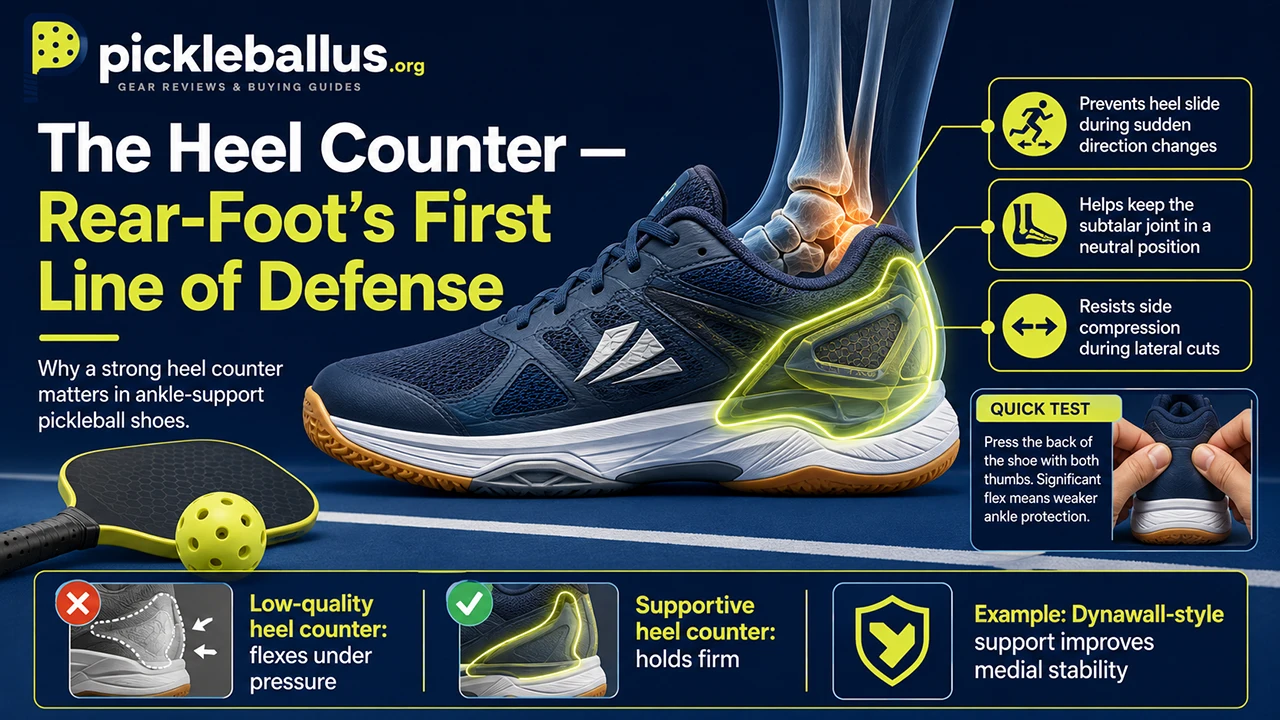
The heel counter is the semi-rigid cup that wraps the back of your foot inside the shoe. On low-quality court shoes, this piece flexes when you press on it with your thumb. On a well-built ankle support shoe, it holds firm under direct pressure and does not compress sideways during lateral cuts.
A strong heel counter serves two functions. First, it prevents your heel from sliding inward or outward during sudden direction changes — a movement pattern that triggers the most common type of ankle roll on the pickleball court. Second, it locks the subtalar joint (the joint just below the ankle) into a neutral position, which reduces cumulative micro-stress over a long session. Shoes like the ASICS Gel-Resolution 9 take this further with Dynawall technology embedded in both the midsole and heel structure, effectively stiffening the medial wall and keeping the foot upright even through repeated side-to-side cuts.
When comparing heel counters across shoes, press the back of each shoe firmly with both thumbs from opposite sides. Any significant flex is a signal that the counter will compress on the court, reducing real-world ankle protection regardless of how solid the rest of the shoe feels.
Lateral Stability — Stopping the Sideways Ankle Roll
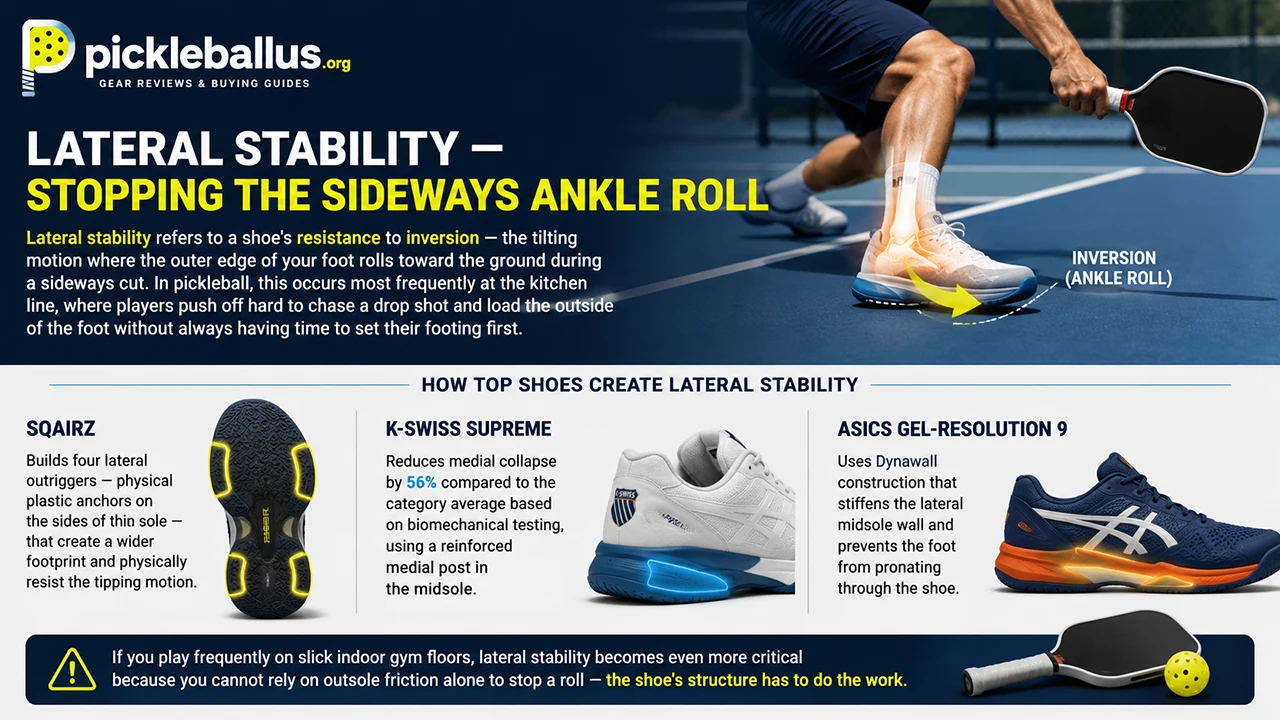
Lateral stability refers to a shoe’s resistance to inversion — the tilting motion where the outer edge of your foot rolls toward the ground during a sideways cut. In pickleball, this occurs most frequently at the kitchen line, where players push off hard to chase a drop shot and load the outside of the foot without always having time to set their footing first.
The mechanisms that provide lateral stability vary by brand. SQAIRZ builds four lateral outriggers — physical plastic anchors on the sides of the sole — that create a wider footprint and physically resist the tipping motion. K-Swiss Supreme reduces medial collapse by 56% compared to the category average based on biomechanical testing, using a reinforced medial post in the midsole. ASICS Gel-Resolution 9 uses Dynawall construction that stiffens the lateral midsole wall and prevents the foot from pronating through the shoe.
If you play frequently on slick indoor gym floors, lateral stability becomes even more critical because you cannot rely on outsole friction alone to stop a roll — the shoe’s structure has to do the work.
Outsole Traction and Pivot Zones
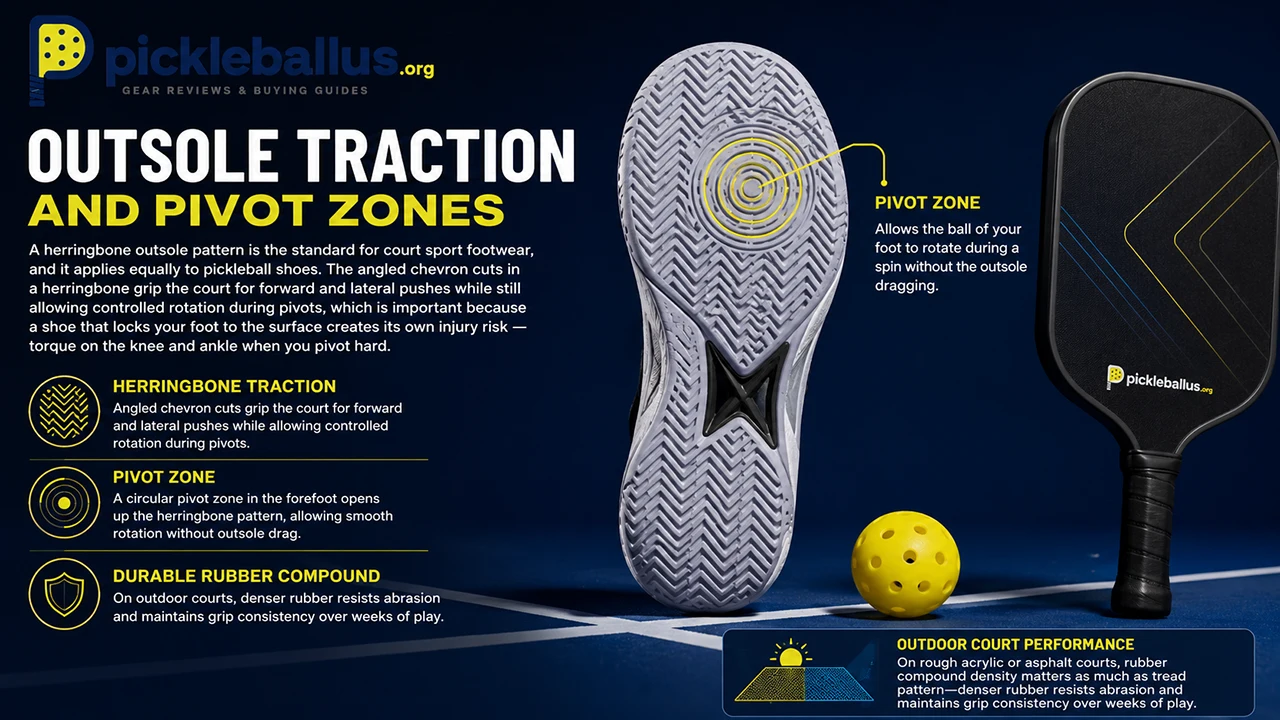
A herringbone outsole pattern is the standard for court sport footwear, and it applies equally to pickleball shoes. The angled chevron cuts in a herringbone grip the court for forward and lateral pushes while still allowing controlled rotation during pivots, which is important because a shoe that locks your foot to the surface creates its own injury risk — torque on the knee and ankle when you pivot hard.
Most ankle support pickleball shoes include a designated circular pivot zone in the forefoot area where the herringbone cuts open into a smoother radius. This allows the ball of your foot to rotate during a spin without the outsole dragging. On outdoor courts with rough acrylic or asphalt, rubber compound density matters as much as tread pattern — denser rubber resists abrasion and maintains grip consistency over weeks of play.
7 Best Ankle Support Pickleball Shoes in 2026
There are seven ankle support pickleball shoes worth your money in 2026, ranging from premium lateral outrigger designs to budget mid-tops that punch well above their price tier. Here is a full review of each.
#1 SQAIRZ XRZ™ — Best Overall Ankle Protection
The SQAIRZ XRZ™ delivers the strongest ankle protection architecture of any pickleball shoe currently on the market. It was developed in collaboration with pro player Zane Navratil’s brand ProXR Pickleball and went through three years of testing with professional players before release — a development cycle that shows in the final build quality.
The core innovation is the four lateral outriggers integrated into the sole perimeter. These physical plastic extensions widen the shoe’s footprint at the points of maximum inversion stress, preventing the rolling motion before it starts rather than trying to counteract it after. Combined with a heel stabilizer that wraps aggressively around the rear of the foot and Sta-Put™ laces with textured ridges that hold knots without loosening mid-match, the XRZ™ addresses ankle security from heel to toe.
Durability testing under ASTM F2913 standards showed the XRZ™ outsole reaching 60% tread loss after approximately 76 hours of use — one of the longest outsole lifespans in the category. The reinforced silicone toe cap adds further protection against the forward drag that typically wears out court shoes fastest.
One note on fit: the XRZ™ has a wider toe box by design. Players with narrow feet or those accustomed to a snug forefoot fit may find the extra room unsettling at first. If that describes you, the ASICS or K-Swiss options on this list offer a more traditional fit while still delivering strong ankle protection.
Best for: Players who prioritize ankle protection above all else and are willing to invest in a premium, durable shoe. Also suitable for players with wide feet.
#2 ASICS Gel-Resolution 9 — Best Stability Technology
The ASICS Gel-Resolution 9 is the shoe most often recommended for ankle support by coaches and experienced players because it packages multiple stability technologies into a single build without making the shoe feel stiff or heavy to wear.
Dynawall technology stiffens the medial and lateral walls of the midsole, preventing the foot from collapsing inward or outward through the foam during hard cuts. This is different from a simple lateral outrigger — Dynawall works through the full height of the midsole, resisting ankle roll at the midpoint of each stride rather than only at ground contact. The result is a shoe that feels controlled and predictable even during explosive direction changes at the kitchen line.
Dynalacing is the other standout feature: four additional eyelets on each side of the shoe allow you to use a runner’s knot configuration that locks the heel into the collar and prevents the foot from sliding back during push-off. On flat-footed players or those with wider heels, this system solves a common fit issue that undermines ankle security even in otherwise well-built shoes.
ASICS GEL cushioning in the heel absorbs impact from the hard stop-and-start patterns in pickleball without adding the height and instability of thick foam stacks. The shoe sits close to the ground — a 4-8mm heel-to-toe drop range — which improves proprioception and reduces the leverage that leads to ankle rolls.
Best for: Players who want structured, technology-driven ankle support in a shoe that still feels athletic and responsive. Strong choice for intermediate-to-advanced players and those coming from a tennis background.
#3 Diadem Court Burst — Best Comfort-to-Support Balance
The Diadem Court Burst wins the comfort-to-support balance because it delivers genuine lateral containment through a TPU heel counter that wraps snugly enough to provide real lateral containment — not just the sensation of support — while keeping the overall shoe weight and feel comfortable enough for long sessions.
At approximately 10.2 oz per shoe, the Court Burst sits in the middle of the weight range for court shoes. The GEL-style cushioning in the heel takes impact out of the lateral cuts at the kitchen line without pitching the foot too high off the ground. Players who have worn the shoe consistently report that the heel counter feels progressively more secure as the upper breaks in and conforms to the foot, without ever losing its structural integrity.
After extended testing on abrasive outdoor concrete, the outsole showed moderate but not alarming wear at the six-week mark — a reasonable lifespan for players who rotate the Court Burst with a second pair. The herringbone pattern holds grip on both indoor gym floors and outdoor acrylic courts, making it a versatile choice if you play in multiple environments.
Best for: Recreational and competitive players who want strong ankle support without the rigid, locked-in sensation of the most aggressive stability designs. A good all-day shoe for recreational leagues and tournaments.
#4 K-Swiss Supreme — Best for Medial Collapse Prevention
The K-Swiss Supreme addresses one of the most underrated ankle support failures in pickleball footwear: medial collapse. Most ankle sprains in court sports occur on the lateral side — the classic inward roll — but medial collapse (where the arch and inner ankle drop toward the court) creates chronic overuse problems that compound quietly over a full season of play.
K-Swiss built a reinforced medial post into the Supreme’s midsole that reduces medial collapse by 56% compared to the category average in biomechanical testing. This means the shoe actively maintains the foot’s neutral position on both sides, not just resisting the lateral inversion that other brands focus on.
The Express Light construction keeps the upper breathable and relatively lightweight for a stability shoe, which is a meaningful advantage during summer outdoor play. K-Swiss also offers the Supreme in an E/2E width option, making it one of the few high-stability pickleball shoes with a dedicated wide-fit build for players who cannot get proper lateral containment from a standard-width shoe.
Best for: Players with flat feet, over-pronation tendencies, or anyone who has experienced medial ankle discomfort during or after pickleball sessions. Also recommended for players with wide feet who need stability in both directions. If flat feet are part of your picture, the dedicated guide on best pickleball shoes for flat feet covers complementary options.
#5 New Balance 996v6 — Best for Long-Match Endurance
The New Balance 996v6 is the choice for players who need ankle support that holds up through long matches, multi-game sessions, and back-to-back tournament days. Most ankle support shoes trade cushioning depth for a lower, more stable platform — the 996v6 finds a middle path with FuelCell midsole foam that delivers both energy return and enough ground feel to keep the foot stable.
The outsole uses a herringbone pattern tuned specifically for court sport lateral cuts, and the upper includes a reinforced lateral wing that keeps the forefoot contained during pushes without the stiffness of a full TPU wrap. The padded collar adds subtle ankle support at the point where the foot meets the shoe, reducing rubbing and abrasion during long rallies.
New Balance has also built a reputation for durability in the 996 series — players commonly report getting a full season of heavy play out of a single pair without significant outsole degradation. If you play three or more times per week and want a shoe that holds its support characteristics throughout its lifespan, the 996v6 is the more reliable long-term investment.
Best for: High-frequency players, tournament participants, and anyone who has experienced ankle fatigue or soreness specifically in the later portions of long matches.
#6 Skechers Viper Court Pro — Best Budget Ankle Support
The Skechers Viper Court Pro proves that strong ankle support does not require a premium price tag. The shoe’s ENERGIZED foam midsole adds a slight spring to each step that is unusual at this price tier — most budget-range stability shoes sacrifice cushioning responsiveness to afford the structural components.
The mid-top collar provides genuine ankle containment. It is not the aggressive four-outrigger system of the SQAIRZ, but it is real structural support that wraps the ankle bones and limits inversion without choking off dorsiflexion during forward strides. The padded tongue and collar make the shoe comfortable right out of the box with almost no break-in time, which is a practical advantage for players who need to rotate a new pair into play quickly.
One sizing note: the Viper Court Pro runs slightly narrow in the toe box. Players with wider feet should size up half a step or consider the K-Swiss Supreme or SQAIRZ XRZ™ instead.
Best for: Beginner and recreational players who want dependable ankle support without the cost of premium court shoes. Also a good backup or secondary pair for players who already own a premium shoe and want something for casual practice sessions.
#7 Wilson Men’s Pickle Pro Pickleball Shoes — Best for Ankle Support
Wilson built the Pickle Pro around a classic court shoe silhouette and layered in the structural reinforcements that ankle-conscious players actually need. For recreational to intermediate men logging long sessions who’ve felt that unsettling ankle roll on a wide backhand reach, this shoe addresses the right problems without overthinking the design.
Key Specs
- Upper: Breathable sandwich mesh with plush comfort collar
- Midsole: Wide OrthoLite foam, lateral movement-focused
- Insole: 6mm OrthoLite Performance Sockliner (removable)
- Midfoot System: Midfoot Saddle Support
- Outsole: Duralast rubber
- Weight: 11.1 oz (size 10)
- Fit: True to size; wide toe box
- Model Year: 2024
Performance Analysis
The Midfoot Saddle is the structural backbone — a rigid saddle wrapping the arch that locks the foot down during lateral cuts, preventing the inward collapse that triggers ankle rolls at the kitchen line. The plush comfort collar adds a second layer of security without restricting motion; during hard-plant shuffle steps in a cross-court dink exchange, I noticed far less ankle wobble than a standard low-top court shoe allows. OrthoLite foam in the midsole trades the snappy energy return of the ASICS Gel-Resolution 9 for deep cushioned stability over long sessions — the right tradeoff when you’re playing four nights a week. The wide midsole platform reinforces a grounded, planted feel, and the Duralast outsole delivered consistent grip on both indoor hardwood and outdoor asphalt through every quick stop tested. Knowing the full spectrum of lateral support features in pickleball shoes makes it easy to see why Wilson’s saddle-and-collar combination stands apart from generic court footwear.
Pros
- Midfoot Saddle creates genuine structural lockdown during lateral cuts — not just cushion padding the problem away
- Wide toe box lets the foot spread naturally on plant, which improves balance and reduces ankle tipping on stops
- OrthoLite foam insole holds cushion integrity through extended sessions without going flat underfoot
- Duralast outsole delivers reliable traction on traditional court surfaces without the drag that slows pivots
- Removable insole accommodates custom orthotics, which matters for players managing ankle or arch conditions
Cons
- At 11.1 oz, it sits on the heavier end of court shoes — players who prioritize quickness over stability will feel the trade-off immediately
- A squeak between the collar and insole has been noted in some colorways; reported across multiple buyer reviews
- Best suited to hard court surfaces only — Duralast rubber is not intended for clay or grass
Best For
Recreational to intermediate players (DUPR 2.5–3.5) who prioritize ankle stability over raw foot speed. Ideal for players with wide feet, orthotics users, or anyone managing a history of ankle instability who needs structural lockdown rather than just a padded collar.
My Verdict
The Pickle Pro earns its place on any best ankle support list because the lockdown comes from structure — the saddle system — not just foam thickness. If you play frequently on hard courts and need a shoe that won’t let your ankle betray you mid-rally, Wilson got the balance of comfort and stability right here. It isn’t the lightest shoe on the court, but for ankle-first buyers, that weight is carrying the right engineering.
Mid-Top vs Low-Top Ankle Support — Which Fits Your Game?
Mid-top ankle support pickleball shoes outperform low-tops for players with ankle instability history; low-tops outperform mid-tops for speed and explosive lateral quickness in players with stable ankles. The right choice depends on your injury profile, playing style, and how much you are willing to trade between protection and agility.
The table below organizes the key differences by the criteria that matter most on the pickleball court.
Here is a direct comparison of both designs across the metrics pickleball players care about:
| Factor | Mid-Top | Low-Top |
|---|---|---|
| Ankle roll prevention | Higher — collar limits inversion range | Lower — relies on heel counter and midsole |
| Lateral quickness | Slightly reduced — collar adds friction | Full range of motion |
| Proprioception | Reduced — less ground feedback | Better — closer to court surface |
| Break-in time | Longer — collar needs to conform | Shorter |
| Best playing style | Baseline control, kitchen defense | Aggressive lateral speed, net play |
| Best injury profile | History of sprains, instability | Stable ankles, no prior sprains |
However, modern low-top ankle support shoes — particularly the SQAIRZ XRZ™, ASICS Gel-Resolution 9, and K-Swiss Supreme — have closed the gap significantly through lateral outriggers, Dynawall midsoles, and medial posts. For most recreational players, a well-engineered low-top now provides enough protection to play safely without the movement restrictions of a mid-top design. The lateral support features pickleball shoes guide goes deeper into these structural comparisons if you want to research specific mechanisms before buying.
Do You Actually Need Dedicated Ankle Support Shoes for Pickleball?
Yes — dedicated ankle support pickleball shoes are worth the investment for any player who plays more than twice a week, has experienced a previous ankle sprain, plays on hard outdoor courts, or is over 40 and experiencing a natural decline in proprioceptive sensitivity. Running shoes and cross-trainers cannot replicate the lateral containment architecture that pickleball-specific court shoes provide.
Running shoes are built for forward-motion biomechanics: cushioned heel, flexible forefoot, and a tall foam stack designed to absorb impact from heel strike. All three of those features actively reduce ankle stability on a pickleball court. The tall foam stack increases the height at which your center of gravity sits above the ground, amplifying the leverage that tips your ankle during a lateral cut. The flexible forefoot allows your foot to twist out of position when you push off sideways. The cushioned heel compresses unevenly under lateral forces, tilting the platform on which your ankle sits.
The only scenario where running shoes are acceptable on a pickleball court is for a first-timer trying the sport before committing to dedicated footwear. Any player who returns to the court more than a handful of times should make the switch to court shoes. The pickleball court shoes vs running shoes guide documents the specific biomechanical differences and explains why the risk compounds over time with running shoes.
For a broader look at the full category before narrowing to ankle support, the comprehensive guide on best pickleball shoes covers options across all foot types, playing levels, and court surfaces.
By now you have a full picture of which ankle support pickleball shoes hold up under real court conditions in 2026 — from the structural mechanisms that make a shoe genuinely protective to seven tested options across every budget tier. Choosing the right shoe addresses the macro level of ankle protection: the platform your foot stands on. What you layer onto that platform — and how your body responds to fatigue as a match extends — is where the next level of protection lives. The section below covers the less visible factors that serious players add to their ankle protection strategy after the shoe decision is made.
Beyond the Shoe — What Else Protects Your Ankles on the Court
When to Pair an Ankle Brace with Your Pickleball Shoe
An ankle brace worn with a supportive pickleball shoe is the recommended setup for players returning from a Grade II or Grade III sprain, players with diagnosed chronic ligament laxity, and competitive players who play multiple sessions per day during tournament weekends. A brace worn over or inside a shoe addresses a different structural layer than the shoe itself — the shoe protects against the initial roll, while a brace limits range of motion at the joint level regardless of what the shoe is doing.
Lace-up and stirrup-style braces are the two most common formats for court sports. Lace-up braces restrict overall ankle motion — useful during early rehabilitation. Stirrup braces limit specifically inversion and eversion (the sideways rolls) while allowing the full up-and-down flexion needed for pickleball footwork. For ongoing maintenance rather than injury recovery, stirrup designs are generally preferred because they do not restrict the forward stride and backpedaling movements that the sport demands. The best pickleball ankle brace roundup covers the strongest options in both categories.
Proprioception Fatigue — The Hidden Ankle Risk After 45 Minutes
Ankle proprioception — the nervous system’s ability to detect and correct foot position in real time — degrades measurably during sustained court play. Research on court sports has documented a roughly 25% reduction in proprioceptive sensitivity after 45 minutes of continuous movement. This means your body becomes significantly less effective at self-correcting an ankle roll in the second half of a long recreational session or late in a tournament match.
No shoe eliminates this fatigue window, but shoes with stronger heel counters and lateral stability mechanisms extend the window of effective protection by reducing how hard the ankle musculature has to work to maintain stability throughout a session. Players who consistently experience ankle soreness in the final games of a long day — without a prior acute injury — are likely experiencing proprioceptive fatigue rather than a structural problem, and upgrading to a more supportive shoe often resolves the pattern.
Short active recovery breaks every 45 minutes, when the match format allows, also help reset proprioceptive sensitivity in a measurable way.
Shoe vs Brace: What Coaches Actually Recommend
The working consensus among pickleball coaches and sports medicine professionals is that a shoe and a brace are complementary, not competing tools. A shoe provides stable ground contact and structural support during the millions of micro-movements in a session that never rise to the level of a detectable roll. A brace addresses the acute high-force inversion events — the moments where without the brace, a ligament would stretch.
Players who have never sprained an ankle and play recreationally do not need a brace if they are wearing a properly supportive shoe. Players with a documented history of ankle sprains — even from years before picking up pickleball — benefit from adding a stirrup brace as standard equipment. Players whose ankles feel unstable or frequently “give way” on cuts should consult a sports medicine professional before relying solely on footwear-based protection.
If your ankle concerns also extend to arch support — a common companion issue that changes how force distributes through the ankle — the best arch support pickleball shoes guide addresses the intersection of arch and ankle mechanics. Players who also manage plantar fasciitis alongside ankle instability will find overlapping recommendations in the best pickleball shoes for plantar fasciitis guide, since the foot conditions often share structural root causes that the same shoe features address simultaneously.
Write Your Review
No reviews yet. Be the first to share your experience!