Best Pickleball Shoes for Foot Conditions: By Condition Guide
The best pickleball shoes for foot conditions, matched by condition, are: the ASICS Gel-Resolution 9 for plantar fasciitis, the Skechers Viper Court Pro Arch Fit for flat feet, the K-Swiss Hypercourt Supreme HB for high arches, the FitVille Wide Pickleball Court Shoe for wide feet, the ASICS Gel-Game 9 (B width) for narrow feet, the New Balance 806v1 for bunions, the HEAD Revolt Pro 4.0 for Achilles tendonitis, the Skechers Arch Fit Viper Court for general arch support, the SQAIRZ XRZ™ for ankle instability, and the ALTRA Solstice XT 3 for players who need a wide toe box.


Pickleball’s movement profile — rapid lateral shuffles, sudden stops, kitchen pivots, and constant weight transfer — places demands on feet that a standard running shoe was never designed to handle. For players with a pre-existing foot condition, those demands aren’t just uncomfortable; they’re the direct mechanism behind flare-ups that end sessions early and, over time, force players off the court entirely. The shoe you wear is the only interface between your foot and a hard court surface, and for players with structural or inflammatory conditions, that interface needs to do specific mechanical work.
Choosing the right shoe becomes complicated because the features that help one condition can actively worsen another. A maximally cushioned shoe that protects a high arch may lack the lateral stiffness an overpronating flat foot needs to stay stable during a split-step. A wide-fitting shoe that relieves bunion pressure may slip at the heel on a narrow foot. This guide cuts through that complexity by mapping each condition to the shoe features that address it at the mechanical level — and links to the dedicated pages where each condition is covered with full product roundups and buying criteria.
Below, you’ll find a brief breakdown of all ten foot conditions covered in this series, along with a top recommendation for each and the key feature that makes it work.
Why Pickleball Is Especially Hard on Feet With Pre-Existing Conditions
Pickleball places repetitive, multidirectional stress on feet at a frequency that outpaces most court sports at the recreational level — not because the movements are more extreme, but because games are shorter, players rotate in quickly, and many recreational players log three to five sessions per week without the conditioning base that would normally protect them.
The sport’s court geometry matters here. The non-volley zone (kitchen) requires players to hold a compressed, forward-leaning stance for extended periods while making micro-adjustments to positioning. The baseline-to-kitchen transition happens dozens of times per game. Each of those transitions involves a stop-and-accelerate pattern that loads the heel, arch, and forefoot in sequence. On a hard court surface — asphalt, concrete, or gymnasium flooring — none of that impact is absorbed before it reaches the foot.
The 4 Movements That Put Feet at Risk on a Pickleball Court
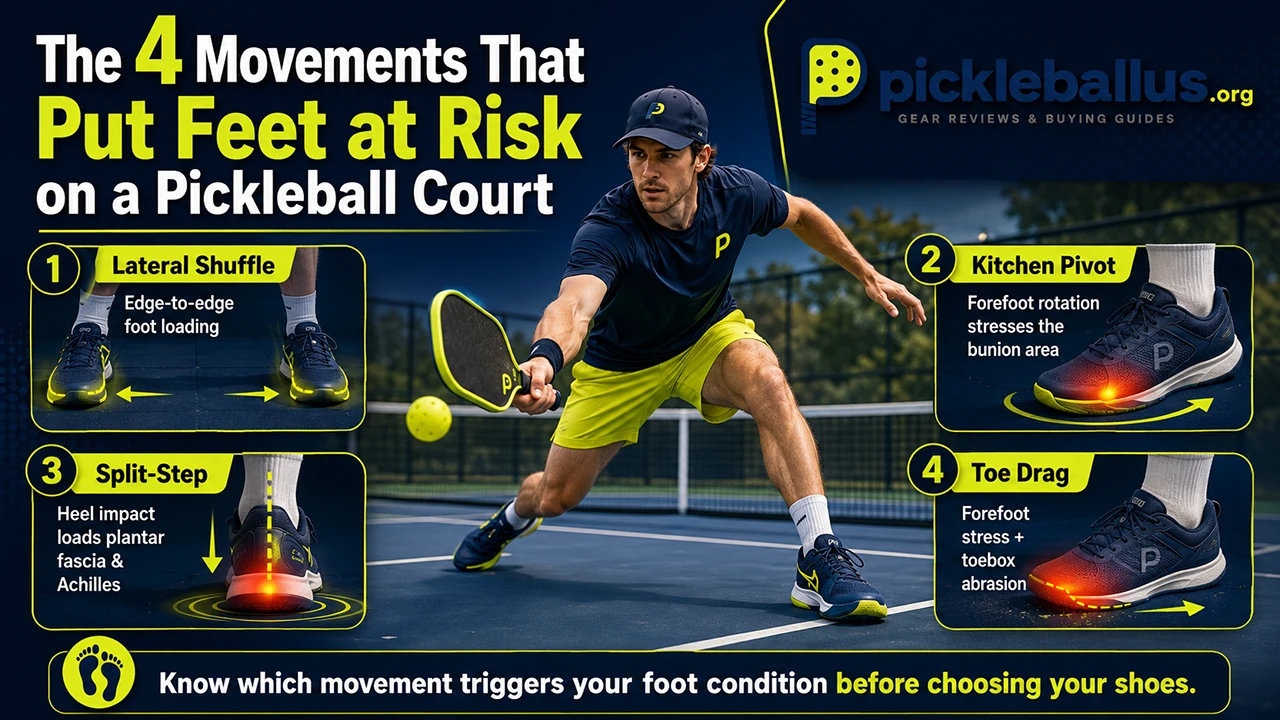
The four movements that most consistently aggravate foot conditions in pickleball are the lateral shuffle, the kitchen pivot, the split-step, and the toe drag — each loading a different part of the foot.
The lateral shuffle demands rapid weight transfer between the medial and lateral edges of the foot. For players with overpronation (flat feet), this motion produces internal tibial rotation on every step. For those with supination (high arches), it loads the lateral fifth metatarsal repeatedly. The kitchen pivot requires the forefoot to absorb a rotational force while the heel lifts — a motion that compresses the first metatarsophalangeal joint directly, which is precisely where bunions develop. The split-step — the anticipatory jump before each opponent shot — creates a bilateral heel-strike event that sends impact force through the plantar fascia and up the Achilles tendon on every landing. Finally, the toe drag that occurs on serve follow-through abrades the toebox and places eccentric load on the forefoot, a contributing factor to neuromas and wide-toe-box issues.
Understanding which movements trigger your specific condition is the first step toward knowing which shoe features to prioritize.
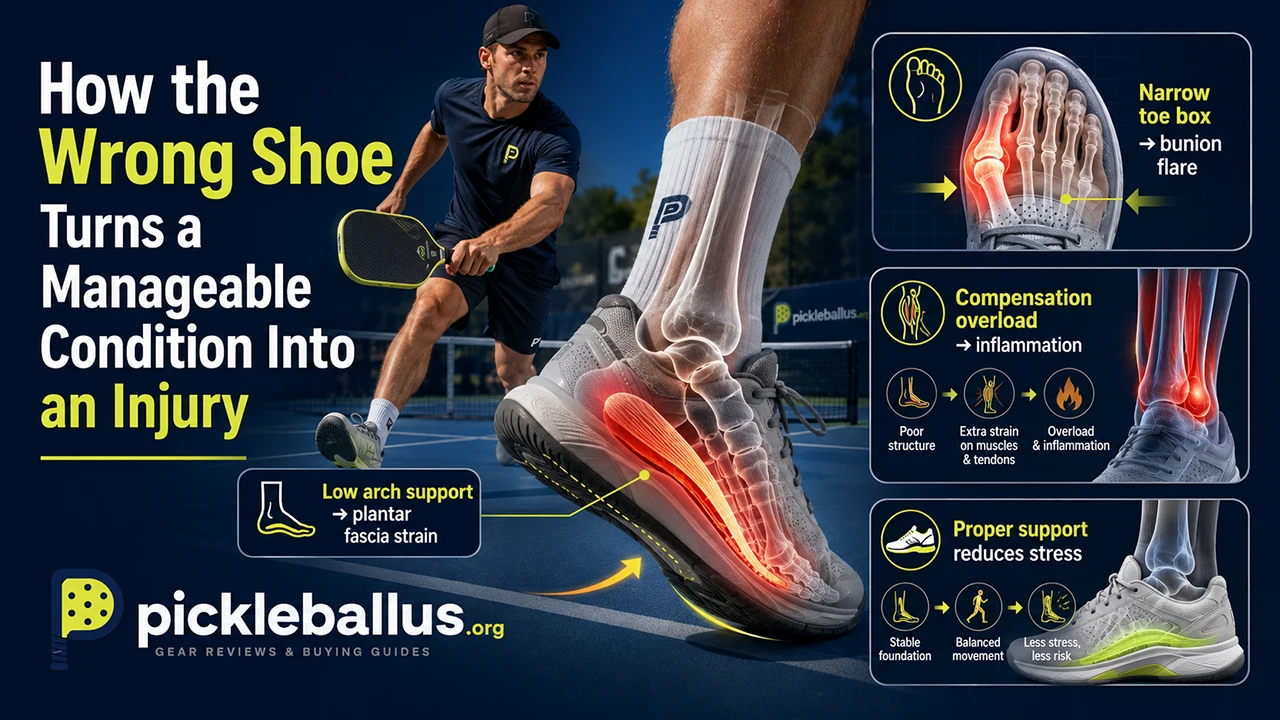
How the Wrong Shoe Turns a Manageable Condition Into an Injury
A shoe that lacks the right structural support for your foot type doesn’t just fail to help — it amplifies the biomechanical stress your condition already creates. For a player with plantar fasciitis, a shoe with insufficient arch support allows the plantar fascia to stretch further with every push-off, extending the strain that causes the characteristic morning heel pain. For a player with bunions, a narrow toe box compresses the first MTP joint throughout play, progressing deformity faster and turning tolerable discomfort into a session-ending pain flare.
The mechanism is the same across conditions: the foot compensates for inadequate shoe structure by recruiting secondary muscles and tendons, overloading them progressively until inflammation sets in. A well-chosen shoe eliminates the need for that compensation.
The 10 Foot Conditions That Require Specific Pickleball Shoes
These ten conditions each require a distinct combination of shoe features — and are covered in dedicated guides linked below. What follows is a condition-by-condition breakdown identifying the primary problem, the mechanical solution, and the top-rated shoe for that condition in 2026.
1. Plantar Fasciitis — Heel Pain That Spikes After Lateral Cuts
Plantar fasciitis is inflammation of the thick band of tissue running along the bottom of the foot from heel to toe, and it’s one of the most common chronic foot complaints among pickleball players. The hallmark symptom is sharp heel pain on the first steps of the morning, but on-court flare-ups typically occur after the heel-strike sequence of a split-step landing or after sustained kitchen play in a forward-weighted stance.
The shoe features that address plantar fasciitis most directly are: a structured arch support system that prevents the fascia from over-stretching, a deep heel cup that distributes and controls heel-strike impact, and a midsole firm enough to resist compression under the arch during lateral push-offs.
Top Pick: ASICS Gel-Resolution 9
The Gel-Resolution 9 combines ASICS’s Gel cushioning in the heel with a firm, medially posted midsole that controls pronation — the movement pattern that most frequently aggravates plantar fasciitis. The FlyteFoam midsole is dense enough to prevent arch collapse during lateral cuts without being rigid underfoot. The heel counter is structured and high, locking the calcaneus (heel bone) in place during every split-step landing. It’s available in both standard D and wider 2E widths for players whose PF co-occurs with a wider fit need.
→ See the full guide to best pickleball shoes for plantar fasciitis for a complete roundup of top-rated options, buying criteria, and a comparison table by PF severity.
2. Flat Feet — Overpronation That Destabilizes Every Push-Off
Flat feet (pes planus) cause the medial arch to collapse during weight-bearing, producing overpronation — an inward rolling of the ankle that affects alignment all the way up to the knee and hip. In pickleball, where lateral push-offs happen on every rally, that inward rolling creates inconsistent foot placement, reduces power transfer, and places repetitive stress on the posterior tibial tendon.
Players with flat feet need a shoe with medial posting (denser foam on the inner midsole to resist inward collapse), a torsion-control shank that prevents the midfoot from twisting, and a firm heel counter. Motion-control or stability-category shoes — not neutral cushioned shoes — are the appropriate choice.
Top Pick: Skechers Viper Court Pro Arch Fit (Men’s/Women’s)
Skechers’ Arch Fit insole system is built on 20 years of foot scan data and carries podiatrist certification specifically for arch support. The Viper Court Pro version adds a court-specific outsole pattern for multidirectional grip and a firmer midsole construction than the casual version of the same insole. For flat-footed players, the medial arch contour prevents midfoot collapse throughout lateral play, and the wide forefoot platform improves stability on push-offs. Available in extra-wide (2E) for players who also have width needs.
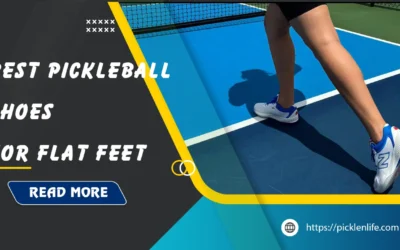
→ See the full guide to best pickleball shoes for flat feet for medial posting comparisons, overpronation severity matching, and budget-friendly options.
3. High Arches — Supination That Loads the Lateral Foot
High arches (pes cavus) cause the opposite problem from flat feet: the foot supinates — rolls outward — placing excessive load on the lateral edge and fifth metatarsal. High-arched players absorb less shock through the arch because the rigid structure transmits impact rather than distributing it. On pickleball’s hard courts, this leads to lateral foot pain, stress fractures over time, and ankle sprains from the outward lean.
The shoe priority for high arches is maximum cushioning in a neutral (non-medially posted) midsole. Motion-control shoes designed for flat feet will worsen a high arch by pushing the foot further into supination. The midsole should be responsive without being firm, and the last should be flexible enough to allow the foot to pronate slightly — which is what high-arched feet lack.
Top Pick: K-Swiss Hypercourt Express 2 HB
The Hypercourt Express 2 HB uses a dual-density midsole that cushions impact without the medial rigidity found in stability shoes. The heel bevel promotes a smooth heel-to-toe transition rather than the abrupt heel-strike pattern that high-arched feet tend toward. The herringbone outsole provides court-specific traction without the thick rubber that would add weight and reduce ground feel. Width options include both standard and wider fits, and the upper wraps the foot without compression at the lateral midfoot — a common pressure point for supinators.
→ See the full guide to best pickleball shoes for high arches for supination correction comparisons, cushioning ratings, and orthotic compatibility notes.
4. Wide Feet — Compression Pain and Blister Risk in Standard Widths
Wide feet (forefoot width exceeding the D-standard last) create compression pain across the metatarsal heads in standard-width shoes, producing blisters, neuromas, and — over the course of a session — a progressive discomfort that limits court time. Standard-width shoes squeeze the metatarsal heads together during push-offs, which can also contribute to pinched nerves between the toes (Morton’s Neuroma).
The solution is a shoe available in 2E, 4E, or wider, with a toe box that allows the toes to splay naturally during impact. The upper material should be soft or mesh rather than rigid synthetic leather, which does not stretch to accommodate wider forefoot anatomy.
Top Pick: FitVille Wide Pickleball Court Shoe
FitVille’s court shoe is purpose-designed for wide feet, available in 2E and 4E widths with a forefoot last that is measurably wider than standard court shoes from ASICS or HEAD. The non-marking rubber outsole is suitable for both indoor and outdoor courts, and the breathable perforated upper reduces heat buildup in enclosed toe boxes — an issue wide-footed players often report. The cushioned insole provides adequate impact absorption without the arch profile that can feel cramped for a wide, lower foot type.
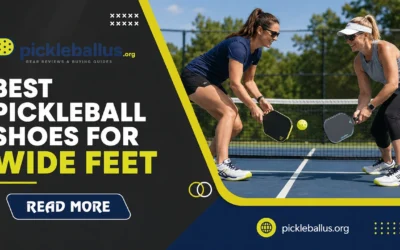
→ See the full guide to best pickleball shoes for wide feet for a width comparison table, 2E vs 4E fit guide, and picks across price points.
5. Narrow Feet — Heel Slippage and Instability in Standard Widths
Narrow feet (forefoot and heel width below the D-standard last) cause heel slippage inside standard-width shoes, which translates into lateral instability during direction changes and increased blister risk from friction at the heel counter. Slippage also means the foot doesn’t engage the shoe’s support systems correctly — the arch support of a stability shoe does nothing if the foot slides past it on every step.
The solution is a shoe available in B (narrow) width, with a secure heel counter and a lacing system that allows the upper to be cinched tight across the midfoot without cutting off circulation at the forefoot.
Top Pick: ASICS Gel-Game 9 (B Width)
The Gel-Game 9 is one of the few widely available court shoes offered in B (narrow) width alongside the standard D. The heel counter is high and rigid, preventing backward slippage during forward lunges. The Flexion Fit upper wraps the foot without excess volume in the midfoot, and the GEL cushioning unit under the heel absorbs impact cleanly for a narrow-footed player whose heel doesn’t sit wide in the heel cup. This is a tennis-origin shoe that works well for pickleball due to shared lateral movement demands.
→ See the full guide to best pickleball shoes for narrow feet for narrow-to-standard width comparisons, sizing tips, and options for narrow + high-arch combinations.
6. Bunions — Pressure Points on the First MTP Joint
A bunion (hallux valgus) is a bony prominence at the base of the big toe, where the first metatarsophalangeal joint has deviated outward. On-court, the kitchen pivot is the movement that most directly stresses a bunion — the rotation loads the MTP joint against the inner sidewall of the shoe precisely where the bunion protrudes. A shoe that fits the midfoot well but squeezes the forefoot will produce progressive pain through a match.
Shoes for bunions need a wide, deep toe box that doesn’t contact the bony protrusion, a soft or seamless inner lining at the first MTP joint area, and a width option that accommodates the wider forefoot profile that often co-occurs with bunions.
Top Pick: New Balance 806v1
The New Balance 806v1 is APMA-accepted (American Podiatric Medical Association), a certification granted to shoes that promote good foot health in clinical assessment. It’s available in widths from D through 6E — among the widest available range of any court shoe. The leather upper at the forefoot is soft enough to mold around a bunion rather than pressing against it, and the ROLLBAR stability post in the midsole prevents the inward rolling that accelerates bunion progression in flat-footed players.
→ See the full guide to best pickleball shoes for bunions for toe box depth comparisons, APMA-accepted picks, and soft upper material reviews.
7. Achilles Tendonitis — Tendon Strain From Heel-to-Toe Drop
Achilles tendonitis is inflammation of the Achilles tendon, the thick cord connecting the calf muscles to the heel bone. In pickleball, the split-step — where both heels drop to the ground simultaneously to absorb impact — is the primary aggravating movement. A shoe with an excessively high heel drop (the height difference between heel and forefoot) shortens the Achilles tendon over time, making it vulnerable to the sudden lengthening that occurs during court lunges.
Players with Achilles tendonitis need a shoe with a moderate-to-low heel drop (8mm or less), a padded heel collar that doesn’t dig into the tendon, and a midsole soft enough to reduce impact at the insertion point. Some shoes include an Achilles notch — a subtle cutaway at the top of the heel collar — specifically to reduce tendon pressure.
Top Pick: HEAD Revolt Pro 4.0
The HEAD Revolt Pro 4.0 has a heel drop in the 8mm range — lower than many court shoes, which typically run 10–12mm — reducing chronic shortening of the Achilles. The padded heel collar is contoured away from the tendon insertion point, and the shoe’s weight (under 12 oz) reduces the eccentric loading that heavier shoes create during split-steps. The rubber outsole pattern is court-specific for multidirectional grip without requiring aggressive forefoot stiffness that would increase tendon tension.
→ See the full guide to best pickleball shoes for Achilles tendonitis for heel drop comparisons, Achilles collar geometry analysis, and options for Achilles tendonitis combined with plantar fasciitis.
8. Flat Arch / Need for Arch Support — Fatigue and Midfoot Collapse
Not every player with arch support needs has clinically flat feet — many players have a mild-to-moderate arch that fatigues under pickleball’s repetitive demands and collapses progressively through a session, causing midfoot ache that worsens as the game continues. This is distinct from structural flat feet; the arch exists but lacks the muscular endurance to maintain itself under load.
For these players, the shoe priority is a well-contoured, firm insole that supports the arch passively (reducing the muscular demand) paired with a rigid midfoot shank that prevents the shoe itself from twisting under load. The arch profile of the insole needs to match the natural arch height — a high arch profile in a low-arch foot is as problematic as no arch support.
Top Pick: Skechers Arch Fit Viper Court
The Arch Fit line’s core technology is a removable, podiatrist-certified insole with a contouring profile derived from 20 years of foot pressure mapping data across 120,000+ subjects. The Viper Court version wraps this insole in a court-specific upper and outsole, making it one of the few shoes that prioritizes arch support as a primary design feature rather than an afterthought. The insole is removable and replaceable, so as it compresses over time, it can be swapped without replacing the shoe.
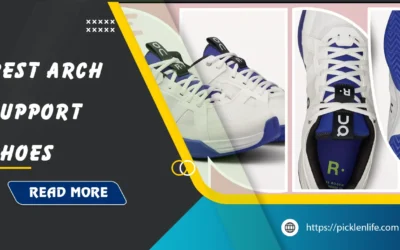
→ See the full guide to best arch support pickleball shoes for arch profile comparisons, insole replacement guides, and picks for progressive arch fatigue vs structural flat foot.
9. Ankle Instability — Repeated Sprains From Lateral Movements
Ankle instability — whether from a history of sprains, ligament laxity, or peroneal muscle weakness — is among the highest-risk conditions for pickleball players because the sport’s lateral movements are precisely the mechanism of a typical ankle inversion sprain. Players with a history of ankle sprains are significantly more likely to re-sprain on the court if the shoe’s lateral structure doesn’t provide external support.
The features that matter for ankle instability are: high sidewalls extending up toward the ankle, medial and lateral outrigger structures that widen the shoe’s base to resist tipping, and a firm midsole that doesn’t compress excessively under load. Some players with severe instability also benefit from a low-cut brace worn inside the shoe, but the shoe’s base structure is the first line of defense.
Top Pick: SQAIRZ XRZ™
The SQAIRZ XRZ™ was co-developed with pro player Zane Navratil after three years of on-court testing and is built specifically for pickleball ankle support. Its four lateral outriggers — extensions of the midsole that protrude beyond the shoe’s upper edge — widen the base of support without raising the shoe’s center of gravity. The heel counter is exceptionally high and rigid, and the midsole is firm enough to resist compression during direction changes. The result is a shoe that mechanically resists the inward tipping motion that causes ankle sprains.
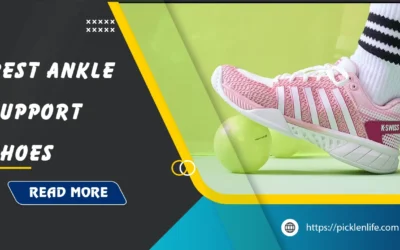
→ See the full guide to best ankle support pickleball shoes for lateral stability comparisons, outrigger geometry analysis, and picks for players who use ankle braces.
10. Wide Toe Box Need — Toe Crowding, Neuromas, Claw Toes
The wide toe box category is distinct from wide feet overall — some players have average-width heels and midfoot but a naturally wide, spreading forefoot (metatarsal width greater than standard), or conditions like hammer toes, claw toes, or Morton’s Neuroma that require space for the toes to function without compression. Standard court shoes taper aggressively at the toe, forcing the metatarsals together and compressing the digital nerves.
The defining feature of a wide toe box shoe is a last shaped to follow the natural spread of toes — widest at the ball of the foot and tapered minimally toward the toe tips, rather than the cosmetically pointed shape of most athletic footwear. Shoes in this category are often described as having a “foot-shaped last.”
Top Pick: ALTRA Solstice XT 3
ALTRA builds every shoe on a foot-shaped last as a brand standard — the toe box width at the metatarsal heads matches or exceeds the natural splay of the foot at rest. The Solstice XT 3 is ALTRA’s court-sport model with a herringbone-patterned rubber outsole suitable for pickleball surfaces. The zero-drop platform (heel and forefoot at equal height) encourages natural toe engagement during push-offs. Players with Morton’s Neuroma report significant relief from the absence of metatarsal compression through a match. Note: the zero-drop platform requires an adjustment period for players accustomed to heel-elevated court shoes.
→ See the full guide to best wide toe box pickleball shoes for toe box width measurements, zero-drop transition guides, and picks for neuromas and hammer toe conditions.
5 Shoe Features That Address the Most Common Foot Conditions
The ten conditions above all trace back to five core shoe features, and understanding those features — rather than memorizing brand names — gives you the ability to evaluate any shoe for your specific need.
The table below maps each condition to its primary and secondary feature priorities:
| Foot Condition | Primary Feature | Secondary Feature | Width Need |
|---|---|---|---|
| Plantar Fasciitis | Structured arch support + deep heel cup | Firm midsole (shock absorption) | Standard to 2E |
| Flat Feet | Medial posting (motion control) | Torsion shank | Standard to 4E |
| High Arches | Neutral cushioned midsole | Flexible last | Standard |
| Wide Feet | 2E / 4E width option | Soft / stretch upper | 2E–4E |
| Narrow Feet | B-width last | Secure heel counter | Narrow (B) |
| Bunions | Wide, deep toe box | Soft seamless lining | 2E–6E |
| Achilles Tendonitis | Low heel drop (≤8mm) | Padded Achilles collar | Standard |
| Arch Support Need | Contoured removable insole | Rigid midfoot shank | Any |
| Ankle Instability | Lateral outriggers | Firm midsole | Standard to 2E |
| Wide Toe Box Need | Foot-shaped last | Zero-drop platform | Standard to 2E |
Arch Support Systems — Rigid vs Semi-Rigid vs Flexible
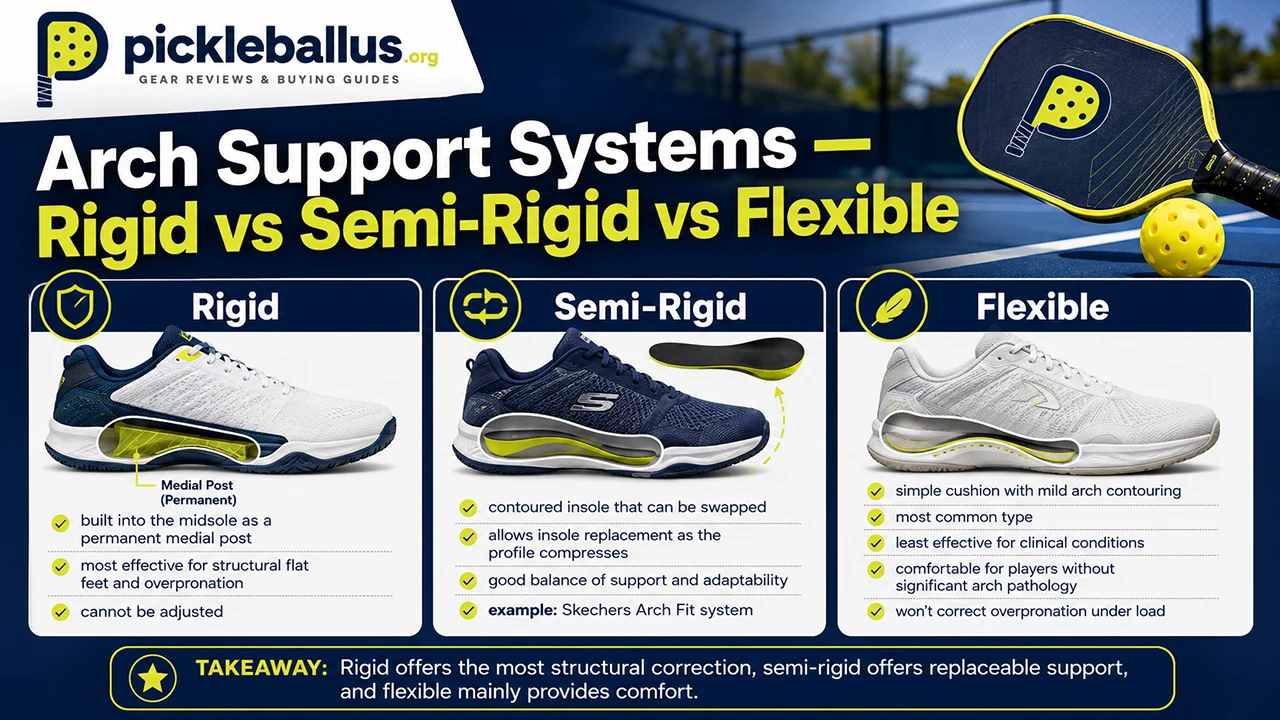
Arch support in a pickleball shoe comes in three structural categories: rigid (built into the midsole as a permanent medial post), semi-rigid (a contoured insole that can be swapped), and flexible (a simple cushion with mild arch contouring). Rigid posting is the most effective for structural flat feet and overpronation but cannot be adjusted. Semi-rigid — like the Skechers Arch Fit system — allows insole replacement as the profile compresses. Flexible is the most common and the least effective for clinical conditions; it provides comfort for players without significant arch pathology but won’t correct overpronation under load.
Cushioning and Shock Absorption — Midsole Thickness and Material
Midsole cushioning in court shoes is deliberately firmer than in running shoes — running shoes absorb impact over long strides on a single plane; court shoes need to return energy quickly across lateral directions. For players with high arches or heel pain, a slightly more cushioned court shoe (ASICS GEL, HOKA Clifton for court use) is appropriate. For flat-footed players, however, excessive cushioning can allow the arch to sink further into the foam, worsening pronation. The ASICS Gel-Resolution 9’s FlyteFoam hits the right balance for conditions requiring both cushioning and stability.
Width Options — How D, 2E, 4E, and 6E Differ for Court Play
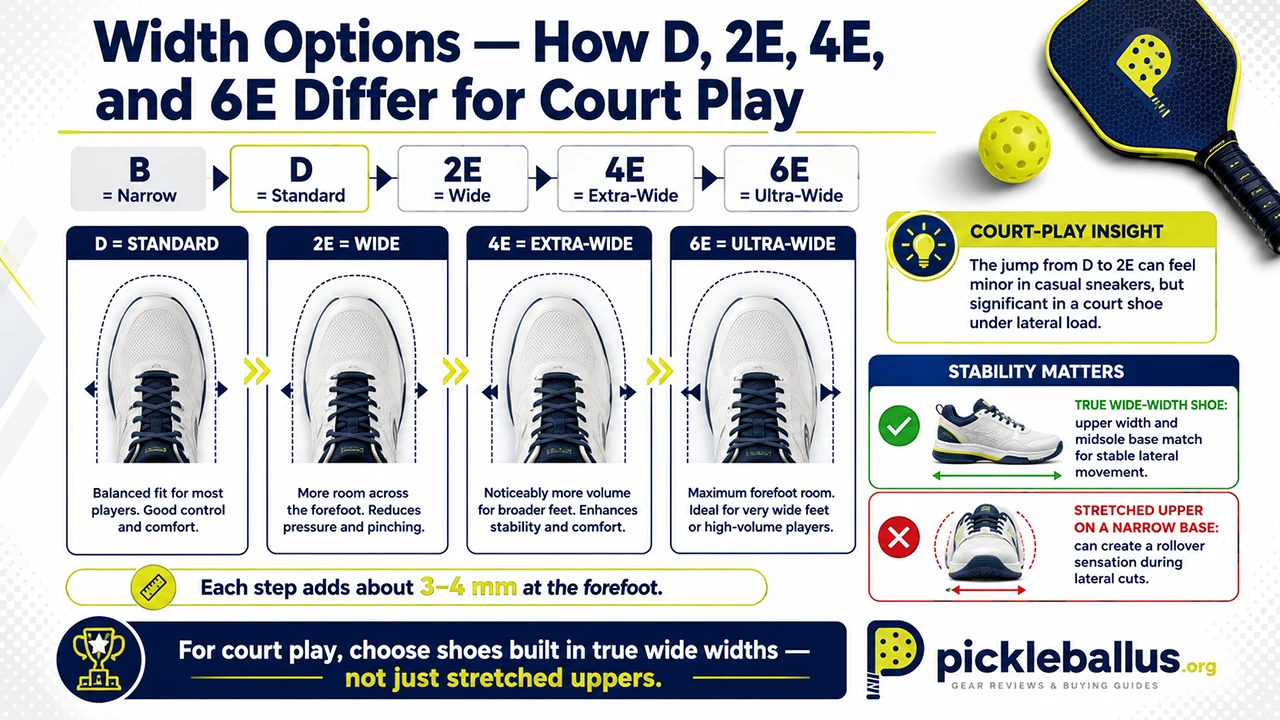
Shoe width sizing runs from B (narrow) through D (standard) to 2E (wide), 4E (extra-wide), and 6E (ultra-wide), with each step increasing the last width by approximately 3–4mm at the forefoot. The difference between D and 2E feels subtle in a casual sneaker but significant in a court shoe under lateral load. For court play specifically, the midsole base must match the upper width — a wide upper on a narrow midsole creates a rollover sensation during lateral cuts. Only shoes purpose-built in wide widths (not simply stretched-upper versions) provide appropriate base stability.
Lateral Stability vs Ankle Support — Two Different Mechanisms
Lateral stability and ankle support are commonly conflated but are mechanically distinct. Lateral stability refers to the shoe’s resistance to tipping at the midfoot and forefoot — achieved through a widened midsole base and outrigger geometry (as in the SQAIRZ XRZ™). Ankle support refers to the upper’s containment of the ankle joint itself, achieved through high collars and rigid sidewall construction. For players with ankle instability, both are necessary. For players who simply want better control on lateral cuts without a history of sprains, lateral stability alone is sufficient — and high ankle collars can restrict the range of motion needed for aggressive kitchen play.
Quick Condition-to-Feature Matching Table
The table below serves as a fast-reference checklist before purchasing. Match your primary condition, confirm the feature is present in the shoe’s product specs, and cross-reference with the dedicated condition guide linked for each condition above.
| Your Condition | Check for This on the Spec Sheet | Avoid |
|---|---|---|
| Plantar fasciitis | “Arch support” + “GEL heel cushion” or “deep heel cup” | Minimalist soles; low heel drop without cushion |
| Flat feet | “Medial post” or “motion control” or “stability” category | Neutral cushioned or minimal shoes |
| High arches | “Neutral” category + thick midsole | Medially posted stability shoes |
| Wide feet | Width listed as 2E, 4E, or “wide” | Shoes with no width variants listed |
| Narrow feet | “Narrow” or “B width” available | Wide-last shoes labeled “fits all widths” |
| Bunions | “Foot-shaped last” or “wide toe box” | Tapered forefoot; rigid synthetic upper |
| Achilles tendonitis | Heel drop ≤8mm + padded collar | High heel-drop shoes (12mm+) |
| Arch fatigue | “Contoured insole” + “removable insole” | Flat foam insoles; non-removable insoles |
| Ankle instability | “Lateral outrigger” or “high sidewall” + firm midsole | Lightweight racers with thin sidewalls |
| Wide toe box | “Natural foot last” or “zero drop” + wide forefoot | Tapered or pointed toe box |
With a clear map of which shoe features address each foot condition, you now have the tools to shop by biomechanical function rather than by brand loyalty or price point alone. For most players, the right shoe makes an immediate and measurable difference in on-court comfort. However, shoes are a structural solution — they control the environment the foot moves in. The condition itself, whether it’s the plantar fascia, the Achilles tendon, or an unstable ankle, may require attention beyond footwear, particularly for players who compete frequently or who have let a condition progress. The next section addresses the interventions that complement shoe selection: orthotics, court-specific wear patterns, and the longstanding question of whether pickleball-specific shoes are necessary at all versus a quality tennis or cross-training shoe.
What Else Affects Comfort for Players With Foot Conditions?
Three factors outside of shoe selection regularly determine whether a player with a foot condition can sustain pain-free court time: the use of orthotics or upgraded insoles, the rate at which they replace their footwear, and whether a sport-specific shoe is actually necessary versus a well-chosen alternative.
Custom Orthotics and Over-the-Counter Insoles — When Shoes Aren’t Enough
For players with moderate-to-severe structural conditions — significant flat feet, rigid high arches, or advanced plantar fasciitis — a shoe’s built-in support system may not provide sufficient correction, and a custom or semi-custom orthotic becomes the appropriate next step. Custom orthotics, prescribed and fabricated by a podiatrist from a cast of the patient’s foot, provide precise arch profiling and medial posting that a mass-produced insole cannot replicate. Semi-custom orthotics (brands like Superfeet, Tread Labs, or Currex) occupy the middle ground: they’re available over the counter in multiple arch profiles and offer substantially more correction than standard flat insoles.
For pickleball specifically, insole compatibility matters: the shoe must have a removable factory insole with sufficient volume to accommodate the orthotic without raising the foot’s position to the point where the heel collar cuts in. Shoes with removable insoles — the Skechers Arch Fit series, the New Balance 806v1 — are the most orthotic-compatible options in the court shoe category.
Court Surface and Shoe Longevity — Why Players With Conditions Replace Shoes Earlier
Players with foot conditions should replace court shoes more frequently than general guidelines suggest. The standard recommendation is every 60–70 hours of play, based on midsole compression data. However, a player with plantar fasciitis whose arch support depends on a semi-rigid midsole may begin to feel symptoms return before that threshold — because the midsole compresses 30–40% in cushioning efficiency before the outsole shows visible wear. Rotating between two pairs extends the effective lifespan of each and allows the foam to decompress between sessions. Outdoor play on asphalt accelerates outsole wear; indoor play on gym floors is harder on the upper and lateral sidewalls. Players with conditions should track hours of play rather than visible wear as their replacement cue.
Can Tennis Shoes or Running Shoes Work for Players With Foot Conditions?
For players with foot conditions, the answer differs by condition. Tennis shoes share pickleball’s lateral movement profile — they’re built with firm lateral sidewalls, durable outsoles for hard courts, and stability midsoles — and are an acceptable substitute for pickleball-specific shoes in most condition-driven scenarios. The ASICS Gel-Resolution 9 and New Balance 806v1 reviewed above are technically tennis shoes that perform equivalently for pickleball. Running shoes, however, are designed for forward-plane motion and lack the lateral stability needed for court play; for players with ankle instability, overpronation, or plantar fasciitis, running shoes under pickleball’s lateral demands actively increase injury risk. Cross-training shoes occupy a similar gap: better than running shoes, but lacking the court-specific outsole durability and midsole firmness that dedicated court footwear provides.