
Pickleball Paddle Weight Guide: Which Oz Is Right for You?
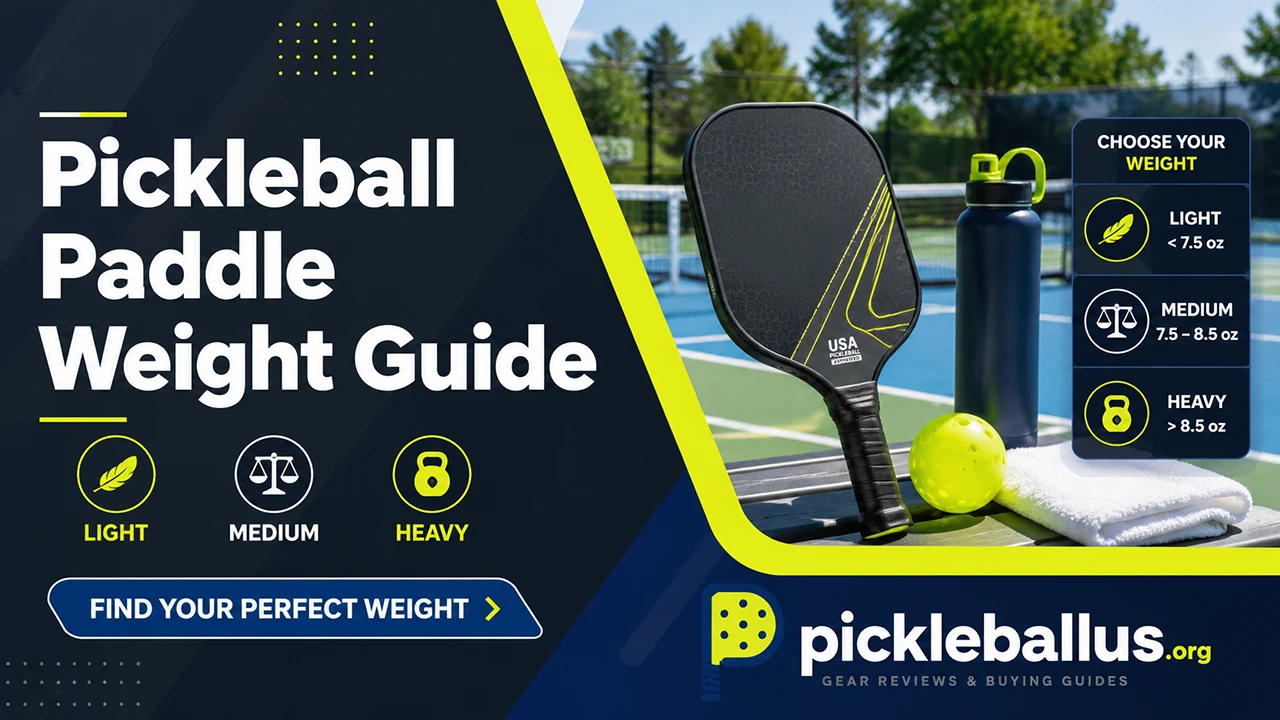
The best pickleball paddle weight for most recreational players is midweight (7.5–8.2 oz), which balances power, control, and maneuverability without overworking your arm. If you prioritize quick hands at the net and reduced joint strain, a lightweight paddle under 7.5 oz is the better fit. If you play aggressive baseline singles and need plow-through power on every drive, a heavyweight paddle at 8.2 oz or above gives you that extra force behind the ball.
Weight is one of the most personal decisions in paddle selection because it interacts directly with your physical strength, playing style, and injury history. A paddle that feels perfectly balanced to a 6’2″ former tennis player may feel like a brick to someone returning from elbow surgery. That’s why understanding the three weight classes — and the tradeoffs each one brings — is more useful than chasing a single number.
Most players don’t realize that even a 0.2 oz difference can change how a paddle responds during a fast hands exchange at the kitchen line. This guide breaks down exactly what those differences mean in real gameplay, which weight suits your specific situation, and when it actually makes sense to experiment beyond the factory setting.
Below is everything you need to make a confident, informed decision on pickleball paddle weight.
What Is Pickleball Paddle Weight?
Pickleball paddle weight is the total mass of your paddle measured in ounces (oz) or grams (g), and it is one of the primary specifications that determines how a paddle performs in your hand. Most paddles on the market fall between 7.0 and 8.5 oz, with no official weight limit imposed by USA Pickleball (USAPA) rules. Every component — the face material, core thickness, edge guard, handle length, grip, and end cap — contributes to the final number on the scale.
How Weight Is Measured (Static Weight Explained)
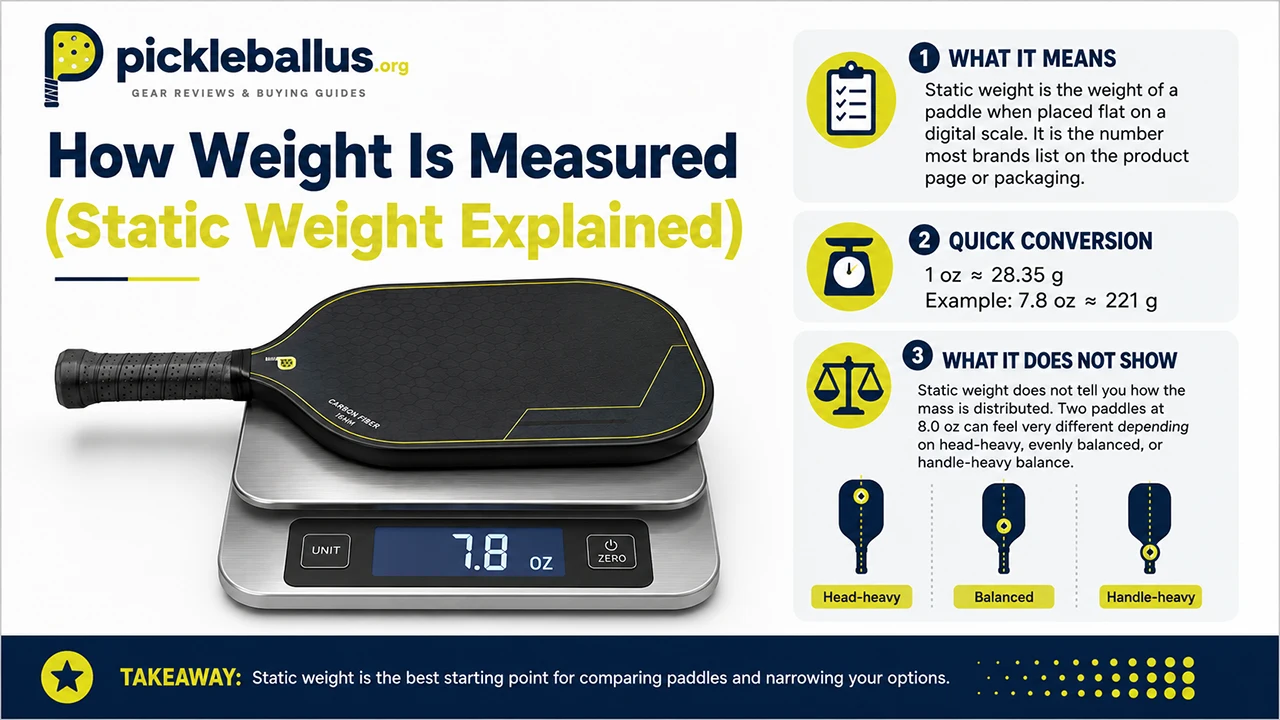
Static weight is what you get when you set a paddle flat on a digital scale. It’s the number printed on the paddle’s packaging or product page. Static weight is the most widely referenced weight specification because it’s simple, consistent, and easy to compare across brands. Most manufacturers measure in ounces, though grams appear increasingly on premium paddles. To convert: 1 oz = approximately 28.35 g. So a 7.8 oz paddle weighs about 221 g.
What static weight does not tell you is how the paddle distributes that mass along its length. Two paddles at exactly 8.0 oz can feel completely different depending on whether the weight is concentrated near the head, centered through the body, or balanced toward the handle. That distinction — covered in the advanced section — explains why some players pick up a paddle, look at the spec sheet, and still feel surprised by how it swings. For shopping purposes, static weight is your starting point and a reliable filter for narrowing down categories.
How Even 0.2 oz Can Change How a Paddle Feels
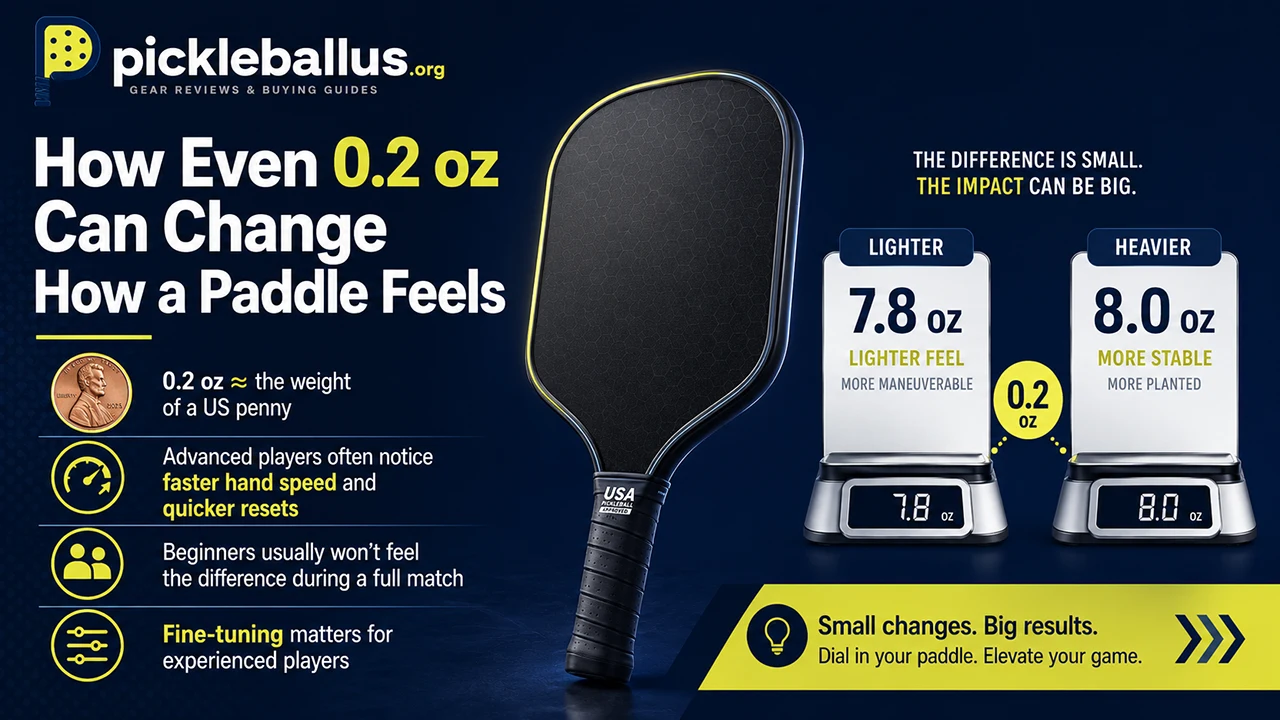
A 0.2 oz difference — roughly the weight of a US penny — is the minimum threshold most experienced players can detect during play. At the kitchen line, where exchanges happen in fractions of a second, that slight difference translates directly into hand speed and reaction time. A player who switches from an 8.0 oz paddle to a 7.8 oz version of the same model often reports noticeably quicker resets and easier wrist flicks on drop shots.
For beginners and casual players, the difference between 7.8 oz and 8.0 oz is generally imperceptible during a full match. However, advanced players — particularly those playing 10+ hours per week — often request guaranteed weight ranges from manufacturers, specifying a target within ±0.1 oz. The practical takeaway: if you’re new to the sport, don’t obsess over fractions of an ounce. If you’re a seasoned player dialing in your setup, even small adjustments matter.
The 3 Pickleball Paddle Weight Classes
Pickleball paddles fall into three broadly accepted weight classes. Different retailers use slightly different cutoff numbers, but the general framework is consistent across the industry. The table below gives you the standard classifications:
| Weight Class | Range | Primary Benefit | Best For |
|---|---|---|---|
| Lightweight | Under 7.5 oz | Quicker hand speed, less arm strain | Net players, seniors, elbow issues |
| Midweight | 7.5–8.2 oz | Balance of power and control | Most players; beginners–intermediate |
| Heavyweight | 8.2+ oz | More driving power, stability | Baseline hitters, power-focused singles |
Lightweight Paddles (Under 7.5 oz) — Pros, Cons & Best For
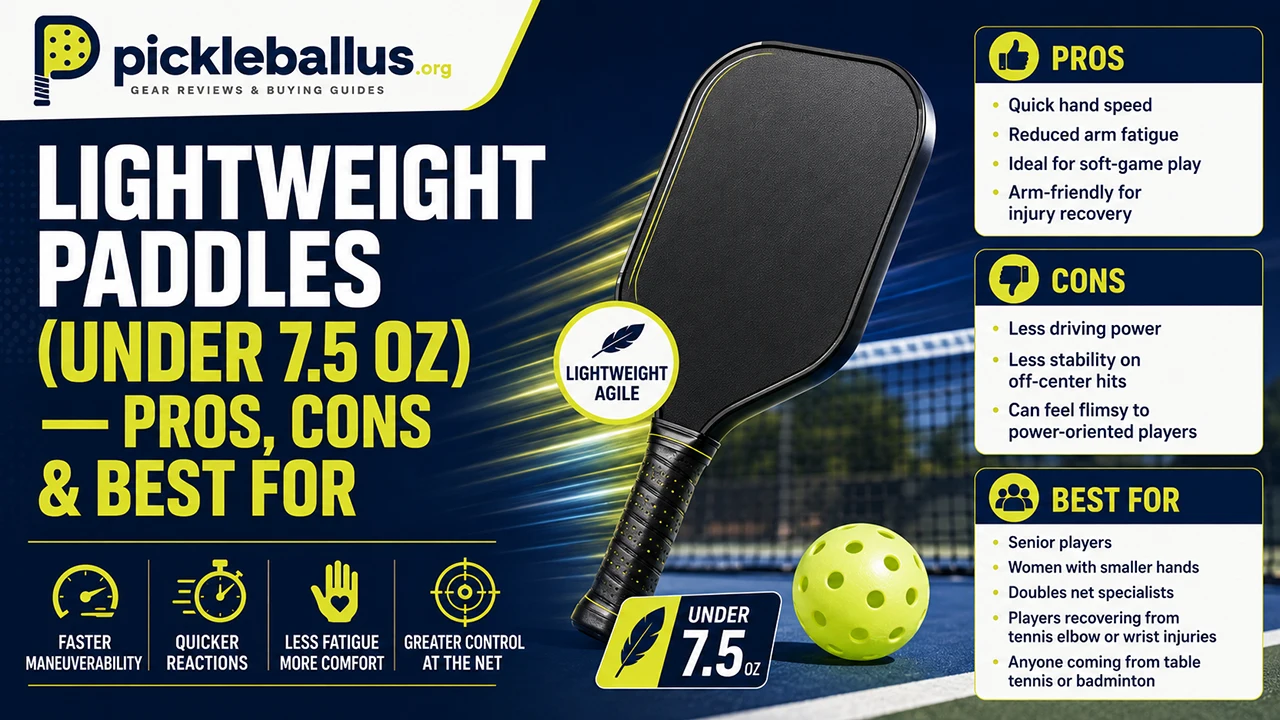
Lightweight paddles give you faster hand speed and easier maneuverability, making them the go-to choice for net-dominant doubles players and anyone managing wrist or elbow discomfort. Because there’s less mass to move, your arm recovers faster between shots — a meaningful advantage during extended kitchen rallies where the paddle has to change direction multiple times per second.
The tradeoff is predictable: less mass behind the ball means less power on drives, serves, and overhead slams. You also sacrifice some stability. When a hard-struck ball catches the edge of a lightweight paddle, the face tends to deflect or twist more noticeably than it would with a heavier option. Wind can also become a factor in outdoor play, as lighter paddles are more susceptible to being pushed off-line on full swings in gusty conditions.
Pros: Quick hand speed, reduced arm fatigue, ideal for soft-game play, arm-friendly for injury recovery.
Cons: Less driving power, less stability on off-center hits, can feel flimsy to power-oriented players.
Best For: Senior players, women with smaller hands, doubles net specialists, players recovering from tennis elbow or wrist injuries, anyone coming from table tennis or badminton.
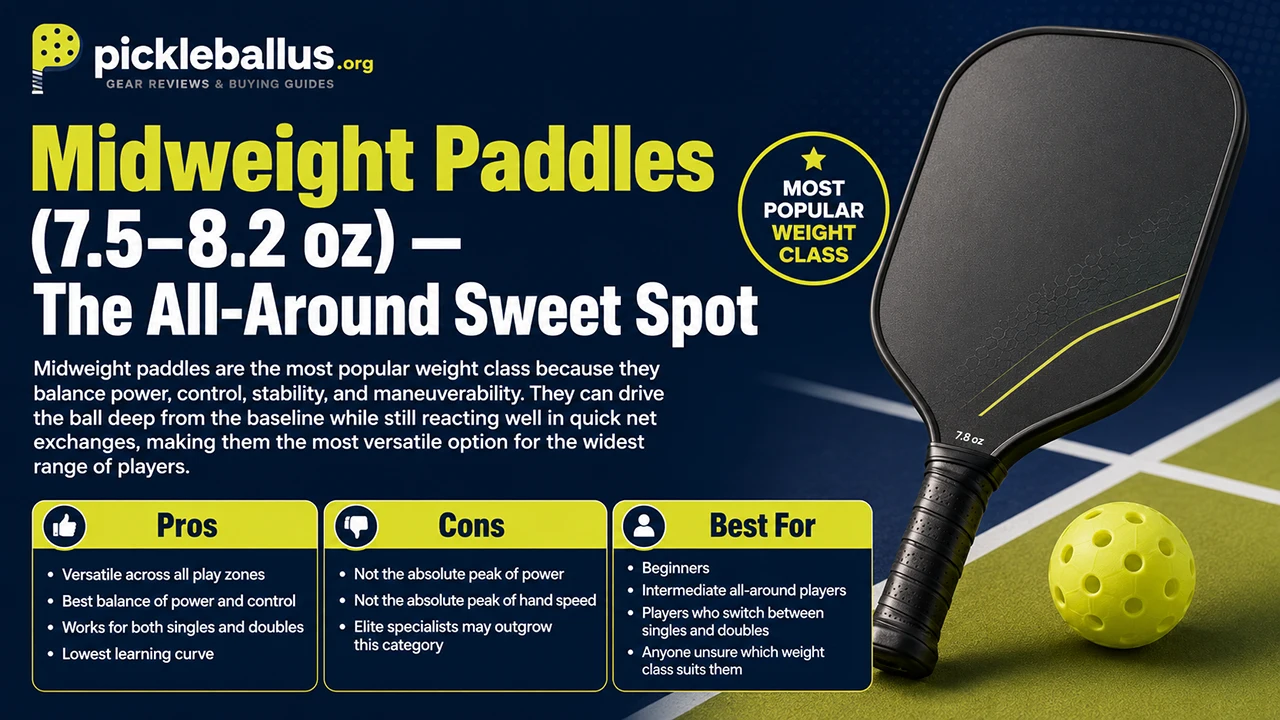
Midweight Paddles (7.5–8.2 oz) — The All-Around Sweet Spot
Midweight paddles are the most popular weight class for good reason: they don’t force you to sacrifice either side of the power-control spectrum. With enough mass to push the ball deep from the baseline and enough maneuverability to handle fast exchanges at the net, midweight paddles work for the widest range of players and playing styles.
Most recreational players will spend their entire pickleball career in this range and never feel underserved. The midweight class is particularly well-suited to beginners who haven’t yet developed strong shot mechanics — the extra stability compared to lightweight options helps absorb mishits without punishing technique too severely. As you develop, midweight paddles scale with you: better footwork and faster wrist action will extract more performance from the same tool.
Pros: Versatile across all play zones, best balance of power and control, works for both singles and doubles, lowest learning curve.
Cons: Not the absolute peak of either power or hand speed — dedicated power hitters and elite net players may eventually outgrow this category.
Best For: Beginners, intermediate players building an all-around game, players who switch between singles and doubles, anyone unsure which weight class suits them.
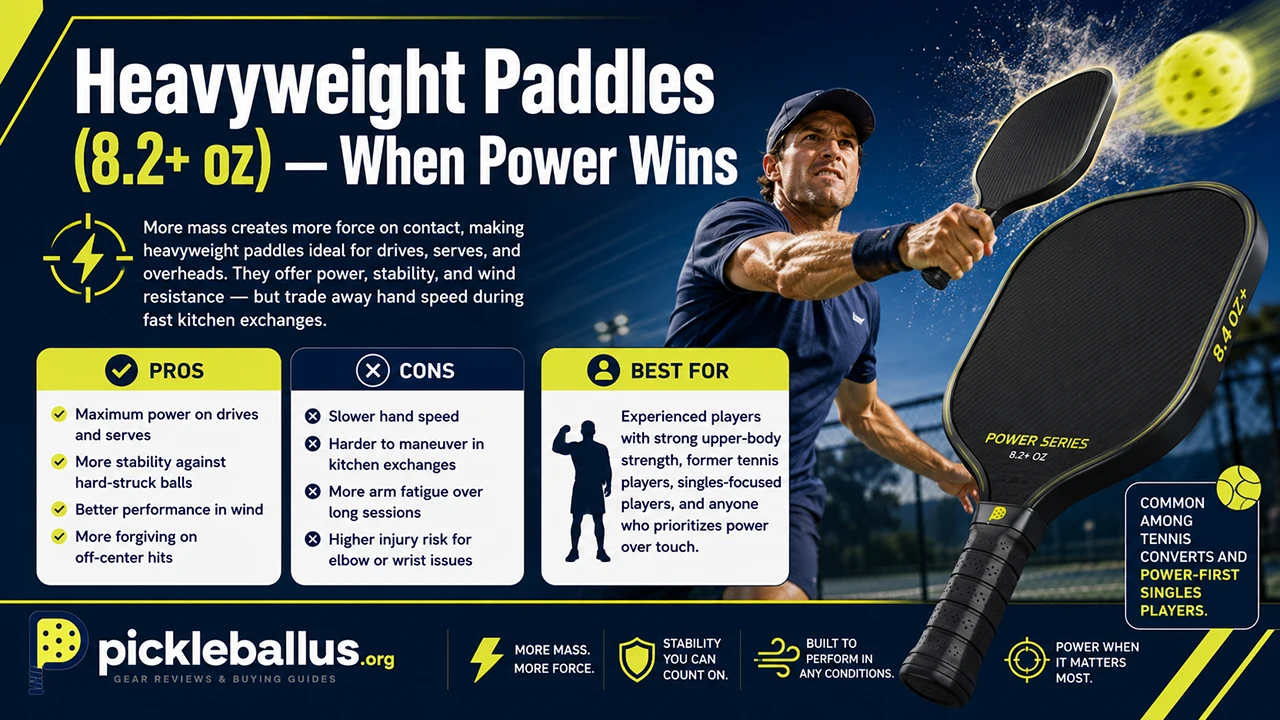
Heavyweight Paddles (8.2+ oz) — When Power Wins
Heavyweight paddles generate the most force on contact because more mass behind the ball translates directly into ball speed off the face. This effect is most pronounced on drives, serves, and overheads — the kind of shots that define aggressive baseline play. Players transitioning from tennis, where rackets routinely weigh 10–11 oz, often gravitate toward the heavier end of the pickleball spectrum because it replicates the heft they’re accustomed to.
The primary cost is hand speed. At the kitchen line — where pickleball matches are frequently decided — a heavy paddle requires more muscular effort to stop and redirect quickly. During fast hands battles, that fraction of a second extra can mean the difference between winning and losing the exchange. Heavily built players with strong forearms and wrists can absorb this limitation better than smaller-framed players, which is why heavyweight paddles are more common in men’s singles than in mixed doubles.
Pros: Maximum power on drives and serves, more stability against hard-struck balls, better performance in wind, forgiving on off-center hits.
Cons: Slower hand speed, harder to maneuver during kitchen exchanges, increases arm fatigue over long sessions, higher injury risk for players with existing elbow or wrist issues.
Best For: Experienced players with strong upper body strength, former tennis players, singles-focused players, anyone who prioritizes power over touch.
How Paddle Weight Affects Your Game
Paddle weight directly influences four performance variables: power output, swing speed, shot control, and physical durability over a long match. Understanding how each variable responds to weight changes gives you a concrete framework for choosing — rather than guessing — which class fits your game.
Power vs Control: The Core Tradeoff
Heavier paddles generate more power; lighter paddles generate more control — and this tradeoff is the central tension in every weight decision you make. The physics are straightforward: a heavier object moving at the same speed carries more kinetic energy into the collision with the ball. Even without swinging harder, a midweight paddle will push the ball deeper and faster than a lightweight paddle on an identical stroke.
Control works the opposite way. A lighter paddle is easier to decelerate and redirect, which is exactly what you need when dropping a soft shot into the kitchen or resetting a hard-driven ball. The smaller mass also means the paddle responds more directly to your wrist input — twitching the face angle by a few degrees produces a more predictable shot placement.
Here’s the key insight most beginners miss: control isn’t just about touch — it’s also about being physically capable of getting the paddle to the right position at the right time. A paddle that’s too heavy for your strength level will reduce your control even on shots where you don’t want power, because the extra weight prevents precise late adjustments. For most players, the right weight is the heaviest one you can still handle comfortably at the end of a two-hour session.
| Performance Factor | Lightweight (<7.5 oz) | Midweight (7.5–8.2 oz) | Heavyweight (8.2+ oz) |
|---|---|---|---|
| Driving Power | Low | Medium | High |
| Net Maneuverability | High | Medium–High | Medium |
| Arm Fatigue | Low | Medium | High |
| Stability on Mishits | Low | Medium | High |
| Wind Resistance | Lower | Medium | Higher |
Weight and Arm Health: What Players Over 50 Need to Know
For players over 50 — or anyone with a history of tennis elbow, wrist strain, or shoulder issues — paddle weight is a health decision as much as a performance one. Heavier paddles amplify vibration transmitted through the handle on every contact. Over the course of a match, that repetitive shock load accumulates in the tendons of the forearm, particularly the lateral epicondyle (the elbow attachment point implicated in tennis elbow).
Lightweight paddles naturally deliver less vibration to the arm, which is why many coaches and physical therapists recommend starting in the sub-7.5 oz range after any arm injury. That said, there’s a counterintuitive finding worth noting: paddles that are too light can also cause problems. A very light paddle that feels flimsy will cause players to grip harder and swing tighter, creating muscular tension that eventually leads to overuse injuries. The recommendation from Pickleball Warehouse — “play with the heaviest paddle you can comfortably handle” — captures this balance accurately. The goal is a paddle heavy enough to feel stable and absorb ball impact well, but not so heavy that it strains your arm over a full session.
If you’re specifically managing tennis elbow, the best pickleball paddles for tennis elbow resource covers both weight and vibration-dampening specifications to look for when shopping for an arm-friendly setup.
How to Choose the Right Pickleball Paddle Weight for Your Style
The right pickleball paddle weight depends on three converging factors: how and where you play, your sports background, and your current skill level. Most players land on a satisfying choice by working through these three filters in sequence.
By Playing Style (Net Player vs Baseline Power Hitter)
Doubles net specialists should lean lightweight; singles baseline power hitters should lean midweight to heavy. This is the most reliable single rule of thumb for weight selection because it maps directly to the physical demands of each playing context.
In doubles, roughly 60–70% of rally time is spent at or near the kitchen line. Shots are quick, compact, and technically precise. The paddle needs to change direction fast, which rewards lower mass. In singles, the court is wider, points are decided more often by drive power and serve depth, and kitchen battles are proportionally less frequent. The extra mass of a midweight or heavyweight paddle pays off across the full match.
If you play both formats regularly — common at the recreational level — midweight is the logical compromise. It will serve you competently in both contexts without optimizing perfectly for either.
By Sports Background (Tennis, Table Tennis, Badminton)
Your previous racket sport shapes your expectations around paddle feel more than any other background factor. Each sport trains a different sense of “normal” weight:
- Former tennis players are accustomed to rackets weighing 10–11 oz. The entire pickleball paddle spectrum will feel light by comparison. Midweight to heavyweight paddles (7.8–8.5 oz) provide the closest physical analog to what they’re used to gripping.
- Former table tennis players are used to paddles weighing 3–5 oz — a fraction of a pickleball paddle’s mass. Lightweight pickleball paddles (under 7.5 oz) feel most natural, and the fast-twitch kitchen game mirrors TT play closely.
- Former badminton players swing rackets in the 3–4 oz range and prioritize wrist speed and touch. Like TT players, they typically adapt fastest to lightweight pickleball paddles.
- No prior racket sport background: Start with midweight. It’s the most forgiving, and you’ll develop your weight preference through play rather than guesswork.
By Skill Level (Beginner, Intermediate, Advanced)
Beginners should default to midweight; advanced players should optimize based on testing. Here’s why the recommendation changes as you develop:
At the beginner level, the most important qualities are consistency and comfort. Midweight paddles are stable enough to handle mishits without flying off in unexpected directions, and light enough not to strain an arm that hasn’t yet built pickleball-specific endurance. Starting at the extremes (very light or very heavy) before you’ve developed proper swing mechanics can reinforce bad habits — over-swinging with a light paddle, or arming the ball with a heavy one.
At the intermediate level, you’ve likely identified whether your game trends toward net play or baseline aggression. This is the right time to experiment one weight class up or down from your current paddle to see if the change unlocks a new dimension in your game.
At the advanced level, weight selection is personal calibration. Many advanced players add lead tape or tungsten tape to factory-weight paddles to fine-tune balance point and swing weight — concepts covered in the next section.
| Skill Level | Recommended Weight | Why |
|---|---|---|
| Beginner | Midweight (7.5–8.0 oz) | Stable, forgiving, easiest to develop mechanics with |
| Intermediate | Midweight or test lightweight | Match your emerging playing style |
| Advanced | Personal preference + swing weight tuning | Optimize for specific game plan |
By now you have a solid framework for understanding the three weight classes and how each one maps to your playing style, physical comfort, and skill level. Choosing the right weight category is the essential first step — but it’s only half the equation for serious players. Beyond the number on the scale, there are advanced weight concepts like swing weight and balance point that explain why two paddles listed at identical ounces can feel completely different on the court. The next section dives into those finer details, along with what to do if you want to fine-tune a paddle you already own.
Beyond the Scale: Advanced Paddle Weight Concepts Players Should Know
Static Weight vs Swing Weight — Why the Scale Lies
Static weight tells you how heavy a paddle is; swing weight tells you how heavy it feels when you swing it — and these two numbers can point in completely different directions. Swing weight (measured in kg·cm²) quantifies how much rotational resistance you feel when the paddle moves through the air. A paddle with its weight distributed toward the head will have a high swing weight — it feels powerful and head-heavy but requires more effort to start and stop. A paddle with weight distributed toward the handle will have a low swing weight — it feels whippy and fast but delivers less plow-through on drives.
Two paddles, both at 8.0 oz static weight, can differ by 15 or more points on the swing weight scale. On the court, one feels like a power weapon and the other feels like a finesse tool. This is why experienced players don’t shop by ounces alone. When manufacturers publish swing weight data (still not universal in the industry), use it alongside static weight for a complete performance picture. If swing weight data isn’t available, a paddle’s balance point — whether it tips toward the head or handle when rested on a finger at the midpoint — gives you a practical proxy.
Balance Point: Head-Heavy vs Handle-Heavy Explained
The balance point is where a paddle’s mass centers along its length, and it directly affects how a paddle plays regardless of what the static weight says. A head-heavy paddle (balance point above the geometric center) delivers more power and stability on contact — the physics are similar to swinging a hammer. A handle-heavy paddle (balance point below center) gives you faster wrist action and easier maneuverability — closer to a surgeon’s scalpel.
Most stock paddles from major brands are designed to be roughly neutral to slightly head-heavy. Former tennis players, accustomed to head-heavy rackets, often gravitate toward head-heavy pickleball paddles naturally. Players coming from table tennis or badminton tend to prefer handle-heavy setups. You can shift the balance point of any paddle by adding weight tape at strategic positions — more detail on this in the next section.
How to Add Weight to Your Paddle with Lead or Tungsten Tape
Adding weight tape is a USAPA-legal way to increase mass, adjust balance point, and expand sweet spot size on any paddle you already own. The two most common materials are lead tape and tungsten tape:
- Lead tape: The most affordable and widely available option. Sold in pre-cut 0.1 oz strips or as a roll you cut yourself. Attaches cleanly to the edge guard or face. Very effective but requires care when handling due to lead content.
- Tungsten tape: A non-toxic alternative that works identically but provides less weight per inch of tape, so you’ll need more of it to achieve the same effect.
Where you place tape changes how the paddle performs:
- Sides of the head (3 and 9 o’clock): Expands the sweet spot and adds stability without dramatically shifting the balance point. The most popular placement for most players.
- Top of the head (12 o’clock): Increases head weight and plow-through power on drives. Slows down hand speed. Best for strong, experienced players — not recommended for anyone with wrist or elbow issues.
- Handle area: Shifts balance toward handle-heavy, increases hand speed, reduces power. Used by players who want a faster, more maneuverable feel.
Start with the smallest increment possible — one 0.1 oz strip — and play a full session before adding more. The cumulative strain of extra weight on small arm muscles and tendons is real, and it builds slowly enough that many players don’t notice the damage until it has progressed.
Light Paddle, Heavy Hits — Does Technique Trump Weight?
Technique matters more than weight in almost every situation, but weight acts as an amplifier of whatever technique you already have. A player with strong mechanics will extract more power from a midweight paddle than a player with poor mechanics will from the heaviest paddle available. Weight doesn’t compensate for bad swing paths, incorrect contact point, or inconsistent footwork.
That said, weight and technique interact in a specific way worth understanding: once your technique is sound, moving to a slightly heavier paddle will produce a measurable power increase without requiring you to swing harder. Conversely, dropping to a lighter paddle won’t suddenly make your dinks and drops more accurate — what it will do is make it physically easier to execute the technique you’ve already built. Think of weight as the volume knob on your existing game, not a cheat code for building a new one.