Pickleball Paddle Comparison: Carbon, Foam, 14mm vs 16mm & More

A pickleball paddle comparison is only useful when you know which specs actually explain the difference — and which are just marketing copy. This guide breaks down every meaningful variable across face material, core, thickness, shape, and weight so you can put any two paddles side by side and know exactly what the numbers mean for your game.

Browse all best pickleball paddles for full ranked recommendations by category.

What Does a Pickleball Paddle Comparison Actually Measure?

A pickleball paddle comparison measures seven core specs that collectively determine how a paddle performs: face material, core material, core thickness, shape, weight, grip size, and construction method. Every other spec — swing weight, balance point, spin RPM — is derived from or closely tied to these seven.

Understanding what each spec does allows you to translate any comparison chart into a real prediction of on-court feel. A paddle that lists “raw carbon fiber face, 16mm polymer core, 8.1 oz, elongated shape” is not just a collection of labels — it is a description of a paddle that generates heavy topspin, forgives off-center hits, and rewards players with long, aggressive swings.

The 7 Specs That Determine How a Paddle Plays

The table below summarizes what each spec controls:

SpecWhat It Controls
Face materialSpin, feel, and initial ball contact
Core materialBall dwell time, touch, and overall power character
Core thicknessForgiveness vs. pop — the single biggest control variable
ShapeSweet spot size, reach, and maneuverability
WeightSwing speed vs. stability trade-off
Grip sizeWrist leverage and comfort over time
Construction methodStructural stiffness and edge performance (thermoformed vs. standard)

Why Independent Testing Differs from Manufacturer Spec Sheets

Manufacturer-listed specs — especially static weight — are averages across a production batch, not guarantees for an individual paddle. A paddle listed at 8.1 oz may ship at 7.9 oz or 8.3 oz depending on the unit. Independent testing labs measure each paddle individually, which is why platforms like Pickleball Studio and Tennis Warehouse University report different weights, swing weights, and COF values than the brand’s own product page. When precision matters, treat manufacturer specs as starting estimates and look for independently verified data before finalizing a comparison.

Face Material Comparison: Carbon Fiber, Fiberglass, Kevlar, or Graphite?

The paddle face is the contact surface — every spin rating, pop rating, and feel description in a comparison starts here. Four materials dominate the current market.

For a deeper breakdown of how each surface interacts with the ball, see the full guide to pickleball paddle materials.

Carbon Fiber — Spin and Crisp Pop

Carbon fiber faces — especially raw carbon fiber — are the current performance standard. Raw carbon has an open-weave texture that grips the ball longer on contact, generating higher spin RPM and a crisper, more responsive feel. Electroplated carbon fiber (often called T700 or T800 carbon) is smoother and produces a firmer, more powerful impact with slightly less spin ceiling.

Carbon fiber suits players who prioritize spin, sharp counters, and predictable power. Most high-performance paddles in 2026 use some form of carbon fiber face.

Fiberglass — Flex-Driven Power

Fiberglass faces flex more on impact than carbon fiber, which compresses the ball slightly longer and redirects more energy back into the shot. The result is a softer, deeper feel with natural power that doesn’t require a fast swing to activate. Fiberglass is popular with beginners and intermediate players who want a forgiving, powerful paddle without a steep learning curve.

The trade-off: fiberglass generates less spin than raw carbon and wears faster under high-frequency play.

Kevlar — Plush Feel and Durability

Kevlar (aramid fiber) absorbs vibration better than any other face material, producing a muted, plush contact that many players describe as “pillowy.” It is the preferred face material for players with arm sensitivity — including those managing tennis or pickleball elbow — because the reduced vibration transmission lessens fatigue over long sessions.

Kevlar paddles also show strong durability under repeated high-impact shots. The downside is a lower spin ceiling compared to textured carbon.

Graphite — The Classic Lightweight Option

Graphite was the dominant face material before the carbon fiber era and still performs well for players who want a lightweight, responsive paddle at a lower price point. Graphite is stiff, thin, and delivers a firm, direct feel. It does not generate spin as effectively as raw carbon, but it offers excellent touch for dinking and soft-game play.

Most graphite paddles today fall into the budget-to-mid-range price tier.

Core Comparison: Polymer Honeycomb vs. Foam vs. Nomex

The face material decides the first contact; what happens inside the paddle — in the core — determines what the ball does next. Core material shapes dwell time (how long the ball stays on the face), sound level, and the overall power character of a paddle.

Polymer Honeycomb — The Balanced Standard

Polymer honeycomb (a polypropylene plastic honeycomb structure) is the most widely used core in modern pickleball paddles. It produces a quiet, controlled response with moderate dwell time — good touch on dinks and resets without sacrificing pace. Most best pickleball paddles under $150 use polymer cores.

For most recreational and competitive club players, polymer is the right starting point unless a specific play style demands foam or Nomex.

Foam Core — Dwell Time and Power

Foam cores — including the full-foam and TruFoam designs from brands like CRBN, Bread & Butter, and Friday — create longer ball dwell on the face. That extended contact translates to more controlled power on drives and better ball-shaping ability at the kitchen line. Full-foam paddles in 2026 have become the choice of many touring pros for their combination of pop and touch.

Foam cores are typically heavier per unit volume than polymer honeycomb, so foam paddles often run toward the midweight-to-heavyweight range.

Nomex — Explosive, High-Volume Play

Nomex (aramid honeycomb) is the original high-performance core material — stiff, rigid, and loud. Nomex paddles produce explosive power with minimal dwell time, which rewards players who generate their own swing speed and want fast, snappy hand-battle exchanges. The trade-off is reduced touch, less forgiveness on off-center hits, and the loudest contact sound of any core material.

Nomex is largely outpaced by modern foam and thermoformed polymer designs in the current market but still appears in certain power-focused paddles and older inventories.

14mm vs. 16mm vs. 19mm: Which Core Thickness Wins?

Once you know what the core is made of, thickness tells you how much of that material’s personality gets amplified on every shot. Core thickness is the single most impactful controllable spec — more than weight, more than shape — for determining how a paddle balances pop against forgiveness.

See the full side-by-side breakdown at 14mm vs 16mm pickleball paddles.

Thinner Cores (14mm) — More Pop, Less Forgiveness

A 14mm core reduces the gap between the two face panels, which increases the trampoline-like rebound effect on contact. Shots hit cleanly feel explosive and fast. However, the smaller buffer between face panels means that off-center hits feel harsher and are harder to control. 14mm paddles favor advanced players with consistent swing mechanics who want to attack.

Thicker Cores (16mm–19mm) — Control, Soft Hands, and Touch

A 16mm core increases the distance between face panels, which absorbs more energy on contact and distributes force more evenly across the face. The result is a larger, more consistent sweet spot, better control on dinks and drops, and a more forgiving response on mishits. 19mm paddles push this further — maximum dwell time, maximum soft-game feel, and a noticeably quieter sound than thinner options.

Most teaching professionals recommend 16mm cores for beginners and intermediate players. At 4.0+ skill levels, the choice between 14mm and 16mm becomes a deliberate tactical decision rather than a default.

Shape Comparison: Widebody vs. Elongated vs. Standard

Shape defines how the paddle meets the ball. The three dominant shapes each optimize a different priority: sweet spot size, reach, or generalist balance.

Widebody — Maximum Sweet Spot

Widebody paddles are shorter and wider than standard shapes, concentrating mass across a broader face for a larger, more forgiving sweet spot that reduces the penalty for slightly off-center hits. Widebody paddles maneuver easily at the net during fast hand exchanges, making them popular with doubles players who prioritize consistency and quick resets.

The trade-off is reduced reach on wide balls compared to elongated shapes.

Elongated — Reach and Two-Handed Backhand Leverage

Elongated paddles extend beyond standard length (up to 16.5 inches) and are narrower across the face. This geometry increases reach for groundstrokes and drives, provides additional leverage for two-handed backhands, and moves the sweet spot toward the tip — closer to where drives are often struck. Elongated paddles are the dominant shape among 4.0+ players and pros.

The narrower face means a smaller sweet spot and a steeper learning curve at the kitchen line.

Standard — The All-Around Performer

Standard-shape paddles sit between widebody and elongated — balanced reach, balanced sweet spot, balanced maneuverability. They suit players who split time between aggressive baseline play and soft kitchen exchanges and don’t want to optimize for one at the expense of the other. Standard shapes are the most common configuration in the beginner-to-intermediate market.

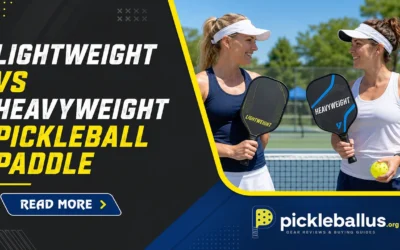
Weight Comparison: How Lightweight, Midweight, and Heavyweight Paddles Play Differently

Shape defines how the paddle meets the ball; weight defines how fast you can get there. The three weight categories each create a distinct physical trade-off between swing speed and stability.

The industry-standard ranges are:

Weight ClassRangeBest For
LightweightUnder 7.8 ozFast hands at the net, players with arm sensitivity
Midweight7.8–8.4 ozBalance of power and control — most common range
Heavyweight8.5 oz and aboveStability, drive power, baseline attackers

Lightweight paddles accelerate faster, which gives net players quicker reaction time during hand exchanges. The trade-off: lighter paddles generate less momentum on drives and can feel unstable on hard-hit balls coming at you.

Midweight paddles (7.8–8.4 oz) cover the largest segment of the market for a reason — they are functional across all shot types without demanding a specialized playing style. Most players choosing their first serious paddle land here.

Heavyweight paddles deliver more power on drives and overheads by momentum alone, but slow hands during fast net exchanges. Players with strong, complete swings who want a stable driving platform can find real advantage here. Players with shoulder or elbow issues should avoid the high end of this range, as heavier paddles increase joint load per swing.

For guidance matched to your play style, see how to choose a pickleball paddle.

Does Thermoformed Construction Make a Paddle Measurably Better?

Yes — thermoforming produces a measurably stiffer, more consistent paddle compared to cold-pressed construction, but whether “better” applies depends on your playing style and skill level.

See the full technical breakdown at thermoformed vs non-thermoformed pickleball paddle.

Thermoforming bonds the face layers to the core under heat and pressure as a unified assembly, eliminating the micro-gaps that form in cold-pressed paddles where face and core are glued at room temperature. The bonded structure produces a stiffer, more responsive paddle with consistent performance across the entire face — and a more pronounced “pop” that many players associate with premium equipment.

The downside for some players: thermoformed paddles feel less forgiving because their stiffness amplifies the difference between clean hits and mishits. Advanced players with consistent mechanics benefit most; newer players may find that a well-constructed cold-pressed paddle with a 16mm polymer core performs better for their game at a lower price.

A note on delamination: Thermoformed paddles became briefly controversial in 2023–2024 when some models delaminated in ways that artificially increased power beyond legal limits. USA Pickleball’s updated testing protocols have since addressed this, but it remains a reason to verify that any thermoformed paddle you’re comparing carries current USA Pickleball Approved status.

By now, you can read any paddle’s spec sheet and understand exactly what each variable means for your game — face material, core, thickness, shape, and weight together form a complete picture of how a paddle performs. But comparing paddles at the Root spec level is only half the equation. The players who choose their equipment most precisely go one layer deeper, into metrics that don’t appear on most product pages but consistently separate paddles that look identical on paper. The next section covers those distinguishing measures: the swing weight, spin RPM, and surface friction data that explain why two carbon paddles at the same price can play completely differently.

Beyond the Spec Sheet — Swing Weight, Spin RPM, and What They Mean

Static Weight vs. Swing Weight: Why the Number on the Scale Lies

Static weight is the number printed on the product page — the total mass of the paddle on a scale. Swing weight measures how heavy the paddle feels when swung, which depends not just on total mass but on how that mass is distributed along the length of the paddle.

A paddle with weight concentrated at the tip will feel significantly heavier during a swing than a paddle of the same static weight with mass distributed near the handle — even though both read identically on a scale. Swing weight is measured in points (RDC units) and directly predicts how fast you can bring the paddle to a ball during hand exchanges: higher swing weight drives more power on drives; lower swing weight delivers faster hands at the net.

When comparing paddles for net play or hand speed, swing weight is more meaningful than static weight. Look for independently published swing weight figures from testing labs rather than manufacturer data, which often omits this spec.

Spin RPM and Surface Friction: How to Read COF Data

Spin RPM measures how many rotations per second a ball achieves off a paddle face under standardized strike conditions. Higher RPM = heavier topspin and slice potential. This spec is driven primarily by the Coefficient of Friction (COF) of the face surface — specifically the kinetic COF (COFk), which measures how well the surface grips a sliding ball during contact.

Paddles with high COFk stop the ball’s slide faster during impact, converting more of that contact into spin. Raw carbon fiber faces consistently record high COFk values; smooth polished surfaces score lower. USA Pickleball’s post-2024 surface roughness limits cap how much texture manufacturers can apply, which is why COF data from independent testing labs — rather than manufacturer spin claims — gives the most accurate comparison between paddles.

How to Use a Pickleball Paddle Comparison Chart Without Getting Lost

A side-by-side paddle comparison chart works best when you approach it with a clear priority order — not by reading every spec simultaneously.

Which 3 Specs to Lock In First at Each Skill Level

Use this framework to narrow a comparison chart to what matters most for where you play:

Skill LevelPriority 1Priority 2Priority 3
Beginner (under 6 months)Core thickness (16mm+)Weight (midweight)Face material (fiberglass or carbon)
Intermediate (6 mo – 2 yrs)Face materialCore thicknessShape (widebody or standard)
Advanced (2+ yrs / competing)Swing weightFace texture / COFkThermoformed vs. standard

Once those three specs align with your needs, you can compare price and brand. Reversing this order — starting with brand or price and working backward into specs — is the most common reason players end up with a paddle that doesn’t fit their game.

For play-style-specific recommendations, the control vs power pickleball paddles comparison covers the full tactical dimension of this choice.

When Delamination and Dead Paddle Signs Matter in Your Comparison

Two performance-affecting conditions are worth checking before finalizing any comparison, especially when buying second-hand or evaluating older inventory:

Delamination occurs when the face separates from the core, creating a “trampoline layer” that boosts power beyond legal limits. On a delaminated paddle, the ball will fly noticeably farther on drives with less effort. If you’re demoing a thermoformed paddle and it feels abnormally hot, ask for a non-delaminated reference paddle.

A dead paddle shows the opposite symptom: the face has hardened or the core has compacted over time, reducing pop and feel. Tap the face with your knuckle in the center and near the edges — a consistent, resonant tone across the face indicates a live paddle; a dull or hollow variation indicates core degradation. Paddle lifespan under regular play runs roughly 1–2 years, shorter for players who hit heavy topspin repeatedly in the center of the face.