

The best pickleball wrist braces for 2026 are the BraceAbility Sport Wrist Brace (best overall), the Copper Compression Wrist Brace (best for pain relief and arthritis), the Neo G Wrist Brace (best official pickleball pick), the OS1st WS6 Performance Wrist Sleeve (best lightweight sleeve), the Domaste Pickleball Wrist Brace (best pickleball-specific design), the DR.SPRING Wrist Brace (best for post-injury recovery), and the Mueller Fitted Wrist Brace (best budget pick).


Picking the right brace for pickleball is harder than it looks. The sport demands fast, repetitive wrist movements — serves, dinks, resets, drives — and the wrong brace either restricts your swing or collapses under that load. The difference between a rigid splint and a compression wrap matters more on court than most players realize.
Most wrist pain in pickleball traces back to one of three issues: wrist instability during impact, repetitive strain from extended play, or an underlying condition like tendonitis or carpal tunnel syndrome. Each requires a different level of support, and choosing the wrong category can slow recovery instead of speeding it.
Below are the seven braces that hold up across all three scenarios, tested against real pickleball demands — not just desk work or general athletic use.

What Makes a Wrist Brace Good for Pickleball?
A quality pickleball wrist brace stabilizes the joint without locking out the range of motion you need to execute shots. That balance — support without restriction — separates a brace designed for court use from one built for typing or manual labor. Three factors define that balance in practice.
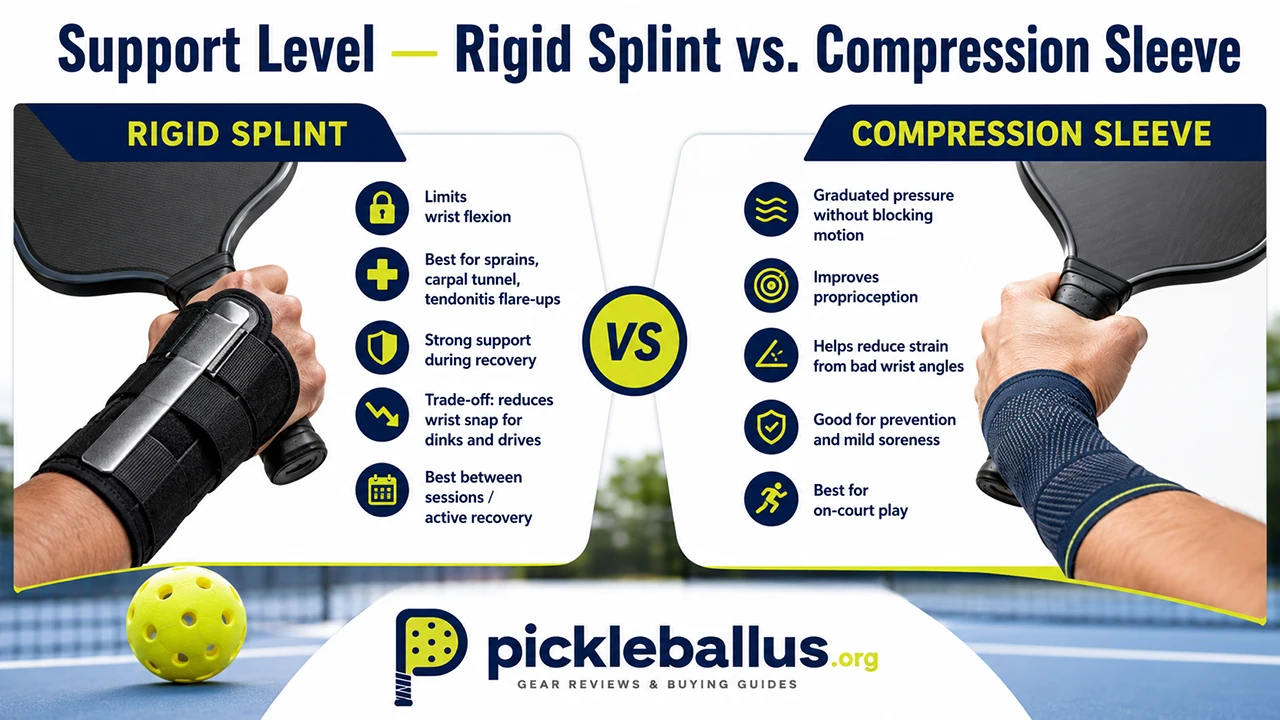
Support Level — Rigid Splint vs. Compression Sleeve
Rigid braces include a metal or thermoplastic stay that prevents wrist flexion beyond a set angle. They suit players recovering from sprains, managing carpal tunnel syndrome, or dealing with tendonitis flare-ups. The trade-off: a stiff stay limits the wrist snap that powers dinks and drives. Players in active recovery often wear a rigid brace between sessions and switch to a lighter compression wrap during play.
Compression sleeves and wraps apply graduated pressure to the wrist without blocking movement. They enhance proprioception — the joint’s sense of its own position — which reduces mis-hit force and helps players catch bad wrist angles before they cause strain. For prevention or mild soreness, a compression option works on court without sacrificing shot mechanics.
Breathability and Court-Specific Fit
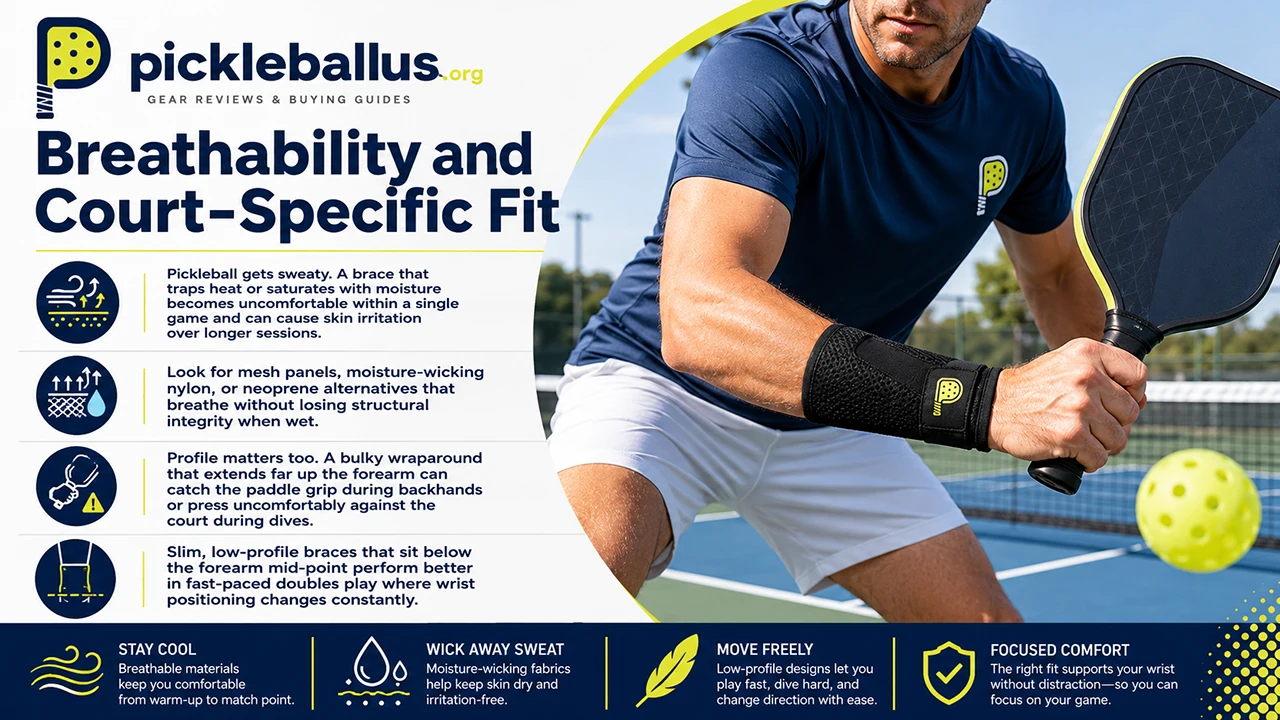
Pickleball gets sweaty. A brace that traps heat or saturates with moisture becomes uncomfortable within a single game and can cause skin irritation over longer sessions. Look for materials with mesh panels, moisture-wicking nylon, or neoprene alternatives that breathe without losing their structural integrity when wet.
Profile matters too. A bulky wraparound that extends far up the forearm can catch the paddle grip during backhands or press uncomfortably against the court surface during dives. Slim, low-profile braces that sit below the forearm mid-point perform better in fast-paced doubles play where wrist positioning changes constantly.
Adjustability and Sizing
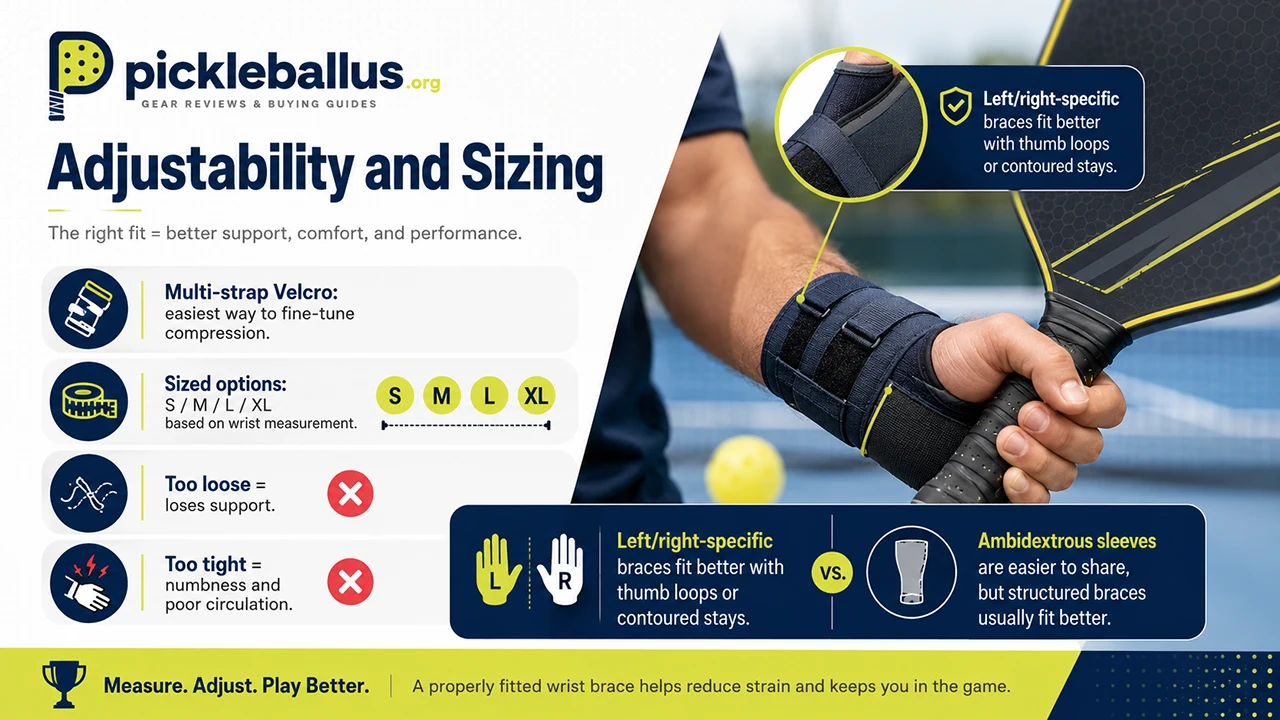
Wrist circumference varies widely. A brace that runs too loose loses compression immediately; one that runs too tight cuts circulation and causes numbness during extended sets. Most quality braces offer either multi-strap Velcro adjustment (best for dialing in compression on the fly) or sized variants (S/M/L/XL) based on wrist measurement.
Left/right specificity also matters. Braces with a thumb loop or contoured stay must match your dominant hand. Ambidextrous sleeves are more flexible for households where braces get shared, but size-specific structured braces typically offer better fit.
7 Best Pickleball Wrist Braces of 2026
#1 BraceAbility Sport Wrist Brace — Best Overall
The BraceAbility Sport Wrist Brace handles the full spectrum of pickleball wrist needs — prevention, mild injury support, and recovery — without making any single trade-off too painful. Where most braces optimize for one use case, this one adapts.
Key specs: Wraparound Velcro design | Soft breathable fabric | Adjustable compression from light to firm | Universal sizing | Left and right-hand versions available
Performance Analysis
The wraparound construction uses wide Velcro closure with two adjustable straps, letting you dial compression from barely-there stabilization to firm immobilization within seconds. The fabric is a soft moisture-wicking blend that stays dry through two-hour sessions on warm courts — a real differentiator against neoprene-heavy options that become sweat-soaked by the second game. Structurally, the brace uses a flexible inner panel that contours to the wrist without a rigid stay, which keeps wrist snap available for dinks while still dampening the micro-instability that leads to tendon overuse.
On court, the BraceAbility holds position during overhead slams and direction changes without bunching or rotating on the wrist — a common failure mode for single-strap wraps. Compared to the Mueller Fitted Wrist Brace, the BraceAbility offers meaningfully better fit for players with larger wrist circumferences, and the dual-strap system distributes compression more evenly. For players dealing with recurring tendonitis who want one brace for court use, gym work, and daily wear, this delivers consistent performance across all three.
Pros
- Adjustable compression accommodates both prevention and mild injury support
- Breathable fabric holds up through long sessions without saturation
- No rigid stay means full wrist snap is available during play
- Dual Velcro straps prevent shifting during aggressive movement
Cons
- No thumb loop, so the brace can drift slightly during extreme wrist flexion
- Not suitable for post-surgical immobilization or severe sprains requiring full rigidity
Best For: Players with recurring wrist soreness who want one brace for court play and off-court recovery. Also ideal for intermediate-to-advanced players who can’t afford range-of-motion loss during competitive matches.
My Verdict: The BraceAbility earns best overall by doing everything reasonably well rather than one thing perfectly. If you can only own one wrist brace for pickleball, this is the one.
#2 Copper Compression Wrist Brace — Best for Pain Relief & Arthritis
The Copper Compression Wrist Brace does something most athletic braces don’t: it targets chronic pain alongside acute instability. The copper-infused nylon isn’t marketing — copper fiber compression has documented benefits for inflammatory joint conditions, making this brace genuinely useful for players managing arthritis or persistent tendonitis.
Key specs: Copper-infused nylon construction | Sizes: S/M and L/XL | Left and right-hand versions | Hook-and-eye strap closure | Targeted conditions: carpal tunnel, arthritis, tendonitis, sprains
Performance Analysis
The compression fabric wraps the wrist with graduated pressure that’s higher at the palm and lighter toward the forearm — a deliberate design that enhances circulation while keeping fingers free. The copper-infused nylon creates a mild antibacterial environment that reduces odor over extended wear, a practical benefit when you’re rotating the same brace through three sessions a week. The hook-and-eye closure is more precise than wide Velcro, allowing micro-adjustments that Velcro closures round off.
During play, the slim profile means it doesn’t interfere with the paddle grip or create pressure points during backhand contact. I played a full recreational session with moderate wrist soreness and found the compression noticeably reduced fatigue during the second hour — the wrist felt actively supported rather than just passively covered. Compared to the OS1st WS6 sleeve, the Copper Compression provides firmer support and addresses pain more directly; the OS1st is better for pure prevention. For players over 50 managing arthritis, this brace stands apart from the rest of the lineup.
Pros
- Copper-infused fabric actively supports inflammation management
- Slim profile doesn’t interfere with paddle grip or shot mechanics
- Hook-and-eye closure provides precise compression adjustment
- Antibacterial properties reduce odor during frequent use
Cons
- S/M and L/XL sizing may not fit very small or very large wrists precisely
- Hook-and-eye closure is slower to put on than Velcro, which matters if adjusting mid-match
Best For: Pickleball players managing arthritis, chronic tendonitis, or carpal tunnel symptoms who need therapeutic compression alongside court-usable support.
My Verdict: No other brace in this roundup addresses inflammation as directly. If wrist pain rather than instability is your primary complaint, start here.
#3 Neo G Wrist Brace — Best Official Pickleball Pick
Neo G carries the official USA Pickleball partnership — not as a marketing footnote, but as a structural fact about how this brace was designed. The requirements for USA Pickleball approval pushed Neo G toward medical-grade compression and sport-specific sizing that general athletic braces skip.
Key specs: Medical-grade compression | Designed for racket sports | USA Pickleball official partner | Adjustable strap | Multiple sizes | Left and right options
Performance Analysis
The Neo G construction uses a reinforced medical-grade compression fabric paired with a contoured strap that anchors the brace at the thumb base — the point where pickleball-specific wrist stress concentrates during forehand drives and volleys. That anchor point distinguishes it from generic wraps that stabilize the mid-wrist without addressing the radial side where most racket-sport injuries originate.
The medical-grade compression level is higher than typical athletic sleeves, which means this brace provides real structural support even without a rigid stay. For players coming back from a wrist sprain and returning to court, the Neo G delivers the confidence layer that prevents re-injury during the hesitancy phase of recovery. Compared to the BraceAbility, the Neo G is more targeted — it’s built for racket-sport biomechanics specifically, not general multi-sport use. Players with pickleball-specific wrist issues will find the thumb-side anchor more meaningful than a symmetric wraparound design.
Pros
- Official USA Pickleball partner design built around racket-sport mechanics
- Thumb-base anchor addresses radial wrist stress specific to pickleball
- Medical-grade compression for meaningful structural support without a rigid stay
- Legitimacy signal for players who want clinically tested product standards
Cons
- Higher compression may feel restrictive for players not accustomed to medical-grade support
- Less adjustable than dual-strap designs; getting the right fit may require a half-size difference
Best For: Players returning from wrist sprains or those who want court-tested, sport-specific support with the credibility of official USA Pickleball approval.
My Verdict: The Neo G isn’t for casual prevention — it’s for players who need genuine structural support and want confidence that the brace was designed with pickleball mechanics in mind.
#4 OS1st WS6 Performance Wrist Sleeve — Best Lightweight Sleeve
The OS1st WS6 solves a specific problem: you need wrist support during play, but a bulky brace ruins your paddle feel. The WS6 is a medical-grade compression sleeve thin enough to wear under clothes, which in pickleball means it completely disappears under your grip without changing how the paddle handle feels.
Key specs: Patented Compression Zone Technology | Sizes S–XL | Ambidextrous | Seamless construction | Moisture-wicking nylon | UPF 50+ | Targeted conditions: carpal tunnel, wrist pain, arthritis
Performance Analysis
The Compression Zone Technology divides the sleeve into six distinct compression areas, each calibrated for the anatomy beneath it — higher compression over the carpal tunnel region, graduated lower pressure toward the forearm. This isn’t uniform squeeze; it’s targeted circulation enhancement that the manufacturer holds a patent on. The seamless construction eliminates seam pressure points that cause discomfort during repetitive grip-and-release motions like dinking.
The ambidextrous design means one size works for either hand — practically useful for players who need coverage on both wrists or who want a spare without buying a matched pair. Because the WS6 has no rigid component, wrist flexion is completely unrestricted. This makes it ideal for prevention and recovery between sessions, but less effective than the Copper Compression or Neo G for active structural support during injury flare-ups. Compared to the Domaste, the WS6 is thinner and more compression-focused; the Domaste adds more targeted stabilization for active play. Outdoor players will appreciate the UPF 50+ rating for sun-exposed wrists.
Pros
- Thin enough to wear under clothes and not affect paddle grip feel
- Patented six-zone compression targets specific wrist anatomy
- Ambidextrous design simplifies purchasing and sharing
- UPF 50+ for outdoor court use
Cons
- No structural support component — not suitable for injury recovery requiring stability
- Ambidextrous sizing means fit is less precise than hand-specific designs
Best For: Players who want prevention-level support that disappears under their grip, or those using a sleeve during post-match recovery and between sessions.
My Verdict: The WS6 is the best pick when you need something during play that doesn’t change how your paddle feels. It doesn’t replace a structured brace for injured wrists, but for prevention it’s unmatched in this category.
#5 Domaste Pickleball Wrist Brace — Best Pickleball-Specific Design
Domaste built this brace specifically for pickleball — not adapted from a general athletic support. The design accounts for the asymmetric wrist load of paddle sports, where the radial and ulnar sides experience different stress depending on whether you’re hitting a forehand or a backhand.
Key specs: 80% nylon, 20% spandex | One size (adjustable) | Right hand | Breathable lightweight construction | Targeted for pickleball court use
Performance Analysis
The spandex-nylon blend gives the Domaste a snug, form-following fit that moves with the wrist rather than against it. The brace uses a compression panel at the palm that stabilizes the carpal region during impact without using a rigid stay — a design choice that preserves natural wrist flex while still dampening excess movement during hard drives. The lightweight construction registers noticeably less on the wrist than structured braces, which reduces the mental adjustment players sometimes make when wearing support for the first time.
The sport-specific intent shows in the strap placement: rather than a generic mid-wrist anchor, the Domaste positions its support band at the point where paddle vibration transmits most directly into the wrist joint. For players dealing with vibration-related soreness rather than structural instability, this placement makes a real difference. Compared to the BraceAbility, the Domaste is lighter and more targeted at pickleball mechanics; the BraceAbility is more versatile across sports and daily activities. Note that this brace is designed for the right hand only.
Pros
- Sport-specific design built around pickleball wrist biomechanics
- Lightweight nylon-spandex blend reduces heat buildup and doesn’t interfere with paddle mechanics
- Compression panel placement targets vibration-transfer point during paddle impact
- Low profile stays out of the way during kitchen play and net exchanges
Cons
- Right-hand only — left-hand dominant players need a different option
- One-size design may not accommodate very small or very large wrists with the same fit quality
Best For: Right-handed players experiencing wrist soreness from repetitive paddle impact who want a brace designed specifically for pickleball rather than general sports use.
My Verdict: For right-handed players who are sold on a pickleball-first design, the Domaste is the most purpose-built option in this lineup and worth the specificity.
#6 DR.SPRING Wrist Brace — Best for Post-Injury Recovery
The DR.SPRING takes a different approach to wrist support: instead of pure compression or rigid immobilization, it adds far-infrared heat therapy through a graphene-coated inner lining. For players in active recovery from tendonitis or post-surgical rehabilitation, that heat layer accelerates circulation in a way passive braces can’t match.
Key specs: Graphene-coated far-infrared heat therapy lining | Double-layer compression | Posture-correcting design | Targeted for rehabilitation | Left and right versions available
Performance Analysis
Graphene’s far-infrared emission in the 4–14μm wavelength range is the mechanism behind the heat effect — graphene absorbs body heat and re-emits it as far-infrared energy, which penetrates tissue more deeply than surface warmth. For inflamed tendons, this effect enhances circulation and flexibility without requiring an external heat source. The double-layer compression combines an inner therapeutic layer with an outer stabilization wrap, giving this brace more structural rigidity than most non-splint designs.
The posture-correcting element addresses a common contributor to wrist pain in racket sports: slight pronation misalignment during backswings that loads the wrist tendons unequally over time. The DR.SPRING’s internal structure gently encourages neutral wrist alignment on approach shots, which may reduce re-injury risk for players whose technique contributes to their wrist issues. Compared to the Copper Compression, the DR.SPRING adds active heat therapy to copper’s anti-inflammatory effect; if budget allows, they address similar conditions through complementary mechanisms. This brace works best as a recovery tool worn between sessions rather than during competitive play.
Pros
- Far-infrared graphene lining provides active circulation enhancement without external heat source
- Double-layer design combines therapeutic compression with structural stabilization
- Posture-correcting internal structure addresses technique-related wrist misalignment
- Clinic-level recovery benefit at home use pricing
Cons
- Heavier and more substantial than prevention-focused options — not ideal for competitive court use
- Graphene heat effect requires body temperature to activate; may take 10–15 minutes of wear to feel
Best For: Players recovering from carpal tunnel surgery, chronic arthritis flare-ups, or repetitive strain injuries who need therapeutic recovery support between sessions.
My Verdict: The DR.SPRING is the most medically sophisticated option in this roundup. If you’re in active recovery rather than just looking for court support, this brace earns serious consideration.
#7 Mueller Fitted Wrist Brace — Best Budget Pick
Mueller has manufactured sports braces for decades, and the Fitted Wrist Brace represents what that experience produces at an accessible price point: a structurally sound, reliable compression brace with a metal stay for players who need more support than a sleeve but can’t justify premium pricing.
Key specs: Metal stay for wrist immobilization | Fitted sizing (S/M/L/XL) | Left and right versions | Adjustable strap | Targeted: sprains, tendonitis, carpal tunnel support
Performance Analysis
The Mueller uses a removable metal palmar stay that holds the wrist in slight extension — the neutral position that relieves pressure on the carpal tunnel and reduces tendon strain. The fitted sizing (measured by wrist circumference) provides more consistent compression than one-size adjustable designs, which often under-deliver on small wrists and over-stretch on large ones. The brace construction uses a firm fabric shell that maintains its shape through repeated use and washing.
For players who need rigid support during court play due to a recent sprain or diagnosed carpal tunnel syndrome, the Mueller’s metal stay provides real immobilization at a price well below comparable structured braces. The trade-off is clear: the metal stay does limit wrist snap during dinks and drives more than flexible-panel designs. Players in the prevention category who don’t need immobilization will get more mileage from the OS1st WS6 or Copper Compression. Compared to the DR.SPRING, the Mueller sacrifices therapeutic features for structural rigidity at lower cost — the right choice for players who need stabilization rather than recovery optimization. This is one of the most widely available braces on Amazon, with thousands of verified reviews supporting its durability.
Pros
- Metal stay provides genuine immobilization for acute injuries or carpal tunnel management
- Fitted sizing delivers consistent, measured compression
- Widely available and backed by decades of Mueller manufacturing reliability
- Substantially more affordable than therapeutic or sport-specific alternatives
Cons
- Metal stay limits wrist snap — affects shot mechanics more than flexible options
- Less breathable than nylon-based options; may feel warmer during long sessions
Best For: Players with diagnosed wrist sprains, carpal tunnel syndrome, or post-injury wrist instability who need a structured, affordable brace for both court use and daily activities.
My Verdict: At its price point, the Mueller delivers more structural support than anything else in this roundup. If immobilization is what you need and budget is a constraint, there’s no better option.
Rigid Brace, Compression Wrap, or Wrist Sleeve — Which One Do You Need?
The right category depends on the severity of your wrist issue, not on brand preference or price. Most players end up with the wrong type because they choose by look rather than by the mechanics of their condition.
The following table summarizes the decision criteria:
| Type | Support Level | Best Condition | Court Use |
|---|---|---|---|
| Rigid brace with metal stay | High — immobilization | Sprain, post-surgical, severe carpal tunnel | Limited — restricts shot mechanics |
| Compression wrap (structured) | Medium — stabilization | Tendonitis, mild sprains, prevention | Yes — some movement restriction |
| Sleeve (compression only) | Low — support and circulation | Prevention, mild soreness, post-match recovery | Yes — full range of motion |
Rigid Braces with Metal Stay: When Immobilization Matters
A rigid stay is appropriate when the wrist needs to be held in a fixed position to heal. Acute sprains, fracture recovery, and moderate-to-severe carpal tunnel syndrome all require limiting wrist flexion beyond a controlled range. The Mueller Fitted Wrist Brace is the clearest example here. The cost is shot mechanics — you lose wrist snap on serves and dinks. Most physicians recommend wearing a rigid brace during the healing phase and transitioning to a compression design when returning to play.
Compression Wraps: Everyday Prevention and Mild Support
Structured compression wraps sit between rigid immobilization and passive sleeves. They stabilize the joint without a fixed stay, allowing most of natural range of motion while adding enough resistance to reduce harmful micro-movement under load. The BraceAbility, Copper Compression, and Neo G all operate in this category. These are the most versatile option for players who want court-usable support that doesn’t compromise their game.
Wrist Sleeves: Light-Touch Play Support and Recovery
Sleeves apply graduated compression without any structural element. They enhance proprioception, improve circulation, and reduce post-match swelling. The OS1st WS6 is the standout here. For players with no active injury but a history of wrist issues, a sleeve worn during play and replaced with a structured brace post-match covers both prevention and recovery in one protocol.
Can Wearing a Wrist Brace Actually Help Your Pickleball Game?
Yes — but only when matched to the right condition and worn consistently. A brace addresses the mechanics, not the cause. Players who brace up and continue the movements that created the injury without addressing technique, rest, or volume will see limited benefit. That said, the proprioceptive effect of even light compression genuinely reduces on-court injury risk for players with prior wrist issues.
How Wrist Instability Affects Your Dink, Reset, and Drive
Wrist instability during impact creates inconsistent contact — the paddle face angle changes fractionally with each uncontrolled micro-movement. On dinks, this shows up as balls that pop up when they should stay low. On drives, it translates to arm and shoulder compensation that overloads proximal joints. A brace that stabilizes the wrist without restricting it improves shot consistency as a direct mechanical effect — not as a placebo. Players who have added compression support after a wrist strain often report that their reset shot, which requires precise wrist absorption, improves noticeably.
When to Wear a Brace vs. When to Rest Completely
Wear a brace for mild-to-moderate soreness during active sessions, and also during high-load daily activities that may aggravate wrist strain off the court. Rest completely — and avoid pickleball — when the wrist shows any of the following: sharp pain during grip (not just soreness), swelling that persists 24 hours after play, numbness or tingling in the fingers during or after play, or pain that intensifies rather than diminishes during warm-up. These signals indicate injury requiring professional evaluation, not brace management.
By now you have a complete picture of which wrist brace category fits your condition and which seven options perform best for pickleball-specific demands in 2026. Choosing the right brace gets you back on the court — but understanding how long to wear it, how to recognize when wrist pain is actually elbow-referred, and the line between soreness and structural injury will determine whether you recover fully or cycle through the same problem every season. The next section covers the details most players miss until they’re already dealing with a setback.
What Most Players Get Wrong About Wrist Braces and Pickleball
How Long Should You Actually Wear a Wrist Brace?
Wear duration depends on the condition — there is no universal timeline. For acute sprains, physical therapists typically recommend continuous wear (including sleep) during the first 48–72 hours, transitioning to activity-only wear after swelling stabilizes. For carpal tunnel symptoms, nighttime wear is often more important than daytime wear, because wrist flexion during sleep is a primary compression mechanism. For prevention-based use during pickleball, the brace should go on before play and come off within an hour after — extended passive compression without movement can reduce blood flow and, over time, reduce the natural muscle support the wrist develops.
Avoid wearing a rigid brace so consistently that the wrist muscles atrophy from disuse. Physical therapists and orthopedic specialists routinely see patients who have over-braced and ended up with a chronically weak joint that is more dependent on external support than before. A brace should be a bridge, not a permanent fixture. Part of your pickleball injury prevention gear plan should include gradual strengthening exercises to complement brace use.
Wrist Pain or Elbow Pain? How to Tell the Difference on Court
Pain on the outer side of the elbow that radiates toward the wrist is often lateral epicondylitis — “tennis elbow” — not a wrist condition. Bracing the wrist for elbow-referred pain addresses the wrong joint and delays treatment. The distinction matters because the source of pain after a forehand drive, for example, is usually the forearm extensor tendons near the elbow — not the wrist joint itself. If you find wrist braces offer no relief despite consistent use, and the pain tracks up the forearm during or after play, shift focus to a best pickleball elbow sleeve designed for lateral epicondylitis rather than continuing to brace a joint that isn’t the source of the problem.
Similarly, outer knee pain during lateral shuffles toward the kitchen is not a wrist brace issue — it requires dedicated lateral stabilization. Reviewing the best pickleball knee brace options separately will serve knee-specific issues better than adding wrist support as a catch-all solution. For lower-body injury prevention in court shoes that lack lateral support, the best pickleball ankle brace category addresses that gap independently.
Soreness vs. Injury — The Line Most Players Ignore Until It’s Too Late
Soreness is diffuse, bilateral, and diminishes within 24 hours of rest. Injury is localized, often unilateral, and either persists or worsens through a rest period. Pickleball players — especially those who came from tennis or other racket sports — often have a high pain tolerance that makes distinguishing the two genuinely difficult during a session. The reliable field test: grip the paddle handle firmly and apply light inward wrist rotation. Soreness produces mild discomfort that doesn’t spike. An injury produces a sharp, specific pain response that sharpens rather than disperses. Any response in the sharp category warrants stopping play immediately and seeking evaluation before returning to court, regardless of where the next tournament falls.
Write Your Review
No reviews yet. Be the first to share your experience!