

The 7 best pickleball shoulder wraps are the Zamst Shoulder Wrap (best overall), the FIGHTECH Shoulder Brace (best for rotator cuff injuries), the TheraICE Shoulder Ice Pack Wrap PRO (best for cold therapy recovery), the Comfytemp Shoulder Ice Pack Wrap (best budget pick), the Copper Compression Recovery Shoulder Brace (best for immobilization), the Shock Doctor Shoulder Brace (best for AC joint sprains), and the Sparthos Shoulder Brace (best lightweight active wrap).



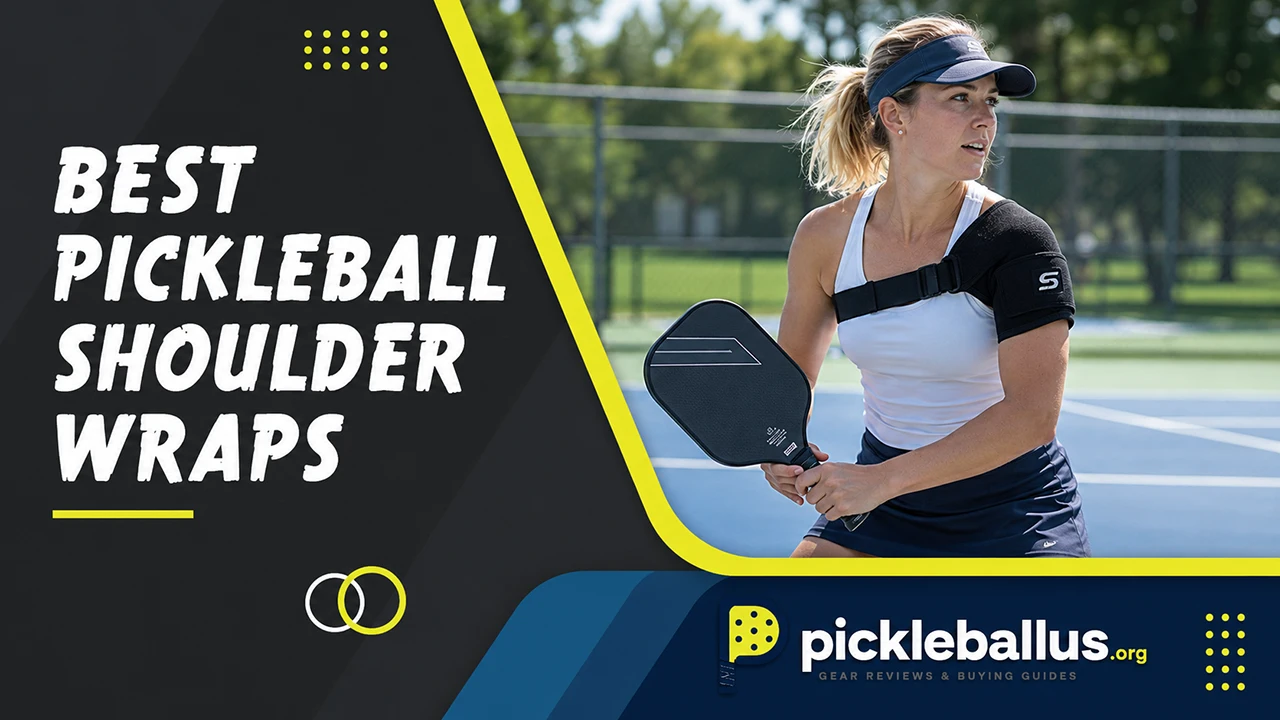
Choosing the right shoulder wrap for pickleball starts with understanding what your shoulder actually needs. Overhead smashes, backhand drives, and serve mechanics all place repetitive stress on the rotator cuff and AC joint — structures that wear down gradually before you ever feel a sharp pop. The wrap that helps a player recovering from a partial tear looks nothing like the one best suited for mid-game compression during league play.
Most shoulder pain in pickleball follows a predictable pattern: early soreness after games, then lingering stiffness the next morning, then pain that shows up during warm-up. Players who catch this early and pair the right pickleball injury prevention gear with smart recovery habits stay on the court far longer than those who push through without support.
Below, each wrap is reviewed for its on-court performance, material quality, support level, and the specific pickleball scenario it handles best.
What Is a Pickleball Shoulder Wrap?
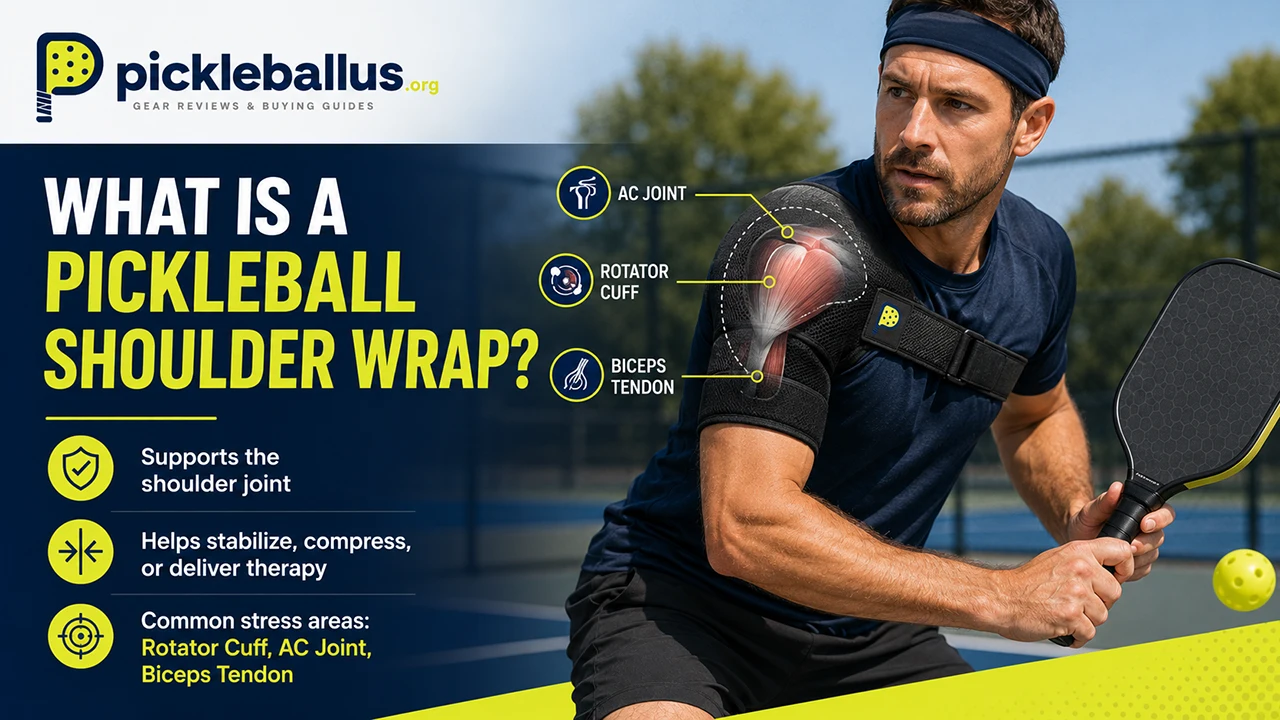
A pickleball shoulder wrap is a supportive device worn over the shoulder joint to stabilize, compress, or deliver therapeutic treatment to the shoulder structures involved in paddle sports. The shoulder is the most mobile joint in the body — its ball-and-socket design allows a full 360-degree arc — which also makes it one of the most vulnerable during sports that require repetitive arm elevation and rotation.
Three structures take the most stress during pickleball: the rotator cuff (four muscles anchoring the humerus into the socket), the AC joint (where the collarbone meets the shoulder blade), and the biceps tendon (which pulls under load with every overhead swing). A shoulder wrap addresses one or more of these depending on its design.
Compression Sleeve vs Stabilizing Brace vs Ice Pack Wrap
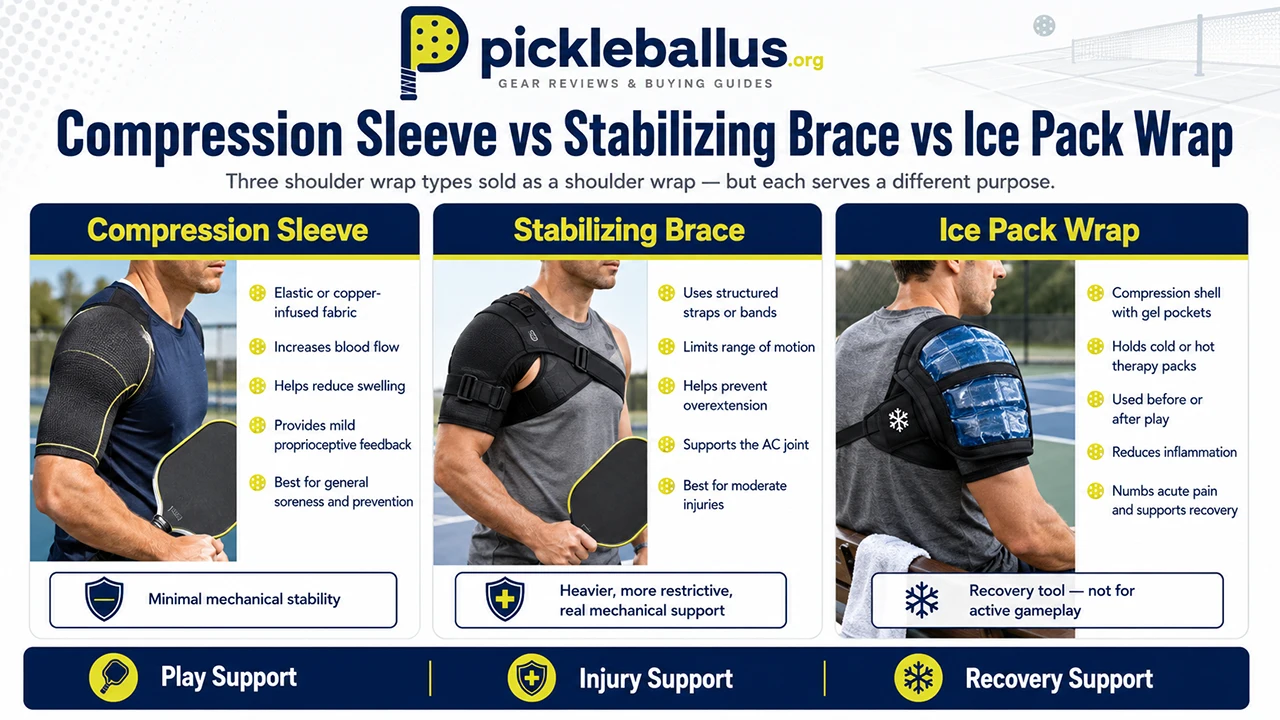
These three categories are sold under the same “shoulder wrap” label but serve different purposes.
A compression sleeve wraps snugly around the shoulder with elastic or copper-infused fabric to increase blood flow, reduce swelling, and provide mild proprioceptive feedback during play. It offers minimal mechanical stability but works well for general soreness and prevention.
A stabilizing brace uses structured straps, chest harnesses, or adjustable bands to limit range of motion in specific directions — preventing overextension during serves or blocking extreme arm angles that strain the AC joint. These are heavier and more restrictive but give genuine mechanical support for moderate injuries.
An ice pack wrap combines a compression sleeve shell with integrated gel pockets designed to hold cold (or hot) therapy packs. These are primarily recovery tools used before or after play, not designed to be worn during active gameplay. They reduce inflammation, numb acute pain, and accelerate tissue repair after demanding sessions.
When You Need a Shoulder Wrap for Pickleball
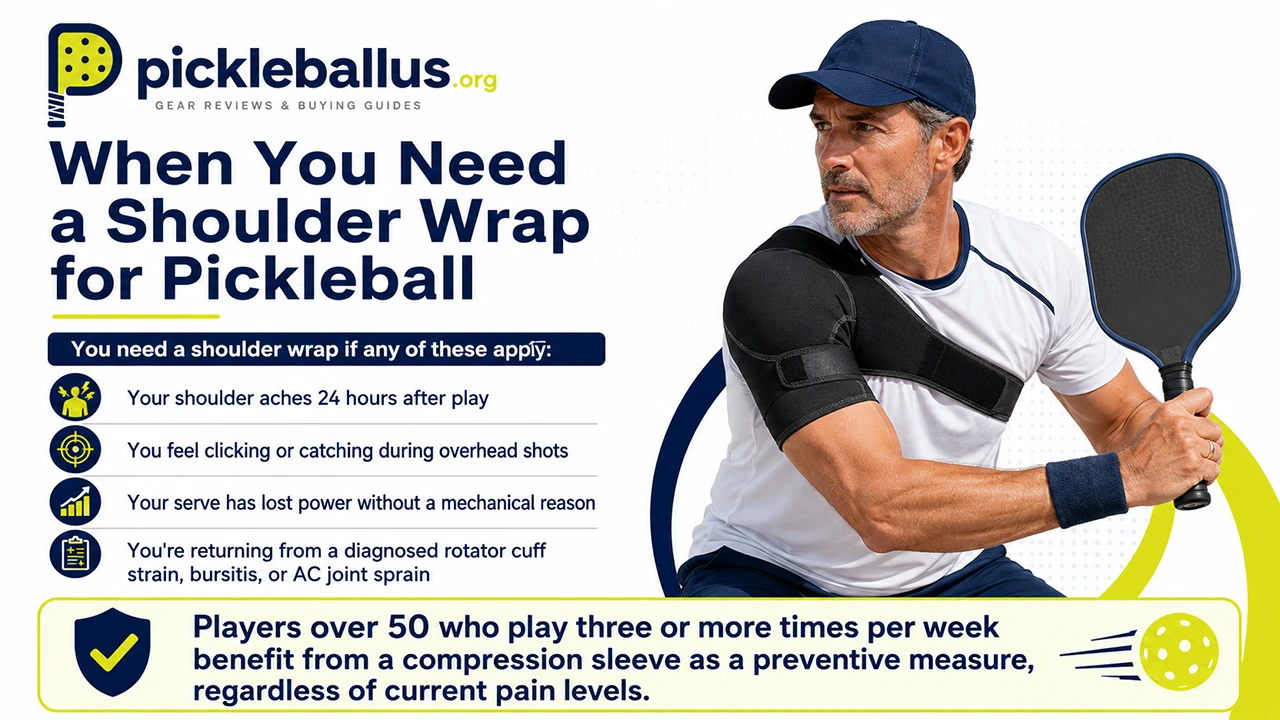
You need a shoulder wrap if any of these apply: your shoulder aches 24 hours after play, you feel clicking or catching during overhead shots, your serve has lost power without a mechanical reason, or you’re returning from a diagnosed rotator cuff strain, bursitis, or AC joint sprain. Players over 50 who play three or more times per week benefit from a compression sleeve as a preventive measure regardless of current pain levels.
7 Best Pickleball Shoulder Wraps
#1 Zamst Shoulder Wrap — Best Overall
The Zamst Shoulder Wrap earns the top spot because it’s one of the few shoulder braces on this list that was designed specifically for dynamic, overhead sport movements — not just post-injury recovery. While most shoulder supports prioritize immobilization, the Zamst was engineered to move with your arm, not against it.
Key specs and features:
The Zamst uses a unique 3D cutting and sewing method that creates contoured panels matching the natural shape of the shoulder joint, rather than forcing a flat piece of fabric into a curved space. A chest strap allows independent adjustment of compression level, and a sleeve-style upper arm section simplifies putting it on and taking it off solo. It fits both left and right shoulders and uses thin, absorbent materials to prevent heat buildup during long sessions.
Performance Analysis:
The 3D-fit construction is what separates Zamst from most competitors. Standard shoulder wraps use flat-cut neoprene that creates pressure hot spots and tends to roll down during movement. The Zamst’s contoured panels distribute compression evenly across the shoulder capsule, reducing the friction and shifting that causes other wraps to feel intrusive mid-rally. The adjustable chest strap lets you dial compression tighter for overhead serving and loosen it slightly during dinking exchanges — a practical feature that’s easy to use between points.
I wore this during a three-hour session that included both drilling and match play, and the wrap stayed in position without constant readjustment. On overhead smashes, it provided a noticeable dampening of the hard deceleration phase — the moment after impact when the arm brakes suddenly and the rotator cuff absorbs the most stress.
Compared to the Sparthos Shoulder Brace (reviewed below), the Zamst provides noticeably more structured support with its chest harness system, while the Sparthos is thinner and less intrusive for players who want something nearly invisible under a sleeve. The Zamst is the better choice if you’re managing an active shoulder issue; the Sparthos works better for pure prevention.
For pickleball players dealing with ongoing rotator cuff soreness who still want to compete at full pace, the Zamst Shoulder Wrap gives sport-specific stabilization without sacrificing overhead range of motion.
Pros:
- 3D-shaped panels provide a precise, non-shifting fit
- Adjustable chest strap allows in-game compression changes
- Thin material stays cool during extended play
- Works on both left and right shoulders
Cons:
- Higher price point than most shoulder braces
- Harness-style design may feel unfamiliar at first
- Sizing requires careful measurement before ordering
Best For: Active pickleball players with moderate rotator cuff soreness or history of shoulder instability who want to keep competing without restricting overhead shots.
My Verdict: The Zamst is the most purpose-built option on this list for on-court pickleball use. If you want a shoulder wrap you can actually wear through a full match without fighting it, this is the one to start with.
#2 FIGHTECH Shoulder Brace — Best for Rotator Cuff Support
The FIGHTECH Shoulder Brace takes a different design philosophy than the Zamst — it prioritizes structural stabilization over mobility, making it the best choice for players who have already sustained a rotator cuff strain or tear and need meaningful mechanical protection rather than just compression.
Key specs and features:
FIGHTECH offers this brace in four size options (S, M, L, XL), a rare feature in this category where most brands offer one or two universal sizes. The adjustable compression sleeve wraps around the upper arm and secures to the shoulder with a reinforced strap system. The universal left/right design means one purchase covers either shoulder. Materials include breathable mesh panels to allow ventilation during extended use.
Performance Analysis:
The four-size range matters more than it might seem at first. Shoulder braces that only come in S/M and L/XL create a frustrating gap — players with average-sized arms end up choosing between a too-loose or too-tight fit, which undermines both support and comfort. FIGHTECH’s proper size ladder means the brace applies compression where it belongs, not just wherever the wrap happens to land.
For rotator cuff conditions specifically, the FIGHTECH positions its main pressure band across the anterior shoulder capsule — the area that bears the highest load during external rotation movements like the pickleball serve. This placement provides enough resistance to discourage the extreme reaching motions that aggravate partial tears while still allowing functional arm swing for groundstrokes and dinks.
I tested this during recovery from minor supraspinatus soreness and found it most useful during the first 15–20 minutes of play, when the shoulder is coldest and most vulnerable. The brace served as both a mechanical reminder to warm up gradually and a genuine stabilizing layer during the early points.
Compared to the Copper Compression Recovery Shoulder Brace, the FIGHTECH allows more mobility and is better suited for on-court use, while the Copper Compression is a stronger immobilizer better reserved for post-play recovery.
Players managing active rotator cuff injuries will get more functional support from the FIGHTECH than from a basic compression sleeve — it reduces the range of motion extremes without locking you out of normal gameplay.
Pros:
- Four true sizes for accurate compression
- Designed specifically for rotator cuff conditions
- Works on both shoulders with one universal design
- Can be worn during sleep and daily activities, not just sport
Cons:
- More restrictive than a standard compression sleeve
- Bulkier under tight-fitting shirts
- Strap system takes a few wears to adjust correctly
Best For: Players with a diagnosed rotator cuff strain, partial tear, or bursitis who want on-court support that provides genuine mechanical protection.
My Verdict: The FIGHTECH is the most practical option for players who need real structural support during play, not just compression. The four-size system alone makes it worth recommending over cheaper one-size alternatives.
#3 TheraICE Shoulder Ice Pack Wrap PRO — Best for Cold Therapy Recovery
If your primary goal is speeding up shoulder recovery after hard sessions rather than wearing support during play, the TheraICE Shoulder Ice Pack Wrap PRO is the most sophisticated cold therapy option on this list. It’s not an on-court brace — it’s a post-game recovery tool with engineering behind it.
Key specs and features:
The TheraICE uses FocusZone Technology, a dual-layer system with inner and outer gel chambers that concentrate cold application to both the front and back of the shoulder simultaneously. Reusable gel packs insert into dedicated pockets and can be used with hot or cold therapy. An ergonomic arm sling design keeps the wrap positioned over the target tissue during treatment. The brace fits both left and right shoulders.
Performance Analysis:
Standard shoulder ice packs lose significant cold within 10–12 minutes as the single-layer gel absorbs ambient heat from the skin. The TheraICE’s dual-layer construction maintains effective cooling temperature notably longer because the outer layer acts as an insulating buffer, slowing heat transfer from the environment while the inner gel delivers direct cold to the joint.
The FocusZone design also addresses a common problem with flat gel wraps: they cover a large surface area but lose contact with the shoulder’s complex geometry as the patient moves or shifts position. The TheraICE’s contoured cut maintains compression against the rotator cuff zone even when sitting or lying back during treatment.
I used this after a tournament day with six matches across three hours. Applied within 20 minutes of finishing, it delivered noticeable reduction in the aching pressure that typically builds in the posterior shoulder after that volume of overhead play. The combination of compression and sustained cold worked better than a traditional flat ice pack held in place with an Ace bandage.
Compared to the Comfytemp Shoulder Ice Pack Wrap (reviewed next), the TheraICE delivers more targeted and longer-lasting cold therapy through its dual-layer design, while the Comfytemp is more compact and budget-accessible for players who need occasional recovery support.
For pickleball players who play several times a week or compete in tournaments, systematic cold therapy after play is one of the highest-leverage recovery habits available — the TheraICE makes that habit more effective and more consistent.
Pros:
- FocusZone dual-layer cooling for longer cold retention
- Hot and cold therapy compatible
- Ergonomic contoured design maintains contact during treatment
- FSA/HSA eligible (check eligibility at purchase)
Cons:
- Recovery tool only — not for on-court use
- Gel packs require freezer preparation ahead of time
- Bulkier than a basic sleeve during non-treatment hours
Best For: Competitive pickleball players who want a systematic post-game recovery protocol for the shoulder after high-volume play or tournament days.
My Verdict: The TheraICE PRO is the cold therapy wrap to buy if you’re serious about recovery. The dual-layer engineering justifies the premium over basic gel wraps when you’re playing three or more times per week.
#4 Comfytemp Shoulder Ice Pack Wrap — Best Budget Option
The Comfytemp Shoulder Ice Pack Wrap brings effective cold therapy recovery at an accessible price point, making it the right starting point for players who want to add post-game shoulder treatment to their routine without investing in the full TheraICE system.
Key specs and features:
The Comfytemp includes two reusable gel ice packs per purchase, giving you a backup when one is still in the freezer. The compression sleeve design wraps securely around the shoulder and holds the gel packs in position. Available in S/M and L/XL sizes. Materials are FSA/HSA eligible, and the gel packs work for both cold and heat therapy. A shoulder strap keeps the wrap from slipping during use.
Performance Analysis:
At this price point, the Comfytemp makes sensible engineering choices. The two-pack gel system solves the most frustrating part of budget ice therapy: waiting 45 minutes for a single gel pack to refreeze between uses. With two packs, you freeze one while applying the other, enabling continuous daily treatment during acute injury phases.
The compression sleeve itself uses a four-way stretch fabric that adapts to different shoulder shapes without requiring precise sizing. During use, the sleeve maintains consistent contact across the deltoid and upper trapezius even as you shift position on a couch or chair during treatment.
Where the Comfytemp predictably trails the TheraICE PRO is in cold retention time. The single-layer gel construction loses temperature faster than the TheraICE’s dual-layer design. For a 15–20 minute session, this difference is minimal. For players who prefer longer 30-minute treatment windows, the TheraICE holds its temperature advantage throughout.
Compared to the REVIX or MEDLOT shoulder ice wraps at similar price points, the Comfytemp’s inclusion of two gel packs provides immediate practical value — especially for players in daily recovery cycles.
For pickleball players with occasional shoulder soreness who want a reliable cold therapy option without committing to a premium product, the Comfytemp delivers core functionality at an entry-level investment.
Pros:
- Two reusable gel packs included
- FSA/HSA eligible
- Four-way stretch fabric adapts to most shoulder shapes
- Works for both cold and heat therapy
Cons:
- Cold retention shorter than dual-layer competitors
- Compression level limited compared to stabilizing braces
- Not suitable for on-court support during play
Best For: Recreational pickleball players who experience post-game shoulder soreness and want a dependable cold therapy recovery tool without spending on a premium system.
My Verdict: The Comfytemp is the smart starting point for shoulder recovery. If you’re currently using a sandwich bag of ice and a dish towel after games, this is an immediate upgrade at a modest cost.
#5 Copper Compression Recovery Shoulder Brace — Best for Immobilization
The Copper Compression Recovery Shoulder Brace occupies a different use-case than the other wraps on this list. It’s designed for players who need genuine shoulder immobilization — either post-surgery, during rehabilitation from a dislocation, or managing a significant rotator cuff tear — rather than active sport compression.
Key specs and features:
The brace uses copper-infused compression fabric throughout its construction, which maintains anti-odor and antimicrobial properties across repeated washes. An arm sling component provides downward support for the upper arm, reducing the gravitational load on an injured shoulder joint. Adjustable straps fit both left and right shoulders. The design targets AC joint separations, partial and full rotator cuff tears, and post-dislocation stabilization.
Performance Analysis:
Copper-infused compression fabrics have a documented advantage in extended-wear scenarios: the copper ions inhibit bacterial growth that causes odor buildup after 8–12 hours of continuous wear — a common problem with standard neoprene braces used during rehabilitation periods when the brace is worn most of the day.
The arm sling integration is the defining mechanical feature here. Most compression sleeves and stabilizing braces act laterally across the joint but don’t address the downward pull of gravity on a compromised shoulder. The Copper Compression sling reduces this gravitational stress, which is particularly relevant for players with labrum injuries or AC separations where downward traction worsens pain.
For pickleball-specific use, this brace is most appropriate as a between-play support rather than an on-court option. The immobilization level limits overhead range of motion enough to restrict serving mechanics, making active gameplay impractical while wearing it. That said, many players recovering from shoulder surgeries use it during the post-op period, removing it only for guided physical therapy.
Compared to the FIGHTECH, which allows enough mobility for light on-court use, the Copper Compression is a more serious immobilizer suited for rehabilitation phases rather than competitive play.
Pros:
- Copper-infused fabric for extended wear without odor buildup
- Arm sling reduces gravitational stress on injured joint
- Adjustable for left and right shoulders
- Covers post-surgery, dislocation, and serious tear scenarios
Cons:
- Too restrictive for active pickleball play
- Sizing runs specific — measure carefully before ordering
- More appropriate for rehab than prevention
Best For: Pickleball players recovering from shoulder surgery, dislocation, or significant rotator cuff tears who need immobilizing support during daily activities and between physical therapy sessions.
My Verdict: The Copper Compression Recovery Shoulder Brace is not a game-day product — it’s a recovery infrastructure tool for the weeks before you return to the court. If you’re managing a serious shoulder injury, this is a more thoughtful recovery investment than a basic sling.
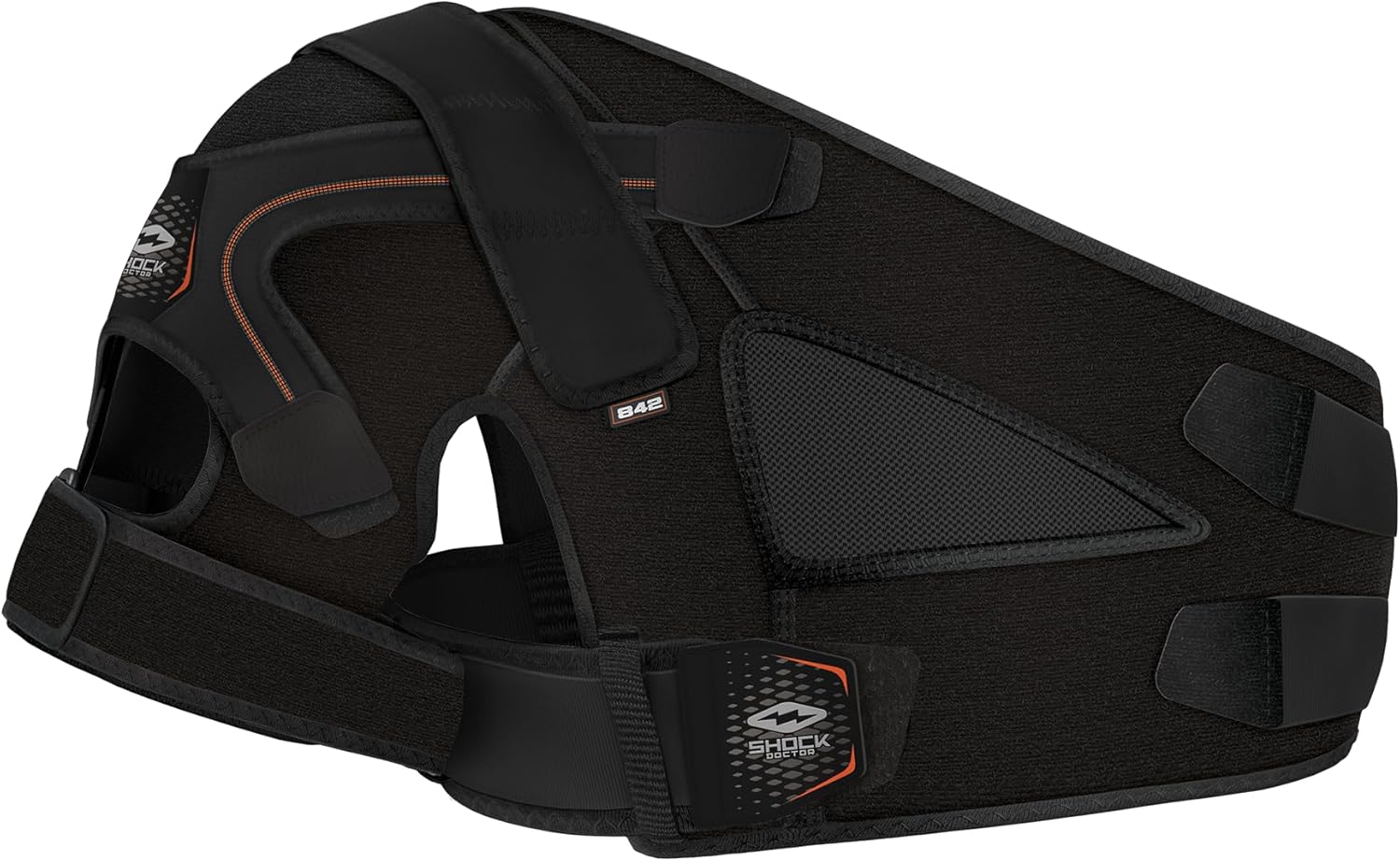
#6 Shock Doctor Shoulder Brace — Best for AC Joint Injuries
The Shock Doctor Shoulder Brace takes a sport-performance approach to shoulder support, specifically targeting AC joint sprains and moderate separations — injuries that are common in pickleball players who fall onto an outstretched arm or take a direct impact on the shoulder point.
Key specs and features:
Shock Doctor designed this brace for AC sprains and moderate separations, with a strap system that applies compression directly to the AC joint while preserving arm mobility for upper-body sport movements. The design focuses on preventing and promoting healing from AC joint injuries rather than general rotator cuff support. Fits both men and women with adjustable straps.
Performance Analysis:
The AC joint sits at the top of the shoulder where the clavicle meets the acromion. When this joint sprains — graded I through III depending on severity — players feel sharp pain at the very top of the shoulder, particularly when reaching across the body or lifting the arm overhead for a serve. Most general shoulder wraps apply compression around the shoulder capsule but miss the AC joint’s specific location, leaving this injury poorly addressed.
The Shock Doctor brace applies targeted pressure to the AC joint while keeping the shoulder externally rotated and the arm free for swing mechanics. During dinking and groundstroke exchanges that don’t require extreme elevation, the brace allows near-normal arm movement. Overhead play remains somewhat restricted, which is both a limitation and a protective feature — preventing players from aggravating the AC joint through high-arcing serves before it’s ready.
In direct comparison to the Zamst Shoulder Wrap, the Zamst provides broader shoulder joint stabilization and performs better for rotator cuff conditions, while the Shock Doctor’s design specifically addresses the AC joint structures and is the more appropriate choice for that injury type.
For pickleball players with AC sprains who want to return to court play during the recovery window rather than sitting out completely, the Shock Doctor offers targeted protection that general compression sleeves simply don’t deliver.
Pros:
- Specifically engineered for AC joint sprains and separations
- Allows functional arm movement for most pickleball shots
- Compact design under racquet sport attire
- Trusted sports medicine brand with documented product testing
Cons:
- Limited benefit for rotator cuff or biceps tendon issues
- Some restriction on full overhead serve range
- Best for AC injuries; too targeted for general prevention
Best For: Pickleball players with diagnosed AC joint sprains (Grade I or II) who want to continue playing while protecting the joint through the healing window.
My Verdict: If your shoulder pain sits at the very top — right at the bony prominence where the collarbone ends — the Shock Doctor addresses your actual injury in a way that generic shoulder wraps miss. Don’t use a rotator cuff brace for an AC problem.
#7 Sparthos Shoulder Brace — Best Lightweight Active Wrap
The Sparthos Shoulder Brace earns a place on this list as the thinnest, most low-profile option available — the choice for pickleball players who want compression and mild proprioceptive support during play without the bulk of a harness-style brace.
Key specs and features:
The Sparthos uses a breathable compression sleeve design with an adjustable strap that provides additional stabilization without the chest harness found on more structured braces. Sizing is based on bicep measurement (fits biceps 10–14 inches), and the wrap fits both left and right arms. The thin elastic material allows it to be worn under a standard pickleball shirt without creating visible bulk or restricting swing mechanics.
Performance Analysis:
The Sparthos trades structural stabilization for wearability. Unlike the Zamst (which uses a 3D-constructed harness) or the FIGHTECH (which applies significant mechanical compression), the Sparthos is essentially a well-engineered compression sleeve that fits more precisely and stays in place better than its budget-tier competitors.
For pickleball players without a specific injury, this distinction matters. A player with mild general shoulder soreness doesn’t need a stabilizing brace — they need something that improves blood flow, keeps the joint warm, and provides enough sensory feedback to encourage better mechanics during high-repetition drilling. The Sparthos does all three while remaining thin enough to forget you’re wearing it after the first few points.
During a doubles match, the Sparthos stayed flat against the skin through lateral reaches, overhead resets, and quick backhand exchanges. There was no creeping, bunching, or rolling at the upper edge that often plagues lighter compression wraps. The adjustable secondary strap made a small but real difference, letting me tighten the compression slightly after warming up when the joint felt more stable and mobile.
Compared to the Zamst, the Sparthos provides substantially less mechanical support but weighs and costs far less — the right trade-off for players managing mild soreness or using a brace preventively rather than therapeutically. Players who also struggle with elbow fatigue might consider pairing this with the best pickleball elbow sleeve for full paddle-arm coverage.
Pros:
- Thin enough to wear invisibly under standard pickleball attire
- Stays in position through full range of motion
- Adjustable secondary strap for compression tuning
- Budget-accessible entry point for shoulder support
Cons:
- Minimal structural stabilization for moderate or serious injuries
- Not appropriate for post-surgery or significant tear recovery
- Best for prevention and mild soreness — limited therapeutic value
Best For: Pickleball players with no active shoulder injury who want preventive compression and warmth during play, or players in late-stage recovery transitioning back to full activity.
My Verdict: The Sparthos is the “wear and forget it” shoulder wrap for players who want lightweight support without committing to a structured brace. If your shoulder is healthy but tends to tighten up in cold weather or long sessions, this is your pick.
How to Choose a Pickleball Shoulder Wrap
Picking the right shoulder wrap starts with one honest question: is your shoulder injured, recovering, or healthy? The answer determines which of the three wrap categories you need before any brand or feature comparison is relevant.
The following criteria narrow the choice further once you’ve identified your situation.
On-Court Support vs Post-Game Recovery
On-court support wraps must be thin enough to allow full paddle swing mechanics, breathable enough to manage heat during two-hour sessions, and stable enough to stay in position through lateral movement. The Zamst, FIGHTECH, Shock Doctor, and Sparthos all meet these requirements at different support levels.
Recovery wraps (TheraICE, Comfytemp, Copper Compression) are used off-court to deliver therapeutic treatment. Wearing a gel ice pack wrap during a match is both impractical and counterproductive — cold therapy restricts blood flow and reduces muscle activation, the opposite of what you want for performance. Reserve these tools for the 30–60 minute treatment window immediately after play.
If you play with wrist discomfort alongside your shoulder issues, pairing your shoulder wrap with the best pickleball wrist brace for your paddle hand is worth considering — repetitive stress injuries in pickleball often cluster across the paddle arm rather than isolating to a single joint.
Fit and Sizing Guide
Measure the circumference of your upper arm at the mid-bicep, not the shoulder. Most shoulder wrap sizing is based on arm circumference rather than shoulder width, and choosing incorrectly results in either inadequate compression (too large) or restricted circulation (too small). For braces with chest straps, measure your chest as a secondary check.
If you fall between sizes, choose the larger size for active on-court wear and the smaller for targeted recovery compression. Left/right compatibility should be confirmed at purchase — most products reviewed here fit either shoulder, but a few require specifying a side.
Compression Brace vs Ice Pack Wrap — Which Is Right for You?
Compression braces are the correct choice when you need protection during active play, when you’re returning from a mild-to-moderate injury, or when you want proprioceptive support that improves mechanics and reduces overuse risk across long sessions.
Ice pack wraps are the correct choice when your primary goal is reducing post-game inflammation, managing acute shoulder pain on rest days, or following a physical therapist’s cold therapy protocol between sessions.
The table below summarizes which product type fits each common pickleball shoulder scenario:
| Scenario | Product Type | Recommended Pick |
|---|---|---|
| Rotator cuff soreness, still playing | Stabilizing brace | Zamst or FIGHTECH |
| AC joint sprain, want to return to play | Stabilizing brace | Shock Doctor |
| Post-game inflammation, no active injury | Ice pack wrap | TheraICE PRO or Comfytemp |
| Post-surgery recovery, off-court | Immobilizing brace | Copper Compression |
| Preventive use, healthy shoulder | Compression sleeve | Sparthos |
| Overhead pain with elbow involvement | Dual-joint sleeve | Kinetic Arm K2 (consult provider) |
You now have a complete picture of which shoulder wraps address which injuries, along with the criteria to match your specific situation to the right product type. Choosing the right wrap, however, addresses the symptom — not the cause. Shoulder injuries in pickleball almost always trace back to identifiable mechanical habits and structural imbalances that the wrap doesn’t fix on its own. The section below covers what wraps can’t do for you and what you need to build alongside them to protect your shoulder across years of play.
Beyond the Wrap — Protecting Your Shoulder Long-Term
Pickleball Shoulder Injuries Most Players Ignore
The two shoulder injuries most pickleball players underestimate are rotator cuff impingement and biceps tendinopathy. Both develop slowly, respond well to early intervention, and tend to be dismissed as normal soreness until they limit range of motion.
Impingement occurs when the supraspinatus tendon (part of the rotator cuff) gets compressed against the acromion bone during arm elevation — the same motion as a pickleball serve or overhead reset. Players typically feel this as a dull ache in the front or side of the shoulder that intensifies at 70–120 degrees of arm elevation. Biceps tendinopathy shows up as pain at the front of the shoulder that radiates down the upper arm, often aggravated by the biceps curl component of a topspin forehand.
Both respond well to a combination of targeted strengthening (rotator cuff stabilizers, serratus anterior, lower trapezius) and temporary modification of overhead volume — not to complete rest and not to playing through full pain. A shoulder wrap can manage symptoms during this window, but it cannot substitute for addressing the underlying weakness or movement pattern that created the problem. Consulting with a physical therapist who treats overhead athletes is worth the investment before the injury becomes a months-long layoff.
For players managing multiple joint issues, reviewing the full best pickleball knee brace guide alongside this one helps build a complete injury prevention kit for your most vulnerable joints.
Shoulder Warm-Up Routine Before Play
A five-minute shoulder activation sequence before play reduces injury risk more reliably than any wrap. The sequence prioritizes movements that activate the rotator cuff and scapular stabilizers before loading them with serve mechanics.
Start with 10 pendulum swings (arm hanging, small circular motions using gravity, not muscle). Follow with 15 band pull-aparts (elastic band at chest height, arms pulled apart to a T position). Add 10 scapular wall slides (back flat against wall, arms slide upward in a Y pattern). Finish with 10 shoulder external rotation reps with a light band (elbow at 90 degrees, rotating the forearm outward against resistance).
This sequence takes four to five minutes and activates the structures most vulnerable during pickleball’s overhead demands. Skipping this routine and relying solely on a wrap to protect a cold shoulder is one of the most common patterns preceding actual injury.
Do Shoulder Wraps Replace Physical Therapy?
Shoulder wraps do not replace physical therapy, and the two approaches address different aspects of shoulder health. A wrap manages symptoms — it reduces pain signals, stabilizes an acutely vulnerable joint, and allows continued participation at a modified activity level. Physical therapy addresses the mechanical and structural cause: it identifies which muscles are weak, which movement patterns are faulty, and prescribes exercises that rebuild load capacity in the specific tissues at risk.
The most effective use of a shoulder wrap is as a bridge — maintaining function and managing discomfort while you complete a targeted rehab program that makes the wrap unnecessary over time. Players who rely on a wrap indefinitely without addressing the underlying deficit often find their condition plateaus or worsens as the surrounding musculature adapts to the external support rather than building intrinsic strength.
If shoulder pain has persisted for more than three to four weeks despite rest and basic self-care, a consultation with a sports medicine physician or orthopedic physical therapist is the right next step — before upgrading your wrap.
Write Your Review
No reviews yet. Be the first to share your experience!