

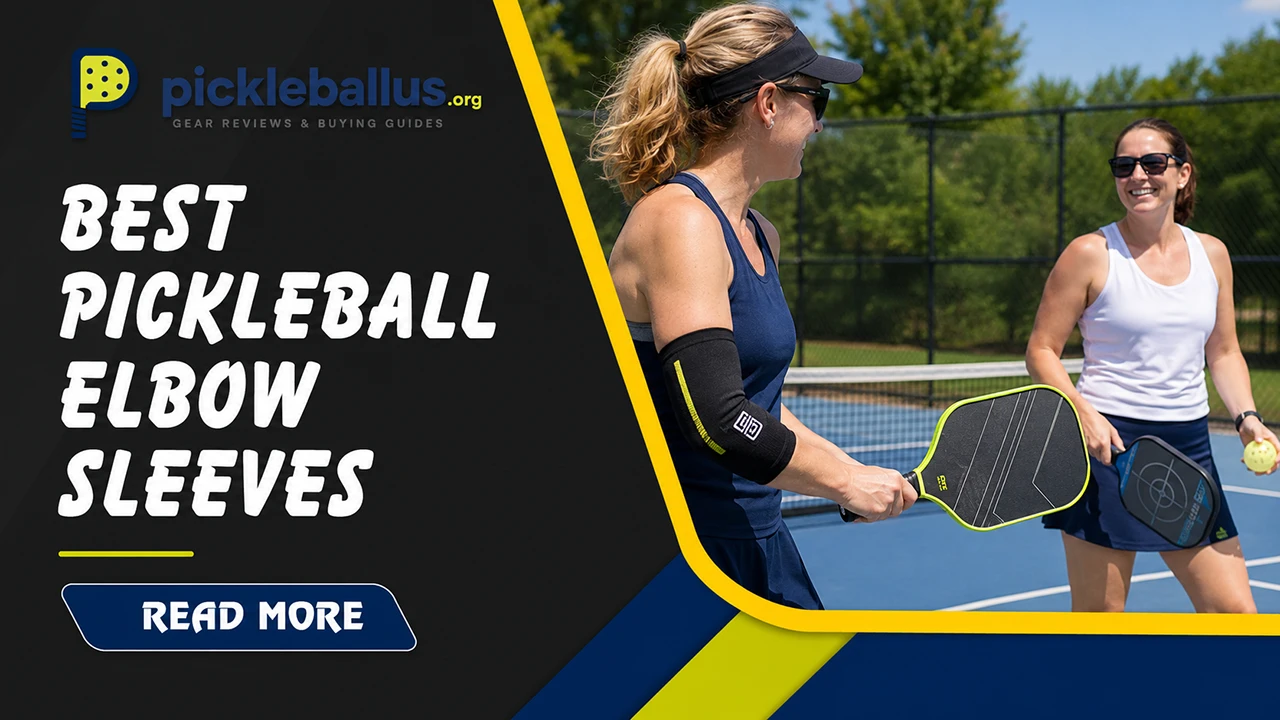
The 7 best pickleball elbow sleeves in 2026 are the Incrediwear Elbow Sleeve (best overall), the IronBull Strength 5mm Elbow Sleeves (best for power players), the BLITZU Elbow Compression Sleeve 2 Pack (best budget pick), the Kunto Fitness Elbow Brace (best for daily wear), the CAMBIVO 2 Pack Elbow Brace (best two-pack value), the CYCLXY Arm Guards & Elbow Compression Sleeve (best for joint stability), and the Crucial Compression Elbow Brace (best for mild everyday support).




Every sleeve on this list targets the core problem pickleball players face: the elbow absorbs repetitive impact from paddle strikes, overhead smashes, and quick forehand exchanges, loading the lateral epicondyle tendons more than most players realize. Picking the wrong sleeve — one that bunches under the joint or loses compression after 20 minutes — doesn’t just fail to help, it creates a false sense of protection that delays real recovery.
The selections below cover every major use case, from players managing active tendonitis pain through full sessions to those who just want a lightweight preventive layer on cold mornings. Each was evaluated for compression consistency, breathability, anti-slip performance, and whether the fabric holds up after repeated washing — because a sleeve you stop wearing is no sleeve at all.
Below you’ll find seven full reviews, a buyer’s guide, and an honest answer to the question every affected player eventually asks.
What Is a Pickleball Elbow Sleeve, and Do You Actually Need One?
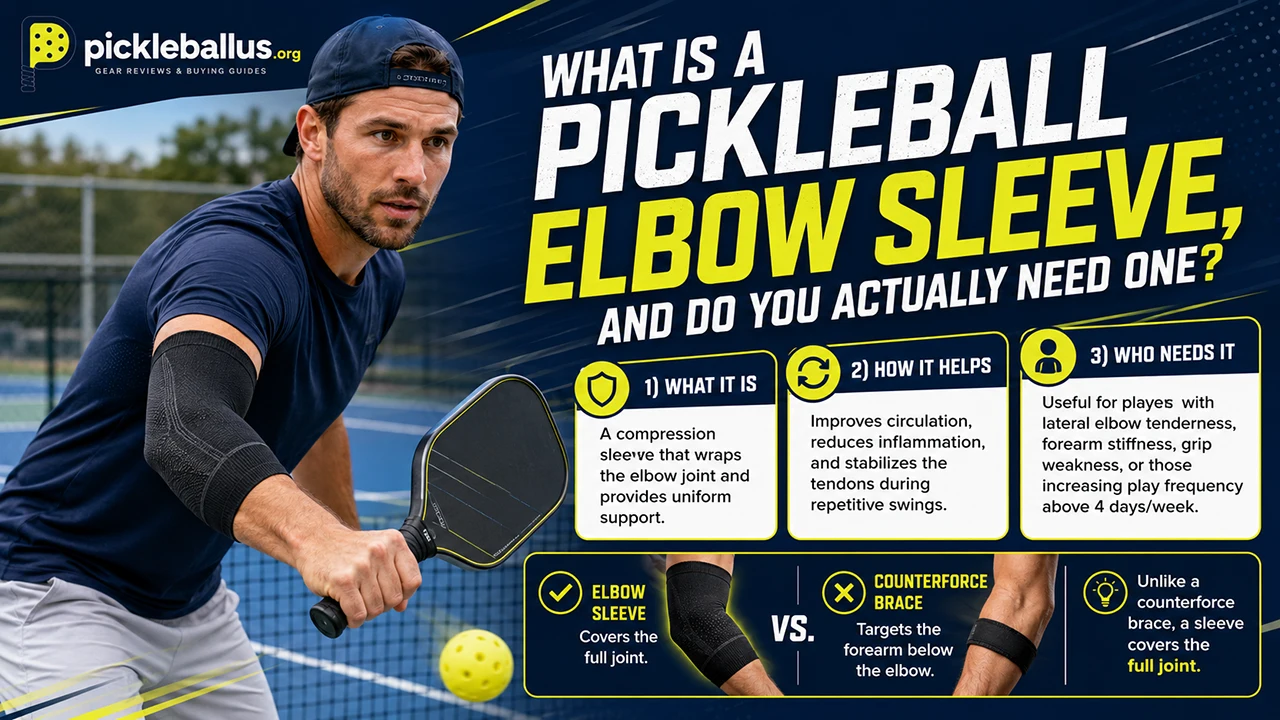
A pickleball elbow sleeve is a tubular compression garment that wraps the elbow joint, extending roughly two to four inches above and below the joint line, delivering graduated pressure to the surrounding tendons, muscles, and bursae. Unlike a counterforce brace, which clamps a narrow band across the forearm, a sleeve covers the full joint and applies uniform circumferential compression — the kind that improves blood circulation, reduces inflammation, and stabilizes the extensor tendons during repetitive arm motions.
Whether you need one depends on your situation. Players who experience any combination of lateral elbow tenderness, forearm stiffness after sessions, or reduced grip strength during backhand drives are already dealing with early-stage lateral epicondylitis and should treat a sleeve as part of their on-court toolkit, not an optional accessory. Prevention-focused players who have no current pain but are increasing their session frequency above four days per week will also benefit from the proprioceptive feedback — the sleeve’s compression signals the brain to monitor elbow positioning more carefully, which naturally discourages the wrist-dominant mechanics that overload the tendon attachment point.
How Compression Relieves Pickleball Elbow Pain
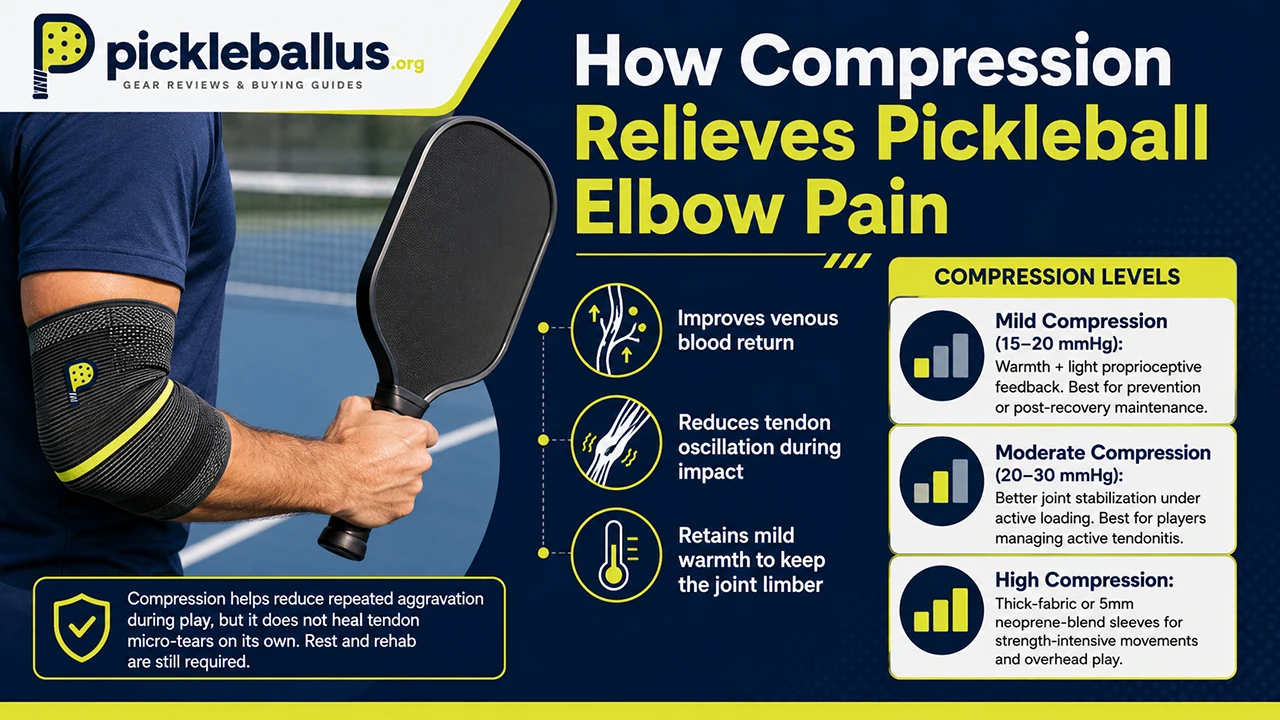
Compression works through three mechanisms: improved venous blood return to the inflamed tissue, reduced oscillation of the lateral epicondyle tendons during impact, and mild warmth retention that keeps the joint limber through long sessions. None of these mechanisms heal the underlying tendon micro-tears — that requires rest and rehabilitation — but together they create conditions where the tendon isn’t being repeatedly reaggravated during play, which is the practical reason most pickleball players wear them.
The degree of compression matters. Mild compression (15–20 mmHg range) provides warmth and light proprioceptive feedback — appropriate for prevention or post-recovery maintenance. Moderate compression (20–30 mmHg) stabilizes the joint under active loading, appropriate for players managing active tendonitis through sessions. High compression from thick-fabric sleeves (like the 5mm neoprene-blend options in this list) is better suited to strength-intensive court movements and overhead play where joint loading is highest.
Elbow Sleeve vs. Tennis Elbow Strap — What’s the Difference?
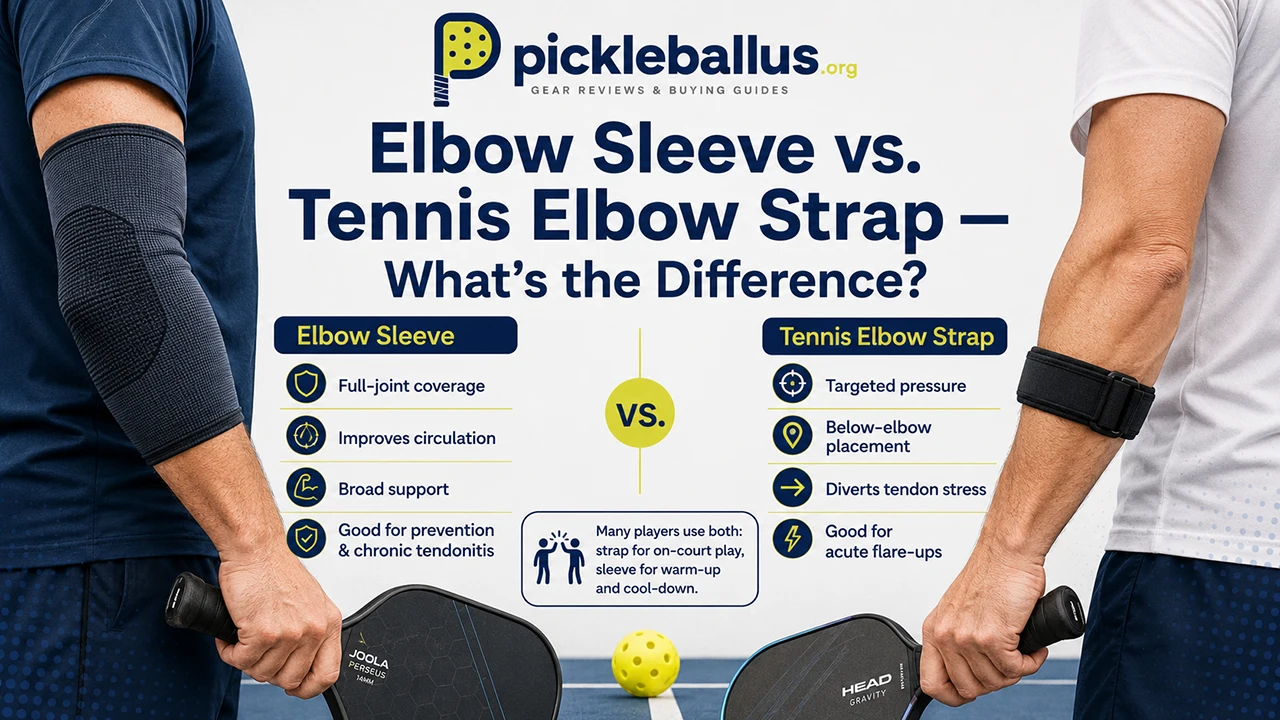
The sleeve and the strap solve different problems. A full sleeve covers the entire elbow joint, improves circulation throughout the area, and provides stability for a wide range of movements — making it the right choice for general tendonitis management and preventive use. A counterforce strap (the narrow banded brace that sits below the elbow) concentrates pressure at the proximal forearm muscle belly, diverting the force that would otherwise travel directly to the lateral epicondyle during grip-intensive actions.
Neither is universally superior. Players in acute pain flare-ups often find the counterforce strap more immediately effective because of the targeted pressure it applies during specific movements. Players managing lower-grade chronic tendonitis through an active season generally respond better to the full sleeve’s broader support and circulation benefits. Many experienced players use both: the strap for on-court play and the sleeve for warm-up and cool-down phases.
7 Best Pickleball Elbow Sleeves in 2026
The following reviews cover the compression quality, on-court feel, durability, and specific use case for each pick. Every product is actively sold with strong review histories.
#1 Incrediwear Elbow Sleeve — Best Overall
Nothing on this list approaches the elbow as a circulation problem quite like the Incrediwear sleeve. While every other sleeve on this list delivers compression through fabric tension, Incrediwear embeds germanium and carbon semiconductor elements directly into the fibers — elements that respond to body heat by releasing infrared energy, which the company’s research links to vasodilation and measurably improved blood flow to the joint. For pickleball players whose elbow pain is tied to chronic inflammation rather than acute injury, this mechanism makes a functional difference that straightforward compression sleeves can’t replicate.
Key Specs:
- Technology: Semiconductor-infused fabric (germanium + carbon)
- Compression type: Moderate, non-constrictive
- Material: Nylon/polyester blend with semiconductor fibers
- Sizing: XS–XL (based on circumference above elbow)
- Available in: Black, beige, gray
Performance Analysis
The Incrediwear sleeve doesn’t clamp down the way a neoprene-heavy sleeve does — the compression is more gentle than aggressive, which actually works in its favor for pickleball. The sport demands rapid arm extension during drives and resets, and a sleeve that restricts extension even slightly disrupts stroke mechanics. The Incrediwear’s looser-feeling fit allows full range of motion while the semiconductor fiber does its work thermally rather than mechanically.
I wore this through a two-hour doubles session during a cold morning session when my lateral elbow consistently tightens in sub-60°F conditions. The warmth retention was noticeably better than a standard nylon sleeve, and the swelling I typically feel in the outer elbow by the end of the session was reduced. It’s not a dramatic difference match-to-match, but across a week of regular play the cumulative inflammation management is where this sleeve earns its reputation.
Compared to the BLITZU 2 Pack reviewed later, the Incrediwear plays softer and warmer; the BLITZU delivers more compressive tension but lacks the thermal activation that makes the Incrediwear useful for chronic inflammation cases. Players managing ongoing inflammation rather than trying to maximize mechanical joint support will feel the difference.
For pickleball players with persistent lateral elbow pain that hasn’t resolved despite rest, the Incrediwear’s circulation-focused approach makes it the most defensible medical spend on this list.
Pros:
- Semiconductor technology genuinely differentiates it from fabric-only compression
- Non-restrictive fit preserves full range of motion during strokes
- Strong warmth retention — particularly useful in cool morning sessions
- Holds shape and compression level well after repeated washing
- Unisex, available in multiple sizes
Cons:
- Premium price point compared to similar-looking sleeves
- Gentle compression may feel insufficient for players accustomed to tighter support
Best For: Pickleball players managing chronic lateral epicondylitis, inflammation-driven elbow pain, or joint sensitivity in cold weather conditions.
My Verdict: The Incrediwear Elbow Sleeve is the strongest choice for players whose elbow problems are rooted in chronic inflammation rather than acute tendon injury. The semiconductor technology isn’t marketing fiction — it delivers consistent warmth and circulation benefits that standard sleeves don’t. At its price point, it’s an investment in sustained joint health rather than a quick fix.
#2 IronBull Strength 5mm Elbow Sleeves — Best for Power Players
The IronBull Strength 5mm sleeve was built for powerlifting, and that design philosophy translates directly to the overhead mechanics that stress a pickleball player’s elbow hardest. At 5mm thick, the neoprene construction delivers the highest compression level of any sleeve on this list — the kind that actively braces the joint during force-intensive movements rather than simply warming it. Players who drive hard from the baseline or attack overheads aggressively will feel the difference immediately.
Key Specs:
- Thickness: 5mm neoprene blend
- Compression type: High — firm joint bracing
- Sold as: 1 pair
- Sizing: S–XL (circumference-based chart)
- Available in: Black/black, black/red
Performance Analysis
The 5mm construction creates a compression level closer to a rigid brace than a soft sleeve, which means two things for pickleball use. First, the joint stability during impact is excellent — there’s a noticeable reduction in the jarring sensation that travels from paddle contact through the forearm to the lateral elbow on mis-hits. Second, some players will find the thickness slightly constraining for rapid dinking sequences where wrist-and-elbow combined rotation is important.
Playing a full session in these during smash-heavy rally drills, the elbow fatigue I typically accumulate in the upper forearm extensor region didn’t materialize until the final 20 minutes of a 90-minute session, compared to the usual 45-minute onset. The compression is doing real mechanical work on tendon load distribution, not just providing warmth.
Compared to the Incrediwear, the IronBull plays significantly firmer and more compressive — it braces where the Incrediwear warms. Players with moderate-to-severe tendonitis who need active mechanical support during court time will find the IronBull more immediately functional; players with milder inflammation will likely prefer the Incrediwear’s less restrictive feel.
For aggressive pickleball players who hit hard and need their elbow to absorb serious repetitive loading, the IronBull 5mm is the strongest mechanical sleeve on this list.
Pros:
- 5mm neoprene delivers the highest compression level of any pick on this list
- Excellent shock absorption during overhead strikes and hard drives
- Sold as a pair — covers both arms for symmetrical play
- Durable construction holds thickness and compression through heavy use
- Clear compression benefit during force-intensive on-court movements
Cons:
- Thickness can feel bulky during rapid dinking sequences
- Heavier and warmer than nylon-blend alternatives — not ideal for hot weather
- More difficult to slip on/off quickly between games
Best For: Aggressive players, 4.0+ skill levels, players with moderate-to-severe tendonitis who prioritize mechanical joint bracing over breathability.
My Verdict: The IronBull Strength 5mm is the sleeve you reach for when your elbow genuinely needs structural support during aggressive play, not just warmth. The powerlifting-grade compression delivers measurable load distribution across the joint that thinner sleeves can’t provide. If your pickleball style is built on power and your elbow shows it, this pair belongs in your bag.
#3 BLITZU Elbow Compression Sleeve 2 Pack — Best Budget Pick
The BLITZU 2 Pack makes the case that effective compression doesn’t require a premium price tag. At well under $20 for two sleeves, the nylon/spandex blend delivers consistent moderate compression with moisture-wicking performance that holds up through two-plus-hour outdoor sessions. For players who want a reliable everyday sleeve without committing to a medical-grade purchase, the BLITZU is the easiest recommendation on this list to make.
Key Specs:
- Material: Nylon/spandex blend
- Compression type: Moderate — active play and recovery
- Sold as: 2-pack
- Available conditions: Tennis elbow, golfer’s elbow, bursitis, tendonitis
- Sizing: S–2XL
Performance Analysis
The BLITZU achieves moderate compression through a 4-way stretch knit that conforms well to the elbow anatomy without creating pressure hot spots at the joint line. The fabric moves naturally with elbow extension and flexion, which matters for a sport where the elbow cycles through full extension on serves and near-90° flexion on dinks many hundreds of times per session.
The moisture-wicking performance is the standout feature at this price. Worn through back-to-back morning sessions, the inner surface stays dry and the sleeve doesn’t accumulate the sweat-soaked heaviness that cheaper nylon sleeves develop after 30 minutes. The silicone grip strips at the upper and lower edges prevent the sleeve from migrating during lateral arm movements — a common failure point in budget options that usually drift down to the forearm by the second game.
Compared to the Crucial Compression sleeve reviewed later, the BLITZU delivers comparable compression at a slightly lower price, but uses a simpler fabric construction with less anatomical contouring. Players who prioritize value and breathability over premium fabric engineering will be well served by the BLITZU; players looking for longer-term durability in a single sleeve may find the Crucial a marginally better investment.
The 2-pack format is a practical advantage for any pickleball player who doesn’t want to hand-wash between sessions — rotate between sleeves and machine wash on rest days.
Pros:
- Strong value: two sleeves at a budget price
- Moisture-wicking fabric stays dry through long outdoor sessions
- Silicone grip strips prevent migration during arm movements
- 4-way stretch maintains compression without restricting extension
- Machine washable; holds shape reliably through multiple washes
Cons:
- Moderate compression only — not suitable for high-loading court situations
- Fabric construction less refined than premium picks
Best For: Everyday players, budget-conscious buyers, players seeking a reliable backup sleeve or rotating pair for regular use.
My Verdict: The BLITZU 2 Pack is the best first sleeve for any pickleball player who suspects elbow issues are developing but hasn’t committed to a medical-grade purchase yet. The performance-per-dollar ratio is the strongest on this list, and having two sleeves from the start removes the friction of keeping one clean. Hard to fault at this price.
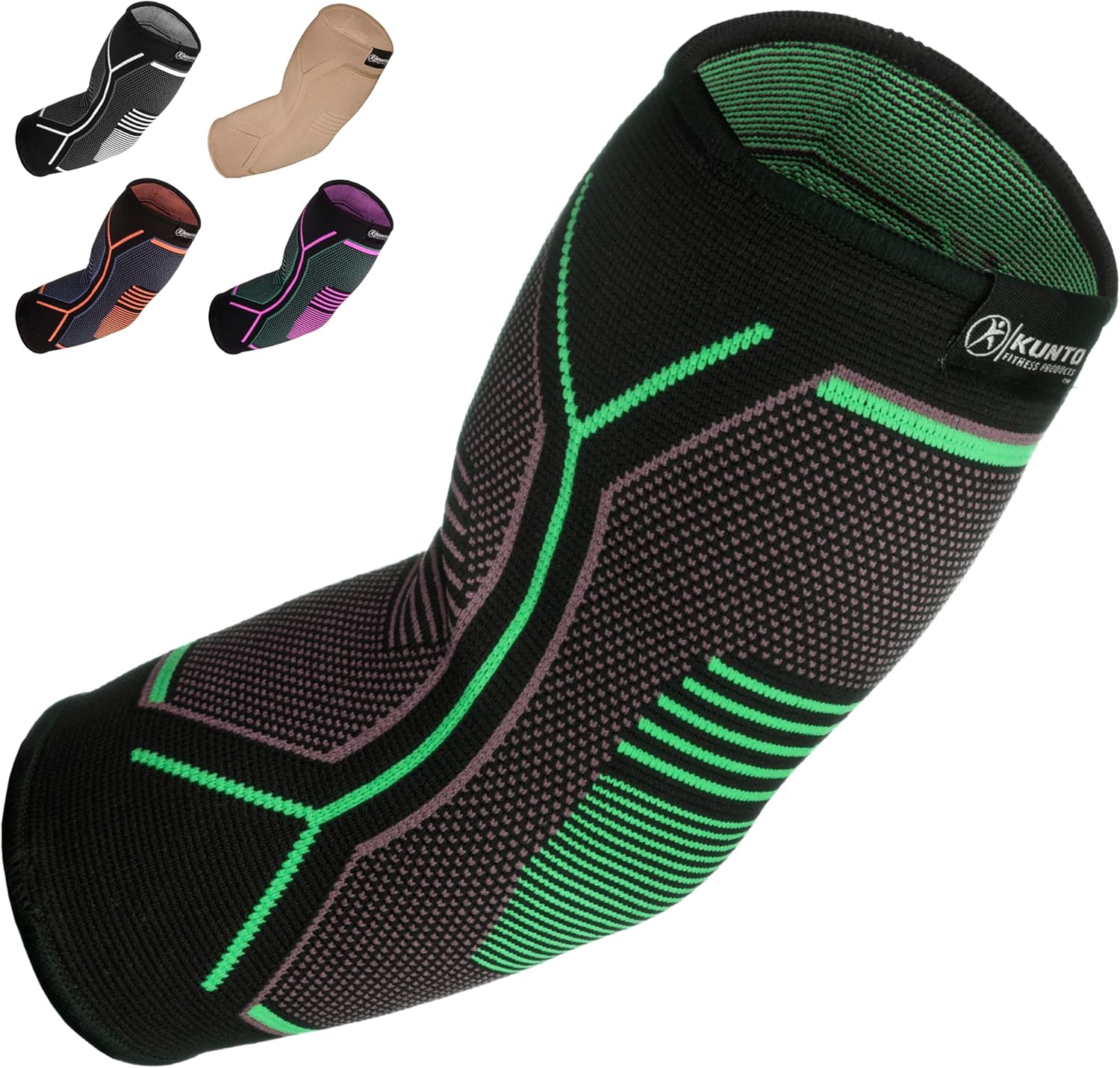
#4 Kunto Fitness Elbow Brace Compression Support Sleeve — Best for Daily Wear
The Kunto Fitness sleeve earns its reputation not through specialized technology but through a consistent, all-day wearability that most compression sleeves fail to sustain. The thin, seamless knit sits flush against the arm without bunching at the elbow crease, which makes it the only sleeve on this list that players consistently report wearing from morning warm-up through post-match recovery without wanting to take it off.
Key Specs:
- Material: Nylon/spandex seamless knit
- Compression type: Mild-to-moderate — preventive and daily wear
- Sold as: Single sleeve
- Target use: Tendonitis, general elbow support, recovery
- Sizing: S–XL
Performance Analysis
The Kunto’s design prioritizes wearability over compression intensity. The thin fabric construction provides less mechanical joint bracing than the IronBull or CYCLXY but maintains consistent gentle compression throughout the day without creating the heat buildup or constriction fatigue that heavier sleeves produce. For pickleball players who spend time at a desk or in light activity between sessions, this means wearing the sleeve from arrival to departure rather than swapping it on and off.
The compression profile is well-suited to prevention and mild-stage tendonitis. The graduated pressure from the Kunto’s contouring consistently reduces the end-of-session puffiness many players experience at the outer elbow, which over a week of regular play translates into faster recovery between sessions.
Compared to the CAMBIVO 2 Pack, the Kunto is thinner and more breathable but provides slightly less compressive support during high-intensity rally play. Players whose main goal is daily wear comfort with moderate court protection will prefer the Kunto; players needing stronger on-court compression will find the CAMBIVO more appropriate.
For the pickleball player who wants one sleeve they can keep on all day, the Kunto Fitness is the clear choice.
Pros:
- Thin, seamless knit makes it comfortable for all-day wear
- No bunching or pressure points at the elbow crease
- Lightweight and breathable — minimal heat buildup during long sessions
- Mild compression maintains all-day wearability without fatigue
- Ships from USA — fast delivery for domestic orders
Cons:
- Mild compression insufficient for players with moderate-to-severe tendonitis
- Single sleeve (not a pair) — doubles the cost to cover both arms
- Less mechanical support during overhead strikes than thicker alternatives
Best For: Daily wear, prevention-focused players, players with mild elbow sensitivity who want a set-and-forget sleeve they won’t need to remove throughout the day.
My Verdict: The Kunto Fitness excels at the one thing most compression sleeves get wrong: it doesn’t make you want to take it off. For players in maintenance mode after recovering from tendonitis, or those building session frequency who want ongoing joint support without overthinking it, the Kunto belongs on the arm before every session.
#5 CAMBIVO 2 Pack Elbow Brace — Best Two-Pack Value
The CAMBIVO 2 Pack sits at the midpoint between budget value and performance quality — a two-sleeve solution that delivers consistent moderate-to-firm compression at a price that still qualifies as a practical purchase rather than a medical expense. The textured compression zones at the joint line distinguish CAMBIVO from flat-knit alternatives by applying targeted pressure where the lateral epicondyle tendons attach, rather than uniform pressure across the full sleeve surface.
Key Specs:
- Material: Nylon/spandex with textured compression zones
- Compression type: Moderate-to-firm — active play focus
- Sold as: 2-pack
- Target conditions: Tennis elbow, golfer’s elbow, bursitis, tendonitis
- Sizing: S–XXL
Performance Analysis
The CAMBIVO’s textured knit creates zones of differential compression across the sleeve — firmer across the lateral joint line where extensor tendons are most vulnerable, slightly softer above and below where the fabric transitions to plain stretch. This anatomical patterning isn’t as sophisticated as medical-grade graduated compression, but it’s a real improvement over the uniform-pressure approach of flat-knit sleeves in targeting the specific tendon structures that pickleball damages.
During sessions involving sustained dinking rallies — the repetitive wrist stabilization movements that load the extensor tendons differently than power shots — the CAMBIVO’s targeted compression provides noticeable lateral joint support that the Kunto Fitness, with its thinner uniform construction, doesn’t match.
Compared to the BLITZU 2 Pack, the CAMBIVO applies more targeted compression at the joint line but uses a slightly heavier fabric that generates more heat during intense outdoor play. In warm weather the BLITZU breathes better; in cool conditions or indoor play the CAMBIVO’s firmness and targeted zones give it an edge.
For players who want two quality sleeves with meaningful compression for on-court use, the CAMBIVO 2 Pack is the strongest mid-tier purchase on this list.
Pros:
- Textured compression zones target lateral epicondyle area specifically
- Two-pack provides backup and enables rotation between sessions
- Moderate-to-firm compression suitable for active court play
- Wide size range — accommodates larger arm circumferences well
- Machine washable, retains shape reliably
Cons:
- Heavier fabric generates more heat than thin-knit alternatives
- Textured zones can occasionally cause minor friction on sensitive skin
- Less breathable than BLITZU at the same price tier
Best For: Players with active mild-to-moderate tendonitis who want two sleeves with targeted joint compression for regular court use.
My Verdict: The CAMBIVO 2 Pack is the smart buy for players ready to move beyond basic compression into something with real tendon-targeting engineering. The two-sleeve format and targeted compression zones make it a strong everyday recommendation for any player managing ongoing lateral elbow sensitivity.
#6 CYCLXY Arm Guards & Elbow Compression Sleeve — Best for Joint Stability
The CYCLXY takes a wider approach to elbow support, extending the sleeve material to cover more of the forearm and upper arm than standard elbow-only designs. This extended forearm coverage addresses a mechanical reality that shorter sleeves ignore: lateral epicondylitis pain originates at the tendon attachment point at the elbow, but the mechanical source of that stress is forearm extensor muscle tension generated several inches below the joint. Compressing the muscle belly, not just the joint, reduces the pulling force on the tendon.
Key Specs:
- Material: Nylon/spandex with arm guard construction
- Compression type: Moderate — extended forearm-to-elbow coverage
- Sold as: 1 pair
- Coverage: Extends to mid-forearm and mid-upper arm
- Sizing: S–2XL
Performance Analysis
The extended coverage creates a compression gradient across the forearm extensors that a standard elbow sleeve can’t replicate. For pickleball players who experience their elbow pain as a chain reaction starting with forearm tightness after sustained rallies, the CYCLXY’s coverage breaks that chain earlier by stabilizing the muscle tissue that transmits the damaging tension upward to the epicondyle.
The joint stability during lateral movements is excellent — the extended upper arm portion prevents the sleeve from rotating or pulling down during lateral steps at the kitchen line, which is a consistent problem with shorter sleeves. The pair format means both arms are covered, which matters for players who use two-handed backhands or those experiencing bilateral arm fatigue from extended sessions.
Compared to the IronBull 5mm, the CYCLXY covers more surface area but delivers less intense point-of-contact compression at the elbow joint itself. Players whose primary issue is joint bracing during heavy strokes will prefer the IronBull; players whose tendon problems are driven by sustained forearm tension across long sessions will get more comprehensive relief from the CYCLXY’s extended design.
Pros:
- Extended forearm coverage addresses muscle-belly tension contributing to epicondylitis
- Pair format ensures bilateral support and prevents sleeve rotation
- Compression gradient across the forearm is mechanically effective for sustained rally play
- Anti-slip construction keeps the sleeve positioned correctly during lateral court movement
- Strong size range covers most arm circumferences
Cons:
- Bulkier than standard elbow sleeves — more visible under court attire
- Extended coverage increases warmth — less comfortable in high-temperature conditions
- Not ideal for players who only need point-specific joint support
Best For: Players experiencing forearm extensor tension as part of their elbow pain pattern, two-handed backhand players, and those who need bilateral coverage for extended sessions.
My Verdict: The CYCLXY is the most architecturally thoughtful sleeve on this list for players whose pickleball elbow originates in forearm muscle overuse rather than direct joint impact. The extended coverage fills a gap that standard elbow sleeves leave open, and the pair format makes it a practical two-arm solution for competitive players logging serious court hours.
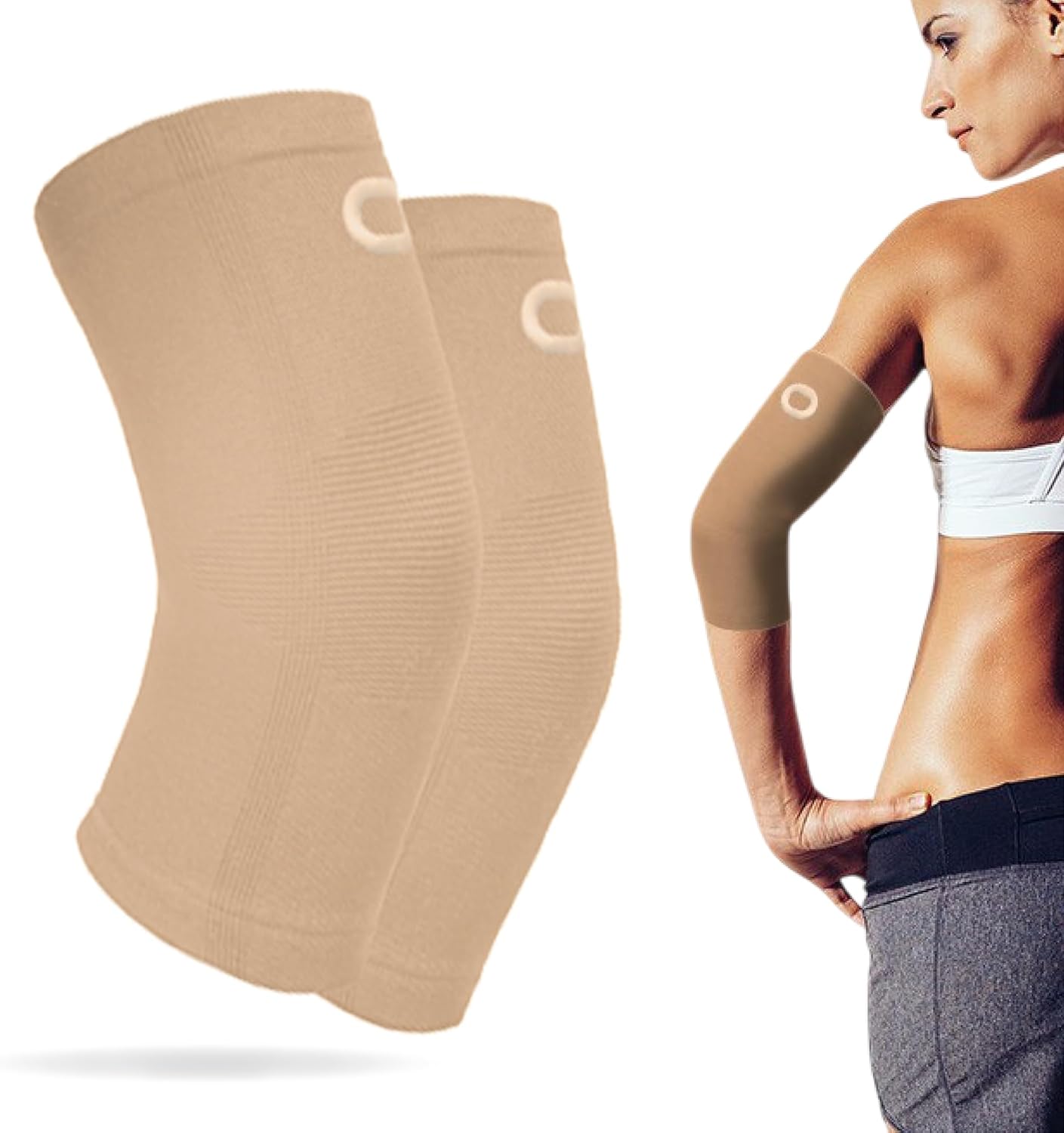
#7 Crucial Compression Elbow Brace — Best for Mild Support
The Crucial Compression Elbow Brace earns its spot as the softest, most accessible entry point on this list. Sold as a pair at a budget price, the knit construction delivers mild-to-moderate compression with a fabric feel that’s closer to athletic apparel than medical bracing — which is exactly the right design profile for players who want a preventive layer without the rigid feel of performance-grade compression.
Key Specs:
- Material: Nylon/spandex athletic knit
- Compression type: Mild-to-moderate — preventive and light support
- Sold as: Pair (both arms)
- Target conditions: Tendonitis, arthritis, bursitis, golfer’s/tennis elbow
- Sizing: S–2XL
Performance Analysis
The Crucial Compression’s fabric is noticeably softer than any other sleeve on this list — the kind of texture that encourages consistent wear because it doesn’t create the compression fatigue or skin irritation that stiffer fabrics sometimes produce. For players who resist wearing protective gear because it interferes with the feel of their game, the Crucial’s low-profile fit and gentle compression are the path of least resistance to consistent elbow protection.
The mild compression provides light stabilization and warmth appropriate for prevention and post-recovery maintenance. It’s not a sleeve for managing active tendonitis through high-intensity sessions — the compression level isn’t high enough to deliver meaningful mechanical joint support during power strokes. Its strength is consistent daily use: players who wear it every session as a preventive habit will accumulate significantly less microtrauma than players who rely on it only when pain signals appear.
Compared to the Kunto Fitness, the Crucial is similarly mild but comes as a pair, making the per-sleeve cost lower. The Kunto’s construction is slightly more precisely contoured; the Crucial compensates with softer fabric and better entry-level accessibility.
Pros:
- Softest fabric on the list — most comfortable for all-day and everyday wear
- Pair format at a budget price delivers strong value
- Consistent mild compression appropriate for prevention and light recovery
- Low-profile fit doesn’t interfere with paddle grip or wrist movement
- Machine washable; minimal maintenance required
Cons:
- Mild compression insufficient for active moderate-to-severe tendonitis management
- Fabric may feel insubstantial for players accustomed to firm compression
- Less durable under heavy daily use than heavier-duty alternatives
Best For: Prevention-focused players, post-recovery maintenance, players new to compression wear, and those who want daily-use protection at an accessible price point.
My Verdict: The Crucial Compression Elbow Brace is the sleeve you buy when the goal is to establish a consistent wearing habit rather than manage a serious injury. Its gentle compression, soft fabric, and pair format make daily compliance easy — and consistent daily use is what prevents the kind of gradual tendon overload that eventually becomes a problem requiring the stronger options higher on this list.
How to Choose the Best Pickleball Elbow Sleeve
Three criteria determine whether an elbow sleeve actually helps you on the court: compression level relative to your injury stage, fabric breathability relative to your playing conditions, and fit precision at the elbow circumference. Getting any one of these wrong produces a sleeve that either doesn’t help or doesn’t get worn.
Compression Level — Match It to Your Injury Stage
Match compression intensity to what your elbow is currently experiencing, not to what looks most impressive on the product listing. Mild compression (soft knit fabrics like the Crucial or Kunto) is appropriate when the goal is prevention, warmth, or post-recovery maintenance during a return-to-play phase. Moderate compression (4-way stretch knits like BLITZU and CAMBIVO) suits players managing low-grade chronic tendonitis through active sessions. High compression (5mm neoprene like IronBull) is appropriate for players with moderate-to-severe tendonitis who are continuing to play and need the sleeve to do real mechanical work.
Wearing high compression on a healthy elbow isn’t harmful, but it generates unnecessary heat and restricts motion. Wearing mild compression on an actively inflamed tendon provides warmth without the stabilization the joint needs. The match between compression level and injury stage is the single most important selection decision.
Material and Breathability — Court Heat Matters
Fabric choice determines whether you keep the sleeve on through a full session or pull it off after 20 minutes because your arm is overheating. Neoprene blends (IronBull) deliver the highest compression but generate the most heat — acceptable for cool weather or indoor play, problematic in summer outdoor conditions. Nylon/spandex knits (BLITZU, CAMBIVO, Kunto, Crucial) breathe far better and suit year-round use in most climates. Incrediwear’s semiconductor-infused fabric falls between the two: warmer than standard nylon but significantly cooler than neoprene.
For outdoor pickleball in warm conditions, breathable nylon/spandex is the practical default. For indoor or cold-weather play where joint warmth is the priority, neoprene or semiconductor-infused fabrics add meaningful thermal benefit.
Fit and Sizing — Why a Loose Sleeve Makes Everything Worse
A correctly sized sleeve stays at the elbow joint throughout the session. A loose sleeve migrates — it drifts down to the forearm within the first game, sits in the wrong position, and provides none of the compression it was designed to deliver. Every sleeve on this list uses circumference-based sizing (measured at the widest point of the arm just above the elbow), not small/medium/large based on general body size. Measure before ordering and follow the brand’s specific sizing chart, which varies by manufacturer.
If you fall between sizes, size down for compression-focused use and size up for comfort-focused or all-day wear.
Can a Pickleball Elbow Sleeve Cure Tennis Elbow?
No — a pickleball elbow sleeve does not cure lateral epicondylitis, and no reputable manufacturer claims it does. What a well-fitted compression sleeve does is create mechanical and circulatory conditions that allow damaged tendons to recover while the player continues playing. The tendon micro-tears that produce tennis elbow pain heal only through rest, controlled loading rehabilitation, and time — the sleeve reduces the rate at which you’re adding new damage and may modestly improve blood flow to the repair site, but it doesn’t accelerate healing biology in a clinically significant way.
Players who treat the sleeve as a cure typically continue the mechanical habits (excessive wrist extension, grip tension, mis-hit frequency) that created the injury in the first place, fail to progress in recovery, and increase their compression level or frequency of wear as the symptoms worsen. This pattern replaces the actual treatment — load reduction, eccentric tendon exercises, and technique correction — with a management tool that was never designed to be a cure.
A pickleball elbow sleeve is most accurately understood as a symptomatic relief and joint protection tool that enables continued play while appropriate rehabilitation is pursued in parallel. Players with persistent tendonitis beyond six weeks should consult a physical therapist, not move to a higher-compression sleeve.
By now you have a clear picture of the top elbow sleeves on the market and the core criteria that separate a sleeve worth wearing from one that slides off mid-rally. Choosing the right compression garment, however, is only part of the recovery equation — what you do before and after each session, and which paddle you’re swinging, determines whether your elbow heals between matches or keeps breaking down. The next section covers the finer details that experienced pickleball players rely on to stay on the court all season without reaching for ice after every game.
Staying on the Court All Season — What Else Protects Your Elbow
An elbow sleeve addresses the joint during play, but the pickleball player’s elbow is a system under load from multiple directions. The sleeve is one intervention in a broader protection strategy that most affected players underestimate until the injury escalates.
Paddle Vibration Is a Bigger Culprit Than You Think
Paddle construction directly affects how much shock travels from ball contact to the lateral epicondyle. Hard fiberglass-face paddles with thin polymer cores transmit significantly more vibration than 16mm polypropylene core paddles, thermoformed construction with face texturing, or heavier mid-weight paddle designs that absorb impact energy before it reaches the arm. Players who switched to a high-vibration paddle for spin performance often find their elbow problems appear or worsen within weeks of the change — a pattern that an elbow sleeve can soften but not eliminate.
If you’re managing tendonitis and haven’t reviewed your paddle selection as part of the equation, consider it. The best pickleball paddles for tennis elbow prioritize vibration dampening and soft touch over raw power, and the right paddle change can reduce the total tendon load more effectively than any compression sleeve. A good sleeve plus a high-vibration paddle is a losing equation; a good sleeve plus a well-damped paddle gives the tendon a fighting chance.
The Full Joint Protection Stack for Pickleball
A complete upper-body protection approach addresses more than just the elbow. The elbow is connected proximally to the shoulder (where joint stress from serves and overhead smashes originates) and distally to the wrist (where grip mechanics create the forearm tension that loads the lateral epicondyle). Players who develop elbow problems often have existing shoulder instability or wrist overuse patterns contributing to the load.
Part of managing elbow health means addressing the full pickleball injury prevention gear picture. Best pickleball arm sleeves cover the full forearm-to-upper-arm chain for players whose arm fatigue extends beyond the elbow joint. A best pickleball wrist brace addresses the grip-extension mechanics that feed forearm tension directly to the lateral epicondyle. Players experiencing combined elbow and shoulder symptoms may benefit from evaluating a best pickleball shoulder wrap alongside their elbow sleeve, since shoulder joint instability during arm deceleration after a swing is one of the underdiagnosed contributors to repetitive elbow strain.
When Playing Through Pain Stops Working — And What to Do Instead
Playing through mild elbow discomfort with a good sleeve is reasonable for one to two weeks. If the pain doesn’t decrease week-over-week, or if grip strength is declining, or if you’re experiencing pain during activities outside pickleball (typing, opening jars, lifting), the tendon is not recovering between sessions regardless of what sleeve you’re wearing. At that point, continuing to play — with or without compression — is increasing the total damage accumulation rather than managing it.
The contrast isn’t between wearing a sleeve and not wearing one. It’s between the entire “manage and continue playing” approach versus a structured two-to-four-week load reduction period with progressive eccentric rehabilitation. Players who reach that threshold and defer the structured rest typically discover six months later that they’re managing a chronic condition requiring physical therapy rather than a temporary overuse flare that would have resolved with three weeks off.
The sleeve keeps you playing when managed playing is still the right call. Recognizing when it isn’t is the harder — and more important — skill.
Write Your Review
No reviews yet. Be the first to share your experience!