

The best knee braces for pickleball in 2026 are the DonJoy Performance Bionic FullStop (best for maximum stability), the Bauerfeind GenuTrain (best for all-day comfort), the NEENCA Professional Knee Brace (best mid-range pick), the Shock Doctor Maximum Support Hinged Brace (best hinged value), the DR. BRACE ELITE (best for mild-to-moderate support), the Modvel 2-Pack Compression Knee Brace (best budget option), and the Bodyprox Patella Tendon Strap (best for patellar tendonitis). Each earns its spot by solving a specific knee problem that pickleball players face on the court — not in the gym, not on a running path, but on the 20×44-foot playing surface where lateral movement is constant and the kitchen line punishes every hesitation.


Pickleball’s footwork is deceptive. The court is smaller than a tennis court, but the lateral cuts, sudden stops, and explosive pushes from the non-volley zone create a repetitive knee-loading pattern that catches recreational players off-guard. Over 65% of pickleball injuries involve the lower limbs, with the patellar tendon and knee ligaments absorbing the majority of that stress. A compression sleeve handles mild soreness and prevention. A hinged brace is the better tool when ligament stability is genuinely compromised. An unloader brace is the medically appropriate choice for players managing osteoarthritis.
Matching the wrong brace to the condition is the most common mistake buyers make. A basic sleeve won’t protect an unstable ACL, and a rigid hinged brace worn by someone who only needs mild compression will restrict movement and reduce performance. Getting that match right is exactly what this guide is built to do.
Below, you’ll find the seven best knee braces for pickleball reviewed in full, followed by a type-by-type comparison and a practical buying guide.
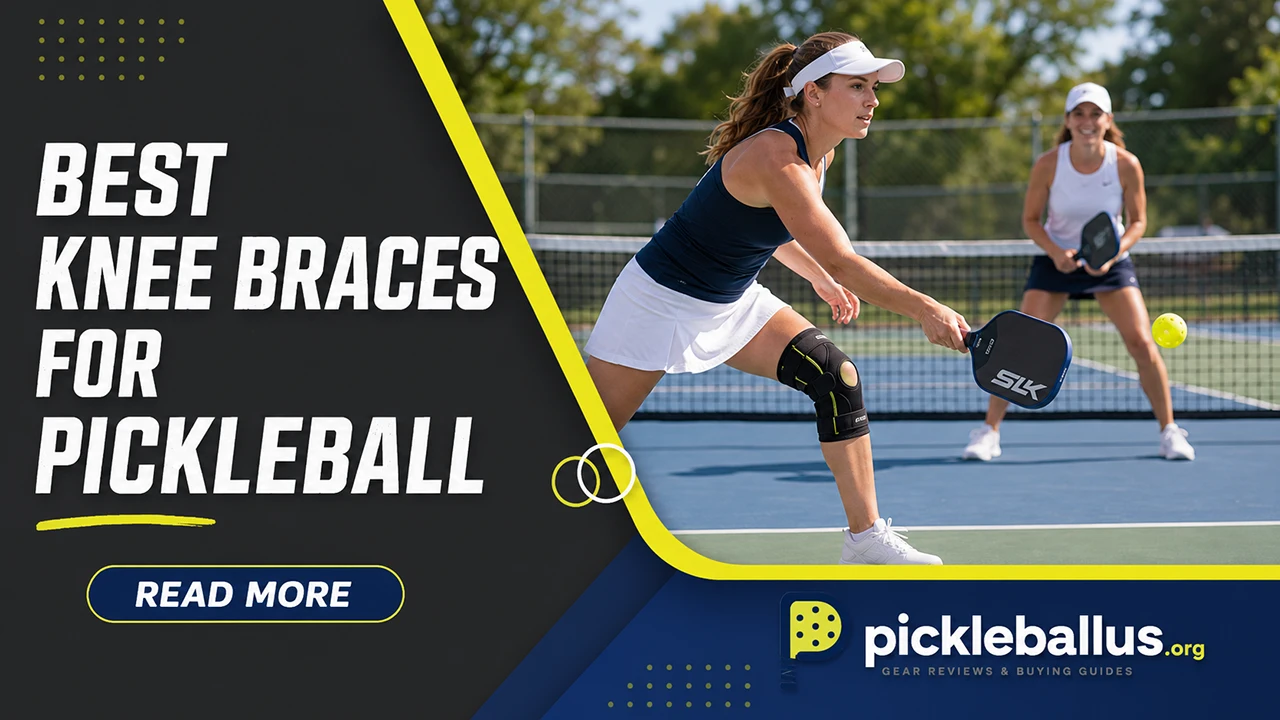
What Is a Pickleball Knee Brace and Do You Actually Need One?
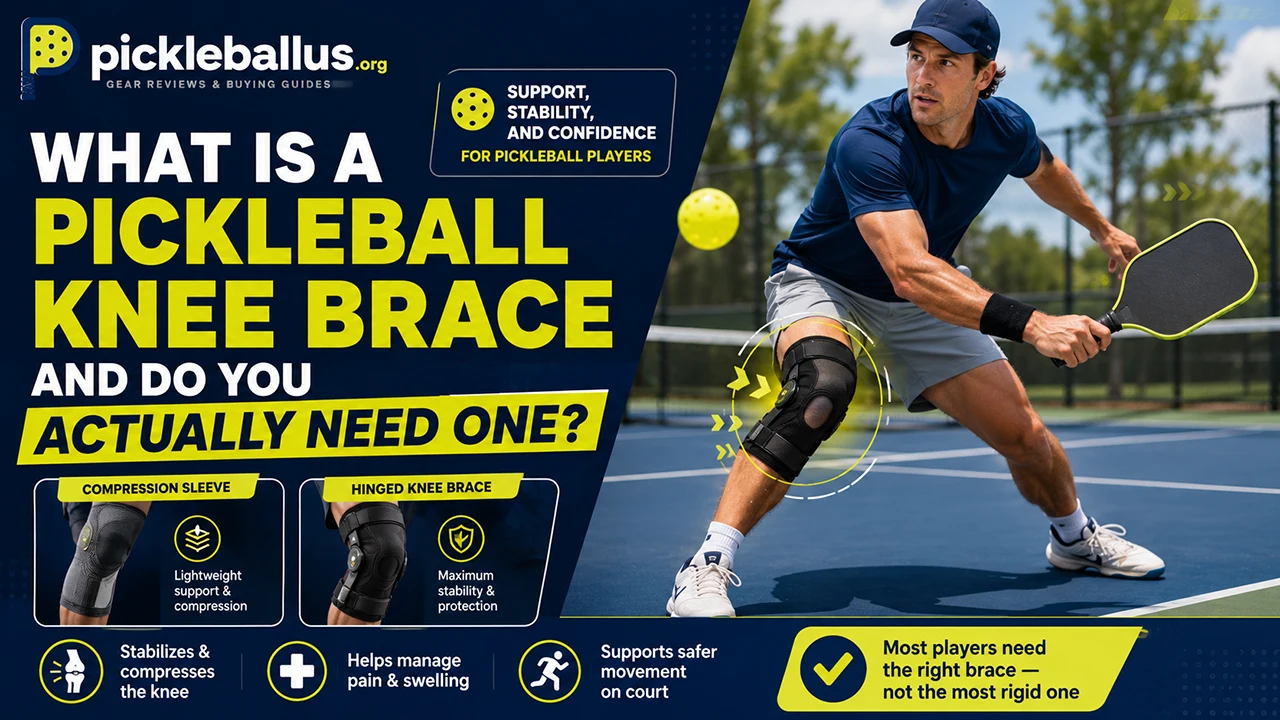
A pickleball knee brace is a wearable support device that stabilizes, compresses, or unloads the knee joint during play — reducing injury risk, managing pain, and helping players maintain court mobility without aggravating existing conditions. The term “knee brace” covers a wide spectrum, from thin compression sleeves worn for warmth and circulation to rigid hinged braces engineered for ligament protection. Most players don’t need the most protective option; they need the most appropriate one.
A brace won’t fix an underlying structural problem. What it can do is provide compression to reduce swelling, add lateral stability during direction changes, and — importantly — give the joint proprioceptive feedback that helps your body make safer movement decisions in real time. For players returning from injury, that feedback layer often makes the difference between confident play and cautious, compensatory movement that leads to new problems elsewhere.
How Pickleball Specifically Stresses the Knee
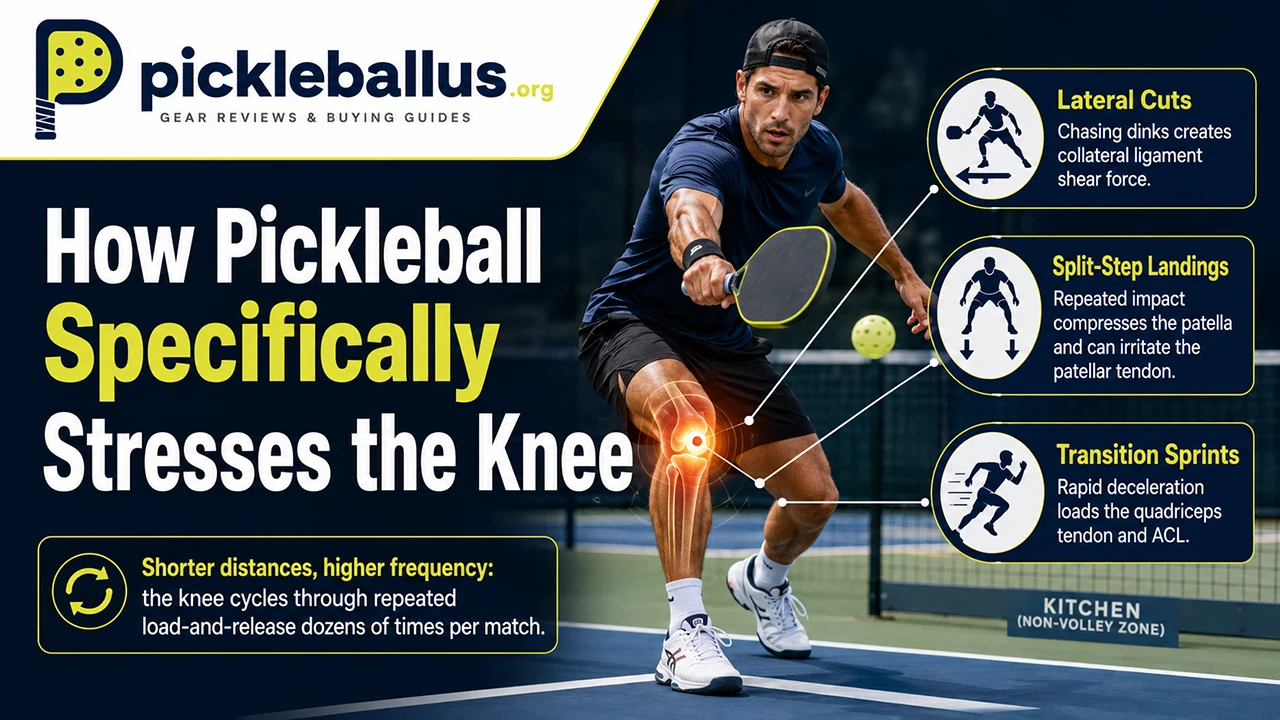
Pickleball’s kitchen line play generates more knee stress per minute than most players expect. The non-volley zone demands repeated low, wide stances — often held for several seconds — followed by explosive lateral slides and quick weight transfers. Add in the game’s point-rally structure, which keeps rallies shorter than tennis but more frequent, and you get joints that cycle through load and release dozens of times per match without the long recovery pauses distance sports provide.
Three movement patterns create the highest knee load in pickleball. Lateral cuts to chase dinks require the medial and lateral collateral ligaments to handle shear forces at angles most daily activities don’t reach. Split-step landings after serving compress the patella against the femur with each impact — the source of most patellar tendonitis complaints among regular players. Transition sprints from baseline to kitchen involve rapid deceleration, placing sudden eccentric load on the quadriceps tendon and ACL. Players who come from tennis or running often underestimate this combination because the distances are shorter, but frequency is higher.
The Four Main Knee Brace Types Explained
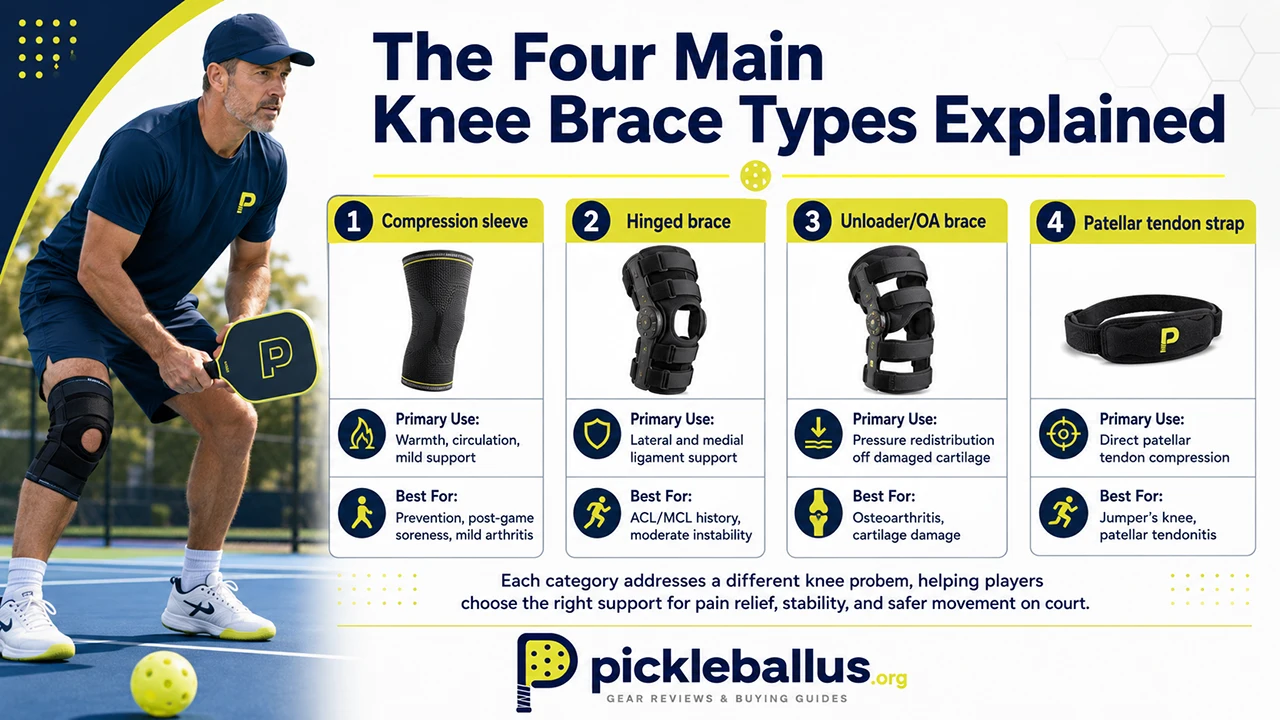
There are four distinct brace categories, each suited to a different need. The following table summarizes them before the full reviews cover how each top product executes on these principles.
The table below maps each type to its primary use case:
| Type | Primary Use | Best For |
|---|---|---|
| Compression sleeve | Warmth, circulation, mild support | Prevention, post-game soreness, mild arthritis |
| Hinged brace | Lateral and medial ligament support | ACL/MCL history, moderate instability |
| Unloader/OA brace | Pressure redistribution off damaged cartilage | Osteoarthritis, cartilage damage |
| Patellar tendon strap | Direct patellar tendon compression | Jumper’s knee, patellar tendonitis |
Each category is represented in the seven picks below, so regardless of where your knee pain originates, you’ll find a product built for that specific mechanism.
7 Best Knee Braces for Pickleball in 2026
#1 DonJoy Performance Bionic FullStop — Best for Maximum Stability
The DonJoy Performance Bionic FullStop earns the top position not because it’s the most comfortable brace on this list — it isn’t — but because no other over-the-counter option provides the same level of ACL and ligament protection during aggressive court movement. This is the brace for pickleball players who have a documented history of ACL injury, moderate-to-severe ligament instability, or who have been told by a physical therapist that they need real structural support, not just compression.
Key Specs:
- Type: Hinged (4-point leverage system)
- Hinge: Dual FULLSTOP dampening polycentric hinges
- Design: Open patella, anti-migration silicone hem
- Material: Breathable mesh with moisture-wicking lining
- FSA/HSA eligible: Yes
- Best for: ACL recovery, ligament instability, hyperextension prevention
Performance Analysis
The FULLSTOP hinge is what separates this brace from generic hinged competitors. Most hinged braces simply limit extreme range of motion passively. The FULLSTOP hinge uses a dampening mechanism that trains muscle memory through a dampening cycle — guiding the knee away from at-risk hyperextension positions on both braced and unbraced joints over time. The four-strap, four-point leverage system prevents the brace from migrating down the leg during lateral movement, a chronic problem with competitors that use fewer anchor points.
The breathable mesh construction handles extended match play reasonably well, though neoprene-heavy alternatives run cooler in hot outdoor conditions. I wore this through a three-game outdoor session on a warm afternoon, and while breathability is acceptable, there is noticeable heat retention compared to the Bauerfeind GenuTrain. For indoor play or cooler climates, the thermal profile is a non-issue. Compared to the Shock Doctor Maximum Support Hinged Brace reviewed below, the FullStop’s FULLSTOP hinge technology provides a meaningfully higher degree of hyperextension protection — the Shock Doctor is the better value, but the DonJoy is the more protective tool for players with serious ligament concerns. For any pickleball player who has been told their lateral cuts put their ACL at risk, this is the one brace that genuinely addresses that specific threat.
Pros:
- FULLSTOP dampening hinges actively prevent hyperextension
- 4-point leverage prevents migration during aggressive lateral movement
- Trains muscle memory for safer knee mechanics over time
- FSA/HSA eligible — significant cost offset for many buyers
Cons:
- Higher price point than most competitors
- Bulkier than sleeves — visible under fitted athletic wear
- Heat retention in hot conditions
Best For: Players returning from ACL surgery or with documented ligament instability who need the highest OTC protection level available.
My Verdict: The DonJoy Performance Bionic FullStop is the most protective non-prescription knee brace you can wear on a pickleball court. If your PT has told you to brace before playing and budget isn’t the primary constraint, this is the brace.
#2 Bauerfeind GenuTrain — Best for All-Day Comfort
The Bauerfeind GenuTrain does one thing better than anything else in this price range: it disappears. Within fifteen minutes of wear, the anatomical knit construction contours to the knee so precisely that players routinely describe forgetting they have it on. For serious recreational players who compete multiple times per week and need moderate support without cumulative discomfort, the GenuTrain is the benchmark.
Key Specs:
- Type: Compression knit with targeted pressure zones
- Design: Anatomical Omega pad around patella, Hoffa pads, lateral wings
- Material: Breathable Klimatex microfiber knit
- Origin: German-engineered, Bauerfeind medical-grade manufacturing
- FSA/HSA eligible: Yes
- Best for: Moderate arthritis, patellar tracking, post-game recovery, frequent play
Performance Analysis
The GenuTrain’s proprietary knit structure applies graduated compression across the entire joint while the Omega insert channels mechanical pressure around — not directly onto — the patella. This design reduces irritation of the fat pads and infrapatellar bursa during the repetitive squatting and resetting common in dink exchanges. The Klimatex microfiber is the most breathable material of any brace tested here, wicking moisture even during two-hour outdoor sessions without bunching behind the knee — a failure point of cheaper sleeves that fold in the popliteal fold during play.
Wearing the GenuTrain through a doubles session on an outdoor hard court, resets and drops felt no different with the brace than without it — no pull, no rotation restriction, no reminder it was there until I actively looked down. Compared to the NEENCA Professional Knee Brace, the GenuTrain provides similar compression intensity but superior fit consistency over long sessions; the NEENCA uses stabilizer bars and gel pads that provide more lateral structure but also more noticeable bulk. For the pickleball player who plays three or more times per week and needs support that doesn’t accumulate fatigue over time, the GenuTrain’s all-day wearability is its defining advantage.
Pros:
- Best-in-class breathability for extended play
- Omega patella insert reduces patella irritation without restricting movement
- Doesn’t bunch behind the knee during low stances
- Durable — maintains compression integrity after many wash cycles
Cons:
- Premium price (~$80–$100)
- Pull-on design requires more time to fit than strap-on alternatives
- Lower lateral stability than hinged options
Best For: Frequent players (3+ times/week) managing mild arthritis, patellar tracking issues, or general joint soreness who prioritize comfort and breathability.
My Verdict: The Bauerfeind GenuTrain is the best knee brace for pickleball players whose main priority is all-day wearability with consistent compression. It’s an investment, but one that pays off over a season of regular play.
#3 NEENCA Professional Knee Brace — Best Mid-Range Pick
The NEENCA Professional Knee Brace has been Amazon’s top-selling knee brace for five consecutive years, and the reason isn’t marketing — it’s that the combination of dual spring stabilizers, anatomical patella gel pad, and anti-slip silicone strips hits the performance target that most recreational players need at a price that doesn’t require budget gymnastics.
Key Specs:
- Type: Compression sleeve with spring stabilizers and gel pad
- Stabilizers: Dual metal spring side stabilizers
- Patella support: Anatomical gel pad surrounding kneecap
- Anti-slip: Non-slip gel strips + internal elastic webbing
- FSA/HSA eligible: Yes
- Best for: General knee pain, meniscus issues, mild ACL/MCL support, arthritis
Performance Analysis
The dual metal spring stabilizers provide lateral and medial support that a plain compression sleeve cannot deliver — important for pickleball’s side-to-side movement. The anatomical patella gel pad surrounds the kneecap to reduce direct compressive pressure during landings and transitions, addressing the patellar pain that many players report after extended kitchen-line play. NEENCA’s patented anti-slip system uses both internal elastic webbing and external non-slip gel strips, which meaningfully reduces the migration problem that plagues single-mechanism sleeves during aggressive play.
Through a full recreational session, the NEENCA held position through lateral cuts and low-stance exchanges without requiring readjustment — a benchmark single-strap sleeves consistently fail. The breathability is good but not exceptional; the material is warmer than the Bauerfeind GenuTrain’s Klimatex knit during outdoor summer play. Compared to the DR. BRACE ELITE, the NEENCA provides comparable stabilizer-based support at a similar price point, but the patella gel pad design offers a clearer comfort advantage for players whose primary complaint is kneecap pain rather than general instability. For pickleball players looking for their first quality supportive brace without committing to a premium price, the NEENCA is the most well-rounded starting point on this list.
Pros:
- Dual spring stabilizers provide lateral support beyond basic sleeves
- Patella gel pad reduces direct kneecap compression
- Reliable anti-slip system holds position through aggressive court movement
- Strong FSA/HSA eligibility — effectively reduces out-of-pocket cost
Cons:
- Warmer than knit-based alternatives in hot conditions
- Multiple components mean more maintenance during washing
- Sizing runs narrow for larger thighs
Best For: Recreational players managing general knee pain, mild meniscus irritation, or patellar discomfort who want meaningful support without a premium price tag.
My Verdict: The NEENCA Professional is the best first step up from a basic compression sleeve. The dual stabilizers and gel pad system address the two most common pickleball knee complaints — lateral instability and kneecap pain — at a price that makes it accessible to every player.
#4 Shock Doctor Maximum Support Hinged Brace — Best Hinged Value
The Shock Doctor Maximum Support Hinged Brace delivers adjustable dual-hinge stability at roughly half the price of the DonJoy FullStop, making it the logical choice for players who genuinely need hinged structure but aren’t recovering from a surgical ACL or a documented instability event.
Key Specs:
- Type: Hinged with bilateral adjustable hinges
- Hinge design: Dual adjustable aluminum hinges
- Design: Open patella, wraparound construction
- Straps: Adjustable hook-and-loop dual straps
- Best for: Moderate ligament support, MCL/LCL history, directional change protection
Performance Analysis
The dual aluminum hinges provide the medial and lateral mechanical guidance that keeps the knee from moving into positions that stress the collateral ligaments — the key physical demand of pickleball’s direction changes. The open-patella design reduces compression directly on the kneecap, and the wraparound construction allows a more customized fit than pull-on sleeves for players whose calf-to-thigh ratio makes standard sleeves migrate. The adjustable strap system lets players dial compression without removing the brace between games.
The Shock Doctor runs bulkier than the NEENCA or Bauerfeind options — visibly so under lightweight athletic leggings — but for players prioritizing protection over aesthetics, this is an acceptable trade-off. Compared to the DonJoy FullStop, the Shock Doctor lacks the FULLSTOP dampening hinge technology and four-point leverage system, making it less appropriate for documented ACL instability. But for the far larger population of pickleball players managing MCL soreness or general ligament awareness without a surgical history, the Shock Doctor provides 80% of the protection at half the price. For pickleball players who need hinged support during aggressive directional play but aren’t managing a post-surgical knee, this is the smart value choice.
Pros:
- Dual hinges provide genuine lateral and medial mechanical support
- Adjustable compression via hook-and-loop straps
- Open patella design reduces kneecap pressure
- Significantly lower price than premium hinged options
Cons:
- Bulkier than sleeve-style braces — visible under athletic wear
- Lacks the FULLSTOP dampening technology of the DonJoy FullStop
- Can feel stiff initially during warm-up
Best For: Players with a history of MCL or LCL soreness who need hinged support without the premium price of the DonJoy FullStop.
My Verdict: The Shock Doctor Maximum Support Hinged Brace is the best value entry point into genuine hinged knee protection for pickleball. If your knee needs mechanical guidance rather than just compression, and you’re not managing a post-surgical ACL, start here.
#5 DR. BRACE ELITE — Best for Mild-to-Moderate Support
The DR. BRACE ELITE carves out its niche between basic compression sleeves and full hinged braces — offering side stabilizers, an open patella design, and gel pads in a wraparound format that fits a wider range of thigh geometries than pull-on alternatives. It’s the right tool for players who’ve outgrown simple sleeves but aren’t convinced they need full hinges.
Key Specs:
- Type: Wraparound with side stabilizers and gel pads
- Stabilizers: Removable side stabilizers
- Design: Open patella with gel pads, X-strap fixation system
- Anti-slip: Open-back design reduces popliteal bunching
- Best for: Mild-to-moderate instability, large thighs, older players
Performance Analysis
The removable side stabilizers give this brace unusual flexibility: players with moderate instability can keep them in; players who just need compression and patellar support can remove them for lighter, more breathable wear. The X-strap fixation system anchors the brace around the knee in a way that accommodates larger thigh circumferences better than the NEENCA’s internal elastic webbing system, making it a consistently better fit for players over 200 lbs or those with shorter leg segments.
The open-back design prevents fabric from bunching in the popliteal fold during deep kitchen stances — a practical detail that players in low-stance-heavy pickleball styles will notice immediately. Compared to the NEENCA, the DR. BRACE provides similar lateral support but excels in fit for larger or less standard leg proportions, while the NEENCA’s patella gel pad is more precisely contoured for kneecap-specific pain. For intermediate pickleball players managing mild-to-moderate knee pain who need a more accommodating fit than standard pull-on sleeves, the DR. BRACE ELITE reliably performs across a wider range of body types.
Pros:
- Open-back design eliminates popliteal bunching during low stances
- Removable stabilizers offer adjustable support levels
- X-strap system fits larger thighs more securely than pull-on designs
- Good value for the feature set offered
Cons:
- Multiple components (straps, stabilizers, pads) can shift with wear
- Bulkier than compression sleeves
- Less patella-specific support than the NEENCA gel pad
Best For: Players who need a better fit than standard pull-on sleeves, or who want the option to scale stabilizer support up or down based on the day’s activity.
My Verdict: The DR. BRACE ELITE is the most versatile mid-range option on this list for players with non-standard leg proportions. If fit has been the persistent problem with sleeves, this brace solves it.
#6 Modvel 2-Pack Compression Knee Brace — Best Budget Option
The Modvel 2-Pack Compression Knee Brace makes the list not because it competes with hinged braces on stability — it doesn’t — but because compression alone is exactly what the majority of recreational pickleball players actually need, and Modvel delivers it reliably at a price that makes buying a backup pair for travel an easy decision.
Key Specs:
- Type: Compression sleeve (no stabilizers or hinges)
- Material: Nylon/spandex blend with moisture-wicking properties
- Design: Pull-on, graduated compression
- Value: 2-pack included
- Best for: Prevention, mild soreness, post-game recovery, beginners
Performance Analysis
The Modvel sleeve applies consistent compression across the full knee joint, improving circulation and reducing the swelling that accumulates in joints during extended play. The nylon-spandex blend is lighter and more breathable than neoprene-based sleeves, making it appropriate for outdoor summer play where heat management matters. There are no stabilizers, hinges, or patella-specific elements — this is pure compression, which is simultaneously the brace’s core strength and its limitation.
For the large population of recreational pickleball players who are playing three or fewer times per week, have no documented injury history, and experience only mild post-play soreness or mild arthritis, this compression level is sufficient. Compared to the NEENCA Professional, the Modvel cannot address lateral instability or patella-specific pain — but for players whose knee needs warmth, circulation support, and light proprioceptive feedback, paying four times as much for the NEENCA is unnecessary. For pickleball beginners or casual players who want joint warmth and light compression without the complexity of stabilizers and gel pads, the Modvel 2-Pack is the most cost-effective protective option available.
Pros:
- Extremely affordable — 2-pack lowers cost-per-brace significantly
- Lightweight and breathable for summer outdoor play
- Graduated compression supports circulation and reduces swelling
- Low profile under athletic wear
Cons:
- No stabilizers, hinges, or patella-specific support
- Insufficient for documented ligament instability or moderate arthritis
- Can slide down during explosive lateral movement
Best For: Casual or beginning pickleball players managing mild post-game soreness or wanting basic joint warmth and compression support during play.
My Verdict: The Modvel 2-Pack is the right call when you need compression support without complexity or cost. Don’t overspend on a hinged brace if your knee is telling you it’s sore — not unstable.
#7 Bodyprox Patella Tendon Strap — Best for Patellar Tendonitis
The Bodyprox Patella Tendon Strap solves one very specific problem — patellar tendinitis and jumper’s knee — with a precision that sleeves and hinged braces cannot replicate. If the pain in your knee is specifically beneath the kneecap and intensifies during the push-off phase of a split-step, this strap is the mechanically correct tool.
Key Specs:
- Type: Patellar tendon strap (targeted compression band)
- Design: Adjustable neoprene strap with direct tendon pressure pad
- Mechanism: Applies pressure directly above the tibial tuberosity to alter patellar tendon tension
- Best for: Patellar tendonitis, jumper’s knee, infrapatellar pain
Performance Analysis
The Bodyprox strap works by applying focused compression directly to the patellar tendon just below the kneecap — altering the biomechanics of tendon pull during knee flexion in a way that reduces pain at the patellar attachment. This mechanism is specific: it addresses infrapatellar pain during repetitive push-off and deceleration, which maps precisely to pickleball’s split-step pattern. It does nothing for lateral instability, ACL stress, or arthritic compression.
The adjustable neoprene strap is slim and low-profile, wearing beneath shorts without restriction. Initial position adjustment requires attention — the pressure pad must sit directly on the tendon below the kneecap, not above it. Worn correctly, the pain reduction during the first point-of-contact moment of a split-step landing is immediate and noticeable. Compared to the Modvel compression sleeve, the Bodyprox strap is far more targeted but far more narrow in application — a full sleeve provides no direct tendon compression, while the Bodyprox strap does nothing for general joint soreness. For pickleball players whose pain is specifically infrapatellar and consistently triggered by the push-off phase of their kitchen movement, this strap provides relief that no other product on this list can match.
Pros:
- Direct patellar tendon compression provides immediate pain relief for tendinitis
- Low-profile design — minimal bulk under shorts
- Adjustable pressure to fine-tune tendon compression level
- Very affordable — cost-effective solution for a specific, well-defined problem
Cons:
- Only effective for patellar tendon–specific pain
- Requires precise positioning to work correctly
- Provides no lateral stability or general joint compression
Best For: Players experiencing infrapatellar pain (under or just below the kneecap) triggered specifically by push-off and landing movements during kitchen play.
My Verdict: The Bodyprox Patella Tendon Strap is the most targeted tool on this list. If your knee problem is patellar tendinitis, this strap will outperform everything else here. If it isn’t, choose something else.
Compression Sleeve vs. Hinged vs. Unloader — Which Type Fits Your Condition?
The correct brace type is determined by the mechanism of your knee problem, not by how much pain you’re experiencing or how often you play. A player with mild arthritis who plays five times per week may need less structural support than a player with documented ACL laxity who plays once a week — frequency doesn’t override biomechanical need.
The following breakdown maps each brace category to the conditions it was engineered to address:
| Condition | Recommended Brace Type | Top Pick |
|---|---|---|
| General prevention / mild soreness | Compression sleeve | Modvel 2-Pack |
| Patellar tendinitis / jumper’s knee | Patellar tendon strap | Bodyprox Strap |
| Mild-to-moderate instability / general pain | Compression with stabilizers | NEENCA or DR. BRACE ELITE |
| ACL/MCL history / moderate instability | Hinged brace | Shock Doctor (value) or DonJoy FullStop (max protection) |
| Osteoarthritis / cartilage damage | Unloader brace | Consult ortho; Ovation Medical OA Brace as OTC option |
| All-day comfort / frequent players | Premium knit compression | Bauerfeind GenuTrain |
Prevention and Mild Soreness → Compression Sleeve
A compression sleeve is appropriate when the knee is structurally sound and the goal is warmth, mild circulation support, and the proprioceptive feedback of having something on the joint. Players who experience stiffness after long sessions or who want preventive support during casual recreational play don’t need — and shouldn’t wear — a hinged brace. The additional structure of stabilizers and hinges on a healthy knee creates restriction without any protective payoff.
Ligament Instability or ACL History → Hinged Brace
A hinged brace becomes the right tool when the knee has a documented history of ligament involvement or when lateral movement produces a sensation of giving way. Hinges mechanically prevent the joint from reaching the range of motion where ligament stress peaks — something compression alone cannot accomplish. Players returning from ACL surgery or managing an MCL sprain that hasn’t fully resolved should not rely on compression sleeves during aggressive court play.
Osteoarthritis or Cartilage Damage → Unloader Brace
An unloader brace redistributes force away from the damaged compartment of the knee — medial or lateral — by applying a three-point pressure system that shifts the joint’s load axis. This is a medically specific mechanism. Players with confirmed osteoarthritis who continue experiencing pain in a compression sleeve or hinged brace should consult a sports medicine physician about an OA unloader prescription, as these braces can be covered by insurance in many cases.
What to Look for When Buying a Knee Brace for Pickleball
The brace that performs best on the court is the one that fits correctly, stays in position during movement, and manages heat appropriately for your playing environment. These three practical criteria are where most purchasing decisions go wrong — buyers focus on brand or structure type while ignoring the fit and material details that determine whether the brace actually helps during the match.
How to Size a Knee Brace Correctly
Sizing a pickleball knee brace requires a single, precise measurement: the circumference of your knee at the center of the kneecap with your leg slightly bent, not extended. This number — not height or weight, which most brace sizing charts incorrectly use — determines whether the brace will apply correct compression or create pressure points and migration during play.
Measure this way: stand on a flat surface, bend the knee to approximately 30 degrees, and wrap a soft measuring tape directly across the kneecap’s midpoint. If your measurement falls between two sizes, size up for sleeve-style braces (too tight restricts circulation) and size down for wraparound/hinged braces with adjustable straps (straps compensate for slight extra volume). Test the brace in full lateral movement — not just walking — before the first match day. A brace that functions correctly while standing can still migrate during the explosive cuts that define pickleball footwork.
Key Features That Matter on the Pickleball Court
When comparing knee braces for pickleball, four features determine real-world performance rather than marketing claims. Anti-migration technology — whether silicone strips, elastic webbing, or strap anchors — is the most critical, because a brace that slides during lateral cuts provides zero stability benefit and creates chafing. Breathability matters more than most buyers anticipate: neoprene retains body heat effectively for cold-weather play but becomes a liability in summer outdoor conditions where sustained heat causes discomfort and sweat accumulation. Open vs. closed patella affects kneecap comfort during extended low stances; players who feel direct compression on the kneecap in full sleeves should prioritize open-patella designs. FSA/HSA eligibility — available on most medical-grade braces including the NEENCA, DonJoy FullStop, and Bauerfeind GenuTrain — can offset 20–35% of actual cost for players with health savings accounts, making premium options significantly more accessible.
By now you have a clear picture of the top knee braces on the market and how to match each type to your specific knee condition — whether you’re preventing soreness, managing ligament instability, or playing through arthritis. Choosing the right brace, however, is only part of the equation; how you fit it, pair it with your warm-up routine, and recognize when a brace alone isn’t enough will determine how many years you stay on the court. The next section covers the finer details that separate players who stay healthy long-term from those who keep re-aggravating the same knee issue.
Beyond the Brace — Keeping Your Knees Healthy Long-Term in Pickleball
A pickleball knee brace is a protective layer, not a treatment protocol. Long-term joint health on the court comes from combining the right support tool with correct fit mechanics, pre-play preparation, and an accurate understanding of when the problem exceeds what any brace can address.
Fit and Sizing Mistakes That Reduce Brace Effectiveness
The most common fit error is wearing a sleeve that has stretched beyond its effective compression range. Compression sleeves lose elasticity over time — typically after 3–6 months of regular use — and a stretched sleeve provides warmth but no meaningful compression. Test your sleeve by holding it up: if the fabric doesn’t spring back to its relaxed shape within two seconds of release, it’s due for replacement. A second common error is positioning a hinged brace with the hinge axis forward or behind the natural knee pivot. The hinge should align directly with the lateral and medial epicondyles of the femur when standing. Misalignment by even half an inch creates torque on the joint with each step, which can cause new discomfort at the hinge site.
For pickleball players who use knee sleeves during aggressive lateral play, the related resource on best pickleball knee sleeves covers specific sleeve designs built for court movement — including anti-slip mechanisms tested specifically for the pickleball footwork pattern. Ankle stability also plays a direct role in knee loading: players with ankle instability compensate with increased knee valgus during cuts; the best pickleball ankle braces section addresses how lower-chain support affects knee mechanics from the ground up.
Warm-Up Movements That Reduce Knee Load Before Play
Wearing the correct brace to a court with cold, unprepared tissue is less effective than a five-minute warm-up followed by a basic sleeve. Dynamic warm-up increases synovial fluid distribution, reducing the friction coefficient of the knee joint during the first twenty minutes of play — the window when most soft-tissue injuries occur. Three movements that directly target pickleball’s knee demands: leg swings in the frontal plane (activating medial and lateral stabilizers), lateral band walks (loading the hip abductors to reduce compensatory knee valgus), and shallow lateral lunges that mimic the kitchen-line stance. These prime the exact muscles and movement planes that pickleball activates without requiring additional equipment or significant time. Players managing chronic soreness also benefit from post-match ice application for 15–20 minutes — reducing inflammation before it accumulates into the chronic low-grade swelling that eventually forces time off the court.
When to See a Sports Medicine Doctor Instead of Self-Treating
A brace is not a substitute for medical evaluation when the knee produces three specific signals. Locking or catching — a sensation that the joint momentarily freezes during movement — indicates possible meniscal displacement that requires imaging, not compression. Audible popping accompanied by immediate swelling following a single incident suggests structural damage (ACL, MCL, or meniscus) that a brace will not stabilize and may mask while the injury worsens. Pain that intensifies with use over multiple sessions despite wearing a brace — rather than stabilizing or improving — signals a condition that has progressed beyond overuse management. In these cases, continuing to play with a brace while deferring evaluation is a common decision that routinely converts recoverable injuries into surgical cases. The related guide on pickleball injury prevention gear provides context on the full spectrum of protective equipment, from wrist braces to ankle supports, as part of a complete approach to joint health on the court.
Write Your Review
No reviews yet. Be the first to share your experience!