

In pickleball, a ball is out of bounds when it lands completely outside the court’s boundary lines — past the baseline, past the sideline, or (when serving) in the non-volley zone. The rule that trips up nearly every beginner is the line call itself: any ball that physically touches any part of a boundary line during a rally is in, not out. This single principle governs everything from casual recreational games to USA Pickleball-sanctioned tournaments, and getting it right is non-negotiable for fair play.
Knowing the definition is only half the challenge. Pickleball has a specific code of conduct for how and when you make the call — including strict timing rules, a visual standard called the “daylight rule,” and a codified principle that all doubtful calls must be resolved in the opponent’s favor. Part of pickleball rules that new players underestimate most is how much the calling process itself matters, not just the outcome.
One of the most common — and costly — mistakes on the court is reaching for a ball that looks like it’s heading out, only to make contact before it lands. The moment your paddle or body touches a ball that hasn’t yet bounced out of bounds, the ball is live and you’ve committed a fault. Understanding exactly when you’re allowed to hit an out ball and when you should let it go is essential at every level of play.
This guide covers all the pickleball out of bounds rules: official line-call standards, what happens in every out-of-bounds scenario, how to correctly call and dispute an out ball, and the 2025 rule updates that changed how doubles partners handle line calls together.

What Does “Out of Bounds” Mean in Pickleball?
A ball is out of bounds in pickleball when it contacts the playing surface in an area completely outside the court’s defined boundaries — past the baselines, past the sidelines, or (specifically on a serve) in the non-volley zone. The court’s painted lines are always “in” during regular rallies.
USA Pickleball’s rulebook defines it this way: a ball contacting the playing surface completely outside of the court is “out.” The word “completely” carries the real weight here. If any fraction of the ball’s surface area touches the line, the ball is not completely outside — it’s in.
The Court Boundaries That Define Out of Bounds
A standard pickleball court measures 20 feet wide by 44 feet long. The outer edges — the baselines running parallel to the net at each end, and the sidelines running perpendicular along each side — form the outer perimeter of the playing field. Anything beyond those lines is out of bounds territory.
During play, four line types determine whether a ball is in or out. How each line is treated depends on the context:
The following table summarizes every line’s status during a rally and during a serve:
| Line | During a Rally | During a Serve |
|---|---|---|
| Baseline | In (if touched) | In (if touched) |
| Sideline | In (if touched) | In (if touched) |
| Centerline | In (if touched) | In (if touched) |
| Kitchen line (NVZ line) | In (if touched) | Out — serve cannot land in kitchen |
Understanding this table alone resolves the majority of disputed calls on any recreational court.
The “Line Touches” Rule — Why Lines Are Always “In”
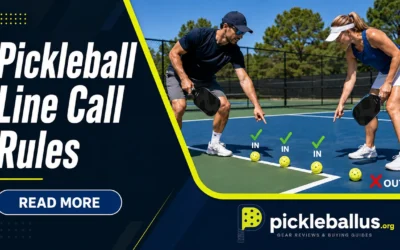
The line touches rule is the single most important principle in pickleball out of bounds calls: if any part of the ball touches any part of the line, the ball is in. This applies uniformly to the baseline, sideline, and centerline during rallies.
What matters is physical contact between the ball’s surface and the painted line. When viewed from above, a ball might appear to sit entirely outside the line — but if the bottom surface, where the ball actually contacts the ground, intersects with the line paint at all, that ball is in. USA Pickleball’s visual standard backs this up: you must be able to see clear daylight — a visible gap — between the ball and the line to call it out. If you can’t see that gap, you cannot make the call. When in doubt, the ball is in.
Is the Kitchen Line In or Out? The Key Exception Explained
The kitchen line plays by different rules depending on context — and this distinction causes more confusion than almost any other single rule in pickleball. During a rally, the kitchen line is “in.” During a serve, the kitchen line is out.
During Rallies — The Kitchen Line Is “In”
When the ball is in active play after the serve, any ball landing on the kitchen line is in bounds. A drop shot that clips the front edge of the kitchen? In. A reset that catches the NVZ line on the way down? In. The kitchen line is treated identically to every other boundary line during a rally. Players who try to call these shots “out” or “kitchen” are making an incorrect call — that ball is live and in play.
Note that touching the kitchen line is different from committing a pickleball kitchen foot fault — the foot fault rule applies to volleys, not to where the ball lands.
During Serves — The Kitchen Line Is “Out”
When serving, the ball must clear the non-volley zone entirely. A served ball landing in the kitchen — including on the kitchen line itself — is out of bounds and results in a fault. This is the only context in which a kitchen line call produces an “out.” The serve must land in the diagonally opposite service court, making contact anywhere between the kitchen line (exclusive) and the opponent’s baseline (inclusive), bounded by the sidelines and centerline.
A serve clipping the kitchen line by even a fraction of the ball’s surface is a fault. No exceptions.
What Happens When You Hit a Ball Going Out of Bounds?
This is the scenario that costs players the most unnecessary points, and the rule is unambiguous: if your paddle, body, or clothing touches a ball before it lands out of bounds, it is your fault. The ball’s trajectory — however clearly heading out — is completely irrelevant once contact is made. This situation constitutes a pickleball fault under official rules, carrying the same consequence as any other fault.
Scenario 1 — Hitting the Ball After It Lands Out (Safe)
The safest approach when you believe a ball is heading out is to let it bounce first. If the ball lands out of bounds and bounces, that confirms a fault against your opponent — and you win the point or the serve. At that point, you can pick up or touch the ball because it’s no longer live.
You can still make the “out” call after the bounce, as long as you do so before your opponent plays the ball again. The correct sequence is: ball lands out → you confirm visually → you call “out” before your opponent strikes. That’s the proper order.
Scenario 2 — Touching the Ball Before It Lands (Live Ball Fault)
The moment your paddle or any part of your body contacts a ball that has not yet touched the ground outside the court, the ball is treated as live, regardless of where it was headed. This is an immediate fault against the player who made contact. It doesn’t matter how obviously the ball was sailing past the baseline — catch it, swipe at it, or deflect it before it hits the out-of-bounds surface, and you lose the point.
The reasoning is elegant: it eliminates every gray area. When one player thinks the ball is going out and another thinks it’s staying in, making contact with the ball kills the debate before any landing confirms anything. The old “it was going out anyway” argument has no standing under official rules. When in doubt, let it bounce.
One nuance that confuses doubles players: if the ball hits you or your partner while you’re standing outside the court and the ball would not have landed in bounds anyway, it is still a fault against your team. Your physical position outside the boundary lines does not insulate you from the live ball rule.
How to Correctly Call Out of Bounds in Pickleball
Making a proper out call isn’t just about seeing the ball land outside the line — there’s a specific procedure USA Pickleball outlines to keep calls fair, timely, and dispute-free. The process is as important as the call itself.
The Timing Rule — When to Call “Out”
An “out” call must be made before your opponent hits the ball or before the ball becomes dead. A call made after your opponent has already struck the ball is invalid — the rally continues as if no call were made. A late call also signals poor sportsmanship and is a consistent source of on-court conflict.
Once an “out” call is made after the ball bounces, it is an official line call that stops play immediately. The ball is dead from that moment. Per the line call rules, if that call is later overruled — by a referee, a partner, or even the original caller — it becomes a fault against the player who made the out call.
One important distinction: if a player shouts “out,” “bounce it,” “no,” or any similar word before the ball lands, that is classified as partner communication under official rules — not a line call. It does not stop play. The official call only becomes valid after the ball has bounced and is called “out” by voice or hand signal.
The Daylight/Gap Rule — The Visual Standard
USA Pickleball’s official guidance gives players a clear visual test for calling a ball out: you must be able to see a visible gap — daylight — between the ball and the line when it contacts the ground. Without that gap, you don’t have sufficient visual confirmation, and the ball must be called in.
This standard is intentionally demanding. It protects against angle-distorted views, hesitation calls, and the human tendency to see what we expect. A ball that looks “close” from across the court is not grounds for an out call. You need a clear, unobstructed view of the landing spot and a definitive gap between ball and line.
When your view is blocked, uncertain from glare, or simply unclear, the rule is direct: call it in. Every doubtful call must be resolved in the opponent’s favor. This isn’t just a recommendation — it’s a codified part of USA Pickleball’s line-calling ethics.
What to Do When Doubles Partners Disagree
In doubles play, disagreements between partners are resolved cleanly under official rules: if two partners cannot agree on whether a ball is “in” or “out,” the ball is in. One partner calling “out” while the other is uncertain — or calling “in” — results in the ball being played as in. There is no replay.
However, one partner can overrule the other’s call in the opponent’s favor. If partner A calls “out” but partner B clearly saw the ball land in, partner B can overturn the call. The team who made the out call loses the benefit, and the rally outcome shifts accordingly. This overrule right extends to self-correction: if you initially called “out” but realize you were wrong, you can correct it — and the correction always favors the opponent.
The moment either team asks for the opposing team’s opinion on whether the ball was in or out, they permanently forfeit their right to make any in/out call for that rally.
Who Is Responsible for Out of Bounds Calls?
Responsibility for calling out of bounds shifts depending on the context of play — recreational games, non-officiated tournaments, or refereed competition.
In recreational and non-officiated play, players call balls on their own side of the court. Each team calls the lines at their end: baseline, sideline, and kitchen line. The opposing team calls lines on the other end. You do not call “out” on your opponent’s side, even with a clear view — that responsibility belongs to the team closest to the landing spot.
The pickleball scoring rules make clear that the outcome of a correct “out” call is a point for the calling team (in rally scoring) or a side-out (in traditional side-out scoring), so accuracy matters every rally.
In refereed tournament play, referees and line judges handle most line-call duties. Line judges manage baseline and sideline calls in their zones, while the referee oversees serves, kitchen violations, and final arbitration. Players may appeal to the referee to overrule a line call, but the referee only acts on clear visual evidence. Without certainty, the benefit-of-the-opponent principle governs.
Under the 2025 USA Pickleball rule update, there is a notable change to partner responsibility: players are now required to call out balls on their partner as well — not just their own shots. If you can clearly see that a ball landing near your partner is out, you must make the call. This update increases line-call accuracy in recreational play, where eyeline positioning often differs between partners.
By now you have a solid foundation: what defines out of bounds in pickleball, how the line-call standard works across every pickleball court line, the live ball fault that catches so many players off guard, and the correct procedure for making — or correcting — an out call. These rules cover the vast majority of what you’ll encounter in any pickleball game at any level. What follows are the finer-grained scenarios that come up less frequently but create real confusion when they do — the edge cases, timing nuances, and rulebook details that separate players who know the basics from those who’ve truly studied the game.
Out of Bounds Situations That Still Confuse Experienced Players
Even players with years of court time run into out-of-bounds scenarios that require rulebook knowledge to resolve correctly. These four situations come up regularly in both competitive and recreational play.
Calling “Out” Mid-Air — Partner Communication, Not a Line Call
When a player shouts “out,” “no,” or “bounce it” while the ball is still airborne, this is classified as partner communication under official rules — not a line call. Play does not stop. The rally continues. The official call only becomes valid after the ball touches down and is clearly called “out” by voice or hand signal.
This distinction matters in two ways. First, an early shout cannot stop play or influence the point while the ball is in motion. Second, if the ball actually lands in after the early warning, no fault is committed by the player who yelled. The “partner communication” classification was designed to let doubles partners coordinate without accidentally triggering dead-ball situations mid-rally.
Balls Hitting Permanent Objects — An Automatic Out
Under USA Pickleball rules, a ball that strikes any permanent object — a wall, ceiling, overhead light fixture, or structural element — before it lands in the opponent’s court is automatically out of bounds. This is especially common on indoor courts where low ceilings and overhead lighting are part of the playing environment.
If the ball hits the ceiling and then lands in bounds, it is still an out. The contact with the permanent object triggers the fault regardless of where the ball subsequently lands. Players on indoor courts should clarify local house rules about ceiling height and overhead obstructions before starting play.
Overruling Your Own “Out” Call — Why It Costs You
Any player can overturn their own out call, their partner’s out call, or even an officiating team’s line call — but only in the opponent’s favor. Self-correction is encouraged when a player realizes they incorrectly called “out.” However, once the overrule happens, the team that made the original out call typically loses the point or serve advantage they had gained.
This rule reinforces pickleball’s core ethos of honesty and integrity. Calling a ball out to stop play and then reconsidering after realizing it was in is treated the same as any corrected call: the point goes to the other side. There is no penalty beyond the loss of the call’s advantage — but the momentum shift is real.
Appealing an Out Call to the Referee
In refereed play, either team may appeal a line call to the referee. The referee will only overturn a call if they have clear visual evidence the original call was wrong. When the referee is not certain, they defer to the original call or — where no call was made — to the benefit-of-the-opponent principle.
If the referee overrules an “out” call, it becomes a fault against the team who made that out call. Disputing a close call carries real risk: if the referee rules against your appeal, your team absorbs the fault. Appeals are best made only when a player has strong visual grounds and confidence that the referee’s angle confirms it.



Write Your Review
No reviews yet. Be the first to share your experience!