

Knowing whether a pickleball is “in” or “out” sounds simple — until you’re mid-rally, your opponent’s shot clips the line, and both sides have completely different opinions. Line call rules govern one of the most common sources of conflict on the court, and understanding them clearly means fewer disputes, faster games, and a reputation as a fair and knowledgeable player.
This guide covers the complete USA Pickleball line call rules for 2025: the in/out definitions, who calls what, how and when to call, how disputes get resolved, and the code of ethics that holds recreational play together.
What Are Pickleball Line Call Rules?
Pickleball line call rules are the official guidelines — governed by Section 6 of the USA Pickleball rulebook — that define when a ball is “in” or “out,” who has the authority to make each call, and how disputes must be handled. These rules are the backbone of fair play in both recreational and tournament pickleball.
Unlike tennis, which uses electronic line-calling systems at the professional level, the vast majority of pickleball is self-officiated. No referee is watching most games at the club or recreational level. That means the line call rules are not just technical regulations — they are a shared social contract between players on the same court.
Why line calls matter in self-officiated play
In self-officiated play, every player is simultaneously a competitor and a referee on their side of the court. This dual role is where most disputes originate. A player who genuinely misreads a close shot can accidentally — or deliberately — change the outcome of a game. The rules are structured to minimize that risk by placing calling responsibility on the player with the best angle (the one on the side where the ball lands) and by establishing a clear default: when in doubt, the ball is “in.”
The official source: USA Pickleball Section 6
The definitive authority on line calls is Section 6 of the USA Pickleball Official Rulebook, updated annually. All rules referenced in this article reflect the 2025 version. For tournament play, this section is binding. For recreational play, it serves as the standard most clubs adopt. You can download the full rulebook at USAPickleball.org.
When Is the Ball “In” or “Out” in Pickleball?
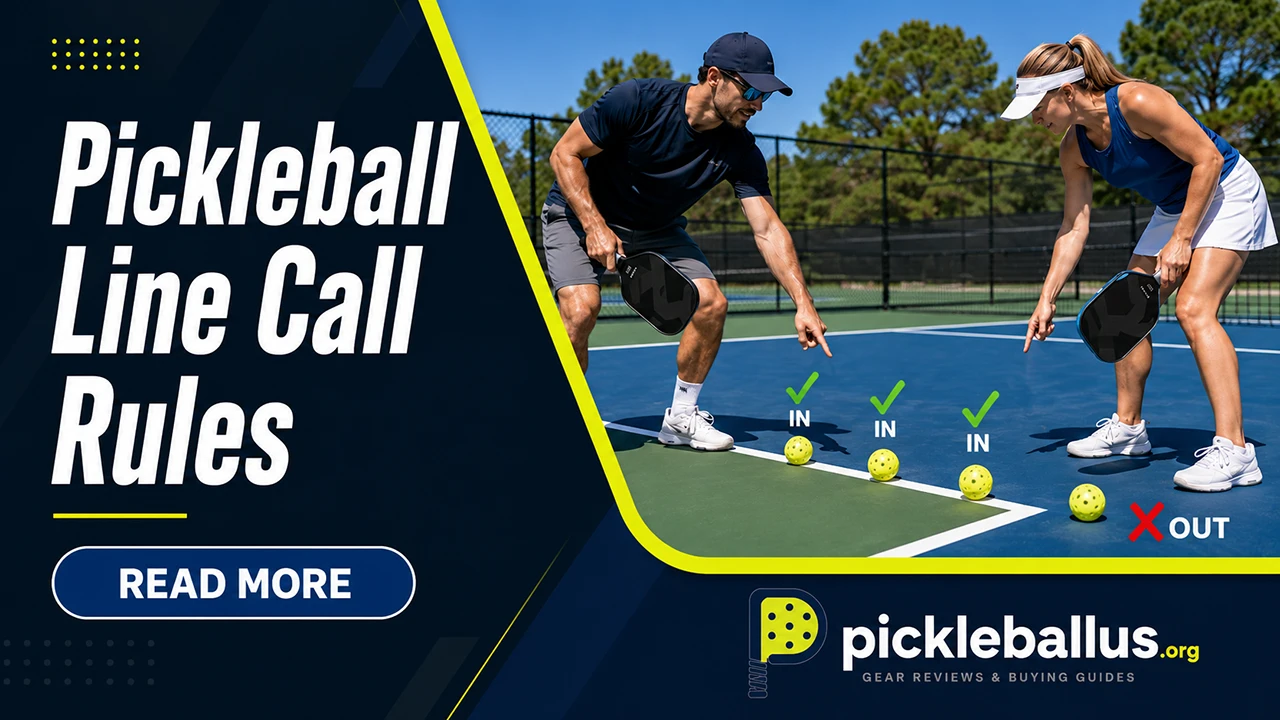
A pickleball is “in” if any part of its contact surface touches a court line — and “out” only when the entire contact surface lands completely outside the boundary lines. This is the foundational rule that governs every rally except the serve.
The in-call rule: touching any line = in
Under Rule 6.A, any ball in play that lands in the court or touches any court line is “in.” This applies to sidelines, the baseline, and the centerline during rallies. The rule is designed to favor the receiving team in ambiguous situations. If even a thin sliver of the ball’s contact point grazes the line, it is a live ball and play continues.
One critical nuance: pickleball balls do not compress the way tennis balls do. The contact point is the bottom of the ball — the part that physically touches the court surface when it bounces. If only the side or top of the ball passes over a line without the bottom touching it, and the bottom lands outside, that ball is out.
The out-call rule: you must see clear space
Under Rule 6.C.6, a player may not call a ball “out” unless they can clearly see a space between the line and the ball’s contact point as it hits the ground. If there is any doubt, the ball must be called “in.” This is not a suggestion — it is a binding rule and also the ethical standard USA Pickleball explicitly sets out in its Code of Ethics for line calling.
In practice this means: if you are not 100% certain you saw daylight between the ball and the line, the call is “in” by default, regardless of how close it looked.
The serve exception: kitchen line and NVZ rules
The serve operates under a different standard from rally play. Under Rule 6.B, a served ball must:
- Clear the non-volley zone (kitchen) entirely — the ball cannot land in the kitchen or touch the kitchen line (NVZ line)
- Land crosscourt from the server
- Fall within (or on) the baseline, centerline, and sideline of the correct service box
This means the kitchen line is live for rally play but not for serves. A ball that clips the kitchen line during a rally is “in.” The same ball during a serve is a fault. This is one of the most commonly misunderstood aspects of pickleball line rules, especially for players coming from tennis.
Who Is Responsible for Making Line Calls?
Each player or team is responsible for calling lines on their own side of the court — meaning the side where the ball lands. This is the cornerstone rule of self-officiated pickleball (Rule 6.C.1).
Your side, your call — the basic principle
The team receiving the ball makes the line call for shots that land on their side. The team that hit the ball does not call it in or out. This structure exists because the receiving team has the best visual angle to judge where the ball lands relative to the lines.
There are two specific exceptions where players may call faults on the opponent’s side:
- Non-Volley Zone foot faults — you may call these on the opponent’s side
- Service foot faults — you may call these on the opponent’s side
If players disagree about either of these cross-court fault calls, the point is replayed.
How doubles partner calls work
In doubles, either partner may make line calls for their team’s side of the court. However, the rules contain an important check: if the two partners disagree about whether a ball was “in” or “out,” the ball is “in.” Disagreement between doubles partners resolves in favor of the opponent, never in favor of the team making the call.
Under Rule 6.C.11, players may overrule their own partner’s call — but only to their own disadvantage. A player cannot upgrade a call from “in” to “out.” They can downgrade a call from “out” to “in,” effectively giving the point to the opponent.
When a referee or line judges take over
In refereed matches (most tournament play), the division of responsibility shifts:
| Match type | Who calls most lines | Exceptions |
|---|---|---|
| No referee (recreational) | Players on receiving side | All calls on their side |
| Referee, no line judges | Players on receiving side | Referee handles: service foot faults, NVZ foot faults, short serves, NVZ rule violations |
| Referee + line judges | Referee and line judges | Players responsible for: centerline call on serve only |
When line judges are present, baseline and sideline calls shift to the line judges. If a referee overrules an “out” call on appeal, it becomes a fault against the player who made the incorrect “out” call.
How to Make a Proper Line Call in Pickleball
Making a legal line call requires the right timing, the right delivery, and an understanding of what counts as communication versus an official call.
When to call — timing requirements
An “out” call is only valid if made immediately after the ball bounces — before your opponent hits their next shot or before the ball becomes dead by other means (Rule 6.C.10). Delayed calls are not accepted as official. If you wait until after your opponent has already returned the ball, the play stands regardless of what you then say.
One common mistake: calling “out” before the ball lands. Under the rules, shouting “out,” “bounce it,” or “no” before the ball lands is classified as partner communication only — not an official line call. After the ball bounces, you must confirm the call verbally for it to count as an official “out” determination.
How to call — voice and hand signal rules
USA Pickleball requires that “out” calls be made clearly, loudly, and promptly — the referee and all players on the court must be able to hear or see the call. The accepted methods are:
- Vocal call: Saying “out” clearly and at sufficient volume
- Hand signal: A raised open hand or extended index finger pointing upward, used alongside or in place of a vocal call
Both methods are acceptable. In noisy environments or during fast play, combining both a voice call and a hand signal is strongly recommended to avoid any ambiguity about whether a call was made.
What “out before the bounce” actually means
Pre-bounce communication is a tactical tool, not a rule violation — but it has important consequences. If Player A shouts “bounce it” before the ball lands, and Player B lets it bounce, Player A must then make a separate explicit “out” call after the bounce to stop play officially. If no second call is made after the bounce, play continues as if the ball is in.
The rule protects players from having ambiguous communication treated as an official call before the evidence (the bounce) is available.
How to Handle Line Call Disputes
The general principle in pickleball is that you do not question your opponent’s line call. Players are bound by a code of ethics to make only calls they clearly see and to resolve all doubt in favor of the opponent. However, the rules do provide structured mechanisms for dispute resolution.
Can you question your opponent’s call?
Directly, no. Under the official rules and code of ethics, a player’s line call on their side of the court stands unless it is overruled by a referee. You may not simply argue that your opponent was wrong. What you can do is appeal to a referee if one is present, or request your opponent’s opinion if no referee is available.
That said, you should never call a ball “out” on your side to try to benefit your own team based on weak visual evidence. The ethical standard is the same as the legal standard: call only what you clearly see, and give the benefit of the doubt to your opponent.
Asking for opponent’s opinion (Rule 6.C.5)
If you are unsure whether a ball on your side was “in” or “out,” Rule 6.C.5 allows you to ask the opposing team for their opinion. Two important consequences follow:
- If the opponent gives a clear call (“in” or “out”), you must accept it — you cannot then override it with your own judgment
- If the opponent cannot give a clear call, the ball is “in” by default
- The moment you ask the opponent’s opinion, you permanently forfeit your right to make any further “in” or “out” call for that rally
This rule ensures that the option to ask for help cannot be used as a delay tactic or a second chance to make a favorable call.
Overruling your own call or partner’s call
Players may overrule any call — their own, their partner’s, or even an officiating team’s call — but only in the direction that disadvantages themselves (Rule 6.C.11). A player cannot call a ball “in” and then change it to “out” later. They can call a ball “out” and then correct it to “in,” giving the opponent the point.
This one-directional overrule rule is one of the clearest expressions of sportsmanship built into the pickleball rulebook.
Appealing to the referee
In refereed play, any player may appeal a line call to the referee at any time before the next serve (Rule 6.C.9). If the referee overrules the call, that referee’s decision is final. Additionally, if the referee determines that the original “out” call was incorrect, the team that made the faulty “out” call is charged with a fault — not simply a replay.
If the referee was not able to clearly see the shot in question, they may not make a call, and the original ruling stands.
By now you have the full picture of what makes a legal line call — who calls it, when to call it, and what happens when calls get contested. That covers the rules as written. But pickleball, more than most sports, runs on unwritten norms between players who share the same courts week after week. The section below goes beyond the rulebook into the ethics, habits, and edge cases that separate players who are technically correct from players who are genuinely good to play with.
Line Call Etiquette and Code of Ethics
USA Pickleball does not leave etiquette to guesswork. The official rulebook includes a Code of Ethics for Line Calling that is binding in all sanctioned play and serves as the standard for recreational play as well. The core mandate: “The player, when assigned line-calling duties, must strive for accuracy and operate under the principle that all questionable calls must be resolved in favor of the opponent.”
The “benefit of the doubt” principle
This is not just good sportsmanship — it is a written rule. Any ball you are not 100% certain about must be called “in.” The standard is not “I think it was out” or “it looked close.” You need to have clearly seen space between the contact point and the line. This standard applies equally in a friendly Monday morning game and a regional tournament.
Understanding the pickleball rules at a deeper level makes this principle easier to apply: when you know exactly what you are looking for (the contact point, not the body of the ball) and exactly what counts as “out” (visible clear space), you make better and more confident calls.
Calling against yourself — when to overrule your own call
One of the most respected acts on a pickleball court is voluntarily overruling your own “out” call when you realize immediately that the ball was actually in. This is legal, ethical, and encouraged. The moment you correct yourself to “in,” the opponent wins the point — no argument, no negotiation.
This also applies if your partner calls a ball “out” and you clearly saw it as “in.” Correct the call out loud, immediately. The ball is “in,” the point goes to the opponent, and your integrity on the court is intact.
For a full picture of how these principles connect to broader pickleball fault rules — including foot faults and other violations that players self-officiate — that section of the rulebook follows the same framework.
What spectators can and cannot do
Under Rule 6.C.4, spectators shall not be consulted on any line call. A player cannot turn to someone watching the game and ask whether a ball was in or out, even if that spectator had a better angle. Spectator input has no standing under the rules, and using it as a basis for a call is a violation.
This rule protects the integrity of calls and ensures that only players on the court — who have the officiating responsibility — determine what happens in the game.
Common Line Call Mistakes (and How to Avoid Them)
Even experienced players make line call errors — often the same ones repeatedly. Recognizing these patterns helps you build better habits at the court and reduces unnecessary friction with opponents.
Calling the ball before it bounces
Pre-bounce shouts like “out!” or “no!” are the single most common line call mistake in recreational pickleball. Players mean well — they are trying to communicate with their partner and prevent a needless return of a ball heading out. But until the ball bounces, no official call exists.
The habit to build: let the ball bounce, watch the contact point, then call clearly and loudly. Pre-bounce signals are fine as partner communication — just remember to follow up with an explicit call after the bounce if you want play to stop.
Calling shots near your feet at the baseline
Baseline balls that land near your feet are among the hardest calls in the game. Your viewing angle is poor, the ball is moving fast, and your brain wants to protect you from a ball to the feet. This combination leads to incorrect “out” calls on balls that actually clip the baseline.
The remedy from the rules is simple: if you cannot clearly see space, it is “in.” Lean into that default. Your opponents will respect the call, and your long-term reputation as a fair line-caller is more valuable than any single point.
Players learning to handle pickleball out of bounds rules alongside line call rules often find these two areas reinforce each other — out-of-bounds coverage explains the spatial boundaries that frame every line call decision.
The “hovering over the line” misconception
Many players believe that if any part of a pickleball is over a line — even if just the upper body of the ball passes through the airspace above it — the ball is “in.” This is partially incorrect and leads to real errors.
The rule is contact-point based: what matters is where the bottom of the ball makes physical contact with the court surface. A ball can have its top half visually crossing over the line while its contact point lands completely outside. That ball is out. Conversely, if the contact point touches the line even slightly, the ball is in regardless of how much of the ball is outside.
Understanding this visual distinction is one of the fastest ways to improve your line calling accuracy. Combined with proper knowledge of pickleball scoring rules and when points are awarded after calls, it gives you a complete picture of how every rally officially resolves.


Write Your Review
No reviews yet. Be the first to share your experience!