

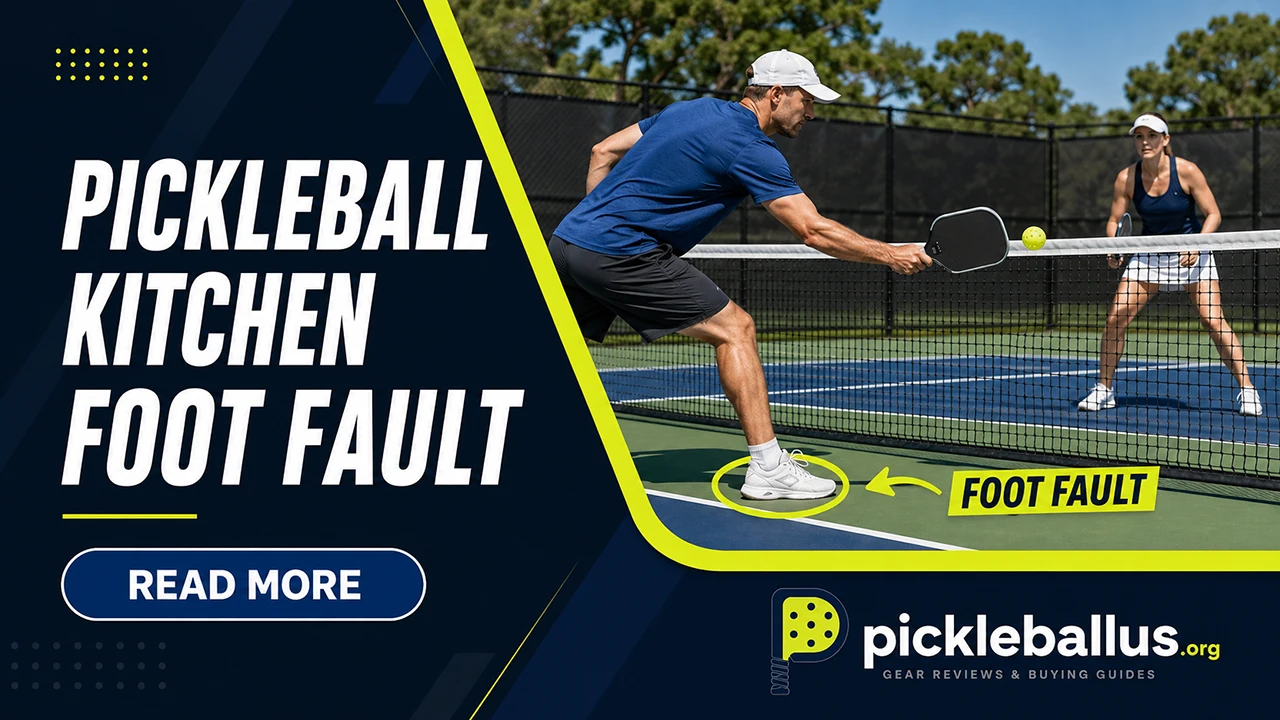
A pickleball kitchen foot fault occurs when a player touches the non-volley zone (NVZ) — or its boundary line — while volleying the ball. Under USA Pickleball Official Rulebook Rule 9.B., any contact between a player and the kitchen during the act of volleying stops the rally and awards the point to the opposing team.
Kitchen foot faults rank among the most common violations at every level of play. They look simple on paper but get complicated when momentum, push-off mechanics, and doubles positioning enter the picture. This guide breaks down every scenario, the exact rules behind each one, and the footwork habits that keep you fault-free at the NVZ line.
What Is a Pickleball Kitchen Foot Fault?
A kitchen foot fault is a specific NVZ violation that happens only during the act of volleying. Unlike the broader category of pickleball fault — which covers out-of-bounds shots, service errors, and double hits — the kitchen foot fault has a single trigger: any part of the player, foot, body, clothing, or paddle, making contact with the NVZ or NVZ line while hitting a volley.
The rule keeps players away from the net during live volleys. Without it, standing at the net and smashing every return at point-blank range would make the game nearly unplayable. The NVZ forces players to let the ball bounce before attacking close to the net, protecting rally quality and rewarding strategic positioning over raw power.
The Non-Volley Zone (NVZ) Explained
The NVZ is the 7-foot-deep rectangle on each side of the net, stretching from sideline to sideline. For a full overview of the zone and how it shapes play, see the pickleball kitchen rule — and if you’ve wondered about the term itself, the background on why it’s called the kitchen in pickleball adds useful context.
Three points to know about the NVZ as a physical space:
- It is a 2D surface, not a 3D volume. Your paddle can arc over the kitchen as long as your feet and body stay behind the line.
- The NVZ line is part of the kitchen. Touching the line equals touching the kitchen.
- You can enter the kitchen freely at any time. The rule applies only when you volley.
What Counts as “Touching” the Kitchen?
Under Rule 9.B., the fault triggers when anything connected to you contacts the NVZ during the act of volleying. That includes:
- Either or both feet
- Your paddle (if it drops into the zone mid-swing)
- Any clothing — hat, wristband, sunglasses
- Your doubles partner, if your bodies are in contact at the moment you volley
The “act of volleying” covers more than the moment of contact. It includes your swing, follow-through, and the momentum generated by the shot. That momentum clause produces more sideline disputes than anything else in this rule.
Does Stepping on the Kitchen Line Count as a Fault?
Yes. The NVZ line is part of the kitchen under Rule 2.B.3. — not a neutral zone like the baseline in tennis. If your toe grazes the line while you volley, even with your heel planted firmly behind it, that is a fault.
The NVZ Line Is Part of the Kitchen
This misunderstanding shows up constantly at recreational courts. Players argue that the line is “outside” the kitchen and that their foot was technically not in the zone. Rule 2.B.3. settles this directly: the NVZ line belongs to the non-volley zone.
Clothing, Paddle, and Partner Contact
The fault extends beyond your feet. During a volley:
- A hat that falls off and lands in the kitchen: fault.
- A paddle that breaks and drops into the NVZ: fault.
- A doubles partner whose foot is on the line while you volley and your bodies are in contact: fault, assigned to the volleying player.
These scenarios reflect a core design principle: the NVZ is a strict zone, and anything you bring into it during a volley is treated as an extension of your body.
5 Kitchen Foot Fault Scenarios You’ll See in Every Game
Most players encounter the same handful of kitchen foot fault situations. Here are the five most common, ranked by frequency in recreational and competitive play.
1. Stepping Into the NVZ During a Volley
The textbook case. A player stands near the NVZ line, a short ball arrives, and they step forward to attack — one foot crossing the line before, during, or after contact. The fix: train your footwork to stop one step short of the line when attacking.
2. The Push-Off Fault
This one catches experienced players. A player volleys near the NVZ line, and the back foot pushes off the line to generate power or recover position. If that foot touches the line at the moment of contact — or before re-establishment outside the zone is complete — it is a fault.
The critical point: the push-off fault is not about where your foot ends up after the shot. It is about whether your foot was touching the NVZ at the moment you volleyed. The kitchen does not care how good the shot was — only where your feet were when you hit it.
3. Momentum Carrying You Into the Kitchen
The most contested scenario. Under Rule 9.C., if momentum from a volley causes you to touch the NVZ after the shot, it is still a fault — even if the ball is already dead, the point is scored, or the rally has ended by other means.
Players who attack aggressively near the transition zone are most vulnerable here. A hard overhead smash, a sharp cross-court put-away — any shot that carries weight forward can produce a fault if a foot reaches the line on the follow-through.
4. Doubles Partner Contact
In doubles, if Player A volleys while Player B (their partner) is touching the NVZ and the two are in physical contact, the fault belongs to Player A. The rule treats bodies in contact as a single unit. This typically happens when partners are stacked tightly near the line and one leans into the other.
5. Follow-Through Contact After Impact
A subtler scenario: a player volleys with both feet behind the line at contact, but the swing causes a knee, elbow, or forearm to graze the NVZ during the follow-through. Because the act of volleying includes the follow-through under Rule 9.B.1., this is still a fault.
Kitchen Foot Fault vs. Service Foot Fault — What’s the Difference?
Both fall under the umbrella of pickleball foot faults, but they govern separate moments in the rally and carry different consequences.
| Kitchen Foot Fault | Service Foot Fault | |
|---|---|---|
| When it occurs | During a volley near the NVZ | During the serve, before ball contact |
| Trigger | Touching NVZ or NVZ line while volleying | Touching the court forward of the baseline |
| Consequence | Fault — point awarded to opponent | Fault — loss of serve (in rally scoring: point to opponent) |
| Momentum rule applies? | Yes — no time limit | No momentum clause |
| Who calls it | Either team or referee | Either team or referee |
The service foot fault is defined under Rule 4.A.1.: the server must keep both feet behind the baseline until contact is made with the ball. It is a cleaner, more time-bounded rule than the NVZ fault, with no momentum clause to complicate it.
What Happens When You Commit a Kitchen Foot Fault?
A kitchen foot fault stops the rally immediately. The faulting team loses the rally and the point goes to the opposing team — regardless of which team was serving. This applies under both traditional side-out scoring and rally scoring. For a full overview of how scoring intersects with fault rules, the pickleball rules hub covers both formats.
Consequences in Recreational Play
In recreational games — the majority of pickleball played — players call their own faults. This applies to kitchen foot faults just as it does to any other violation. Either team can call the fault, and the opposing team is typically better positioned to observe it. Foot faults sit outside Rule 6.D.1. (which governs line calls when the ball contacts the court) and fall under Sections 7–9 of the USA Pickleball rulebook, which leave it open for either team to call.
Consequences in Competitive/Tournament Play
In sanctioned tournament play, a referee calls kitchen foot faults in real time. Players do not need to self-report. In non-refereed tournament matches — common at club-level events — the self-call standard applies.
Who Can Call a Kitchen Foot Fault?
Either team can call a kitchen foot fault. The USA Pickleball Association confirmed this in collaboration with the USAPA Rules Chair: Sections 7, 8, and 9 of the rulebook leave it open for either team. Rule 6.D.1., which some players incorrectly cite to restrict fault-calling to the near team, applies only to line calls when the ball lands near the NVZ — not to foot faults.
The opposing team often has the cleaner sightline. When calling a fault on the other team, players are expected to be certain before making the call, consistent with the sportsmanship standards the game is built on.
How to Avoid Kitchen Foot Faults
Reducing kitchen foot faults requires court awareness and controlled footwork — not just memorizing the rule. Players who drill their NVZ positioning consistently commit far fewer faults under game-speed pressure.
Three Footwork Drills at the NVZ
1. The Freeze Drill. Have a partner feed volleys from across the net. After each shot, freeze for two seconds. Check: are both feet behind the NVZ line? Is any part of your body or clothing past the line? Run this drill for 10-minute blocks until the frozen-behind-the-line position is automatic.
2. Shadow Stepping. Without a ball, approach the NVZ line from the transition zone and stop exactly one step behind it. Repeat with lateral movement — approach from the right, stop; approach from the left, stop. This trains proprioception and line awareness without the distraction of a live rally.
3. Push-Off Awareness. Stand with your back foot near the NVZ line. Simulate a volley motion and check where that foot ends up. Many players find their toe drifts onto the line during the push. Practice keeping the back foot fully behind the line through the full swing.
Balance and Positioning Habits
Beyond drills, these habits reduce fault frequency in live play:
- Lead with your paddle, not your feet. When a short ball arrives at the NVZ, extend your paddle forward rather than stepping into the zone. Your reach is longer than most players expect.
- Land behind the line deliberately. After any overhead or put-away, plan to land with both feet behind the NVZ line. If a forward step is unavoidable, take it after the ball is gone — but only after re-establishing position.
- Use partner communication in doubles. A partner positioned behind you sees your feet more clearly than you do. Develop a signal: your partner calls “line” when your foot grazes the NVZ, so you know immediately rather than three shots later.
With the main rule, its most common scenarios, and the drills to fix them all covered, most players have what they need to stop losing points to kitchen foot faults. But there is a gap between knowing the rule and understanding why certain plays still get called as faults even when they look clean — and that gap lives in three concepts that standard explainers skip. The next section addresses the momentum rule’s unlimited time horizon, the precise standard for re-establishment after entering the kitchen, and the doubles chain fault that transfers your partner’s NVZ contact directly to you.
Advanced Kitchen Fault Rules Most Players Get Wrong
The core rule is clear. The edge cases below are where player knowledge typically ends — and where rallies are most likely to be disputed at the club and tournament level.
The No-Time-Limit Momentum Rule
Rule 9.C.1. states there is no end time to the momentum rule. If you volley a ball and forward momentum eventually causes you to touch the NVZ — even after the ball is dead, the point is scored, or the game ends — it is still a fault. The rule explicitly covers four moments that players mistakenly believe reset the clock:
- The opponent returns the ball (rally continues)
- A rally ends and a point is scored
- The ball is called dead
- The game ends
None of these events reset the momentum requirement. The most common real-world scenario: a player hits an overhead smash and their forward movement carries one foot past the NVZ line a half-second after the ball lands in the opponent’s court. The point appears scored — but the momentum fault negates it.
Re-Establishment: Both Feet Fully Outside
Re-establishment is the standard a player must meet after entering the kitchen (for a legal ground stroke under the pickleball two-bounce rule) before volleying again. Under Rule 9.D., the standard is strict: both feet must make full contact with the playing surface outside the NVZ, without touching the NVZ line. One foot does not satisfy it. “Mostly outside” does not satisfy it.
This matters most when a player dinks from inside the kitchen, steps out, and immediately receives a fast return they want to volley. If they volley before fully re-establishing both feet, it is a fault — even though the dink was legal. The safe standard: if there is any doubt, assume you have not re-established. Let the ball bounce, or take one deliberate step to confirm both feet are clear.
The Doubles Chain Fault
The doubles chain fault is the least intuitive scenario in this category. If Player A volleys while Player B (their partner) is touching the NVZ — and Players A and B are in physical contact at that moment — Player A commits the fault. Player B’s NVZ contact transfers to Player A through the chain of physical contact.
This rule prevents a team from placing one partner anchored in the kitchen while the other volleys, passing NVZ contact invisibly between them. The faulting player is always the one executing the volley — but the triggering contact can originate with their partner.
In pickleball kitchen line strategy, experienced doubles teams stay aware of proximity and accidental body contact near the NVZ precisely because of this chain rule. Maintaining a shoulder-width gap between partners at the line eliminates the risk entirely.



Write Your Review
No reviews yet. Be the first to share your experience!