

A foot fault in pickleball is any violation where a player’s feet cross a restricted boundary at the wrong moment — during a serve, a volley, or from the momentum of a shot. There are three distinct types: the serving baseline fault, the kitchen (NVZ) foot fault, and the push-off momentum fault. Each one is governed by a specific rule, occurs at a different moment in play, and requires a different correction.
Each type carries its own consequence — serving baseline faults cost the server their turn; kitchen foot faults end the rally outright, awarding the point to the opposing team. Knowing which rule applies to which situation is the first step toward cleaner play.
Most foot faults don’t happen because players are careless — they happen because controlling foot position at game speed is physically hard. The moment a volley exchange heats up at the kitchen line, or when a server drifts forward on a big swing, the boundary disappears from conscious awareness.
This guide covers every type of pickleball foot fault, the USA Pickleball rules that govern them, what each one costs you, and the court habits that prevent them.

What Is a Foot Fault in Pickleball?
A foot fault in pickleball is a rule violation where a player’s feet contact or cross a restricted zone boundary at a defined moment of play. Under pickleball rules, foot faults are a subcategory of pickleball fault — rule violations that immediately stop the rally and result in either a loss of serve or a point awarded to the opposing team.
Foot faults differ from other common faults like hitting out of bounds or violating the two-bounce rule: the violation is not about where the ball lands — it is about where your feet are at the moment you make contact with the ball, or what your feet do after contact due to forward momentum.
Two boundary zones generate virtually all foot faults in pickleball: the baseline (serving line) and the non-volley zone line (kitchen line). Understanding the exact rule language for each zone separates players who guess at these calls from players who understand them with confidence.
The Two Zones Where Foot Faults Happen
The baseline is the back boundary of the pickleball court, running parallel to the net. It is the line the server must stay completely behind when making contact with the ball. The non-volley zone (NVZ) line — the kitchen line — runs 7 feet from the net on both sides of the court. This line, and the zone it encloses, is where kitchen foot faults originate.
These two lines are physically separate, govern different moments of play, and carry different consequences when violated. Serving foot faults can only occur during the serve; kitchen foot faults can occur during any volley exchange at any point in the rally — first exchange or fifteenth.
What Counts as “Touching” the Line?
Under USA Pickleball rules, touching the line counts as being on it — there is no partial credit for a toe on the edge. For the serving baseline, any contact at the moment of the swing, whether with the toe, heel, or any part of the shoe, is a fault.
The serving baseline rule has one distinction from the kitchen rule: momentum after contact is allowed. If a server’s forward drive carries them across the baseline after the paddle strikes the ball, that is not a fault. The rule governs the position of the feet at the moment of ball contact. The kitchen rule has stricter momentum language — addressed in the push-off fault section below.
Types of Pickleball Foot Faults
There are three types of pickleball foot faults: the serving baseline fault, the kitchen NVZ fault during a volley, and the push-off momentum fault. Each type is governed by different rule language, occurs at a different moment in play, and requires a different correction.
Serving Foot Fault — Baseline Violations
A serving foot fault occurs when a server’s feet violate the baseline boundary at the moment the paddle makes contact with the ball. USA Pickleball rules require the server to keep both feet behind the baseline — not touching it — during the serve swing.
The pickleball serving rules define three specific zones that are off-limits at the moment of contact:
| Zone | Rule | Common Mistake |
|---|---|---|
| The baseline itself | Feet cannot touch or be on the baseline | Server drifts forward on a big swing |
| Imaginary centerline extension | Feet cannot cross the imaginary continuation of the centerline | Server crowds the middle of the court |
| Imaginary sideline extension | Feet cannot touch outside the imaginary continuation of the sideline | Server angles too wide laterally |
The centerline and sideline extension rules catch many experienced players off guard. A server whose feet land laterally outside the imaginary continuation of the sideline — even while staying behind the baseline — is committing a fault. The serve box is bounded laterally, not just by depth.
After the paddle strikes the ball, the server is free to step forward. Forward momentum that carries the server across the baseline post-contact is not a fault.
Kitchen (NVZ) Foot Fault During a Volley
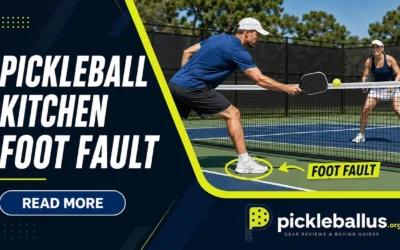
A kitchen foot fault occurs when a player steps into or makes contact with the non-volley zone — including the NVZ line itself — while hitting a volley. A volley is any shot struck before the ball bounces on the court.
The NVZ line is treated the same as the NVZ itself: touching the line while volleying is a fault. Players near the kitchen line must keep both feet behind the NVZ line, not merely out of the kitchen zone. This distinction trips up players transitioning to the kitchen during fast exchanges — the line is the boundary, not an inch inside it.
The pickleball kitchen foot fault rule applies during the entire volleying motion, not only the split second of paddle contact. USA Pickleball defines the act of volleying to include the swing, the follow-through, and the momentum from the action.
The Push-Off (Momentum) Foot Fault
The push-off foot fault is the most misunderstood rule in pickleball — forward momentum from a volley that carries a player into the NVZ after contact is still a fault, even after the point is technically over.
This is where pickleball differs from casual court intuition: the rally ending does not cancel the fault. If a player pushed off outside the kitchen to generate power on a volley, and that momentum deposits their foot in the NVZ after the ball is hit, it is a fault. The point goes to the opponent even if the shot was clean and unreturnable.
The concept governing this rule is re-establishment. Re-establishment means both feet must be completely outside the NVZ and not touching the NVZ line before hitting a volley. If a player stepped into the kitchen during the previous exchange, even to retrieve a dink, they must fully re-establish position outside the kitchen before volleying again. Hitting a volley without re-establishing is a fault regardless of foot position at the exact moment of contact.
Consequences of a Foot Fault in Pickleball
The consequence of a foot fault depends on when it occurs and who commits it. USA Pickleball applies two different penalties depending on whether the fault occurs during the serve or during a live rally.
Foot Fault on the Serve — What Happens?
A serving foot fault results in a loss of serve — no point transfers to the opposing team; only the serve does. In doubles, the serving player’s turn ends, and the second server on the team takes over. If both servers have faulted, the serve passes to the opposing team entirely.
Serve foot faults are treated identically to other service faults. The rally does not count, no points change hands, and the server does not receive a second serve as in tennis. Each serve attempt is independent — a foot fault on the first attempt means the serve is gone, not delayed.
Kitchen Foot Fault During a Volley — What Happens?
A kitchen fault during a rally produces an immediate rally loss — the faulting team loses the point. Under traditional side-out scoring, if the serving team commits a kitchen fault, the serve transfers without a point. If the receiving team commits it, the serving team earns a point.
The rally-ending consequence applies equally to the push-off momentum fault. If momentum carries a player into the NVZ after an apparent winning volley, the shot is void: the point goes to the opponent. Whether the ball landed in or out, and whether the opponent could have returned it, is irrelevant once a kitchen fault is confirmed.
How to Avoid Foot Faults in Pickleball
Eliminating foot faults requires combining court positioning habits with footwork mechanics. Foot faults rarely happen because players don’t know the rules — they happen because controlling foot position under pressure at game speed hasn’t been trained into muscle memory.
Fix Your Serve Stance — Baseline Discipline
Stand 6 to 12 inches behind the baseline before serving, not pressed against it. This buffer absorbs the natural forward drift in a serve swing without risking baseline contact.
Before each serve, take a deliberate look at your feet. Confirm they are behind the line, not crowding the centerline, and within the lateral boundary of the service area. Players who adopt this pre-serve foot check as a ritual reduce baseline foot faults measurably within two to three sessions.
Avoid inching closer to the baseline for serve power. The baseline distance has minimal effect on serve speed compared to swing mechanics — the cost of a fault outweighs the marginal gain from one inch of forward positioning.
Kitchen Awareness Drills for NVZ Fault Prevention
Pickleball footwork drills focused on kitchen awareness target the root cause of NVZ foot faults: rushing forward without controlling deceleration. Two habits are foundational.
The split-step is the most important kitchen-line tool. Before each volley near the NVZ line, plant both feet with a small split-step — feet roughly shoulder-width, balanced, stationary — before making contact. Players who split-step before volleys at the kitchen naturally stop their forward momentum before it carries them across the line.
The shadow footwork drill trains feet to stop precisely at the NVZ line under simulated pressure. Walk to the kitchen line repeatedly, stopping on the last step before the line. Increase speed over time. The goal is training the deceleration reflex so feet don’t cross the line when the game accelerates.
Avoid the “chasing the net” habit — advancing to the kitchen during every exchange without a disciplined final stop. Aggressive net approaches without a split-stop are the most common cause of kitchen foot faults in recreational play.
Re-Establishing Outside the NVZ Before Volleying
Re-establishment is the single most important habit for eliminating push-off momentum faults. After entering the kitchen for any reason — retrieving a dink, landing after a momentum carry — both feet must be outside the NVZ line before volleying the next ball.
The pause-and-check is the practical version of this habit: after any kitchen entry, confirm both feet are outside the NVZ line before swinging. In fast exchanges, this pause is brief — but without it, players who frequently enter the kitchen accumulate momentum faults they don’t know they’re committing.
Drills alternating dink shots from inside the kitchen with volleys from outside train re-establishment automatically. The pickleball kitchen transition drill — dink from inside the NVZ, step out, re-establish, then volley — builds the physical pattern of checking position before every air strike.
How Foot Faults Are Called in Pickleball
Foot fault protocol differs significantly between officiated tournament play and recreational games — knowing both settings prevents disputes and keeps matches fair.
Referee-Called Faults in Tournament Play
In officiated matches, a certified referee can call foot faults on any player at any time. Referees observe both the baseline during serves and the NVZ line during volleys, though catching every push-off momentum fault in a live rally is demanding even for experienced officials.
If a referee calls a foot fault, the fault stands. Players may not contest the call outside of a formal appeal process. The rally ends immediately at the moment the fault is signaled.
Calling Foot Faults in Recreational and Non-Officiated Play
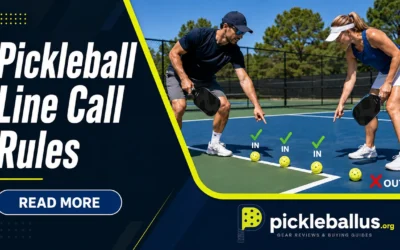
Most pickleball — recreational open play, leagues, and informal matches — is non-officiated. Players self-call faults and call faults on opponents. Foot fault calls on opponents are among the most sensitive disputes in recreational play.
According to DUPR referee guidance, there are two acceptable outcomes when an opponent calls a foot fault on you in a non-officiated match: the called player agrees and the fault stands, or the called player disagrees and the point is replayed. Only one player needs to agree a foot fault occurred for the replay to proceed. This keeps disputes clean and avoids arguments that stall the game.
A useful self-monitoring habit: at the end of any disputed point, freeze in place and look at your feet before moving. Are you in the kitchen after a volley? Did you drift past the baseline on the serve? Self-calling builds court discipline and is a practice the best recreational players maintain at every skill level.
By now you understand every type of pickleball foot fault, the specific zones where they occur, and the consequences each violation carries. Knowing the rules, however, is only half the equation — the other half is building physical habits that keep your feet in the right place under pressure, at game speed, when awareness is hardest to maintain. The next section covers the edge-case rules that referees look for, the scenarios that trip up even experienced players, and the self-calling practices that keep recreational games fair without an official on court.
Foot Fault Edge Cases and Advanced Rules Most Players Miss
Beyond the baseline and NVZ violations in the main rules, USA Pickleball governs several edge cases that even experienced players — and some referees — don’t consistently apply correctly.
The Imaginary Line Extension Fault During the Serve
Most players know they cannot touch the baseline while serving. Fewer know that feet cannot touch outside the imaginary extensions of the sideline or the centerline during the serve either. The valid serving area is a rectangle: bounded behind by the baseline, laterally by the imaginary continuation of the sideline, and inward by the imaginary continuation of the centerline.
A server positioned too close to the center, with feet crossing the imaginary centerline extension, is faulting. A server standing too wide, with feet outside the imaginary sideline extension, is also faulting — even if they haven’t touched the baseline. Both are legitimate fault calls, though rarely observed in recreational play.
Partner Foot Fault in Doubles — Does It Count?
In doubles, serving foot fault rules apply only to the server, not the server’s partner. The non-serving player can stand anywhere on their side of the court — near the kitchen, at the baseline, or anywhere between — without committing a service fault.
NVZ foot faults apply to any player who volleys while standing in the kitchen, regardless of position. If the non-server moves to volley a ball while inside the NVZ, that is a kitchen fault. The rule governs who makes contact with the ball in the air, not proximity to the zone.
How to Handle Disputed Foot Faults Without a Referee
The most effective approach to disputed foot faults in recreational play uses three steps: stay calm, apply the freeze-and-look technique after contested moments, and use the replay protocol when genuine disagreement persists.
Freeze-and-look means stopping in place at the end of any disputed point and checking foot position before moving. If you’re in the kitchen after a volley, call it on yourself. If your position is clearly outside the NVZ line, you have reasonable grounds to dispute the call. Pickleball beginner mistakes frequently include failure to self-call on obvious kitchen entries — a habit that erodes trust and makes games harder to enjoy for everyone.
In rated play through platforms like pickleball DUPR rating, unresolved foot fault disputes follow a replay convention: any good-faith dispute that players cannot resolve by agreement becomes a replayed point. This prevents fault calls from becoming competitive leverage while acknowledging the rule’s validity.


Write Your Review
No reviews yet. Be the first to share your experience!