

A double hit in pickleball is legal under one strict condition: the contact must happen within a single, continuous stroke in one direction by one player. USA Pickleball Rule 11.A permits this type of contact — a ball that ticks your paddle twice in one natural swing is a valid shot, not a fault. Understanding this rule changes how players make real-time calls during fast exchanges at the kitchen line, where contact is less controlled.
What trips most players up is not the rule itself — it is knowing which situations cross the line. A double hit becomes a fault the moment the ball changes direction between the two contacts, when a second player on your team also strikes the ball, or when the motion clearly breaks into two separate swings. These distinctions are easy to miss during high-speed rallies, and missed calls in recreational play cause more disputes than almost any other rule.
The other concept players confuse with the double hit is the carry — when the ball slides or rests on the paddle face instead of bouncing cleanly off it. As of the 2024 USA Pickleball rulebook update (Rule 7.L), a carry is a fault regardless of whether the player intended it or not. Before 2024, only intentional carries were called faults, which created inconsistent rulings. The current rule removes that ambiguity entirely.
Below is a complete breakdown of the double hit rule: when it is legal, when it is a fault, how it differs from a carry, and what to do in both recreational and competitive play when a disputed double hit occurs.
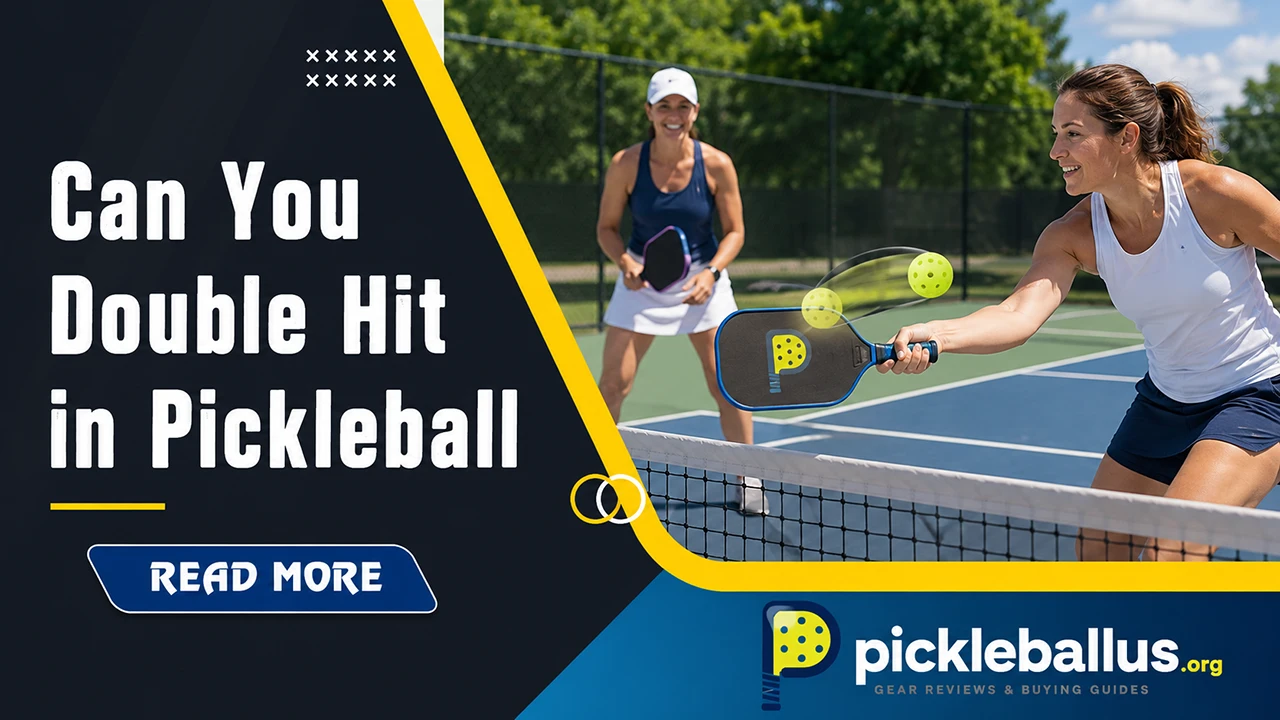
What Is a Double Hit in Pickleball?
A double hit occurs when the paddle makes two separate contacts with the ball during a single swing. It is one of pickleball’s most misunderstood rules because the instinctive reaction — “you hit the ball twice, that’s a fault” — contradicts the actual rulebook, which permits it under specific conditions.
Double hits happen because of the physics of the game. At the kitchen line, players often contact the ball at an angle where it briefly rolls or ticks along the paddle face rather than bouncing cleanly away. On defensive shots struck under pressure, a compact swing can produce two contact points within milliseconds. These are rarely intentional — they result from normal shot mechanics and court positioning.
Intentional vs. Unintentional Double Hits
The distinction between intentional and unintentional double hits matters less than most players assume. USA Pickleball does not require the double hit to be unintentional for it to be legal — the only legal criterion is stroke mechanics: continuous motion, single direction, one player. A player who deliberately brushes the ball twice in one forward swing has not committed a fault, provided both conditions are met.
What makes a double hit illegal is not the player’s intent — it is the mechanical outcome. If the ball’s direction visibly changes between the first and second contact, the player has effectively struck the ball a second time as a separate act, which is a fault under the pickleball rules. Intent does not factor into the ruling.
When Double Hits Happen Most Often
Double hits occur most frequently in four situations:
- Kitchen line exchanges (dinks): The ball arrives low and with pace, and the paddle angle causes it to skid across the face before leaving.
- Defensive blocks: A hard drive forces a compact, rushed paddle movement — two contact points can occur within milliseconds.
- Backhand returns with slice: The paddle undercuts the ball, and on follow-through, the ball occasionally contacts the paddle edge a second time.
- Drop serve attempts: Players sometimes clip the ball twice if their hand positioning is off at the moment of contact.
In all four cases, the double hit is typically unintentional and happens fast enough that neither player can confidently confirm it occurred. This is why the rule’s clarity on what makes it legal — and who makes the call — is so important.
Can You Double Hit in Pickleball? The Official Answer
Yes, you can double hit in pickleball — but only when both contacts happen within a single, continuous stroke in one direction by one player. USA Pickleball Rule 11.A is the controlling rule. Under it, the ball may contact the paddle twice in one swing without the shot being called a fault, provided neither the stroke direction nor the player involved changes.
That rule contains three conditions that must all be true simultaneously: (1) one continuous stroke, (2) a single direction of ball travel, (3) one player only. If any condition fails — the ball reverses course, the swing breaks into two distinct movements, or a second player touches the ball after the first — the double hit is a fault.
When a Double Hit Is Legal
A double hit is legal when all three of the following apply:
1. Continuous motion. The paddle does not stop, reset, or pause between the two contacts. From the player’s perspective, they made one swing — the two contacts happened within that single physical movement. There is no “windup, hit, windup again, hit again” in a legal double hit. It is one fluid arc.
2. Single direction. The ball travels in the same direction after both contact points. If the first hit sends the ball forward and the second redirects it sideways or backward, the shot fails this criterion. The ball’s trajectory after both contacts should look like the result of one intentional shot, not two competing redirections.
3. One player only. In doubles, a double hit by two different players — partner A grazes the ball first, partner B hits it second — is always a fault. Both players on a team cannot contribute to hitting the same shot.
The following table summarizes what qualifies each condition. A continuous stroke means one unbroken swing motion with no pause or reset between contacts. Single direction means the ball does not change course between the first and second contact. One player means only the individual making the original swing touches the ball — no partner contact allowed.
| Condition | What It Requires | Common Failure |
|---|---|---|
| Continuous stroke | One unbroken swing — no pause or reset | Stopping and re-swinging between contacts |
| Single direction | Ball does not change course between contacts | Ball deflects on second contact point |
| One player | No partner contact on the same shot | Teammate’s paddle also touches the ball |
When a Double Hit Is a Fault
Direction change. The ball clearly travels in one direction on first contact, then visibly reverses or deflects on the second. This tells the referee or watching players that two distinct forces acted on the ball — the player effectively hit it twice, not once with two incidental contacts.
Two players contact the ball. In doubles, if player A and player B both make paddle contact on the same rally shot, that is an automatic fault. It does not matter if the contacts were nearly simultaneous. The rule requires only one player to strike the ball per shot.
Separate swing motions. A player who swings, makes contact, pauses the paddle, then swings again for a second hit has produced two distinct strokes — not a single continuous motion. This is a fault even if the ball happened to travel in the same direction across both hits.
Double Hit vs. Carry in Pickleball — What’s the Difference?
A double hit and a carry are two separate fault situations, and the terms are not interchangeable. A double hit involves two distinct contact points of the paddle striking the ball. A carry occurs when the ball does not bounce cleanly off the paddle but instead slides along the paddle face or momentarily rests on it before releasing.
Both can happen within a single swing, and both occur most often at the kitchen line during soft play. The key physical difference: a double hit produces two impact events, while a carry is one prolonged contact event where the ball is guided or scooped rather than struck.
What Is a Carry in Pickleball?
A carry happens when a player’s paddle surface traps or guides the ball rather than rebounding it sharply. Instead of an audible pop on contact, a carry often produces a softer, delayed release. On camera, the ball can be seen resting against the paddle face a fraction of a second longer than a normal strike.
Carries are most common on:
- Soft dink attempts where the player angles the paddle sharply upward to lift the ball
- Defensive shots where the player reacts late and catches the ball at an awkward angle
- Drop shots executed with an excessively open paddle face
The 2024 Rule Change — Carries Are Always a Fault
Before the 2024 USA Pickleball rulebook update, a carry was only called a fault if the referee or players could determine it was intentional. Rule 7.L was changed so that a carry is now a fault whether intentional or not.
The practical effect: if the ball visibly slides or rests on the paddle longer than a normal clean contact — regardless of whether the player meant to guide it — it is a fault. Players cannot argue they “didn’t mean to” carry the ball. The motion is judged on what physically happened, not the player’s intention.
This 2024 update brings the carry rule in line with how double hit faults are treated: judgments are based on observable mechanical outcomes, not intent.
Common Double Hit Scenarios — Legal and Illegal Examples
The abstract rule is easier to apply when matched against specific in-game situations. The following scenarios cover the most frequently debated double hit situations in recreational and competitive pickleball.
Accidental Double Hit on a Groundstroke (Usually Legal)
Scenario: You hit a return groundstroke from the baseline. The ball makes clean first contact and, due to your follow-through angle, briefly ticks the paddle edge a second time as the ball is already leaving.
Ruling: Legal. The second contact happened within the same continuous forward motion. The ball’s direction did not change between the first and second tick. This is the most common form of a legal double hit, and it is so fast that players often cannot tell it occurred. If you hear a slight double pop on your groundstroke but the ball traveled where you intended, the shot is almost certainly legal.
Double Hit at the Kitchen Line During a Dink (Context-Dependent)
Scenario: You attempt a soft cross-court dink. The ball hits the paddle face, then catches the paddle edge a second time — but the second contact sends the ball in a noticeably different direction than your original shot intended.
Ruling: Fault. Even though both contacts happened close together in time, the ball changed direction on the second hit. A double hit that redirects the ball is a fault under Rule 11.A, regardless of how unintentional the direction change was.
However — if the same dink produces two contacts and the ball still travels in the same cross-court line you aimed for, that double hit is legal. The direction test is the deciding factor.
Teammate Contact After Your Hit (Always a Fault)
Scenario: In doubles, you step forward and hit a volley. The ball glances off your paddle, and before it clears the net, your partner’s paddle also makes contact.
Ruling: Fault. Under Rule 11.A, only one player may contact the ball per shot. Two players on the same team cannot both strike the same ball on a single rally shot. This is true even if the partner contact was accidental — intent is not a factor. The pickleball fault is called automatically when two paddles from the same team contact the same ball.
Double Hit on the Serve (Gray Area)
Scenario: During a drop serve, you drop the ball and swing — but the paddle clips the ball twice during the serving motion.
Ruling: Depends on mechanics. The same Rule 11.A conditions apply on the serve. If both contacts occurred within one continuous downward-forward swing motion and the ball traveled in the same direction, the serve is legal. If the player clearly tapped the ball, reset their paddle, and tapped again in two separate motions, that is a fault.
A practical wrinkle in non-officiated play: only the server has a clear line of sight to the serving hand and contact point. The opponent typically cannot confirm a double hit on the serve from across the court. Double hit calls on serves in recreational play are almost exclusively self-calls by the serving player.
How to Avoid Double Hit Faults in Pickleball
The most effective way to avoid double hit faults is clean, decisive paddle contact — using a firm wrist position and a clear paddle angle before the ball arrives. Players who hesitate mid-swing, guess at the last second, or use an overly open paddle face at the kitchen are most likely to produce accidental direction-changing double hits.
Paddle Mechanics That Reduce Double Hits
Wrist firmness. A loose wrist at the point of contact creates unpredictable paddle face angles. When the paddle face flexes slightly on impact, the ball can ride the surface longer, increasing the chance of double contact. A firm but relaxed wrist at impact keeps the face stable.
Grip pressure. Neither a death grip nor a loose hold is optimal. Medium grip pressure — roughly 4–5 on a 10-point scale — keeps the paddle from twisting on off-center contact without absorbing shock too rigidly. Learning how to grip a pickleball paddle correctly reduces erratic face angles that produce double hits.
Swing plane. A compact, forward swing plane with a clear follow-through is less likely to produce double contact than a choppy or interrupted stroke. Players who punch dinks with a short forward motion rather than guiding or pushing the ball produce cleaner, more reliable contact.
Kitchen Line Positioning and Footwork
The kitchen line is where most double hits occur. Players who are slightly out of position — too close to the kitchen, leaning too far forward, or off-balance — tend to produce forced contact where the paddle angle is uncontrolled.
Staying one full step behind the kitchen line with a centered, balanced stance gives players the optimal reach range for dink shots. Combined with awareness of the pickleball kitchen rule and pickleball foot faults — particularly avoiding steps into the NVZ on volleys — correct positioning eliminates many of the rushed, awkward angles that cause double hits.
By now you have a clear picture of when a double hit is legal, when it crosses into fault territory, and how it differs from the carry rule. These rules govern every shot in every rally — and for the vast majority of recreational players, applying them comes down to honest self-calls in non-officiated settings. However, tournament play and the professional circuit introduce a different dynamic: who has the authority to call a double hit, how referees evaluate the shot in real time, and where the rulebooks of the PPA and USA Pickleball actually diverge. The next section covers the finer points that matter when points and rankings are on the line.
Double Hit Rules in Tournament and Professional Pickleball
In competitive play, double hit calls are governed differently than in recreational settings — the authority to make the call, who has access to it, and which rulebook applies all shift depending on the level of play.
Who Makes the Call in Non-Officiated Recreational Play
In non-officiated club and recreational play, USA Pickleball rules state that players call faults on their own side of the net. A double hit call against yourself is a self-call — you are expected to call your own faults if you know or are fairly certain a fault occurred.
Your opponent cannot enforce a double hit call from across the net. If they believe you double-hit the ball but you did not feel or hear it, there is no mechanism in recreational play for the opponent to overturn your assessment without your agreement. Unlike foot faults near the non-volley zone, which opponents can call from across the net, double hit calls are not enforceable without the offending player’s acknowledgment in most recreational settings.
The practical takeaway: call the fault on yourself if you are certain you double-hit. If you are unsure, play on — and if your opponent disputes it, the shot stands in your favor absent clear evidence.
How Double Hits Are Handled in Officiated Tournament Play
In USA Pickleball-officiated tournaments, a referee can call a double hit if they observe clear evidence — a visible ball direction change, audibly separate impacts, or an obvious two-stroke swing. However, double hits happen fast enough that they are often not called even in officiated matches, particularly the legal version where both contacts occur in one continuous motion.
When a double hit produces an obvious direction change, tournament referees call it a fault. Players have limited recourse to challenge the call, though they may appeal to a head referee in some tournament formats.
The PPA Tour and Double Hit Rules
The PPA Tour largely aligns with USA Pickleball on double hits, though the PPA has made independent rule modifications in other areas (such as prohibiting the drop serve and the chainsaw spin serve). On the double hit question, the PPA has not diverged from Rule 11.A’s core framework: legal when continuous, unidirectional, and executed by one player.
At the PPA Tour level, illegal double hits are rare because professional stroke mechanics are refined — the kind of off-balance contact that produces direction-changing double hits is unusual at that level. When double hit questions do arise in professional play, they tend to involve soft reset shots near the kitchen where contact angles are most compressed.
Double Hits on the Serve — A Gray Area
The double hit on the serve is an edge case worth understanding within the broader context of the pickleball serving rules. The volley serve requires a continuous, below-waist, downward arc; the drop serve requires the ball to be dropped naturally without added force. In either case, a double hit on the serve follows Rule 11.A logic: continuous motion plus single direction plus one player equals a legal serve.
Where this gets complicated: in non-officiated play, only the server has a clear line of sight to the serving hand and contact point. The receiver typically cannot confirm a double hit on the serve from serving distance. For this reason, double hit calls on serves in recreational play are almost exclusively resolved as self-calls by the serving player.
Write Your Review
No reviews yet. Be the first to share your experience!