

Pickleball court shoes outperform running shoes in every metric that matters on the court: lateral stability, outsole traction on hard surfaces, midsole firmness under multidirectional stress, and reinforced upper support that prevents ankle rolls. Running shoes, by contrast, are engineered exclusively for a heel-to-toe stride — a motion that accounts for roughly 20% of what your feet actually do during a pickleball rally.
The comparison matters because the structural differences are not subtle. A running shoe built with a high-stack foam midsole and a rocker-profile sole raises your center of gravity and introduces instability the moment you shuffle sideways, split-step, or plant hard for a dink at the kitchen line. Court shoes eliminate those failure points through a lower profile, firmer midsole density, and lateral support structures woven into the upper itself.
Most players switching from running to pickleball underestimate how much footwear affects performance — until they roll an ankle or notice their running shoes wearing out unevenly after just a few sessions. The outsole tread on a running shoe is optimized for pavement, not for the herringbone-grade grip demands of a hard court surface. Traction that works on an asphalt trail fails during a quick lateral shuffle on a sport court.
Below is a full breakdown of how these two shoe categories compare across every structural dimension — and a practical guide to choosing the right court shoe for your surface, foot type, and play frequency.
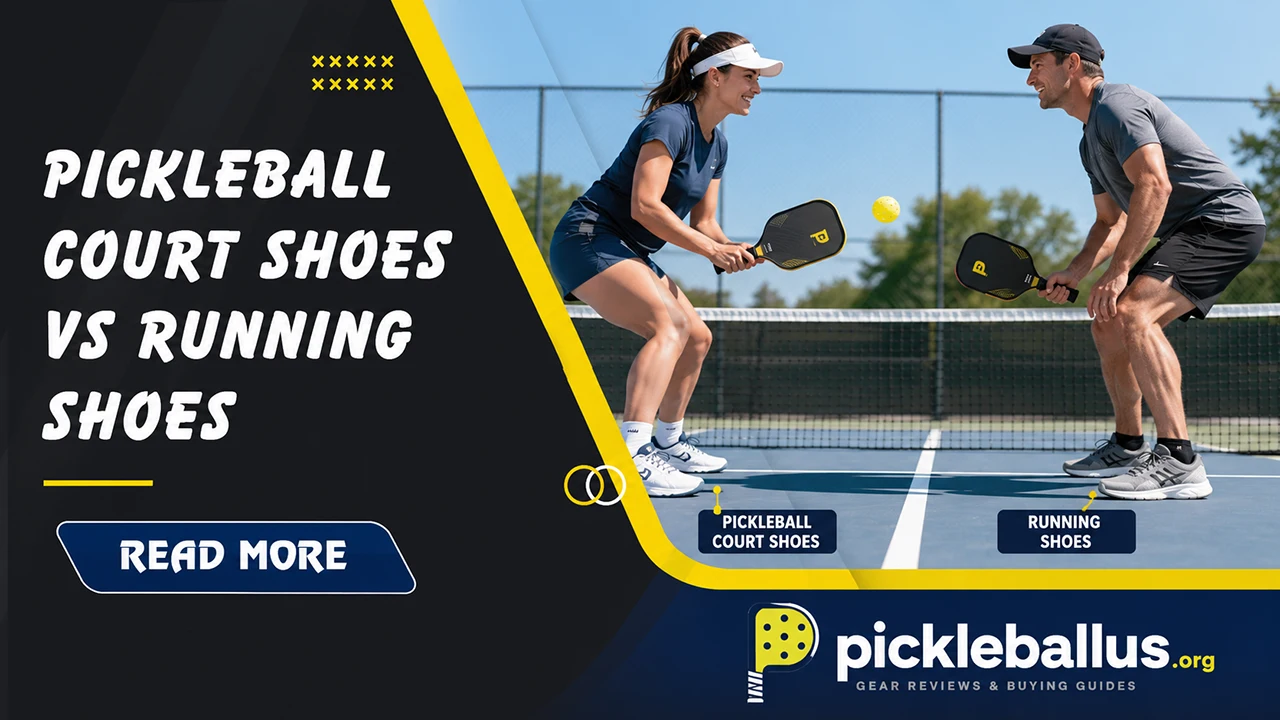
Can You Wear Running Shoes for Pickleball?
Wearing running shoes for pickleball is not recommended because they lack the lateral stability, outsole traction pattern, and midsole firmness that the sport’s multidirectional movement demands — making rolled ankles, slips, and joint fatigue significantly more likely. For casual backyard play or a one-time session on a soft surface, they pose lower risk. For any regular court play — indoor or outdoor — they are a liability.
The short answer is technically yes, you can wear them, but the structural mismatch creates real consequences. Running shoes are designed around a single, efficient movement: forward propulsion from heel to toe. Every element of their construction — the curved rocker sole, the high-stack foam cushioning, the flexible mesh upper — serves that one goal. Pickleball demands the exact opposite profile in almost every dimension.
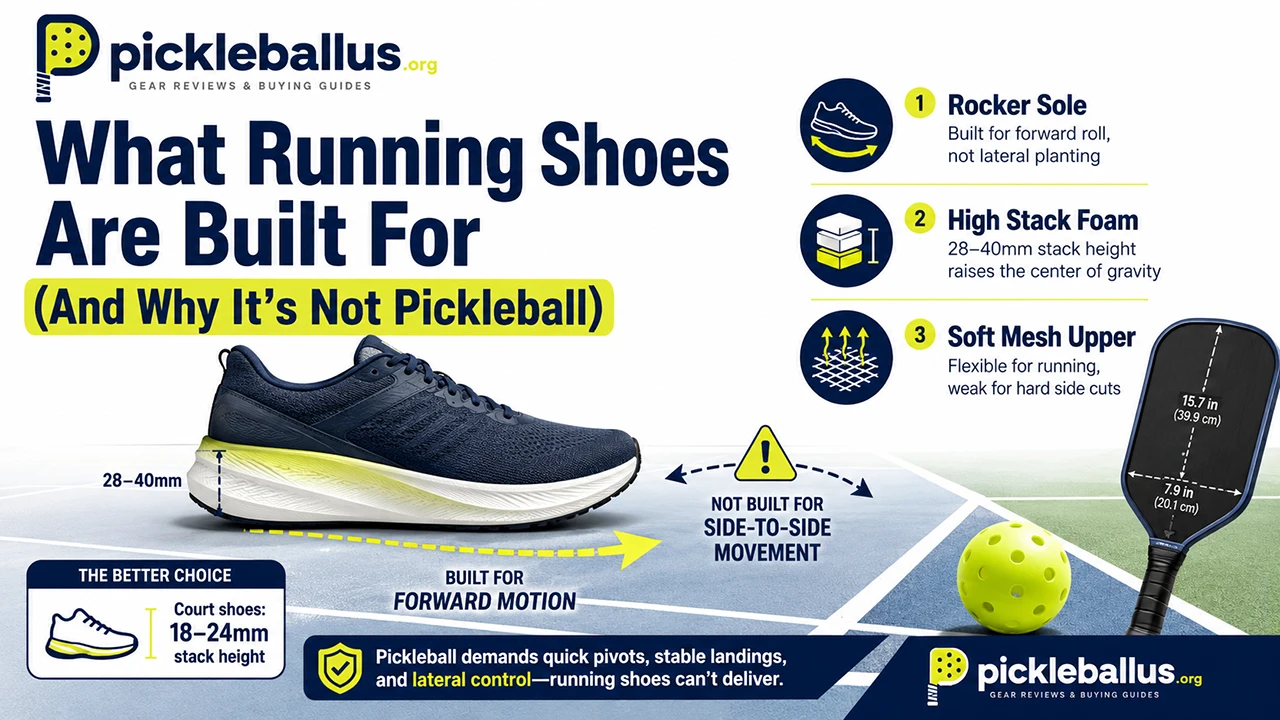
What Running Shoes Are Built For (And Why It’s Not Pickleball)
Running shoes prioritize forward-motion efficiency through a heel-to-toe rocker profile and high-stack midsole foam — two design features that actively undermine court stability. The rocker sole curves upward at the toe and heel to encourage smooth forward roll. On a running track, this propels you efficiently. On a pickleball court, it means your foot has no stable flat platform to pivot on, split-step from, or plant laterally against.
Stack height — the total midsole thickness from ground to foot — in running shoes typically ranges from 28mm to 40mm. Modern max-cushion running shoes like the Hoka Bondi or Brooks Ghost sit at 33–38mm. By comparison, court shoes typically run 18–24mm. That 10–15mm difference represents a measurable shift in your center of gravity. On a flat court surface where all lateral force is generated from the ground up, a higher stack means more leverage working against you during any sideways movement.
The mesh upper on a running shoe is intentionally soft and flexible to reduce weight and allow natural foot splay during the push-off phase of a stride. That same flexibility provides zero resistance when your foot rolls over the sole edge during a hard lateral cut.
The Injury Risk of Playing Pickleball in Running Shoes
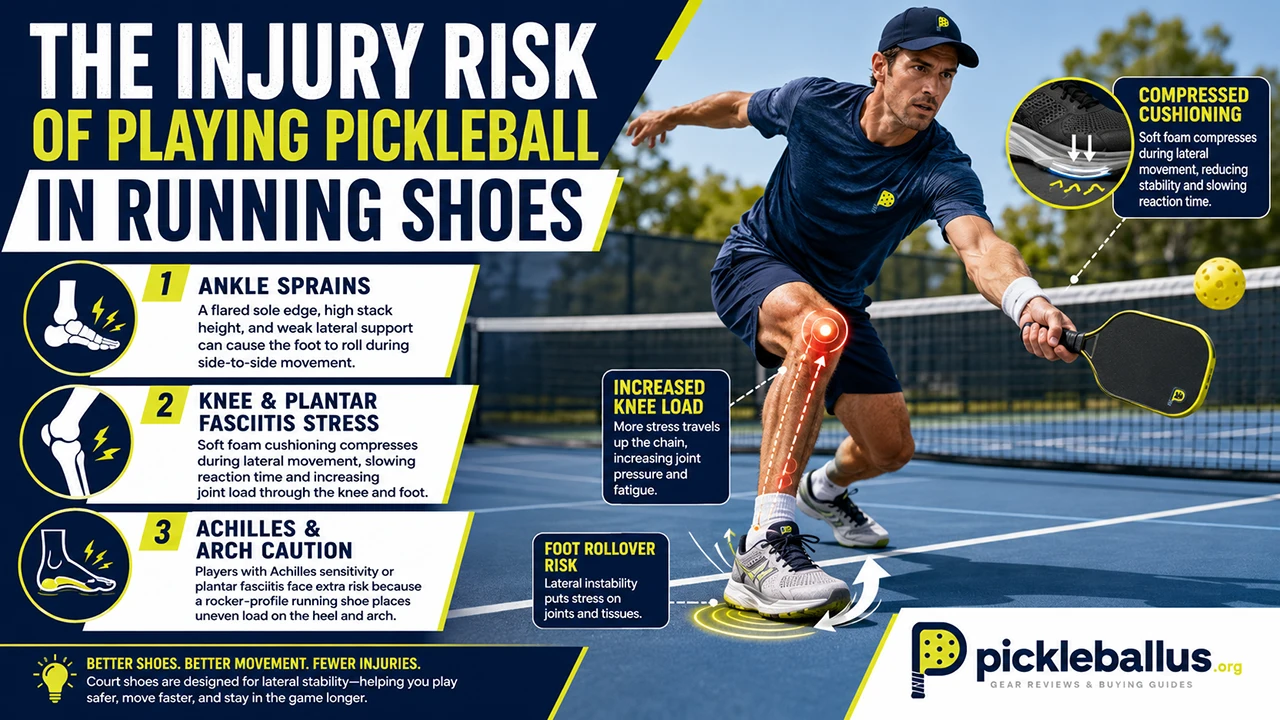
Ankle sprains are the most direct injury risk from wearing running shoes on a pickleball court, caused by the combination of a flared sole edge, high stack height, and absent lateral reinforcement in the upper. When you shift weight rapidly to the side — as you do during a wide forehand reach, a side shuffle, or a kitchen-line reset — the flared outsole edge acts as a fulcrum. Your foot rolls over it rather than being held in place.
Beyond ankle sprains, the soft foam midsole in running shoes creates secondary injury pathways. Running shoe cushioning compresses under body weight during lateral movements, introducing a slight sink that slows ground reaction time and increases the joint load transferred upward through the knee. Over multiple sessions, this contributes to knee discomfort and accelerates plantar fasciitis symptoms, particularly in players who transition from long-distance running to daily court play without allowing their feet to adapt.
Players who already have achilles tendon sensitivity or plantar fasciitis should exercise particular caution — the instability of a running shoe’s rocker profile places asymmetric load on the heel and arch during the plant-and-push mechanics unique to pickleball.
What Makes Pickleball Court Shoes Different?
Pickleball court shoes are built around five structural elements that running shoes lack: a traction-optimized outsole, a firm midsole, a reinforced lateral upper, a rigid heel counter, and a low-profile sole geometry — all designed to support multidirectional movement on hard court surfaces. Together, these features convert the forces of a quick direction change into controlled stability rather than instability.
Understanding what how to choose pickleball shoes effectively starts with knowing which of these five elements matters most for your specific playing style and surface type. A player on an indoor wood gym floor needs different outsole characteristics than one playing outdoor asphalt courts — but both need all five structural features that running shoes omit.
Outsole — Traction Pattern Built for Court Surfaces
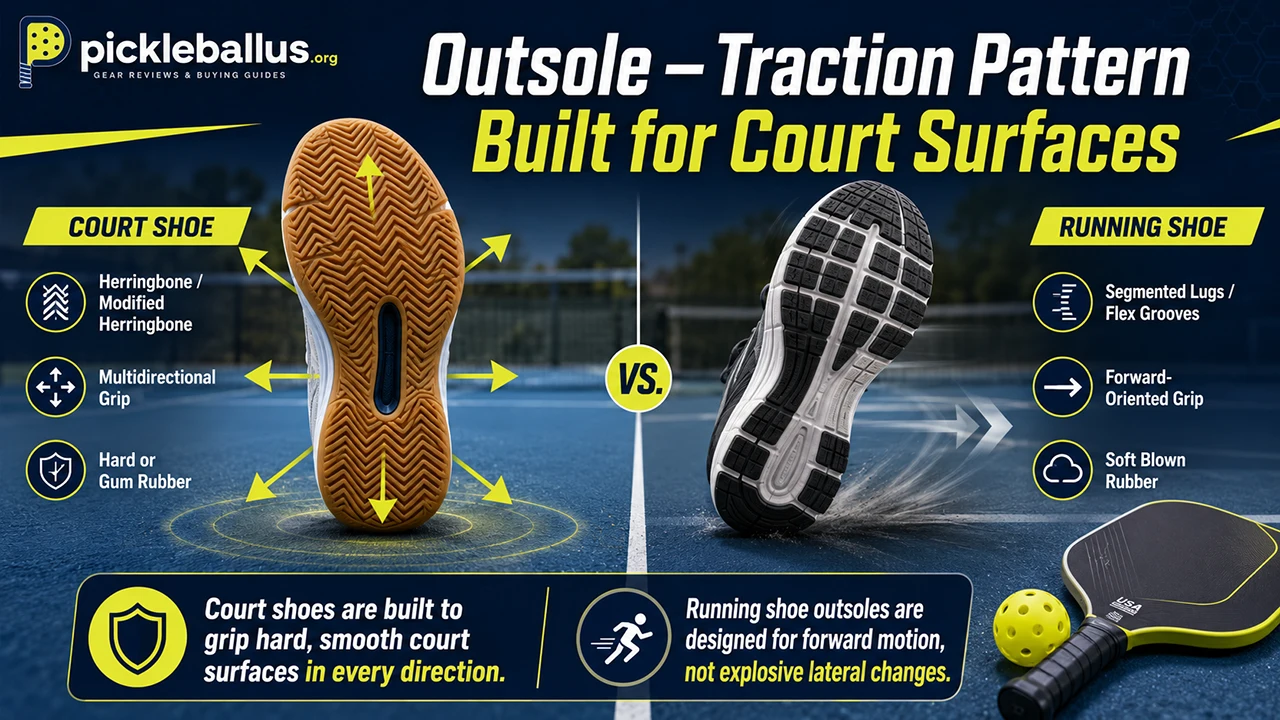
The outsole on a court shoe uses a herringbone or modified herringbone tread pattern engineered to grip hard, smooth surfaces in all directions simultaneously — a demand that running shoe outsoles, optimized for linear forward grip on asphalt and trails, are not designed to meet. The herringbone configuration creates multidirectional bite: each angled groove catches the court surface when you push off laterally, diagonally, or straight back.
Running shoe outsoles typically feature segmented lugs or flex grooves oriented along the heel-to-toe axis. On a pickleball court, these grooves align with the direction of least stress (forward) while offering minimal resistance in the directions of highest stress (lateral and diagonal). The result is that a running shoe outsole slides rather than grips during the explosive direction changes pickleball demands.
The rubber compound matters equally. Court shoe outsoles use a harder rubber — both gum rubber for indoor non-marking compliance and harder carbon rubber compounds for outdoor durability. Running shoe outsoles use blown rubber in high-wear zones for lightweight cushioning, which is too soft for the abrasive surface of an outdoor hard court and wears through unevenly.
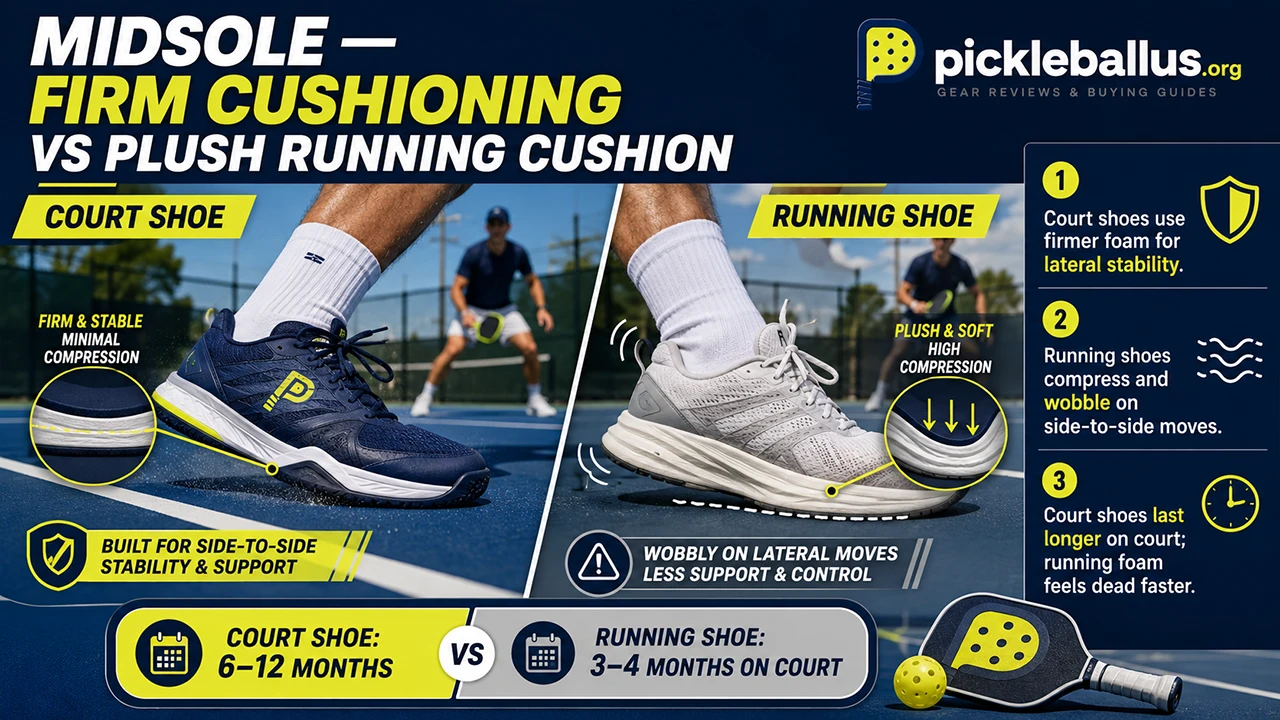
Midsole — Firm Cushioning vs Plush Running Cushion
Court shoe midsoles use a denser foam or EVA compound that resists lateral compression — maintaining the shoe’s structural geometry even during hard plant-and-push movements that would visibly compress a running shoe’s softer midsole. The firmness that runners complain about in court shoes is the exact property that provides stability during lateral stress.
Running shoe midsoles are engineered to compress under heel strike and rebound during toe-off. This compression-rebound cycle is efficient for running but produces instability on court. Each time you plant for a lateral shot, the midsole compresses slightly under your foot, introducing a slight wobble and slowing the ground reaction force your legs need to push off cleanly. Over a two-hour session, this cumulative instability produces measurable fatigue in the stabilizing muscles of the ankle and lower leg.
Midsole density also directly affects durability. Running shoe foam, optimized for cushioning, loses its mechanical properties faster under lateral court stress than under the repetitive linear compression it’s designed for. Players who use running shoes regularly on pickleball courts often report the shoes feeling “dead” — without adequate support — after just 3–4 months, versus the 6–12 months typical for a proper court shoe.
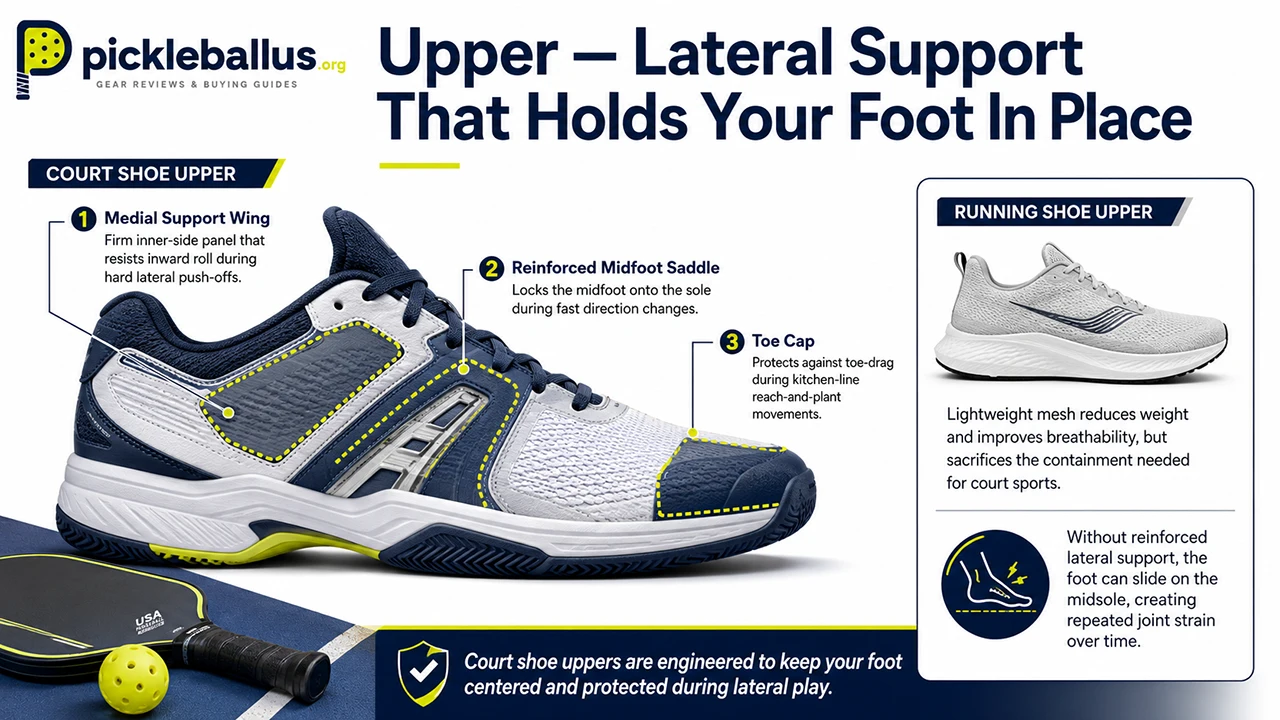
Upper — Lateral Support That Holds Your Foot In Place
The upper on a court shoe features reinforced lateral support structures — including a medial support wing, a toe cap, and a reinforced midfoot saddle — that physically prevent the foot from sliding off the sole during direction changes. Running shoe uppers use lightweight mesh to minimize weight and maximize breathability, sacrificing exactly the containment a court sport requires.
The medial support wing is the most critical difference: a firmer panel built into the inner side of the upper between the midfoot and the arch that resists the inward roll (overpronation) that happens when you push off hard from the outer edge of your foot during a lateral movement. Without it, the foot slides inward on the midsole — not enough to cause an immediate fall, but enough to cause joint strain over repeated movements.
The toe cap in a court shoe protects against toe-drag during the reach-and-plant mechanics of dink exchanges at the kitchen line, where the toe box scrapes the court surface repeatedly. Running shoes have no reinforcement here because running gait doesn’t generate this stress pattern.
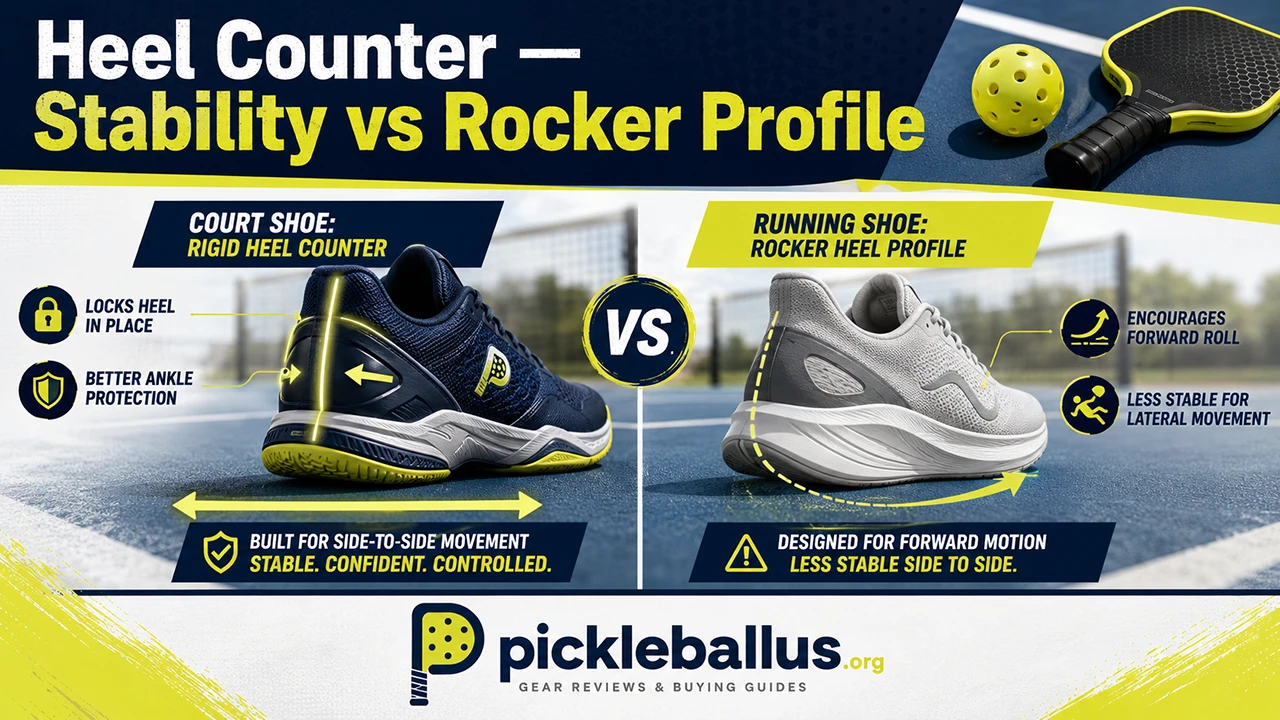
Heel Counter — Stability vs Rocker Profile
Court shoes use a rigid heel counter — a structural cup molded into the rear of the upper that locks the heel in position and prevents sideways roll — while running shoes use a rocker profile that encourages heel lift and forward roll, actively destabilizing lateral movement. The heel counter is non-negotiable for pickleball safety.
In a running shoe, the heel is designed to be the first point of ground contact and the launch point for forward propulsion. The rocker curve at the heel makes this transition smooth. On a pickleball court, where your heel may contact the ground from any angle — during a backpedal, a split-step, or a pivot — the rocker curve creates an unpredictable landing surface that the ankle has to compensate for on every repetition.
A rigid heel counter eliminates that compensation requirement. Your heel lands, is locked in position by the counter, and transfers force cleanly to the midsole. This is why even beginner-level court shoes that sacrifice midsole quality still provide meaningfully more ankle protection than premium running shoes — the heel counter alone changes the injury risk profile substantially.
Court Shoes vs Running Shoes — Side-by-Side Comparison
Court shoes win on every metric relevant to pickleball, while running shoes win only on cushioning comfort for straight-line forward movement — a movement pattern that represents a fraction of pickleball footwork. The table below shows how each shoe type performs across the five structural elements that determine court safety and performance.
The following comparison covers both categories across all key dimensions for a pickleball-specific context:
| Feature | Pickleball Court Shoes | Running Shoes |
|---|---|---|
| Outsole traction pattern | Herringbone — multidirectional grip | Heel-to-toe lug pattern — forward grip only |
| Outsole rubber | Hard rubber or gum rubber (non-marking) | Blown rubber — soft, wears fast on courts |
| Midsole density | Firm, low-compression under lateral load | Soft, high-compression — compresses during lateral cuts |
| Stack height | 18–24mm — low center of gravity | 28–40mm — elevated center of gravity |
| Upper construction | Reinforced mesh, medial wing, toe cap | Flexible breathable mesh — no lateral containment |
| Heel counter | Rigid — locks heel in place | Curved rocker — encourages forward heel roll |
| Lateral ankle support | Built-in structural reinforcement | Absent — flexible mesh only |
| Court surface grip | Optimized for hard court (indoor & outdoor) | Designed for asphalt, trails — poor court bite |
| Lifespan on court | 6–12 months (3–5x/week play) | 3–5 months — midsole degrades under lateral stress |
| Injury risk on court | Low — designed for multidirectional load | High — flared sole + rocker profile + soft midsole |
Which Shoe Wins for Pickleball Performance?
Court shoes win unconditionally for any player who plays pickleball more than once a week — beginner, casual, or competitive. The structural mismatch between running shoes and court sport demands is not bridged by technique, fitness level, or shoe quality. A premium running shoe still fails on lateral support; a budget court shoe still provides lateral containment.
For beginners, the advantage is injury prevention — the stage where footwork is still inconsistent and unpredictable weight shifts are most common. For intermediate players, the advantage shifts to performance: court shoes enable faster split-steps, more confident direction changes, and quicker push-offs from the kitchen line. For competitive players, the right lateral support features pickleball shoes provide become the foundation for every high-speed movement pattern the game requires.
When Is It OK to Wear Running Shoes on the Pickleball Court?
Running shoes are acceptable for one-time casual play on soft or non-abrasive surfaces, such as a backyard court on grass or a recreational gym session where the pace is low and direction changes are gradual. For any regular play on hard courts — indoor sport court, outdoor asphalt, or concrete — they should be avoided regardless of the running shoe’s quality or price.
The key variable is frequency and intensity. A player who joins a single casual game at a community center while waiting for their court shoes to arrive faces low risk. A player who plays three or more times per week in running shoes is accumulating lateral joint stress and soft-tissue fatigue that compounds over weeks into the injury patterns outlined above.
The Running Shoe Types Least Dangerous for Occasional Court Use
Low-stack, firm-midsole running shoes carry the lowest risk for occasional court use — specifically stability running shoes like the Brooks Beast, Brooks Ariel, or ASICS Gel-Kayano in its firmer variants, which feature reinforced medial posts and lower stack heights than neutral or max-cushion models. These are not safe court shoes, but their construction is less mismatched than a Hoka Bondi or Nike Pegasus.
Avoid wearing these running shoe types on a court under any circumstances: max-cushion models (Hoka Bondi, On Cloudmonster, Brooks Glycerin), rocker-sole models (Hoka Clifton, ASICS Gel-Nimbus recent generations), and minimalist racing flats, which provide no cushioning or support for court impact forces. Trail running shoes, despite their grippy outsoles, have multidirectional tread designed for soft surfaces that behaves unpredictably on hard court surfaces.
Signs Your Current Shoes Are a Hazard on Court
Three physical tests identify whether your current shoes present unacceptable court risk. First, the foam compression test: press your thumb firmly into the midsole at the midfoot. If the foam compresses more than 4–5mm under moderate thumb pressure, the midsole is too soft for lateral court stability. Second, the twist test: hold the shoe by the heel and toe and try to twist it along its length. A court shoe resists torsion. A running shoe twists easily — a sign of insufficient structural rigidity. Third, check the rocker geometry: place the shoe on a flat surface and press on the toe. If the sole rocks forward and backward, the rocker profile will destabilize lateral cuts.
Worn tread on the lateral edge of the outsole — especially near the big toe joint and the lateral midfoot — is the final sign that any shoe, court shoe or otherwise, needs replacing. At that point, grip is compromised and the risk of slipping during a direction change increases substantially.
How to Choose the Right Pickleball Court Shoes
The right pickleball court shoe depends on three variables: court surface, foot condition, and play frequency — and getting all three right delivers meaningfully better performance and injury protection than defaulting to the most expensive option or relying on brand recognition alone. The best pickleball shoes on the market cover a range of price points and foot types, with the right answer differing significantly between an outdoor recreational player and an indoor competitive one.
Indoor vs Outdoor Court Shoes — Surface Matters
Indoor pickleball court shoes use gum rubber outsoles — a softer, stickier compound that grips smooth gym floors and wood sport courts without leaving scuff marks — while outdoor court shoes use hard carbon rubber that resists the abrasion of concrete and asphalt surfaces. Using an outdoor shoe indoors produces acceptable grip but may mark the floor. Using an indoor shoe outdoors dramatically accelerates outsole wear, cutting the shoe’s lifespan from 6–12 months down to 2–4 months.
For indoor vs outdoor pickleball shoes, the tread depth also differs: indoor soles use shallower herringbone cuts suited to smooth surfaces, while outdoor soles use deeper grooves that clear grit and debris from the contact zone to maintain grip. Players who use one pair for both surfaces should choose an outdoor shoe — it will survive outdoor use and still provide adequate indoor performance, at the cost of some grip quality on wood floors.
Best Pickleball Shoes by Player Type
Beginners and casual players (1–2x per week) should prioritize comfort and ankle protection over premium performance features. A mid-range court shoe in the $65–$100 range from ASICS, K-Swiss, or New Balance provides the five structural elements that differentiate court shoes from running shoes without over-investing in technology suited to competitive play. Fit is the priority at this stage: a half-inch of toe room, no heel slippage, and snug but not restrictive midfoot containment.
Intermediate and competitive players (3–5x per week) should evaluate lateral support density, outsole durability ratings, and midsole lifespan. Brands like Selkirk, HEAD (Revolt Pro line), and Fila offer court shoes with reinforced toe boxes specifically for the drag wear pattern that dinking and kitchen-line play produces. At 3–5 sessions per week, expect to replace shoes every 6–9 months regardless of brand — the lateral stress of court play accelerates wear in ways that weekly mileage metrics developed for running don’t predict.
By this point, you have a complete structural picture of why pickleball court shoes and running shoes are engineered for opposing demands — and which specific features determine your safety and performance on the court. Choosing the right shoe type is the foundational decision, but how long that shoe continues to protect you depends on details that most players never think to check until something goes wrong. The next section covers the finer mechanics and lesser-known distinctions that experienced court players use to extend shoe lifespan, stay compliant with indoor court rules, and avoid the reverse mistake of cross-using court shoes for runs.
What Serious Pickleball Players Know About Court Shoes That Beginners Don’t
The Toe-Drag Wear Zone — Why Pickleball Kills Shoes Differently
Pickleball accelerates outsole wear at the toe box — specifically the lateral edge of the big toe area — through a movement pattern called toe drag, which occurs when players reach forward for dinks, resets, and drop shots at the kitchen line and drag the toe across the court surface repeatedly during the recovery step. This wear pattern is distinct from running shoe wear (which concentrates at the heel and ball of foot) and from tennis shoe wear (heel and lateral forefoot), making running shoe lifespan metrics irrelevant for predicting when a pickleball shoe needs replacement.
The practical implication: inspect the toe-box rubber on your court shoes monthly if you play frequently. When the herringbone pattern in the toe drag zone flattens — even if the rest of the outsole looks intact — the shoe’s grip on forward-reaching shots is already compromised. Replacing shoes based on toe-zone tread, rather than overall outsole appearance, prevents the friction failures that cause slips during aggressive net play.
Stack Height and Your Center of Gravity — The Physics of Ankle Rolls
Every additional millimeter of stack height shifts your center of gravity upward and increases the leverage force applied to your ankle joint during lateral cuts — a relationship that becomes consequential at stack heights above 28mm, which is where most neutral running shoes begin. On a flat hard court, there is no terrain variation to compensate for; the only variable is the shoe geometry itself.
The mechanism works as follows: during a hard lateral shuffle, your foot contacts the court at an angle. A low-stack shoe (20mm) allows the ankle to absorb and redirect that force with minimal lever arm. A high-stack shoe (35mm) places the ankle 15mm higher above the point of ground contact, increasing the torque that any sideways force exerts on the joint by a corresponding margin. This is why high-cushion running shoes feel unstable during pickleball even to experienced athletes — it is a mechanical phenomenon, not a conditioning deficit.
Non-Marking Soles — The Indoor Court Rule Most Beginners Violate
Most indoor pickleball courts, gyms, and recreation centers require non-marking soles — a designation that applies to gum rubber compounds that grip without leaving dark streaks on wood or sport court flooring. Many running shoes use dark carbon rubber outsoles that fail this requirement, and players wearing them on indoor courts may be asked to leave or replace their footwear before play. Non-marking compliance is not cosmetic; carbon rubber compounds contain compounds that chemically bond to certain floor coatings over time, causing permanent surface damage.
Identifying non-marking soles is straightforward: the rubber is translucent or light tan in color rather than black. If the outsole is black, it is not non-marking. Most court shoes marketed for pickleball or tennis use compliant compounds, but confirm on the product page before purchasing if you play exclusively indoors.
Can You Cross-Use Court Shoes for Running?
Court shoes should not be used for road running — the same firmness that makes them stable on court becomes a liability on pavement, where the midsole’s inability to compress and rebound efficiently transfers impact force directly to the knee and hip joints. The absence of a rocker profile means heel strike is harder and toe-off is less efficient, increasing energy expenditure per stride and elevating injury risk for runners with knee sensitivity.
The reverse of the running shoe problem is real: players who use court shoes for their morning run to “get more use” from an expensive pair accelerate midsole breakdown in ways that specifically degrade lateral stability — the exact property the court shoe was purchased for. Use each shoe type for its intended surface, and both will last significantly longer.
Write Your Review
No reviews yet. Be the first to share your experience!