How to Choose Pickleball Shoes: Outsole, Fit & Court Type
The best pickleball shoes share four non-negotiable traits: a court-specific outsole that grips without marking the surface, a reinforced upper that locks the foot during lateral cuts, a midsole thick enough to absorb repeated hard-court impact, and a toe box that keeps you stable without restricting natural movement. These are not the same priorities a running shoe or cross-trainer is built around — and choosing the wrong footwear is one of the most common mistakes new pickleball players make.
Picking the right pair starts with your court surface, then your foot type, then your playing style. Those three filters alone narrow down the options significantly before you even look at price. If you’re still researching top-rated options at the same time, the roundup of best pickleball shoes covers court-tested picks across every budget and surface type.
Pickleball’s movement pattern demands more from a shoe than most racket sports. The game takes place largely at the kitchen line, where players shuffle laterally, stop hard, reset, and push off again — often within a span of 12 to 24 inches. That constant lateral stress, combined with the explosive pivots needed to track a drive or reset a speed-up, puts load on the ankle, knee, and hip in ways that forward-dominant sports like running never stress. The right shoe manages that load. The wrong shoe transfers it to your joints.
Below is a complete framework for evaluating any pickleball shoe on the market — from the rubber compound on the outsole to how the heel counter should hold the back of your foot.
What Makes Pickleball Shoes Different from Regular Athletic Shoes?
Pickleball shoes are court shoes — a category engineered for multi-directional movement on hard surfaces, not forward propulsion. The distinction matters because shoe construction follows movement intent, and pickleball’s lateral-first demands require design choices that conflict with running or cross-training priorities.
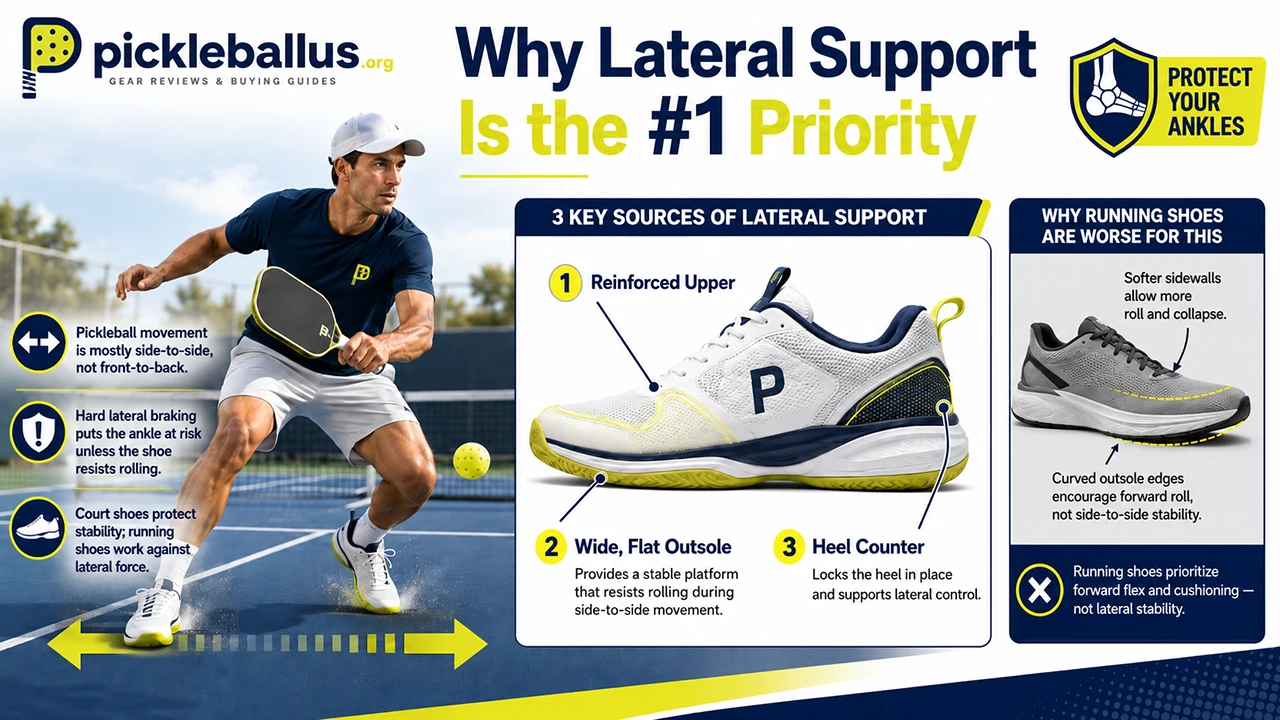
Why Lateral Support Is the #1 Priority
The dominant movement in pickleball is side-to-side, not front-to-back. At the kitchen line, a player may shuffle left and right a dozen times in a single rally, braking hard with the outer edge of the foot and pushing off immediately in the opposite direction. This puts the ankle into a high-risk position — valgus stress, the same mechanism behind most ankle sprains — unless the shoe’s upper resists it.
Lateral support in a pickleball shoe comes from three places working together: a stiff, reinforced upper that prevents the foot from rolling over the sole edge; a wide, flat outsole that extends the stable base; and a heel counter that prevents rearfoot inversion. A running shoe inverts this priority — it’s built to flex forward and cushion heel strike, which means the sidewalls are soft and the outsole curves upward at the edges. That design actively works against the lateral braking force pickleball generates.
The 4 Structural Zones of a Court Shoe
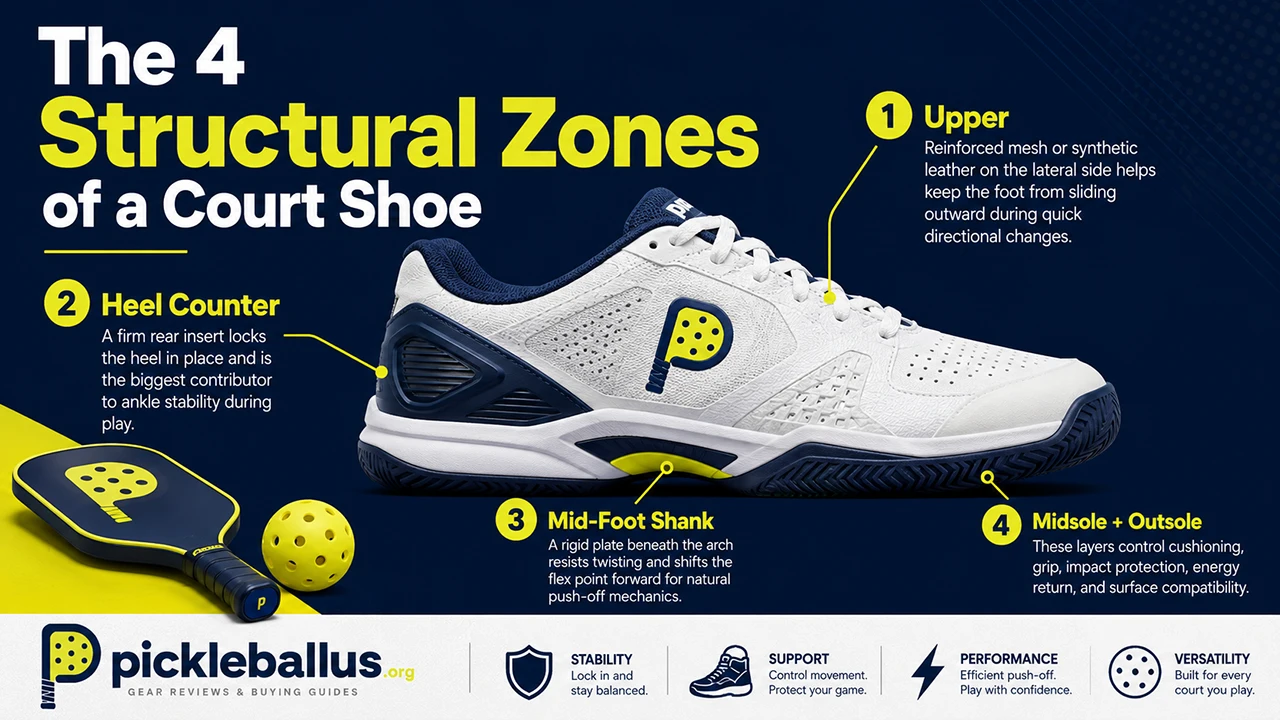
Every pickleball shoe — regardless of brand or price point — is evaluated across four zones:
The upper is the material wrapping the top and sides of the foot. A good pickleball upper uses reinforced mesh or synthetic leather on the lateral side wall, keeping the foot from slipping outward under sharp directional changes.
The heel counter is the hard insert embedded in the rear of the shoe. It prevents the heel from lifting and the rearfoot from shifting laterally inside the shoe. A firm, well-fitted heel counter is the single biggest contributor to ankle stability during play.
The mid-foot shank is a rigid plastic plate beneath the arch. It prevents the midfoot from twisting when the foot pivots, and it shifts the shoe’s flex point forward to the ball of the foot — where it should be for natural push-off mechanics.
The midsole and outsole are the cushioning and contact layers. Together, they determine impact protection, energy return, court grip, and surface compatibility. These are also the layers that wear out first and vary most between indoor and outdoor designs.
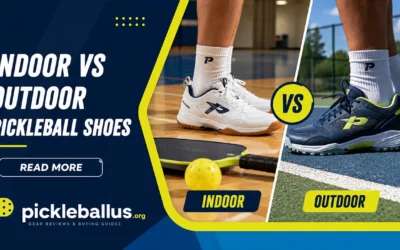
Indoor vs. Outdoor Pickleball Shoes: Which Type Do You Actually Need?
The court surface you play on most should determine your outsole choice — rubber compound, tread depth, and durability requirements differ enough between surfaces that a shoe optimized for one will underperform, or wear out prematurely, on the other.
Indoor Pickleball Shoes — Grip on Gym Floors
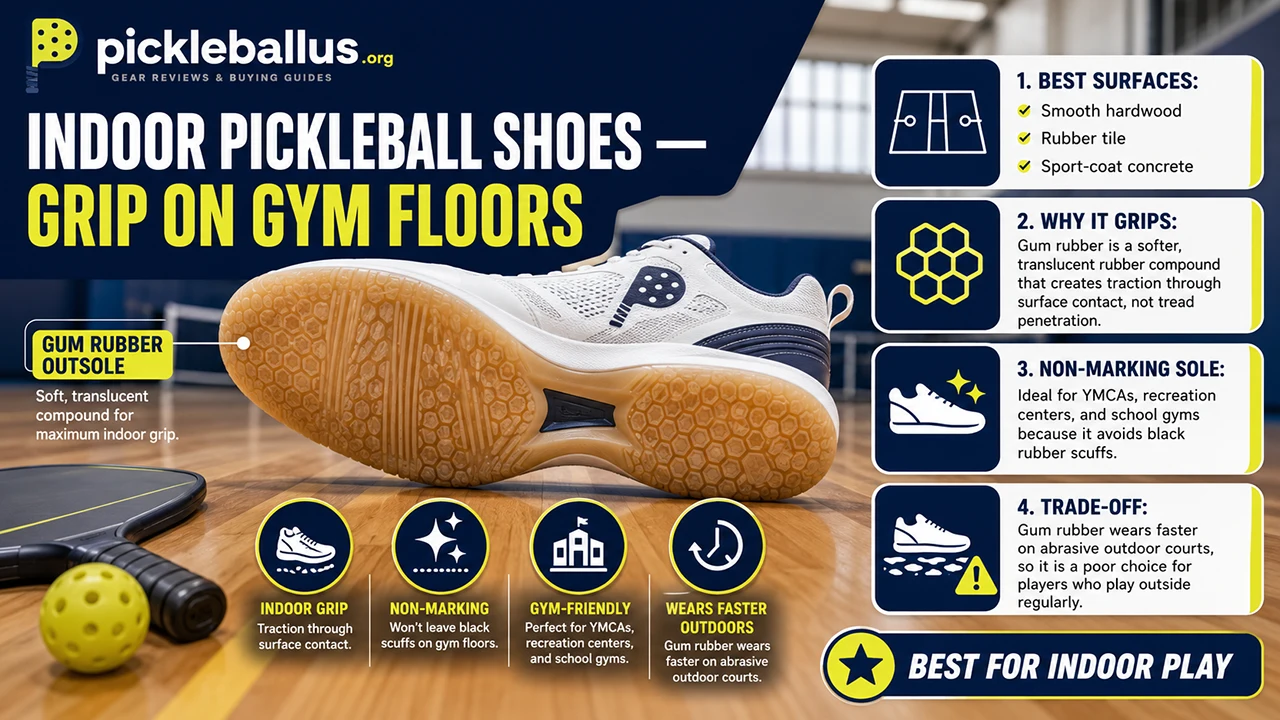
Indoor courts are typically smooth hardwood, rubber tile, or sport-coat concrete. These surfaces require a gum rubber outsole — a softer, translucent rubber compound that generates grip through surface contact rather than tread penetration. Gum rubber maximizes traction on smooth floors, which is why it’s also used in basketball and volleyball shoes designed for gym surfaces.
The best indoor pickleball shoes also carry a non-marking sole designation. Most indoor facilities — YMCAs, recreation centers, school gyms — prohibit outsoles that leave black rubber marks on their floors. Indoor-specific shoes use a lighter rubber compound formulated to meet this requirement. The trade-off: gum rubber wears faster on abrasive outdoor surfaces, making it a poor choice for players who play outside regularly.
Outdoor Pickleball Shoes — Durability on Hard Courts
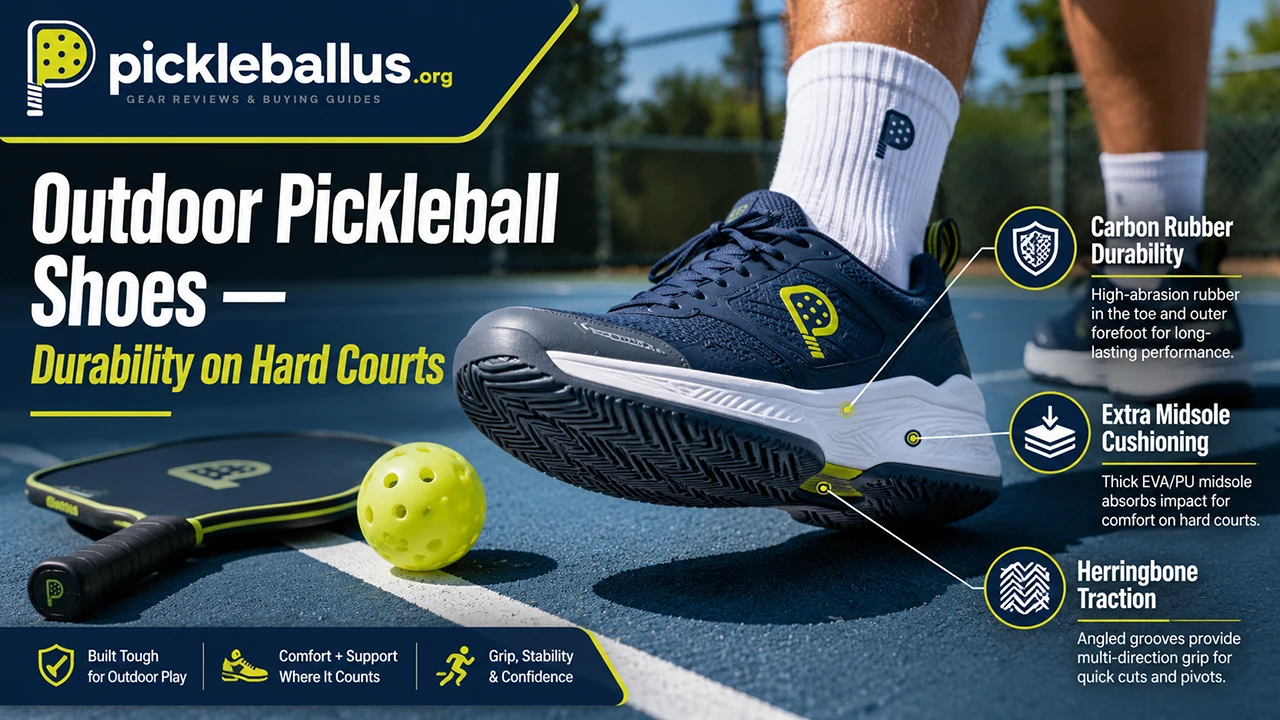
Outdoor pickleball courts use asphalt or concrete — surfaces that abrade outsoles aggressively. An outdoor shoe requires a high-abrasion carbon rubber compound in the highest-wear zones (typically the toe area and the outer forefoot, where lateral stops concentrate friction). This rubber is harder and denser than gum rubber, built to withstand repeated grinding against rough court surfaces.
The best outdoor pickleball shoes also add extra midsole cushioning compared to their indoor counterparts. Outdoor hard courts have no give, meaning every step, pivot, and stop transmits impact force directly into the foot and up the kinetic chain. A thicker EVA or PU midsole absorbs that force before it reaches the knee and hip — a detail that matters more the longer your sessions run.
Tread patterns on outdoor shoes typically use a herringbone design — angled grooves that interlock with hard court texture to resist sliding in multiple directions simultaneously.
Can One Pair Do Both? The Hybrid Shoe Trade-Off
Hybrid court shoes exist to serve players who split time across surfaces. They use a medium-density rubber outsole that offers adequate grip indoors and adequate durability outdoors — but they are not optimal for either. The rubber is not soft enough for maximum gym floor grip, and not hard enough to fully resist outdoor abrasion. Serious players who play on both surfaces regularly typically own two pairs, rotating to match the surface and extending the lifespan of both. For recreational players playing two to three times per week on a single surface, a hybrid is a practical and cost-effective starting point.
The 5 Core Features to Look For When Choosing Pickleball Shoes
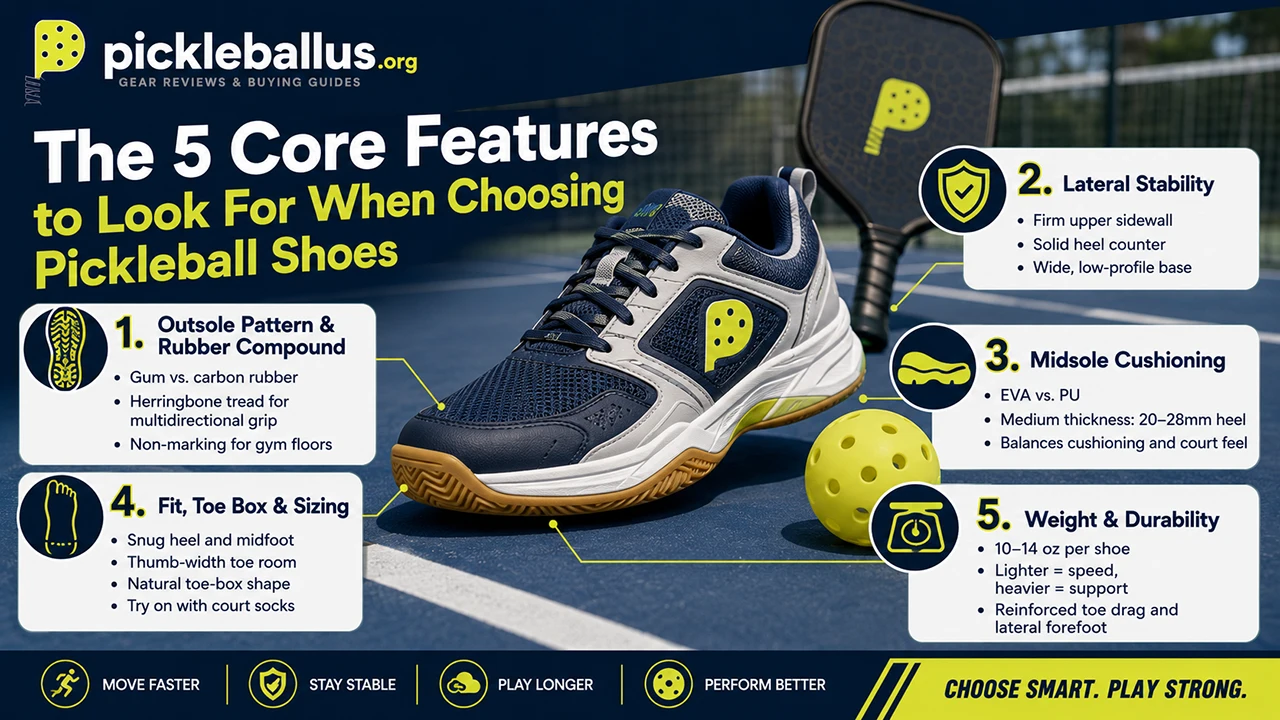
The five features below apply to every pickleball shoe purchase, regardless of surface type, brand, or price bracket. Evaluate these in order — each one serves a distinct function in court performance and injury prevention.
1. Outsole Pattern and Rubber Compound
The outsole is the first point of evaluation because it determines surface compatibility. Check two things: the rubber compound (gum vs. carbon rubber) and the tread pattern. A herringbone pattern is the standard for court shoes — it provides multidirectional grip without catching on the surface. Avoid outsoles with deep lugs (designed for trail running) or flat, slick soles (designed for casual wear). Look for the non-marking designation if you play on gym floors.
2. Lateral Stability — Upper and Heel Counter
Press your thumb against the sidewall of the upper near the midfoot. A pickleball shoe’s upper should resist this pressure — it should feel firm and structured, not soft and collapsible. Then check the heel counter: grip the back of the shoe with two fingers and try to compress it inward. A solid counter holds its shape under pressure. A soft counter is a warning sign for a shoe not built for lateral sport movement.
The lateral support features in a well-designed court shoe also include a low-profile silhouette — the outsole extends wide and flat rather than curving upward — which creates a broader base of stability during side cuts.
3. Midsole Cushioning — EVA vs. PU, Thickness Matters
Midsoles in pickleball shoes use either EVA (ethylene vinyl acetate), PU (polyurethane), or a combination. EVA midsoles are lighter and softer, providing immediate cushioning comfort. They compress over time with heavy use, losing their shock absorption properties. PU midsoles are denser and more durable, maintaining cushioning performance longer but feeling firmer underfoot at first.
Midsole thickness affects two things simultaneously: cushioning and court feel. A thicker midsole absorbs more impact — beneficial for players with joint sensitivity or those on outdoor hard courts. A thinner midsole lowers your center of gravity, making directional changes feel faster and more agile. Most players benefit from a medium-thickness midsole (around 20–28mm heel height) that balances both.
4. Fit, Toe Box, and Sizing
Pickleball shoes should fit snugly through the heel and midfoot but allow about a thumb’s width of space between the longest toe and the front of the shoe. Your foot swells during sustained play — a shoe that fits perfectly when cold will feel tight after 45 minutes on court, increasing blister risk and discomfort.
The toe box shape matters for players with wider feet or common conditions like bunions. Some court shoes taper sharply at the forefoot, compressing the toes — a fit that causes discomfort quickly during lateral movement. Look for a toe box that follows the natural spread of your foot. Always try shoes on with the same socks you wear on court, not thin cotton socks, which misrepresent the actual fit.
5. Weight and Durability
Pickleball shoes typically weigh between 10 and 14 ounces (per shoe). Lighter shoes improve speed and reduce leg fatigue over long sessions; heavier shoes often offer more structural support and durability. The right weight depends on your play style: kitchen-dominant players who shuffle laterally for long stretches benefit from lighter shoes. Power baseliners who take harder steps may prefer the added stability of a slightly heavier court shoe.
Durability concentrates in two places: the toe drag zone (the front edge of the outsole, which drags against the court during serves and forward lunges) and the lateral forefoot (where braking forces wear the rubber fastest). Higher-quality shoes add reinforced rubber overlays in these zones. Inspect these areas on any pair you’re considering — visible reinforcement is a sign of durability engineering, not just cosmetics.
Can You Use Tennis Shoes for Pickleball?
Yes, tennis shoes work for pickleball — with notable limitations that become more significant at higher levels of play. Tennis and pickleball share enough structural DNA that a quality court tennis shoe is always better than a running shoe or cross-trainer for pickleball.
For a detailed breakdown of how the two types compare across six design categories, the dedicated guide on pickleball vs tennis shoes covers the differences in outsole pattern, midsole height, upper stiffness, and weight in full.
Where Tennis Shoes Work
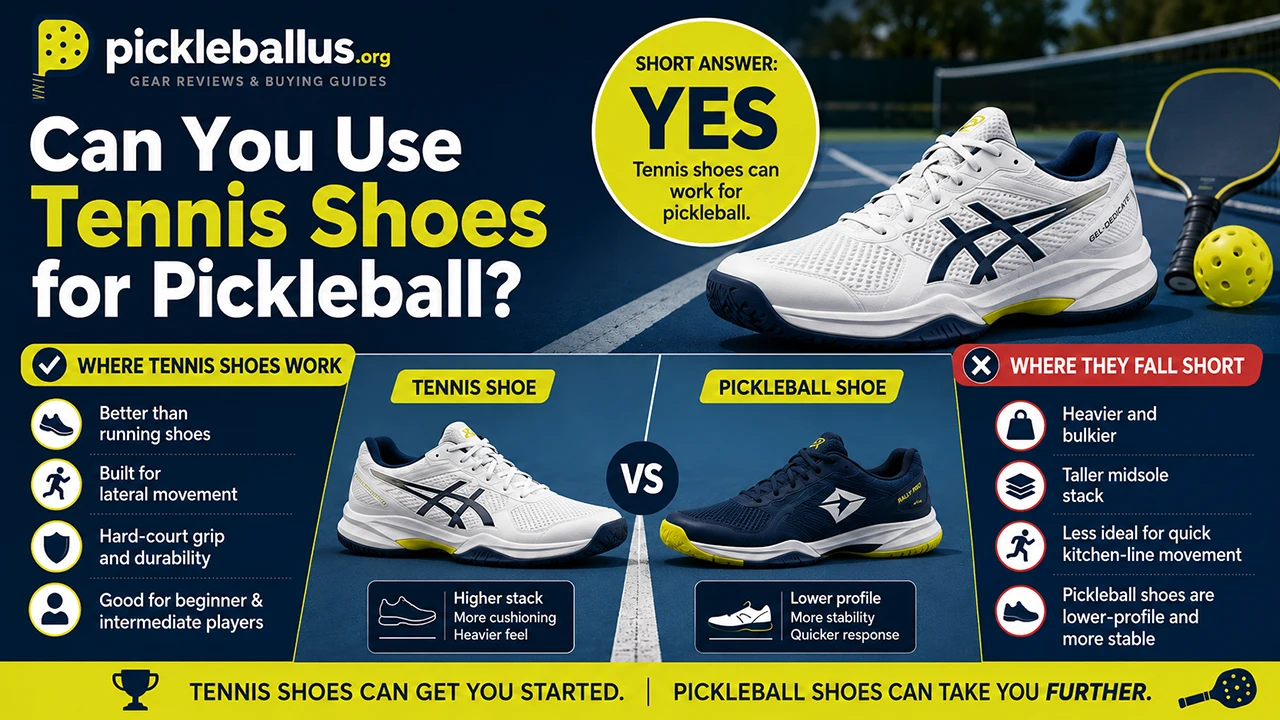
Tennis shoes are court shoes. They are built for lateral movement, hard court abrasion, and multidirectional grip. The outsole patterns, heel counter construction, and lateral upper reinforcement all carry over directly to pickleball. A good tennis shoe — particularly a hard court model — provides the foundational support pickleball demands. For beginner and intermediate players, a well-fitted tennis shoe is a perfectly functional choice.
Where They Fall Short for Pickleball
Pickleball’s movement is more compact and rapid than tennis. Players cover less ground per point but change direction more frequently, often in tight spaces around the kitchen line. Tennis shoes are optimized for longer lateral slides and wider court coverage, which means they tend to carry slightly more weight and bulk than the ideal pickleball shoe.
The larger concern is midsole height. Tennis shoes designed for baseline play often carry a taller midsole stack to cushion the long sprints between points. That extra height slightly raises the center of gravity — a minor factor in tennis, where movements are wider and longer, but a more noticeable factor in pickleball, where fast micro-adjustments at the kitchen line require low, stable foot positioning. A purpose-built pickleball shoe is typically 5–10% lower profile than its tennis equivalent, reflecting the sport’s tighter movement envelope. For more on this tradeoff, the full comparison of pickleball court shoes vs running shoes also clarifies where court-specific design pays off.
How to Match Your Pickleball Shoe to Your Playing Style
The right shoe depends on where you spend most of your time on court and how you generate power. Three player profiles cover the majority of recreational and intermediate pickleball players. Most people fit one profile primarily, with elements of a second.
Heavy Baseline Player — What to Prioritize
Players who prefer staying back, hitting drives, and attacking from the transition zone generate significant braking force with each directional change across a wider court area. They cover more ground than kitchen players and hit at higher velocity, which increases impact force at the heel and forefoot on every plant-and-drive sequence.
Prioritize: durable carbon rubber outsole, thicker midsole cushioning (PU preferred for longevity), reinforced toe drag zone, firm lateral upper. A slightly heavier shoe is acceptable — durability outweighs the weight penalty for this style.
Kitchen-Line Specialist — What to Prioritize
Players who operate primarily from the non-volley zone take shorter, faster lateral steps and rarely cover more than a few feet per point. Their load is concentrated in high-frequency, low-amplitude movements — shuffle steps, weight transfers, quick resets. Cushioning matters less; agility and court feel matter more.
Prioritize: lightweight construction, thin-to-medium midsole for low center of gravity, gum rubber outsole (if primarily indoor), snug forefoot fit to prevent slipping inside the shoe during rapid weight transfers.
Beginner / Recreational Player — What to Prioritize
Players who are new to the sport or play one to two times per week don’t yet have the specific movement patterns that create highly concentrated wear zones. Their primary needs are comfort over a range of movements, basic lateral support to prevent ankle rolls, and durability across mixed use.
Prioritize: a medium-weight court shoe with adequate lateral support, a well-padded midsole that accommodates longer learning sessions, and a fit that allows a full thumbnail of toe space. A hybrid indoor/outdoor shoe is often the best starting option, providing flexibility without requiring two pairs.
By now you have a solid framework for evaluating any pickleball shoe on the market — from outsole rubber type to how the heel counter holds the rearfoot during lateral cuts. Choosing the right pair, however, goes one step further for many players: individual foot anatomy and long-term usage patterns can change what “good support” means in practice. The next section covers the details that matter most once you’ve narrowed down your surface type and playing style.
What Else Should You Know Before Buying Pickleball Shoes?
Shoes for Flat Feet, Plantar Fasciitis, and Ankle Issues
Foot structure directly affects how force travels through the body during pickleball’s rapid directional changes. Players with flat feet (low or absent arch) overpronate — the arch collapses inward on each step, rotating the knee inward and placing strain on the plantar fascia and Achilles tendon. They need motion control shoes with a firm medial post (a denser foam section along the inner midsole) that resists excessive inward roll.
Players with plantar fasciitis need arch support that prevents the plantar fascia from overstretching, combined with cushioning under the heel where the fascia attaches. Many players in this category add an aftermarket orthotic insole to a standard court shoe rather than limiting their options to specialized footwear. The roundup of best pickleball shoes for foot conditions covers the top options for flat feet, high arches, plantar fasciitis, achilles issues, and bunions.
For ankle instability — either from prior sprains or chronic hypermobility — look for a high-top or mid-top upper that wraps above the ankle bone, combined with a firm heel counter. This combination restricts the inversion range of motion that leads to ankle rolls on lateral cuts.
How Long Do Pickleball Shoes Last — and When to Replace Them
Most pickleball shoes last 45 to 60 hours of actual play time before the outsole or midsole degrades enough to affect performance. At two to three sessions per week, this translates to roughly six to nine months for frequent recreational players. Three signs indicate it’s time to replace a pair:
The toe drag zone wears through to the midsole foam — visible as a worn-flat or slightly translucent patch on the front edge of the outsole near the big toe side. Once the rubber is gone, the shoe loses grip on forward lunges and serve movements.
The midsole compresses permanently — a shoe that once felt cushioned now transmits more impact to the foot and lower leg. Press a thumbnail firmly into the midsole edge; if it barely dents, the foam has lost most of its absorption capacity.
The upper separates or de-laminates at the lateral sidewall — the zone under highest stress during side cuts. A cracked or separating upper no longer provides lateral resistance, which eliminates one of the core protections against ankle rolls.
The Real Cost of Wearing the Wrong Shoes
Running shoes are the most common mistake. They’re built for heel-strike shock absorption and forward propulsion, with a curved last (the shoe’s internal form), a raised heel, and soft sidewalls — all of which reduce the lateral stability pickleball demands. On a lateral cut, the foot tips over the rounded outer edge of a running shoe the way it would tip off the edge of a cylinder, rather than planting flat against a wide stable base. This dramatically increases ankle sprain risk.
Cross-trainers are a closer match but still optimized for a broader activity range rather than court-specific movement. The outsoles of most cross-trainers lack the herringbone tread pattern needed for hard court grip, and the lateral support in the upper is typically softer than a purpose-built court shoe provides.
Beyond injury risk, wearing street shoes or non-court soles on indoor gym floors can scuff and damage the surface — many facilities have explicit rules prohibiting it, and some will ask players to leave if they aren’t wearing appropriate court footwear. A non-marking, court-specific outsole is both a performance and a courtesy requirement in organized indoor play.