

The 7 best portable pickleball nets are the Srikel FlashCourt (best overall), the Onix Portable Pickleball Net (best 2-in-1), the Dominator Rolling Portable Net (best on wheels), the HEAD Portable Net System (best indoor/outdoor), the PickleballCentral Rally Net (best for frequent players), the Champion Sports Portable Pickleball Net (best budget pick), and the Gamma Portable Pickleball Net (best entry-level steel frame).




Picking the right portable net comes down to more than price. Frame material, net tension, and setup speed all determine whether a net becomes a fixture in your game or collects dust in the garage. The difference between a net that stands through a gust of wind and one that wobbles on contact often comes down to knowing which features matter at your playing level.
Most players buying their first portable net focus on price, then regret the decision when the frame bends after a few months or the net sags mid-game. What you need to weigh is the balance between portability, durability, and how often you plan to use it.
Below you’ll find detailed reviews of all seven nets, a direct comparison of portable versus permanent options, and what USA Pickleball says about regulation size.

What Should a Good Portable Pickleball Net Actually Offer?
A portable pickleball net worth buying delivers three things: a stable frame that won’t shift during rallies, regulation-compliant dimensions, and a setup process measured in minutes rather than hours. Those three criteria filter out most low-quality options on the market.
Frame Material — Steel vs. Aluminum
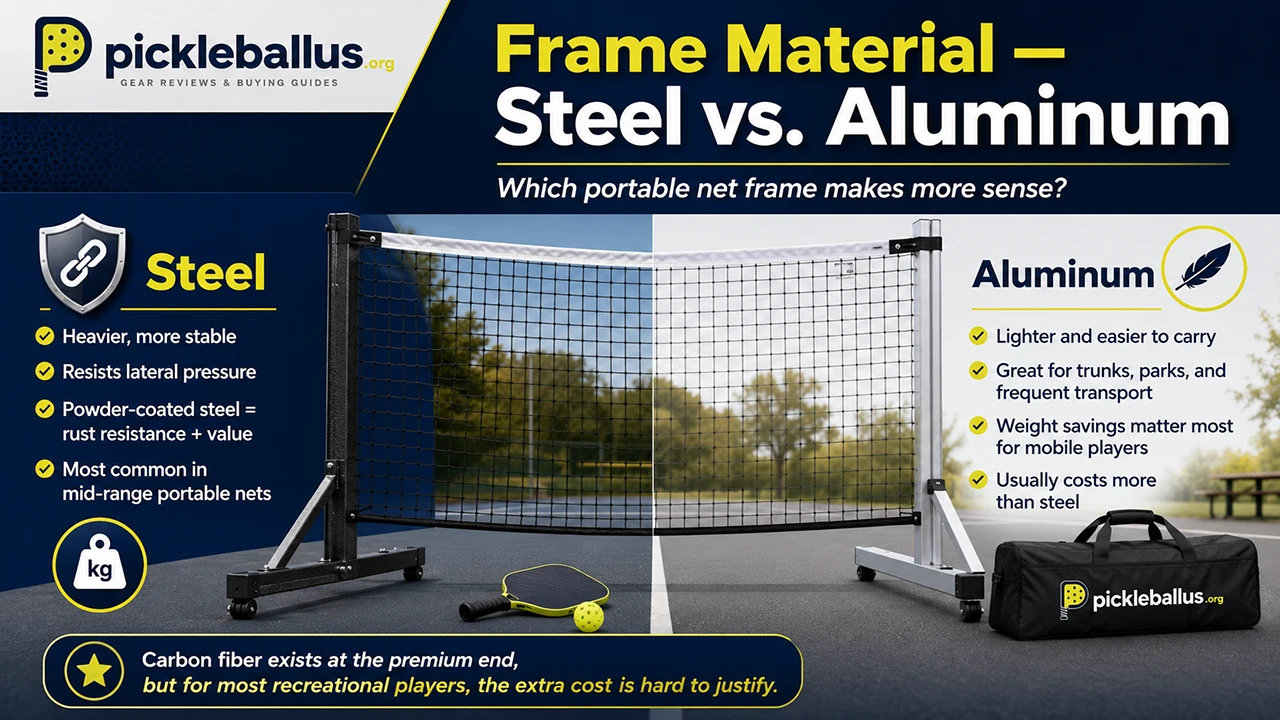
Steel and aluminum are the two dominant frame materials, and each fits a different use case. Steel frames are heavier but resist lateral pressure — the kind that comes from a player bumping the post during a scramble. Aluminum frames weigh less, which matters if you’re loading a net into a car trunk or carrying it to a park. Powder-coated steel is the most common combination you’ll find in mid-range portable nets: it resists rust, adds structural integrity, and costs less than aluminum.
Carbon fiber frames appear at the premium end, but unless you’re transporting a net to multiple locations weekly, the weight savings don’t justify the price premium for most recreational players.
Regulation Dimensions and Net Tension
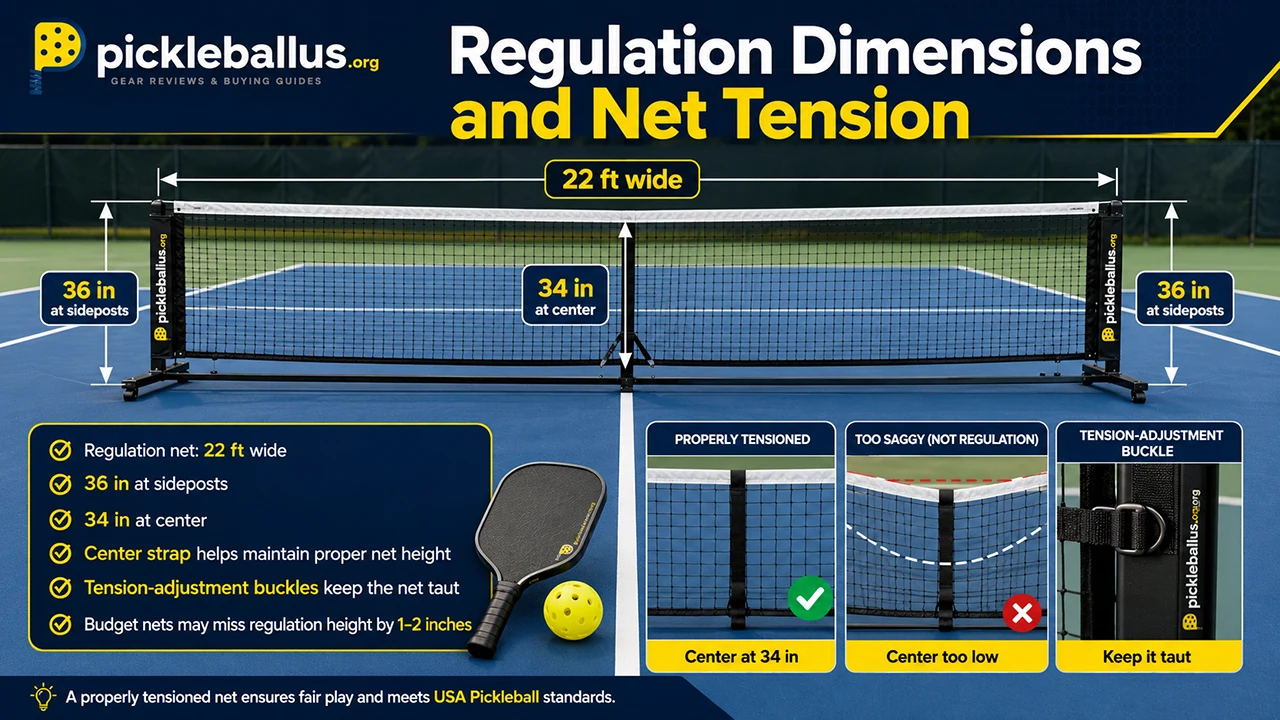
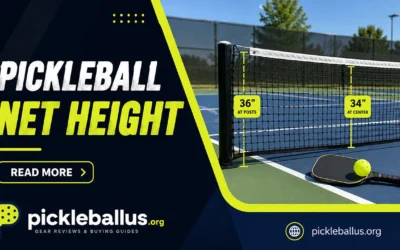
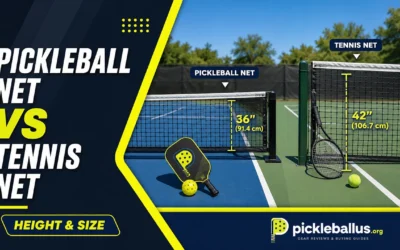
USA Pickleball specifies a regulation net at 22 feet wide, 36 inches tall at the sideposts, and 34 inches at the center. Any net used in organized play must meet these dimensions exactly. Most mid-range and premium portable nets hit this standard; budget options sometimes fall short by an inch or two at the sides, which changes the angle of play near the post significantly.
Net tension matters as much as height. A sagging center net changes the game — it rewards low dinks that should realistically clip the net. Look for a center strap or tension-adjustment buckle on each side. Both features keep the net taut game after game without requiring a full reset every session.
Setup Time and Carry System
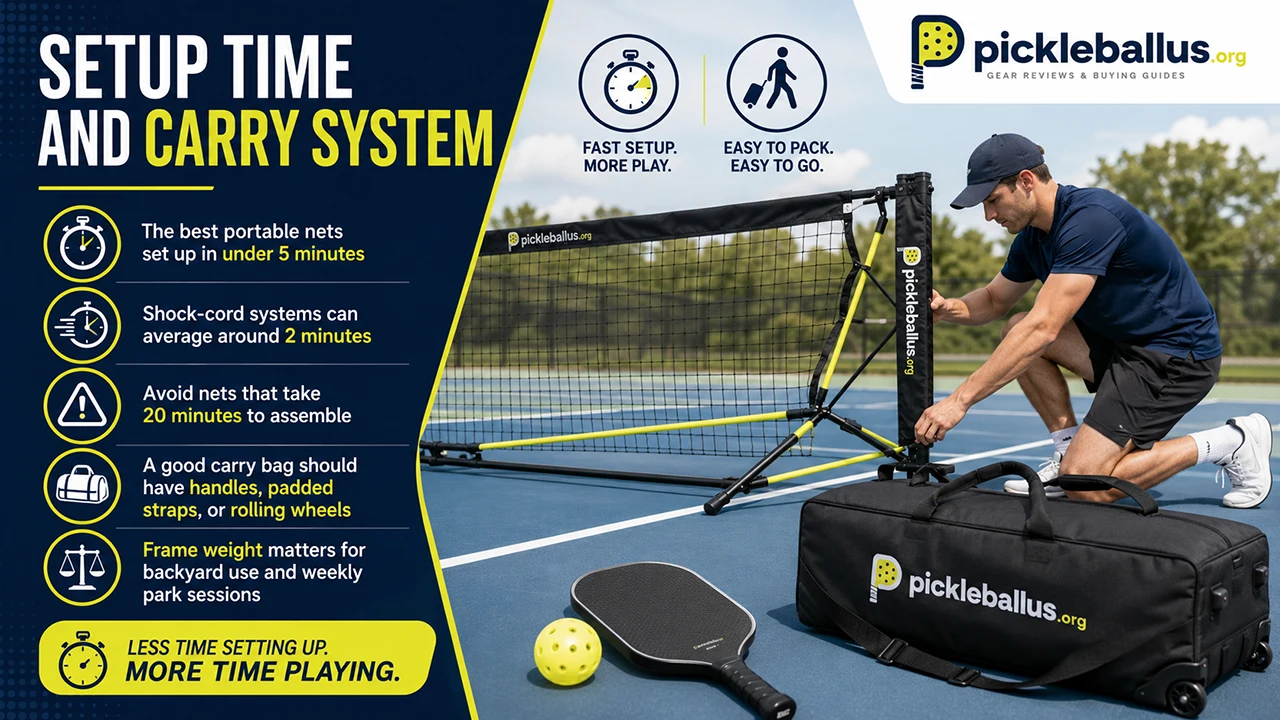
Setup time separates good portable nets from frustrating ones. A net that takes 20 minutes to assemble stops being portable in practice — you’ll leave it outdoors and exposed to weather rather than breaking it down after each session. The best portable nets assemble in under five minutes, with options like the Srikel FlashCourt averaging around two minutes using a shock-cord system.
For a how to choose a pickleball net that fits your playing habits — from occasional backyard use to weekly park sessions — frame weight and carry bag design deserve as much attention as the net itself. A carry bag that’s too tight or lacks handles makes transport a chore; the best systems include padded straps or rolling wheels.
7 Best Portable Pickleball Nets of 2026
#1 Srikel FlashCourt Pickleball Net — Best Overall
The Srikel FlashCourt is the fastest-setup portable net in 2026, and that single fact separates it from the field. Most portable nets require sorting and connecting eight to twelve separate poles. The FlashCourt reduces that to four to six components held together by a pre-connected shock cord — once you’ve done it once, the entire system is up and playable in roughly two minutes.
Key specs:
- Regulation dimensions: 22ft wide, 36in sides, 34in center
- Frame: lightweight alloy with shock-cord internal connection
- Carry bag included with padded handles
- Suitable for: outdoor and indoor surfaces
Performance analysis: The FlashCourt holds up better than its light weight suggests. The shock-cord design keeps every pole under tension, which prevents the lateral wobble common in heavier steel frames that rely on friction-fit connections. The net sits tight from the first use. Net-cord shots feel realistic — the resistance is firm without being rigid, so the ball bounces predictably rather than dying on contact.
Pros:
- Two-minute setup that actually delivers on the claim
- Consistent net tension without constant re-adjustment
- Premium build quality at a mid-range price point
Cons:
- Not the best choice for players who leave nets assembled outdoors for days at a time
- Carry bag is snug — repacking requires practice the first few times
Best For: Players who set up and break down their net regularly — backyard, park visits, gym sessions. Anyone frustrated by slow assembly on cheaper nets.
My Verdict: The Srikel FlashCourt earns its top ranking because it solves the main problem with portable nets: nobody wants to spend ten minutes on setup before a game. If portability is the reason you’re buying a portable net, start here.
#2 Onix Portable Pickleball Net — Best 2-in-1
The Onix Portable Pickleball Net is the only widely available portable option that converts between full court (22ft) and half court (10ft), making it a standout for players who want a drilling and dinking practice setup without buying a second piece of equipment.
Key specs:
- Two configurations: 22ft full court, 10ft half court
- Frame: quality alloy construction
- Transport: wheeled carrying case
- Suitable for: driveways, indoor courts, gymnasiums
Performance analysis: Switching between full-court and half-court configurations takes roughly three to four minutes. The conversion is straightforward — the Onix uses a sectional frame that repositions the center posts. In full-court mode, the net meets regulation specs. The wheeled carry case is where the Onix distances itself from most competitors: rolling a net to the court is far more practical than shouldering a heavy bag, especially for players who use their net multiple times per week.
Pros:
- Unique 2-in-1 sizing flexibility
- Wheeled carry case reduces transport strain
- Solid construction from a well-established pickleball brand
Cons:
- Setup takes longer than the FlashCourt
- Heavier than aluminum-only competitors
- Premium pricing reflects the dual-size feature — value depends on whether you’ll actually use both modes
Best For: Players who practice dinking, kitchen shots, and solo drills at half-court alongside full-court games. Coaches running small-group clinics.
My Verdict: The 2-in-1 functionality is genuinely useful rather than a gimmick. If you’d otherwise buy a separate practice net for drilling, the Onix consolidates that into one purchase.
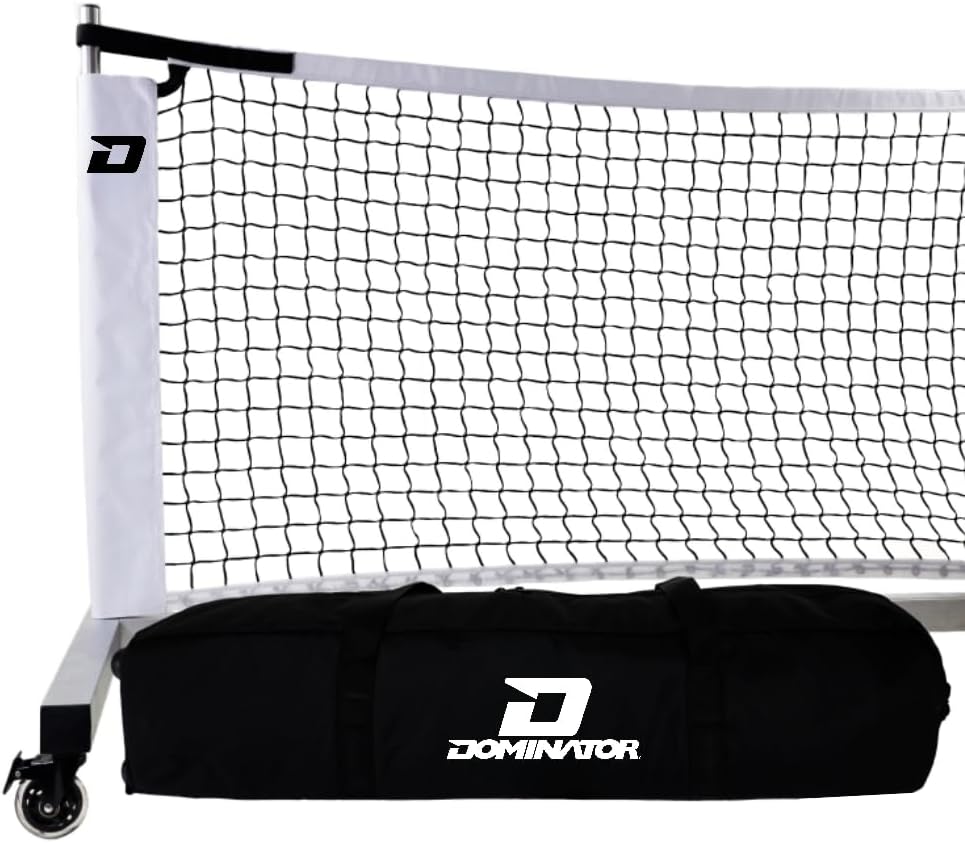
#3 Dominator Rolling Portable Pickleball Net — Best on Wheels
The Dominator Rolling Net is the best choice for players who set up on the same surface repeatedly — a home driveway, a community center, or an outdoor concrete pad — and want to store the net nearby without lifting it.
Key specs:
- Frame: rust-proof powder-coated steel
- Transport: locking wheels integrated into base frame
- Assembly: approximately 5 minutes
- Meets USA Pickleball official specifications
- Suitable for: driveways, outdoor hard courts, gymnasium floors
Performance analysis: The locking wheel system is the Dominator’s defining feature. You roll it out, lock the wheels, and play. No carry bag required, no disassembly if you’re returning tomorrow. The rust-proof powder-coated frame handles weather exposure well — better than most nets in this category that claim all-weather durability but corrode after a wet season. Lateral stability is excellent; the wide base prevents rocking on hard surfaces even when the ball clips the post.
For the full category breakdown of best pickleball nets on wheels, the Dominator remains the benchmark — no competing wheeled net at this price point matches its structural integrity.
Pros:
- Roll in/roll out convenience for fixed outdoor setups
- Rust-proof frame for genuine all-weather use
- USA Pickleball regulation compliant
Cons:
- Heavier than non-wheeled options — not suited for frequent car transport
- Overkill for players who travel to different courts
- Doesn’t fold as compactly as frame-only nets
Best For: Home driveway players or community center regulars who use the same space consistently and want wheel convenience without investing in a permanent installation.
My Verdict: Buy the Dominator if you play in one fixed location and want to eliminate the setup/teardown routine. The wheeled base changes how you interact with the net entirely.
#4 HEAD Portable Pickleball Net System — Best for Indoor/Outdoor Use
HEAD — known for decades in racket sports — brings reliable construction and a trusted quality standard to its portable pickleball net. The HEAD system suits players who split time between indoor gymnasiums and outdoor courts and need a net that handles both without compromise.
Key specs:
- Frame: powder-coated steel with locking mechanisms
- Net dimensions: regulation 22ft x 36in (34in center)
- Carry bag included
- Suitable for: indoor court flooring, outdoor hard courts, light-use grass
Performance analysis: The locking frame mechanisms on the HEAD net are noticeably more robust than most competitors at comparable pricing. Every joint clicks firmly — there’s no ambiguity about whether a section is locked in, which matters when setting up in a gymnasium where a frame collapse mid-session disrupts the entire group. The net material resists fraying better than nylon-only options; HEAD uses reinforced mesh that holds tension over time without stretching loose.
Pros:
- Trusted brand with consistent quality standards
- Firm locking mechanisms prevent mid-game frame collapse
- Performs equally on indoor and outdoor surfaces
Cons:
- Mid-range pricing without the setup speed of the FlashCourt
- Frame is heavier than aluminum alternatives
- Carry bag shoulder-only — no wheels
Best For: Players who move between indoor and outdoor settings. Anyone who values brand reliability and post-purchase support.
My Verdict: The HEAD net won’t surprise you with innovations — it performs consistently. That predictability is worth paying for if cheaper nets have let you down before.
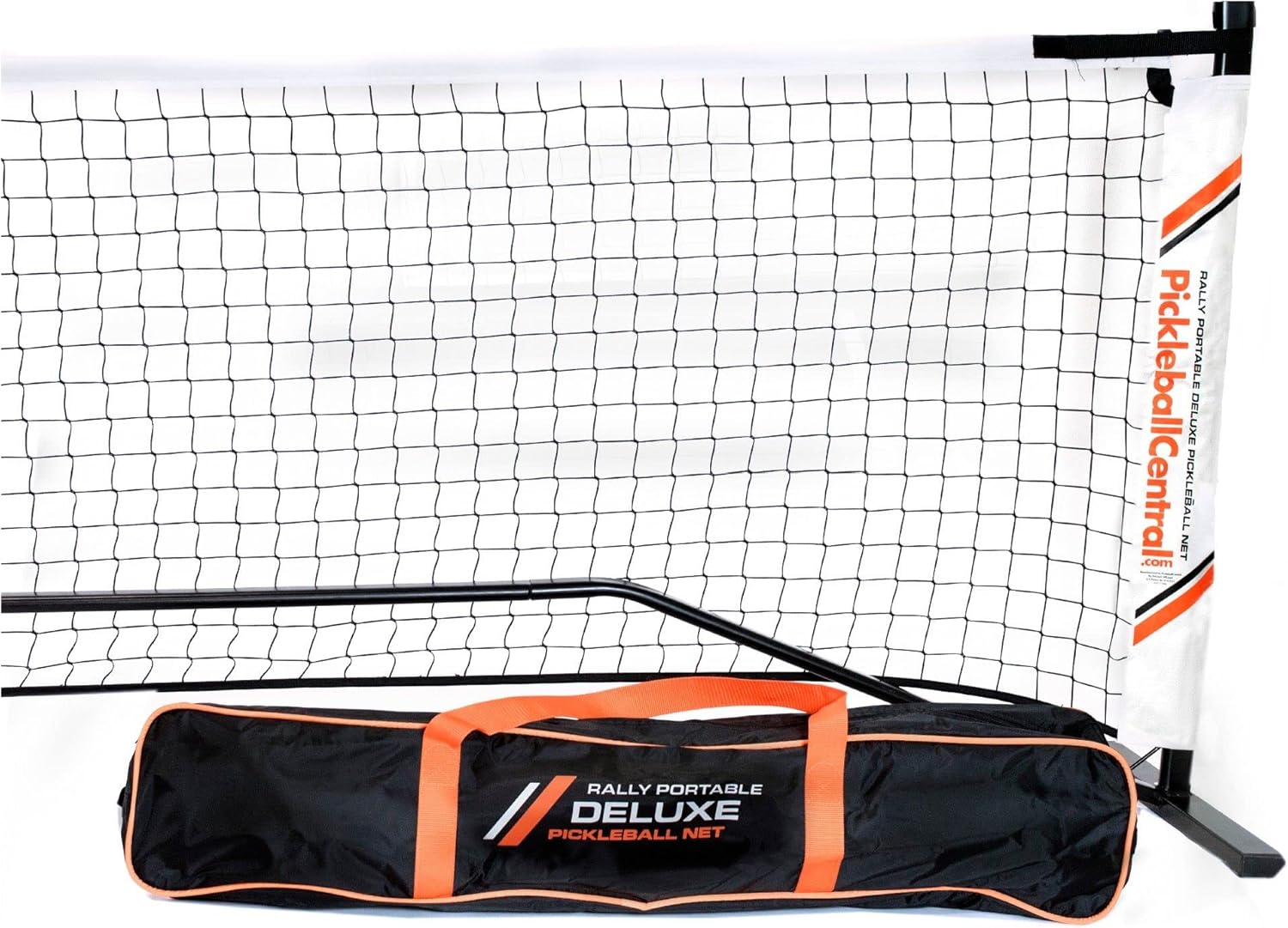
#5 PickleballCentral Rally Pickleball Net — Best for Frequent Players
The Rally Net from PickleballCentral is built for players who assemble and break down multiple times per week — a usage level that exposes the weaknesses in most consumer-grade nets within a few months.
Key specs:
- Frame: alloy steel construction
- Net dimensions: regulation 22ft, indoor/outdoor rated
- Carry bag with grab handles included
- Suitable for: driveways, parks, gymnasiums, light competitive use
Performance analysis: What separates the Rally Net from similarly priced competitors is long-term durability rather than any single standout feature. The alloy steel frame holds up to repetitive assembly without loosening at the joints — a common failure mode in cheaper frames where friction-fit connections develop play over time. The center strap and side buckle system keep the net taut across hundreds of setups. Players who use the Rally Net daily report it holds its shape through an entire season without re-tensioning.
Pros:
- Long-term durability suited to high-frequency use
- Consistent net tension over hundreds of assemblies
- Well-priced for what it delivers to regular players
Cons:
- Assembly takes roughly 7–10 minutes — slower than top-tier options
- Heavier than aluminum nets
- Carry bag fits snugly; repacking requires a little patience
Best For: Players who use a net three or more times per week. Pickleball clubs managing shared equipment.
My Verdict: The Rally Net delivers durability where it counts — at the joints, the tension system, and the carry bag reinforcement. If longevity matters more than setup speed, this is the better buy.
#6 Champion Sports Portable Pickleball Net — Best Budget Pick
The Champion Sports Portable Pickleball Net is the most compelling budget option for buyers who still need full regulation-size play — not a practice setup, but a complete 22ft court net meeting USAPA standards.
Key specs:
- Frame: powder-coated steel
- Net dimensions: 22ft wide, 36in sides, 34in center (USAPA compliant)
- Features: locking mechanisms, center strap for tension
- Carry bag included
Performance analysis: At a budget-friendly price, the Champion Sports net delivers the fundamentals without unnecessary extras. The powder-coated steel frame snaps together quickly, the locking mechanisms provide solid stability for recreational play, and the center strap holds regulation height throughout a session. It won’t outlast the Rally Net or FlashCourt under daily use — the joints develop looseness after a season of frequent assembly — but for players who use a net once or twice per week, it performs reliably.
If you’re searching for the best pickleball net under $100 that meets regulation specs and holds its shape through a backyard session, the Champion Sports net sits at the top of that category.
Pros:
- Budget-friendly price with regulation-compliant specs
- Locking frame mechanism adds unexpected stability for the price tier
- Center strap included — most nets at this price skip it
Cons:
- Not built for daily high-frequency use
- Frame joints loosen faster than premium options under repeated assembly
- Net material thinner than mid-range competitors
Best For: Casual players using a net once or twice per week. New players testing the sport before committing to premium equipment. Families who need a regulation net without a large investment.
My Verdict: The Champion Sports net earns the “best budget pick” label because it doesn’t cut corners on the features that affect play — regulation size and net tension — while keeping the price accessible.
#7 Gamma Portable Pickleball Net — Best Entry-Level Steel Frame
The Gamma Portable Pickleball Net delivers a straightforward steel-frame setup for players who want a reliable first net without features they won’t use.
Key specs:
- Frame: steel construction
- Carry bag: nylon bag included
- Net dimensions: full regulation size
- Suitable for: backyards, light outdoor use
Performance analysis: Gamma has a long history in racket sports accessories, and their portable net reflects that background — solid fundamentals, clean construction, no surprises. The steel frame assembles in under 10 minutes and holds its shape well for light-to-moderate use. The nylon carry bag fits all components without forcing them, making packing up less frustrating than many competitors at this price tier. The net mesh sits at regulation height with a center tension strap to prevent sagging.
For best pickleball nets for driveway setups where durability matters over portability, Gamma’s steel construction offers a dependable option at an accessible price.
Pros:
- Steel frame durability for outdoor recreational use
- Clean, straightforward setup process
- Nylon carry bag that fits all components without struggle
- Consistent manufacturing quality from an established brand
Cons:
- Heavier than aluminum alternatives — less convenient for travel
- No standout features (no wheels, no 2-in-1 sizing)
- Better options available if budget allows a step up
Best For: Players who want their first regulation-size net without over-investing. Backyard and driveway recreational groups. New players getting started.
My Verdict: The Gamma net is dependable and unambitious. For players who just want to play without overthinking the purchase, that’s enough. For players who want more, there are better options higher on this list.
Portable vs. Permanent Pickleball Net — Which One Do You Need?
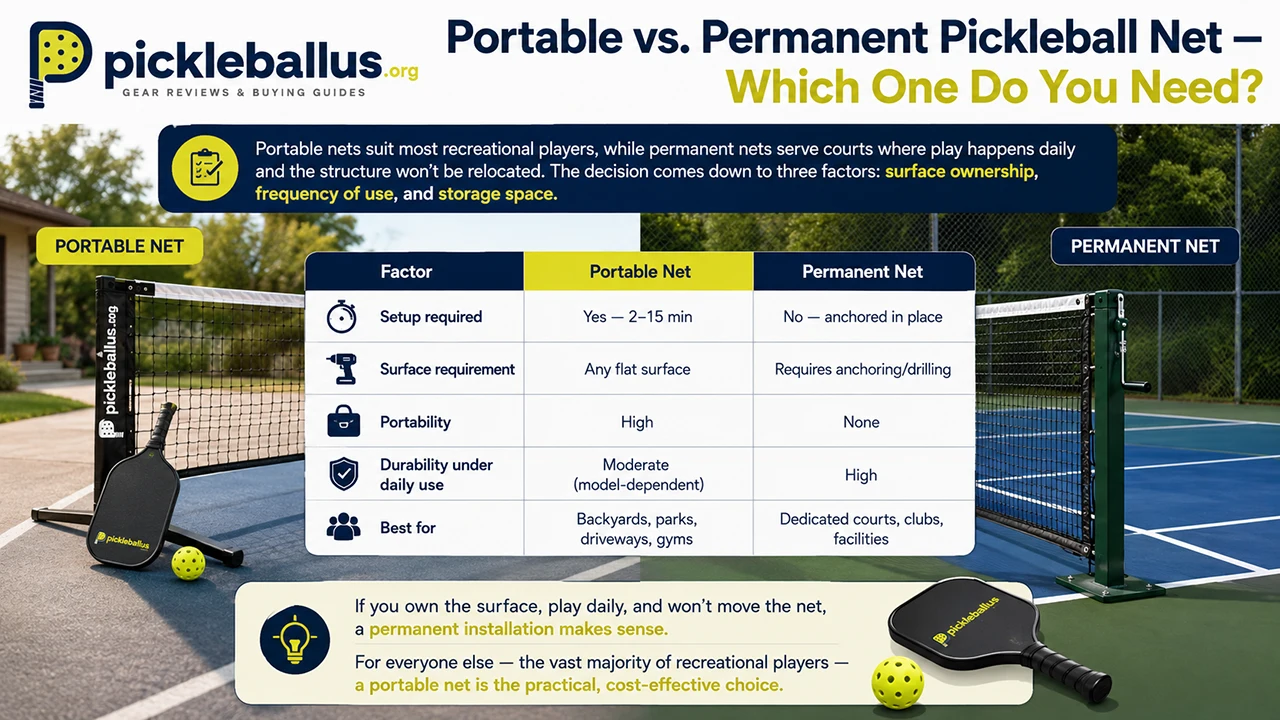
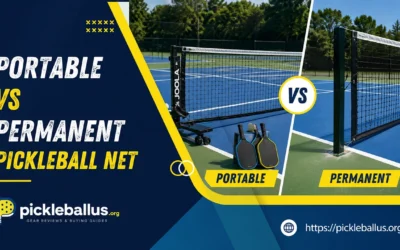
Portable nets suit most recreational players, while permanent nets serve courts where play happens daily and the structure won’t be relocated. The decision comes down to three factors: surface ownership, frequency of use, and storage space.
The table below summarizes the key differences:
| Factor | Portable Net | Permanent Net |
|---|---|---|
| Setup required | Yes — 2–15 min | No — anchored in place |
| Surface requirement | Any flat surface | Requires anchoring/drilling |
| Portability | High | None |
| Durability under daily use | Moderate (model-dependent) | High |
| Best for | Backyards, parks, driveways, gyms | Dedicated courts, clubs, facilities |
If you own the surface, play daily, and won’t move the net, a permanent installation makes sense. For everyone else — the vast majority of recreational players — a portable net is the practical, cost-effective choice. A full breakdown of the tradeoffs appears in the portable vs. permanent pickleball nets comparison, including weight specs and surface-by-surface recommendations.
Does a Portable Pickleball Net Have to Be Regulation Size?
Yes — for any organized or competitive play, a portable pickleball net must meet USA Pickleball’s official specifications: 22 feet wide, 36 inches at the sideposts, and 34 inches at the center. For casual backyard games or solo practice, a slightly smaller or non-certified net won’t disrupt enjoyment, but it will affect how you calibrate shot-making — especially net clearance on dinks and drives.
The 34-inch center measurement is the number that matters most in practice. A net sagging below 34 inches changes the margin for error on low shots and trains habits that won’t transfer to a regulation court. Every net on this list meets the 34-inch center spec. If a net you’re considering doesn’t list the center height, that’s a signal to look elsewhere.
What Else Do You Need to Know Before Buying a Portable Pickleball Net?
By now you have a clear picture of which portable nets deliver the best balance of setup speed, frame durability, and regulation compliance across every price point. Choosing the right net, however, is only part of the decision — knowing whether wheels genuinely improve your experience, how long a portable net realistically lasts under regular use, and whether spending more on quality pays off will determine whether your purchase lasts years or frustrates you within a season. The details below cover what only becomes clear once you’ve been playing with a portable net for a while.
Do Wheels on a Portable Net Actually Make a Difference?
Wheels matter if you use the same surface consistently — and become a liability if you transport the net frequently. A wheeled net like the Dominator shaves roughly five minutes off every session by eliminating the carry-and-setup routine. On a home driveway or community court, that convenience compounds quickly over a season. The tradeoff is weight: wheeled frames are always heavier than their non-wheeled counterparts, making them awkward to load into a car trunk. If your net travels to different locations, choose a lightweight frame with a good carry bag over a wheeled option.
Can You Use a Portable Net for Tournament Play?
Most portable nets are not certified for sanctioned USA Pickleball tournament play. Tournament directors use nets that meet the full USAPA spec list — including net tension standards and post-construction requirements beyond just dimensions. The Dominator Rolling Net is one of the few portable options marketed as meeting USA Pickleball official specs, but acceptance still varies by tournament director. For competitive players, portable nets serve practice and recreational play rather than official competition.
How Long Do Portable Pickleball Nets Last?
A well-maintained portable net lasts two to four seasons under moderate use (three to five sessions per week). The joints are the first failure point: friction-fit connections develop play over time, leading to a wobbly frame no amount of adjustment fixes. Shock-cord and locking-pin systems degrade more slowly, which explains why the Srikel and HEAD nets outlast similarly priced friction-fit competitors. Store the net dry, avoid leaving it assembled in direct sun for days, and the frame material will far outlast the connection points.
Budget Net vs. Quality Net — Is the Price Gap Worth It?
Spending mid-range on a portable pickleball net pays off if you play more than once a week. Budget nets typically last one season under regular use before the joints loosen or the net sags. The mid-range options on this list — the Srikel, HEAD, and Rally Net — are built to last two to four seasons, effectively reducing cost-per-use to a fraction of the budget option’s rate. If you’re playing once a month, a budget-friendly pick like the Champion Sports net makes sense. Once usage increases, the quality gap becomes a financial argument, not just a performance one.


Write Your Review
No reviews yet. Be the first to share your experience!