

A portable pickleball net suits casual players, shared spaces, and anyone without a dedicated court — it sets up in minutes and stores in a bag. A permanent net post system is the right call for dedicated home courts, club facilities, and venues hosting competitive play, where ground-anchored stability and consistent net tension matter more than convenience. The choice between them comes down to four things: how often you play, whether you own or share the space, how much you want to spend upfront, and whether tournament-level compliance is a requirement.
The court setup you’re working with shapes every aspect of this decision. A backyard player who converts a driveway on weekends has completely different needs from a sports facility installing four dedicated courts. In between, there’s a third category most buyers overlook — the semi-permanent, heavy-duty wheeled net — that performs close to a permanent system without the concrete work. Understanding where each type performs well, where it falls short, and what actually happens to your game over time is what this guide covers.
Cost is a common sticking point. Portable nets start at a fraction of what permanent posts cost, but that upfront gap often narrows when you factor in replacement cycles. A cheap portable net used daily outdoors rarely survives more than a season or two. A permanent system with proper installation, on the other hand, can last more than a decade with minimal maintenance. The gap between “affordable entry point” and “long-term value” changes significantly depending on how hard and how often you play.
Below is a breakdown of both systems — how they’re built, who they serve best, where each type falls short, and how to think about regulation compliance so you’re never caught with the wrong net for a competitive game.
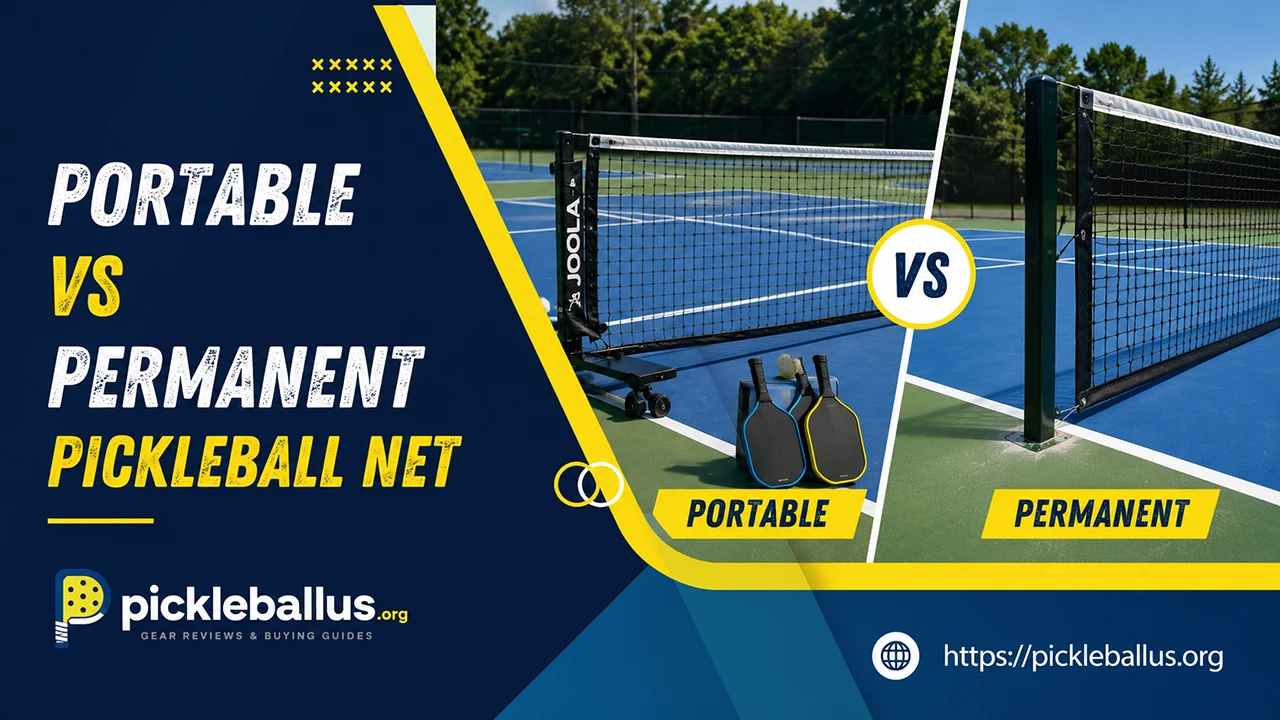
What Are Portable and Permanent Pickleball Nets?
Portable and permanent pickleball nets are the two main structural categories for net systems used in play. Both must meet the same dimensional standard — a 22-foot span, 36 inches high at the posts, and 34 inches at the center — but how they achieve and hold that standard is fundamentally different. According to the pickleball net official specifications set by USA Pickleball, net height, tension, and post placement must all fall within defined tolerances for sanctioned play.
How a Portable Pickleball Net System Works
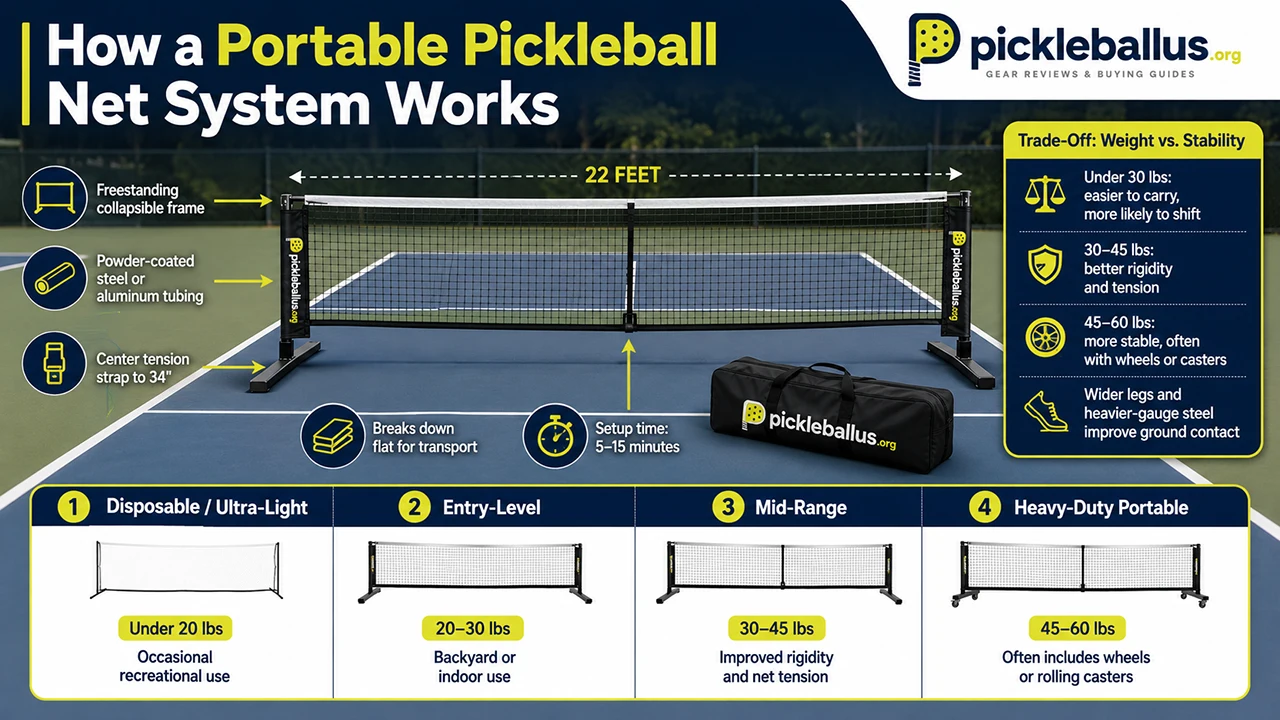
A portable net is a freestanding, collapsible frame that spans the 22-foot court width without any anchoring into the ground. Most systems use powder-coated steel or aluminum tubing for the frame, a center tension strap to pull the net down to 34 inches, and a carrying bag for transport. Setup typically takes 5 to 15 minutes depending on the model, and the whole system breaks down flat enough to fit in a car trunk.
The trade-off is weight management. Lightweight portable nets — those in the entry-level and mid-range tiers — are susceptible to shifting during aggressive play or in wind. The feet of the frame can lift or slide on hard court surfaces without additional ballast or straps. Higher-quality portable systems address this with wider base legs, heavier-gauge steel, and anchor points, bringing the total weight up to 35–50 lbs and improving ground contact significantly.
Portable nets are available across four general tiers:
- Disposable/ultra-light: Under 20 lbs, designed for occasional recreational use. Lifespan is typically one season of regular use.
- Entry-level: 20–30 lbs, stable enough for backyard or indoor use. Lasts 1–3 years with care.
- Mid-range: 30–45 lbs, improved frame rigidity and net tension. Suitable for more frequent use.
- Heavy-duty portable: 45–60 lbs, often with wheels or rolling casters. Performs comparably to permanent posts on flat, calm surfaces.
How a Permanent Net Post System Is Installed
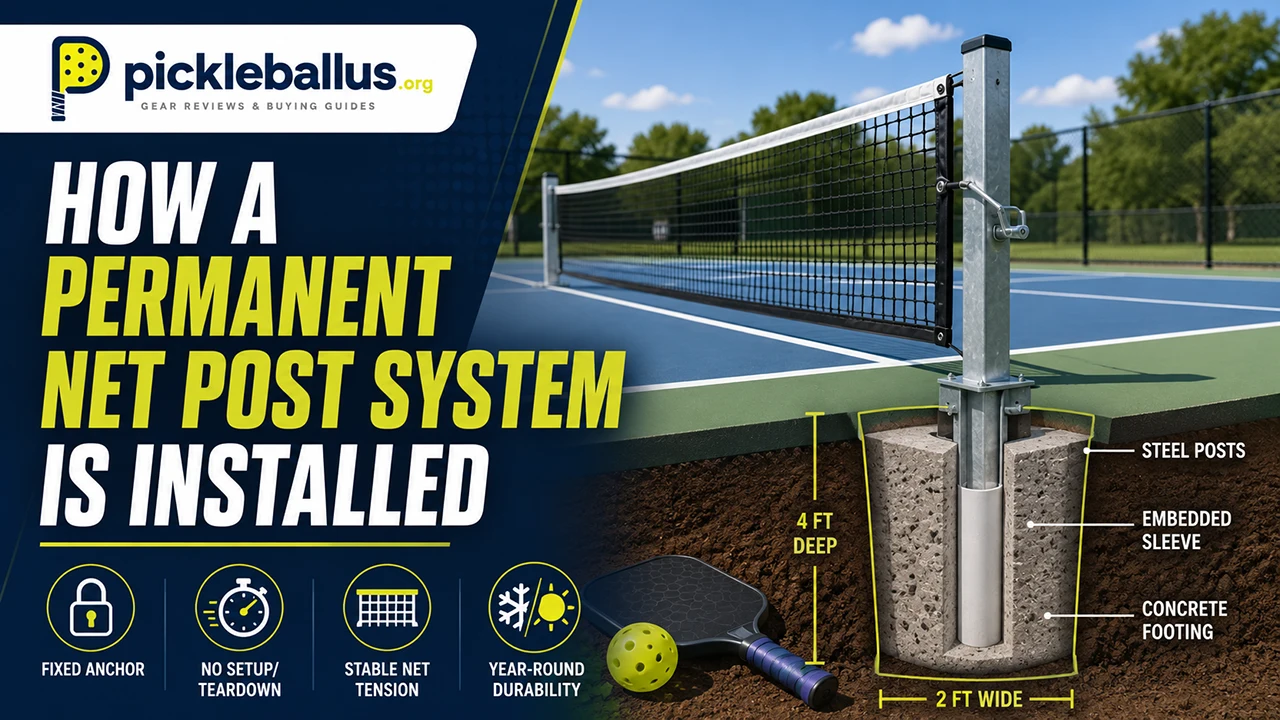
A permanent pickleball net uses steel or galvanized metal posts anchored into the ground through a concrete footing — typically about 2 feet wide and 4 feet deep — with a PVC or metal sleeve embedded in the concrete. The net attaches to the posts, which don’t move. There’s no setup or teardown between sessions; the net is always ready to play.
The permanent system’s main advantages come from that fixed anchor: it doesn’t shift during play, it holds net tension consistently without re-adjustment, and — when built with weather-resistant materials — it handles outdoor conditions year-round. Professional courts, recreation centers, and tournament venues use permanent posts precisely because the stability is guaranteed, not just likely.
Installation, however, requires site preparation. You’ll need the concrete footings poured at the correct positions, which means the court layout must be finalized before installation. Moving permanent posts after installation is not practical without breaking out the concrete, which is why it’s essential to commit to both the court location and the post placement before any groundwork begins.
The Semi-Permanent (Rolling/Wheeled) Tier — Where It Fits
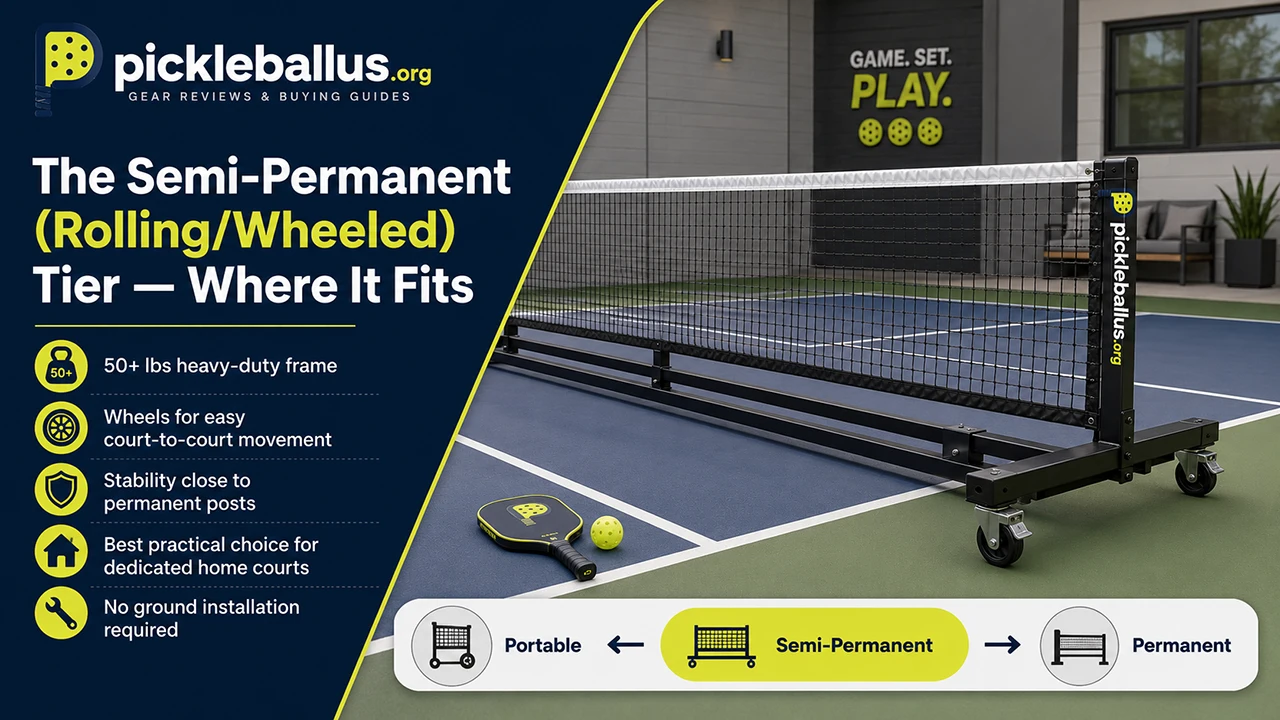
A semi-permanent or wheeled net system occupies the space between the two main categories. These are heavy-duty portable frames — often 50+ lbs — with attached wheels or rolling casters, allowing them to be moved between courts but providing stability close to that of permanent posts. They’re commonly used in facilities that need to reconfigure courts, run multiple sessions across one space, or want a professional-feel system without the ground disruption of permanent installation.
The rolling heavy-duty net is frequently the most practical recommendation for dedicated home courts, eliminating both the installation cost of permanent posts and the performance compromises of standard portable nets.
Portable vs Permanent Pickleball Net: 6 Key Differences
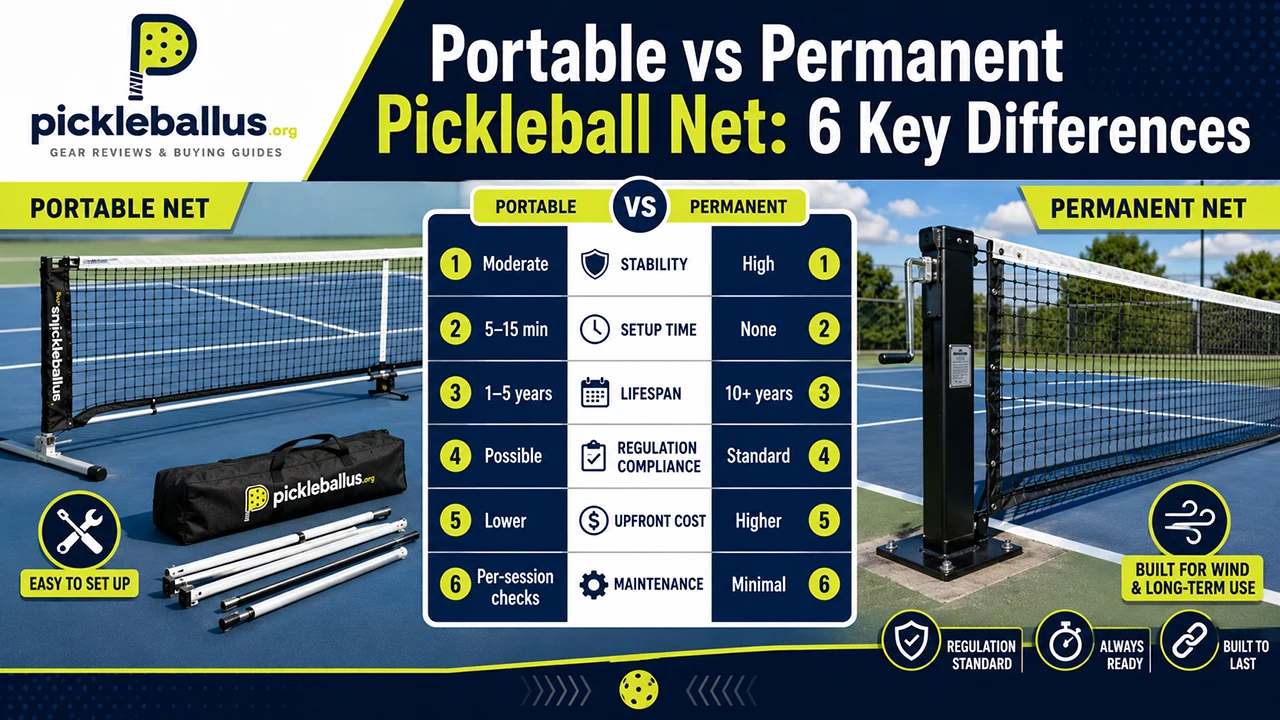
Portable and permanent systems diverge across six measurable categories: stability, setup time, lifespan, regulation compliance, upfront cost, and maintenance burden. The table below summarizes where each type wins and where it doesn’t.
The following table compares the two systems across these categories at a glance:
| Category | Portable Net | Permanent Net |
|---|---|---|
| Stability | Moderate — varies by weight/tier | High — ground-anchored, wind-resistant |
| Setup Time | 5–15 minutes per session | None — always in place |
| Lifespan | 1–5 years (tier-dependent) | 10+ years with proper installation |
| Regulation Compliance | Possible at mid/heavy tiers | Standard at all quality levels |
| Upfront Cost | Lower | Higher (includes installation labor) |
| Maintenance | Net tension checks each session | Minimal once installed |
Stability and Wind Resistance
Permanent posts deliver superior stability because they’re anchored into concrete and cannot shift. On a windy outdoor court, even a 30 lb portable net can drift or tip without ballast. Entry-level and mid-range portable systems are notably more vulnerable — even a moderate gust can shift the net mid-rally, introducing inconsistency into the game that players eventually find frustrating.
Heavy-duty portable nets with wide base legs and additional weight close this gap on calm days, but they still can’t fully replicate the ground-locked stability of concrete-anchored posts in variable conditions. If your outdoor space experiences regular wind, this difference will be felt during play regardless of the portable net’s quality tier.
Setup Time and Ease of Use
Portable nets require 5–15 minutes of assembly at the start of every session, including frame connection, net attachment, and center strap tension adjustment. That’s a minor inconvenience for occasional players but adds up fast for anyone playing daily or hosting regular games. Permanent posts eliminate this entirely — you walk onto the court and play.
For facilities managing multiple courts and daily sessions, the cumulative time cost of portable setup becomes meaningful. Staff time spent assembling and storing nets each day is a real operational consideration, particularly if courts serve back-to-back sessions with tight turnaround.
Durability and Expected Lifespan
Permanent nets last 10 years or longer under normal outdoor use when installed with weather-resistant posts and quality netting. The concrete anchor doesn’t degrade, and most post systems use galvanized or powder-coated steel designed to resist rust and UV damage.
Portable nets span a wide range. Disposable and entry-level models typically last one to three seasons of regular play — the frame welds weaken, the net fabric frays, and the tension strap loses elasticity. Higher-quality mid-range and heavy-duty portable systems can last four to six years with proper storage, but they still require more active maintenance than permanent posts. Storing a portable net indoors when not in use significantly extends its life, particularly in climates with UV exposure or extreme temperature shifts.
Regulation and Tournament Compliance
Both portable and permanent nets can meet USA Pickleball regulation standards, but not all do — and it’s the portable category where non-compliant nets are more common. Regulation requires a 22-foot width, 36-inch post height, 34-inch center height, and specific net tension. Many cheap portable nets are built to approximate these dimensions rather than meet them precisely, and net tension drifts as the session progresses without active re-adjustment.
For a more detailed look at what the spec sheet actually requires, the pickleball net official specifications cover every dimension that referees and facility managers need to verify before sanctioned play.
Who Should Choose a Portable Pickleball Net?
A portable pickleball net is the right choice for three main player and setup types: casual home players, anyone operating in a shared or multi-sport space, and players who don’t have a dedicated permanent court available to them.
Casual Players and Home Setups
Recreational players who don’t have a fixed dedicated court get the most value from a portable net. If you’re setting up in a driveway, a patio, a gym floor, or a shared park area, a portable system is the only practical option. There’s no ground to anchor into, the location may change session to session, and the lower upfront cost matches the occasional use case.
For home players who play two or three times per week without hosting competitive sessions, a mid-range portable net in the 30–45 lb tier delivers more than enough performance. The key is choosing a system heavy enough to stay stable and built with materials durable enough to survive repeated setup and breakdown cycles.
Multi-Sport or Shared Spaces
Any court that serves multiple sports or activities needs the flexibility of a portable net. A gym that converts to a pickleball court for evening sessions, a school facility that runs different programs throughout the week, or a community center that shares space between tennis and pickleball players — all of these need a net they can set up, break down, and store. Permanent posts would lock the space into pickleball geometry permanently.
For venues managing this kind of multi-use scheduling, the best portable pickleball net options in the heavy-duty tier offer the durability to survive daily commercial use without the ground commitment of permanent installation.
Players Without a Dedicated Court
Public parks, open paved areas, and shared recreational spaces rarely offer permanent pickleball infrastructure outside of dedicated pickleball courts. Players who travel to play, use different locations depending on availability, or organize pop-up games need a portable net that fits in their car, sets up quickly, and breaks down just as fast. This is exactly the use case portable nets are built for — and where even a mid-tier portable system performs well.
Who Should Choose a Permanent Pickleball Net?
Permanent net posts make sense in three scenarios: a dedicated court that’s yours to modify, a facility running regular competitive or club-level play, and anyone making a long-term investment where the upfront installation cost is offset by durability over time.
Dedicated Home or Club Courts
Anyone building a permanent pickleball court on their property should plan for permanent net posts from the start. If you’re pouring a concrete slab, painting lines, and fencing a space specifically for pickleball, installing permanent posts at the same time adds relatively little to the total project cost. The alternative — using a portable net on a permanent court — works but introduces the ongoing inconvenience of daily setup and the instability compromises described above.
Club courts serving dozens of members per week belong in the same category. Members expect a consistent, professional feel each session, and permanent posts deliver that without relying on proper portable assembly every time.
Facilities Hosting Competitive or Tournament Play
Dedicated sports facilities and recreation centers that host tournaments or rated competitive play need permanent posts to ensure consistent regulation compliance. Tournament directors verify net dimensions before each match, and a portable net’s tendency to shift or lose tension mid-session creates a liability that permanent anchoring eliminates.
For facilities that run both casual and competitive programming, the best permanent pickleball net options are engineered specifically for high-frequency institutional use — heavy gauge posts, commercial-grade netting, and consistent tension across sessions.
Long-Term Cost Considerations
A permanent net system costs more upfront, often significantly so when installation labor is included alongside the hardware. But the lifespan difference changes the long-term calculus. Replacing a mid-range portable net every three to four years on a dedicated court that’s used regularly adds up. A permanent installation that lasts 10+ years with minimal maintenance cost can represent better value over time, particularly for courts where the game is played year-round.
Can a Portable Pickleball Net Meet Regulation Standards?
Yes — a portable pickleball net can meet USA Pickleball regulation standards, but only if it’s designed to do so and properly set up each session. The regulation dimensions — 22-foot width, 36-inch post height, 34-inch center height — are achievable in portable systems at the mid-range and heavy-duty tiers. The challenge isn’t the specification; it’s the consistency.
Portable nets require a center tension strap to pull the net down from 36 to 34 inches at the centerline. If the strap isn’t tightened correctly, the net sags or sits too high. Net tension also loosens over the course of a session as the frame flexes, particularly during aggressive baseline play or if anyone touches the net. Players and referees on regulated courts should re-check the pickleball net height at the start of each game if using a portable system.
Cheap, lightweight portable nets — especially those under 20 lbs — are generally not designed to hold accurate regulation dimensions. The frame is too flexible, the net fabric too loose, and the tension mechanism too imprecise for reliable compliance. If regulation-level play is a requirement, the net system needs to be either a permanent installation or a heavy-duty portable meeting commercial-grade quality standards.
By now you have a clear picture of the structural, financial, and performance differences between portable and permanent pickleball net systems — and which player or facility type each one actually serves. Owning the right net, however, is only part of the equation: how you maintain it, what materials hold up in your climate, and whether a middle-ground solution could outperform both extremes are questions that separate a good setup from one that lasts years without frustration. The next section covers those finer details that most buyers only discover after their first season.
What Else Should You Know Before Committing to a Net System?
Net Tension, Height Compliance, and Why It Drifts Over Time
Net tension is not a set-and-forget spec — it’s something that changes with play, temperature, and the age of the net fabric. In a portable system, the center strap tension loosens as the frame flexes under lateral pressure during play. On a hot day, netting made from nylon or polypropylene expands slightly, dropping the center height below 34 inches. In cold weather, synthetic netting contracts and may pull tighter than intended.
For players who care about accurate play, a quick check with a measuring tape at net center before each game takes 30 seconds and eliminates most compliance issues. Permanent systems are more stable in this regard — the fixed post height holds 36 inches reliably, and a properly tensioned permanent net holds center height far more consistently through a full day of play.
Frame Materials: Aluminum vs Steel vs Galvanized — What Holds Up Outdoors
The frame material determines how long your net lasts outdoors. Aluminum frames are lighter and naturally corrosion-resistant, making them a smart choice for portable nets that will be stored outside or in humid environments. The trade-off is rigidity — aluminum bends more easily under impact than steel and is harder to repair if a joint cracks.
Steel frames are heavier and stronger, with better rigidity at the base legs, but standard steel is vulnerable to rust if the coating is scratched or worn. Look for powder-coated or galvanized steel in any net system meant for year-round outdoor use. Permanent post systems almost universally use galvanized or powder-coated steel specifically because they’re exposed to weather without the option of indoor storage.
Semi-Permanent Nets on Wheels — The Overlooked Middle Ground
The heavy-duty wheeled portable net is the most underrated option in the market. Weighing 50 lbs or more and designed with wide, reinforced base legs and rolling casters, these systems perform on-court like permanent posts — minimal wind movement, stable net tension, consistent play height — while still allowing the court space to be reconfigured or the net to be stored off the playing surface.
For anyone building a dedicated home court but hesitant about the irreversible commitment of poured concrete sleeves, a semi-permanent wheeled system is often the smarter first investment. It can serve as the main net for years, and you can always transition to anchored permanent posts later without losing the value of the original purchase for multi-court or backup use.
Portable vs Permanent for Tournament Play: What Referees Actually Check
Tournament referees verify four things when checking a net system before sanctioned play: overall net width (22 feet), post height (36 inches), center height (34 inches), and net tension across the full span. The net must not sag noticeably between the posts, and the center strap must hold the 34-inch measurement without slack.
Permanent nets pass these checks without preparation because the post height is fixed and the tension doesn’t drift between sessions. Portable nets need active management — re-tighten the center strap, verify the post height hasn’t been bumped, and check that the base legs are seated correctly before competition begins. Referees at USA Pickleball-sanctioned events can disqualify a court if the net system doesn’t meet spec, so understanding which portable nets actually hold regulation dimensions under play conditions matters before tournament day.
For a full overview of how to evaluate and select the right net for your specific court, the how to choose a pickleball net guide covers setup types, material comparisons, and buying criteria in one place.





Write Your Review
No reviews yet. Be the first to share your experience!