

Pickleball balls come in yellow, orange, neon green, white, and pink — and each color serves a different court, lighting condition, and player preference. Yellow is the default choice at most tournaments and outdoor courts. Orange performs best under gym lights. Neon green is gaining ground among evening and low-light players. White and pink fill specialty roles that most recreational players rarely think about until they actually need them.
Picking the right color is less obvious than it sounds. Court surface, lighting type, time of day, and even the background behind the baseline all affect how easily you can track a fast-moving ball. A yellow ball that pops perfectly on an outdoor hard court can disappear against a sunlit beige wall. An orange ball that reads well under fluorescent lights might get lost against certain gym flooring. These aren’t trivial differences — visibility directly affects reaction time, and reaction time determines who wins rallies.
Most players default to whatever color ball the court provides. But once you understand why these colors were developed and where each one performs, you’ll make a deliberate choice instead of a default one. You’ll also understand why tournament organizers, casual leagues, and serious players each tend to reach for different hues.
Below is a complete breakdown of every mainstream pickleball ball color — how each performs, where it works best, and what USA Pickleball actually says about color requirements for sanctioned play. If you want to go deeper on best pickleball balls overall, that guide covers materials, durability, and brand comparisons alongside color considerations.
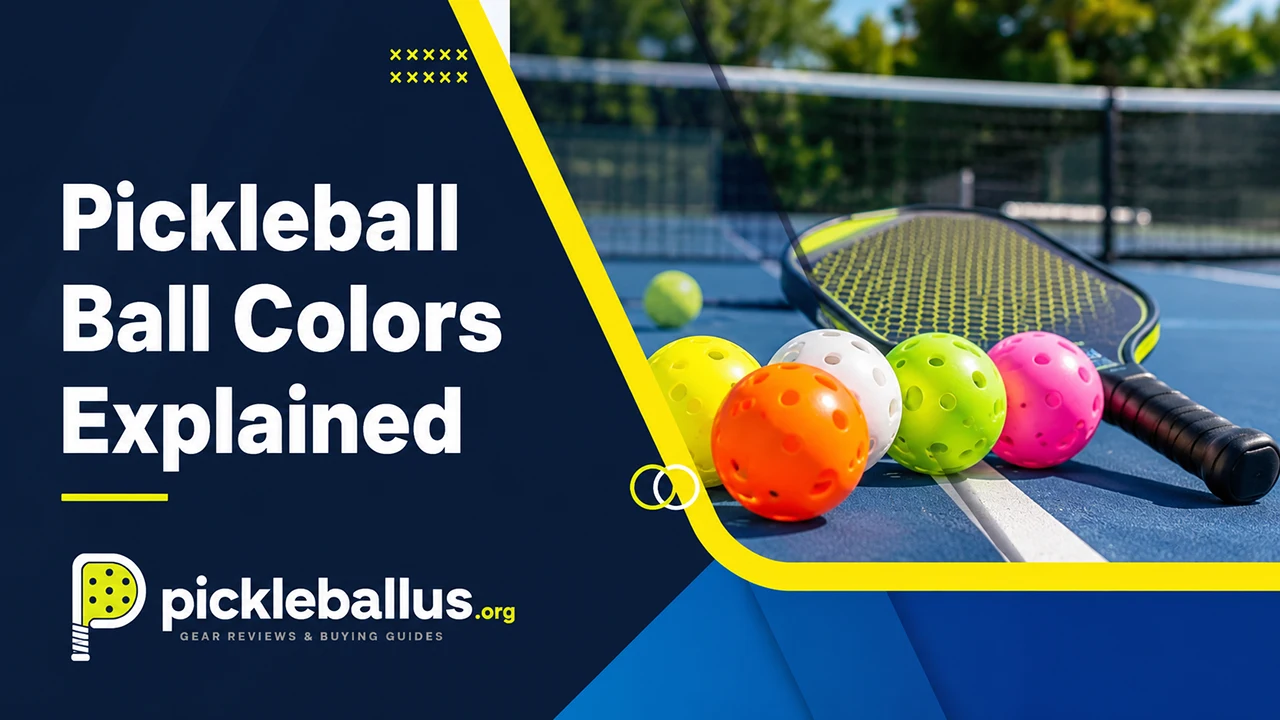
What Colors Do Pickleball Balls Come In?
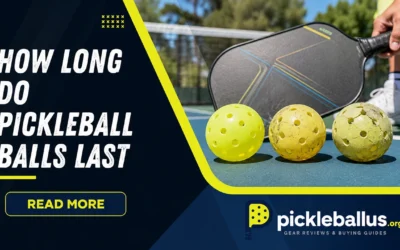
Pickleball balls are manufactured in five main colors: yellow, orange, neon green, white, and pink. Yellow accounts for the largest share of balls in circulation, followed by orange, then neon green. White was the original choice in early recreational play but has become less common outdoors. Pink and specialty dark colors like black and indigo exist primarily in niche training contexts.
The spectrum exists because no single color works equally well across every court and lighting situation. Manufacturers responded to that reality by expanding their ranges over time. Today, brands like Onix, Franklin, and Dura each offer multiple color variants of their flagship balls, and the choice among them is now a meaningful equipment decision rather than an aesthetic one.
Here is how each color performs in practice.
Yellow — The Universal Standard
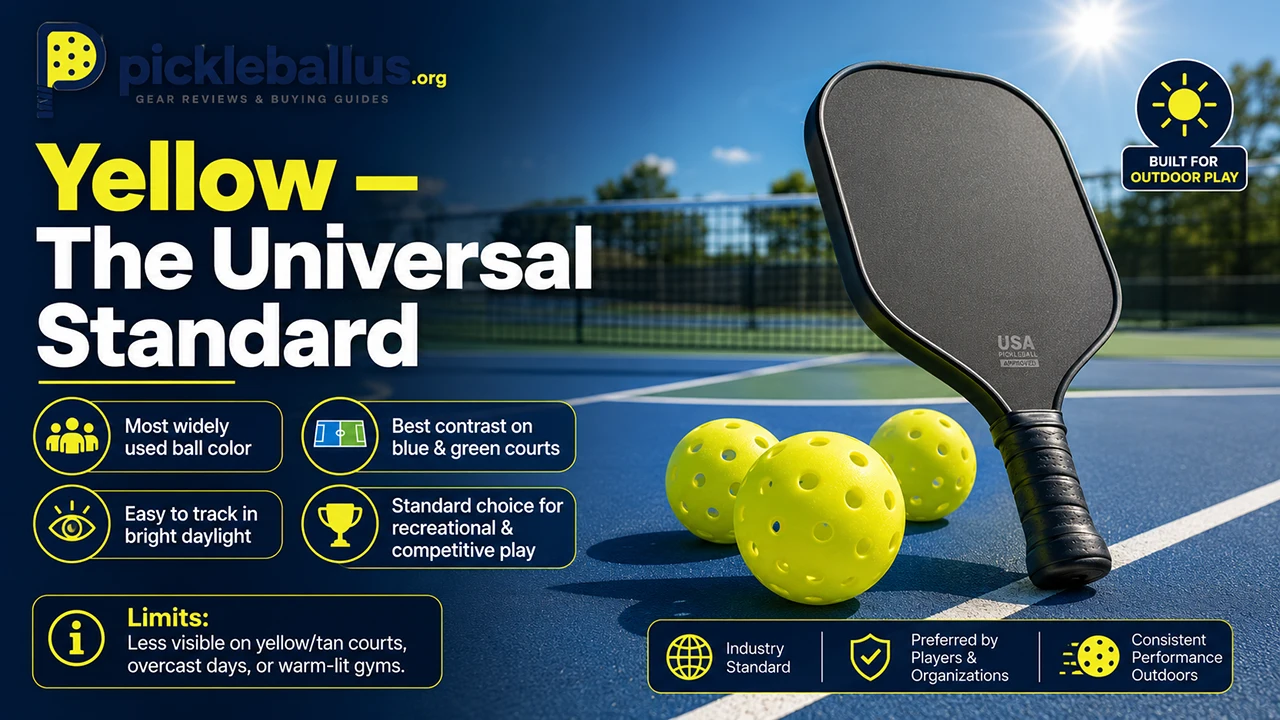
Yellow is the most widely used pickleball ball color and serves as the de facto standard across both recreational and competitive play. The color’s dominance traces back to its performance in the most common playing condition: outdoor courts in daylight.
Yellow offers strong contrast against blue and green court surfaces, the two most prevalent colors used in USAPA-approved pickleball facilities. Under direct sunlight, the yellow pigment reflects light at a wavelength the human eye processes quickly, which reduces the cognitive delay between seeing the ball and initiating a reaction. In practical terms, players tracking a yellow ball outdoors in bright conditions can pick up spin direction and trajectory earlier than with most alternatives.
There is a secondary reason yellow became so dominant: tennis. Because pickleball emerged partly from equipment already in use on tennis courts, and because yellow tennis balls were already the recognized visual standard, pickleball manufacturers early on defaulted to yellow. The familiarity helped the sport gain adoption quickly among tennis crossover players.
Yellow does have weaknesses. Against yellow or tan court surfaces, it loses contrast. On overcast days, the brightness drops and tracking becomes harder. In gym environments with warm-tinted artificial lighting, yellow can wash out against light-colored walls or wood flooring.
Orange — The Indoor Favorite
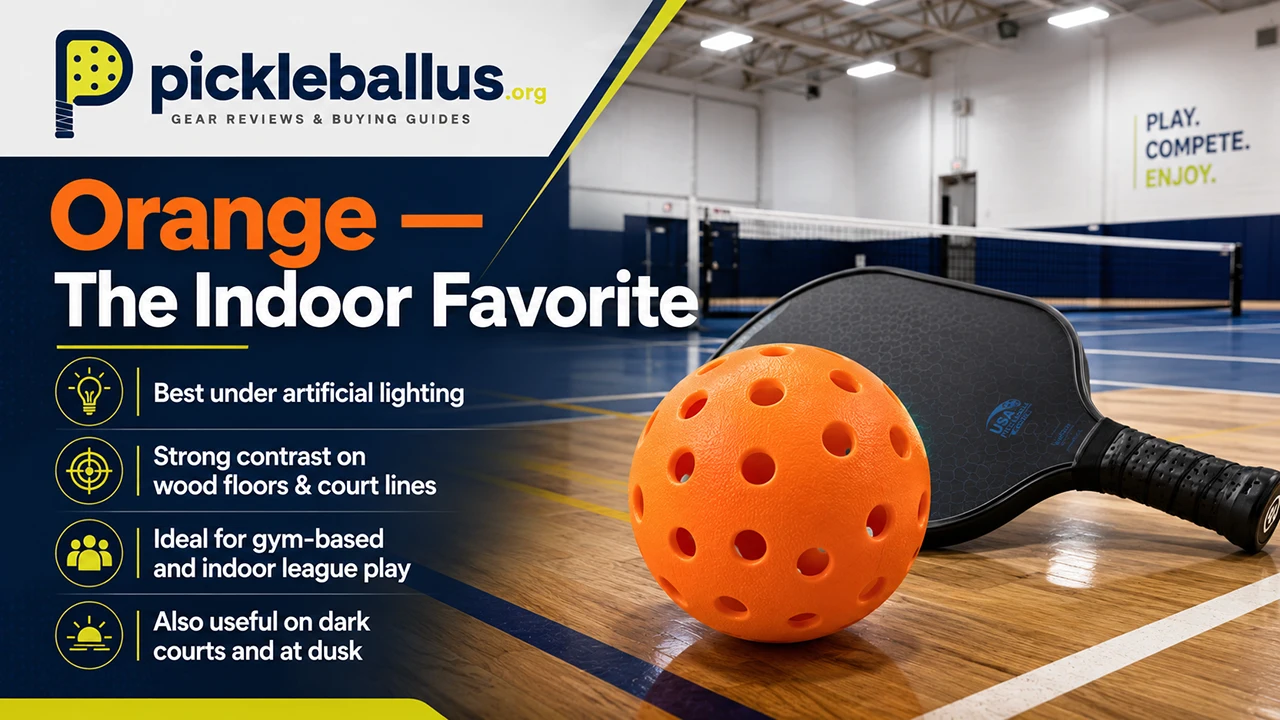
Orange pickleball balls perform best under artificial lighting, which is why they became the go-to choice for gym-based and indoor league play. The orange wavelength creates stronger contrast against the wood tones, court lines, and white walls common in indoor pickleball facilities than yellow does under the same conditions.
The shift from yellow to orange for indoor play reflects a practical observation among experienced players: under fluorescent or LED overhead lighting, orange tends to stand out more cleanly from the visual clutter of a gym environment. Wood floors with overlapping court lines for multiple sports — basketball, volleyball, badminton — create a complex visual background. Orange separates from that background more reliably than yellow.
Outdoors, orange works well on dark court surfaces like asphalt or dark gray concrete, where yellow can sometimes blend into ambient light. Evening outdoor players also report better visibility with orange compared to yellow once the sun drops below the horizon and natural light shifts to a cooler, dimmer spectrum.
For players who split time between indoor and outdoor venues, keeping a set of orange balls specifically for indoor sessions is a practical approach that many regular players eventually adopt.
Neon Green — The Rising Performer
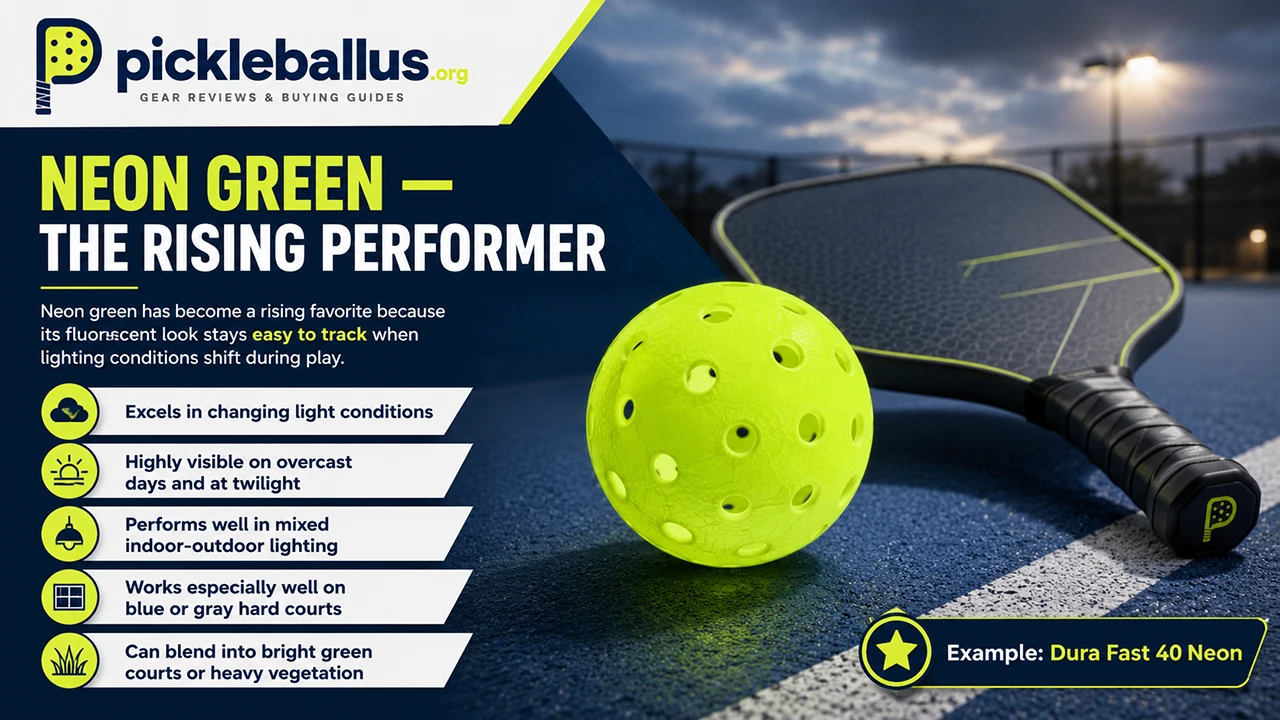
Neon green has emerged as one of the most visible options across a range of lighting conditions, which explains its growing popularity among players who deal with inconsistent court environments. The fluorescent quality of neon green means it reflects light effectively even when ambient light is low, a property that standard yellow does not share to the same degree.
On overcast days, during twilight outdoor sessions, or in mixed-use indoor-outdoor facilities where natural and artificial light interact unpredictably, neon green tends to maintain visibility better than yellow or orange. Several players describe it as the easiest color to track when conditions change mid-game, such as when clouds shift during an outdoor session or when overhead lights mix with fading natural light through windows.
Neon green is not without drawbacks. On courts with bright green surfaces or heavy green background vegetation, the color can blend in ways that yellow does not. On standard blue or gray outdoor hard courts, however, it performs well across the widest range of lighting scenarios.
The Dura Fast 40 Neon is one of the most visible examples of this color in the tournament-approved category, and recreational players have increasingly shifted toward neon green as awareness of its visibility advantages has spread.
White and Pink — The Specialty Options
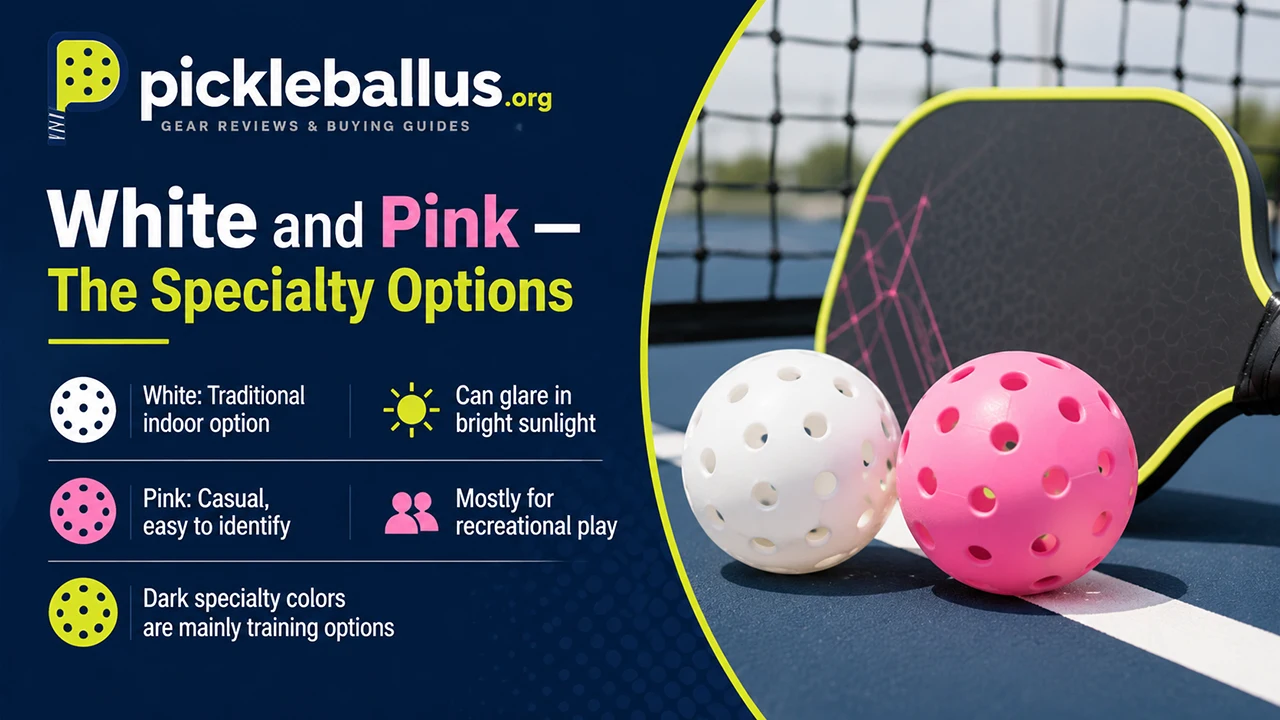
White pickleballs were common in early recreational play but have largely been displaced by yellow and orange in most settings. White still appears in certain indoor leagues and recreational setups where tradition or preference drives the choice. On dark court surfaces indoors, white can offer good contrast, though it tends to glare under bright overhead lighting in ways that orange and yellow do not.
The main practical downside of white outdoors is its behavior in direct sunlight. The ball can take on a washed-out, high-glare appearance that makes tracking spin and seam position harder. Against lighter court surfaces or in environments with reflective walls, white also offers limited contrast.
Pink pickleball balls occupy an even narrower niche. Primarily used in casual and recreational settings, pink balls offer no performance advantage in standard play conditions but appeal to players who prefer visual variety or want to distinguish their balls from others on a busy court. Some youth programs use pink balls for the same reason — quick visual identification in a high-activity environment.
Dark specialty colors — black, indigo, and red — appear in specific training products rather than standard recreational or tournament balls. These will be covered in the Supplementary section below.
Does Pickleball Ball Color Affect Visibility?
Yes, ball color meaningfully affects how quickly and consistently players can track the ball in real game conditions. The relationship between color and visibility is not static — it depends on the interaction between the ball’s pigment, the court surface, the background environment, and the lighting source. The same color that performs best in one setting can perform worst in another.
Understanding this relationship helps explain why experienced players own balls in multiple colors rather than buying a single color in bulk. Conditions change, and the right color changes with them.
Outdoor Courts: Which Colors Pop in Sunlight
On outdoor courts in direct daylight, yellow remains the strongest performer for most standard court surfaces — particularly blue and green acrylic surfaces. The contrast between yellow and blue or green is visually clean, and the yellow wavelength benefits from full-spectrum natural sunlight.
Neon green offers comparable visibility on blue courts and edges ahead on gray or concrete surfaces where yellow has slightly less contrast. Orange performs well on dark surfaces like asphalt but can appear less distinct against blue courts in bright sunlight compared to yellow.
The underlying principle is contrast: you want the ball’s color to differ as much as possible from the court surface, the surrounding boundary lines, and the visual background beyond the baseline. On courts bordered by trees, fencing, or painted walls, what’s behind those baselines matters too.
Indoor Courts: Which Colors Work Under Artificial Lights
Indoor courts present a different challenge. Artificial lighting — whether fluorescent tubes, LED panels, or halogen spots — shifts the color spectrum in ways that reduce yellow’s advantage. Under warm-tinted LED lighting common in newer gym installations, orange outperforms yellow because its warmer hue remains distinct from the light tone rather than blending into it.
Cooler, bluer LED or fluorescent lighting tends to work well with both yellow and neon green. The general guideline experienced players follow: if the gym has warm-toned lighting and a wood or light-colored floor, choose orange. If the lighting is cooler or neutral, yellow and neon green both work.
White balls, despite their intuitive association with visibility, often cause problems in well-lit gyms because the glare off the ball’s surface can make tracking harder rather than easier. Orange and neon green are generally the safer indoor choices by most accounts.
Low-Light and Evening Play: What Players Prefer
For twilight outdoor play or evening sessions under court lighting systems that don’t provide full-spectrum illumination, neon green is the preferred color among most experienced players. Its fluorescent quality means it reflects the available light more efficiently than standard yellow or orange.
Orange comes in second in low-light outdoor conditions, particularly when court perimeter lighting creates warm pools of light that orange can leverage. Yellow tends to drop off faster than both alternatives as ambient light fades.
Players who compete in evening leagues or tournaments at venues with variable lighting have noted that carrying neon green or orange balls for backup use when official tournament balls aren’t provided can meaningfully improve warm-up and casual rally quality.
What Color Pickleball Ball Is Used in Tournaments?
USA Pickleball does not specify a required color for approved tournament balls. The organization’s equipment standards address size, weight, bounce height, hardness, and hole specifications — color is not part of the formal approval criteria. Any ball that meets the technical specs can receive USA Pickleball approval regardless of its color.
In practice, yellow is the de facto tournament standard because it’s the color used by the most widely adopted tournament balls. The Franklin X-40, which serves as the official ball at many major events, is used primarily in yellow. The Dura Fast 40, another staple of competitive outdoor play, comes in yellow, orange, neon, and white — but yellow is the most commonly seen color at outdoor tournaments.
USA Pickleball Approval — Color Rules Explained
USA Pickleball’s approval process evaluates balls against a defined set of physical performance standards. A ball earns approval based on how it bounces, how it withstands impact, how uniform its holes are, and whether it falls within the specified weight and diameter range. Color is explicitly outside those criteria.
This means tournament organizers have discretion on which approved balls to use, and by extension, which colors appear at their events. Most outdoor tournaments default to yellow because it is the most familiar and widely stocked option among approved ball suppliers.
Indoor sanctioned events show more variation. Some leagues run on orange, others on yellow, and neon green has appeared at certain facilities where visibility conditions favor it. Players entering their first tournament should check with the event organizer or review the event’s equipment list to confirm which ball — and which color — will be used.
Major Tournaments and Their Ball Color Choices
The U.S. Open Pickleball Championships, one of the most prominent events in the sport, has historically used yellow balls. The PPA Tour and MLP events similarly default to yellow for outdoor formats. Indoor sanctioned events vary more, with orange and yellow both appearing depending on the venue.
The consistency at the top level of the sport reinforces yellow as the standard that competitive players practice with most often. For players preparing for tournament play, using yellow outdoor balls in regular training ensures there is no color-adaptation adjustment on match day.
How to Choose the Right Pickleball Ball Color for Your Court
The best way to choose a ball color is to match it to where and when you play most often. No single color wins everywhere, but a simple three-factor evaluation — court surface, lighting type, and time of day — covers most decision scenarios.
The table below provides a starting reference. Match your most common playing conditions to the recommended color and use it as a starting point. Players with varied schedules often settle on two colors: yellow for outdoor daytime play and orange or neon green for everything else.
| Playing Condition | Recommended Color | Runner-Up |
|---|---|---|
| Outdoor, direct sunlight, blue court | Yellow | Neon green |
| Outdoor, direct sunlight, gray/asphalt | Orange | Neon green |
| Outdoor, overcast or variable light | Neon green | Orange |
| Outdoor, evening / low-light | Neon green | Orange |
| Indoor, warm LED or fluorescent lighting | Orange | Neon green |
| Indoor, cool/neutral lighting | Yellow | Neon green |
| Indoor, wood floor, mixed sport lines | Orange | Yellow |
| Tournament (outdoor) | Yellow | — |
Matching Ball Color to Court Surface
Court surface color creates the primary contrast variable. The rule of thumb: pick a ball color that contrasts sharply with the dominant court color. Blue courts favor yellow or orange. Green courts favor yellow or orange. Gray or concrete surfaces favor neon green or orange. Tan or beige surfaces call for something other than yellow — orange or neon green provide better differentiation there.
If your home court has unusual coloring, the fastest test is to bounce each color you’re considering and observe which one your eye locks onto most quickly from the baseline. That immediate visual snap is the real-world measure of contrast.
Matching Ball Color to Lighting Conditions
Lighting type often matters more than court surface. Warm artificial light shifts the effective visibility of yellow toward orange — the warm ambient color absorbs yellow’s contrast advantage. Cool artificial light maintains yellow’s effectiveness. Natural daylight favors yellow and neon green roughly equally on most surfaces.
Players in regions with strong seasonal lighting variation — particularly those who play indoors more during winter — often find that shifting to orange or neon green for their winter season and returning to yellow for outdoor summer play produces the most consistent visibility experience year-round.
Does Personal Preference Matter?
Player preference is a legitimate factor, but it should rank below performance considerations rather than above them. Some players develop a strong attachment to one color because it is what they learned on, and familiarity provides a real if small advantage in ball tracking. If you’ve played thousands of hours with yellow balls, switching to neon green may feel disorienting initially even if neon green would theoretically serve you better in your playing environment.
The practical approach: use the color that performs best in your primary conditions, and give yourself enough time — usually a few sessions — to adapt before dismissing a new color as uncomfortable. Visibility advantages that seem small during warm-up become meaningful in fast exchanges at the kitchen line.
For players who bring their own balls to outdoor pickleball sessions, having both yellow and neon green on hand covers most situations. Players who primarily play indoor pickleball often find that a pack of orange balls handles most of their sessions without requiring further selection.
By now you have a clear picture of every mainstream pickleball ball color, what drives visibility across surfaces and lighting types, and what USA Pickleball actually requires — and doesn’t require — on color. Choosing the right color, however, is only one dimension of picking a ball that performs. The brand, construction method, indoor vs. outdoor designation, and material hardness all interact with color to determine how a ball actually plays. The next section covers what lies beneath the surface of the color choice.
Beyond Color — What Else Should You Know About Pickleball Balls?
Indoor vs. Outdoor Balls: Color Is Just the Beginning
The indoor vs. outdoor designation matters more than color when it comes to how a ball actually plays. Indoor balls have 26 larger holes and use softer plastic that creates a slower, lower bounce suited to gym surfaces. Outdoor balls have 40 smaller holes and use harder plastic that resists wind and performs on rough surfaces like asphalt and concrete.
Playing an indoor ball outdoors — regardless of its color — will produce an unpredictable flight path in any wind and a mushy feel that makes power shots inconsistent. Playing an outdoor ball indoors is less problematic but still changes the game pace, bounce dynamics, and control feel compared to a purpose-made indoor ball.
For a complete breakdown of the performance differences, the indoor vs outdoor pickleballs comparison covers each variable in detail. Color selection only makes full sense once you’ve already confirmed you’re using the right ball type for your environment.
Brand-Specific Color Offerings
Each major ball brand has its own color lineup, and not every color is available across every ball model. Onix offers yellow, orange, pink, and neon green across its Fuse and Pure 2 lines. The Dura Fast 40 comes in yellow, orange, neon, and white. The TOP ball is available in yellow, orange, neon, and white. Franklin’s X-40, one of the most tournament-used outdoor balls, is primarily available in yellow and orange.
If you need a specific color in a specific ball model — for example, pink for a youth program or neon green in a USA Pickleball-approved outdoor ball — verify availability before purchasing, since not every color is produced in every quantity or packaging format. The best pickleball balls guide includes current availability data and performance notes for each model.
Two-Tone and Dark-Colored Training Balls — Are They Worth It?
Dark-colored balls — sold under names like Midnight Indoor — come in black, indigo, red, and deep pink. These were developed specifically for indoor environments where a dark ball creates maximum contrast against light-colored walls and flooring. PickleballCentral’s Midnight line uses Jugs balls dyed in these darker shades, targeting players who wanted something visually different from standard indoor options.
Two-tone training balls combine two contrasting colors in a single ball, often split at the seam. The visual contrast is intended to help players read ball spin more quickly — the rotating color split makes spin direction and speed visible in a way that a solid-color ball does not allow. For players working deliberately on reading spin, two-tone balls offer a training advantage that solid-color balls cannot replicate.
For standard recreational and competitive play, however, single-color balls are the norm. Dark and two-tone options are worth knowing about if you encounter them, but how to choose a pickleball ball for most players comes down to the core four-color range: yellow, orange, neon green, and white.
![7 Best Pickleball Balls for Cold Weather [2026 Tested]](https://tegahillsfarms.com/wp-content/uploads/best-pickleball-balls-for-cold-weather-400x250.webp)
Write Your Review
No reviews yet. Be the first to share your experience!