

The official pickleball ball specs set by USA Pickleball require a diameter between 2.87 and 2.97 inches, a weight between 0.78 and 0.935 ounces, a bounce of 30–34 inches when dropped from 78 inches, and 26 to 40 circular holes. Every ball used in sanctioned tournament play must meet these standards and appear on the official USA Pickleball approved ball list.
Those numbers apply equally to indoor and outdoor play, but the two ball types are built differently within those shared limits. Outdoor balls use a harder shell with smaller, more tightly spaced holes to handle wind, while indoor balls carry larger holes and a softer construction for gym floors where control and sound matter more. Neither type gets a separate spec category — they both live inside the same rulebook numbers.
Most players asking about specs have a practical concern: does my ball pass muster for a tournament, or is it just fine for recreational play? The answer comes down to whether your ball carries the USAPA approval seal and whether it’s still physically within spec after weeks of court use. Balls wear out of spec gradually — they crack, go out of round, and lose hardness — and most players don’t notice until something feels off in a rally.
Below, every spec is broken down with the official figures, a plain-English explanation of what each number means, and a clear comparison of how indoor and outdoor balls handle those requirements differently.
What Are the Official Pickleball Ball Size Specs?
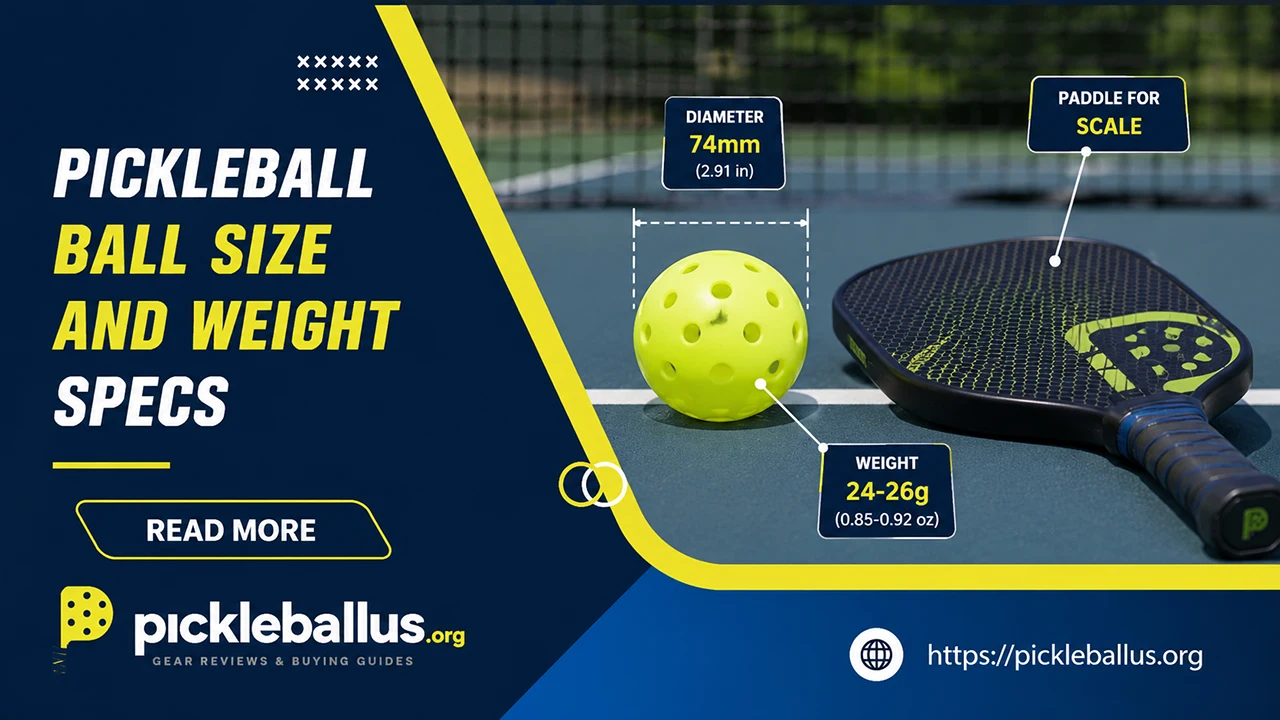
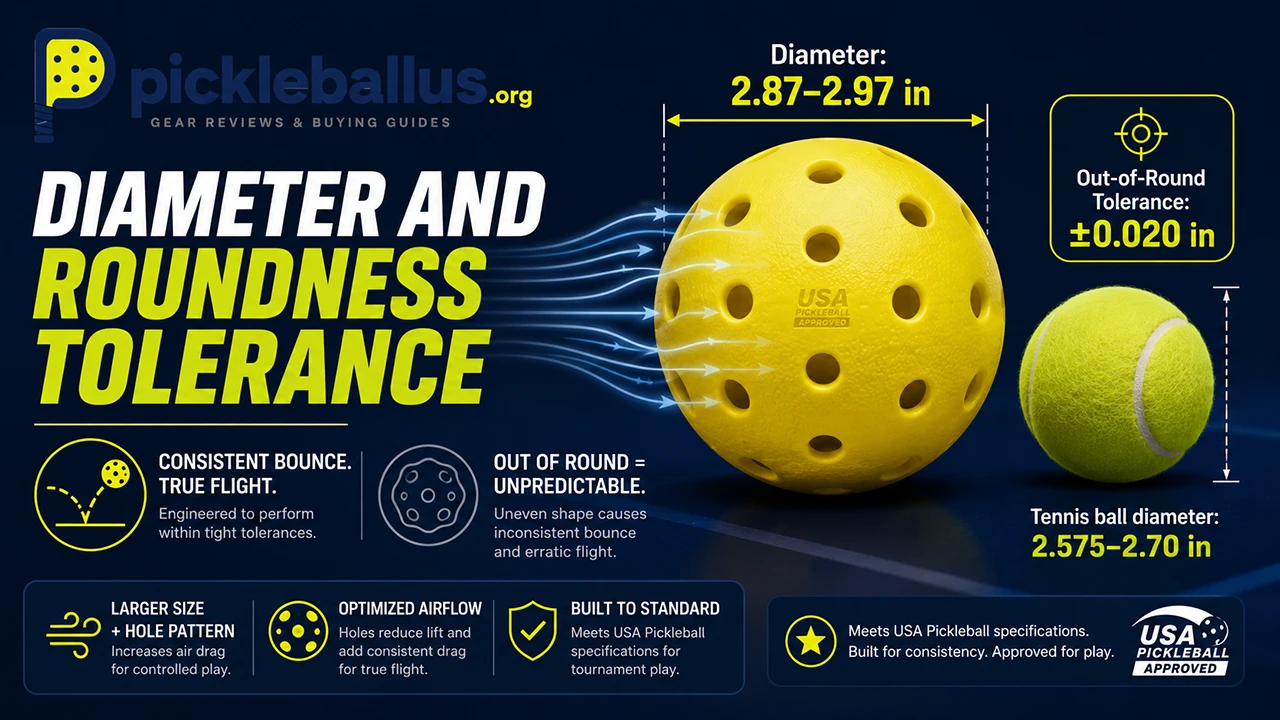
A pickleball must measure between 2.87 inches (7.29 cm) and 2.97 inches (7.54 cm) in diameter, per the 2025 USA Pickleball Equipment Standards Manual. That’s roughly the size of a baseball, but hollow and much lighter. The maximum out-of-round variance — how much the ball can deviate from a perfect sphere — is capped at ±0.020 inches (0.51 mm). A ball that wobbles visibly off the paddle face is almost certainly beyond that tolerance.
Diameter and Roundness Tolerance
The 2.87–2.97 inch diameter window is tighter than it looks. That 0.10-inch range exists to accommodate minor manufacturing variation, not to give brands freedom to size their balls differently. Most quality balls from established manufacturers cluster near the center of that range. The ±0.020 inch out-of-round tolerance is the more practically important number: a ball that is technically within diameter range but uneven in shape will produce inconsistent bounce and erratic flight, both of which are grounds for a referee to pull it from play.
For reference, a pickleball is slightly larger than a regulation tennis ball, which must measure 2.575–2.70 inches in diameter. That size difference, combined with the hole pattern, explains why a pickleball slows down dramatically in the air compared to a tennis ball — air drag through the holes takes effect over a larger surface area.
Circumference
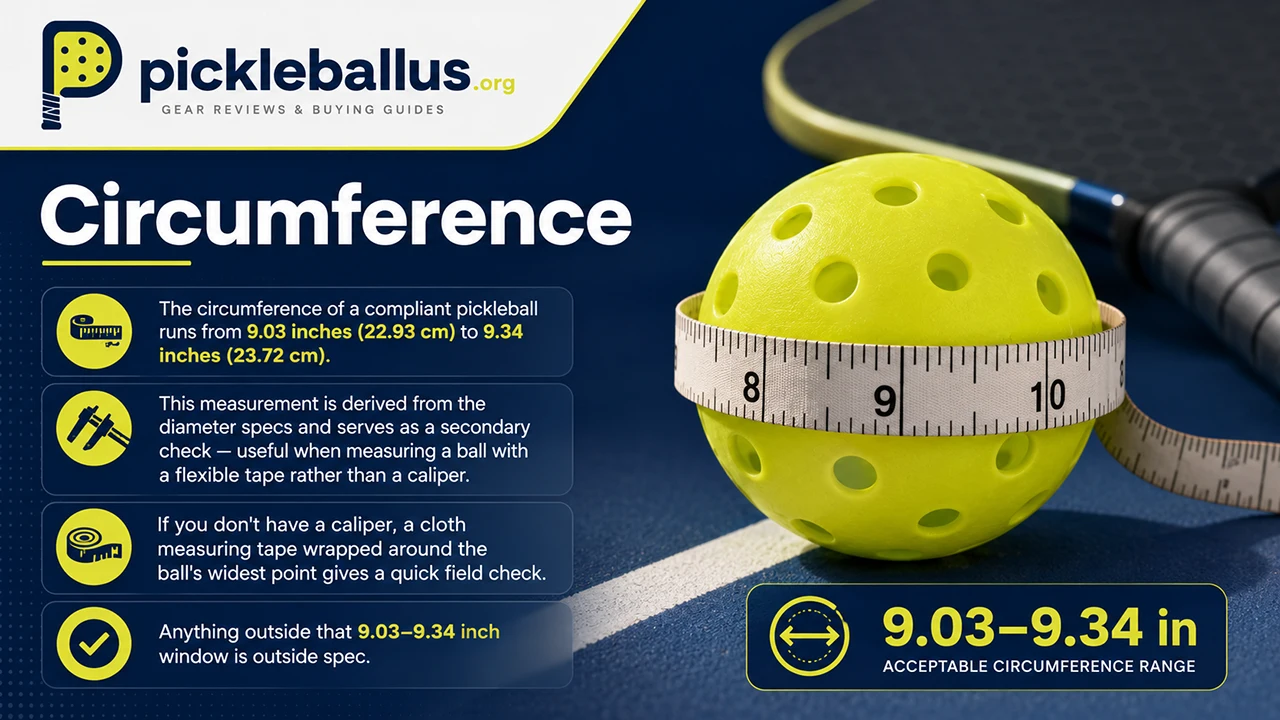
The circumference of a compliant pickleball runs from 9.03 inches (22.93 cm) to 9.34 inches (23.72 cm). This measurement is derived from the diameter specs and serves as a secondary check — useful when measuring a ball with a flexible tape rather than a caliper. If you don’t have a caliper, a cloth measuring tape wrapped around the ball’s widest point gives a quick field check. Anything outside that 9.03–9.34 inch window is outside spec.
How Much Does a Pickleball Weigh?
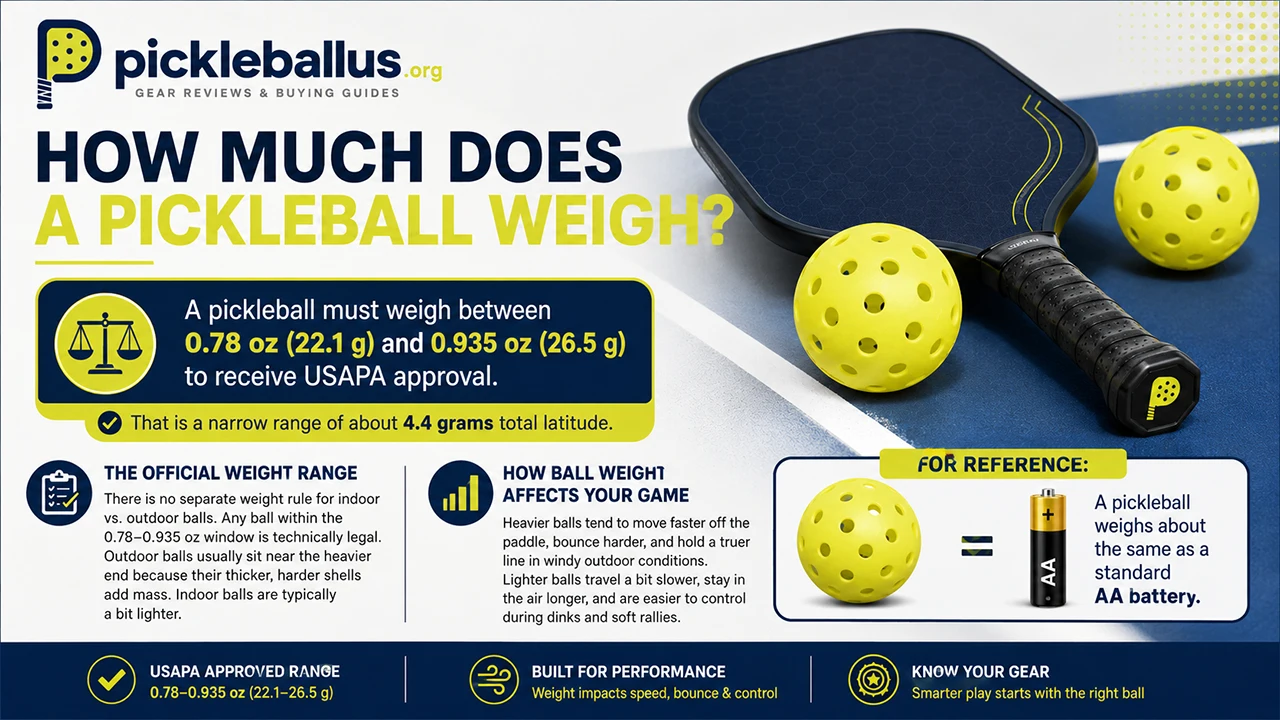
A pickleball must weigh between 0.78 ounces (22.1 grams) and 0.935 ounces (26.5 grams) to receive USAPA approval. That’s a narrow range — roughly 4.4 grams total latitude — that keeps the flight characteristics consistent across brands and venues. There is no separate weight rule for indoor versus outdoor balls; any ball that clears the 0.78–0.935 oz window is technically legal for either environment.
The Official Weight Range
The 0.78–0.935 oz range sounds like a small number, and it is. A pickleball weighs about the same as a standard AA battery. Despite that light construction, the weight spec has real consequences. A ball at the low end of the range travels more slowly, sits in the air longer, and responds more to spin. A ball near the upper end moves faster off the paddle face, loses less velocity in the air, and bounces harder off the court surface.
In practice, outdoor balls tend to land near the heavier end of the range because their thicker, harder shells add mass. Indoor balls typically sit closer to the lighter end, though brands don’t publish exact weights by the gram — just “USAPA approved,” which tells you it cleared the minimum threshold.
How Ball Weight Affects Your Game
Heavier balls reward aggressive players and punish passive ones. On a windy outdoor court, a ball sitting near 0.9 oz holds a truer line through gusts because its mass-to-surface-area ratio reduces wind drift. Lighter balls, by contrast, are easier to control during dinking exchanges and soft-game rallies — they don’t shoot off the paddle as fast, giving players a longer window to adjust.
If you’ve ever switched from an outdoor game to an indoor gym session and felt like you suddenly had extra time on every shot, the weight difference between ball types is a major reason why. The transition goes the other way too: outdoor balls on a windy day can feel almost unpredictable to players used to the slower, floatier indoor version.
What Are the Bounce and Hardness Requirements?
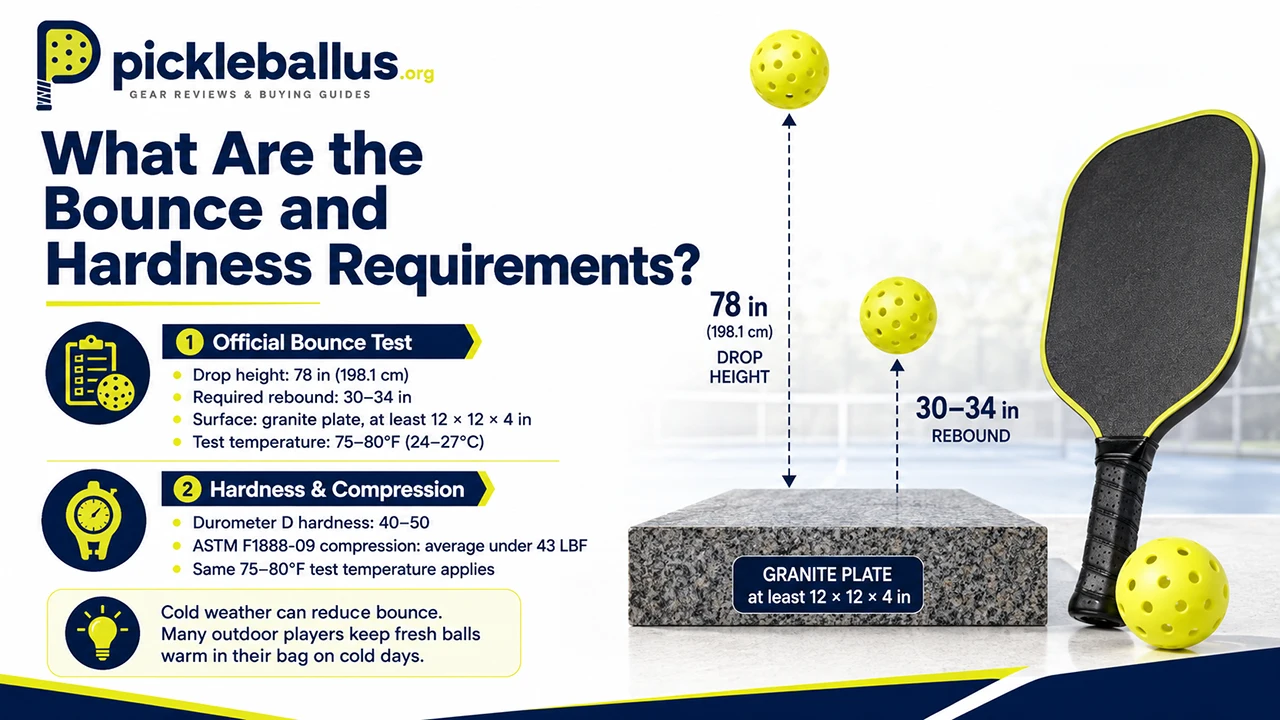
A USAPA-approved pickleball must rebound 30–34 inches when dropped from a height of 78 inches onto a granite surface plate. The test is conducted at an ambient temperature of 75–80°F (24–27°C). Bounce is not just a performance spec — it’s a safety and fairness spec. A ball that bounces too low turns every groundstroke into a guessing game; one that bounces too high makes the non-volley zone (the kitchen) nearly unplayable for touch players.
The Official Bounce Test
The drop height of 78 inches (198.1 cm) and the 30–34 inch rebound range are the two numbers that matter. The granite surface plate must be at least 12 × 12 × 4 inches — hard and flat enough to remove any surface variation from the result. Temperature control is strict: the 75–80°F window is enforced because plastic stiffens in cold and softens in heat, both of which directly change how much energy the ball retains on contact. A ball tested in a cold garage will bounce lower than the same ball tested at room temperature.
This matters practically for outdoor play in colder climates. Balls cracked more often and bounced lower in sub-60°F conditions before manufacturers started designing cold-weather formulations. The spec doesn’t change for cold weather — a tournament ball must still bounce 30–34 inches — but real-world performance at low temperatures often falls short of that window, which is why experienced outdoor players keep a sleeve of fresh balls warm in their bag on cold days.
Hardness and Compression Standards
Pickleball hardness is measured on the Durometer D scale and must register between 40 and 50. This test runs at the same 75–80°F ambient temperature as the bounce test. Durometer D measures the resistance of hard plastics to indentation — a reading of 40 is about the firmness of a hard hat, while 50 approaches the stiffness of a solid nylon gear. Pickleballs occupy the softer end of that scale to allow enough deformation on contact for control without going so soft that the ball loses its shape over time.
The companion standard is the ASTM F1888-09 compression test, which requires the ball to yield an average result of less than 43 LBF (pounds-force). This measures how much the ball compresses under a fixed load — essentially a quality control gate that filters out balls that are too soft or structurally inconsistent. You won’t find this number on retail packaging, but it’s one of the criteria USA Pickleball’s testing process checks before a ball earns its approval listing.
How Many Holes Does a Pickleball Have?
A regulation pickleball must have between 26 and 40 circular holes, with spacing and overall hole pattern designed to produce stable, predictable flight characteristics. The exact number within that 26–40 range is left to the manufacturer, and it’s this choice — more than any other design variable — that separates outdoor balls from indoor balls.
The holes are not decorative. They create aerodynamic drag that slows the ball down relative to a solid sphere, keeping rallies at a speed that players of all skill levels can track and react to. A ball with fewer, larger holes moves slower and is easier to spin. A ball with more, smaller holes cuts through the air faster and holds a straighter line in wind.
Outdoor Pickleballs (Typically 40 Holes)
Most outdoor pickleballs use 40 holes, distributed evenly across the surface in a tight, regular pattern. The holes are smaller in diameter than those on indoor balls, which reduces the cross-sectional area exposed to wind gusts. Combined with the heavier, harder shell, this design keeps the ball tracking straight on outdoor concrete and asphalt courts where wind is a constant variable.
The Franklin X-40 — one of the most widely used tournament balls in outdoor pickleball — is named directly for its 40-hole count. Durafast 40, Onix Pure 2, and Engage Tour are all 40-hole outdoor designs approved by USA Pickleball for sanctioned outdoor play. If you’re shopping for best outdoor pickleball balls, the 40-hole count is the first spec to confirm.
Indoor Pickleballs (Typically 26 Holes)
Indoor pickleballs most commonly use 26 holes, which are larger in diameter and spaced further apart than those on outdoor balls. The larger holes make the ball slightly aerodynamically unstable — by design. On a gymnasium floor, this slower, floatier flight creates longer rallies and more opportunity for soft-game play, which suits the typical indoor competitive format.
The softer shell on indoor balls is also intentional. Gymnasium floors are harder than most outdoor court surfaces, and a softer ball absorbs more energy on impact, keeping the bounce within the 30–34 inch window without needing the thicker plastic wall that outdoor balls require. The Jugs Indoor and Franklin X-26 are standard examples of 26-hole indoor designs. For a full breakdown of performance differences, the indoor vs outdoor pickleballs comparison covers everything you need.
Outdoor vs. Indoor Pickleball Specs: Side-by-Side
The table below maps the key specification differences between standard outdoor and indoor pickleballs. Both types operate within the same official USAPA limits, but their design choices land at opposite ends of those ranges.
| Spec | Outdoor Ball | Indoor Ball | USAPA Limit |
|---|---|---|---|
| Diameter | 2.87–2.97 in | 2.87–2.97 in | 2.87–2.97 in |
| Weight | ~0.9 oz (heavier end) | ~0.8 oz (lighter end) | 0.78–0.935 oz |
| Hole count | ~40 holes | ~26 holes | 26–40 holes |
| Hole size | Smaller | Larger | No spec limit |
| Shell hardness | Harder plastic | Softer plastic | 40–50 Durometer D |
| Bounce | 30–34 in (per spec) | 30–34 in (per spec) | 30–34 in |
| Best surface | Concrete, asphalt | Gymnasium floor | — |
Where Size and Weight Overlap
Both ball types share the same diameter and circumference window — there is no “smaller indoor ball” or “larger outdoor ball” in the official rulebook. The 2.87–2.97 inch diameter spec applies universally. Similarly, both must clear the same weight floor of 0.78 oz and the same ceiling of 0.935 oz. The differences in felt weight come from where each ball type tends to land within that range, not from separate weight categories.
Where Shell Hardness and Hole Pattern Diverge
Shell hardness and hole pattern are where outdoor and indoor balls genuinely split. Outdoor balls use harder, often polyethylene-based plastics that resist cracking on rough concrete and hold their shape at the 40-hole stress distribution. Indoor balls use softer polypropylene formulations that flex slightly more on gym floor impact, which keeps bounce within spec without overpowering the court surface.
The hole pattern difference — 40 tight holes vs. 26 large holes — produces the flight feel players notice immediately when switching between environments. A 40-hole ball on an indoor court feels almost too fast and too predictable; a 26-hole ball outdoors flutters in any breeze and loses its flight line quickly.
Choosing the Right Ball for Your Court
Match the ball to the surface, not to personal preference. On an outdoor hard court, always use a 40-hole ball — a 26-hole ball will become unpredictable the moment there’s any wind. On a gymnasium floor, a 40-hole ball hits too hard off the surface, overshoots the kitchen, and wears out the gym floor finish faster than softer indoor designs. If you’re unsure which ball fits your game best, the how to choose a pickleball ball guide walks through the decision by playing style, surface, and skill level.
The best way to find your go-to outdoor ball is to test a sleeve of each top option on your actual court. For curated top picks, the roundup of the best pickleball balls covers the highest-rated options across both categories.
By now you have the full spec picture — diameter, weight, bounce, hardness, and hole count, all with official USAPA numbers. These figures answer the rules question, but they don’t tell the whole story of how a ball behaves once you’re actually playing. Understanding what happens when a ball drifts outside those numbers — through wear, cold weather, or a manufacturing shortcut — is what separates players who just grab any ball from the bag from those who know exactly what they’re holding. The next section covers the finer details that matter once you move from the rulebook to the court.
What Else Should You Know About Pickleball Ball Standards?
There’s more to a legal pickleball than the raw spec numbers. How a ball earns its approval, how it differs from the wiffle balls that inspired the sport, and how to tell when it’s no longer within spec are all questions that come up regularly — especially once you start playing in organized league or tournament settings.
How USAPA Approves Tournament Balls
USA Pickleball maintains an official approved ball list on USAPickleball.org, and only balls on that list may be used in sanctioned tournament play. Approval requires a manufacturer to submit balls for independent testing against all spec criteria — size, weight, bounce, hardness, and compression. Balls that pass receive one of two seals: the “USA Pickleball Competition” seal for tournament-grade balls, or the “USA Pickleball Approved” seal for recreational-grade balls cleared to the same physical specs.
The tournament director at any sanctioned event selects the official tournament ball from the approved list. Players don’t choose — the ball is chosen for them. That’s worth knowing before you buy a case of your favorite brand for tournament practice, only to find the event uses a different model with a noticeably different feel.
Every approved ball must carry the manufacturer’s or supplier’s name or logo printed or embossed on the surface. A ball with no branding is automatically outside compliance regardless of its physical measurements.
Pickleball vs. Wiffle Ball — Not the Same Thing
Modern pickleballs and wiffle balls share a visual resemblance but are engineered to completely different standards. The original game of pickleball in 1965 used an actual wiffle ball — a lightweight, lopsided plastic ball designed for backyard baseball practice with one-sided hole placement. That asymmetrical design creates unpredictable flight, which was fine for a casual backyard game but incompatible with competitive play.
Today’s pickleballs use uniform, symmetrically distributed holes and consistent wall thickness across the entire sphere. The plastic compounds are purpose-formulated for court durability, not toy production. A wiffle ball dropped from 78 inches would bounce nowhere near 30–34 inches and wouldn’t survive more than a few minutes on a hard court surface. They are fundamentally different products that happen to look similar from a distance.
How to Tell If Your Ball No Longer Meets Spec
A ball that has drifted out of spec shows three signs: visible cracking, an out-of-round wobble when spun on a flat surface, and a bounce that falls noticeably short of the 30-inch floor. You don’t need lab equipment to catch these problems. Crack inspection takes two seconds — run your fingernail around the seam and across the surface. Any crack that catches means the ball is done.
The spin test is the field equivalent of the roundness tolerance check. Place the ball on a flat table and spin it like a top. A ball within ±0.020 inch roundness tolerance spins cleanly and settles smoothly. A ball outside that tolerance wobbles noticeably and lists to one side. If your ball fails the spin test, it’s almost certainly producing inconsistent bounces you’re already noticing in play.
Cold weather accelerates this process. Balls used at temperatures below 60°F become brittle, lose hardness on the Durometer scale, and crack faster at the seam. Keep a fresh sleeve in your bag for cold-weather sessions, and retire balls after any session where they’ve been stressed by temperature extremes — even if they look intact. To understand how long a well-maintained ball lasts under normal conditions, the how many holes does a pickleball have guide includes context on construction durability across different hole-count designs.

Write Your Review
No reviews yet. Be the first to share your experience!