How to Choose a Pickleball Ball: Indoor, Outdoor & Skill Level
Choosing the right pickleball ball starts with one non-negotiable decision: are you playing indoors or outdoors? Indoor balls use softer plastic with 26 larger holes, while outdoor balls use harder plastic with 40 smaller holes — and using the wrong one for your court will make your game feel completely off. Once you nail that split, the remaining factors — weight, material hardness, bounce consistency, and skill level — are what separate a frustrating session from a great one.
The key criteria for choosing a pickleball are playing environment (court surface and weather), hole count (which drives aerodynamics), ball hardness (which controls speed and feel), and skill level (recreational players and competitive players need different balls). Get these four right and the brand choice almost takes care of itself.
Most players who grab the wrong ball don’t realize it until the game already feels wrong — either the ball is cracking on the second session outdoors, bouncing unpredictably on a gym floor, or making shots feel sluggish on a fast concrete court. The ball matters far more than most beginners expect, and switching to the correct type can feel like a gear upgrade without spending a dollar on a new paddle.
Below is a practical breakdown of every factor you need to understand before buying a pickleball, starting with the foundation of the best pickleball balls available today and the specs that separate them.
What Is a Pickleball Ball and Why Does It Matter?
A pickleball is a hard, hollow plastic sphere with evenly spaced holes, manufactured to tight tolerances set by USA Pickleball (formerly USAPA). The ball isn’t just a prop — its weight, hardness, and hole pattern directly determine how fast the game plays, how much spin you can generate, and how forgiving the bounce is on different surfaces.
Official Size, Weight, and Hole Count Standards
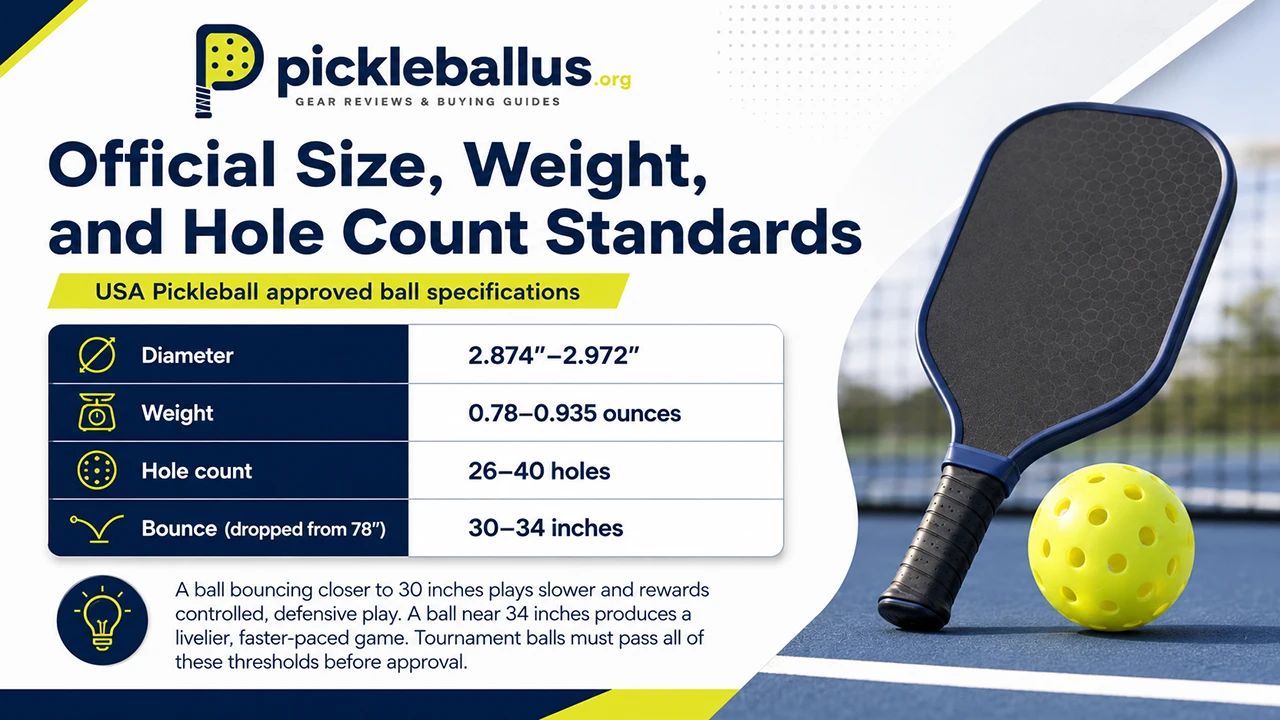
USA Pickleball mandates that all approved balls fall within these specs:
| Specification | Approved Range |
|---|---|
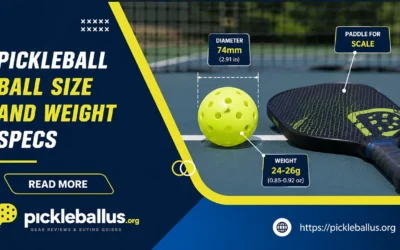
| Diameter | 2.874″–2.972″ |
| Weight | 0.78–0.935 ounces |
| Hole count | 26–40 holes |
| Bounce (dropped from 78″) | 30–34 inches |
The bounce specification is particularly useful to understand: a ball bouncing closer to 30 inches plays slower and rewards defensive, controlled play, while a ball near 34 inches produces a livelier, faster-paced game. Tournament balls are tested against all of these thresholds before they receive approval.
How the Ball Affects Game Speed, Control, and Bounce
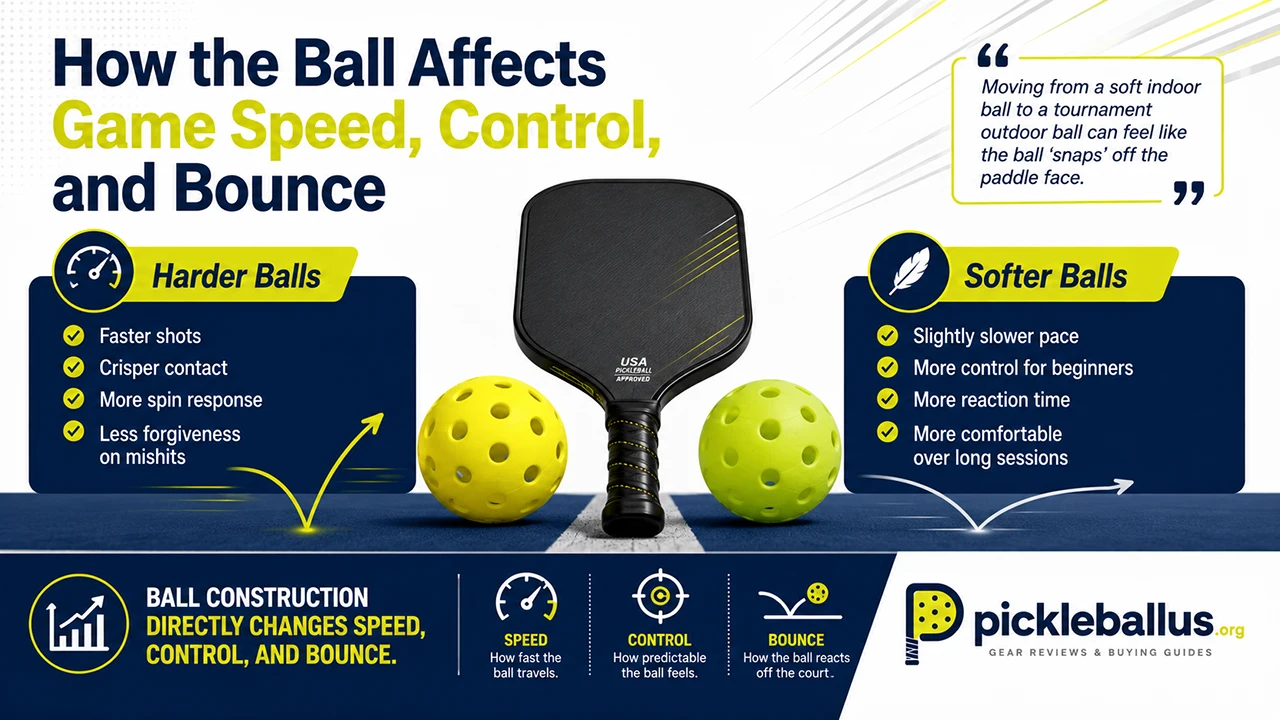
Ball construction has a direct impact on how your game feels. Harder balls transfer energy more efficiently at contact, making shots faster, crisper, and more responsive to spin — the trade-off is less forgiveness for mishits. Softer balls absorb a small amount of that energy, which slows the game slightly, gives beginners more reaction time, and feels more comfortable over long sessions. This isn’t a minor difference. Players stepping from an indoor soft ball to a tournament outdoor ball often describe the contact feeling like it “snaps” off the paddle face.
Indoor vs. Outdoor Pickleballs — What’s the Real Difference?
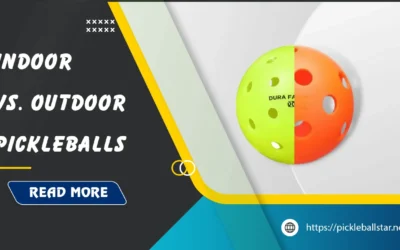
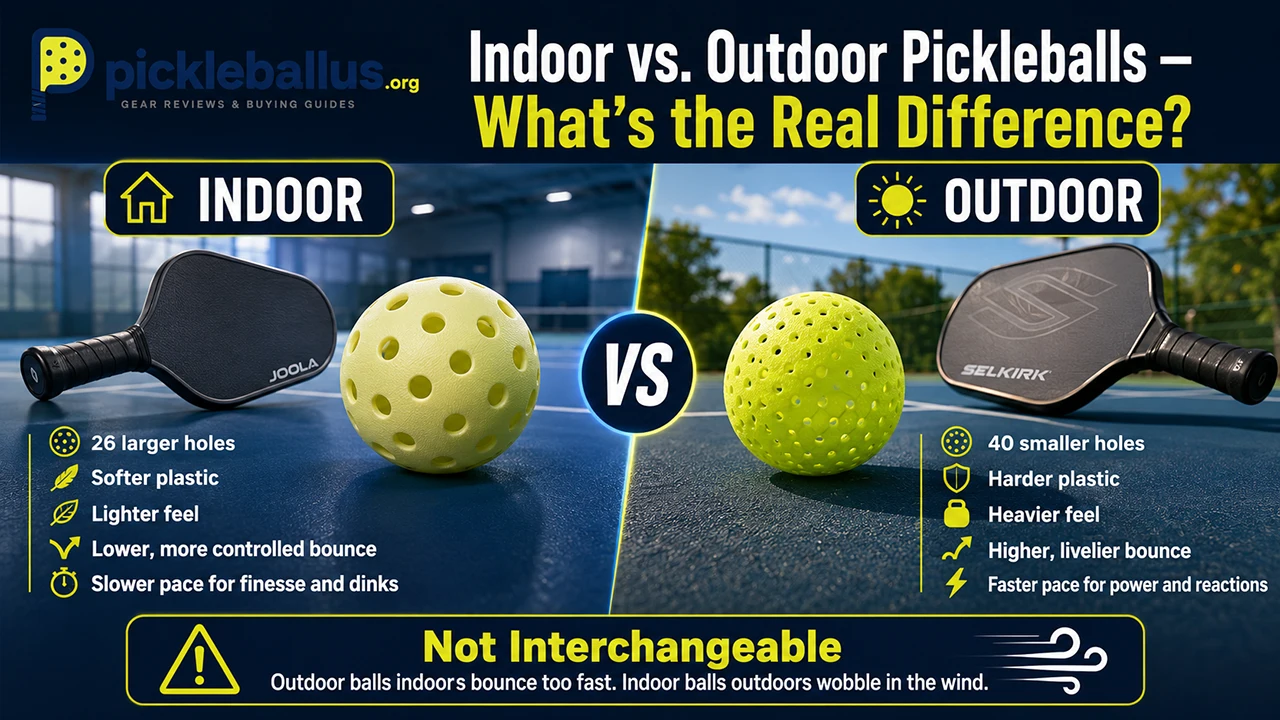
Indoor and outdoor pickleballs are not interchangeable. The differences run deeper than just hole count — they reflect entirely different design priorities built around surface type, airflow conditions, and the physical demands of competitive vs recreational play. For a full side-by-side breakdown, the guide on indoor vs outdoor pickleballs covers every spec in detail.
Indoor Pickleball Balls — Softer, Lighter, 26 Holes
Indoor balls are engineered for smooth gymnasium and sports court floors. Their 26 larger holes reduce aerodynamic drag, allowing the ball to glide predictably in still indoor air without wind interference. The softer plastic keeps the bounce controlled on harder gym floors that would amplify a stiffer ball’s rebound unpredictably.
Key characteristics of indoor balls:
- Hole count: 26 larger holes
- Plastic hardness: Softer, more pliable
- Weight: Toward the lighter end of the approved range
- Bounce feel: Lower, more controlled — rallies last longer
- Game pace: Slower, which rewards finesse and dinking strategy
Indoor balls tend to be gentler on the body during long sessions. Because the pace is slower and the bounce is less aggressive, they are excellent for beginners still building rally consistency. If you’re looking for the right model, best indoor pickleball balls lists the top-rated options currently available.
Outdoor Pickleball Balls — Harder, Heavier, 40 Holes
Outdoor balls are built to survive asphalt and concrete surfaces, which are abrasive and unforgiving. The 40 smaller holes serve a specific purpose: they reduce the surface area available for wind to push the ball off its trajectory. On a breezy outdoor court, a 26-hole indoor ball would drift noticeably on every shot. The 40-hole pattern keeps the flight path tighter.
Key characteristics of outdoor balls:
- Hole count: 40 smaller holes
- Plastic hardness: Stiffer, denser construction
- Weight: Toward the heavier end of the approved range
- Bounce feel: Higher, livelier — faster exchanges at the net
- Game pace: Quicker, rewards reaction speed and power
The trade-off with outdoor balls is durability under hard court conditions. They crack more readily than indoor balls, especially in cold temperatures, because the harder plastic becomes brittle. For the best performers in this category, see best outdoor pickleball balls.
Can You Use an Outdoor Ball Indoors (and Vice Versa)?
No — and you’ll feel it immediately. Using an outdoor ball on a gym floor produces a bounce that’s too high and too fast for the surface, making rallies erratic and difficult to control. Using an indoor ball outdoors creates the opposite problem: the ball wobbles in any wind, bounces too low on hard court surfaces, and wears out quickly from the abrasive texture of asphalt. Treat these as completely separate equipment categories, not interchangeable options.
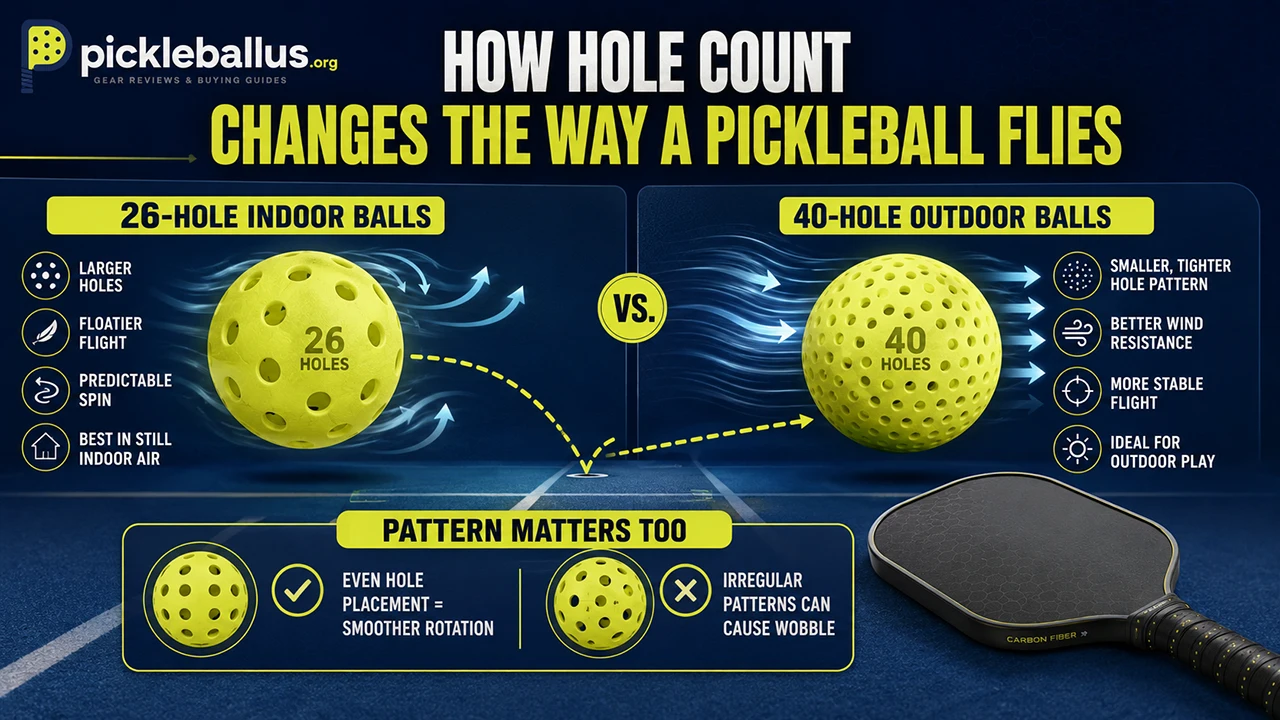
How Hole Count Changes the Way a Pickleball Flies
Hole count is the primary aerodynamic variable in pickleball design. It determines how air moves through and around the ball during flight, which in turn controls trajectory stability, speed off the paddle, and how much spin you can put on the ball before it drifts.
The Aerodynamics of 26-Hole Indoor Balls
With 26 larger holes, indoor balls have more open surface area relative to their diameter. In a controlled indoor environment with no wind, this creates a slightly floatier flight path — the ball slows down a touch mid-flight before it drops, which is why indoor rallies from the baseline tend to feel more measured. This float also means spin shots behave predictably; topspin drops the ball at a consistent rate, making the game more readable for developing players.
Why 40-Hole Outdoor Balls Resist Wind Better
The 40 smaller holes on outdoor balls create a tighter pattern that limits how much lateral wind force can grab the ball. Think of it like the dimple pattern on a golf ball: the geometry stabilizes flight by managing airflow around the sphere. On a calm outdoor day the difference between a 26 and 40-hole ball is subtle. On a gusty day, it’s the difference between a playable shot and a completely unpredictable one.
Does Hole Pattern Matter or Just Hole Count?
Both matter, but hole count has the larger effect. Hole placement (how evenly they’re distributed around the sphere) affects whether the ball has a consistent rotational axis during flight. Balls with irregular or asymmetrical hole patterns can develop a “wobble” that makes high-speed shots behave unpredictably — this is why USA Pickleball requires approved balls to pass flight consistency tests. For a complete look at how hole count plays into official specs, the guide on how many holes does a pickleball have is worth reading.
Pickleball Ball Hardness and Material — Soft vs Hard Plastic
Material hardness is the variable that separates a recreational ball from a tournament-grade one. Both are plastic, but the compound used and the manufacturing process determine everything about how the ball feels at contact, how long it lasts, and how consistently it performs over many sessions.
What Makes a Ball “Hard” or “Soft”
Hardness in pickleball balls is not officially measured on a consumer-facing scale, but the practical feel difference is significant. Soft balls compress slightly at contact with the paddle face, which creates a brief moment of dwell time — the ball stays on the paddle just a hair longer. This translates to more feel, easier shot placement, and less arm fatigue during long sessions. Hard balls compress less, which snaps the ball off the paddle faster, amplifying power and spin but reducing the window of control.
Injection-Molded vs Rotational-Molded — The Construction Difference
These two manufacturing methods produce balls with meaningfully different performance profiles:
| Construction Method | How It Works | Best For |
|---|---|---|
| Injection-molded | Melted plastic injected into a precision mold under pressure | Indoor, competitive play — consistent flight paths, smooth surface |
| Rotational-molded | Plastic heated and spun in a mold, creating a thicker wall | Outdoor, recreational play — durability on rough surfaces |
Injection-molded balls tend to have tighter tolerances, meaning each ball from a batch performs nearly identically. This consistency is why they dominate tournament play. Rotational-molded balls sacrifice some consistency for toughness, which makes them the better choice for public courts where the surface is unpredictable.
How Hardness Affects Bounce, Durability, and Feel
A harder ball maintains its bounce spec longer during a session — it doesn’t absorb court energy the way a softer ball does. However, hardness and durability have an inverse relationship in cold weather. Below 50°F, hard plastic becomes brittle and is far more likely to crack mid-game. Softer balls hold up better in cool conditions, though neither type is designed for cold-weather play. For players who need most durable pickleball balls regardless of conditions, there are specific models built to handle outdoor abuse better than the rest.
How to Choose a Pickleball Ball by Skill Level
Your skill level should be the second filter after playing environment. Beginners and tournament-level players are not competing under the same conditions — they need different ball characteristics to develop properly and play at their best.
Best Ball Type for Beginners and Recreational Players
Beginners benefit from a softer, slower ball — almost always an indoor-style ball or a soft outdoor ball rated for recreational use. The slower pace gives developing players more reaction time, which means longer rallies, more opportunities to practice shot placement, and less frustration from erratic bounces.
What to look for as a beginner:
- Softer plastic hardness
- Indoor ball if playing on a gym floor; soft outdoor ball if playing outside
- USAPA approval (ensures the ball meets consistent bounce standards)
- Sold in multipacks — beginners go through balls faster as they learn to keep them in play
The best pickleball balls for beginners guide covers the specific models that hold up well through the learning curve without breaking the bank.
Best Ball Type for Intermediate Players (3.0–3.5)
At the 3.0–3.5 level, players are developing consistent third-shot drops, dinking exchanges, and directional serving. This level benefits from a medium-hardness outdoor ball that plays closer to tournament conditions while still offering enough control for developing consistency.
What to look for at 3.0–3.5:
- Standard outdoor ball (40 holes, USAPA-approved)
- Medium hardness — not the softest recreational ball, not the stiffest tournament ball
- A ball the local club or league uses, so your practice environment matches your match environment
Playing with the same ball type used in your regular games accelerates skill development. Practicing with a softer recreational ball and then competing with a harder tournament ball creates a gear mismatch that affects shot timing and depth perception.
Best Ball Type for Competitive and Tournament Players (4.0+)
Tournament and competitive players (4.0 and above) use hard, injection-molded outdoor balls — typically the same models sanctioned by USA Pickleball for tournament play. At this level, every variable in ball behavior matters: how the ball responds to spin at pace, how consistently it bounces off different court surfaces, and how it performs in the second hour of a match after repeated hard contact.
What to look for at 4.0+:
- USA Pickleball-approved outdoor ball
- Injection-molded construction for flight consistency
- The ball approved for the specific tournament or league you compete in (some events designate an official ball)
- Hardness that matches your paddle surface — raw carbon fiber paddle faces paired with a very hard ball can produce a combination that’s too uncontrollable even for experienced players
Does Weather Affect Which Pickleball You Should Use?
Yes, temperature is one of the most overlooked factors in outdoor ball selection. The plastic compounds used in pickleball construction respond to temperature in ways that significantly affect performance and durability.
Playing in Cold Weather — What Happens to Outdoor Balls
Below about 50°F (10°C), outdoor pickleball balls — especially hard ones — become noticeably more brittle. The plastic contracts slightly in the cold, making the wall stiffer and more prone to cracking from the impact stress of hard shots. A ball that survives a full outdoor session at 75°F may crack in the second game at 45°F. Cold also reduces bounce height, making the game slower and requiring players to hit harder to reach the same depth.
If you play regularly in cool weather, look specifically for balls marketed as cold-weather or low-temperature balls. These use modified plastic compounds that stay more flexible below 50°F — best pickleball balls for cold weather covers the specific models that hold up best in those conditions.
Hot Weather and How It Changes Bounce
At the other extreme, heat softens the plastic slightly. A ball that bounces at 33 inches at 70°F may bounce closer to 31 inches at 95°F — the ball is physically softer and absorbs more court energy. This makes the game feel slower and flatter in high heat, particularly on blacktop courts that radiate surface temperature upward. Experienced outdoor players in hot climates often switch to a slightly harder ball than they’d use in mild weather to compensate for the heat-induced softening effect.
By this point, you have a clear framework for matching the right ball to your court, climate, and skill level — from the fundamental indoor/outdoor split through material construction and weather performance. Choosing the correct ball, however, is only the beginning of getting the most out of your equipment; understanding how long a ball realistically lasts and recognizing the warning signs that it’s time to retire one will protect both your game and your wallet. The next section covers the finer details that experienced players pay attention to but rarely talk about.
What Experienced Players Know About Pickleball Ball Lifespan & Brands
How to Tell When a Pickleball Is Dead (The Spin Test)
A pickleball doesn’t announce when it’s dead — it just starts playing slightly worse until you realize the ball, not your technique, is the problem. The most reliable field test is the spin test: place the ball on a flat hard surface and spin it on its axis with your fingers. A ball in good shape spins smoothly and settles without wobbling. A ball that has gone out of round wobbles visibly — it has lost its spherical geometry from repeated impacts and will produce unpredictable flight on every shot.
A visible crack, even a hairline one, is an automatic discard. Cracked balls affect trajectory and can cause irregular bounces that neither player can predict or account for. The how long do pickleballs last guide covers average ball lifespan across different surfaces and play styles.
USAPA-Approved Balls — Does Approval Actually Matter?
For recreational play: minimally. For competitive play: completely. USAPA approval means the ball has been tested and certified to meet the official bounce, weight, and diameter specs. Non-approved balls can still be excellent for practice and casual games, but they may behave slightly differently from the balls used in league or tournament play.
If you play in any sanctioned league or enter tournaments, stick to approved balls for all practice — not because unapproved balls are bad, but because muscle memory built on one ball’s bounce profile carries into match play.
Tournament-Official Balls and Why They Play Differently
Tournament-designated balls — like the Franklin X-40 (used by USA Pickleball) or the Dura Fast-40 (formerly used by the PPA Tour) — are hard, fast, and spin-responsive in ways that recreational balls are not. These balls reward precise technique and punish mishits. A player accustomed to recreational balls stepping into tournament play with a hard ball for the first time will find the game noticeably quicker and less forgiving, particularly at the kitchen line where dink exchanges happen at pace.
The performance gap between a hard tournament ball and a soft recreational ball is one of the best arguments for matching your practice ball to your competitive environment as your skill level advances.
Cheap vs Premium Balls — Is the Price Gap Worth It?
The answer depends entirely on your play frequency and court surface. Budget balls use thinner plastic walls and less precise manufacturing tolerances, which means they crack faster on rough outdoor surfaces and play less consistently from ball to ball within the same pack. For a beginner hitting once a week on a smooth indoor court, a budget ball is perfectly adequate and the savings add up quickly.
For players on outdoor courts three or more times per week, premium balls pay for themselves in lifespan. The plastic compound is denser, the wall thickness is more consistent, and the bounce holds its spec longer. You’ll replace premium balls far less often than budget ones, and the game will feel more consistent throughout each session. Investing in better balls is especially worth it if you’ve already spent money on a quality paddle — the paddle can only perform as well as the ball allows.