

The best pickleball balls for beginners in 2026 are the Franklin X-40 (best overall), the Gamma Photon Outdoor (best for visibility and slow flight), the Penn 40 (slowest outdoor ball for absolute beginners), the Onix Fuse G2 Outdoor (best versatile all-surface pick), the Onix Fuse Indoor (best for gymnasium floor courts), the Jugs Indoor Pickleball (best for youth and young beginners), and the Onix Pure 2 Outdoor (best budget option). Every ball on this list shares one defining trait: it gives new players the reaction time and forgiveness to actually learn the sport.


Choosing the right ball matters more than most beginners expect. The speed and bounce of a pickleball directly affect how much time you have to react, how consistent your rallies are, and whether your first sessions feel encouraging or frustrating. A ball that is too fast — like the Vulcan VPRO FLIGHT or the Life Time LT-48 — punishes early technical mistakes that a slower ball would absorb.
There is also a widely misunderstood rule: picking a pickleball is not about whether you play inside or outside. It is about the surface you play on. A beginner on a hard-court indoor facility still needs an outdoor ball. One playing on a gymnasium’s wood floor needs an indoor ball. Getting this wrong leads to skidding, inconsistent bounces, and a frustrating first experience that has nothing to do with skill.
Below are full reviews of all seven balls, a breakdown of what makes a ball beginner-friendly, and a guide to matching ball type to your specific court.
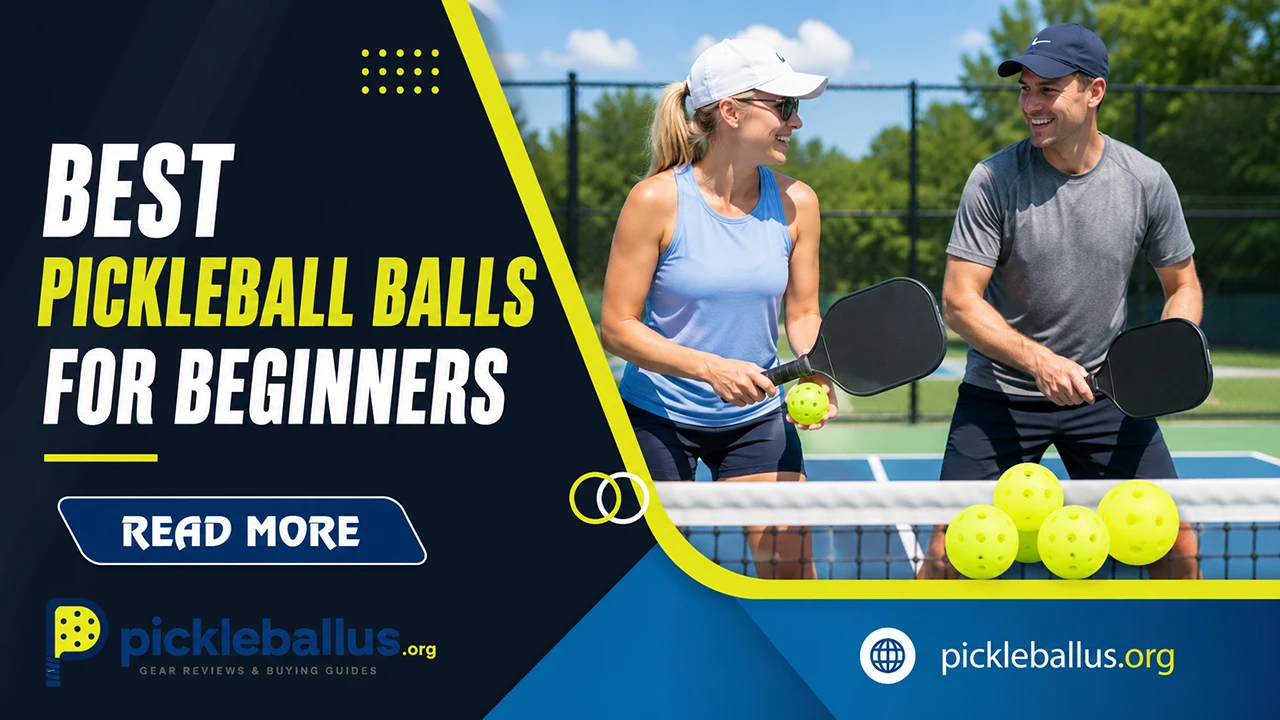
What Makes a Pickleball Ball Good for Beginners?
A beginner-friendly pickleball plays slower, bounces predictably, and survives early technical mistakes — not one that performs best at the highest competitive levels. Understanding why these traits matter will help you avoid spending money on the wrong ball.
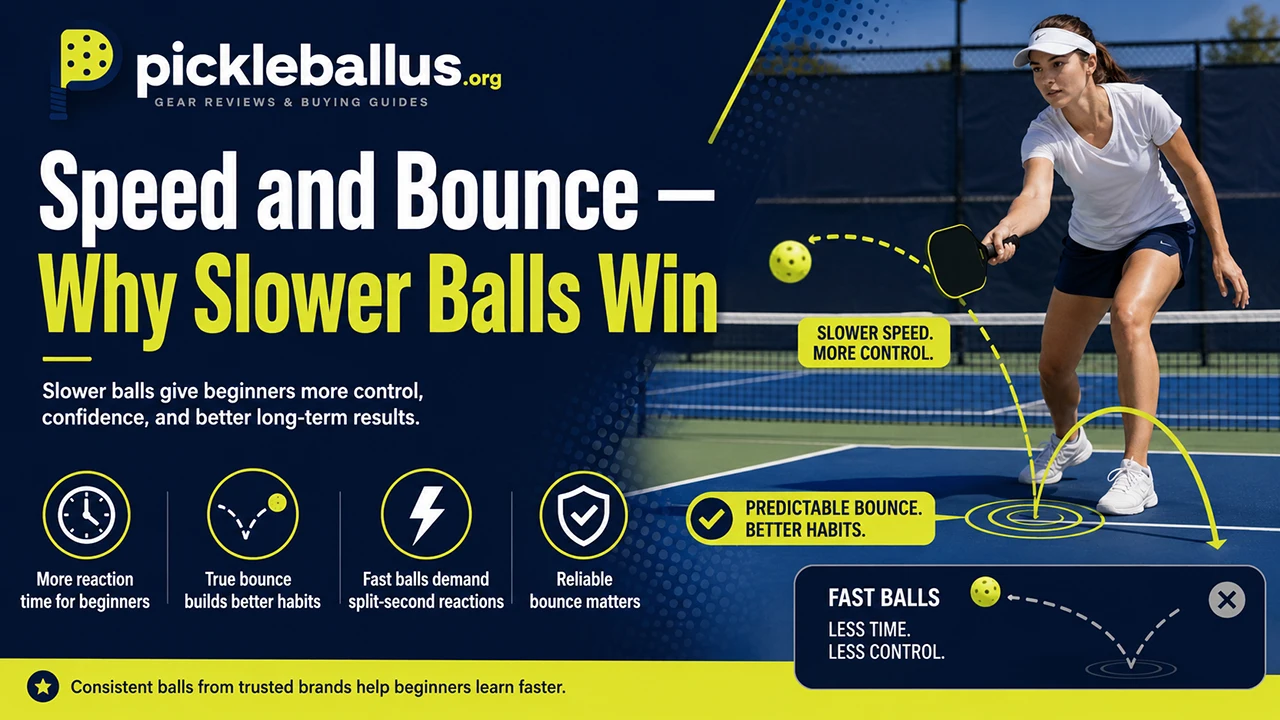
Speed and Bounce — Why Slower Balls Win
Slower balls give beginners more reaction time, and reaction time is the single most important advantage at the learning stage. When a ball travels at a manageable pace, you can get into proper position, execute a swing with reasonable technique, and watch the ball contact the paddle face. Fast balls — like those used on the professional tour — demand split-second reactions that no beginner has trained yet.
Consistent bounce is equally critical. A ball that bounces true lets you build predictive habits: where to position your feet, how far to reach, when to swing. Inconsistent bounce — caused by poor manufacturing tolerances or a ball that has gone out of round — trains bad habits by forcing improvisation on every shot. Brands like Franklin, Onix, and Gamma build tight enough tolerances that bounce stays reliable game after game.
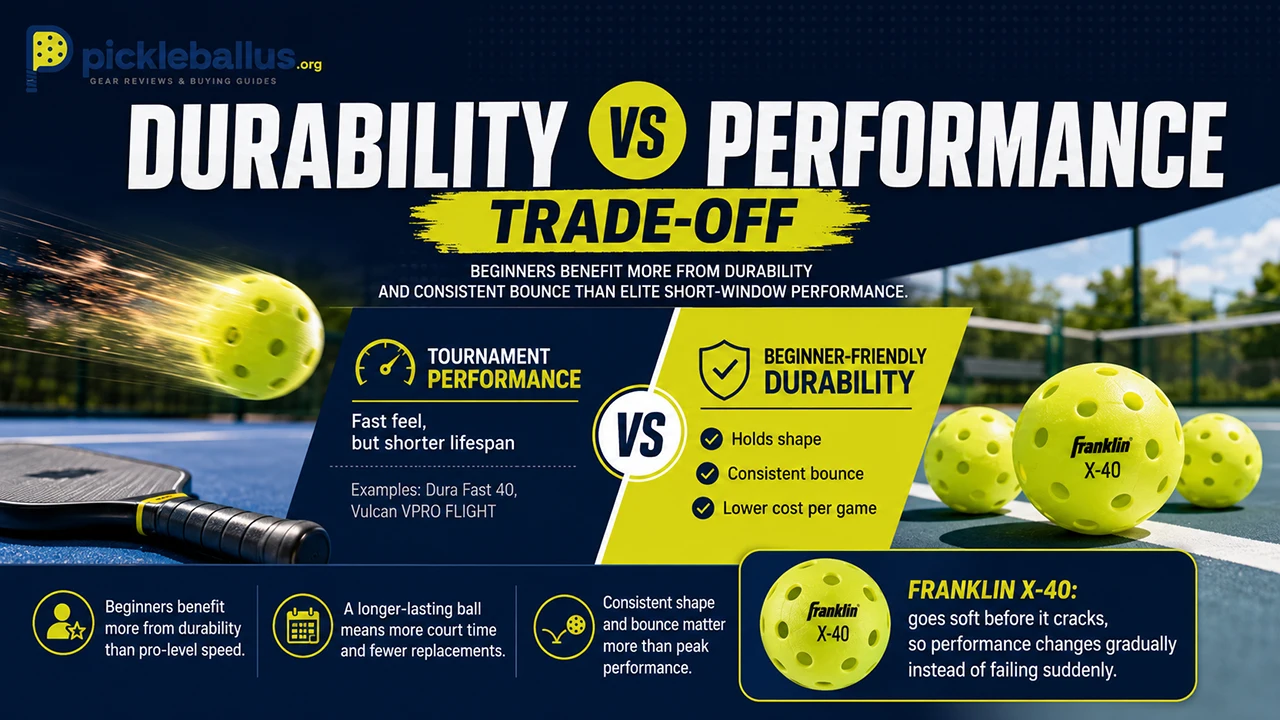
Durability vs Performance Trade-off
Most high-performance tournament balls sacrifice durability for speed and feel, and that is the wrong trade-off for a beginner. Pro-level balls like the Dura Fast 40 or Vulcan VPRO FLIGHT are engineered to play well for a shorter window, then crack. A beginner does not need that. What they need is a ball that holds its shape, maintains consistent bounce, and does not require replacing every few sessions.
Franklin’s X-40 sets the standard here — it goes soft before it cracks, which means it changes gradually rather than failing suddenly. For beginners who are not hitting hard enough to notice minor performance shifts, this extended usable life means more court time at lower cost per game.
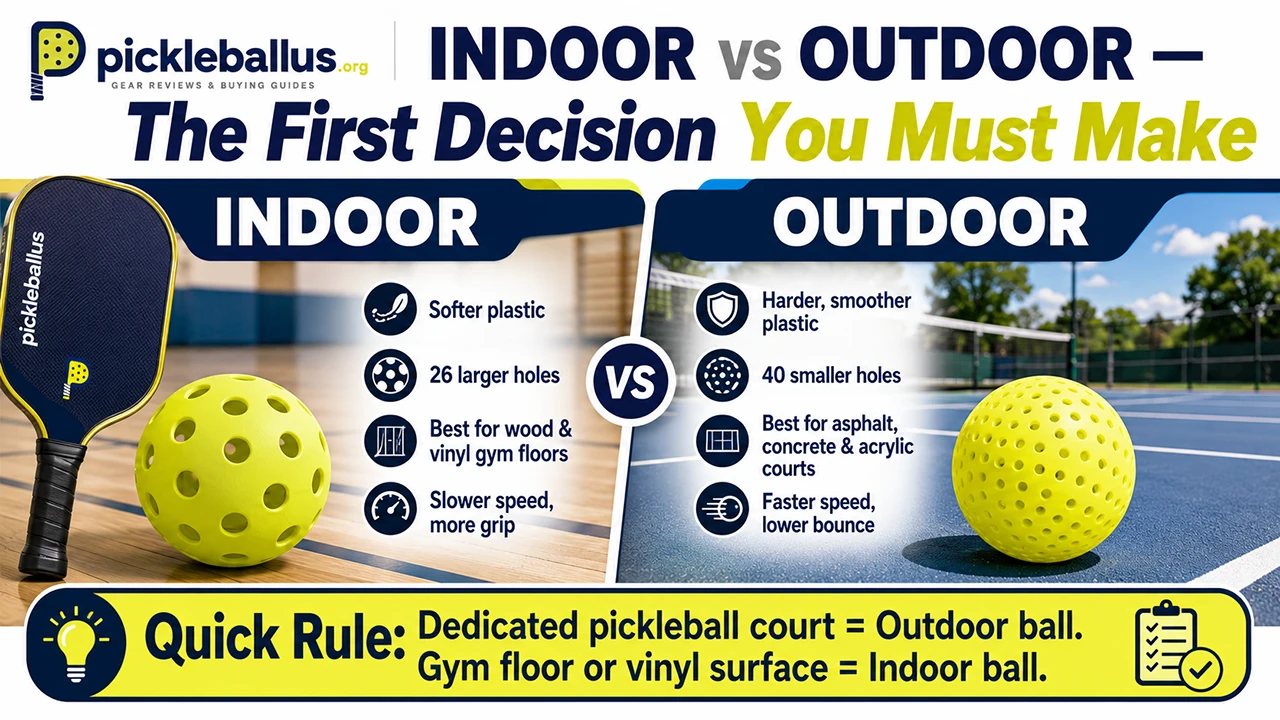
Indoor vs Outdoor — The First Decision You Must Make
The most important decision for any beginner is not which brand to buy, but which type — indoor or outdoor — matches their court surface. This is a major area of confusion for new players.
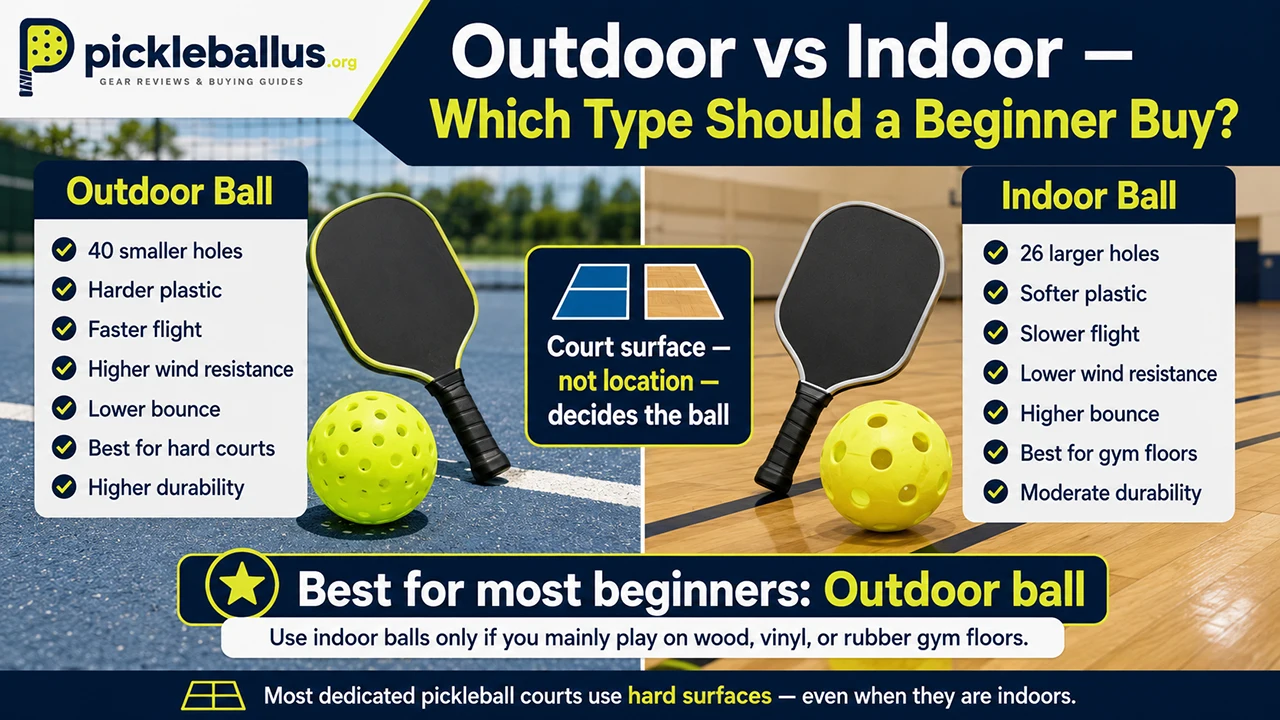
Outdoor pickleball balls use harder, smoother plastic with 40 smaller drilled holes. The smaller holes resist wind and the harder shell handles rough surfaces like asphalt, concrete, and acrylic hard courts. These balls bounce lower and travel faster than indoor versions.
Indoor pickleball balls use softer plastic with 26 larger holes. The larger holes reduce speed, and the softer material grips gymnasium-style wood and vinyl floors — preventing the skidding and skipping that outdoor balls cause on those surfaces.
The practical rule: if you are playing on a dedicated pickleball court (whether physically inside or outside), use an outdoor ball. If you are playing on a basketball gymnasium floor, vinyl surface, or similar smooth indoor flooring, use an indoor ball. Our guide on indoor vs outdoor pickleballs covers every scenario in detail, including the edge cases that trip up intermediate players too.
7 Best Pickleball Balls for Beginners (2026 Rankings)
The seven balls below were selected based on proven beginner-friendliness: controlled flight speed, consistent bounce, solid construction, and active availability on Amazon with strong review histories.
#1 Franklin X-40 — Best Overall Beginner Pickleball Ball
The Franklin X-40 is the most recommended pickleball ball for beginners, and the reason is straightforward: it plays slower than most outdoor balls, holds its shape longer than any competitor in its price range, and delivers a bounce so consistent that even newer players start reading it within a session or two.
Key Specs & Features
- Type: Outdoor (hard court surface)
- Holes: 40 precision-drilled
- Construction: Seamless single-piece plastic
- USAPA approved: Yes
- Colors: Optic yellow, neon pink, orange
Performance Analysis
The X-40’s defining characteristic is controlled flight. It does not jump off the paddle face aggressively, so more balls stay in play during early learning sessions. The seamless construction keeps the ball round game after game — no warping, no odd bounces — and the optic yellow colorway is among the most visible of any ball available.
Durability-wise, the X-40 outlasts virtually every competing ball in its category. It does not crack cleanly; it softens gradually. That gradual softening actually extends its useful life for beginners who are not hitting hard enough to notice the performance change early on. Where other balls snap in cold weather or shatter on a single bad bounce, the X-40 just keeps going.
One constraint: the X-40 is an outdoor ball designed for hard courts. Do not use it on gymnasium wood flooring — it will skip and skid, making the game significantly harder to learn.
Pros
- Best-in-class durability — lasts 20–30 games of regular play in most conditions
- Slow, forgiving flight speed ideal for learning fundamentals
- Highly consistent bounce across sessions and temperatures
- USAPA-approved for tournament play when you’re ready to compete
- The real-world standard at US leagues, clinics, and tournaments
Cons
- Goes soft rather than cracking — gradual performance change (not a concern for most beginners)
- Outdoor hard court only — not for wood gym floors
Best For: Beginners playing on any dedicated pickleball court, indoor hard courts, or outdoor asphalt and concrete surfaces.
My Verdict: Buy the X-40 in a 6-pack and do not overthink it. This is the ball most players — from total beginners to 5.0-level competitors — use. The slow speed, proven reliability, and USAPA approval make it the one ball you can carry from your very first session all the way to your first tournament without switching.
#2 Gamma Photon Outdoor — Best for Visibility and Controlled Flight
The Gamma Photon Outdoor is one of the slowest outdoor balls on the market, making it a natural pick for beginners who feel like rallies are ending before they can even get set. Its vibrant neon yellow-green color is among the most visible of any ball available, significantly reducing the “I lost it in the air” problem that plagues first-time players.
Key Specs & Features
- Type: Outdoor (hard court surface)
- Holes: 40 drilled
- Construction: Seamless, durable plastic
- USAPA approved: Yes
- Colors: Bright neon yellow-green
Performance Analysis
The Gamma Photon plays noticeably slower than the Franklin X-40. Where the X-40 suits players at all levels, the Photon sits in a sweeter spot for pure beginners — especially those who feel overwhelmed by pace. Rallies last longer, which means more touches per session and faster skill development in the early weeks.
Shape retention is solid. The Photon holds its round shape well through extended use and does not develop obvious dead spots the way cheaper balls do. Its color also stands out better against certain court backgrounds than standard yellow, which coaches notice quickly in group settings.
Pros
- Slower than the X-40 — ideal for pure beginners
- Outstanding visibility due to bright coloring
- Consistent bounce suitable for skill-building
- USAPA approved
- Good durability at its price point
Cons
- Slower speed means the transition to faster balls (like the X-40) requires an adjustment period
- Not widely used at tournaments above recreational level
Best For: Brand-new beginners who want maximum control and reaction time; recreational players who prefer longer rallies.
My Verdict: If the Franklin X-40 feels too quick in your first few sessions, the Gamma Photon is your answer. Use it for a few weeks to build your fundamentals, then transition to the X-40 once you feel comfortable.
#3 Penn 40 — Best Slowest Outdoor Ball for Absolute Beginners
The Penn 40 is the slowest outdoor pickleball ball widely available, and that is entirely the point. For players who are brand new to paddle sports of any kind — no tennis, no ping pong background — the Penn 40 gives the most forgiving experience possible on a hard court.
Key Specs & Features
- Type: Outdoor (hard court surface; also usable on gym wood floors)
- Holes: 40
- Construction: One-piece plastic
- USAPA approved: Yes
- Colors: Yellow only
Performance Analysis
The Penn 40 plays heavy and slow. It does not bounce as high as other outdoor balls and its pace is deliberately muted. This is ideal for beginners because it exaggerates reaction time — when the ball moves slowly and bounces lower, new players can focus on footwork and swing mechanics without panic setting in.
A useful characteristic: the Penn 40 can actually double as a gym floor ball — unusual for an outdoor design. It plays soft enough on smooth indoor surfaces that it does not skip the way harder outdoor balls do. This versatility is a practical advantage if your group plays in multiple settings.
Penn, a HEAD brand, has been trusted in racquet sports for decades. Manufacturing consistency here is reliable even at entry-level.
Pros
- Slowest widely available outdoor ball — maximum reaction time for beginners
- Can double as a gym floor ball in a pinch
- Trusted brand with consistent manufacturing
- USAPA approved
- Budget-friendly per-ball cost
Cons
- Only available in yellow — no color choice
- Goes soft faster than Franklin under heavier hitting
- Not suitable for competitive play beyond recreational level
Best For: Absolute beginners with no racquet sports background; players who want the game to slow down as much as possible.
My Verdict: The Penn 40 is not a forever ball. Use it for your first month or two, then graduate to the Franklin X-40. Think of it as training wheels — useful at the beginning, easy to leave behind once your skill grows.
#4 Onix Fuse G2 Outdoor — Best Versatile Ball for Beginners
The Onix Fuse G2 is the most versatile option on this list, offering a slightly softer feel than the Franklin X-40 while remaining USAPA-approved and suitable for hard court play. Its reliable bounce and manageable pace suit beginners who are not yet sure what surface they will primarily be playing on.
Key Specs & Features
- Type: Outdoor / Hard court
- Holes: 40 drilled
- Construction: Seamless plastic
- USAPA approved: Yes
- Colors: Neon green, yellow, orange, pink
Performance Analysis
The Onix Fuse G2 plays a touch softer than the X-40, which means more forgiveness on off-center hits. New players mishit frequently — that is simply the nature of learning — and the Fuse G2 keeps those mishits in play more often than harder balls do. Bounce is predictable and consistent, the core requirement for any beginner ball.
Multiple color options are a practical benefit. Different colors perform differently under various lighting conditions, and being able to choose neon green for indoor gym lighting versus yellow for outdoor sun is a small advantage that adds up over time.
Pros
- Slightly softer feel than the Franklin X-40 — more forgiving on mishits
- Multiple color options improve visibility in different settings
- USAPA approved
- Good durability across hard court surfaces
- Predictable, consistent bounce from the first game
Cons
- Slightly less durable than the Franklin X-40 under heavy hitting
- Does not stand out as the clear top choice for any specific use case — it is a reliable middle option
Best For: Beginners who want a softer, slightly more forgiving feel than the Franklin; players who want multiple color options to match their court environment.
My Verdict: The Onix Fuse G2 is the quiet professional of beginner balls. It earns its place with consistent performance and a forgiving feel. A solid second choice if the X-40 is out of stock, or if you want a softer contact sensation as you build your swing.
#5 Onix Fuse Indoor — Best Indoor Ball for Beginners
The Onix Fuse Indoor is the top recommended indoor pickleball ball for beginners playing on gymnasium wood floors or similar smooth surfaces. Its 26 larger holes slow the ball considerably compared to outdoor versions, and the softer plastic prevents the skidding that makes outdoor balls unplayable on gym surfaces.
Key Specs & Features
- Type: Indoor (gymnasium / wood floor / vinyl)
- Holes: 26 larger holes
- Construction: Softer plastic
- USAPA approved: Yes (for indoor play)
- Colors: Yellow
Performance Analysis
The Fuse Indoor plays differently from any outdoor ball. It is slower through the air, bounces more predictably on smooth gym surfaces, and gives beginners a much better sense of shot placement and control. The larger holes reduce wind resistance and speed — exactly what a beginner on a gym floor needs to build reliable mechanics.
Durability is strong for an indoor ball. The Fuse Indoor holds its shape longer than most competitors in the indoor category. This matters because indoor balls use softer plastic and are therefore more prone to deformation over extended play.
Pros
- Designed for wood and smooth indoor surfaces — true bounce, no skidding
- Slower speed ideal for beginner skill-building on gym courts
- USAPA approved for indoor tournament use
- Better durability than most indoor ball competitors
- Widely trusted by coaches in beginner programs
Cons
- Not suitable for outdoor or hard-court indoor use — purpose-specific only
- Fewer color options than the outdoor Fuse G2
Best For: Beginners playing on gym wood floors, community center courts, or any smooth indoor surface that is not a purpose-built hard pickleball court.
My Verdict: If you are starting on a gymnasium floor, do not make the mistake of buying an outdoor ball. The Onix Fuse Indoor is built for this situation. Use it on the correct surface and your first sessions will be dramatically more enjoyable and productive.
#6 Jugs Indoor Pickleball — Best for Youth and Young Beginners
The Jugs Indoor Pickleball is the softest, slowest ball on this list, built specifically for young players — particularly those in the 5–12 age range — who need maximum forgiveness and control during early learning sessions.
Key Specs & Features
- Type: Indoor (gymnasium surface)
- Holes: Large-hole configuration
- Construction: Ultra-soft plastic
- USAPA approved: No (training tool)
- Colors: Vision-enhanced green
Performance Analysis
The Jugs ball is exceptionally soft and has a slower, more deliberate flight path than any other ball reviewed here. For a young beginner still developing coordination, this ball changes the learning experience — it stays in the air long enough for a child to track it, react, and make contact with reasonable technique. The slower flight also reduces impact stress on a young player’s arm and wrist, which matters for sessions where a child is hitting many balls in a row.
Coaches frequently reach for the Jugs ball in youth clinics because it maximizes successful contacts per session. More successful contacts build confidence, and confidence keeps kids coming back to play.
Pros
- Softest and slowest ball available — ideal for building fundamental mechanics in young players
- Vision-enhanced green color aids tracking
- Confidence-building through higher rally success rate
- Widely used in youth coaching programs
Cons
- Not USAPA-approved — cannot be used in official or competitive play
- Not suitable for adult beginners who play with others using standard balls
- Indoor gymnasium surface only
Best For: Young players (ages 5–12) in their first pickleball sessions; youth coaching programs; any setting where maximizing beginner confidence is the priority over competitive readiness.
My Verdict: If you are buying balls for a child’s first pickleball experience, start here. The Jugs ball removes the frustrating variables of speed and bounce surprise, letting the child focus on having fun. Transition to the Onix Fuse Indoor once their confidence and coordination grow.
#7 Onix Pure 2 Outdoor — Best Budget Outdoor Ball for Beginners
The Onix Pure 2 Outdoor offers one of the softest feels in the outdoor ball category, making it appealing for beginners who want more control and cushioning than the Franklin X-40 provides — at a typically lower cost per ball.
Key Specs & Features
- Type: Outdoor (hard court surface)
- Holes: 40 drilled
- Construction: Softer, single-piece plastic
- USAPA approved: Yes
- Colors: Yellow, orange, green, pink
Performance Analysis
The Onix Pure 2 plays slower than the X-40 and has a softer feel on contact. Beginners often describe it as more comfortable to hit — the softer construction translates to higher forgiveness on mishits and a less jarring sensation for players still working on grip and swing technique.
Durability is the trade-off. The Pure 2 goes soft faster than the Franklin under consistent play, and players who hit hard will notice performance degradation sooner. For a beginner playing two to three times per week, however, the ball lasts a reasonable number of sessions before needing replacement.
Pros
- Softest outdoor ball feel — maximum comfort for beginners
- USAPA approved
- Multiple color options for different lighting environments
- Budget-friendly per-ball cost
- Slower flight suits early-stage skill development
Cons
- Goes soft faster than the Franklin X-40
- Not ideal for players improving quickly who want a ball that transitions with them
Best For: Beginners who prioritize comfort and control over durability; budget-conscious new players buying their first set.
My Verdict: The Onix Pure 2 is a solid starter ball, particularly for players who find the Franklin X-40 too firm at first. Buy a small pack, play with it while you get your bearings, and upgrade to the X-40 once your form is more consistent.
Outdoor vs Indoor — Which Type Should a Beginner Buy?
Most beginners should start with an outdoor pickleball ball, because most dedicated pickleball courts — whether physically indoors or outdoors — use hard surfaces that require an outdoor ball. The exception is players who will primarily be on gymnasium wood or vinyl floors, who must use an indoor ball.
How Court Surface (Not Location) Decides the Ball
The most common misconception is that “indoor” and “outdoor” describe where you are physically playing. They do not. They describe the surface. The short version:
- Hard court surface (concrete, asphalt, acrylic) → outdoor pickleball ball, regardless of whether you are inside a building or outside
- Gymnasium floor (wood, vinyl, rubber) → indoor pickleball ball
Using an outdoor ball on a gym floor causes skidding and unpredictable bouncing. Using an indoor ball on a hard court wears the softer plastic down fast and produces an inconsistent bounce. Getting this right on day one saves hours of confusion. For the full breakdown including edge cases, our indoor vs outdoor pickleballs guide covers every scenario.
Holes, Hardness, and Speed — Key Differences at a Glance
The table below covers the core technical differences that matter for beginners choosing between ball types.
| Feature | Outdoor Ball | Indoor Ball |
|---|---|---|
| Number of holes | 40 (smaller) | 26 (larger) |
| Plastic hardness | Harder | Softer |
| Flight speed | Faster | Slower |
| Wind resistance | Higher | Lower |
| Bounce height | Lower | Higher |
| Best surface | Hard courts | Gym floors |
| Typical durability | Higher | Moderate |
Indoor balls are actually slower — which might seem more beginner-friendly on paper. But since most beginners play on hard courts, an outdoor ball is still the right choice for the majority.
How Many Pickleball Balls Do Beginners Need?
A beginner needs between 3 and 6 pickleball balls to start — enough to keep a session running without constantly chasing balls, without replacing a large inventory when they wear out. A 6-pack is the sweet spot for most new players. It gives you enough balls to share with a partner, enough backup when one goes soft or out of round, and enough quantity to get a better per-ball price than a 3-pack offers.
If you are buying balls for a group lesson, a 12-pack or larger bulk purchase makes more sense. The Onix Pure 2 and Gamma Photon both offer cost-effective bulk pricing for coaches and organizers who need quantity.
For a broader look at how these balls compare across all skill levels and court types, our best pickleball balls guide covers every category from beginner through pro.
By now you have a complete picture of the best pickleball balls for beginners across every court surface and playing scenario. Choosing the right ball is only the foundation, however — the finer details of ball maintenance, color selection, and knowing when to upgrade to a performance ball shape your longer-term development as a player. The section below goes into those specifics that most beginners never think to ask about until they have already made a few avoidable mistakes.
What Else Beginners Should Know About Pickleball Balls
Ball Color and Visibility — Does It Matter?
Ball color affects visibility more than most beginners expect, and visibility directly impacts how quickly you improve. Neon yellow, neon green, and high-visibility orange are the easiest colors to track in most lighting conditions. Yellow is the standard for outdoor play, while green and orange often perform better under indoor gym lighting.
Avoid white balls outdoors during sunny conditions — they disappear against bright sky backgrounds. For your first several months of play, prioritize the highest-visibility color your chosen brand offers. Most beginners underestimate how much a harder-to-track ball slows down skill development.
How Long Do Pickleball Balls Last?
Lifespan depends on surface type, playing frequency, and temperature. Outdoor balls on hard courts typically last 10–30 games of regular play before performance degrades noticeably. Indoor balls last a similar range on gymnasium surfaces but can wear faster on rougher floors.
Balls fail in two main ways: they crack (common in cold weather) or they go soft and out of round (common in heat). The Franklin X-40 is unusual in that it goes soft rather than cracks — useful to know so you are not surprised when it does not shatter cleanly the way other balls do.
Cold weather accelerates cracking in any ball. Playing below 50°F, expect shorter lifespans and keep extra balls on hand. For cold-weather-specific picks, our guide on best outdoor pickleball balls covers balls with better cold-weather resistance in detail.
When Should a Beginner Switch to a Performance Ball?
Consider switching to a performance ball — like the Vulcan VPRO FLIGHT or Life Time LT-48 — when you consistently win rallies against peers at a similar level and start feeling that the ball, not your technique, is limiting you. This transition typically happens somewhere between the 3.0 and 3.5 skill level.
Until that point, faster balls actively work against skill development by compressing reaction time before you are ready to handle it. Our guide on how to choose a pickleball ball outlines exactly what to look for when you are ready to make that upgrade — and what to expect when the game starts to feel different at a faster pace.
![7 Best Pickleball Balls for Cold Weather [2026 Tested]](https://tegahillsfarms.com/wp-content/uploads/best-pickleball-balls-for-cold-weather-400x250.webp)
Write Your Review
No reviews yet. Be the first to share your experience!