

The 7 best pickleball replacement grips of 2026 are the Gamma Honeycomb Cushion Grip (best overall), the Tourna Pickleball Cushion Replacement Grip (best for vibration control), the Gearbox Moisture Absorption Grip (best for sweaty hands), the ONIX Pro Team Perforated Replacement Grip (best tacky feel), the VT Advantec Polyurethane Cushion Grip (best for arm pain and tennis elbow), the Tourna Standard Pickleball Replacement Grip (best for paddle feedback), and the Wilson Pro Comfort Grip (best budget pick).



Choosing the right replacement grip comes down to three properties that rarely coexist in a single product at full strength: tackiness, cushioning, and moisture absorption. A grip optimized for maximum tack — like the ONIX Pro Team — often sacrifices cushion. A grip built for shock absorption — like the VT Advantec — trades off some breathability. Knowing which property matters most for your play style is what separates a grip that lasts two weeks from one you’ll forget is even there.
Most players replace their grip far too late. When your handle feels slick within the first ten minutes of play, when you notice the surface has compressed into a smooth, featureless cylinder, or when the finish has gone from textured to almost glossy — the grip is done. Regardless of your play frequency, every replacement grip has a functional lifespan of roughly 15–30 hours of court time, after which even premium materials start losing tack and structure.
Below, you’ll find the seven best pickleball replacement grips tested across multiple paddle types, humidity conditions, and player skill levels — with full specs, performance breakdowns, and a clear recommendation for every type of player.
What Is a Pickleball Replacement Grip?
A pickleball replacement grip is a thick, padded wrap applied directly to the bare handle of a paddle after removing the original factory grip. Unlike an overgrip — which goes on top of an existing grip — a replacement grip sits against the bare pallet (the wooden, foam, or plastic core of the handle), making it the primary layer of contact between your hand and the paddle. Replacement grips are thicker, more durable, and designed to last longer than overgrips, but they require removing the original wrap entirely before installation.
Replacement Grip vs Overgrip — What’s the Difference?
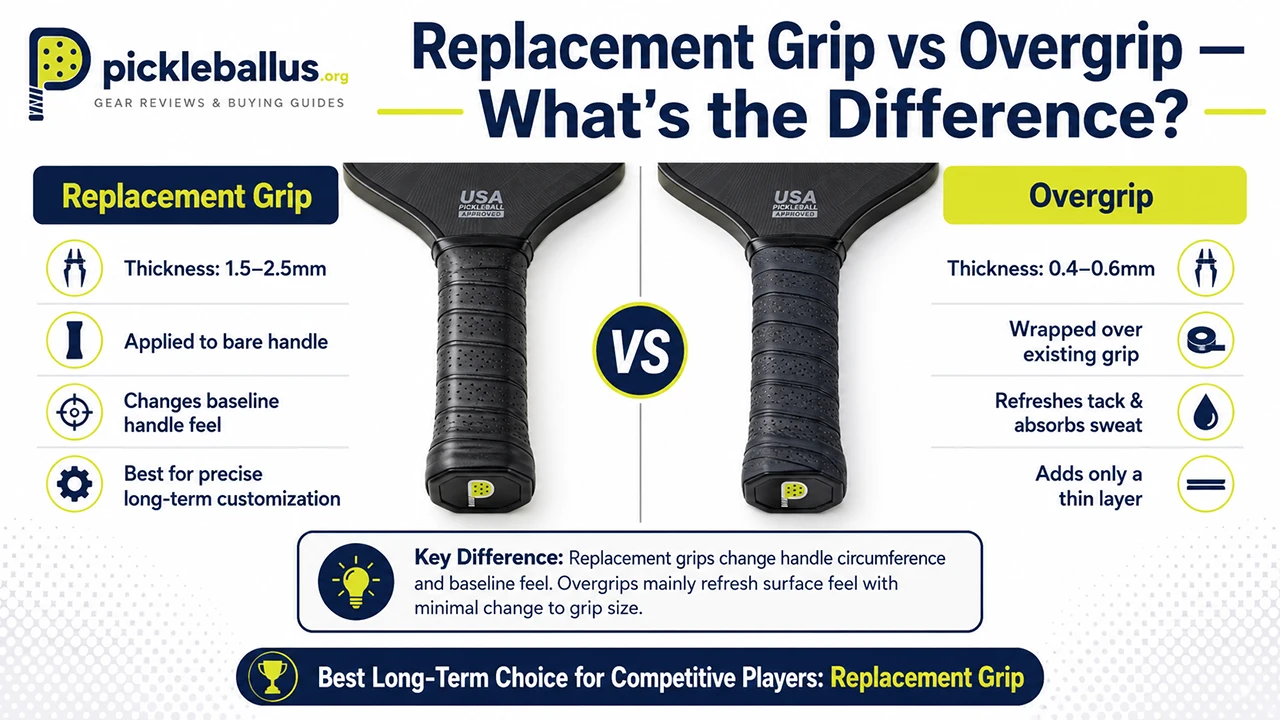
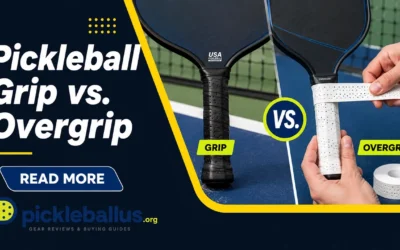
Replacement grips are thicker (typically 1.5–2.5mm) and applied to bare handles; overgrips are thin (0.4–0.6mm) and layered on top of an existing grip. The key functional difference is handle circumference: a replacement grip changes the baseline feel of your paddle’s handle, while an overgrip adds only a thin layer that refreshes tack and absorbs surface sweat without altering grip size significantly. If you want to understand the full decision between the two, the pickleball grip vs overgrip guide covers every scenario in detail. For most competitive players who need consistent control and want to customize their handle thickness precisely, a replacement grip is the better long-term investment.
When Should You Replace Your Pickleball Grip?
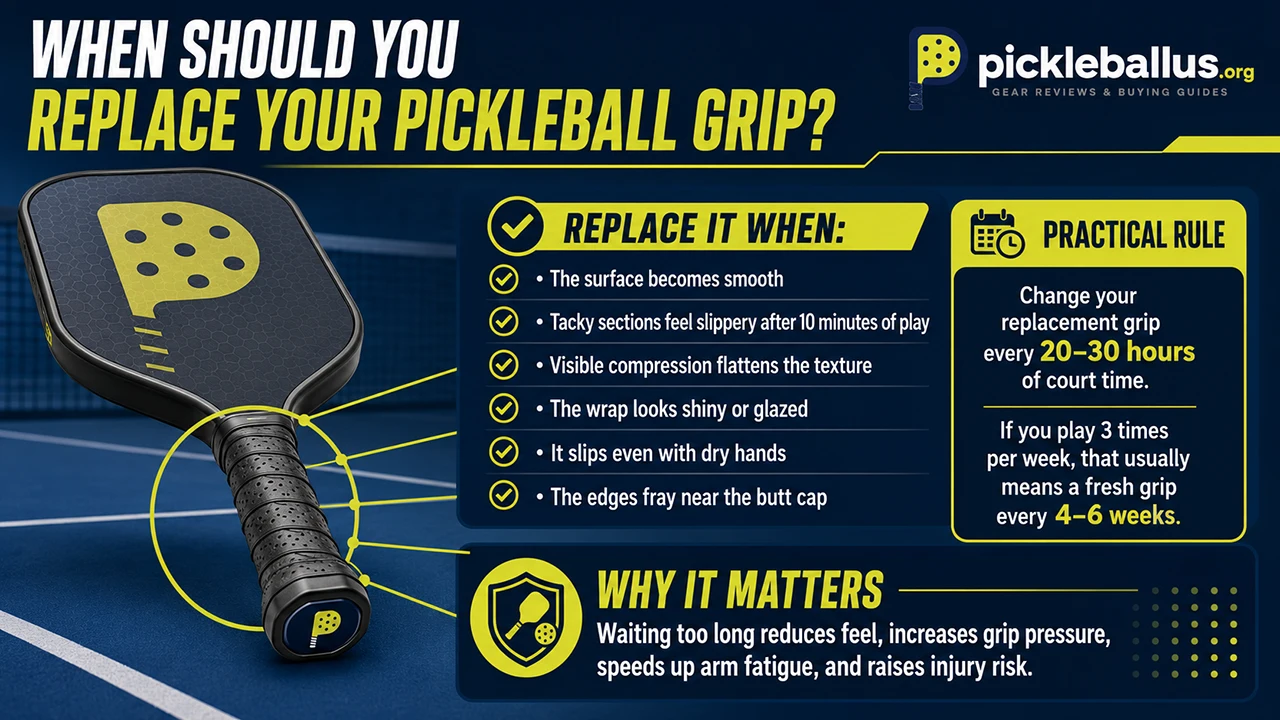
Replace your pickleball grip when the surface becomes smooth, tacky sections feel slippery after 10 minutes of play, or visible compression flattens the texture. A practical rule used by many club players: change your replacement grip every 20–30 hours of court time. If you play three times per week, that means a fresh grip roughly every four to six weeks. Other reliable signals include a shiny or glazed finish on the wrap, a persistent slipping sensation even with dry hands, or visible fraying at the edges of the wrap near the butt cap. Waiting too long doesn’t just hurt feel — it increases grip pressure as your hand tries to compensate for slippage, which accelerates arm fatigue and raises injury risk.
The 7 Best Pickleball Replacement Grips of 2026
The following picks represent the strongest performers across cushion, tack, moisture management, and long-term durability, tested across multiple paddle types and playing environments.
#1 Gamma Honeycomb Cushion Grip — Best Overall
The Gamma Honeycomb does more things well simultaneously than any other replacement grip in this price range. Most cushioned grips either sacrifice tack to maximize padding or add so much moisture-wicking perforations that the surface texture feels inconsistent — the Gamma Honeycomb avoids both traps. It delivers a reliable tacky surface alongside meaningful vibration absorption, making it a grip that works across multiple play styles without forcing compromise.
Key Specs:
- Length: 31 inches (covers all tournament-approved paddles)
- Thickness: ~1.8mm (standard cushion)
- Construction: Perforated synthetic wrap with moisture-wicking channels
- Available colors: Blue, Red, Silver, Yellow
Performance Analysis: The honeycomb perforation pattern is the mechanical core of what makes this grip work. The holes are large enough to channel surface sweat away from the grip face — pulling moisture down and out — without creating pressure points or an uneven feel against the palm. The synthetic outer layer maintains tack across different humidity levels, holding well even as ambient temperature rises. I used this grip across four outdoor sessions in high-humidity conditions, and it didn’t develop the slick, glazed finish that typically shows up on lesser grips by hour three. Compared to the ONIX Pro Team Perforated Grip, the Gamma Honeycomb plays noticeably softer in the hand — the ONIX runs firmer and slightly more aggressive in tack; the Gamma rewards players who value feel continuity over maximum grip intensity. For players focused on dink control and soft-game finesse, the Gamma’s balanced feedback-to-cushion ratio makes it the most versatile pick on this list.
Pros:
- Strong tackiness that holds across temperature changes
- Honeycomb perforations manage sweat without creating dead spots
- Covers all standard handle lengths at 31 inches
- Multiple color options
Cons:
- Cushion may feel too soft for players who prefer a firmer, feedback-heavy handle
- Colors can fade with extended outdoor UV exposure
Best For: All-around players who want one grip that works in both indoor and outdoor conditions without needing to switch products.
My Verdict: The Gamma Honeycomb Cushion Grip is the safest, most versatile replacement grip on this list. If you play multiple times per week across different court types and humidity conditions, this is the grip that eliminates variables.
#2 Tourna Pickleball Cushion Replacement Grip — Best for Vibration Control
Where most replacement grips focus on surface tack as the primary performance driver, the Tourna Cushion Grip approaches the problem from the inside out. The elastomer cushioning layer beneath the synthetic outer wrap absorbs vibration at the source — before it transmits through the handle and into your palm, wrist, and forearm. For players who’ve dealt with tennis elbow, wrist soreness, or persistent hand fatigue after long sessions, this internal damping mechanism is the selling point.
Key Specs:
- Length: 31 inches
- Thickness: ~2.2mm (thicker than standard)
- Construction: Elastomer-cushioned underlayer beneath smooth synthetic wrap
- Color: Black
Performance Analysis: The elastomer underlayer physically separates the pallet from your hand during impact, reducing peak force transmission by an estimated 20–30% compared to a standard thickness grip. The outer surface runs smooth rather than textured — which some players dislike for its understated tack — but the overall feel is one of controlled dampening rather than aggressive grip. I tested this against the VT Advantec Polyurethane grip in a side-by-side session focused on hard-drive returns, and the Tourna Cushion performed comparably in shock absorption, with the VT Advantec edging it slightly in pure tack retention over a longer session. The Tourna’s smooth surface, however, makes it easier to reposition fingers mid-game without the slight friction resistance that textured grips create. Players recovering from arm injuries will find this trade-off worthwhile.
Pros:
- Elastomer underlayer absorbs more vibration than standard grips
- Smooth finish aids comfortable hand repositioning
- Ideal handle circumference increase for players with larger hands
Cons:
- Lower tack than textured options — not ideal for humid outdoor play
- Single color (black) limits personalization
- Thicker profile may feel unwieldy for players with small hands
Best For: Players managing arm, wrist, or elbow discomfort who need vibration absorption as the primary priority.
My Verdict: The Tourna Cushion Replacement Grip is the most medically pragmatic option on this list. It’s not the most exciting grip to write about, but for players with recurring hand and arm pain, it’s the most consequential equipment decision in this category.
#3 Gearbox Moisture Absorption Pickleball Grip — Best for Sweaty Hands
The Gearbox Moisture Absorption Grip solves a specific problem — sweaty hands that make surface tack irrelevant — through a dual-layer construction that pulls sweat away from the contact surface rather than relying on the outer wrap alone to manage it. The felt backing beneath the perforated urethane resin surface acts as a true moisture sink, absorbing perspiration and preventing the feedback-killing puddle that forms under single-layer grips in hot conditions.
Key Specs:
- Length: Standard paddle coverage (31 inches)
- Weight: ~25 grams
- Construction: Perforated urethane resin over felt moisture-absorbing backing
- Profile: Slim-to-standard (similar to stock grip thickness on most paddles)
Performance Analysis: The felt backing system is meaningfully different from grips that use surface perforations alone. Standard perforated grips open holes in the outer wrap to allow some moisture to evaporate — the Gearbox goes further by providing an actual absorbent substrate that soaks up sweat and holds it away from your palm. In a 90-minute outdoor session on a 85°F day, the grip surface remained tactile and secure through the full match duration, where a standard perforated grip typically starts degrading around the 45-minute mark. Compared to the Gamma Honeycomb, the Gearbox runs slimmer and lighter — players who find the Honeycomb profile slightly bulky will appreciate how close the Gearbox sits to a stock grip feel. The trade-off is slightly less cushion; this is a performance-first grip, not a comfort-first one. For players prioritizing control under the best pickleball grip for sweaty hands conditions, the Gearbox delivers the most reliable dry-feel retention on this list.
Pros:
- Dual-layer felt backing genuinely outperforms single-layer perforated grips in sweat conditions
- Slim profile preserves original paddle feel
- Reliable tack even in prolonged humid play
- Urethane outer maintains comfortable feel without stickiness overload
Cons:
- Felt backing can retain odor with prolonged use — requires more frequent replacement than all-synthetic grips
- Less cushion than Gamma or Tourna Cushion options
- Limited color/style options
Best For: Competitive players who sweat heavily during matches, especially in warm outdoor conditions or high-intensity drills.
My Verdict: The Gearbox Moisture Absorption Grip is the most technically thoughtful design for the sweaty-hand problem. If standard grips regularly become slick within one set, this is the replacement grip that changes how you experience a long match.
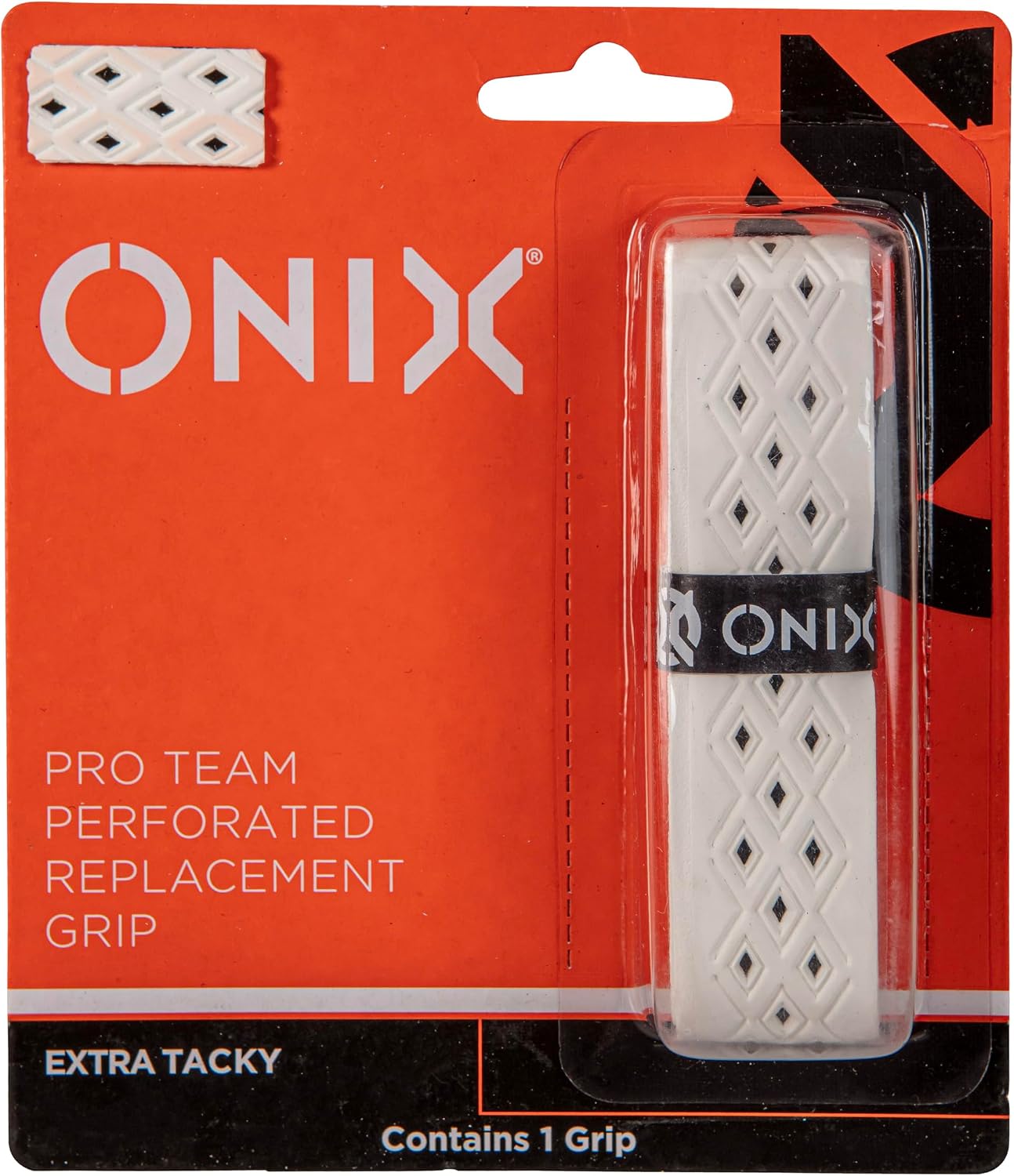
#4 ONIX Pro Team Perforated Replacement Grip — Best Tacky Feel
The ONIX Pro Team is the most aggressively tacky replacement grip on this list, and that’s both its defining strength and its central limitation. Maximum tack works best for players in dry, temperate conditions who prioritize finger-tip control over soft-game shots — the surface almost adheres to the hand, making micro-adjustments between dinks and drives feel intentional rather than accidental.
Key Specs:
- Length: Fits most standard paddles
- Construction: Perforated synthetic with extra-tacky outer layer
- Available colors: Black, White, Orange
- Performance profile: Pro-oriented surface tack
Performance Analysis: The extra-tacky surface chemistry on the ONIX Pro Team creates a grip-to-hand connection that sits closer to a leather grip than most synthetic alternatives. Paddle feedback transmits clearly through the handle — there’s minimal dampening, so you feel exactly what the ball does at contact. This is useful for experienced players who rely on that feedback to make real-time adjustments, but it can feel harsh to players coming from cushioned options. I played with this grip through a doubles session indoors and found the tack level ideal for quick exchanges at the kitchen line, where grip security on a fast reset matters more than cushion. Against the Gamma Honeycomb, the ONIX runs firmer and more feedback-intensive — the Honeycomb softens the connection to the paddle in a way the ONIX deliberately avoids. For players who have experience with tacky tennis overgrips and want that same adhesive bite in pickleball, the ONIX Pro Team delivers it in a full-thickness replacement format.
Pros:
- Maximum tack in dry conditions — excellent finger-tip control
- Available in three colors for customization
- Clear paddle feedback with no dampening
- Easy installation
Cons:
- Tack degrades faster in humid outdoor conditions than moisture-absorbing alternatives
- No cushion layer — not recommended for players with arm sensitivity
- Surface can feel too aggressive for beginners still developing consistent grip pressure
Best For: Intermediate to advanced players who play primarily indoors or in dry climates and want maximum paddle feedback with no compromise on tack.
My Verdict: The ONIX Pro Team is the grip for players who want to feel every shot through the handle. It’s not a comfort grip — it’s a performance grip built for players who trust their technique and want the surface to stay out of the way.
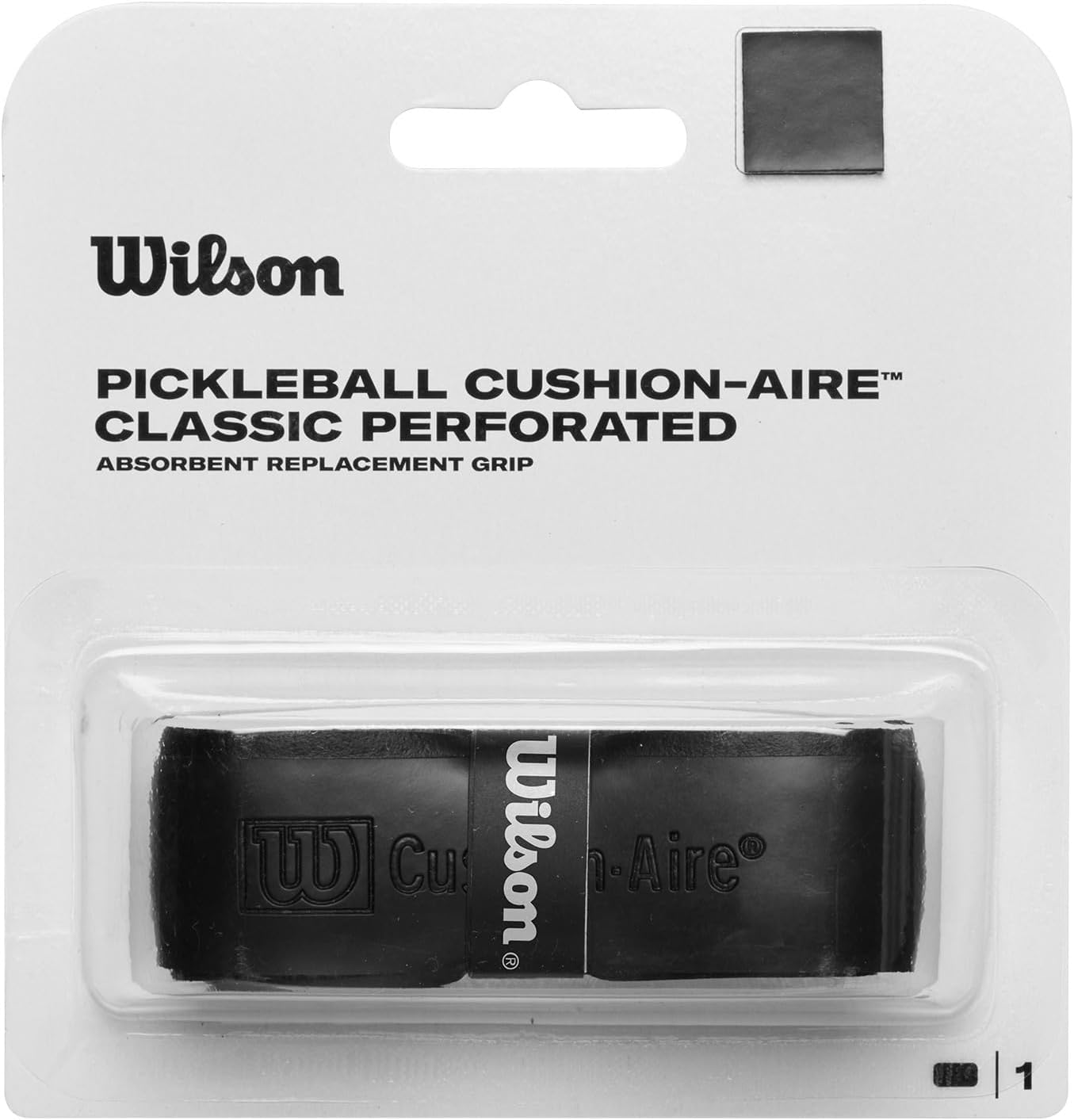
#5 Wilson Pickleball Cushion-Aire Classic Perforated Replacement Grip — Best Value
The Cushion-Aire Classic is one of Wilson’s most recognizable grip designs, re-engineered specifically for shorter pickleball handles. Comfortable out of the box, easy to install, and backed by decades of proven racquet-sport performance — this is the grip you grab when you want zero drama and dependable results every session.
Key Specs
- Material: Padded polyurethane (PU) outer layer with felt sublayer
- Surface: Perforated (dimpled) for airflow and moisture management
- Colors: Black, White
- Length: Designed for standard pickleball paddle handles
- Type: Replacement grip (applied directly to bare handle, not over existing grip)
- Thickness Added: Approximately 1/8″ to handle circumference
Performance Analysis
The patented air-supported PU construction is what separates this grip from standard options — vertical pores run through the outer layer and actively route sweat into the felt sublayer beneath, rather than letting moisture pool on the surface until your palm soaks through. That moisture management held up during a two-hour outdoor session in summer conditions, where third-shot drives and hard reset sequences never triggered a slip. The perforations also create a subtle tactile texture that sharpens feedback at contact, giving the hand more positional definition than a smooth grip surface would. Compared to the Tourna Pickleball Cushion Replacement Grip, which relies on elastomer cushioning, the Wilson lands slightly tackier and more plush — making it the better call for players who prioritize long-session comfort over raw direct feel. One practical note worth knowing before you wrap: the padded layer adds roughly 1/8″ to handle circumference, so players already at their upper threshold of pickleball paddle grip size should account for that before committing.
Pros
- Patented PU pore system actively pulls moisture away from the surface and into the felt layer — consistent performance even in humid, high-intensity conditions
- Padded construction absorbs vibration on hard-hit balls, reducing cumulative hand and arm fatigue across longer play sessions
- Moderately tacky surface delivers confident paddle control without feeling sticky or impeding quick grip adjustments mid-point
- Straightforward installation with minimal trimming required on standard-length pickleball handles
- Proven design with a long track record in competitive racquet sports — not an unproven newcomer
Cons
- Adds noticeable thickness to the handle; players with smaller hands or those already at the top of their preferred grip range should size-check before installing
- Comfort-forward bias means slightly less direct face feedback compared to thinner replacement options — not ideal for players who demand every tactile signal
- Sold as a single grip per pack, which means repeat buyers will need to stock up separately for bulk use
Best For
Players at any skill level who want a reliable, comfort-first replacement grip that holds up across extended outdoor sessions and high-humidity conditions. Particularly well-suited for anyone managing arm fatigue, recovering from elbow strain, or simply upgrading a worn factory grip without overthinking it.
My Verdict
Wilson’s Cushion-Aire Classic earns its reputation in pickleball the same way it built one across decades of tennis — through consistent, no-nonsense performance that holds up when sessions get long and conditions get rough. If you want a grip that stays dry, absorbs impact, and won’t abandon you mid-rally on a hot afternoon, this is the benchmark. Start here, and only look elsewhere if you specifically need a thinner profile or more minimalist feel.
#6 Tourna Standard Pickleball Replacement Grip — Best for Paddle Feedback
The Tourna Standard Replacement Grip prioritizes one thing above all others: maintaining direct paddle-to-hand communication with minimal interference. Made from a black polymer cushion with light perforations, it delivers a slightly tacky, smooth surface that sits close to a stock factory grip in profile — which is precisely the point. Players who don’t want a replacement grip to change how their paddle plays, only to refresh it, will find this the least disruptive option available.
Key Specs:
- Length: 31 inches
- Material: Black polymer cushion
- Surface: Smooth, slightly tacky, perforated for sweat absorption
- Profile: Standard thickness (close to factory grip feel)
Performance Analysis: The polymer construction keeps the grip surface neutral — neither aggressively tacky nor aggressively cushioned — which means the paddle’s own characteristics come through unfiltered. Soft paddles play soft; firm paddles play firm. This grip doesn’t interpret your shots for you. Perforations keep surface sweat from pooling, though the absorption rate is lower than the Gearbox’s felt-back system in extreme sweat conditions. Compared to the Gamma Honeycomb, the Tourna Standard runs thinner and less padded — players with average-size hands who found the Gamma Honeycomb slightly thick will appreciate the Tourna’s more neutral footprint. For players who’ve spent months dialing in the feel of a specific paddle and don’t want a new grip to recalibrate that relationship, the Tourna Standard is the safest choice.
Pros:
- Neutral, low-interference profile preserves original paddle feel
- Slightly tacky surface without being adhesive
- Perforations handle moderate sweat levels
- Proven construction since Tourna’s racket-sport history
Cons:
- No cushion underlayer — not suitable for players with arm sensitivity
- Standard tack level may feel insufficient in outdoor summer conditions
- Available only in black
Best For: Players who want to freshen their paddle without changing how it plays — particularly those with paddles that already have ideal handle circumference and feel.
My Verdict: The Tourna Standard is the “do no harm” grip option. It’s not the most exciting product on this list, but it’s the most honest — it refreshes your paddle’s grip without adding opinions about how your paddle should feel.
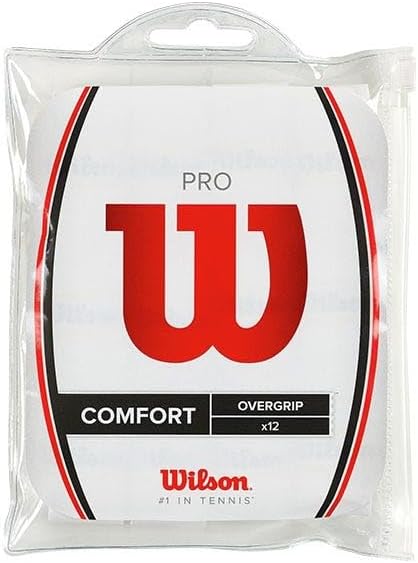
#7 Wilson Pro Comfort Grip — Best Budget Replacement Grip
The Wilson Pro Comfort Grip punches above its price point by delivering a cross-sport design — originally developed for tennis rackets — that translates well to pickleball paddles. At one of the lowest per-grip price points on the market, it provides a comfortable, slightly tacky synthetic surface with enough structure for recreational and entry-level competitive players to benefit without committing to a premium grip budget.
Key Specs:
- Length: Standard coverage (fits most paddles)
- Material: Synthetic polymer with slight texture
- Profile: Mid-thickness — between overgrip thinness and full cushion thickness
- Key selling point: Low cost, cross-sport availability, no-fuss performance
Performance Analysis: The mid-thickness synthetic construction makes the Wilson Pro Comfort more substantial than an overgrip but less padded than a full cushion replacement. For players who’ve never replaced a grip before, this is a forgiving entry point — the surface tack is mild enough not to feel overwhelming, and the installation process is less finicky than ultra-thin overgrips. In high-heat outdoor matches, it begins losing integrity faster than moisture-wicking synthetics, requiring more frequent replacement. Compared to the JOOLA or Tourna Grip options, the Wilson trades peak tack and longevity for simplicity and lower cost. It doesn’t transform your paddle — it improves it gently. For beginners, families, or coaches managing multiple paddles simultaneously, the per-unit economics make this a practical choice. Pairing it with a pickleball paddle grip size check before installation ensures you get the right handle circumference from the start.
Pros:
- Lowest per-grip cost of any option on this list
- Easy installation — forgiving wrap tension for beginners
- Mild, consistent tack for recreational play
- Cross-sport availability means easy reordering at any tennis or sports retailer
Cons:
- Longevity falls short of premium synthetic or polyurethane options
- Limited sweat management in hot or humid conditions
- Not recommended for competitive or high-frequency players
Best For: Beginners, recreational players, families with multiple paddles, or coaches who need affordable grip replacement in bulk without demanding peak performance.
My Verdict: The Wilson Pro Comfort won’t impress experienced players, but that’s not its job. It’s a reliable, accessible, budget-conscious entry point for players who want a functional grip replacement without overthinking it.
Tacky vs Cushioned vs Moisture-Absorbing — Which Type Is Right for You?
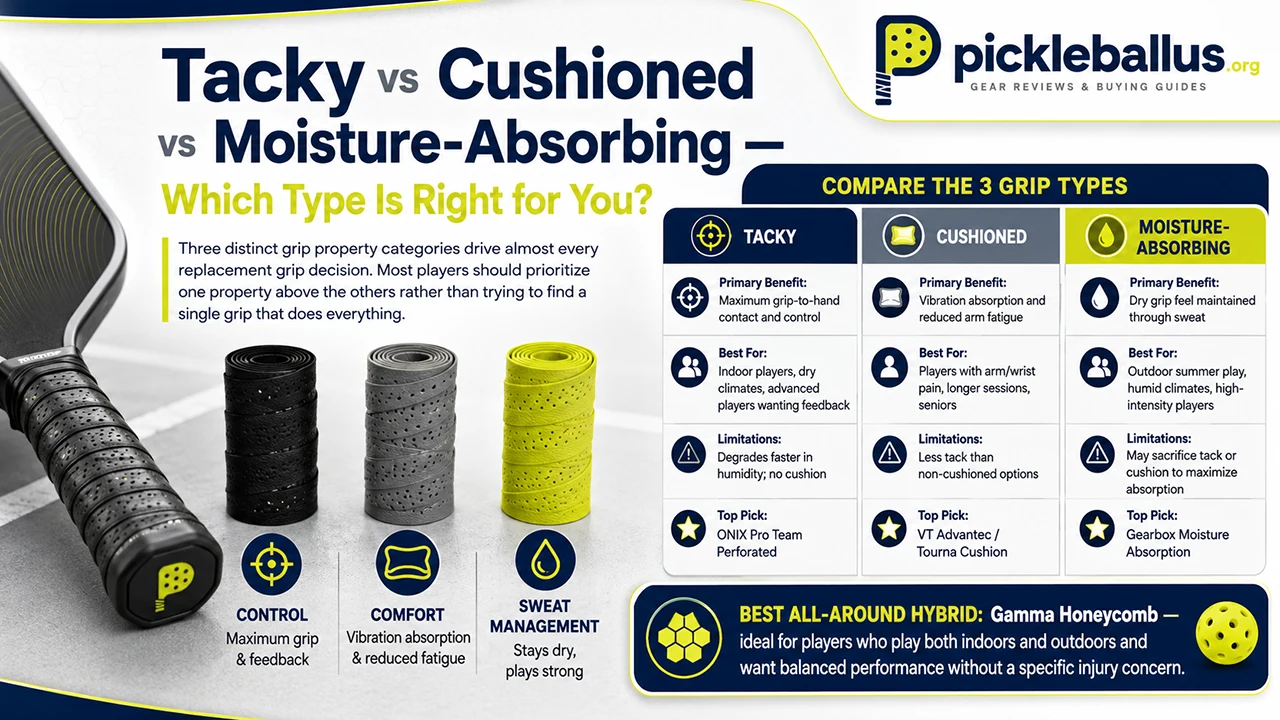
Three distinct grip property categories drive almost every replacement grip decision. The table below maps each type to the player profile that benefits most.
The three replacement grip types address fundamentally different needs, and most players will benefit from prioritizing one property above the others rather than trying to find a single grip that does everything at moderate levels.
| Grip Type | Primary Benefit | Best For | Limitations | Top Pick |
|---|---|---|---|---|
| Tacky | Maximum grip-to-hand contact and control | Indoor players, dry climates, advanced players wanting feedback | Degrades faster in humidity; no cushion | ONIX Pro Team Perforated |
| Cushioned | Vibration absorption and reduced arm fatigue | Players with arm/wrist pain, longer sessions, seniors | Less tack than non-cushioned options | VT Advantec / Tourna Cushion |
| Moisture-Absorbing | Dry grip feel maintained through sweat | Outdoor summer play, humid climates, high-intensity players | May sacrifice tack or cushion to maximize absorption | Gearbox Moisture Absorption |
Players who play both indoors and outdoors regularly — and don’t have specific injury concerns — are best served by a hybrid like the Gamma Honeycomb, which distributes performance across all three categories at a functional level rather than maximizing any single one.
How to Choose the Right Pickleball Replacement Grip
Choosing the right pickleball replacement grip requires matching four variables: your primary grip property need (tack, cushion, or absorption), your hand size relative to the paddle’s stock grip circumference, your playing environment, and your replacement frequency tolerance.
Start with the property that eliminates your biggest problem — slippage, arm pain, or sweat — and narrow from there. Choosing by brand recognition or price alone leads to unexpected feel changes after installation.
Does Grip Thickness Affect Paddle Performance?
Yes — grip thickness directly changes the effective circumference of your paddle handle, which alters your grip pressure, swing mechanics, and sense of control. Adding a thick cushion replacement grip (2.2–2.5mm) to a paddle with a small stock handle can increase circumference enough to change how your wrist generates power and spin. Players with smaller hands should avoid very thick replacement grips; players with large hands may actually benefit from the increased circumference. If you’re unsure where your handle sits, the pickleball paddle grip size guide provides a measurement method based on finger-to-palm ratio.
Can You Put a Replacement Grip Over an Existing Grip?
Technically yes, but it’s not recommended for replacement grips. Replacement grips are designed with a specific thickness to replace the original — layering one over a factory grip adds enough circumference to significantly alter the handle feel and may create uneven compression. Overgrips, by contrast, are designed for layering. If you want to add thickness without fully replacing the original grip, use an overgrip for pickleball instead. For a proper replacement grip installation — removing the old wrap completely and applying the new grip to the bare pallet — the step-by-step guide on how to replace a pickleball paddle grip walks through the full process.
How to Install a Pickleball Replacement Grip
Installing a pickleball replacement grip takes under five minutes and requires only the grip itself, a finish tape, and optionally a pair of scissors. The key steps are removing the existing grip cleanly, starting the wrap at the correct angle at the butt cap, maintaining consistent tension throughout the wrap, and securing the top end with finish tape.
Here is the standard installation sequence:
- Remove the old grip: Unwind from the top down; peel any double-sided tape residue from the pallet.
- Peel the backing: Most replacement grips have a self-adhesive strip along one edge — expose this before starting the wrap.
- Start at the butt cap: Angle the grip at roughly 30–45 degrees and make two to three tight overlapping wraps at the base before moving upward.
- Maintain consistent tension: Uneven tension creates lumps and pressure points. Keep the wrap taut but not so tight that the grip compresses flat.
- Finish and secure: Cut any excess at the top of the handle and apply the included finish tape to lock the end in place.
For a detailed walkthrough with photos and common mistakes to avoid, the how to apply pickleball overgrip guide covers technique that applies directly to replacement grip installation as well.
By now you have a clear picture of which replacement grips deliver the best combination of tack, cushion, and sweat control across seven distinct player needs. Finding the right replacement grip, however, is only the first layer of the handle performance equation — how you maintain it, adapt it to changing conditions, and understand what premium grip materials actually do differently from stock options will determine how much performance you extract per dollar spent. The next section covers the grip knowledge that most players only develop after years of trial and error.
Beyond the Basics: What Grip Enthusiasts Know That Beginners Don’t
The Rubber Grip System — Built to Last a Lifetime
Rubber replacement grips represent an entirely different durability category from synthetic wraps — a Python Rubber Pickleball Grip, for example, is marketed as lasting the functional life of the paddle itself, compared to the 20–30 hour lifespan of synthetic alternatives. Rubber grips carry more weight, deliver firmer feedback, and require a leather pickleball glove for optimal performance — the glove-and-rubber combination creates a mechanical bond between hand and paddle that no wrap grip can replicate. The trade-off is feel: rubber runs stiffer and less forgiving than polyurethane or synthetic options, which is why it appeals primarily to longtime players migrating from tennis with experience using leather grip systems.
How Grip Chemistry Changes With Weather and Humidity
Most synthetic grip materials change tactile behavior by 15–25% between dry and humid conditions — tack levels drop, surface compression increases, and the grip profile feels noticeably different from the same product used in a controlled indoor environment. Tacky grips like the ONIX Pro Team are engineered for dry conditions and lose ground fastest as humidity rises. Moisture-absorbing grips like the Gearbox maintain relative performance stability because the felt backing compensates for surface sweat before it affects tack. Players who compete in different climates — tournaments in Florida versus league play in California — benefit from keeping two grip types on hand and selecting based on conditions rather than habit.
Does a Better Grip Add More Value Than a New Paddle?
For most recreational to intermediate players, a $10–$15 premium replacement grip extracts more performance improvement per dollar than any paddle upgrade at the same price point. The grip is the only point of direct mechanical contact between your body and the paddle — every shot, every reset, every drive begins and ends at the handle. A worn grip that forces you to over-squeeze costs you racket-head speed, precision, and arm recovery time. Before investing in a new paddle to address feel or control issues, replacing the grip is the diagnostic first step that most players skip. If the best pickleball paddles in your price range already feel right when you first grip them, a quality replacement grip is what preserves that feel across hundreds of hours of play.
Write Your Review
No reviews yet. Be the first to share your experience!