

Your paddle handle has two separate layers — and confusing them costs you money, comfort, and control. Most players who say their grip “feels off” have actually diagnosed the wrong layer. They peel off a perfectly functional base grip and start fresh when all they needed was a fresh overgrip. Others keep slapping on overgrip after overgrip while the compressed foam underneath quietly blurs the bevel edges that control their paddle angle. Understanding which layer does what — and when to address each one — is one of the smallest adjustments that makes the biggest difference in how your paddle feels from session to session.
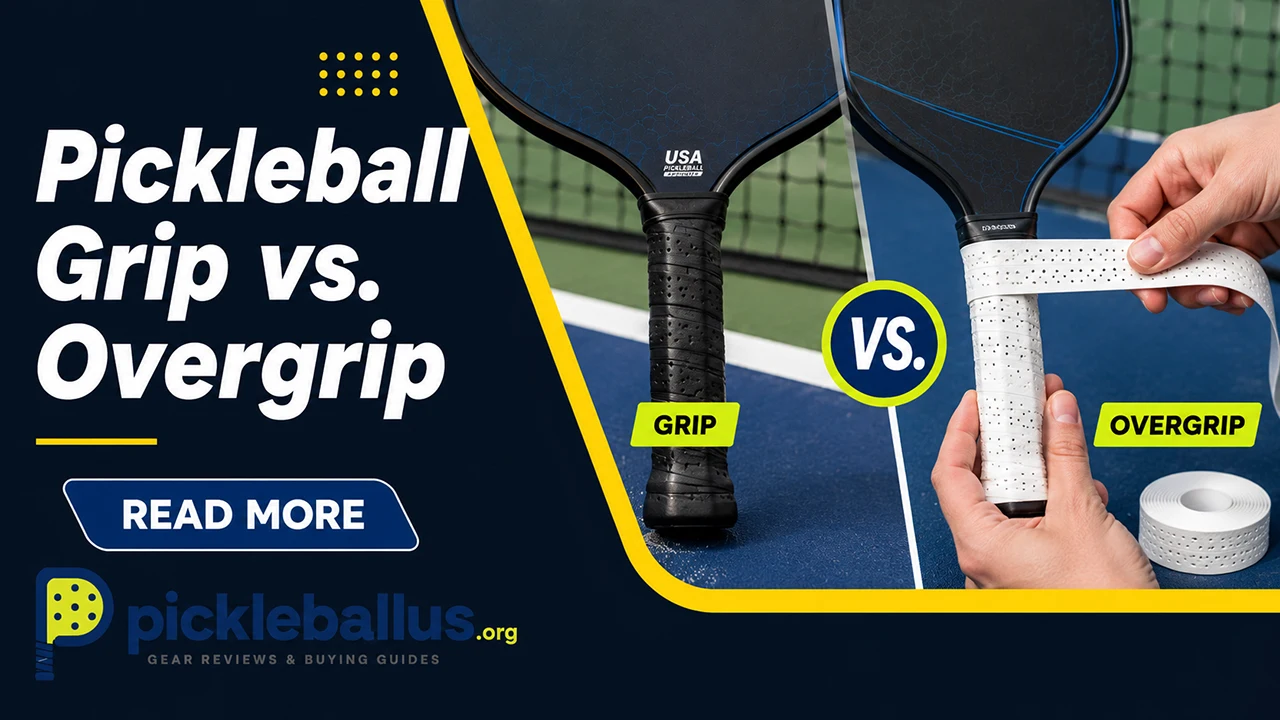
A pickleball grip (also called a replacement grip) is the thick foundational layer bonded directly to the bare handle of your paddle. It provides shock absorption, defines the octagonal bevel edges, and cushions your hand against the hard polymer or carbon core underneath. A pickleball overgrip is the thin consumable wrap applied on top of that base layer. It manages sweat, adds tackiness, and refreshes the surface feel — without adding significant bulk or changing the handle’s structural properties.
The two grips are not interchangeable. One is the mattress; the other is the fitted sheet. Replacing the mattress every week is wasteful and expensive. Never changing the sheet is unhygienic and costs you control. The mistake most players make is treating both products the same way because they look similar in the store.
Below is a complete breakdown of both layers: what they do, how they differ across thickness, cost, and replacement schedule, and — most importantly — which one your paddle actually needs right now.
What Is a Pickleball Grip (Replacement Grip)?
A replacement grip is the primary cushioning and structural layer wrapped directly over the bare handle of a pickleball paddle. It bonds to the handle through a pressure-sensitive adhesive backing and defines every physical property of the handle that affects your game: thickness, bevel sharpness, vibration damping, and overall diameter.
How a Replacement Grip Is Installed
Replacement grips attach directly to the bare paddle handle with a sticky adhesive backing that creates a semi-permanent bond. Installation starts at the butt cap and spirals upward with consistent overlap until the entire handle is covered, then terminates with a finishing tape at the top. Unlike an overgrip — which relies purely on tension — a replacement grip stays in place through adhesive contact. Removing it requires peeling from the butt cap end and, occasionally, cleaning off adhesive residue before installing a new one. This is not something you do between sessions or even between months. Most players touch their replacement grip once or twice a year.
The thickness range of a standard replacement grip runs from 1.5mm to 2.5mm. That cushion comes from an EVA foam core that absorbs the vibration pulse generated at ball contact — a vibration that travels straight up the handle and into your wrist and elbow if the base layer is absent or degraded. This is why players dealing with elbow discomfort should audit their replacement grip first before blaming their paddle.
How Long Does a Replacement Grip Last?
A replacement grip lasts 6 to 12 months for a player who competes or drills multiple times per week. Recreational players who get on the court once or twice a week may extend that to 18 months before degradation becomes noticeable. The failure mode is gradual: the EVA foam compresses over time, the bevel edges soften and blur, and the handle starts to feel like a round cylinder rather than an octagon. When that happens, paddle angle control — especially on dinks and resets — becomes inconsistent because your fingers no longer feel the eight flat reference points that anchor your grip.
The key signal: if you can no longer feel a clear distinction between flat faces and edge bevels, the replacement grip is due for replacement, not the overgrip.
What Is a Pickleball Overgrip?
A pickleball overgrip is a thin, flexible, consumable wrap applied over the top of an existing replacement grip. It does not bond with adhesive. Instead, it holds in place through tension — the act of wrapping it tightly with consistent overlap compresses the stretchy material so it stays secure without leaving any residue when removed. An overgrip typically measures 0.4mm to 0.6mm thick, thin enough that it does not meaningfully increase handle diameter or mask the bevel edges underneath.
The purpose of an overgrip is surface management: it provides tackiness so the handle does not slip from your palm, sweat absorption to keep moisture from building up between your hand and the handle, and a minor amount of additional cushion that improves comfort during long sessions. When an overgrip wears out — usually well before the replacement grip underneath does — you simply peel it off, discard it, and wrap a fresh one. No adhesive residue. No tools needed. The whole process takes under two minutes.
Tacky vs. Absorbent Overgrip — Which Type Do You Need?
Overgrips divide into two functional categories: tacky and absorbent. Tacky overgrips use a surface material that clings to your palm even in dry conditions — these suit players whose main problem is paddle rotation on contact or in a firm-grip style. Absorbent overgrips are made from softer, more porous materials (often a polyurethane or microfiber blend) that wick sweat away from the surface during play — these suit players who compete in heat, tend to sweat heavily, or play long sessions without breaks.
The two types are not mutually exclusive: some overgrips blend both properties, trading peak tackiness for moderate absorption. Players in humid climates — particularly in the Southeast U.S. during summer — tend to prefer absorbent-forward overgrips because a tacky grip saturated with sweat becomes slicker than a worn one. Players in dry climates or indoor facilities often prefer tacky options because sweat is not the primary grip issue. Your best pickleball grip for sweaty hands will depend on this climate-and-sweat interaction more than any other variable.
How Often Should You Replace an Overgrip?
Replace your overgrip every 4 to 8 weeks if you play two or more times per week. The wear curve is nonlinear: an overgrip feels good for the first several sessions, then degrades quickly once the surface breaks down. By the time the overgrip looks obviously worn, it has already been underperforming for two or three sessions. Players who notice their hand tightening involuntarily mid-match — squeezing harder to compensate for a slippery handle — are overdue for a replacement. A useful rule: schedule overgrip changes the same way you schedule restringing a tennis racquet — by sessions played, not by how it looks.
Pickleball Grip vs. Overgrip — Key Differences
The most important difference between a replacement grip and an overgrip is what each one is designed to do. A replacement grip provides the structural and cushioning foundation of the handle. An overgrip manages the surface interface between your hand and that foundation. Removing the replacement grip to apply an overgrip directly to bare carbon or polymer is a common and damaging mistake — the overgrip is not thick enough to protect your hand or provide adequate vibration damping on its own.
The table below compares both products across five key dimensions:
| Dimension | Replacement Grip | Overgrip |
|---|---|---|
| Thickness | 1.5mm – 2.5mm | 0.4mm – 0.6mm |
| Installation | Adhesive backing — bonded to bare handle | Tension wrap — no adhesive |
| Cost | $10 – $20 per grip | $3 – $6 per wrap (often sold in 3-packs) |
| Replacement frequency | Every 6–12 months | Every 4–8 weeks (heavy play) |
| Primary function | Shock absorption, bevel definition, handle structure | Sweat management, tackiness, surface refresh |
Thickness and Handle Feel
Replacement grips define the tactile map of your handle. The 1.5mm–2.5mm of foam sits thick enough that your fingers press into it slightly on contact, allowing you to feel each of the eight bevels as a distinct flat surface. That bevel feedback is what tells your hand — without looking — whether your paddle face is square, open, or closed. When foam compresses past its useful life, those bevel edges fade, and paddle angle control degrades. An overgrip, at under 0.6mm, adds a thin skin over that structure without masking it. You can still feel every bevel beneath a fresh overgrip, which is by design.
Cost and Replacement Frequency
Overgrips cost less upfront but demand more frequent replacement. A three-pack of quality overgrips runs $10–15 and may cover six to eight weeks of regular play. A single replacement grip costs $10–20 but lasts up to a year. Players sometimes resist buying best pickleball replacement grips because the per-unit cost is higher — but when you factor in the replacement schedule, the annual cost of overgrips exceeds the annual cost of replacement grips for most active players. The comparison only makes sense when you treat them as what they are: two separate products serving two separate purposes.
Can You Use Both at the Same Time?
Yes — using a replacement grip and an overgrip together is the correct and intended setup for most players. The two layers complement each other. The replacement grip handles the mechanical work: shock absorption, structural bevel definition, and handle diameter. The overgrip handles the surface work: sweat, tack, and feel. Removing the replacement grip to install an overgrip directly over bare carbon defeats the purpose of both products and leaves your hand without vibration protection.
The one scenario where players skip the overgrip entirely is when the factory base grip provides enough tack and comfort on its own — common for players who don’t sweat heavily, play shorter sessions, or prefer the slightly firmer feel of a grip with fewer layers. This is a valid choice. What is not valid is using only an overgrip with no replacement grip underneath.
When Should You Replace Your Grip vs. Add an Overgrip?
The right answer depends on which layer has actually failed. Both products degrade at different rates and show different failure signals. Diagnosing the wrong layer means spending money and time without fixing the problem. The three-question test below resolves most cases:
- Can you still feel sharp bevel edges when you hold the paddle without looking? If no → replacement grip issue.
- Does the surface feel smooth or damp even at the start of a session? If yes → overgrip issue.
- Has it been longer than 12 months since you changed the base grip? If yes → replacement grip issue regardless of feel.
Signs Your Replacement Grip Needs to Go
Your replacement grip has failed when the EVA foam no longer provides bevel definition or vibration absorption. Specific indicators: the handle feels smooth and round rather than octagonal; you notice wrist or elbow discomfort that wasn’t present six months ago; you can see compressed or cracked material along the spiral seam; or the grip has shifted or separated from the handle near the butt cap. These issues do not resolve by adding a fresh overgrip on top. A new overgrip over a dead base grip still transmits hard vibration pulses directly into your hand.
Knowing how to replace a pickleball paddle grip properly — removing the old adhesive, aligning the butt cap correctly, and maintaining even overlap — determines how long the new grip lasts and how cleanly it performs.
Signs You Only Need a Fresh Overgrip
Your overgrip has failed when the surface loses its tactile properties — tackiness or absorption — without any change in the handle’s structural feel. The bevels still feel sharp. The handle diameter still feels right. But the surface has gone slick, or it absorbs sweat more slowly than it used to, or the material has visibly pilled or peeled at the seams. In these cases, a fresh overgrip resolves the issue in two minutes. Pulling the entire base grip to solve a surface problem is unnecessary and often makes things worse if the replacement is not installed correctly. When comparing best pickleball overgrip options, prioritize the surface property that matches your primary failure mode: tackiness if you’re dealing with rotation and slipping; absorption if sweat is building up faster than the material can manage.
By this point, you understand the two-layer system that makes up your pickleball paddle handle and how each layer fails differently. Choosing between a grip and an overgrip stops being confusing once you treat them as what they are: two tools for two separate problems. However, the handle system goes one layer deeper — handle diameter, overgrip stacking, and build-up tape all interact with these two layers in ways that affect your shot-making at the margin. The next section covers the finer points that inform a complete handle setup.
What Else Affects Your Pickleball Handle Setup?
The replacement grip and overgrip together form the standard two-layer handle system. But three additional variables — grip size, overgrip stacking, and build-up tape — interact with that system and change how the handle performs for different hand sizes and preferences.
How Grip Size Affects Your Overgrip Choice
Handle diameter — measured as grip circumference — determines how your fingers close around the handle and whether your swing generates wrist-driven or arm-driven power. Most pickleball paddles ship with a grip circumference between 4 and 4.5 inches. Players with smaller hands often perform better with a smaller circumference that allows full finger wrap and precise control. Players with larger hands may find a thicker grip reduces wrist fatigue and prevents the handle from rotating on impact.
An overgrip adds approximately 1/16 of an inch to the overall circumference — minor but measurable. If your grip size is already at the upper limit of your comfort range, stacking an overgrip can push it past that threshold. Conversely, if the factory handle is slightly too thin, one overgrip may bring it into the correct range without any other modification. Understanding pickleball paddle grip size before purchasing an overgrip prevents the common frustration of adding material that makes the handle feel worse.
Can You Stack Two Overgrips?
Stacking two overgrips is possible and sometimes practical, but it comes with trade-offs. Double overgripping increases handle circumference by roughly 1/8 of an inch, which some players deliberately use to customize thickness without purchasing a new replacement grip. The downside is reduced bevel feedback: two layers of overgrip material soften the transition between flat faces and edges, making paddle angle registration less precise. For power players who grip firmly and hit with a full swing, this trade-off is acceptable. For dink-focused players who rely heavily on bevel awareness at the kitchen line, a single overgrip over a properly fitted replacement grip will almost always outperform a double-wrapped setup.
Build-Up Tape — The Hidden Third Layer
Build-up tape is a thin foam tape applied between the bare handle and the replacement grip to incrementally increase handle diameter without replacing equipment. Most players never need it. It becomes relevant when a player’s ideal grip size falls between the standard options a paddle manufacturer offers — for example, when the 4-inch grip is too thin but adding a full replacement grip on top creates a diameter that’s noticeably too large.
Build-up tape solves this sizing gap precisely because it comes in measured thickness increments, typically 1/16 inch per layer. If you find yourself stacking two overgrips just to achieve your preferred handle feel, build-up tape under the replacement grip delivers the same diameter increase with better structural integration and cleaner bevel definition. For a full breakdown of surface grip options beyond the standard two-layer setup, the best pickleball grip tape guide covers the full product range and application methods.


Write Your Review
No reviews yet. Be the first to share your experience!