

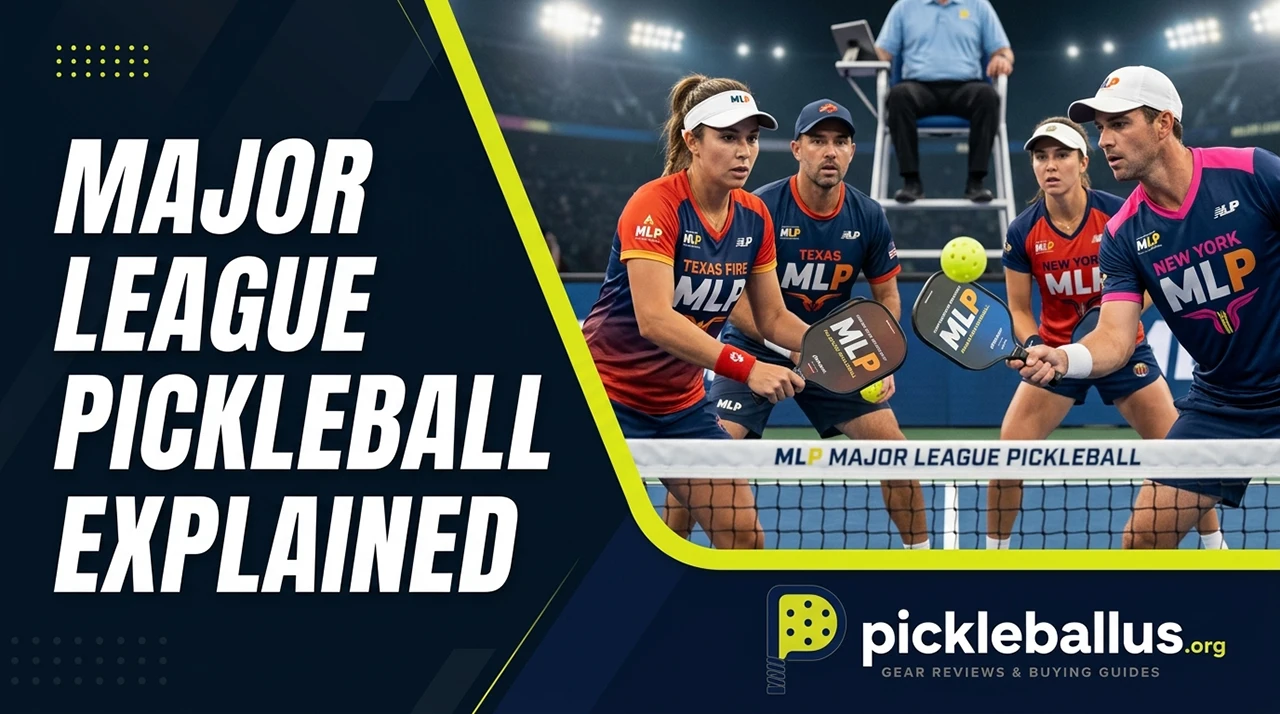
Major League Pickleball (MLP) is the only professional coed team-based pickleball league in the world, where 20 city-based franchises compete head-to-head across a nine-event regular season for a national championship. Unlike individual tournament circuits, MLP turns pickleball into a franchise team sport — rosters of three men and three women compete together under one banner, earning collective standings points that build from event to event until the season-long playoffs.
Every MLP event runs across four days using the MLPlay™ format, a competition structure no other sport quite mirrors. Each team match consists of four games — women’s doubles, men’s doubles, and two mixed doubles — with every game played to 11 points. When a match ends tied 2-2, MLP’s most dramatic format element kicks in: the DreamBreaker™, a rally-scoring race to 21 where each player cycles through four consecutive points as server. It transforms a tied match into one of the most tension-filled moments in professional racket sports.
MLP launched in 2022 and grew rapidly, drawing celebrity investors including LeBron James, Tom Brady, and Mark Cuban — and completing a strategic merger with the PPA Tour to consolidate the professional pickleball leagues landscape under one umbrella. The result: a league with the biggest prize pools, the strongest media presence, and the fastest-growing fan base in the sport.
Below is a complete breakdown of how MLP works — from team rosters and the draft system to DreamBreaker mechanics, the season format, and how to watch live in 2026.
What Is Major League Pickleball?
Major League Pickleball — or MLP — is a professional coed team league where 20 city-based franchises compete for standings points across a structured regular season leading to a national championship. It sits at the top of what is pickleball‘s competitive landscape, representing the sport’s most funded, most watched, and highest-profile competitive format.
MLP’s founding concept was deliberate: take pickleball — long structured around individual brackets and doubles pairings — and rebuild it as a franchise-based team league, closer in model to the NBA or NFL than to a traditional tennis or racquet sports circuit.
How MLP Started — From Steve Kuhn to a 20-Team League
MLP was founded in 2021 by Steve Kuhn, a former Wall Street hedge fund manager who believed pickleball’s explosive player growth needed a professional product fans could follow like a local team. The league ran its first competitive events in 2022 and grew fast — attracting marquee investors from professional sports and entertainment within its first two seasons.
Celebrity buy-in generated national media attention far beyond what most new sports leagues earn in their first years. LeBron James, Tom Brady, Patrick Mahomes, and Mark Cuban all became involved as franchise co-owners — names that brought mainstream sports coverage to a sport still earning its professional infrastructure.
By 2026, MLP operates as a unified 20-team league, having previously tested a two-tier Premier Level and Challenger Level structure before consolidating back to a single competitive level where all 20 teams chase the same championship. The Brooklyn Pickleball Team and NY Hustlers merged in 2026, and other franchises explored ownership transitions, reflecting the active roster-management culture the league now operates with.
How MLP Is Different from the PPA Tour
The pickleball PPA explained page covers this in depth, but the structural difference is fundamental: the PPA Tour is an individual tournament circuit where players compete for themselves. MLP is a team league where city-based franchises compete collectively. The two organizations merged strategically, and many top players participate in both circuits during the same season — but MLP events are built entirely around the team format.
The decisive difference is roster accountability. A PPA Tour loss is an individual result. An MLP match loss costs your entire franchise standings points — everyone wins and loses together. That collective stake reshapes tactics, lineup strategy, and the psychological weight of every DreamBreaker.
How Does an MLP Team Work?
An MLP team consists of six players — three men and three women — and, as of the 2026 rule changes, coaches can deploy all six players across a single match, giving lineup decisions real tactical depth for the first time in league history.
Previously, teams carried only four active players per match. The expanded six-player deployment rule changed how franchises approached rosters and trades — depth now matters as much as star power at the top of the lineup.
Roster Size, Gender Makeup, and Player Deployment
Every MLP roster is gender-balanced by design: three men and three women. This isn’t a policy preference — it’s the structural foundation of MLPlay™, which requires gender-alternating pairings in the mixed doubles games. A valid lineup requires equal gender representation, no exceptions.
Each team’s six players compete across four games: one women’s doubles, one men’s doubles, and two mixed doubles. With six players available, coaches must decide which women pair together for women’s doubles, which men handle men’s doubles, and how to construct two separate mixed doubles lineups — sometimes using different player combinations for each game to create tactical mismatches against the opponent.
Player ratings under DUPR (Dynamic Universal Pickleball Rating) factor into how teams build rosters, since every player’s competitive skill level directly shapes lineup flexibility and match strategy.
How the MLP Draft and Free Agency Work
MLP uses an annual draft and free agency system, so rosters shift from season to season. Players without existing contracts enter the draft pool, where franchises select them in structured rounds. Teams with lower previous-season standings pick earlier — a competitive balance mechanism borrowed from major professional sports.
Free agency allows players with expired contracts to negotiate directly with franchises. In 2026, MLP introduced a cash-for-player trade rule for the first time in league history, permitting teams meeting certain roster conditions to pay cash to other franchises in exchange for a player. This cash-trade rule signals how far the league has matured since its 2022 launch.
Players must be UPA (United Pickleball Association) signed to compete in MLP events. The player pool draws from the top ranks of professional pickleball, but the draft has also opened pathways for rising players to secure their first franchise contracts.
Who Owns MLP Teams?
MLP team ownership is a mix of private sports investors, celebrities, and entrepreneurs. High-profile co-owners include LeBron James (co-owner of the LA Mad Drops), Tom Brady, Patrick Mahomes, and Mark Cuban — names that brought national media attention well beyond pickleball’s traditional audience.
Beyond the celebrity tier, most teams carry deeper ownership groups with sports operations experience. Running an MLP franchise requires real infrastructure: coaching staffs, player contracts, scouting, and event logistics at the level of any professional team sport. Celebrity names open media doors; experienced operators keep the franchise running.
How Does an MLP Match Work?
An MLP team match consists of four games, always played in full — women’s doubles, men’s doubles, and two mixed doubles — regardless of score, with each game played to 11 points, win-by-two, using side-out scoring.
The four-game-always rule is one of MLP’s most deliberately designed features. Because standings points depend partly on point differentials, all four games run to completion even when a team has already clinched three wins. Teams cannot coast — they compete hard through every game, producing more entertainment for fans and more meaningful data for standings tiebreaks.
Women’s Doubles, Men’s Doubles, and Mixed Doubles Explained
Every MLP match follows a fixed game order: women’s doubles first, men’s doubles second, then two mixed doubles games. Teams switch ends at 6 points within each game.
The two mixed doubles games are where lineup strategy grows most complex. With three men and three women on a roster, coaches must decide pairings for both mixed games — sometimes deploying different combinations per game to create positional mismatches. Pairing a strong baseline player with a precise net player creates a different tactical dynamic than two aggressive attackers, and the opponent’s lineup influences those decisions in real time.
Each game runs to 11 points under side-out scoring — a team scores only when serving. Win-by-two applies at 10-10: play continues until one team leads by two. This differs from the DreamBreaker, which uses rally scoring throughout.
What Is the DreamBreaker and How Does It Work?
The DreamBreaker™ is MLP’s signature tiebreaker — triggered when a match ends 2-2 after four regulation games. It’s a rally-scoring race to 21 points where each player takes four consecutive points as server before the rotation moves to the next player.
The sequence cycles through all four competing players: both women and both men rotate in order. Points only count on your own serve, so a poor service rotation doesn’t just stall scoring — it hands momentum directly to the opponent. The format creates individual accountability within a team context: one bad rotation can swing the entire match result.
The DreamBreaker applies in both the regular-season group stage and on Super Sunday, maintaining the same high-stakes mechanics at every level of each event. Fans who understand the rotation can track exactly which player serves next and calculate how many points each team needs — creating a chess-clock tension absent from traditional pickleball scoring.
Scoring Rules: Side-Out, Win-by-Two, and the 4-Game-Always Rule
The four-game-always rule eliminates dead rubbers entirely. In most team sports, once a team clinches a series with a 3-0 lead in a four-game match, the remaining game carries no stakes. MLP removes that situation: all four games run to completion, every time.
This matters for three reasons. First, fans always see a full match’s worth of court time. Second, teams cannot tank a fourth game to preserve energy. Third, point differential data is available for tiebreaking when multiple teams share the same win count in group standings — which, in a tight group of five teams, happens regularly.
Side-out scoring means only the serving team scores. Rally scoring — where every rally produces a point regardless of who served — is used exclusively in the DreamBreaker, which is why the DreamBreaker plays faster and raises the stakes on every single point.
How Does an MLP Season Work?
The 2026 MLP season consists of 13 total events: nine regular season events, one Mid-Season Tournament, and three playoff weekends. All 20 teams compete across the regular season, earning standings points at every event that accumulate toward final playoff seedings.
The Four-Day Event Structure (Thursday to Sunday)
Each MLP event runs Thursday through Sunday, split into two phases: a three-day group stage (Thursday through Saturday) and a single decisive Super Sunday.
At every regular-season event, the 20 teams divide into groups — typically 10 to 11 teams split into Group A and Group B, with five or six teams per group. Each team plays every other team in their group in round-robin format during the Thursday-Saturday phase. All four games in every match always run to completion; teams switch ends at 6 points per game.
Group standings follow a points structure: three points for a regulation match win, two for a DreamBreaker win, one for a DreamBreaker loss. The top four teams from each group advance to Super Sunday. Every match matters for seeding even when group position appears secure, since point differential tiebreakers can determine which four teams advance — and those tiebreakers draw on every point scored in every game.
How MLP Standings Points Are Earned
MLP standings points accumulate across the entire regular season — Event 1 results add to Event 2, and so on through Event 9. This is the feature that separates MLP’s format from nearly every other team league at this level.
Teams don’t just win or lose individual events. A franchise that consistently finishes in the top four at every event may accumulate more season points than a franchise that wins one event but underperforms at three others. Every event appearance carries weight, and the system rewards consistent performance over single-event peaks.
The cumulative structure creates meaningful decisions around the DreamBreaker: converting a 2-2 regulation tie into a DreamBreaker win earns two points instead of one. Winning in regulation earns three. That one-point gap compounds significantly over nine regular-season events — a team that wins its DreamBreakers all season builds a standings advantage that cannot be overcome with one strong event at the end.
The 2026 MLP Playoffs — Format and Qualification
The top 12 teams in the regular-season standings qualify for the 2026 MLP Playoffs, seeded No. 1 through 12 by accumulated points. Seeds No. 1–4 receive First Round byes and begin play at the Quarterfinals in San Diego.
The First Round in Dallas features seeds No. 5–12, with winning teams advancing to the Quarterfinals. The bracket proceeds through Semifinals and Championship Sunday. Playoff matches follow the same MLPlay™ format — four games always played, DreamBreaker if needed — so the competitive structure fans followed all regular season applies at the highest possible stakes.
How to Watch Major League Pickleball
All MLP events stream live, with matches broadcast on Pickleball TV and additional TV distribution partners that vary by event. After each match day, all 2026 season matches are archived on MLP’s official YouTube channel for on-demand viewing.
Pickleball TV is the primary streaming home for MLP content, offering live coverage, replays, and supplemental programming around each event. For television viewers, MLP has secured distribution deals with network and cable partners, though specific channels vary by event and region. Checking the league’s official site before each event confirms the broadcast details for that weekend.
Live attendance is available at all MLP events, held across various markets nationwide. Major markets typically host MLP in larger indoor arenas with court configurations designed for the team match format — multiple courts running simultaneously, with seating arranged to follow the action across the full event weekend.
By now you have a complete picture of what Major League Pickleball is, how teams are built, how the match format works, and how a season unfolds from opening event to championship weekend. Understanding the structure — the four-game match, DreamBreaker mechanics, standings points accumulation — changes how you watch. Every match result means something; every DreamBreaker is a potential season-altering moment. The section below covers what goes beyond the rulebook: the forces driving MLP’s rise, why celebrity ownership accelerated the league’s trajectory, and what the amateur side of MLP offers recreational players.
What Makes MLP the Most Exciting League in Pro Pickleball?
MLP’s rise isn’t purely a format story — it’s a combination of celebrity capital, smart competition design, and pickleball’s population boom converging at the right moment. These factors explain why MLP generates the kind of attention most new professional leagues spend a decade trying to build.
Celebrity Investors and the Star-Power Angle
LeBron James, Tom Brady, Mark Cuban, and Patrick Mahomes are among MLP’s most recognizable franchise co-owners. Their involvement produced national media coverage that pickleball’s traditional audience could not have generated alone.
Celebrity ownership in MLP works differently from a standard endorsement deal. These investors hold equity in franchises — they carry financial exposure and reputational stakes. When LeBron or Brady is connected to a team, mainstream sports media covers the league. That coverage reaches audiences who don’t yet follow pro pickleball players like Ben Johns or Anna Leigh Waters but recognize the investors, creating a conversion path from mainstream sports fandom into the MLP audience.
This model echoes how Major League Soccer used David Beckham’s involvement in Inter Miami to accelerate mainstream credibility for a sport still earning its American foothold.
How MLP Has Grown Since 2022
MLP launched in 2022 with a small group of teams and limited media presence. By 2026, the league runs 20 franchises, has merged with the PPA Tour, stages 13 annual events, and distributes matches across both streaming and broadcast television. That trajectory mirrors pickleball growth in the United States more broadly — the sport has shifted from backyard recreation to a competitive ecosystem with professional contracts, college programs, and national broadcast deals in under a decade.
The 2026 cash-for-player trade rule signals league maturity: franchises now generate enough revenue and roster depth that financial transactions between teams make practical sense — a threshold most new sports organizations don’t reach in their first five years.
MLP Amateur Format: Bringing Team Pickleball to Recreational Players
The MLPlay™ format isn’t reserved for professionals. MLP has partnered with DUPR to offer an amateur team format — a four-player (two men, two women) end-of-season draft and championship tournament that mirrors the professional structure. This brings MLP-style competition into recreational clubs and community leagues, where players compete under the same DreamBreaker rules they watch the pros use on television.
For recreational players who want to experience DreamBreaker pressure firsthand, the amateur format provides direct access. Many clubs now host MLP-style league nights, and the format scales naturally — from players picking up their first best pickleball paddles to competitive 4.5+ players chasing a club championship. For developing players who want a pathway beyond recreational play, the Association of Pickleball Professionals Tour offers its own competitive circuit alongside MLP, rounding out the full professional pickleball ecosystem.



Write Your Review
No reviews yet. Be the first to share your experience!