

Champions Series Pickleball (CSP) is the first professional pickleball league built exclusively for mature athletes — players aged 40+, 50+, and 60+ — offering both a team-based pro league and a standalone tournament series in the United States. Founded in 2022 under the name National Pickleball League, CSP completed three seasons before announcing a landmark partnership with Major League Pickleball in early 2026, setting the stage for its biggest expansion yet: 16 teams, four age-specific divisions, and a fully integrated schedule with the sport’s most prominent pro circuit.
Most mainstream pickleball coverage focuses on the open-age professional scene — players in their 20s and 30s competing in MLP or PPA events. CSP flips that model entirely. Its founders, who are competitive players themselves, built the league specifically to give athletes over 40 a genuine professional stage, not a side exhibition or an age-division bracket at a general tournament. That difference in philosophy — pro-level competition designed from the ground up for a specific age group — shapes everything from how teams are structured to how the tournament series is run.
What makes CSP worth understanding isn’t just that it exists, but that it has grown steadily and is now aligned with the most powerful organizational force in professional pickleball. For anyone over 40 who competes seriously, follows the sport closely, or is curious about where senior pickleball is heading, CSP’s structure and trajectory matter.
This breakdown covers how CSP works, who competes, what changed in 2026, and why the league’s approach to senior competition represents something new in the professional pickleball leagues landscape.
What Is Champions Series Pickleball?
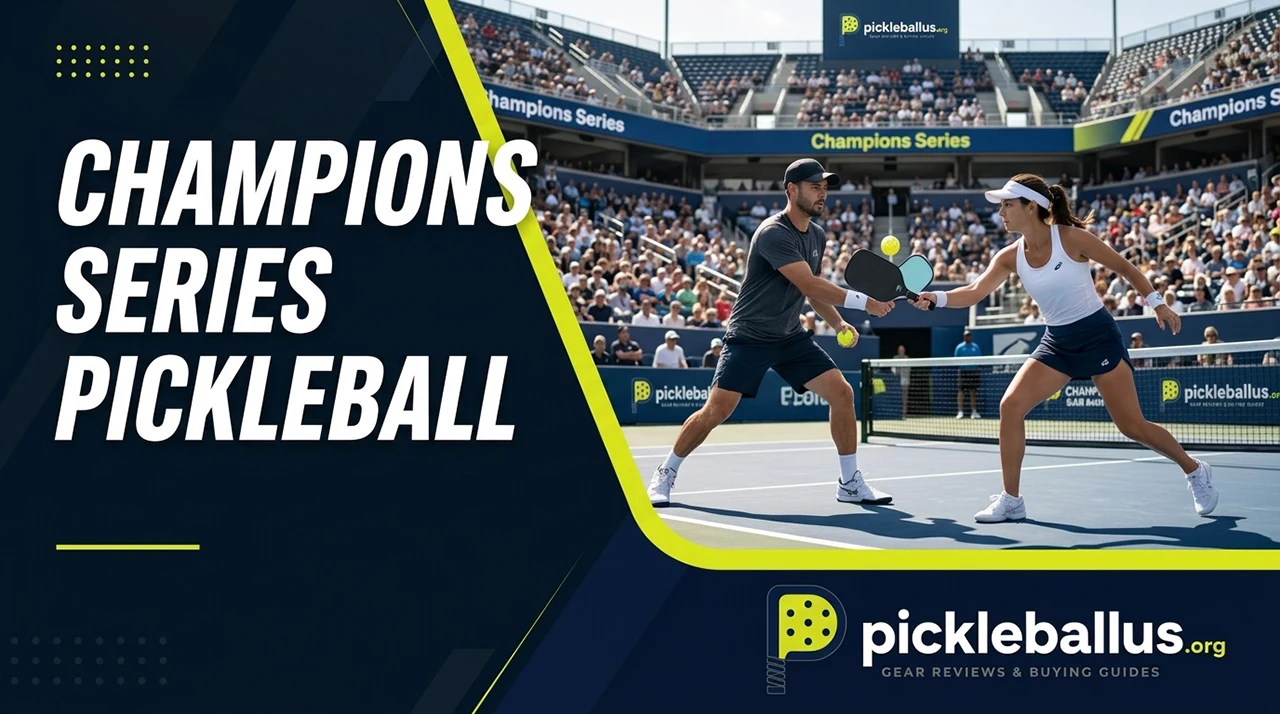
Champions Series Pickleball is a nationwide team-based professional pickleball league for athletes aged 40 and above, established in 2022 as the National Pickleball League and subsequently rebranded to reflect its current focus on a Champions Division format. CSP runs two distinct competition formats: a team league where players represent city-based franchises, and a tournament series open to both professional and amateur participants across the 40+, 50+, and 60+ age groups.
The founding premise was straightforward but unfilled at the time: professional pickleball’s fastest-growing demographic — mature, competitive, serious players — had no dedicated pro league. Open-age circuits like MLP and the PPA Tour are built around players in their peak physical years. CSP’s founders, themselves experienced pickleball pros, saw that as a structural gap and moved to close it.
Within three seasons, CSP grew from a startup concept to a 12-team league with approximately 200 Champions Pro players competing across cities including Austin, Boca Raton, Columbus, Denver, Houston, Indianapolis, Kansas City, Naples, Oklahoma City, Princeton, and Seattle. The league’s tagline — “age is no barrier to greatness” — isn’t just branding; it reflects the operational decisions that set CSP apart from amateur senior brackets at general pickleball events.
From National Pickleball League to Champions Series Pickleball
CSP launched in 2022 as the National Pickleball League, making it one of the earliest dedicated professional pickleball organizations for the 40+ age group. The rebrand to Champions Series Pickleball came as the league expanded its identity beyond a single national format to include a broader tournament series alongside its team-based league. The shift also signaled a clearer focus on the “Champions” category of players — experienced, competitive, and aged 40 or older — as distinct from the open-age pro field.
The name change wasn’t just cosmetic. It coincided with structural changes: the addition of new age divisions, a tournament series with separate amateur brackets, and eventually the high-profile partnership with Major League Pickleball that formally arrived in March 2026. Each of those developments made “National Pickleball League” feel too narrow. Champions Series Pickleball captures both the league format and the tournament circuit under a single identity.
What Makes CSP Different from Other Pro Pickleball Leagues
CSP is the only professional pickleball league structured entirely around age-based divisions, while organizations like MLP and the broader professional pickleball leagues circuit operate as open-age competitions with no similar structure for mature athletes. The practical difference is significant: at an MLP event, a 55-year-old professional competes against players who may be 22. At CSP, every player on the court is drawn from the same generational cohort.
Beyond the age structure, CSP also operates with a co-founder ethos that distinguishes it from investor- or media-company-driven leagues. The organization was explicitly built by Champion Pros for Champion Pros — the people who designed the formats, the tournament experience, and the competitive rules are also the players who compete in them. That internal feedback loop shows up in decisions like the choice to use indoor venues for tournament play, eliminating weather cancellations, and the Player Combine format used for team placement rather than a draft system open to front-office manipulation.
Who Are the Champions Pros?
Champions Pros are competitive pickleball players aged 40 and above who compete at a professional level within the CSP system — distinct from amateur recreational players and from open-age professionals under 40. The term is both a player classification and a cultural identity within CSP: it acknowledges that elite athletic performance doesn’t stop at 39, and that the strategic, technical game experienced players develop over decades deserves its own competitive arena.
Not every 40+ pickleball player qualifies as a Champions Pro. CSP uses a structured evaluation — the Player Combine — to assess skill level, place players into the appropriate division, and assign them to teams. The pathway into professional play at CSP is merit-based and distinct from simply signing up for an age-division bracket at a recreational tournament.
Understanding who qualifies and how they compete is essential context for understanding the league. CSP isn’t a recreational senior circuit with professional trappings — it’s a professional competition that happens to be age-defined.
Age Divisions — Prime (40+), Premier (50+), Masters (60+), and Next Up
CSP structures its competition into four age-based divisions, each targeting a different segment of the mature player population:
The Prime Division is the 40+ bracket, the youngest age group in CSP and the one with the broadest potential pool of players. Prime Division players may be transitioning from open-age competition or reaching peak competitive form within their age cohort.
The Premier Division targets players aged 50 and above, and historically represented the core of CSP’s professional league format. When the league operated as the National Pickleball League, the 50+ group was the primary competitive focus. Premier Division players are the most established within the CSP ecosystem, with the most competitive infrastructure built around them.
The Masters Division is the 60+ bracket. Its addition reflects CSP’s recognition that competitive pickleball has no natural ceiling age — players in their 60s and beyond can compete at an elite level, and a specific division creates meaningful competition rather than forcing older players to compete against those a decade younger.
The Next Up Division is a 50+ grouping for players who weren’t placed on a Premier team following the Player Combine. It serves two purposes: it gives strong 50+ players who narrowly missed a Premier roster a competitive home, and it creates a development pipeline. Next Up players are also eligible to substitute for Premier and Prime Division teams, giving them additional exposure and competitive reps.
In 2026, Masters and Next Up players became eligible to substitute in Prime and Premier games — a cross-division flexibility that keeps rosters full while giving younger-division players additional competition against the 60+ bracket.
How Player Selection and the Combine Works
The Player Combine is CSP’s evaluation system for placing athletes into teams and divisions, replacing the traditional draft format common in investor-backed professional leagues. Players register for the Combine, then participate in a structured multi-session evaluation that includes skill assessments, observed play in gender-based doubles, and mixed doubles rounds across multiple days.
The 2026 Combine format includes three required sessions: the first covers gender-based skills assessment followed by evaluated play for preliminary placement; the second is a gender doubles scrambled partner round robin with separate 40s and 50s+60s divisions; the third is a mixed doubles round robin. An optional open play session precedes the evaluation.
This format rewards on-court performance over reputation, social networks, or front-office relationships. A player who dominates the Combine earns a team placement; one who performs below their claimed skill level gets slotted into the appropriate tier. For competitive players who have spent years in recreational or club competition without a clear path to professional play, the Combine represents a merit-based entry point that other professional leagues don’t offer.
How the CSP League Format Works
CSP’s league structure is a team-based, co-ed format in which city-named franchises compete in matches across a regular season schedule, culminating in championship events. Teams are built through the Player Combine process, with rosters drawn from the local and national pool of eligible Champions Pros. The co-ed team design means every CSP team includes both male and female players, making team construction a strategic exercise that mirrors MLP’s format for open-age professional play.
The league dimension of CSP — as distinct from its tournament series — is where the longest-term player development and team identity happen. Players build familiarity with teammates across a season, team cities develop followings among local pickleball communities, and the competitive stakes grow as teams accumulate wins and losses toward championship berths.
Team Structure — Cities, Rosters, and the Coed Format
In Season 3, CSP fielded 12 city-based teams with rosters drawing from across the country regardless of where players actually live. City representation is a branding and organizational structure rather than a geographic recruitment requirement. Teams competed from Austin, Boca Raton, Coachella Valley, Columbus, Denver, Houston, Indianapolis, Kansas City, Naples, Oklahoma City, Princeton, and Seattle — a geographic spread that mirrors the cities where pickleball culture is most developed.
The co-ed team format is a deliberate structural choice. Rather than running separate men’s and women’s competitions with entirely different rosters and schedules, CSP requires mixed-gender teams. This doubles the competitive value of each team slot, makes scheduling more efficient, and creates a more complete competition experience for fans. It also aligns CSP more directly with the most prominent format in professional American pickleball, which made the eventual MLP partnership a natural fit.
Rosters across Season 3 included approximately 200 Champions Pro players — a figure that reflects professional infrastructure, not a small invitational circuit. With 12 teams and roughly 200 players, each roster carried meaningful depth, and the overall player pool represented a genuine cross-section of elite mature pickleball talent in the United States.
The 2026 Season: 16 Teams and New Divisions
The 2026 season marks CSP’s most significant structural expansion, growing from 12 to 16 teams while simultaneously introducing three new age-specific divisions alongside the existing Premier (50+) league. The Prime Division (40+) and Masters Division (60+) are entirely new competitive categories, as is the Next Up Division (50+ developmental tier). The number of teams in the new divisions will be determined by player registrations at the Player Combine, giving the league a demand-responsive expansion mechanism.
This expansion matters for the sport broadly because it extends professional competitive infrastructure down to 40-year-olds — an age that, in most sports, would signal the end of a professional career rather than the beginning of a purpose-built league. For players who have developed their game over decades and are entering their 40s or 50s, CSP’s 2026 structure creates more entry points than any previous version of the league.
MLP Champions Series — The 2026 Partnership Explained
In March 2026, Major League Pickleball and CSP announced a formal partnership that rebrands CSP events as the MLP Champions Series, integrating them into the 2026 MLP schedule and aligning the two organizations on marketing, promotions, and media. CSP licenses the MLP brand for its professional co-ed senior team format, while MLP gains exposure to the mature athlete market that CSP has built over three seasons. The partnership does not dissolve CSP or absorb it into MLP — CSP retains its identity as the premier senior partner within the broader Major League Pickleball explained ecosystem.
The MLP Champions Series events for 2026 are scheduled as monthly competitions in July, August, September, and October, with a championship in late October. Events coincide with the MLP presented by DoorDash schedule, meaning professional pickleball fans can follow both open-age and senior professional competition within the same organizational calendar. The 50+ division will feature 16 teams under the MLP Champions Series umbrella.
What CSP Gains from the MLP Partnership
CSP gains brand recognition, media infrastructure, and scheduling alignment that a standalone organization in its fourth year would struggle to achieve independently. The MLP brand is the most prominent in professional pickleball following the 2024 merger of MLP and the PPA Tour under the United Pickleball Association. Licensing that brand for CSP’s senior events immediately elevates the visibility of those events among fans, sponsors, and media outlets.
The partnership also integrates CSP into the MLP scheduling calendar — a practical benefit that reduces conflicts, allows venues and organizers to plan around a unified pro pickleball schedule, and puts CSP events in front of the audience already following MLP. For pro pickleball players in the 50+ division who have competed outside the main professional spotlight, this integration directly raises their competitive profile.
MLP Champions Series vs. Traditional CSP Events
The key structural difference is branding and integration, not format: MLP Champions Series events operate under CSP’s existing co-ed team format for the 50+ Premier Division, with MLP’s name and organizational backing attached. The 40+ Prime Division, 60+ Masters Division, and Next Up Division continue under CSP’s independent structure. Not all CSP competition is folded into MLP — the partnership is scoped specifically to the 50+ premier professional tier, which was always the original core of what began as the National Pickleball League.
Traditional CSP events outside the MLP Champions Series umbrella continue to operate, particularly the Tournament Series — the separate open competition format running four cities in 2026 with both professional and amateur brackets. The tournament series gives players who didn’t earn league roster spots an additional competitive outlet and keeps the CSP community active across more of the calendar year.
How to Get Involved with Champions Series Pickleball
CSP offers two pathways for competitive players aged 40 and above: the league through the Player Combine process, and the tournament series through direct event registration. The league pathway leads to team placement and season-long competition; the tournament series is event-by-event and includes amateur divisions alongside the professional brackets.
Joining as a Player — Leagues and Tournament Series
Players enter the CSP league through the annual Player Combine, a multi-day evaluation held before each season. Registration opens through the CSP official website and dedicated pickleball tournament platforms. The Combine is the mandatory evaluation step for team placement — there is no shortcut based on self-reported skill level, and players who skip the Combine are not eligible for team rosters. Given the 2026 expansion to four divisions, there are more roster spots open than in any previous season.
For players who want to compete without committing to a full league season, the 2026 Tournament Series offers four events in confirmed cities, running indoors to eliminate weather interference. The tournament series is the only CSP-branded event explicitly designed by pro players to give amateurs a direct experience alongside professional competition. Amateur divisions are age-segmented to match the league structure, so 40+, 50+, and 60+ competitors face peers rather than a combined open field.
Following CSP as a Fan
CSP maintains an active presence through its official website (nplpickleball.com), YouTube channel, and social platforms including Facebook. The league distributes season updates, team announcements, and tournament information through its newsletter, which is the most reliable channel for schedule changes and expansion news. With the 2026 MLP Champions Series integration, coverage will also appear within MLP’s media infrastructure — the same platforms covering open-age MLP events will carry MLP Champions Series content, broadening the audience beyond CSP’s existing community.
For fans already exploring what is pickleball more broadly, CSP events offer a different viewing experience than open-age professional play. The players are more experienced, the strategic dimension is more pronounced, and the physical style of competition reflects athletes who have optimized their games around placement, patience, and court intelligence rather than raw athleticism alone.
Engaging with CSP is only the entry point, however; what makes this league significant sits one level beneath the formats and schedules. The sport of pickleball is growing at a historically unusual rate, and the emergence of a dedicated professional league for 40+, 50+, and 60+ athletes reflects something specific about how that growth is reshaping competitive culture. The next section steps back from the operational details to examine why that matters — and what CSP signals about the trajectory of senior pickleball at the professional level.
Why Champions Series Pickleball Matters for Senior Pickleball Culture
CSP represents the first systematic answer to a structural gap: professional pickleball, for all its growth, had treated mature athletes as a recreational demographic rather than a competitive one. The league’s existence — and its expansion in 2026 — signals that the sport’s infrastructure is catching up to where its player base actually is.
The Rise of Senior Professional Pickleball
Pickleball’s fastest-growing participant segment is players over 40, and CSP is the first organization to build professional competitive infrastructure around that demographic rather than treating them as a side category. Unlike tennis or golf, where senior professional circuits developed decades into established open-age structures, pickleball’s senior professional format arrived while the sport itself is still in early institutional development. CSP is not competing with the “real” pro tour — it’s growing alongside it, with complementary rather than competing structures.
The pickleball growth in the United States has been concentrated heavily in the 40+ demographic. Parks and recreation programs, community centers, and club facilities across the country have seen mature players drive adoption in ways younger demographics haven’t matched. CSP translates that grassroots energy into a professional format — giving the sport’s largest demographic a competitive ladder that runs from recreational club play all the way to a partnership with MLP.
CSP’s Indoor Tournament Philosophy — Player Experience First
CSP’s decision to run its tournament series exclusively in indoor venues traces directly to the founders’ own experience: competing in outdoor tournaments where weather disruptions, heat, and inconsistent surface conditions undermined the competitive experience. The indoor policy eliminates cancellations and rain delays, ensures consistent playing conditions, and signals that player experience is a first-order priority rather than an afterthought.
For mature athletes whose bodies are more sensitive to environmental conditions, this is a material improvement over outdoor tournament play. An indoor venue also enables the upscale event experience CSP promises: consistent lighting, climate control, and event management that doesn’t depend on weather forecasts. It’s a small operational detail that reflects the “by Champions Pros, for Champions Pros” philosophy in concrete terms.
What “Age Is No Barrier” Actually Means in Competitive Pickleball
CSP’s tagline captures a real tension in the sport: the dominant narrative around professional pickleball is youth-oriented — prodigies like Anna Leigh Waters and Ben Johns define what “pro pickleball” looks like in mainstream coverage. The implicit message is that professional competition belongs to players in their 20s and 30s.
CSP’s counter-argument isn’t that mature players can compete with 22-year-olds at the same physical level — it’s that they don’t need to. The game that 50- and 60-year-old professional players play is strategically sophisticated, technically precise, and athletically demanding in ways that are distinct from, not inferior to, the open-age game. Building a league structure that evaluates players on those terms — rather than asking them to compete in a system designed around a different physical profile — is what “age is no barrier” actually means in practice. Whether CSP’s 2026 expansion delivers on that premise at scale is the most important question in senior professional pickleball right now.

Write Your Review
No reviews yet. Be the first to share your experience!