

Becoming a professional pickleball player requires a DUPR rating of 5.0 at minimum and 5.5+ to compete seriously on tour, a structured training regimen averaging 12 to 20 hours per week, and a deliberate tournament progression that takes most players two to four years to complete. The path to the pro level includes hiring a certified coach, drilling two to three times more than you play, and entering sanctioned events consistently enough to build a verifiable competitive record.
Most players who stall at the 4.0–4.5 range do so not because of a talent ceiling but because their training lacks direction. They play recreationally four or five days a week, improve slowly, and never close the specific gaps that tournament-level opponents will expose. The difference between a serious amateur and a touring professional is not raw ability alone — it’s a training structure built around deliberate skill development, competitive exposure, and physical preparation.
The concern most aspiring pros carry is whether the window has passed. Pickleball’s growth over the last decade has produced more competition at every level, but it has also created more legitimate pathways — through the APP Tour, the PPA Tour, and Major League Pickleball — than existed just five years ago. The barrier is high, but the road is clearer now than it’s ever been.
This guide walks through the exact benchmarks, training habits, and tournament milestones you need to hit. If you’re already competing as a pickleball for advanced player and want to understand what separates that tier from the professional stage, everything below is written with that gap in mind.
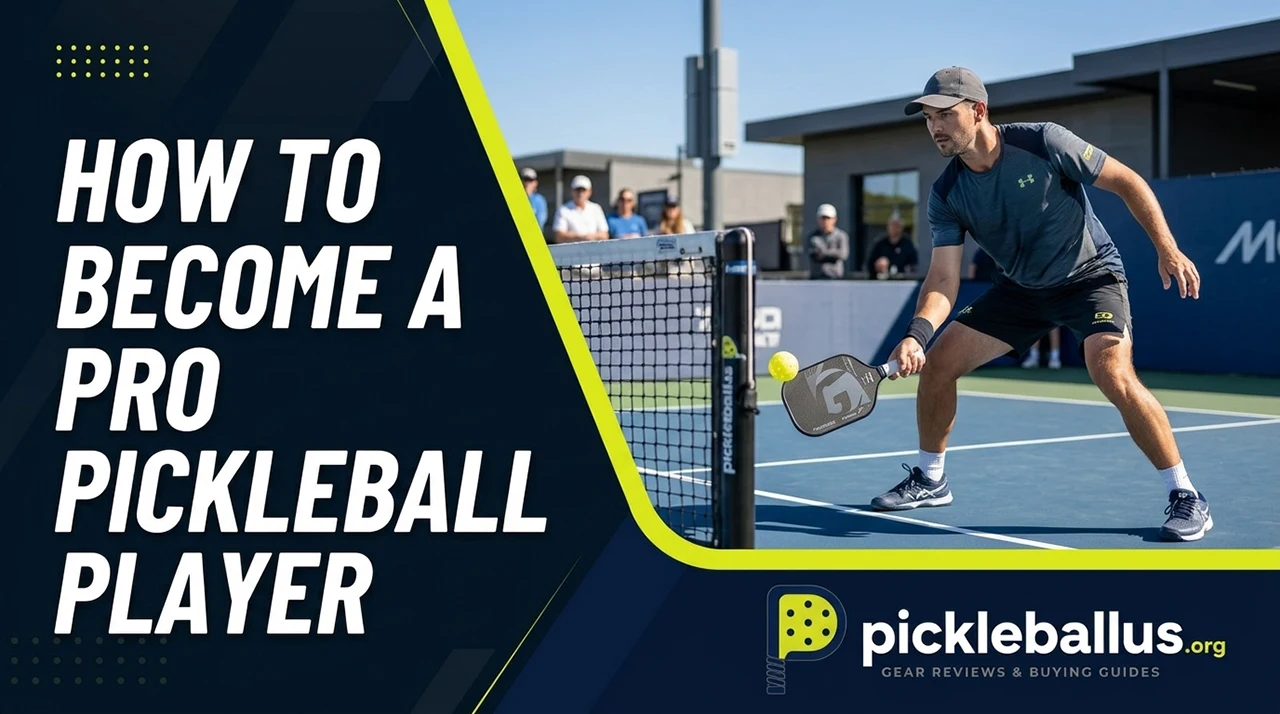
What Does It Actually Mean to Be a Pro Pickleball Player?
A professional pickleball player competes in sanctioned open-division events, earns prize money from tournament results, and may hold a sponsorship agreement with a paddle or apparel brand. The defining characteristic is not a high skill rating alone — it’s active competitive participation in the circuits that define the sport’s elite tier.
That distinction matters because many recreational players conflate “playing at a high level” with “going pro.” You can be a 4.5 player who wins local tournaments every weekend and still be a decade away from professional readiness. The professional level demands consistency across long matches against opponents who make almost no unforced errors, maintain elite-level shot selection under pressure, and arrive at every tournament as a prepared, conditioned athlete.
DUPR Rating — The Universal Skill Benchmark
DUPR (Dynamic Universal Pickleball Rating) is the primary rating system used by professional circuits to assess a player’s skill level. It runs on a 2.0 to 8.0 scale, calculates your score based on outcomes in registered tournament matches and organized games, and updates in near real-time as you compete.
Unlike older self-assessment systems, DUPR is results-based — your rating moves up or down based entirely on how you perform against rated opponents. This makes it a more reliable predictor of competitive level than any badge or certification. Sanctioned tournaments use it to bracket players fairly, and professional circuits reference it as a baseline for entry eligibility.
Amateur vs. Professional — Where the Line Is Drawn
The gap between a strong amateur and a touring pro is most visible in three areas: shot execution under fatigue, mental composure during close matches, and the quality of their weakest shot. Amateur players, even excellent ones, usually have a clear vulnerability — a weak backhand, inconsistent resets at the kitchen line, a shaky third-shot drop under pressure. Pro players have fewer of those holes, and the ones they have are small enough that opponents can’t reliably exploit them.
At the professional level, a single weak pattern becomes a playbook for your opponent. Matches are long, opponents are analytically sharp, and fatigue amplifies every technical flaw you haven’t eliminated. Reaching that standard takes more than practice time — it takes targeted gap-closing over an extended period.
What DUPR Rating Do You Need to Go Pro?
A DUPR rating of 5.0 is the commonly cited minimum for pro-track consideration, but most players competing seriously at the APP Tour open division operate at 5.5 or higher. Top PPA Tour regulars typically hold ratings between 6.0 and 8.0. The 5.0 benchmark is a floor, not a destination.
The answer depends on which part of the professional ladder you’re targeting. Entry-level pro events and open-division APP tournaments are accessible at 5.0–5.5 with strong tournament results. The upper tier of the PPA Tour and the team format of Major League Pickleball requires a different level entirely — one where even an 8-second stretch of passive play in a dinking rally can hand the point to your opponent.
How DUPR Is Calculated
DUPR calculates your rating from the results of every registered game you play, weighting outcomes based on the DUPR gap between you and your opponent. Beating a player with a higher rating moves your score up more than beating someone at your level. Losing to a lower-rated player carries a stronger downward effect than losing to someone rated above you.
This system rewards you for punching up. Consistent wins against stronger opponents accelerate your rating growth far faster than stacking wins against similar or weaker players. The implication is clear: playing up — entering brackets where you’ll face better competition — builds your DUPR faster than dominating your own skill tier.
The 5.0 Threshold vs. the 5.5+ Reality
Reaching 5.0 DUPR is the point at which your skill level becomes legible to tournament directors and sponsors, but real competitive viability begins at 5.5. Players in the 5.0–5.4 range compete in open divisions but frequently lose to 5.5+ opponents in ways that reveal still-fixable technical gaps. The 5.5 mark is where most coaches, sponsors, and circuit directors begin to pay serious attention.
The following table shows how DUPR ranges map to competitive tiers in the current professional landscape:
| DUPR Range | Competitive Context |
|---|---|
| 4.0 – 4.4 | Strong club player; inconsistent in open-level tournaments |
| 4.5 – 4.9 | Competitive amateur; can hold ground in regional open brackets |
| 5.0 – 5.4 | Entry-level pro; eligible to compete in APP open events |
| 5.5 – 5.9 | Touring amateur / emerging pro; sponsored player territory |
| 6.0+ | Established touring professional; regular PPA/MLP presence |
How to Actively Grow Your DUPR Score
Growing your DUPR requires registering every competitive game in the system and consistently scheduling matches against players rated above your current level. Casual games that go unregistered do nothing for your rating — every session with competitive intent should be logged.
Beyond registration, the fastest DUPR gains come from structured play against 5.0+ opponents rather than drilling alone. How to increase pickleball DUPR rating is a process of deliberate exposure — find the strongest local open-play sessions, enter open-bracket tournaments above your rating tier, and track your point patterns after every match to identify what you’re consistently losing on.
How to Build a Pro-Level Skill Set
Pro-level skill is built through structured drilling, expert coaching, and a deliberate focus on eliminating the weaknesses that match analysis reveals. Logging hours on the court is necessary but not sufficient — the shape of those hours matters more than the total count.
Most serious players who stall below 5.0 spend too much court time in casual rallies that reinforce existing habits rather than drilling patterns that challenge and change them. The shift from advanced amateur to emerging professional is largely a shift in how you allocate your practice time.
The Core Four — Serve, Dink, Third-Shot Drop, Reset
The four foundational shots that define readiness for the professional level are the serve, the dink, the third-shot drop, and the reset. Every professional pickleball player has made these so automatic that they execute cleanly under fatigue and match pressure. For most aspiring pros, one or two of these remain technically inconsistent — and that inconsistency is where matches are lost.
The serve at the professional level is not merely about keeping the ball in — it’s about placement, spin variation, and using the serve to set up the third-shot. The dink requires touch so precise that you can redirect the ball at odd angles while absorbing pace from an aggressive opponent. The third-shot drop is the most difficult shot in the game to master under pressure. The reset — returning a hard-driven ball softly into the kitchen — is the shot that most 4.5 players have yet to make reliable.
Work on each of these in isolation before integrating them into live play. A session dedicated entirely to third-shot drop drilling from both sides will produce more DUPR-relevant improvement than two hours of casual games.
The 2:1 Drill-to-Play Ratio (and Why Most Players Ignore It)
At the stage where you’re seriously pursuing the pro level, you should be drilling two to three times more than you’re playing match games. This ratio is counter-intuitive for players who fell in love with the game through competitive play, but it reflects how skill gaps close at elite levels.
Match play reinforces your current habits — both the good ones and the bad ones. Drilling breaks the bad ones by isolating specific movements and patterns until the correct version becomes automatic. Players who reverse this ratio — playing six days a week and drilling one — tend to plateau hard once they reach the 4.5–5.0 range because their errors have been grooved into their muscle memory.
The most effective drilling combines solo repetitions, two-person feeding drills, and structured live-ball sequences. Pickleball drills at the 4.5+ level should include dink consistency work, reset-under-pressure sequences, and erne approach footwork — not just feeding serves and rallying crosscourt.
Hiring a PCI-Certified Pickleball Coach
A certified coach, particularly one credentialed through Pickleball Coaching International (PCI), brings an objective outside eye that players cannot replicate through self-assessment. You cannot fully see your own footwork gaps, your grip pressure under stress, or the shot selection patterns you default to when points get tight. A qualified coach can.
The investment in structured coaching pays off fastest when you use sessions to work on your weakest areas, not to confirm your strengths. Bring match footage. Ask the coach to identify the three patterns your opponents are most likely to exploit. Build your drilling schedule around fixing those patterns before your next tournament cycle.
Many elite coaches now run remote video analysis sessions, making high-quality feedback accessible regardless of your geographic location. Some professional players also run clinics and camps — direct exposure to pro-level guidance in an immersive format that accelerates development faster than weekly lessons alone.
Advanced Shots That Separate 4.5 from 5.0+
The shots that most clearly separate 4.5 amateurs from 5.0+ emerging pros are the erne, the snap volley, and the offensive speed-up from the kitchen. These are not trick shots — they are tactical weapons that professional players deploy selectively to disrupt an opponent’s rhythm and force errors.
The erne requires precise footwork and anticipation to execute legally, jumping outside the kitchen to attack a cross-court dink before it crosses the sideline. The snap volley generates sudden pace from a soft exchange and punishes any dink that sits up even slightly above net height. The speed-up initiates an attack from a position where your opponent expects another patient dink exchange.
Developing these shots takes months of deliberate drilling before they’re reliable enough to use in match situations. Pair them with the study of professional match footage to understand when top players choose these options and why. For more on the shot mechanics and tactical patterns that define this tier, pickleball advanced tips covers the specific situations where each advanced shot creates the most leverage.
The Tournament Pathway — From Local Clubs to Pro Circuits
The tournament pathway to the professional level follows a clear progression: local sanctioned events → regional open divisions → national open events → APP Tour open divisions → PPA Tour qualifiers. Skipping stages accelerates DUPR exposure but at the cost of competitive experience and match toughness that only comes from sustained tournament play.
Most players who enter professional circuits before their game is genuinely ready leave more discouraged than prepared. The progression exists for a reason — each stage builds the mental and technical resilience required for the one above it.
Local and Regional Sanctioned Events (the Foundation)
Begin with USA Pickleball-sanctioned local tournaments in your region, competing in the open age-group or open-skill bracket that puts you against the strongest available competition. The gold bracket at most regional tournaments features 4.5+ players who compete regularly and have developed tournament-specific habits — composure on big points, efficient serve return patterns, strategic adjustments mid-match — that club play rarely teaches.
Register your results in DUPR from the start. Every registered outcome builds your rating profile and creates a verifiable competitive record that tournament directors and potential sponsors can review.
National Open Events — Your First Real Test
National open events hosted by USA Pickleball and the Association of Pickleball Professionals (APP) expose you to a higher baseline of play than even strong regional competition provides. At these events, the open division typically includes 4.5–5.5 players, with serious touring amateurs and emerging pros across the bracket.
Your first few national events will likely result in early-round exits. That’s not a sign to retreat — it’s data. Review what you lost on, which patterns your opponents exploited, and how your execution changed in the third game of a long match. That information should shape the next training cycle.
APP vs. PPA vs. MLP — Which Tour to Target First
The APP Tour is the most accessible entry point into professional competition, hosting open-division events that allow skilled amateurs to compete alongside emerging and established professionals in the same bracket format. Entry is straightforward for players with sufficient DUPR and event registration.
The PPA Tour operates a tiered structure with pro draws, select amateur draws, and age-based categories. Earning consistent results in the APP open division builds the competitive profile and DUPR score needed to move toward PPA-level consideration. Major League Pickleball uses a draft system for team-based competition and is most accessible to players already established on the APP or PPA circuit.
The table below outlines the basic entry profile for each circuit:
| Circuit | Entry Model | Primary Audience |
|---|---|---|
| APP Tour (open division) | Open registration; DUPR benchmarks apply | 4.5–5.5 serious amateurs and emerging pros |
| PPA Tour | Pro draw + select amateur events | 5.5+ competitive players; established pros |
| Major League Pickleball | Draft-based team format | Established touring professionals |
For more on building the competitive habits needed to perform in these events, pickleball competitive tips covers the tactical and mental patterns that high-level tournament play rewards.
Physical Conditioning for Pro-Level Pickleball
Professional pickleball demands a level of athletic preparation that most recreational players underestimate. The combination of explosive lateral movement, sustained hand speed over long three-game matches, and the mental sharpness required during extended dinking exchanges places real demands on a player’s fitness base. Arriving at tournaments physically unprepared becomes apparent by the end of Day 1.
Training Volume — Breaking Down a 12–20 Hour Week
Serious pro-track players commit to 12 to 20 hours of total training per week, distributed across on-court drilling, match play, off-court conditioning, and recovery. That breakdown typically looks like this:
| Training Type | Weekly Hours (approx.) |
|---|---|
| Drilling (structured) | 5–7 hours |
| Match play / competitive games | 3–4 hours |
| Strength & conditioning | 2–4 hours |
| Footwork & agility work | 1–2 hours |
| Recovery (stretching, mobility) | 1–3 hours |
The players who sustain this training load without injury are the ones who take recovery as seriously as the active sessions. Neglecting mobility work, sleep quality, and off-day nutrition is how careers plateau or end prematurely.
Lateral Movement, Strength, and Recovery Work
Pickleball-specific conditioning focuses on lateral quickness, core stability, and the explosive hip rotation that drives shot power and precision. Unlike sports that emphasize straight-line speed, pickleball demands repeated short bursts of lateral movement, quick direction changes at the kitchen line, and the stability to hold a wide defensive stance during extended exchanges.
Resistance band lateral walks, lateral plyometric drills, and rotational core work translate onto the court immediately. Strength training for pickleball does not require a bodybuilder’s training block — focused sessions two or three times per week, targeting the legs, core, and rotator cuff, produce the athletic foundation the game demands. If you’re currently at the 4.5 level and building toward 5.0+, how to improve pickleball from 4.0 to 4.5 covers the skill and physical benchmarks where that transition typically stalls.
Is Going Pro Realistic for You?
Going pro in pickleball is realistic for dedicated players who start structured development early, train with direction rather than volume alone, and commit to a 2–4 year improvement arc. It is not realistic for players who approach it casually, who resist coaching feedback, or who expect talent to substitute for structure.
The sport’s growth has created a wider professional ecosystem than existed five years ago — but it has also raised the competitive floor. The baseline quality of a 5.0 player today is higher than it was in 2020. The bar is clear; the question is whether you’re positioned to clear it.
The Timeline — 2 to 4 Years for Most Serious Players
Most players who reach the professional level with structured intent take two to four years from their starting point of strong intermediate play (3.5–4.0) to their first legitimate pro-level competitive appearances. Players with strong tennis, racquetball, or table tennis backgrounds sometimes progress faster — their existing hand-eye coordination, footwork patterns, and competitive experience compress the early phases.
Speed of progression matters less than consistency of direction. Players who plateau for six months and then break through after a coaching adjustment often end up at the same 4-year mark as players who improved steadily. The plateau is normal; the response to it is the variable.
Athletic Background, Age, and the Variables That Matter
Athletic background is an accelerant, not a prerequisite. Players with racquet sport experience transfer footwork patterns, shot mechanics, and competitive composure faster than those coming from non-racquet sports. But pickleball’s specific skills — the dink game, the kitchen line battle, the third-shot drop under pressure — require dedicated development regardless of prior athletic history.
Age is a real variable but a less decisive one than most aspiring players assume. Pickleball’s relatively low-impact movement demands and the primacy of technique and strategy over raw athleticism mean that players in their 30s, 40s, and even 50s compete at the professional level. What age affects more than physical performance is recovery time — which makes the conditioning and sleep habits described above even more important for older players building toward pro competition.
By now you have a realistic picture of the skill standards, training demands, and competitive pathway that define professional pickleball — from where your DUPR needs to be to how your weekly calendar needs to look. What most guides stop there and miss is what the professional level actually looks like once you arrive: how players sustain themselves financially, what separates those who stay on tour from those who burn out after one season, and the mental demands that hit hardest when the stakes are real. The next section goes into those details — the parts that only matter after you’ve earned your spot.
What Professional Pickleball Actually Looks Like Off the Court
Professional pickleball is not yet a sport where prize money alone sustains most players financially. The economics require diversification — and the players who build long, stable careers at the pro level treat themselves as small businesses as much as they treat themselves as athletes.
Revenue Streams — Prize Money, Coaching, Clinics, and Content
Prize money from APP and PPA Tour events varies widely by bracket and draw size, with top-tier PPA event winners earning significant payouts and mid-level competitors earning more modest returns. The income gap between the top-ranked pros and the rest of the professional field is substantial.
Most professional players supplement prize money through private coaching, group clinics, and increasingly through content creation — YouTube channels, instructional courses, and social platforms that build audiences around their playing brand. Coaches who compete professionally often find that their playing credential drives demand for their coaching services, creating a reinforcing loop where competitive visibility builds a business.
The players who build sustainable careers are deliberate about developing these revenue streams before they need them, not after.
Sponsorships and Gear Deals — How Players Get Them
Sponsorship conversations typically begin when a player reaches the 5.5+ DUPR range and has a verifiable national tournament record that brands can point to. The Selkirk Emerging Pros program is one of the most structured sponsorship pathways in the sport — it requires a high DUPR application score and a demonstrated competitive history, and it provides equipment support and exposure for players on the trajectory toward the professional tier.
Most gear sponsorships at the emerging-pro level begin with paddle and equipment agreements rather than financial contracts. Players receive preferred equipment, sometimes in exchange for tournament-branded wear and social promotion. As competitive results and audience size grow, the financial components of sponsorship deals tend to follow.
The Mental Game at the Professional Level
The mental demands of professional competition are the least-discussed and most underestimated factor in whether players who reach the pro level stay there. At the club and amateur level, mental errors — a long run of frustration after an error, passive play after a close game loss — cost points but rarely determine match outcomes against weaker competition. At the professional level, composure under pressure is a technical skill, one that opponents have developed and will exploit.
Working with a sports psychologist, developing a pre-point routine, and building structured approaches to error recovery are the investments that separate players who compete professionally for one season from those who build multi-year careers. The mental game is trainable. Most players never train it.


Write Your Review
No reviews yet. Be the first to share your experience!