How to Choose a Pickleball Net: Frame, Mesh, and Size Explained
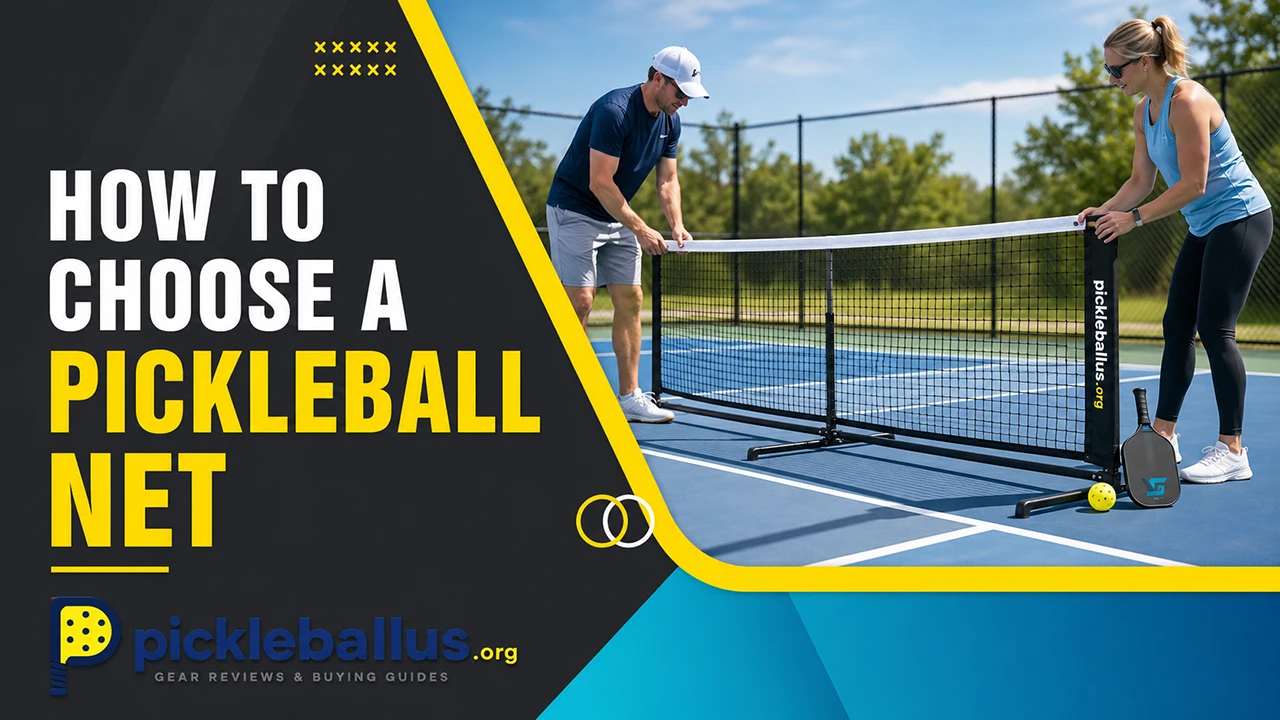
Choosing the right pickleball net comes down to five core decisions: net type (portable vs permanent), frame material, mesh quality, regulation compliance, and how easily it sets up in your specific playing environment. Get those five right and the rest falls into place — get them wrong and you’ll be back shopping within a season.
The gap between a net that holds tension through hundreds of games and one that sags after six months isn’t luck. It’s frame construction, mesh material, and knowing what specs actually matter for how you play. A few key details — especially official dimensions and how the tension system works — separate nets that perform consistently from ones that frustrate you at the worst moments.
Most buyers split their decision on one major axis: portability. Whether you’re setting up in a driveway, a gym, or a permanent backyard court changes everything about which net makes sense. That single question shapes almost every other feature worth comparing, from frame weight to how the net anchors.
Below is a full breakdown of every factor that matters when picking a pickleball net, starting with the fundamentals and moving toward the details that separate average nets from ones that hold up long-term.
What Is a Pickleball Net?
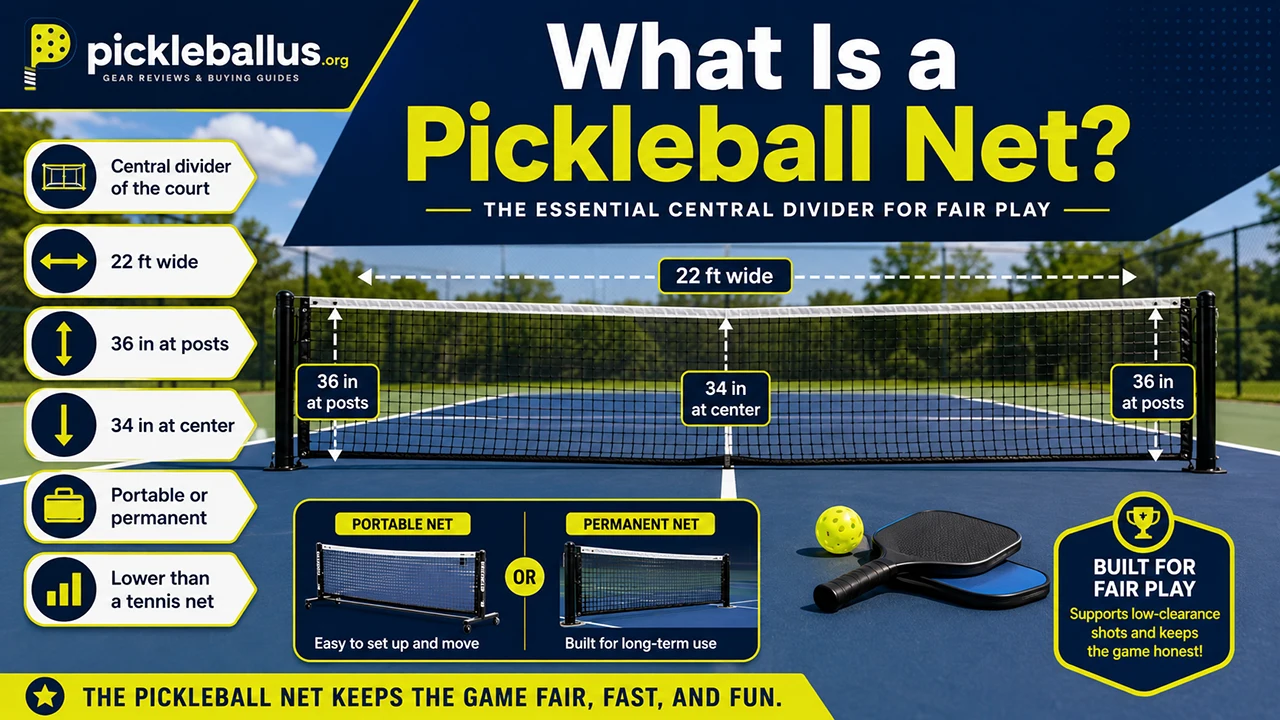
A pickleball net is the central dividing structure of any pickleball court — a rectangular mesh panel suspended between two posts, stretched taut by a tensioning system, and held at a specific height by a center strap. The net defines the playing field, forces low-clearance shots that are central to the game’s strategy, and must meet precise dimensions to ensure fair play.
Unlike a tennis net, which is higher and wider, a pickleball net is shorter at the center (34 inches vs tennis’s 36 inches) and spans a narrower court (22 feet vs 36 feet). That lower center clearance is why the kitchen game in pickleball — soft dinks over the middle of the net — is so strategically dominant. A net that sags even an inch below regulation height changes that dynamic in ways that matter to any player past the beginner stage.
Pickleball nets come in two broad forms: portable systems that assemble and break down quickly, and permanent fixtures anchored to the ground. Each serves a different type of player and playing environment, and the choice between them is one of the first decisions worth locking in before you evaluate anything else.
What Are the Official Dimensions of a Pickleball Net?
USA Pickleball (USAP) and the IFP require nets to measure 22 feet wide, 36 inches tall at the sideline posts, and 34 inches tall at the center — and understanding why those numbers differ matters for anyone buying a net intended for competitive or semi-competitive play. You can find the full breakdown in the pickleball net official specifications guide, but here’s what you need before purchasing.
Net Height — Center vs Sidelines
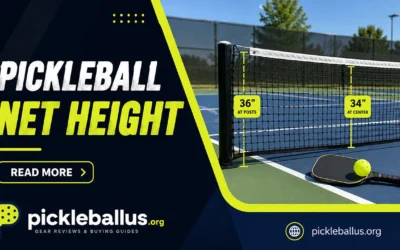
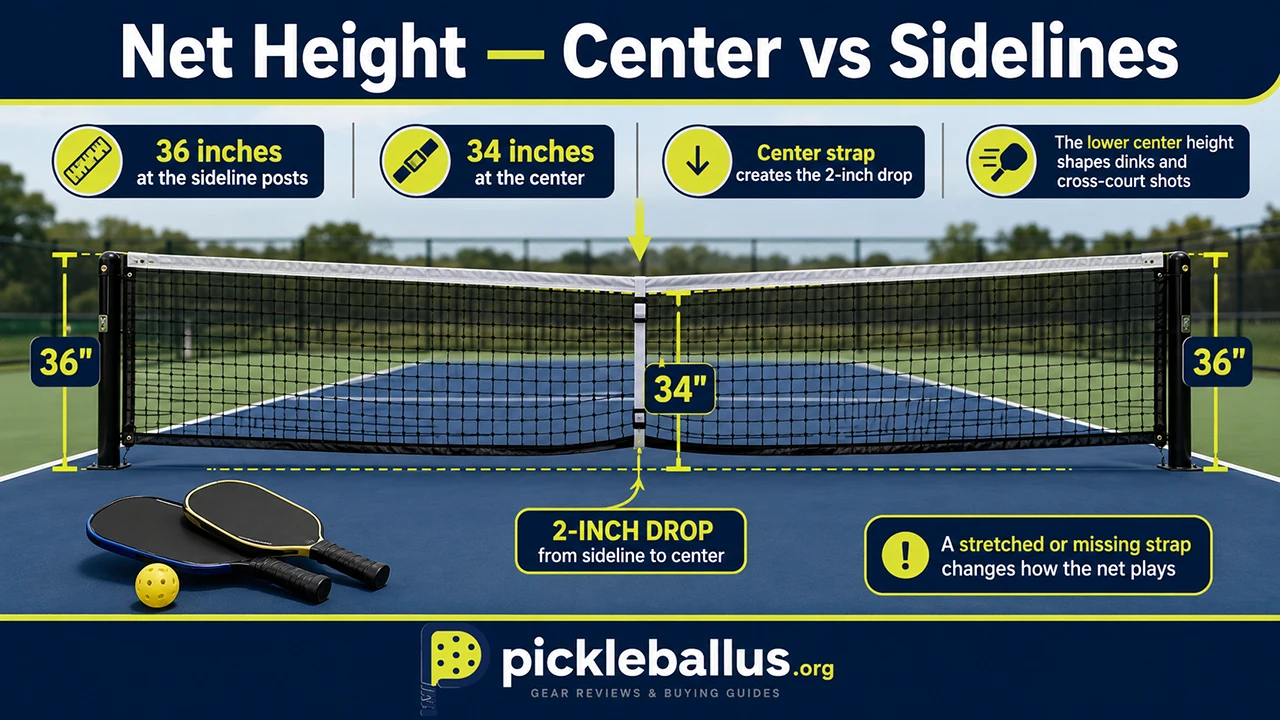
The net stands 34 inches at the center and 36 inches at the sideline posts, with the two-inch difference created by a center strap that pulls the net down slightly at its midpoint. That lower center point is deliberate — it creates the highest-percentage path for cross-court shots and dinks, and is fundamental to how pickleball’s rally structure works.
For a deeper look at how height affects court setup and what happens when nets are misconfigured, see pickleball net height and dimensions. A net without a center strap — or one with a low-quality strap that stretches over time — will lose that 34-inch center height and affect every shot played over the middle.
Net Width, Post Placement, and Center Strap
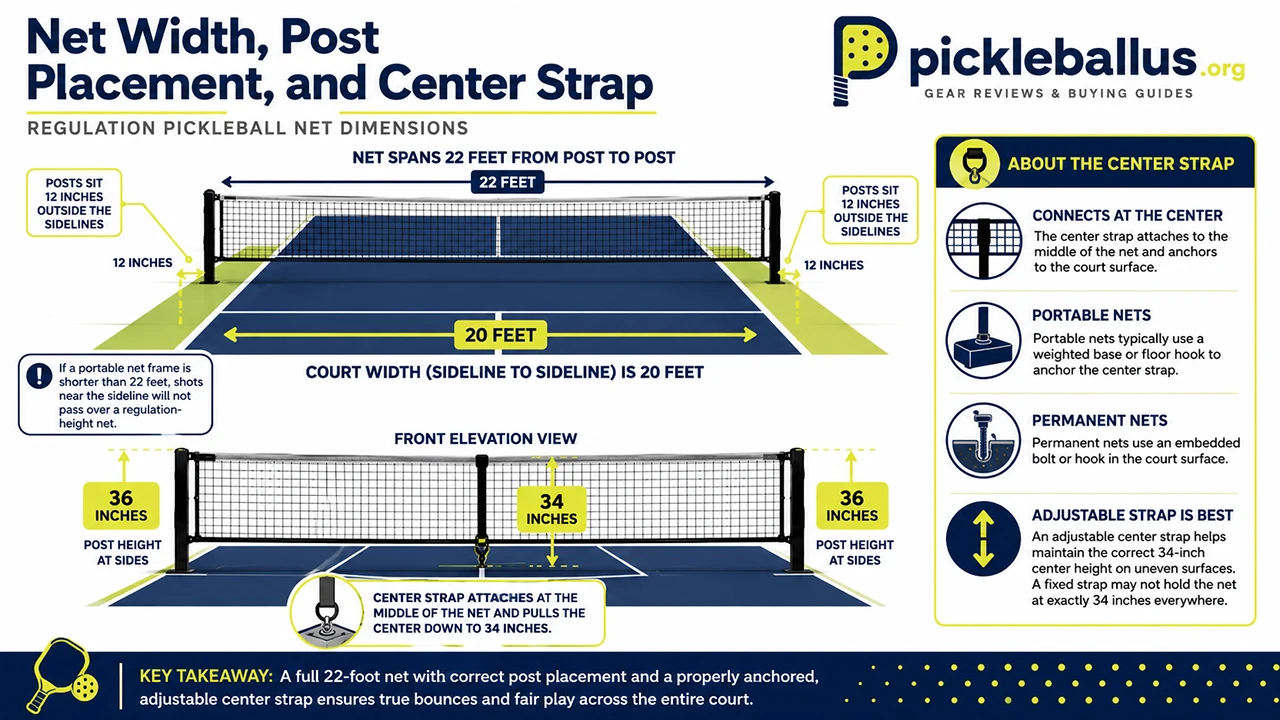
The net spans 22 feet from post to post, with posts positioned 12 inches outside the sidelines of the 20-foot court. That post placement matters: if a portable net’s frame is shorter than 22 feet, shots near the sideline won’t pass over a regulation net height, creating an uneven playing surface.
The center strap attaches to the middle of the net and connects to a small anchor point at the court surface. On portable nets, this anchor is typically a weighted base or a floor hook. On permanent nets, it’s a bolt or hook embedded in the court. A center strap that allows adjustment is worth prioritizing — courts and surfaces aren’t always perfectly flat, and a fixed strap may not hold the net at exactly 34 inches in every location.
Portable vs Permanent Pickleball Net — Which One Is Right for You?
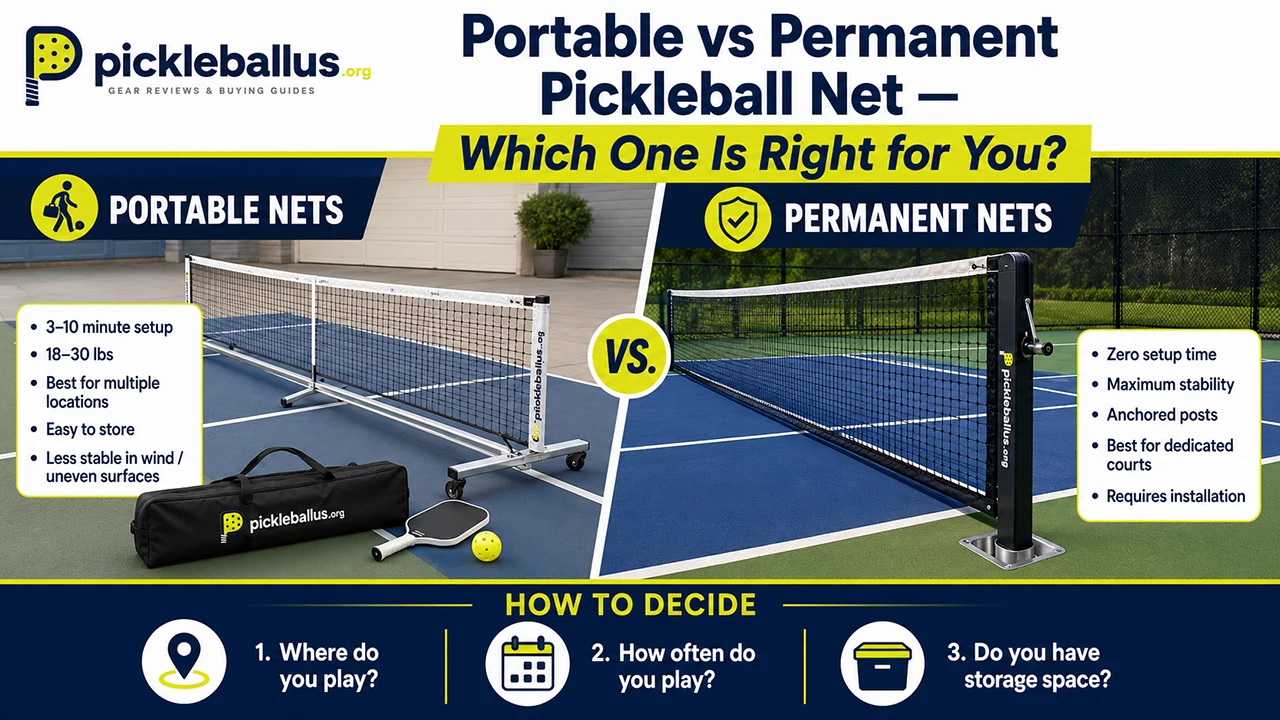
A portable net works best if you play in multiple locations or need to store the net between sessions; a permanent net is the right call if you have a dedicated court and want zero setup time. For a detailed side-by-side breakdown, portable vs permanent pickleball nets covers each type’s structural tradeoffs in full. Here’s how to think through the decision quickly.
Portable Nets — Setup Speed, Weight, and Where They Work Best
Portable pickleball nets use lightweight aluminum frames that assemble in three to ten minutes without tools, making them the default choice for players who set up on tennis courts, driveways, gym floors, or any flat surface that isn’t a dedicated pickleball court. Most portable systems fold down into a carrying bag with shoulder straps or wheels, and the better ones weigh between 18 and 30 pounds — light enough for one person to carry from a car.
The tradeoff is stability. Portable frames rely on tension from the net itself and weighted feet (or bungee cord systems) to stay in position. On uneven asphalt or windy outdoor courts, lower-quality portable nets can drift or tip mid-rally. For well-built options that hold position reliably, the best portable pickleball net roundup covers frames tested in real playing conditions.
Permanent Nets — Stability, Anchoring, and Facility Use
Permanent pickleball nets use steel or heavy-gauge aluminum posts sunk into ground sleeves, delivering tournament-level stability that no portable system can fully match. Once installed, they require no assembly — which matters enormously if your court sees daily use. The net height is set once and stays there. There’s no drift, no tipping in wind, and no need to check that the frame is square before every session.
The limitation is obvious: permanent nets don’t move. They require a dedicated court with installed ground sleeves, which means they’re primarily for backyard courts, school facilities, or recreation centers. Installation typically involves concrete footings and professional or semi-professional setup. For players committed to a fixed court, the best permanent pickleball net options include systems designed for both residential and facility-grade use.
How to Decide Based on Your Playing Environment
Three questions help narrow the choice:
1. Where do you play? If you play at public tennis courts, a gym, or rotate between locations, a portable net is the only practical option. If you have a dedicated concrete or asphalt pad at home, a permanent net is worth considering.
2. How often do you play? Players who set up three or more times per week often find that even a well-built portable net’s assembly time adds up. A permanent net eliminates that friction entirely.
3. Do you have a storage solution? Portable nets need a dry storage space — a garage, shed, or car trunk. If a portable net will be left outside long-term, it will degrade faster than the frame was designed for.
What Materials Should a Pickleball Net Be Made Of?
Net quality depends on two material decisions: what the mesh is woven from and what the frame is built of — and those choices have very different implications for durability, weight, and how the net handles outdoor conditions.
Net Mesh Material — Nylon, Polyester, and Polypropylene
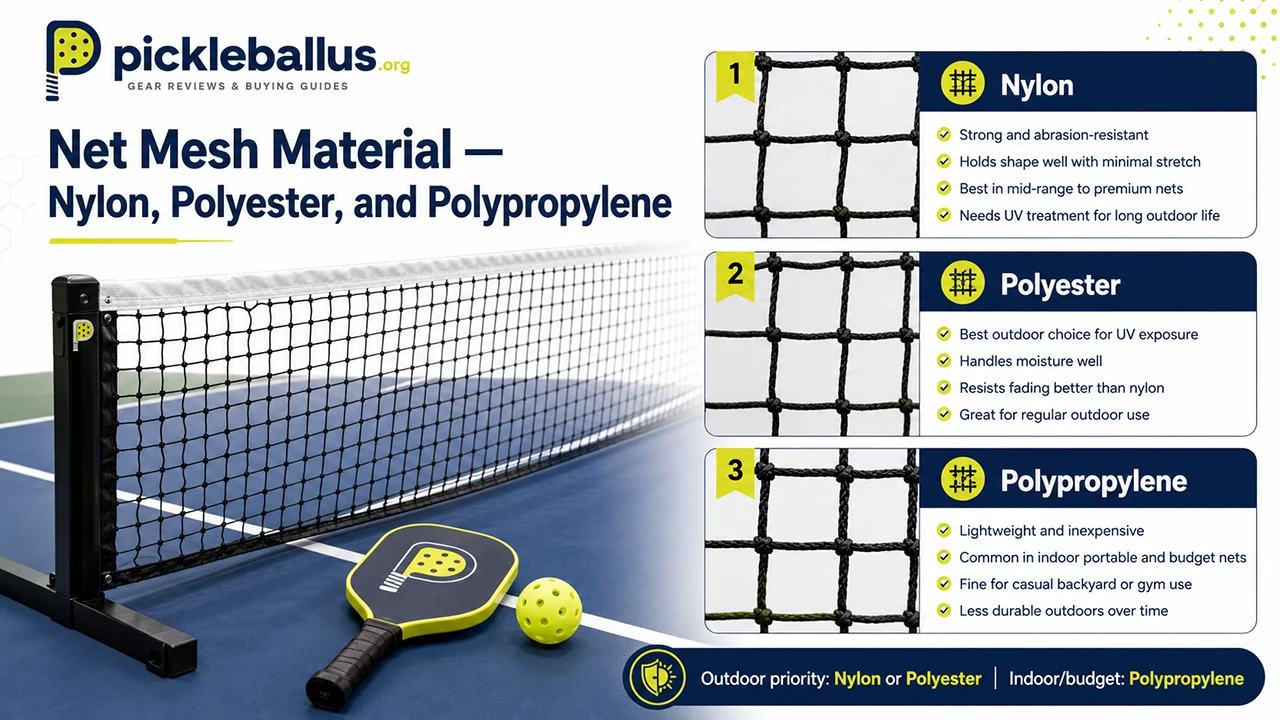
The three most common mesh materials each have a distinct performance profile:
Nylon is the most widely used material in mid-range to premium nets. It’s strong, resists abrasion well, and holds its shape over time without significant stretch. The limitation is UV sensitivity — over months of sun exposure, untreated nylon weakens and becomes brittle. Higher-quality nylon nets add UV stabilizers to extend outdoor lifespan.
Polyester is the better outdoor choice when UV exposure is a concern. Polyester has inherently higher UV resistance than nylon and handles moisture better, making it the preferred mesh material for nets that will spend significant time outdoors. It’s also less prone to color fading, which matters for tournament-grade nets.
Polypropylene is primarily used for indoor portable nets and lower-price entry-level options. It’s lightweight and inexpensive, but its outdoor durability is limited — prolonged sun and weather exposure degrades it faster than nylon or polyester. For casual backyard use or gym-only setups, polypropylene mesh nets work fine. For anything used outdoors regularly, prioritize nylon or polyester.
Frame Material — Aluminum vs Steel
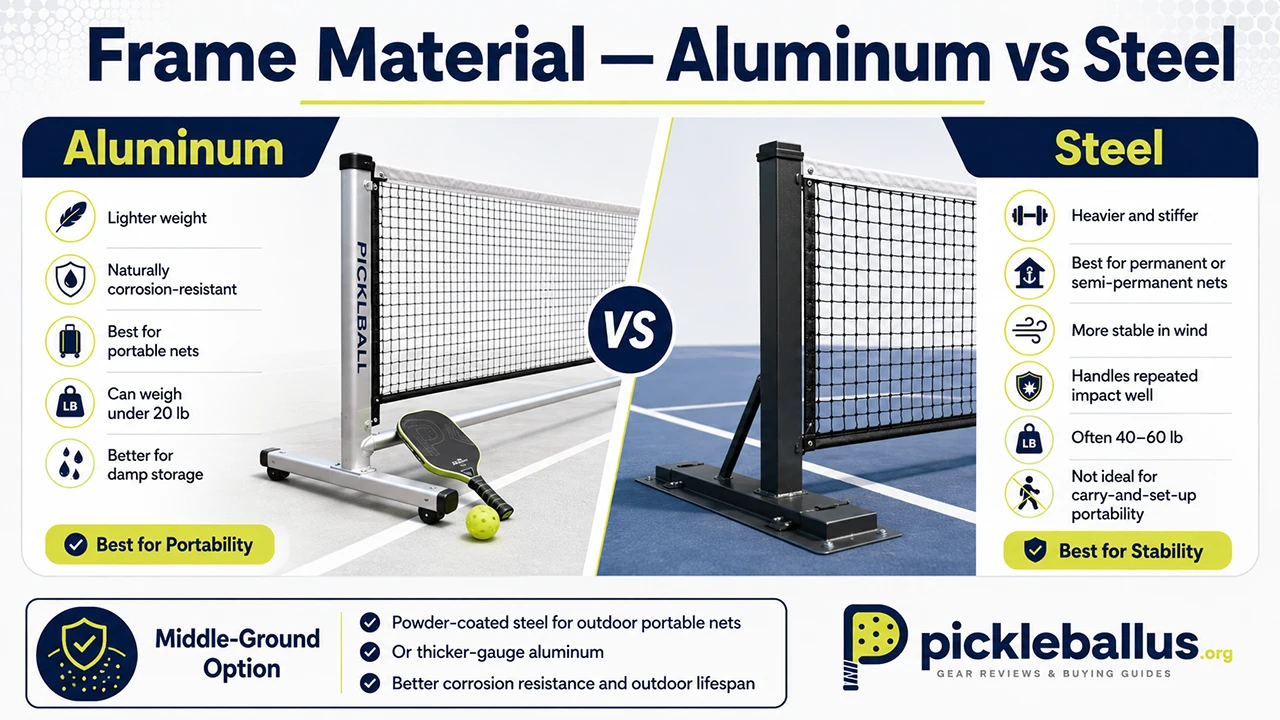
Aluminum frames are lighter, naturally corrosion-resistant, and the right choice for portable nets. The lower density of aluminum means a portable net with an aluminum frame can weigh under 20 pounds while still providing a rigid, square structure. Because aluminum doesn’t rust, it tolerates damp storage conditions better than steel.
Steel frames are heavier, stiffer, and the preferred material for permanent or semi-permanent nets where ground anchoring provides the stability that steel’s weight isn’t providing alone. A steel-framed net won’t flex in wind the way a light aluminum frame might, and it handles repeated high-impact ball contact without micro-deformations over time. The tradeoff is weight — steel-framed systems often run 40 to 60 pounds, making them impractical as carry-and-set-up portable solutions.
A middle-ground option exists: powder-coated steel frames for outdoor portable nets. The powder coating adds corrosion resistance and extends the frame’s outdoor lifespan significantly. If portability matters but you’re playing outdoors, a powder-coated steel or thicker-gauge aluminum frame is worth the extra weight.
6 Key Factors to Check Before Buying a Pickleball Net
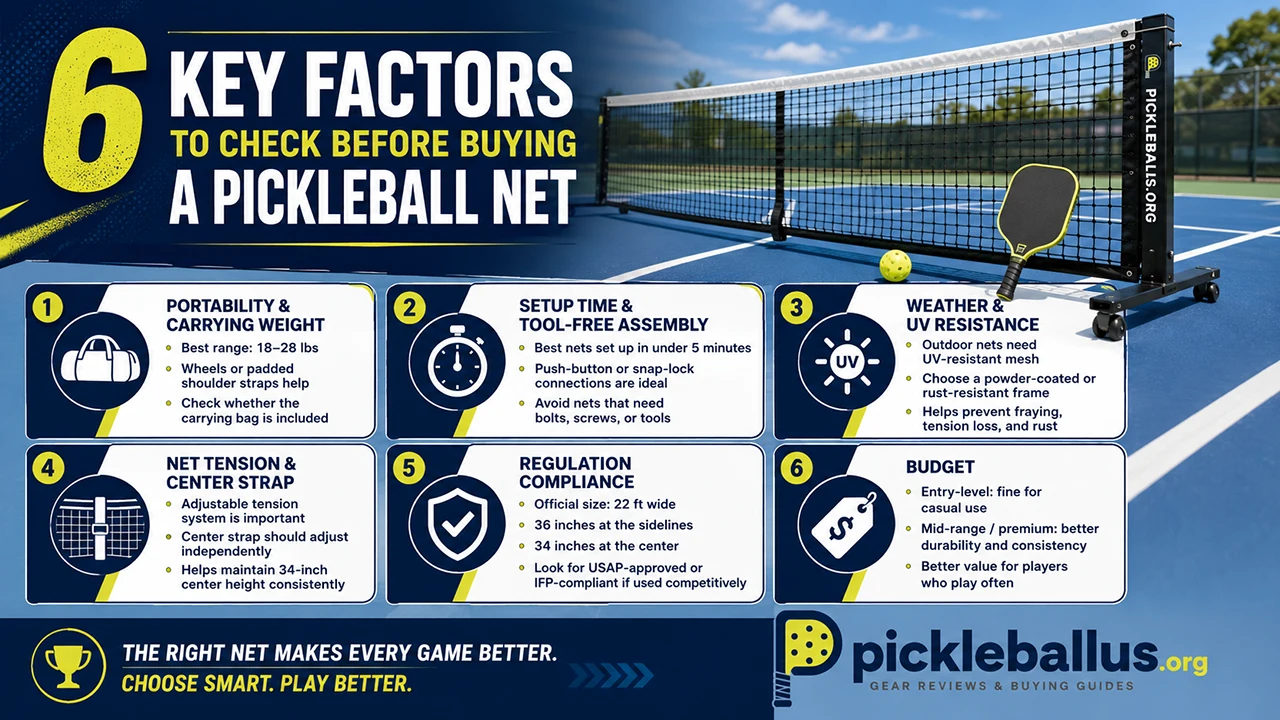
The following six criteria separate nets that perform consistently from ones that look good on a spec sheet but disappoint in use.
Portability and Carrying Weight
The most useful portable nets weigh between 18 and 28 pounds and pack into a bag with wheels or padded shoulder straps. Above 30 pounds, carrying solo from a car to a court becomes genuinely uncomfortable across the length of a season. Check whether the carrying bag is included in the listed price — some budget nets charge extra for it.
Setup Time and Tool-Free Assembly
The best portable nets assemble in under five minutes using push-button or snap-lock frame connections that require no tools. Nets that require hardware (bolts, screws, a wrench) are slower to set up and add friction that discourages use. If you plan to set up before every session and break down after, tool-free assembly isn’t a convenience feature — it’s a requirement.
For a full walkthrough of how portable net setup actually works in practice, how to set up a portable pickleball net covers the assembly sequence step by step.
Weather and UV Resistance for Outdoor Play
Outdoor nets need UV-treated mesh and powder-coated or rust-resistant frames — these two features together determine how long a net lasts outside. An untreated nylon net left in direct sun for a full summer will often show fraying and tension loss by fall. Frames without corrosion-resistant coating develop rust at connection joints within one to two seasons in humid or wet environments.
Look for nets that explicitly state “UV-resistant mesh” and “powder-coated frame” in their specifications. For nets used indoors exclusively, these features matter less and shouldn’t drive the purchase decision.
Net Tension System and Center Strap Quality
A net that can’t hold consistent tension will sag at the center and change the playing surface every rally. The best tension systems use a velcro-and-bungee or ratchet-style mechanism at the base of the frame that lets you adjust net tightness in seconds. The center strap should be adjustable independently of the overall net tension — this lets you hit exactly 34 inches at the center regardless of surface variations.
Test or check reviews specifically for how a net holds its tension over an extended session. Some budget nets hold tension fine when first assembled but loosen noticeably after 20 minutes of play as the frame shifts.
Regulation Compliance for Competitive Use
If you plan to host or enter tournaments, your net must meet USAP’s official dimensions — 22 feet wide, 36 inches at the sidelines, and 34 inches at center. Many recreational nets are slightly narrower (often 21 feet 9 inches) or use approximate heights that are close but not certified. For casual backyard play, the difference is negligible. For competitive or sanctioned use, verify that the net is explicitly USAP-approved or IFP-compliant.
Budget — Entry-Level to Premium
Entry-level portable nets in the budget tier cover casual recreational use and are worth considering for anyone testing pickleball before committing to better equipment. The tradeoffs are real — lighter mesh, less precise tension systems, and frames that may flex more than ideal — but for occasional play, they get the job done. For players who are already invested in the sport and play multiple times per week, a mid-range or premium portable net pays for itself in longevity and consistent performance. The best pickleball nets under $100 roundup covers well-tested options at entry price points.
By now you have a solid understanding of what separates a reliable pickleball net from one that sags, rusts, or collapses mid-game — regulation size, frame construction, mesh material, and use-case fit cover the core of every buying decision. Choosing a net is slightly more layered than those factors alone suggest, though, because the category has expanded to include setups built for specific situations most buying guides don’t address in depth. The next section looks at three of those narrower use cases: reduced-size training nets, rolling nets built for multi-court facilities, and how to recognize when an existing net has run its course.
Three Net Types Worth Knowing Before You Finalize Your Purchase
Half-Court Nets and Reduced-Size Training Setups
Half-court pickleball nets measure roughly 10 feet wide and are designed for solo drilling, skill training, or play in tight spaces where a full 22-foot net won’t fit. They’re particularly useful for players working on dinking accuracy, third-shot drops, or any drill that focuses on the NVZ side of the net. Because they’re smaller, they’re also among the lightest nets available — many fold flat and store in a standard equipment bag.
The limitation is obvious: they’re not suitable for full-game play. A half-court net is a training tool, not a court net. If you’re shopping for a net primarily to play games, this category isn’t your answer — but if you practice solo or have a limited setup space, it fills a gap that full-size nets can’t.
Facility Nets on Wheels — The Rolling Solution
Nets on wheels (often called roll-away or wheel-base nets) attach the standard net assembly to a base with lockable casters, allowing the entire system to be rolled off the court to a storage area without disassembly. This type is almost exclusively used in gyms, recreation centers, and multi-sport facilities where the same floor space hosts different sports at different times.
The setup is heavier and more expensive than standard portable nets, and the wheeled base isn’t designed for outdoor terrain. For facility managers who need to clear courts between programs, however, the time savings over repeated assembly and breakdown are significant. For individual players, this category is worth skipping unless you’re managing a shared facility.
Signs Your Current Pickleball Net Needs Replacing
A net past its useful life shows three clear indicators: visible mesh fraying or holes, a frame that no longer holds square, and a tension system that won’t maintain net height through a full session. Fraying mesh affects ball rebound and flight unpredictably; a bent or warped frame means the net height drifts from regulation across its width; and a tension system that loosens during play effectively changes the game’s rules mid-rally.
Rust at frame connection joints is a secondary warning sign — surface rust alone doesn’t necessarily mean the frame is structurally compromised, but rust that’s penetrated connection sleeves weakens the joint. If the frame wobbles at connection points that previously locked solid, the structural integrity is gone and replacement is the right call.
For guidance on when repair is worth attempting versus when replacement makes more sense, replacing a pickleball net covers both scenarios with practical criteria.