

24.3 million Americans played pickleball in 2025 — making it the fastest-growing sport in the United States for the fifth straight year. The SFIA 2026 Topline Participation Report, the most rigorous annual measure of US sports participation, places pickleball firmly in the top 25 most-played sports and activities in the country after recording a 479% expansion in just five years.
But understanding the full scope of pickleball growth in the United States requires more than one headline number. Two major research bodies — the SFIA and the Association of Pickleball Professionals (APP) — measure participation differently, and the gap between their figures (24.3 million vs. 48.3 million) matters because they answer fundamentally different questions about who counts as a player.
The sport’s demographic profile has also shifted in ways that surprised most observers. Five years ago, pickleball skewed heavily toward adults 55 and older. Today, over 70% of players fall between 18 and 44, and the average participant age sits at 34.8. A sport once associated with retirement communities has become the default recreational choice for working-age adults across every US region.
Below is a full breakdown: current player count, year-by-year growth, demographics, regional distribution, and what the numbers mean for the sport’s next chapter.
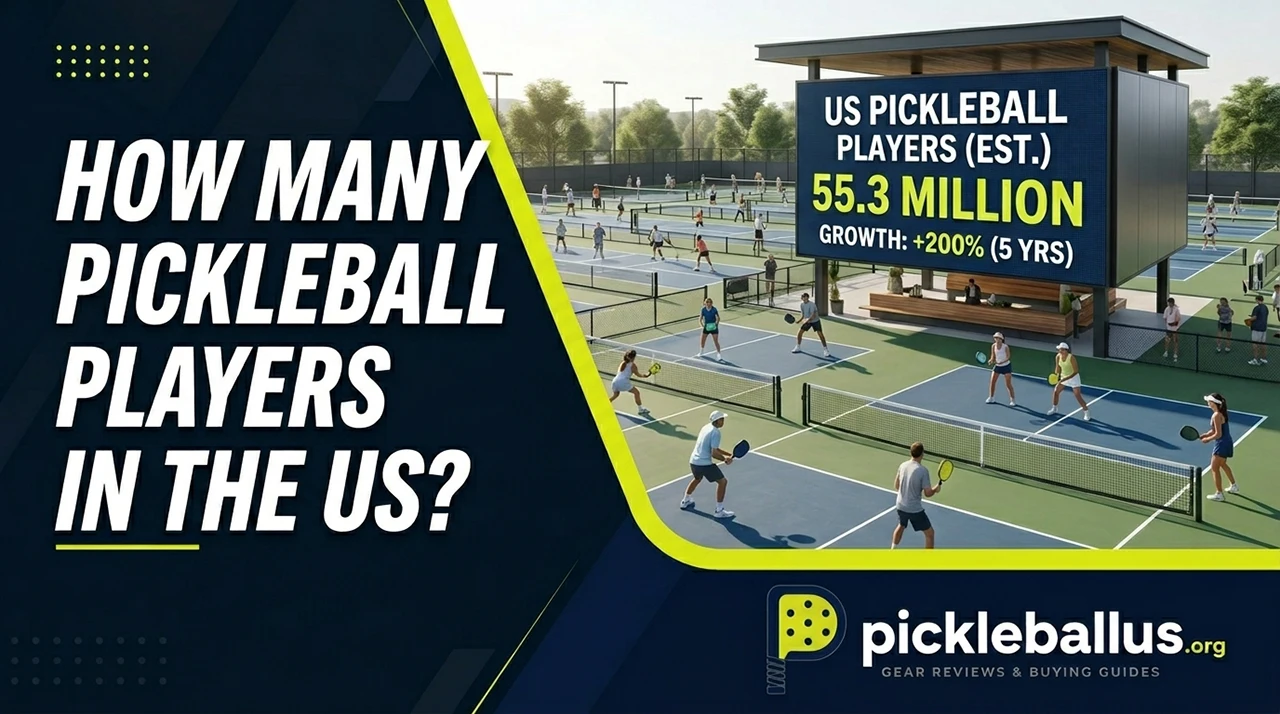
How Many People Play Pickleball in the US Right Now?
24.3 million Americans played pickleball in 2025, per the SFIA 2026 Topline Participation Report. That marks a 22.8% increase from 2024’s total of 19.8 million, and extends a streak of five consecutive years in which every US region recorded a net gain in participation.
For scale: 24.3 million exceeds the combined population of New York City and Los Angeles. It also surpasses total US participation in activities like recreational volleyball, skiing, and baseball. If you’ve been wondering what is pickleball and why everyone seems to be talking about it, those numbers tell the story as plainly as anything.
The SFIA tracks participation through a nationally representative household survey, applying the same methodology used for every other sport it monitors. Its threshold: playing the sport at least once in the calendar year.
SFIA vs. APP — Why the Numbers Look So Different
The APP reported that 48.3 million adult Americans played pickleball at least once in the preceding 12 months — nearly 19% of the total adult US population. Against SFIA’s 24.3 million, that’s a gap of over 24 million people.
The difference comes down to methodology and scope. The SFIA samples a fixed panel of US households annually using the same framework applied to every sport it tracks. The APP commissioned a broader consumer research study with a different sample population, counting all adults who recalled playing at any point in the prior year — including single-occurrence players at corporate events, school programs, or a neighbor’s backyard who may not self-identify as pickleball participants.
Neither number is wrong. The SFIA figure supports year-over-year trend analysis and cross-sport comparisons. The APP figure better captures total market reach — the full population with any exposure to the sport. For this article, SFIA data serves as the primary reference for all growth and comparative statistics.
Core Players vs. Casual Players — The 7.48M Who Play Year-Round
Within SFIA’s 24.3 million total, one split defines the sport’s economic engine:
The table below shows the two primary participation tiers in 2025:
| Player Type | 2025 Count | Year-Over-Year Growth |
|---|---|---|
| Casual (1–7 sessions/year) | 16.8 million | +23.9% |
| Core (8+ sessions/year) | 7.48 million | +20.4% |
Core players drive the sport’s commercial and competitive infrastructure. They buy high-performance gear, join leagues, book court time regularly, and compete in sanctioned tournaments. The 20.4% growth in core players in 2025 signals that pickleball isn’t merely accumulating curious first-timers — it’s converting them into habitual participants at a strong rate.
Demand for best pickleball paddles reflects exactly this shift. Five years ago, the paddle market was dominated by budget recreational equipment. Today, professional-grade carbon fiber and thermoformed paddles make up a growing share of total sales, because the core player base increasingly expects performance tools rather than entry-level gear.
How Fast Has US Pickleball Participation Grown?
Pickleball grew 171.8% over three years and 479% over five years — the fastest multi-year growth rate of any sport the SFIA tracks. In 2025 alone, approximately 4.5 million new players took up the sport, adding more participants in a single year than the entire sport had in its first two decades combined.
The following table shows SFIA-tracked US participation from 2020 through 2025:
| Year | Players | Year-Over-Year Change |
|---|---|---|
| 2020 | 4.2 million | — |
| 2021 | 4.8 million | +14.3% |
| 2022 | 8.9 million | +85.4% |
| 2023 | 13.6 million | +52.8% |
| 2024 | 19.8 million | +45.8% |
| 2025 | 24.3 million | +22.8% |
The 2025 growth rate of 22.8% represents a deceleration from the hyper-growth years of 2022–2024. SFIA noted in a mid-year update that “early indicators suggest its explosive growth may be slowing.” That framing needs context: a sport adding nearly 4.5 million new participants in a single year and expanding at 22.8% annually is not slowing meaningfully — it’s normalizing. Sustained growth at that level would still push pickleball past 50 million US participants before the end of the decade.
The acceleration that peaked in 2022 (+85.4%) was partly pandemic-driven: outdoor courts became one of the few accessible social activities during lockdowns, and millions of Americans who had never considered racquet sports tried pickleball for the first time. What followed in 2023–2025 was not a pullback but a continued expansion built on infrastructure investment, media coverage, and the word-of-mouth network of committed players introducing the sport to their networks.
How Pickleball Stacks Up Against Other US Sports in 2025
At 24.3 million players, pickleball trails tennis (27.3 million) in raw participant count — but grows at almost four times the rate. Tennis posted 6.2% year-over-year growth in 2025. Pickleball posted 22.8%. The sports are converging rapidly.
The SFIA named pickleball “the dominant multi-year growth leader across all tracked sports.” Pickleball now ranks among the top 25 most-played sports and activities in the United States — a position it didn’t occupy at all five years ago. Among all eight racquet sports tracked by SFIA in 2025, seven posted year-over-year gains. Pickleball accounted for the majority of that growth.
Who Is Playing Pickleball in America?
The average US pickleball player is 34.8 years old, and over 70% of active players fall between 18 and 44. This demographic profile overturns the sport’s longstanding reputation as a retiree activity. Understanding the history of pickleball helps frame this shift: for most of its first 40 years, the sport grew mainly among older adults drawn to its lower physical demands. What changed after 2018 was that younger adults — discovering it through social media, college recreation programs, and urban fitness centers — began entering at a rate that changed the sport’s demographic center of gravity.
Age Breakdown — Why the 25–44 Cohort Now Dominates
Players aged 25–34 form the largest single age bracket, accounting for 16.7% of the total pickleball-playing population in the most recent demographic data. The 35–44 cohort follows closely. Together, millennials and older Gen Z adults represent the sport’s fastest-growing and most economically significant segment.
Older players (55+) remain a substantial portion of the base — particularly in the South, in recreational doubles formats, and in organized senior leagues. But their share of total participation has declined as younger adults entered at a disproportionate rate. That generational shift affects everything from equipment design preferences (lighter, faster, more performance-oriented paddles) to venue formats (evening league play and competitive ladders rather than morning open-play sessions).
The practical consequence: pickleball is no longer a sport that equipment brands can market as a gentle recreational activity. The 25–44 demographic expects competition-grade gear, performance coaching, and structured competition — and the market is responding accordingly.
Men vs. Women — The Closing 59/41 Gender Gap
Men currently account for 59.1% of US pickleball players; women represent 40.9%. That gap has been narrowing, with women’s participation growth trending higher than men’s over the past three years.
Several structural factors favor continued women’s growth. Pickleball’s lower physical impact relative to tennis removes a common barrier for adult-onset athletes. Its social doubles format — where play requires a partner and conversation is built into the game’s structure — aligns well with how women most commonly describe their sports motivations: social connection plus fitness. Women’s divisions at USA Pickleball sanctioned events have expanded sharply, and women’s-specific equipment — lighter paddles, adjusted grip circumferences — now represents one of the gear market’s fastest-growing product segments.
Which US Region Has the Most Pickleball Players?
The South Atlantic region — covering Delaware, Florida, Georgia, Maryland, North Carolina, South Carolina, and Virginia — leads the country with approximately 2.8 million players. Florida’s combination of year-round outdoor play conditions, a large 55+ residential population, and a well-established network of HOA courts drives much of that total.
The Pacific, East North Central (Great Lakes states), and Middle Atlantic regions follow closely. New England posted the slowest regional growth rate, though it still recorded a positive increase — the fifth consecutive year in which every US region saw participation rise.
The geographic spread matters because it reveals the sport’s maturation. Pickleball is no longer a Sun Belt phenomenon sustained by retirees and warm weather. Midwest and Northeast markets are constructing indoor facilities at an accelerating pace, sustaining year-round growth in regions where outdoor courts are unavailable for four to five months annually. Where indoor courts are built, participation tends to rise, and the inverse holds: in regions where court access remains limited, growth has been slower regardless of demographic interest.
Why Is the US Pickleball Player Count Still Growing?
Yes — pickleball’s growth is structural, not a passing trend, driven by three compounding factors: court infrastructure investment, a favorable demographic pipeline among younger adults, and a barrier-to-entry profile that no comparable racquet sport can match.
Why is pickleball so popular goes beyond the surface-level explanation that circulates in casual coverage. The sport expanded during the same years that tennis, golf, and squash plateaued — suggesting growth is partly substitutional, drawing athletically capable adults away from sports with steeper learning curves and higher equipment costs.
Courts Are Multiplying — But Still Can’t Keep Pace With Demand
70,641 pickleball courts now exist in the US, according to the Pickleheads court database confirmed by USA Pickleball’s Annual Growth Report. The number of dedicated play venues grew over 50% in 2024 alone, reaching 16,210 at the start of 2025. Dedicated indoor facilities expanded 55% year over year in 2024 — the single strongest infrastructure signal in the sport’s history.
Despite this, court supply has not kept pace with player growth. Analysts estimate $855 million in additional court construction is needed over the next 5–7 years just to meet current and projected demand. Courts at public parks are routinely overbooked. Wait times for open-play sessions in urban markets remain long. In most major US cities, the limiting factor on pickleball participation is not interest — it’s available court space.
Private capital has recognized this gap. The surge in private indoor pickleball clubs in 2023–2025 — many purpose-built in converted retail and warehouse spaces — is the market’s direct response. But the deficit accumulated during five years of explosive player growth is substantial, and closing it will take time.
Why Beginners Choose Pickleball Over Tennis
The court geometry alone explains a significant portion of the beginner appeal. A standard tennis court runs 78 feet; a pickleball court runs 44 feet. The ball travels slower, the paddle face is more forgiving, and most beginners achieve consistent rallying within their first session — something that takes weeks of dedicated practice in tennis.
For adults 35 and older, the reduced physical impact matters equally. Pickleball’s smaller court demands less lateral movement, places lower stress on knees and hips, and carries a lower injury rate than tennis or squash. A typical recreational session still delivers meaningful cardiovascular exercise — calorie burn comparable to moderate tennis — while joint stress is substantially lower. Combined with its inherently social doubles format, pickleball addresses fitness and social connection simultaneously. That combination is difficult to find in most other individual or pair sports, and it explains why the sport has absorbed such a large portion of the recreational fitness market previously shared by tennis, cycling, and golf.
By now you have a clear, data-backed picture of US pickleball participation: 24.3 million active players in 2025, up 479% from five years ago, skewing younger than most observers predicted, and growing across every region of the country. Those macro numbers capture pickleball at scale — the broad view of courts, players, and demographics. The questions that matter most for the sport’s next decade are narrower: how does the US compare globally, what realistic ceiling exists, and which constraints could interrupt the growth curve? The final section addresses what the headline numbers don’t show.
What the Player Count Numbers Really Mean for Pickleball’s Future
The 24.3 million figure confirms pickleball’s status as a mainstream US sport. What it can’t show by itself is whether the growth is sustainable, how the US compares to the rest of the world, or where a realistic ceiling lies. Each of those questions has a specific answer.
How the US Compares to Global Pickleball Participation
The US accounts for roughly 60–70% of all pickleball players worldwide. Global estimates place total participation between 36–40 million, meaning the sport remains overwhelmingly American despite international expansion in Spain, Canada, India, and Australia. No other country has come close to building the court density, competitive infrastructure, or media ecosystem that the US has developed over the past decade.
The International Federation of Pickleball (IFP) and USA Pickleball continue to pursue IOC recognition. Olympic inclusion — whether in the 2032 Brisbane cycle or 2036 — would be the single biggest catalyst for global expansion. If pickleball earns Olympic status, international participation figures could shift dramatically, reducing the US share of the global player base while growing the absolute number of American players through the halo effect of Olympic visibility.
Will Pickleball Reach 50 Million Regular US Players?
At the 2025 growth rate of 22.8% annually, pickleball would cross 50 million US participants by approximately 2028. At a more conservative 11–12% annual rate — roughly half of 2025’s pace — that milestone arrives around 2033.
The APP’s figure of 48.3 million people who played at least once in the prior 12 months suggests the latent market already exists. The conversion question is how many of those infrequent experimenters become regular participants. That conversion rate is ultimately determined by court access, social networks, and the quality of beginner-friendly entry points — all three of which improve year over year. The core player segment’s 20.4% growth in 2025 suggests conversion is already happening at a meaningful rate.
The $855M Infrastructure Gap That Limits Player Growth
With 70,641 courts for 24.3 million players, the US ratio sits at roughly 1 court per 344 active players. Tennis maintains approximately 1 court per 50–60 active players. The gap is not a minor inconvenience — it actively constrains how often core players can access court time and how quickly casual players convert to regular participants.
$855 million in new court construction is the estimated investment needed over the next five to seven years to approach adequacy. The 55% growth in dedicated indoor facilities in 2024 is the strongest evidence that private capital is moving in the right direction. But the multi-year deficit will not close quickly. Until it does, court scarcity will remain the primary friction point between pickleball’s current 24.3 million participants and the 50 million that market data suggests are ready to play.








Write Your Review
No reviews yet. Be the first to share your experience!