

Pickleball is popular because it layers seven mutually reinforcing advantages into one unusually accessible sport: a near-zero learning curve that produces early success; the ability to play at any age or fitness level; a social structure that builds friendships faster than almost any other game; startup costs under $100; cardiovascular and joint-health benefits that don’t come with the physical toll of tennis or running; court availability that has expanded to nearly every American city and suburb; and the COVID-19 pandemic, which pushed millions outdoors at the exact moment all other physical outlets closed.
What separates pickleball from sports that tried and failed to go mainstream is that each of these advantages reinforces the others. Low cost removes the financial barrier. Small courts make finding a game easy. Simple rules mean a 70-year-old and a 25-year-old can compete meaningfully within minutes of meeting. No single factor explains pickleball’s rise — they compound.
The numbers confirm this isn’t hype. The Sports & Fitness Industry Association counted 19.8 million regular players in 2024, while the Association of Pickleball Professionals reports that 48.3 million U.S. adults — roughly 19% of the adult population — played at least one game in the previous twelve months. That level of penetration, sustained across a decade, doesn’t happen by accident.
Below, each of the seven reasons gets the detail it deserves — what makes it real, why it sticks, and what the data says about whether pickleball is here to stay.
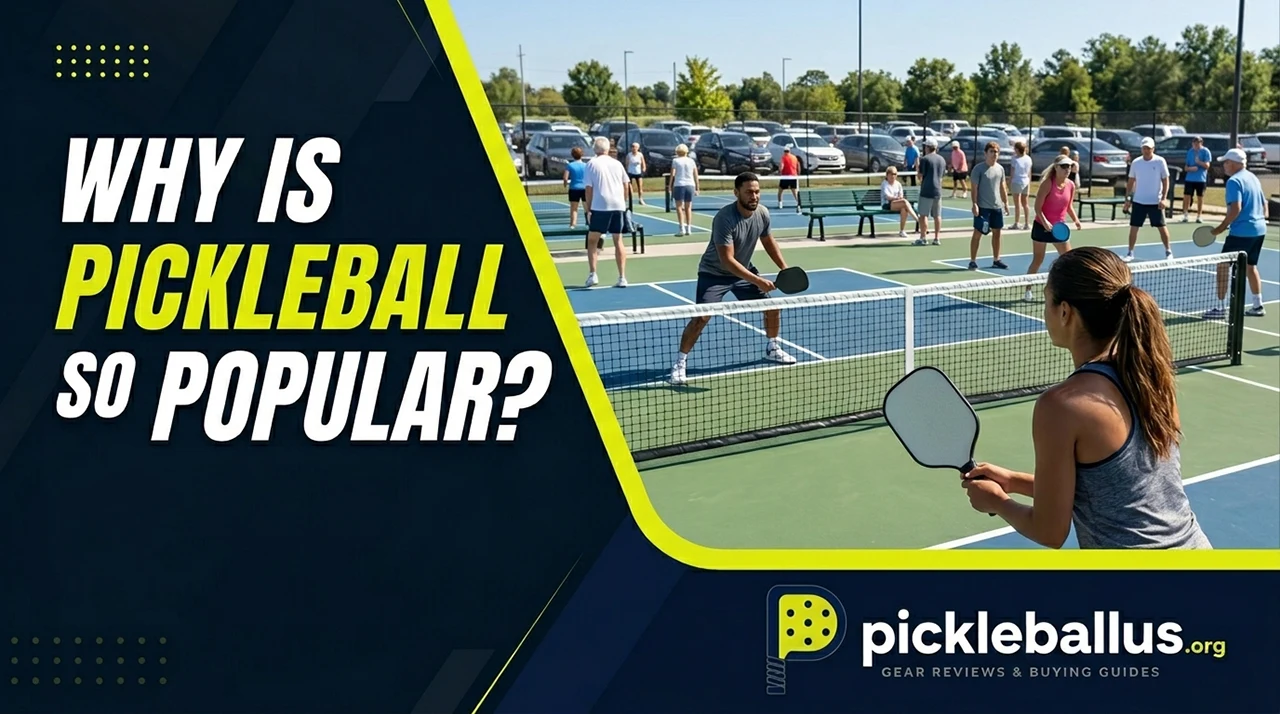
What Is Pickleball — and Why Are People Calling It the Perfect Sport?
Pickleball is a paddle sport played on a compact court using solid paddles, a lightweight perforated plastic ball, and a mandatory underhand serve — combining core elements of tennis, ping-pong, and badminton into a format designed to produce fast competency with no athletic pedigree required. What is pickleball, exactly, remains a genuine question for millions of people who have heard the name but never seen the game; the reality is a distinct sport with its own strategy, culture, and developmental ceiling.
How it works — paddle, perforated ball, smaller court
The court measures 20 feet wide by 44 feet long — roughly one-fourth the playing area of a tennis court. A 7-foot non-volley zone (the “kitchen”) on each side of the net prevents players from camping at the net and volleying every ball, which forces the diagonal dinking game that defines high-level pickleball strategy. Ball speed in recreational play averages 25–40 mph, compared to 70–100+ mph in amateur tennis — a difference that makes the game readable for beginners and far less punishing on reaction time.
The serve must be made underhand, below the waist, with no spin applied at contact. This single rule removes the most technically demanding and injury-prone element in racket sports: the overhead serve. Most beginners produce a legal, functional serve in their first session.
How pickleball compares to tennis, badminton, and ping-pong
Pickleball borrows its scoring system and net structure from tennis, its court dimensions from badminton, and its paddle physics and reflex demands from ping-pong — while stripping the physical and technical barriers that make each of those sports difficult to enter. A tennis beginner typically needs months of lessons before sustaining a ten-shot rally. A pickleball beginner typically does it in the first hour.
That design philosophy — borrow the fun, remove the friction — explains why pickleball spread once the right conditions (aging population, cheap court conversion, social media, pandemic) arrived. To understand the full arc of its development, the history of pickleball traces how a 1965 backyard improvisation became a 48-million-player sport over six decades.
How Big Has Pickleball Actually Gotten?
Pickleball’s growth is among the fastest in American sports history, moving from 3.1 million players in 2014 to over 48 million people who played at least once in 2024. The full story of pickleball growth in the United States involves regional patterns, facility investment cycles, and demographic shifts that explain why this growth has been durable rather than trend-driven.
From 3.1 million to 48 million — what the data shows
The following table tracks the trajectory across the decade that defined the sport’s expansion:
| Year | U.S. Player Count (approx.) |
|---|---|
| 2014 | 3.1 million |
| 2019 | 3.5 million |
| 2020 | 4.2 million (+21% YOY) |
| 2022 | 8.9 million |
| 2024 | 19.8M regular / 48.3M played at least once |
The jump from 3.5 million to 4.2 million between 2019 and 2020 — a 21% single-year increase during a global pandemic — is the inflection point in the sport’s growth curve. For a breakdown of how many pickleball players are in the US by region, age, and participation type, the data shows which states lead, which demographics are accelerating, and where the growth ceiling might eventually appear.
Who plays pickleball? The demographics tell a different story than the stereotype
Early pickleball was almost exclusively a senior sport — low-impact, well-suited to retirement communities in Florida, Arizona, and the Pacific Northwest. That profile has fundamentally shifted. As of 2024:
- Players under 35 are now the fastest-growing age segment, accounting for over 28% of new participants
- Women represent approximately 46% of players — one of the most gender-balanced ratios in any court sport
- Average player age has dropped from the mid-60s to the mid-40s over the past decade
- The income spread is wide: the same sport is played at free public parks and $150/hour private club facilities
This demographic diversity — crossing age, gender, income, and geography — is one of the structural reasons pickleball sustains growth rather than peaking as a demographic-specific fitness trend. When a sport appeals equally to a retired teacher and a 28-year-old software engineer, it stops behaving like a niche and starts behaving like infrastructure.
7 Reasons Pickleball Is So Popular Right Now
Pickleball achieved mainstream dominance because seven specific advantages arrived simultaneously and compounded each other. No single factor would have been sufficient; together, they created a growth loop that conventional sports rarely find.
Reasons 1–3 — Accessibility, cost, and the learning curve
Reason 1 — The learning curve is nearly nonexistent. A complete beginner can sustain a rally within 20–30 minutes on court. The underhand serve, smaller court, slower ball, and forgiving paddle face all produce early success — and early success is the most powerful hook in any sport. Tennis, golf, and even bowling punish beginners with extended periods of failure before the fun begins. Pickleball inverts that pattern: beginners feel competent on day one, which generates the return visit that becomes the habit that becomes the addiction.
Reason 2 — Startup cost is among the lowest in organized sport. A functional beginner paddle costs $30–$60. Balls run $10–$15 per six-pack. Most cities offer free or low-cost public courts. Total investment to start: under $100, with no membership, lesson fee, or specialized gear required. Compare that to golf ($200–$500 minimum), tennis ($100+ racket plus court time plus lessons), or cycling ($500+ for a road-worthy bike), and the entry cost is negligible. When you’re ready to upgrade, the best pickleball paddles for beginners covers which models deliver real performance improvement without overcomplicating the choice.
Reason 3 — Courts are everywhere, and one tennis court converts into four. Parks departments across the country have repainted hundreds of existing asphalt surfaces. Basketball courts, gym floors, church parking lots, and hotel courtyards host games with just a portable net. This court ubiquity means finding a game is rarely the bottleneck — which removes the friction that kills adoption of sports requiring specialized venues.
Reasons 4–5 — Social bonding and community
Reason 4 — Pickleball is structurally social. The 20×44-foot court keeps players close enough for normal conversation during play. In doubles — the dominant format — you’re standing 8–12 feet from both your partner and your opponents for most of the game. Players of dramatically different skill levels can compete meaningfully together because the slower ball and smaller court narrow the gap between novice and veteran. This closeness creates connection in a way that golf (too spread out), tennis (too one-on-one), and most team sports (too much standing around waiting) rarely produce.
Reason 5 — The community self-perpetuates through open play. Open play — where strangers rotate in and out of games at public courts — is the default format in most American cities. Walk onto an open play court and within ten minutes you’ve played with four strangers and been invited to Tuesday evening pickup. This social onboarding built into the game’s structure is a competitive advantage almost no other sport can match. Players join for the exercise. They stay for the people.
Reasons 6–7 — Health benefits and the pandemic effect
Reason 6 — It’s real exercise that doesn’t feel punishing. A one-hour pickleball session burns approximately 400–600 calories depending on pace and body weight, delivers cardiovascular benefit comparable to moderate jogging, and improves balance and hand-eye coordination — all with significantly lower joint stress than tennis or running. The underhand serve removes shoulder impingement risk. Short lateral bursts rather than long baseline sprints reduce knee load. Orthopedic specialists who began recommending pickleball to recovering patients found their advice spreading patient-to-patient before it reached mainstream awareness. The benefits of playing pickleball covers the cardiovascular, cognitive, and social health data in full.
Reason 7 — COVID-19 was the single largest accelerant in the sport’s history. When gyms closed in spring 2020 and team sports suspended operations for months, millions of Americans needed outdoor, socially-distanced physical activity. Pickleball — outdoor, naturally distanced by court structure, and already growing — absorbed that wave of displaced exercisers. The 21% single-year player increase from 2019 to 2020 maps directly to this moment. Many pandemic-era adopters stayed, which is the key: emergency habits that deliver real value tend to stick, and pickleball delivered real value.
Is Pickleball Just a Trend, or Here to Stay?
Pickleball is structurally built to last — not because of enthusiasm alone but because of the infrastructure, capital, and institutional investment now anchored to it. Sports that fade typically lack the investment cycle that locks in permanent venues, broadcast contracts, and youth pipelines. Pickleball now has all three.
Pro leagues and broadcast deals signal long-term legitimacy
Professional pickleball operates through multiple competing organizations — Major League Pickleball, the PPA Tour, and the APP Tour — with tournaments broadcast on ESPN and major streaming platforms. Top professional players earn six-figure salaries, with the highest-ranked names generating significantly more through endorsements. When ESPN covers a sport and athletes build careers from it, that sport is no longer a trend — it is an industry.
The professional ecosystem creates the aspirational pipeline that sustains mainstream participation: recreational players watch pros, model technique, buy comparable equipment, and book lessons. The same mechanism drove the post-Tiger Woods golf boom and the Federer-Nadal era surge in tennis. It is now running in pickleball at scale.
Celebrity investment and court real estate signal lasting demand
LeBron James, Tom Brady, Drew Brees, and Kevin Durant are among the investors who have backed pickleball facilities, leagues, or equipment brands — not for publicity, but because their advisors see durable growth projections. Private equity has entered court construction. Residential developers now include pickleball courts as standard amenities in community plans, replacing tennis courts in some markets, embedding the sport directly into America’s growing suburban housing stock.
When a sport appears in HOA documents and master-planned community blueprints, it has left the trend category permanently.
By now you have a clear picture of the core forces driving pickleball’s explosive growth — from its near-zero learning curve to the genuine friendships forged at the kitchen line. These root reasons explain the sport’s reach across demographics, budgets, and geographies. They don’t fully account for why players who try pickleball once rearrange their schedules to play again the following week — and then the week after that. The next section covers the psychological and cultural dynamics that make pickleball something closer to a social movement than a sport.
The Deeper Side of Pickleball’s Popularity
The mastery cycle — why pickleball is addictive by design
Pickleball’s addiction loop is structural, not incidental. The sport has a near-zero barrier to initial competence (you succeed within minutes) followed by a steep ceiling to mastery (it takes years to develop a reliable third-shot drop, erne, or reset under pressure). This “easy to learn, difficult to master” architecture — the same dynamic that drives chess, golf, and rock climbing — triggers a continuous improvement loop that keeps players motivated for years without requiring external rewards.
Behavioral psychologists call this the mastery cycle: early success builds confidence, early success quickly runs into the ceiling of intermediate play, intermediate players seek coaching and competitive games to improve, and each incremental breakthrough renews engagement. Most sports offer either too-easy mastery (which produces boredom) or too-slow initial progress (which produces dropout). Pickleball threads the space between both failure modes — which is why player retention rates are unusually high compared to other recreational sports.
Pickleball as “third space” — community beyond home and work
American social connection is in documented decline, with loneliness rates at historic highs and traditional third spaces — civic clubs, church communities, neighborhood networks — contracting across most demographics. Pickleball has emerged as one of the most effective third spaces (places outside home and work where regular social connection forms) in contemporary American life, largely by accident.
The format fits the function almost perfectly: open play rotates groups of four; courts are clustered so multiple games are visible from any bench; talking during play is normal and expected rather than disrupted. Players in their 50s and 60s consistently report making more new friends through pickleball than through any other channel in their adult lives. This community function — documented in player surveys and studied in social psychology research — explains why pickleball participation resists weather, injury, and competing activities in a way that reflects deeper social need rather than mere recreational preference.
Noise wars and growing pains — when popularity creates conflict
The paddle-on-ball impact generates approximately 70–85 decibels at the player’s position, decaying to 55–65 dB at a park perimeter — roughly equivalent to normal conversation in volume, but repetitive and percussive in a way that neighbors find uniquely irritating. Dozens of U.S. municipalities have faced legal disputes, city council battles, and restraining orders over pickleball noise at public parks.
This friction is a reliable indicator of genuine mainstream penetration. Sports with marginal participation don’t generate legal disputes. The noise controversy has also accelerated indoor court construction, as municipalities and private developers respond with enclosed facilities that eliminate the issue entirely — which further cements the sport’s permanent infrastructure and year-round playability.
Pickleball’s Olympic path — farther than it looks, closer than you’d think
USA Pickleball has received provisional recognition from the Sports Accord body, and the International Federation of Pickleball is pursuing full IOC recognition — the prerequisite for Olympic inclusion. Optimistic timelines point to the 2032 Brisbane Games; a more realistic projection suggests 2036 as the earliest plausible date. For a full breakdown of where that process stands, the question of is pickleball an olympic sport covers the governing body negotiations, qualification criteria, and what official recognition would mean for global participation rates.
What makes Olympic status plausible rather than merely aspirational is the combination of: global participation (70+ countries), growing youth programs (an IOC priority for new sports), and a professional structure sophisticated enough to qualify athletes from multiple nations for a tournament bracket. Whether or not the 2032 or 2036 timeline holds, the pursuit generates sustained international media coverage that extends the sport’s growth curve independent of any governing body decision.
Write Your Review
No reviews yet. Be the first to share your experience!