Pickleball Training Equipment: Machines, Hoppers & Drills
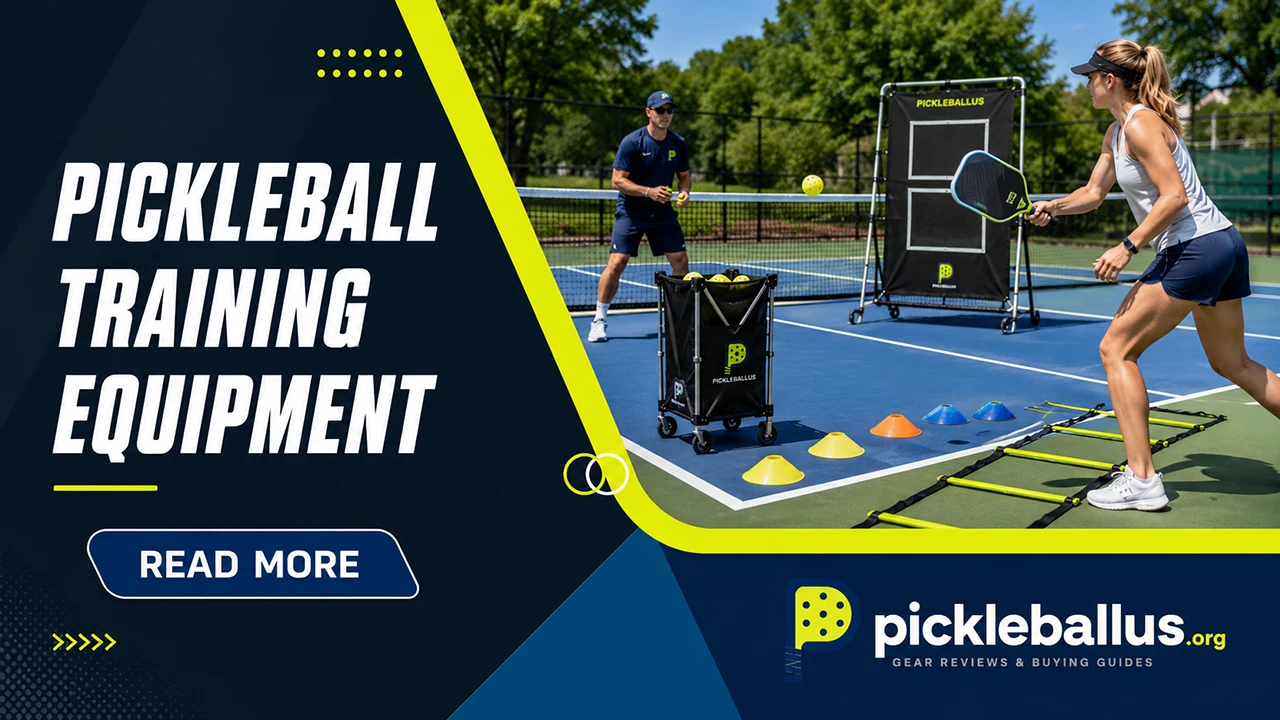
Pickleball training equipment covers five main categories: ball machines (automated feeding for solo drilling), ball hoppers (portable storage for drill sessions), ball carts (high-capacity storage for coaches and clubs), training cones (footwork and court positioning markers), and practice aids like rebounders and target boards. Each category solves a different problem — the right one depends on whether you practice alone or with a partner, how seriously you play, and how much court time you can realistically book.
Most players start with the wrong category. They buy a ball machine before they have a structured drill habit, or they skip a ball hopper and spend half their practice time chasing balls across the court. This guide maps out all five categories, explains what each one actually does for your game, and helps you figure out which to prioritize first based on your level and how you train.
The fastest gains in pickleball come not from playing more games but from deliberate, repetitive drilling — and that requires the right equipment. A rebounder lets you log 300 forehand repetitions in 20 minutes. A set of training cones turns a vague “practice footwork” intention into a structured movement drill. A ball machine simulates live match feeds your drill partner can’t replicate consistently.
Below is a complete breakdown of every training equipment category, including how to compare the options within each and when it makes sense to invest.
What Is Pickleball Training Equipment?
Pickleball training equipment refers to any tool or device designed to accelerate skill development outside of standard match play — by increasing repetition volume, adding structure to solo practice, or replicating game scenarios without a partner.
This is different from court equipment (nets, posts, lines) and playing equipment (paddles, balls, shoes). Training equipment sits in its own category because it’s designed to change how you improve, not just how you play.
Training Equipment vs. Court Equipment — What’s the Difference?
Court equipment is what you need to play pickleball. Training equipment is what you need to improve at it. A portable net and a paddle are court equipment — you can’t run a point without them. A ball machine, a ball hopper, a set of cones, or a rebounder wall are training equipment — you can play without them, but your skill development will be slower and less structured.
The distinction matters because many players conflate the two and either overspend on training tools they’re not ready for, or underspend and rely solely on open play to improve. Open play is valuable, but it doesn’t deliver deliberate repetition. You might hit 80 third-shot drops across an entire two-hour open play session. A ball machine gives you 80 in ten minutes.
Why Training Equipment Speeds Up Skill Development
Repetition volume drives skill acquisition in racket sports. The more correct repetitions you log for a specific shot under controlled conditions, the faster that shot becomes reliable under match pressure. Training equipment creates conditions for high-volume repetition that casual play cannot.
A rebounder or practice wall gives you continuous ball return for stroke work. A ball machine delivers consistent, repeatable feeds at adjustable speed, spin, and location — so you can isolate a weakness like your kitchen transition or your cross-court dink and drill it systematically. Ball hoppers and carts remove the friction of chasing balls mid-drill, keeping your session high-tempo. Cones and target markers turn abstract “be more accurate” goals into physical targets with measurable feedback.
Together, these tools don’t just help you practice more — they help you practice better.
What Are the Main Types of Pickleball Training Equipment?
There are five main categories of pickleball training equipment: ball machines, ball hoppers, ball carts, training cones, and practice aids (rebounders, target boards, and weighted training tools). Each addresses a different aspect of deliberate practice, and serious players eventually use all of them.
Ball Machines — Automated Feeding for Solo Drilling
A pickleball ball machine is a motorized device that feeds balls at controlled intervals, speeds, spins, and court locations. It replaces the need for a drill partner to hand-feed or toss — making it the highest-impact training investment for solo practitioners. Most machines hold between 80 and 150+ balls and run on rechargeable batteries.
Entry-level machines deliver straight-feed shots at fixed speed — good for beginners building stroke mechanics. Mid-range machines add spin control, oscillation (randomized lateral feeds), and basic programmable drill sequences. Premium machines offer full programmability, remote control, and app integration that mimics real-match shot patterns.
Ball machines work best when paired with a structured drill plan. Without intentional targeting — “I’m going to hit 50 cross-court dinks from the left side, then 50 from the right” — even the most expensive machine won’t accelerate improvement as efficiently as it should.
→ Full reviews and comparisons: best pickleball machines
Ball Hoppers & Ball Carts — Storage and Court Flow
Ball hoppers and ball carts solve the same core problem — storing and collecting balls during drill sessions — but at different scales and for different contexts.
A pickleball ball hopper typically holds 40–80 balls in a collapsible wire or mesh basket with a flip-top lid. You can flip it upside down to use as a ball-feed stand, pick up balls without bending, and carry it to and from the court easily. It’s the essential companion for solo drilling or two-person partner practice — you load it before the drill, work through the balls, then gather everything in one sweep.
A pickleball ball cart is a larger, wheeled storage unit designed to hold 100+ balls at court level. Carts are built for coaches, clinics, and club environments where multiple players are drilling simultaneously. They’re bulkier and less portable than hoppers but far more efficient when you’re managing large ball volumes across a full lesson or group drill session.
If you practice solo or with one partner, a hopper is the right tool. If you coach, run drills, or manage a club program, a cart makes the difference between a smooth session and spending half your time on ball retrieval.
→ Hopper comparisons: best pickleball ball hopper → Cart comparisons: best pickleball ball cart
Training Cones & Target Markers — Footwork and Accuracy
Pickleball training cones are low-profile disc or mini-cone markers used to define target zones, footwork patterns, and court boundaries during drills. They cost a fraction of other training equipment yet deliver consistent improvement in two of the most neglected areas of pickleball development: court movement and shot placement accuracy.
Common cone applications include marking the kitchen corners as dinking targets, setting up a side-shuffle footwork course for transition drills, outlining the thirds of the court for return positioning, and creating visual landmarks for split-step timing. Unlike ball machines or rebounders, cones work equally well for solo practice, partner drills, and coach-led group sessions — making them the most versatile training tool per dollar.
Most serious recreational and competitive players own a set of 12–20 cones as a permanent part of their gear bag. They’re lightweight, pack flat, and set up in under two minutes.
→ Cone reviews and drill applications: best pickleball training cones
Practice Nets, Rebounders & Other Training Aids
Beyond the four main categories above, pickleball practice aids cover a broad range of solo training tools: rebounder walls (angled surfaces that return the ball after contact), practice nets with target zones, weighted paddle rings for strength training, tethered ball systems, and target boards for dink and drop-shot accuracy work.
These tools vary widely in quality and application. A high-quality rebounder that holds its angle delivers genuine skill development for forehand and backhand mechanics, reset shots, and reaction speed. A poorly made one wobbles on contact and builds bad habits. The same applies to practice boards — construction material and target accuracy matter significantly.
Rebounders are best for players without a consistent drill partner. They’re less customizable than a ball machine but considerably more affordable, and they work in driveways, garages, or any space where a full court isn’t available.
→ Complete breakdown of practice aids: pickleball training aids explained
Ball Machine, Rebounder, or Hopper — Which Should You Buy First?
A ball hopper is the best first training purchase for most players, a rebounder is the best solo tool for players without drill partners, and a ball machine is the highest-value investment for anyone training seriously three or more times a week. The right starting point depends on how you currently practice and what’s limiting your improvement.
The comparison below breaks down the three most common first purchases by what they actually solve:
| Equipment | Best Solves | Requires Partner? | Relative Investment |
|---|---|---|---|
| Ball hopper | Court flow, drill tempo | Yes (for ball feeding) | Budget-friendly |
| Rebounder/practice board | Solo stroke repetitions | No | Budget to mid-range |
| Ball machine | High-volume solo drilling | No | Mid-range to premium |
| Training cones | Footwork + accuracy structure | Optional | Budget-friendly |
Best Choice for Beginners (Budget-Conscious)
For players still building basic stroke mechanics, a ball hopper paired with a set of training cones is the most efficient starting combination. The hopper removes the friction of ball retrieval so you can stay focused on repetition. The cones give your partner a clear target to feed to and give you a visual goal to hit. Together, these two low-cost tools turn an informal hit-around into a structured drill session.
A rebounder is the right add-on for beginners who don’t have a consistent practice partner. A quality rebounder allows 200+ forehand or backhand reps in 20 minutes — more repetitions than most casual players accumulate across an entire week of open play. At this stage, resist the urge to buy a ball machine. The investment is only justified once you have a structured drill program and can maximize the machine’s repetition output.
Best Choice for Intermediate Players
Intermediate players — those with solid mechanics but inconsistent execution under pressure — benefit most from targeted repetition with variability. This is where a ball machine starts to pay off. Oscillating feed patterns train your split-step and transition footwork in a way that fixed-feed drills can’t replicate.
If a ball machine isn’t in the budget yet, a mid-range rebounder with adjustable angle settings plus a pickleball training aids guide for structured drill progressions covers most of the same ground at lower cost. The key at this level is pairing equipment with intentional drill selection — random hitting on a rebounder won’t develop consistency the same way structured drill progressions do.
Best Choice for Advanced / Club Players
Competitive players (4.0+) and serious recreational players who train multiple times a week should consider a programmable ball machine as a core part of their setup. At this level, the ability to customize feed sequences — speed, spin, depth, and court location — is what separates general conditioning from deliberate, match-specific preparation.
A full training setup at this level typically includes a ball machine for solo drilling, a ball cart for high-volume practice sessions, training cones for footwork structure, and a rebounder or target board for warm-up touch work. This isn’t a single purchase — it’s a setup built over time as your training volume and goals evolve.
How to Choose Pickleball Training Equipment That Matches Your Level
Yes — you can make a meaningful choice about training equipment without a large budget, as long as you match the tool to how you actually train rather than how you hope to train. Most equipment regret in pickleball comes from buying aspirationally: purchasing a premium ball machine when you only practice once a week, or buying four different training aids and not using any of them.
Two factors matter more than anything else: how often you practice solo versus with a partner, and whether you have a specific shot or movement pattern you’re actively trying to improve.
Key Questions to Ask Before You Buy
Before purchasing any training equipment, answer these four questions honestly:
1. Do I practice alone or with a partner? Solo players should prioritize rebounders and ball machines. Players who always train with a partner get more value from hoppers and cones, since their partner feeds balls and the equipment just structures the session.
2. How many hours per week do I actually drill (not play)? Under two hours per week: start with cones and a hopper. Two to five hours per week: a rebounder or entry-level ball machine. Five or more hours per week: invest in a programmable machine and full setup.
3. What specific part of my game am I trying to improve? Kitchen play (dinks, resets, drops): target boards and rebounders. Court movement and positioning: cones. Stroke mechanics and shot variety: ball machine. General repetition volume: hopper.
4. Where will I be using this equipment? Home driveway or garage: rebounder or portable practice net. Public court: hopper and cones (portable, no setup required). Dedicated practice space: full ball machine setup.
Features That Matter vs. Features You’ll Never Use
Ball machine marketing tends to emphasize features that impress in spec sheets but rarely affect most players’ training: remote-control apps, LED speed displays, programmable shot sequences with 50+ preset patterns. For most recreational and intermediate players, what actually matters is oscillation reliability (consistent lateral feeds without jamming), hopper capacity (fewer interruptions to reload), and battery life (enough for a full session without recharging mid-drill).
For hoppers and carts, the meaningful features are wire gauge (thicker = less flex and longer lifespan), handle ergonomics, and whether the hopper base doubles as a ball-feed stand. Thin wire hoppers look identical to quality models in photos but bend and deform within a season of regular use.
For training cones, the only feature that matters consistently is profile height. Low-profile disc cones are better for agility footwork courses (you can step on them without tripping). Taller mini-cones are better as visual targeting markers because they’re easier to spot from a distance.
By now you have a solid grasp of the five training equipment categories, how they compare in cost and function, and which tier fits your game. Choosing the right tools, however, is only the starting point — getting the most out of your investment means understanding how each piece of equipment connects to structured practice. The next section goes deeper into the details that separate recreational use from purposeful skill development.
Getting More Out of Your Pickleball Training Gear
Training equipment only accelerates improvement when paired with intentional structure. The players who see the fastest gains aren’t necessarily the ones with the most gear — they’re the ones who use what they have with a clear purpose each session.
How to Structure a Solo Practice Session With a Ball Machine
A ball machine session is most effective when organized into three blocks: warm-up, targeted skill work, and match simulation. Start with 10–15 minutes of straight-feed groundstrokes at moderate speed to build feel and timing. Move into 20–25 minutes of deliberate skill work — isolate one shot (third-shot drop, cross-court dink, reset volley) and drill it at consistent feed settings until you hit a clear accuracy benchmark. Finish with 10 minutes of oscillating feeds at match speed, forcing you to reset your footwork and recover position between shots.
Avoid using the machine on “random” mode for the full session. Random feeds feel challenging but they don’t build the specific neural pathways that come from focused, repetitive work on a single shot pattern.
Using Cones and Target Boards Together for Drill Accuracy
Cones define where you need to be; target boards define where the ball needs to go. Used together, they create complete drill structure that trains both movement and shot execution simultaneously. A practical example: place two cones at the kitchen corners as targets for your cross-court dink, and two cones three steps wide of the centerline to mark your recovery position after each shot. Now your drill has movement, positioning, and accuracy components — all from inexpensive gear.
Target boards at the net are most effective for drop-shot and dink accuracy work. Aim for a defined zone rather than a general area, and track your hit rate across sets of 20. Measurable feedback — “I hit 14/20 in zone, up from 9/20 last week” — is what converts drilling into skill acquisition.
When Is It Time to Upgrade Your Training Setup?
The signal to upgrade isn’t about gear envy — it’s about whether your current equipment is creating a ceiling on your training quality. Specific indicators: your ball hopper capacity means you’re reloading every five minutes and losing rhythm; your rebounder’s fixed angle limits you to one shot pattern; your entry-level ball machine can’t produce the spin variance that’s been beating you in matches. These are functional ceilings, not aesthetic ones. When you hit them, upgrading pays off. When you haven’t, it doesn’t.
Most intermediate players who feel “stuck” haven’t hit an equipment ceiling — they’ve hit a drill structure ceiling. More gear solves the wrong problem. A better practice plan usually solves the right one.
The Gear Serious Players Use — and What Beginners Waste Money On
Competitive and club-level players rely on a ball machine with reliable oscillation, a quality wire hopper, and a full cone set as their core training toolkit. These three tools cover the majority of structured solo and partner drill scenarios without redundancy.
What beginners commonly overspend on: high-end ball machines with app features they’ll never configure, elaborate target board systems when basic cones achieve the same result, and multiple rebounders at once. The pattern is consistent — more gear before more structure. The equipment isn’t the bottleneck. Drilling with basic tools builds more skill than drilling occasionally with premium ones.