

Pickleball is not an Olympic sport. As of 2026, it has not been included in any Olympic Games program — not Paris 2024, not Los Angeles 2028 — and no governing body has received official recognition from the International Olympic Committee (IOC). The sport’s rise to over 24.3 million players in the United States alone has made this gap feel surprising, even baffling, to the millions who play it weekly. Yet the path from “fastest-growing sport in America” to “Olympic event” is longer and more complex than popularity alone determines.
To qualify for the Olympics, a sport must clear five categories of criteria set by the IOC: global geographic reach across multiple continents, a single unified international federation recognized by the IOC, adherence to anti-doping standards, a standardized competitive structure, and a track record of meaningful international competition. Pickleball currently falls short on at least two of these five — and the governance problem, specifically the ongoing split between competing international federations, is the single biggest roadblock standing between pickleball and the Olympic rings.
The timeline is clearer now than it was two years ago. The 2028 Los Angeles Games program is already locked. The 2032 Brisbane Olympics represent the earliest realistic opportunity, but getting there requires federation unification and significant global expansion before the IOC evaluation window opens around 2028. For many insiders, 2036 is the more likely debut year for full medal competition.
Below is a complete breakdown of where the process stands, what needs to change, and what an Olympic future would actually mean for the sport.
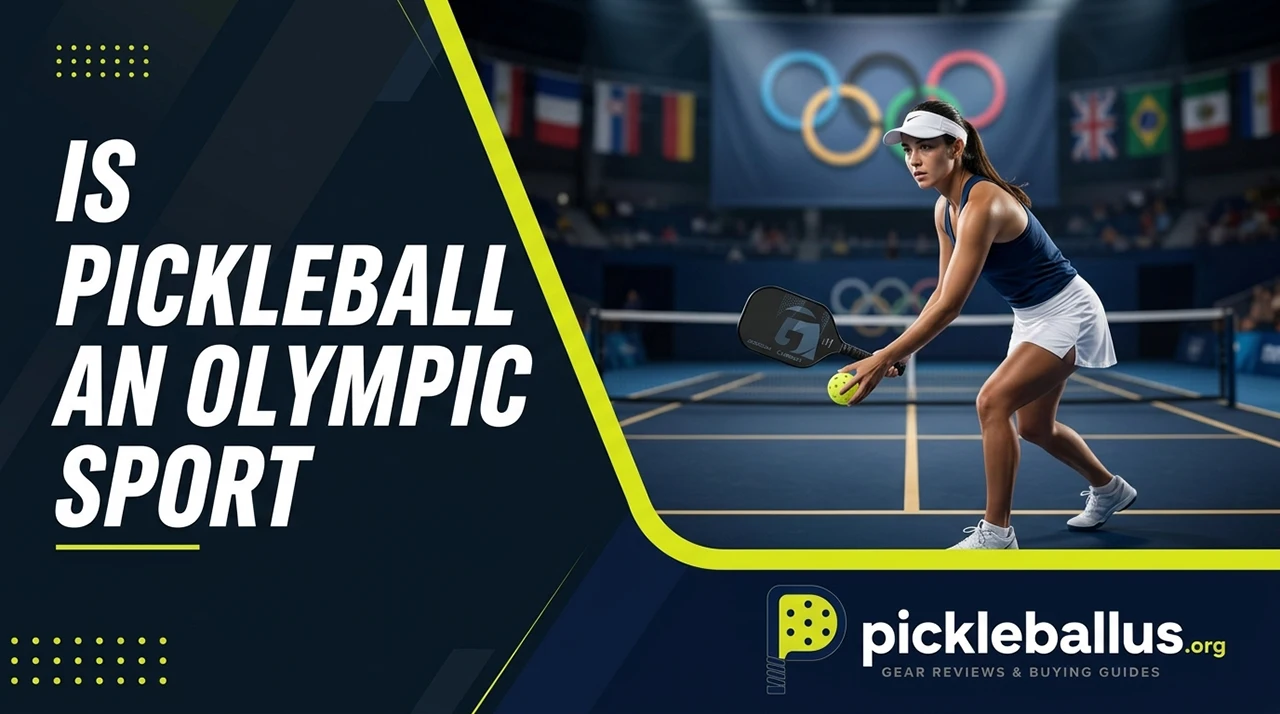
Is Pickleball an Olympic Sport Right Now?
Pickleball is not an Olympic sport as of 2026, and it will not appear in the Los Angeles 2028 Summer Olympics. The sport has never been part of the Olympic Games program — neither as a full medal event nor as a demonstration event — and no pickleball governing body has received official IOC recognition. That status has not changed despite the sport’s remarkable growth over the past five years.
The question catches many people off guard because pickleball has been so visible. It’s in community centers, retirement communities, and now on national television. Its professional leagues — the Professional Pickleball Association (PPA) and Major League Pickleball (MLP) — have attracted serious sponsorship and media coverage. But visibility and popularity in a handful of countries, especially a single dominant one, does not automatically translate into Olympic eligibility. The IOC applies the same standardized framework regardless of how fast or loud a sport grows in its home market.
Why This Question Has Millions of Players Wondering
Pickleball became the fastest-growing sport in the United States for the third consecutive year, according to the Sports & Fitness Industry Association’s 2024 report. More than 24.3 million people played the sport in 2025 in the US alone. Globally, participation has expanded into Europe, Australia, Southeast Asia, and parts of South America — making the absence of an Olympic program feel increasingly incongruous.
The growth has also accelerated through professional organization. Major League Pickleball launched in 2021, broadcast deals have followed, and celebrity ownership groups have raised the sport’s cultural profile well beyond the recreational player. Add to this that pickleball was invented in 1965 — documented in the history of pickleball — and the case for Olympic recognition feels to its advocates not just reasonable, but overdue.
That sentiment is partly why the Olympic question matters. For players, coaches, and national federations building programs in countries where government funding is tied to Olympic status, inclusion in the Games would mean more than a medal ceremony. It would mean infrastructure investment, youth development programs, and institutional legitimacy at a level professional leagues cannot provide on their own.
What “Olympic Sport” Actually Means — and Why It Matters
An Olympic sport is one officially included in the program of the Summer or Winter Olympic Games by the IOC Session — the body’s supreme authority. Being an Olympic sport means athletes compete for gold, silver, and bronze under the Olympic rings, with all the associated funding, visibility, and national investment that entails.
Separately, the IOC has an optional sports category, introduced at the Tokyo 2020 Games, where host cities can propose one-time additions to the program. These sports are contested with medals but are not permanent fixtures. This pathway differs from full Olympic status and would represent a meaningful but temporary debut — not the same as being a permanent, recurring Olympic event.
For pickleball’s purposes, even the optional sports route requires IOC recognition of the sport’s governing federation, a step that hasn’t happened yet. The pathway to either status runs through the same institutional bottleneck.
What the IOC Requires Before Pickleball Can Join the Olympics
Pickleball must meet five core criteria to qualify for Olympic inclusion: sufficient global geographic reach, a single IOC-recognized international federation, compliance with the World Anti-Doping Code, a standardized ruleset and competitive structure, and a track record of international competition at scale. The sport currently falls short on at least two of these five.
This is not a subjective judgment or a bias against pickleball — the Olympic Charter applies the same framework to any sport seeking admission. What makes pickleball’s situation notable is that the two areas where it falls short are structural, not performance-based. They can be fixed. But fixing them requires decisions by multiple competing organizations, not just one.
The following table summarizes where pickleball stands against each core criterion:
| IOC Criterion | Requirement | Pickleball’s Current Status |
|---|---|---|
| Global reach | Men: 75 countries / 4 continents; Women: 40 countries / 3 continents | ~60+ countries claimed; depth varies widely |
| Recognized federation | Single IOC-recognized international body | IFP and GPF split — no recognition granted |
| Anti-doping compliance | WADA Code adherence, registered testing program | Professional leagues have conduct policies; no unified WADA program |
| Standardized rules | Uniform ruleset across all member nations | Broadly consistent; minor variations remain |
| Competitive track record | International championship history | Bainbridge Cup and US Nationals established; no true World Cup equivalent |
The Global Reach Requirement (75 + 40 Countries)
To qualify as a full Olympic sport, pickleball must be practiced by men in at least 75 countries across four continents and by women in at least 40 countries across three continents. These aren’t suggested benchmarks — they are hard requirements written into the Olympic Charter.
As of 2025, the International Federation of Pickleball (IFP) claims affiliations in over 60 countries, but the depth and activity levels of those affiliations vary widely. Pickleball’s participation is heavily concentrated in North America — the United States, Canada, and Mexico — along with Australia and parts of Western Europe. In Africa, Central Asia, and most of South America, organized presence is minimal.
The geographic distribution matters as much as the raw country count. A federation that claims 65 member nations but derives 85% of its competitive activity from three countries does not demonstrate the global footprint the IOC is looking for. Sustainable Olympic sports need genuine multi-continental competition, not nominal national memberships.
The path to meeting this requirement runs through national federation building in underrepresented regions, which requires years of grassroots work, domestic tournament structures, and local coaching pipelines — none of which can be fast-tracked.
The Governance Problem: IFP vs. GPF
The single biggest obstacle to pickleball’s Olympic bid is not global reach — it’s the governance split at the top of international pickleball. Two organizations claim authority over the sport at the global level: the International Federation of Pickleball (IFP) and the Global Pickleball Federation (GPF). The IOC will only recognize one international federation per sport. With two competing bodies, the IOC cannot proceed with recognition for either.
The IOC’s stance is clear: before any formal recognition process can begin, pickleball’s international organizations need to merge into a single unified body with one set of rules, one anti-doping framework, and one competitive calendar. Seymour Rifkin, president of the World Pickleball Federation, acknowledged publicly that the pickleball community itself — its inability to consolidate — is the primary barrier, not IOC resistance.
Mergers of this kind in international sports governance are notoriously difficult. They involve not just organizational structures but also commercial interests, sponsorship agreements, national federation alignments, and differing philosophies about amateur vs. professional structure. The IFP and GPF have held discussions, but no formal merger has been finalized. Until a single body emerges and builds a track record of unified governance, IOC recognition cannot move forward.
This governance challenge is detailed further in the context of pickleball organizations, which covers the competing mandates of international governing bodies in the sport.
Anti-Doping, Standardization, and Olympic Charter Compliance
Beyond global reach and governance, pickleball must demonstrate full compliance with the World Anti-Doping Code (WADA). This means establishing a testing program, registering athletes in the ADAMS database, and partnering with a recognized testing authority. Professional leagues like the PPA have their own conduct policies, but these do not substitute for a WADA-compliant national and international anti-doping framework.
Standardization is also required: the IOC expects a sport’s rules to be identical across all member nations, administered by the single recognized federation. Pickleball currently has broadly consistent rules — the USA Pickleball rulebook is widely adopted — but variations still exist in how different national bodies implement rules around equipment specifications and scoring formats. Unifying these under one international standard is achievable, but requires the governance unity that doesn’t yet exist.
Could Pickleball Be in the 2032 or 2036 Olympics?
The 2032 Brisbane Olympics are the earliest realistic opportunity for pickleball to debut, and even that window carries significant conditions. The 2028 Los Angeles program is finalized. The IOC evaluates sports for 2032 several years in advance, meaning the critical decision window for Brisbane opens around 2028 — roughly the same timeline within which pickleball would need to achieve federation unification and meaningful global expansion.
Many insiders, including national federation leaders, consider 2036 the more likely first appearance as a full medal sport. That is not a pessimistic assessment — it reflects realistic timelines for governance merger, anti-doping infrastructure, and geographic expansion, none of which can be compressed arbitrarily.
The rapid acceleration of pickleball growth in the United States demonstrates that the sport has the commercial and competitive energy to sustain an Olympic program. The challenge is translating that energy into the institutional structures the IOC requires.
Why the 2028 Los Angeles Games Are Officially Off the Table
The 2028 Olympic program was finalized years before the Los Angeles Games. Under the Olympic Charter, the sports program for a given Games is determined by the IOC Session, tied to the host city’s selection — a timeline that places the decision well before the opening ceremony. For Los Angeles 2028, sports like cricket, lacrosse, baseball/softball, flag football, and squash were added through a process that concluded in 2021–2022.
Pickleball had no realistic path into that window. The sport wasn’t recognized by the IOC, no unified federation existed to petition the IOC Session, and the governance split remained unresolved. Even if those structural problems had been solved overnight, the Olympic Charter allows a last-minute amendment only “not later than three years prior to the relevant Olympic Games” — meaning 2025. That date has passed.
The only theoretical route into 2028 would have been through the optional/demonstration sports pathway proposed by the Los Angeles organizing committee. That door also closed without pickleball. The 2028 Games will proceed without it.
The Case for 2032 Brisbane — and Its Challenges
Brisbane 2032 represents the earliest genuine opportunity, and the Australian pickleball community is one reason for optimism. Australia has one of the strongest pickleball communities outside North America, with active state federations, national tournaments, and a player base that has grown steadily since 2018. A host nation with a built-in pickleball audience could give the Brisbane organizing committee a reason to advocate for the sport’s inclusion through the optional sports pathway.
For pickleball to clear the Brisbane window, the IFP and GPF would need to complete a merger and establish unified global governance by approximately 2027–2028, when the IOC begins its formal evaluation of the 2032 program. That gives the two organizations roughly two years — a tight but not impossible timeline if both sides commit to resolution.
Beyond governance, the sport needs to demonstrate active national federations and competitive programs across Africa, Southeast Asia, and South America before the IOC evaluates its global footprint. These requirements call for real investment in grassroots development in markets that remain early-stage.
Why 2036 Might Be the More Realistic Debut Year
Squash provides the most instructive comparison. The sport petitioned for Olympic inclusion for over 30 years before finally being added to the 2028 Los Angeles program. It had a unified international federation, was played in more than 185 countries, and had a well-established professional circuit — and it still took decades. Pickleball is at an earlier institutional stage than squash was when squash’s bid finally succeeded.
The 2036 Olympics — with a host city yet to be announced — gives pickleball time to build what it currently lacks: a merged international body, consistent global competition across four continents, and a WADA-compliant testing program with years of operational history. More importantly, it gives the sport time to grow organically in underrepresented regions rather than manufacturing membership counts to satisfy a minimum threshold.
For players and fans, 2036 feels distant. From a strategic perspective, arriving at the Olympics with the institutional foundations properly in place is better than rushing into a bid that fails and potentially delays recognition even further.
How Does Pickleball’s Olympic Bid Compare to Other Racket Sports?
Among racket sports, pickleball is the newest to pursue Olympic admission — and its situation looks different depending on which comparison you draw. Squash spent decades petitioning before finally being approved for 2028. Padel, another fast-growing racket sport, is further along in its international federation development than pickleball despite being similarly young. Understanding where pickleball sits in this competitive landscape clarifies both the challenge and the opportunity.
Sports That Made the 2028 Cut vs. Pickleball
The five sports added to the 2028 Los Angeles program were cricket, lacrosse, baseball/softball, flag football, and squash. Each had something pickleball currently lacks: a single, long-established international federation with IOC recognition. Cricket has the ICC; squash has the WSF; lacrosse has World Lacrosse. These bodies had decades of governance history, global competition records, and formal IOC relationships before their inclusion was approved.
Flag football’s addition at LA 2028 is the most recent precedent — it was proposed by the Los Angeles organizing committee under the optional sports pathway. It succeeded partly because the NFL and International Federation of American Football had already established a credible international competitive structure and the Games were hosted in football’s largest market. The Los Angeles organizing committee’s advocacy was the decisive push.
Pickleball’s situation at Brisbane 2032 could mirror the flag football precedent — a host-city proposal amplified by local sport popularity — but only if the international federation problem is resolved first. A divided governance structure gives the Brisbane organizing committee no recognized body to work with.
Why 24.3 Million Players Isn’t Enough — The Concentration Problem
Population concentration is the aspect of pickleball’s situation that often surprises newcomers to the Olympic admission process. The sport has 24.3+ million players in the United States — more than tennis in the US — and milions more in Canada and Australia. By raw numbers, it is one of the most-played racket sports in the world.
The IOC, however, doesn’t evaluate national participation counts. It evaluates global distribution. A sport where 90% of organized play happens in three countries, regardless of total player count, does not satisfy the multi-continental requirement. The requirement isn’t designed to be punitive — it reflects the Olympic movement’s core mission of representing the world’s athletes, not the most popular sport in one market.
Pickleball’s growth in Europe has been real but modest. In Asia, Southeast Asia has seen the most activity, particularly in Singapore, the Philippines, and India. In Latin America, Brazil and Mexico are emerging. But none of these markets has yet produced the depth of federation infrastructure, national competition calendars, and registered athletes that would satisfy a formal IOC country count with genuine competitive substance behind it.
At this point you have a clear picture of where pickleball stands in its Olympic journey: not in the Olympics, not at LA 2028, and facing real structural barriers around federation unity and global reach before any bid can succeed. Those are the macro facts. But the Olympic question isn’t purely about bureaucratic milestones — it also raises a deeper conversation that matters to the millions of people who play the game every week. The next section explores what Olympic status would actually change for pickleball’s culture, its community, and the players who built it from the ground up.
What Would Olympic Pickleball Actually Change for the Sport?
Olympic recognition would transform pickleball’s funding, visibility, and global infrastructure in ways that professional leagues and private investment cannot replicate. But it would also place new pressures on a sport that has, so far, grown with a distinctly community-oriented identity. Understanding both sides of that equation matters.
Investment, Infrastructure, and the Funding Surge Olympic Status Brings
When a sport achieves Olympic status, national governments begin directing public funding toward it through their national Olympic committees. Coaches receive certification pathways, training facilities get built, and athletes can apply for grants and performance-funding programs that are otherwise unavailable.
In countries where pickleball culture is still developing — where the sport relies entirely on private investment and enthusiast energy — Olympic status would accelerate development by years. It would give national federations the institutional weight to negotiate with governments, secure court-building grants, and establish youth development pipelines that feed into international competition.
The professional side of the sport — professional pickleball leagues like the PPA and MLP — would also benefit indirectly. Olympic cycles generate media interest, commercial sponsorship, and youth participation spikes in every host country. That’s a multiplier for the sport’s existing commercial structure, not a replacement for it.
The 2026 Special Olympics Debut — A Signal the World Is Watching
Pickleball made its official debut as a Special Olympics sport at the 2026 USA Games in Minnesota. This is not the same as the Olympics — the Special Olympics operates independently and focuses on athletes with intellectual disabilities — but it is a meaningful milestone. Inclusion reflects that the sport has reached a threshold of international accessibility, organizational readiness, and adaptive playing guidelines that a formal sporting body is willing to endorse.
For the broader Olympic bid, the Special Olympics debut signals something the IOC cares about: youth and inclusive participation. One of the IOC’s stated criteria for evaluating new sports is whether they enhance the “popularity of the Games, while ensuring the numbers of athletes, and the cost and complexity of the event, remain manageable.” A sport with a track record of broad, age-diverse, adaptive participation makes a stronger case than one confined to elite professional competition.
Could Olympic Pressure Hurt Pickleball’s Community-First Culture?
The tension between institutional ambition and grassroots identity is real in any sport that transitions from pickup games to professional leagues. Pickleball built its following on accessibility — short learning curves, affordable equipment, and a social culture that rewards participation over performance. Olympic development programs, by their nature, focus on elite pathways and standardized training, which can sometimes crowd out the recreational infrastructure that made a sport popular in the first place.
This isn’t hypothetical. Breakdancing was added to the Tokyo 2020 Olympics amid genuine enthusiasm from the breaking community — and then removed from the LA 2028 program after the IOC decided it didn’t fit the long-term Games strategy. The episode raised uncomfortable questions about whether Olympic ambition serves a sport’s community or exploits its cultural moment for institutional purposes.
For pickleball, the risk is subtler: that elite development pressure reshapes how the game is taught, played, and valued at the community level in ways that its millions of recreational players never asked for. That tension is worth acknowledging as the Olympic conversation accelerates.
How Everyday Players Can Support the Olympic Push
The most direct way recreational players can support pickleball’s Olympic bid is to register with their national pickleball federation rather than playing exclusively through private clubs. National federations aggregate membership data that supports the IFP’s global participation claims to the IOC. Numbers matter — but only the numbers that national bodies can formally document.
Beyond membership, players can advocate for local court funding through municipal governments — infrastructure investment that also strengthens the case that pickleball is a sport requiring public support, not just a backyard pastime. Understanding what is pickleball in its full cultural and competitive context helps clarify why institutional participation, not just recreational play, moves the needle.
The story of why is pickleball so popular is already well documented. The harder and more important story is whether the sport can translate that popularity into the institutional credibility the Olympic movement requires. The pieces are in motion. The timeline is longer than most fans would prefer. But the direction is clear.


Write Your Review
No reviews yet. Be the first to share your experience!