

The best pickleball sling bags in 2026 are the Franklin Sports Pickleball Sling Bag (best overall), the Mangrove Pickleball Sling Bag (best budget), the Athletico Pickleball Sling Bag (best for versatility), the Sucipi Pickleball Sling Bag (best convertible design), the A11N SPORTS Reversible Crossbody Sling Bag (best lightweight), the KAVIGOR Pickleball Sling Bag (best for wet/dry separation), and the JOOLA Essentials Sling Bag (best compact brand-name pick).

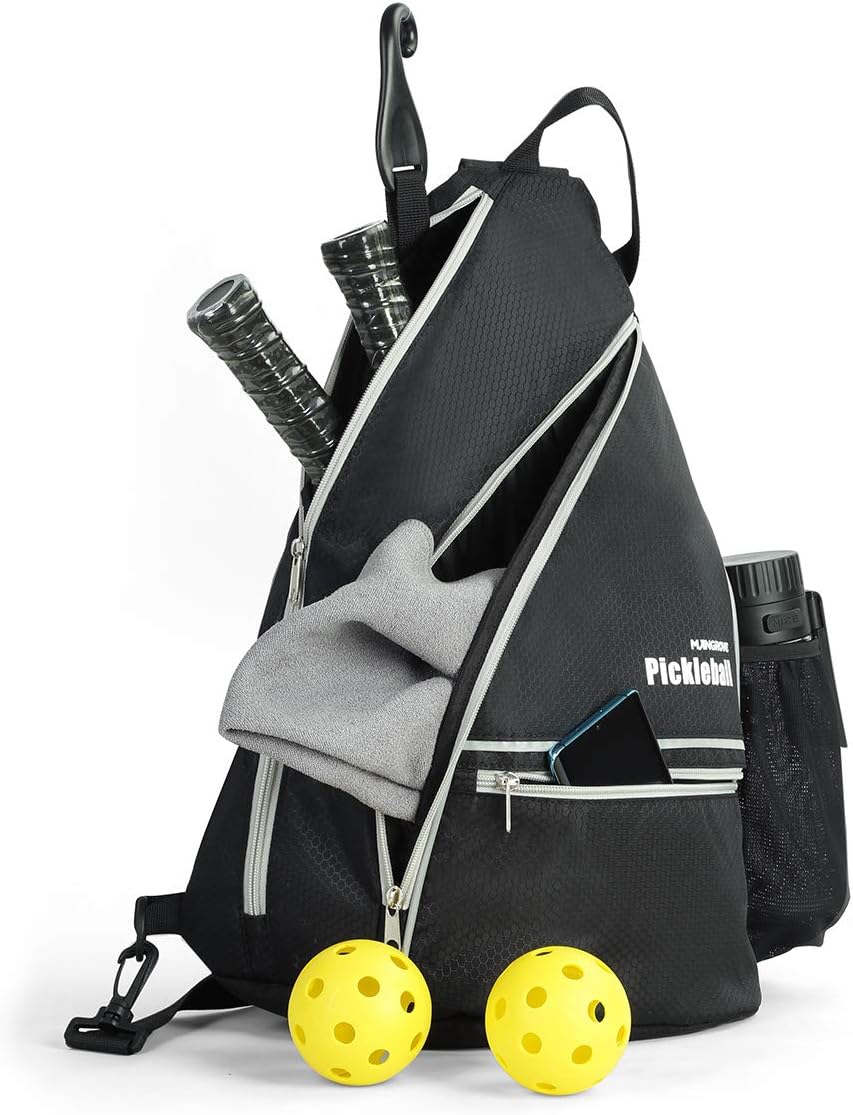


Sling bags are the most popular style in the best pickleball bags category for a reason: they carry everything a focused session requires — one to three paddles, a water bottle, balls, phone, and keys — without the bulk of a backpack or the open-access vulnerability of a tote. Three things separate a good pickleball sling from a generic crossbody bag sold at a sporting goods store: a dedicated padded paddle compartment that protects the face from scratches, a fence hook you can use mid-game without searching through pockets, and a strap system that handles the load without cutting into your shoulder after two hours.
The sling format has limits. It holds less than a backpack, rests on one shoulder instead of distributing weight across two, and has no room for a separate shoe compartment. For players who drive to their court, play for an hour or two, and don’t need extra clothing or shoes, those limits are irrelevant — a sling handles the session without any of the overhead a larger bag creates.
Below are detailed reviews of the seven best pickleball sling bags on Amazon in 2026, followed by a buying guide covering the features that actually matter in this format and a clear breakdown of when to choose a sling over other bag styles.
What Is a Pickleball Sling Bag?
A pickleball sling bag is a single-shoulder carry bag designed to hold one to three paddles along with game-day essentials — balls, a water bottle, phone, keys, and small accessories. It sits diagonally across the body or hangs from one shoulder, making it faster to swing on and off than a backpack and more secure than an open tote.
The format shares its basic shape with a standard crossbody sling, but pickleball-specific versions add features that matter on court: padded paddle sleeves that prevent face scratches, fence hooks that keep the bag off the ground while you play, and compartment layouts built around pickleball gear dimensions. Most sling bags in this category hold two paddles in a side-by-side sleeve; wider designs fit up to six paddles in a stacked configuration.
The key trade-off is capacity versus convenience. A backpack provides more room for shoes, a towel, and extra gear, but requires both hands to access and sits squarely on both shoulders. A sling stays on the body during warm-ups, unzips with one hand, and weighs under two pounds loaded for a typical session. For recreational players who court-hop between games, that trade-off lands firmly in the sling’s favor.
7 Best Pickleball Sling Bags in 2026
Here are the seven best pickleball sling bags available in 2026, each reviewed for paddle protection, strap comfort, organization, and real-world court usability.
#1 Franklin Sports Pickleball Sling Bag — Best Overall
The Franklin Sports Pickleball Sling Bag has been one of the most recognized names in this category for several years, and in 2026 it still holds the top spot for players who want a proven, all-purpose crossbody bag without paying a premium.
What sets this bag apart is its connection to competitive play — this is the official bag of the U.S. Open Pickleball Championships, which means its design has been validated at a serious level. The main padded compartment holds up to six paddles, which exceeds what most players need at a single session, and a built-in fence hook tucks inside the largest pocket so it’s available when you need it without snagging the bag during carry.
Key Specs and Features:
- Padded main compartment: up to 6 paddles
- Built-in fence hook (inside the largest pocket)
- Dual padded cell phone and key storage
- Weather-resistant zipper pulls
- Adjustable shoulder strap with back support
Performance Analysis: The padded main compartment is the Franklin sling’s real strength. Weather-resistant zipper pulls hold up through wet courts and light rain better than budget bags that lose their zipper pulls within the first season. The fence hook placement is particularly well-executed — it tucks cleanly inside the main pocket so it doesn’t snag when carrying, and the hook itself is rigid enough to support a fully loaded bag without bending. During back-to-back recreational sessions, hanging the bag courtside rather than setting it down on asphalt or puddle-prone surfaces makes a practical difference across a full season of use. Compared to the Athletico on this list, the Franklin has a simpler compartment layout — fewer pockets, more raw paddle capacity. If you don’t carry electronics or multiple valuables beyond a phone, Franklin’s streamlined organization removes friction rather than creating it.
For players who want a bag from a brand with genuine pickleball credentials at an accessible price, the Franklin sling delivers.
Pros:
- Official U.S. Open Pickleball Championships bag
- Six-paddle main compartment capacity
- Fence hook with clean, snagle-free placement
- Budget-friendly
Cons:
- Fewer organizational pockets than the Athletico
- Limited color options
Best For: Recreational and club players who want a proven, no-fuss sling with maximum paddle capacity for the format.
My Verdict: The Franklin Sports sling does what most players actually need — holds gear, protects the paddle, and stays organized during game day. Its US Open credentials reflect what the construction already suggests.
#2 Mangrove Pickleball Sling Bag — Best Budget Pick
The Mangrove Pickleball Sling Bag consistently appears on recommended lists across pickleball communities. The reason is simple: it delivers genuine pickleball-specific features at a price point accessible to players who are still deciding whether they need a dedicated bag.
The defining feature is the reversible strap system, which lets you switch shoulder position using left and right clips with a quick-release buckle. Wearing it crossbody, you can unclip the strap without pulling it over your head — a detail that matters for players who cycle or use public transit to the courts. Two to three paddles fit comfortably, and the built-in fence hook is among the stronger units at this price.
Key Specs and Features:
- Reversible strap with quick-release buckle
- Fence hook (built-in)
- Fits 2–3 paddles comfortably
- Six color combinations
- Pressure-reducing mesh back panel for airflow
Performance Analysis: The mesh back panel on the Mangrove does more than provide cosmetic texture — it improves airflow between the bag and your body, reducing sweat buildup during summer sessions. The quick-release buckle on the shoulder strap is smoother than expected at this price point and hasn’t shown loosening or fraying after daily club play. The main compartment fits two paddles side-by-side with enough room for a can of balls; a third paddle fits if you leave the water bottle at the bench. Compared to the JOOLA Essentials on this list, the Mangrove has better strap ergonomics and the reversible design adds genuine flexibility for players who switch shoulders. The JOOLA wins on brand recognition; the Mangrove wins on practical value.
Budget-conscious players who want a reliable sling for daily club sessions will find the Mangrove holds its own against bags priced significantly higher.
Pros:
- Reversible strap with quick-release buckle
- Strong fence hook for the price
- Mesh back panel for improved airflow
- Proven strap durability through daily use
Cons:
- Limited to 2–3 paddle capacity
- No dedicated tech/electronics pocket
Best For: Budget-conscious players and beginners who want a well-designed sling without committing to a premium price.
My Verdict: The Mangrove proves you don’t need to spend a lot to get a pickleball sling that works. It’s the best value pick on this list.
#3 Athletico Pickleball Sling Bag — Best for Versatility
The Athletico Pickleball Sling Bag is built for players who carry more than paddles. It’s the right choice for someone who also brings a laptop to the courts, has valuables to protect, or needs a bag that moves from pickleball to everyday carry without looking out of place.
The main compartment is padded and holds up to six paddles, which is generous for a sling format. More notable is the secondary main compartment for balls, towels, and accessories, plus a felt-lined tech pocket that protects a phone or tablet from scratches — a detail that matters when your phone lives next to a fence hook and paddle grip tape all session. A hidden security pocket on the back panel, accessible only when the bag is off your body, protects valuables during fence-hung carry.
Key Specs and Features:
- Padded main compartment: up to 6 paddles (or 1 laptop/tablet)
- Secondary main compartment for balls, towels, accessories
- Felt-lined tech pocket for phone and electronics
- Large front pocket for snacks and personal items
- Mesh bottle pocket with drawstring and cord lock
- Hidden security pocket on back panel
- Padded strap with quick-release buckle, left/right reversible
Performance Analysis: The multi-compartment layout is what separates the Athletico from simpler slings. The felt-lined pocket protects a phone screen from paddle grip tape and key edges — a small design decision that prevents a common gear-damage pattern. The cord lock on the mesh bottle pocket keeps a full 32oz bottle secured over uneven terrain, which is more than the simple stretch pocket on most bags provides. I’ve carried the Athletico as a daily bag between pickleball sessions and it holds its shape even when lightly loaded. Compared to the Franklin Sports on this list, the Athletico offers significantly more organizational depth — more pockets, better phone protection, and a dedicated security pocket. Franklin wins on paddle capacity and price; Athletico wins on organization and multi-use flexibility.
Players who bring electronics to the court or want a bag that doubles as a commuter bag will get the most from the Athletico’s layout.
Pros:
- Felt-lined tech pocket for electronics protection
- Hidden security pocket prevents theft while bag hangs courtside
- Versatile enough for non-pickleball daily use
- Strong padded strap with quick-release buckle
Cons:
- Bulkier than minimalist slings
- Heavier empty compared to lighter options on this list
Best For: Players who carry electronics or valuables to the court, or anyone who wants a sling that functions as both a court bag and a daily carry bag.
My Verdict: The Athletico is the right pick if you want a sling that does more than carry paddles. Its organizational depth outperforms every other bag in this category at a similar price point.
#4 Sucipi Pickleball Sling Bag — Best Convertible Design
The Sucipi Pickleball Sling Bag is the most versatile carry option on this list. Its 2-in-1 strap system switches from crossbody sling to backpack carry in about 15 seconds. For players whose routine shifts between a quick session (sling) and a longer tournament prep day (backpack), this single bag covers both modes without buying two separate bags.
The convertible straps are the central feature — a clean transition between single-shoulder sling and dual-strap backpack mode. Fence hook, large main compartment, and a safety pocket for valuables round out a feature set that covers most session types.
Key Specs and Features:
- 2-in-1 convertible strap system (sling ↔ backpack)
- Fence hook included
- Large main compartment
- Safety/valuables pocket
- Full strap adjustment range
Performance Analysis: The strap conversion on the Sucipi is smoother than most 2-in-1 designs, which often feel retrofitted rather than built in. Switching from sling to backpack mode takes one adjustment rather than a full re-thread. In backpack mode, the bag sits more securely during walks to distant courts. In sling mode, the single strap holds its adjustment setting without loosening during play. Compared to the Mangrove on this list, the Sucipi’s convertible design offers more carry-mode flexibility, but the Mangrove’s reversible strap is more refined for pure single-shoulder use. If you only sling, the Mangrove’s strap system is tighter. If you need both modes, the Sucipi has no close competition on this list.
Players who want one bag for both a light game-day sling and a heavier tournament carry will find the Sucipi’s dual-mode design solves a real gear problem.
Pros:
- Genuine 2-in-1 convertible carry (sling + backpack)
- Fence hook included
- Works across both casual and semi-tournament days
- Good capacity for the sling format
Cons:
- Not as refined as single-mode slings in pure sling use
- Convertible straps add slight bulk to the design
Best For: Players who want one bag functioning as both a quick crossbody sling and a short-haul backpack depending on the session type.
My Verdict: The Sucipi’s 2-in-1 design solves a real problem for players whose gear needs shift between session types. If versatility across carry modes is your priority, this is the pick.
#5 A11N SPORTS Reversible Crossbody Sling Bag — Best Lightweight
The A11N SPORTS Reversible Crossbody Sling Bag is for players who want to travel as light as possible. Waterproof fabric, reinforced seams, and a reversible strap are built into a bag that weighs almost nothing empty and stays honest under load.
The A11N’s defining quality is its waterproof construction — not water-resistant, but waterproof fabric with reinforced seams that hold up through rain and wet bench surfaces. The bag is also reversible, anchoring the strap to either side without re-threading buckles. A strong review record with a 4.8-star average across hundreds of ratings suggests the build quality holds beyond initial use.
Key Specs and Features:
- Waterproof fabric with reinforced seams
- Reversible strap (left/right carry)
- Lightweight construction
- Multiple interior pockets
- Available in navy and select colorways
Performance Analysis: The waterproof construction on the A11N is the most honest weather protection on this list. Most bags in this category are water-resistant, which means surface-level splash protection. The A11N’s waterproof fabric sheds water rather than absorbing it, so a bag left on a wet bench during a rain delay stays dry inside. The bag is narrower than the Athletico or Franklin, which limits paddle capacity but keeps it genuinely compact for players carrying one primary paddle and a backup. Compared to the KAVIGOR on this list, the A11N has stronger overall weather resistance but no dedicated wet/dry separation compartment. If waterproofing against external rain is the priority, the A11N leads; if you need internal wet/dry separation for soaked towels or wristbands, the KAVIGOR solves a different problem more directly.
Outdoor players dealing with unpredictable weather — or anyone wanting the lightest possible sling for short commutes — get the most from the A11N.
Pros:
- Waterproof fabric (genuine, not just water-resistant)
- Reinforced seams for long-term durability
- Reversible strap adds carry flexibility
- Strong documented review history
Cons:
- Smaller capacity than wider slings
- Limited color options
Best For: Outdoor players dealing with rain or wet courts, or players who prioritize true waterproofing over additional storage.
My Verdict: The A11N SPORTS sling earns its place through one specific strength — waterproof fabric that outlasts standard water-resistant treatments in real outdoor conditions.
#6 KAVIGOR Pickleball Sling Bag — Best for Wet/Dry Separation
The KAVIGOR Pickleball Sling Bag is the most thoughtful design on this list for players who carry items that need separation from wet gear — towels, a damp wristband, or a water-logged pickleball. Its dedicated wet/dry pocket addresses a problem that most sling bags ignore.
The standout feature is a dedicated waterproof wet/dry compartment that isolates wet items from your paddle, phone, and dry accessories. The bag also uses a skin-soft fabric exterior gentler on clothing and car upholstery than standard polyester, and it converts from sling to backpack via the adjustable strap. Up to four paddles fit in the main compartment.
Key Specs and Features:
- Dedicated wet/dry separation pocket (sealed waterproof compartment)
- Skin-soft exterior fabric
- Convertible sling-to-backpack carry
- Fits up to 4 paddles
- Ultra-lightweight construction
Performance Analysis: The wet/dry pocket on the KAVIGOR is not a marketing feature — it’s a sealed compartment with its own zipper, positioned outside the main gear zone. After a session where a wristband was soaked and a phone needed to stay dry, the separation made packing easier and kept the main compartment clean for the next session. The skin-soft exterior fabric is noticeably different to the touch from standard polyester and doesn’t snag on court fencing or car upholstery. Compared to the A11N SPORTS on this list, the KAVIGOR has better internal organization for mixed dry/wet gear, while the A11N has stronger protection against external water. Players who generate wet items during play — through sweat, wet courts, or carrying beverages — and need to separate them from electronics will find the KAVIGOR addresses that gap directly.
Pros:
- Dedicated wet/dry separation pocket (sealed, not just fabric-lined)
- Skin-soft exterior fabric
- Converts from sling to backpack
- Fits up to 4 paddles
Cons:
- Wet/dry pocket slightly reduces main compartment space
- Skin-soft exterior may show dirt more readily than standard polyester
Best For: Players who carry wet towels, soaked wristbands, or damp gear and need them kept separate from paddles and electronics.
My Verdict: The KAVIGOR’s wet/dry separation fills a gap every other bag on this list leaves open. If managing mixed wet and dry gear is a recurring friction point, this bag solves it directly.
#7 JOOLA Essentials Sling Bag — Best Compact Brand-Name Pick
The JOOLA Essentials Sling Bag is the entry point into the JOOLA ecosystem for players who want a compact, no-frills sling from a brand with genuine pickleball credentials. JOOLA is known for paddles and tournament gear, and the Essentials sling reflects that brand’s understanding of what a game-day bag requires.
The JOOLA Essentials is built for simplicity and compactness — enough room for one to two paddles, a few balls, and session essentials. It serves players who prioritize brand consistency over expanded features, or who want a reliable second bag to leave in the car.
Key Specs and Features:
- Compact sling format for 1–2 paddles
- Front accessory pocket
- Side water bottle pocket
- Adjustable shoulder strap
- JOOLA brand quality and warranty
Performance Analysis: The JOOLA Essentials doesn’t compete with the Athletico or KAVIGOR on feature depth — it’s a straightforward, well-built compact sling from a trusted brand. Zipper quality matches JOOLA’s standard for accessories, which runs cleaner than expected for a bag in this price tier. The main compartment fits one or two paddles snugly without the slack that makes under-loaded bags feel disorganized. The bag’s compact footprint makes it practical for players with limited car trunk space or those who bike to the courts with the bag front-mounted. Compared to the Mangrove on this list, the JOOLA Essentials is more compact but lacks strap flexibility — no reversible or quick-release system. The Mangrove outperforms it on practical strap design; the JOOLA wins on brand recognition and gear ecosystem consistency if you’re already using JOOLA paddles.
Pros:
- JOOLA brand quality and reputation
- Compact and lightweight for minimal-carry sessions
- Clean zipper performance
- Budget-friendly within the JOOLA lineup
Cons:
- Limited to 1–2 paddles
- No reversible strap or quick-release buckle
- Fewer pockets than most other bags on this list
Best For: Players already invested in JOOLA gear, or anyone who wants a simple, compact sling from a recognized pickleball brand without extra features.
My Verdict: The JOOLA Essentials is the right pick if you want brand consistency and compact carry over feature depth. It’s a clean, no-drama bag that does its job without overcomplicating the format.
What Features Should a Pickleball Sling Bag Have?
Not every bag sold as a “pickleball sling bag” is designed around how players use a bag on court. The following four features separate purpose-built pickleball slings from generic crossbodies with a logo applied.
Paddle Compartment and Protection
The most important feature in any pickleball sling bag is the paddle compartment. It needs to be padded — not just fabric-lined — and sized to hold a standard paddle without the handle sticking out of the zipper. Most paddles measure between 15.5 and 16.5 inches. A bag that accommodates 15 inches will leave longer handles exposed.
Padding matters more than most buyers realize. Carbon fiber and fiberglass paddle faces scratch against zipper hardware, keys, or an adjacent paddle if the compartment doesn’t cushion and separate them. Look for a bag where paddles sit in sleeves or against padded dividers, not in an open cavity where everything slides together during carry.
Strap Comfort and Adjustability
A sling bag carries its load on a single shoulder, which means the strap design carries more responsibility than on a two-strap backpack. The best slings in this category use padded straps with a quick-release buckle, letting you swing the bag off without pulling it over your head — important when wearing a hat or sunglasses.
Reversible straps that anchor to either the left or right side of the bag add meaningful flexibility for left-handed players or players who switch shoulders to reduce fatigue. A chest strap that clips across the front redistributes weight off the shoulder joint and prevents the bag from swinging during faster movement between courts.
Water Bottle Access and Organization
The most practical water bottle setup on a sling bag is a side-mounted mesh pocket with a drawstring or cord lock, positioned so you reach the bottle without putting the bag down. Bags that store the water bottle inside the main compartment create friction during play — you’re unzipping a full bag every time you need a drink.
Secondary pockets for phone, keys, and accessories keep the main compartment cleaner and make the bag faster to use. A felt-lined or padded tech pocket for a phone or small electronics is worth the added design complexity, since phones scratched by paddle grip tape or metal fence hooks are a recurring problem with cheaper bag designs.
Build Quality and Weather Resistance
Court bags take real abuse — dropped on concrete, rested on asphalt benches, left in rain. The minimum standard for a pickleball sling is weather-resistant fabric with reinforced zipper pulls. Water enters through zipper tracks on lower-quality zippers even when the fabric itself is treated.
Reinforced seams at stress points — strap attachments and bottom corners — determine how long the bag lasts under daily use. A bag that loses strap integrity after three months of club play is not a budget purchase; it’s a failed investment. Check strap attachment points and bottom corner construction before buying. For a full breakdown of what to look for when selecting any pickleball bag, the how to choose a pickleball bag guide covers capacity planning, format selection, and construction quality in detail.
Pickleball Sling Bag vs. Backpack vs. Duffel: Which Is Right for You?
Sling bags win on speed and convenience; backpacks win on capacity and comfort; duffel bags win on raw storage. The right format depends on how you get to the court and what you carry.
The table below compares the three formats across the dimensions that matter most for pickleball players:
| Feature | Sling Bag | Backpack | Duffel Bag |
|---|---|---|---|
| Paddle capacity | 1–3 paddles | 2–4 paddles | 4–6+ paddles |
| Carry comfort | One shoulder | Two shoulders (distributed) | Shoulder or hand-carry |
| Access speed | Fast (one-hand unzip) | Moderate (swing off first) | Depends on design |
| Shoe compartment | No | Yes (most designs) | Yes |
| Best for | Quick sessions, light carry | Daily players, tournament prep | Tournament days, heavy carry |
| Typical weight (empty) | Under 1 lb | 1–2 lbs | 2–3 lbs |
A sling bag is the right choice if you drive to the court, play one or two sessions, and don’t need shoes or a change of clothes. Players who bike or use transit often prefer slings because they swing on and off more easily than backpacks around helmets and transit seats.
A pickleball backpack is worth the upgrade if you play daily, carry a separate pair of court shoes, or need laptop or valuables storage with two-shoulder weight distribution. If your shoulder is sore after a loaded sling carry, that’s the signal to move to a backpack.
A duffel bag is for tournament days or players who haul six paddles, extra balls, towels, shoes, snacks, and first aid supplies. The format trades carry convenience for maximum capacity and works best when you have vehicle trunk space rather than a commute.
By now you have a clear picture of the seven best pickleball sling bags and the features that separate a well-designed sling from a generic crossbody bag. Choosing the right sling is only the first decision — how you use specific features like the fence hook, strap reversibility, and capacity range determines how much the bag actually improves your court routine. The next section covers the details that experienced players typically only discover after purchasing their first dedicated sling bag.
What Experienced Players Know About Pickleball Sling Bags
Reversible Straps and Fence Hooks: More Important Than They Look
A reversible strap is not a marketing bullet point — it’s a functional feature for left-handed players and anyone who switches shoulders to reduce fatigue. Without a reversible strap, the bag’s main compartment faces the wrong direction for left-hand carry, making the fence hook and front pocket harder to access naturally. If you carry your bag on your left shoulder, confirm that strap reversal is a genuine clip-and-swap system, not a vague claim that technically lets you thread the strap through the wrong side.
The fence hook is the feature that most cleanly separates pickleball bags from general sport bags. A hook that anchors the bag to a chain-link fence keeps it off dirty surfaces and within reach during warm-ups without a bench or dry surface nearby. Not all fence hooks are equal — some are thin metal clips that bend under a loaded bag; others are thick rigid hooks designed to hold full gear weight. Test the hook with a loaded bag before trusting it with a carbon fiber paddle.
Sling Bags for Women vs. Men: Is There a Real Difference?
Most pickleball sling bags are marketed as unisex, and functionally, they are. Practical differences come down to strap position and carry geometry. Bags designed for women as the primary audience often place the strap clip point lower on the bag body, creating a diagonal carry angle that distributes weight more naturally across a shorter torso. Men’s versions tend to offer longer strap adjustments for broader shoulder carry.
For players finding that a unisex sling sits uncomfortably high or low, the real fix is strap adjustability range, not a gender-specific version. Most bags on this list have a full strap adjustment range. If a bag’s shortest setting still sits too long for a comfortable carry, the bag isn’t sized correctly for your body type. For a wider selection of bags designed with women’s carry in mind, the best pickleball bags for women roundup covers format, strap geometry, and colorways specific to that audience.
When to Upgrade from a Sling to a Backpack
The sling bag format has real capacity limits. A single shoulder handles up to about 10 pounds comfortably on a short carry. Beyond that weight — or if you carry the bag for more than 20 minutes at a stretch — shoulder fatigue sets in faster than most players expect. The warning signs that you’ve outgrown a sling are consistent shoulder soreness after the walk to court, a habit of unpacking from the sling into a second bag at the courts, and regularly needing to carry shoes separately.
When those patterns emerge, the best pickleball backpacks provide the same paddle protection and pickleball-specific features with two-shoulder weight distribution and dedicated shoe compartments. The shift from sling to backpack typically follows a player’s move from casual recreational play to structured club sessions or tournament play. For players staying in the sling format but needing more capacity at a lower cost, the best pickleball bags under $50 list includes several sling options that maximize storage without the jump to backpack sizing.

Write Your Review
No reviews yet. Be the first to share your experience!