

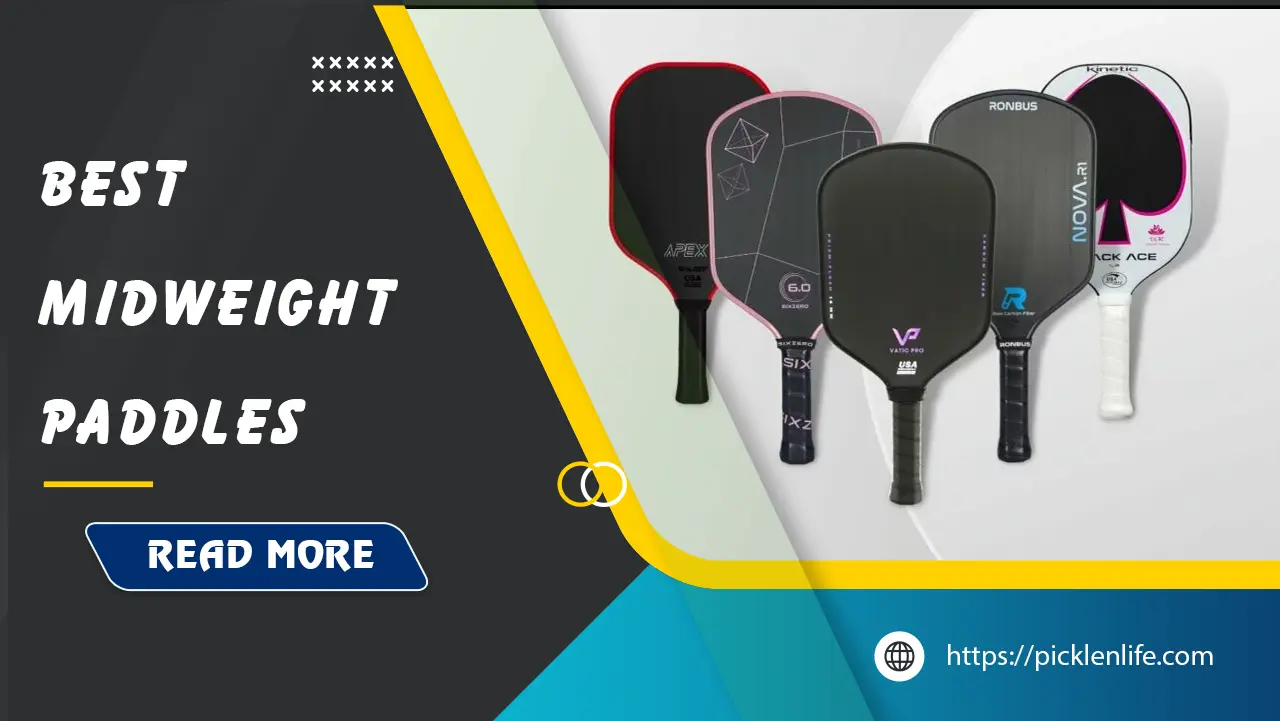
The best midweight pickleball paddles in 2026 are the JOOLA Ben Johns Perseus Pro IV 16mm (best overall), the Selkirk AMPED Epic (best for control), the Paddletek Bantam EX-L Pro (best for intermediate players), the Bread & Butter Invader (best all-court hybrid), the Six Zero Ruby 16mm (best for soft game players), the Engage Pursuit MX 6.0 (best for spin), the HEAD Radical Pro (best for power), and the Vatic Pro Prism Flash (best budget pick).
Midweight paddles — those falling in the 7.8 to 8.4 oz range — occupy the performance sweet spot of the weight spectrum. You get enough mass behind the ball for solid drives and put-aways while maintaining the speed needed to reset quickly at the kitchen line. That balance explains why roughly 65–70% of recreational and competitive players gravitate toward this weight class.
The challenge is that “midweight” is not a single thing. An 8.0 oz raw carbon fiber paddle with a 16mm polymer core plays completely differently from an 8.1 oz fiberglass widebody, even if both carry the same label. Face material, core thickness, and balance point interact with raw weight in ways that determine whether a paddle suits your game or fights against it.
Below you will find detailed reviews of eight paddles representing the best the midweight category has to offer in 2026, followed by a buying framework to match the right paddle to your playing style, skill level, and physical needs.
What Is a Midweight Pickleball Paddle?
A midweight pickleball paddle falls in the 7.8 to 8.4 oz range, occupying the middle ground between featherlight finesse tools and the heavier, drive-focused options at 8.5 oz and above. Most modern paddles from major manufacturers land somewhere in this window by default — a reflection of how well the weight class serves a wide range of play styles.
The Exact Weight Range: 7.8–8.4 oz
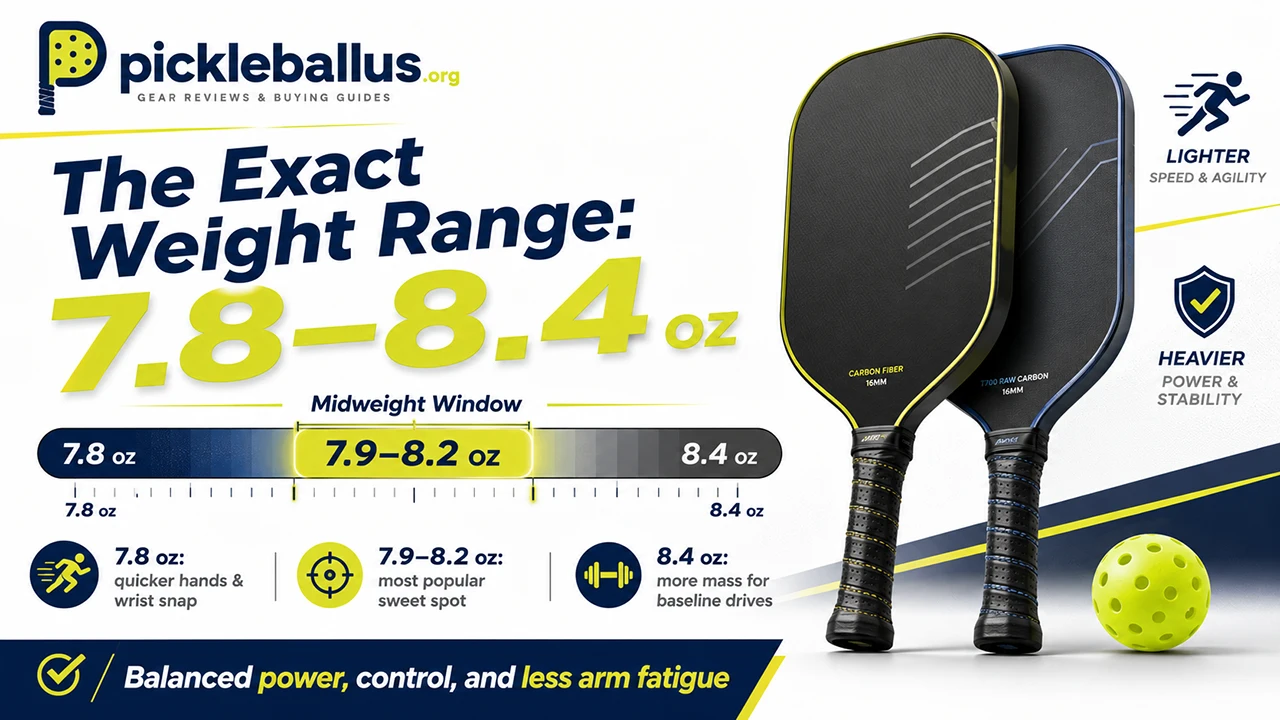
The 7.8 to 8.4 oz range is the industry-accepted midweight window, though some manufacturers use slightly different cutoffs depending on their product line. At 7.8 oz, a paddle borders on the best lightweight pickleball paddles category and rewards players who rely on quick hands and wrist snap. At 8.4 oz, the paddle approaches heavier territory, favoring baseline grinders who want more mass behind two-handed drives.
The most popular sub-range is 7.9 to 8.2 oz, where the majority of best-selling paddles land. At this weight, you generate enough momentum for sharp groundstrokes without the arm fatigue that comes with heavier options. For players logging three or more sessions per week, staying in this core window also reduces cumulative stress on the elbow and shoulder.
How Midweight Differs From Lightweight and Heavyweight
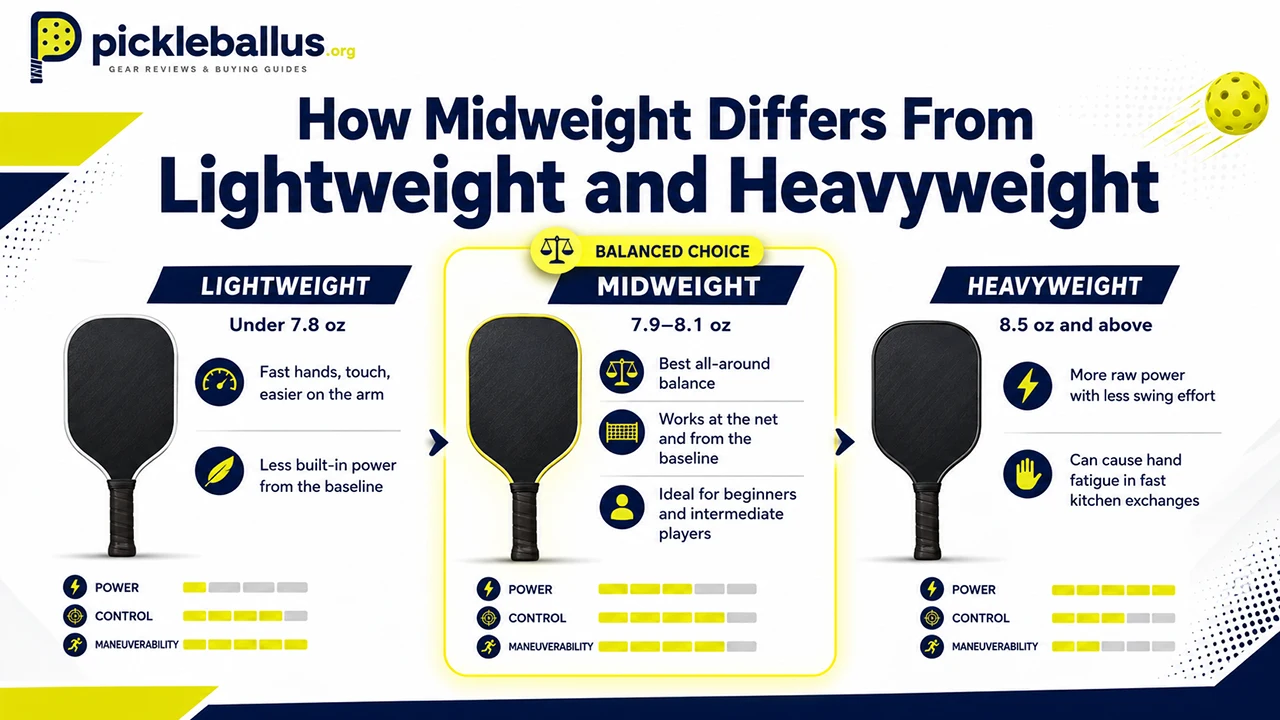
Lightweight paddles (under 7.8 oz) prioritize reaction speed and touch. They suit players who spend most of their time at the net, rely on two-handed resets, or have existing elbow concerns. The tradeoff is that generating power from the baseline requires more deliberate swing mechanics, since the paddle contributes less momentum.
Heavyweight paddles (8.5 oz and above) deliver raw driving power with minimal swing effort. Singles specialists and aggressive baseliners gravitate here for ball-flattening capability. The downside is that sustained rapid kitchen exchanges cause hand fatigue, and extra weight magnifies any mechanics flaws in dink technique.
Midweight paddles avoid both extremes. They work for net play, baseline exchanges, and everything in between. According to pickleball paddle weight research across player skill levels, the 7.9–8.1 oz center range is where beginners and intermediate players see the fastest skill development — partly because the paddle does not resist natural swing mechanics in either direction.
8 Best Midweight Pickleball Paddles in 2026
The following eight paddles were selected based on verified sales data, player reviews, build quality, and consistent availability on Amazon. Every product below receives a full review covering specs, performance, pros, cons, and a clear best-for recommendation.
#1 JOOLA Ben Johns Perseus Pro IV 16mm — Best Overall
The JOOLA Perseus Pro IV 16mm is the benchmark all-court midweight paddle of 2025–2026. It earns that status through genuine versatility, consistent feel, and pro-level technology that translates to recreational play.
Key Specs:
- Weight: ~7.9–8.1 oz (midweight)
- Core: 16mm polymer + high-density foam throat section
- Face: Raw carbon fiber (CFS technology)
- Shape: Elongated hybrid
- Grip length: 5.5 inches
Performance Analysis:
What separates the Perseus Pro IV from its predecessor is the high-density foam section built into the throat area. This addition increases dwell time noticeably — the ball stays on the face longer, giving you better feel and more ability to shape shots. During kitchen exchanges, the paddle communicates reset quality in a way that cheaper alternatives cannot replicate.
Power generation is substantial for a 16mm build. The raw carbon face grabs the ball with enough texture to produce meaningful spin without requiring the aggressive wrist action that thinner paddles demand. Drives land flatter and with more pace than most players expect from a control-oriented core width.
One nuance to know: the elongated shape adds reach and leverage at the expense of the enlarged sweet spot you find on standard-shape paddles. Players transitioning from tennis will find the shape intuitive; players coming from recreational pickleball with a widebody paddle may need a brief adjustment period.
Pros:
- Excellent balance of power and touch
- Throat foam adds real forgiveness and dwell time
- Raw carbon face delivers strong spin potential
- Consistent performance throughout the paddle’s lifespan
Cons:
- Elongated shape has a narrower sweet spot than widebody options
- Premium pricing reflects its flagship position
Best For: Intermediate to advanced all-court players who want one paddle that performs well in every situation without a clear weakness.
My Verdict: The Perseus Pro IV 16mm is the best single-paddle investment in the midweight category right now. Its strengths — feel, spin, forgiveness — show up in both grinding baseline rallies and fast kitchen exchanges. If you are buying one midweight paddle this year, start here.
#2 Selkirk AMPED Epic — Best for Control Players
The Selkirk AMPED Epic is the standard-shape midweight paddle from one of the most trusted names in pickleball. It remains a top choice for players who prioritize soft-game dominance and precise placement over raw power.
Key Specs:
- Weight: ~8.0–8.2 oz (midweight)
- Core: Polypropylene FiberFlex honeycomb
- Face: FiberFlex fiberglass
- Shape: Traditional/standard
- Grip length: 4.75 inches
Performance Analysis:
The AMPED Epic is built around FiberFlex fiberglass face technology, which produces a softer response than carbon fiber paddles. That softness translates directly to better touch on drops and dinks — the ball absorbs into the face slightly rather than deflecting off a harder surface. Players whose game centers on kitchen work will find the Epic’s feel genuinely enjoyable to play with over extended sessions.
Spin generation is moderate. Fiberglass does not produce the same raw friction that textured carbon delivers, which is a tradeoff for added feel. For players at the 3.0–4.0 level whose game is built on consistency and angle play rather than heavy topspin, this limitation rarely decides points.
The standard shape provides a large, forgiving sweet spot that reduces the cost of off-center contact — a meaningful advantage for players still refining their mechanics. The shorter grip suits two-handed backhand players less well, but singles-grip players will find the handle proportions comfortable for extended sessions.
Pros:
- Superb touch and feel for dinking and drop shots
- Wide sweet spot on standard shape
- Trusted brand with consistent build quality
- Vibration absorption makes long sessions comfortable
Cons:
- Lower spin ceiling compared to raw carbon alternatives
- Shorter grip limits two-handed backhand development
Best For: 3.0–4.0 players who prioritize consistency, dink quality, and forgiving contact over spin-heavy aggressive play.
My Verdict: The Selkirk AMPED Epic remains one of the best control paddles in the midweight class. If your game is built on patience, placement, and kitchen discipline, the Epic rewards that style better than most midweight alternatives.
#3 Paddletek Bantam EX-L Pro — Best for Intermediate Players
The Paddletek Bantam EX-L Pro targets intermediate players who have outgrown entry-level paddles and need a midweight option that rewards developing technique without demanding advanced mechanics to unlock its performance.
Key Specs:
- Weight: ~8.0–8.3 oz (midweight)
- Core: Smart Response Technology polymer
- Face: Textured fiberglass/composite blend
- Shape: Standard widebody
- Grip length: 4.25 inches
Performance Analysis:
Paddletek’s Smart Response Technology core differs from a standard polymer honeycomb. Core density varies across zones — firmer at center for power shots, softer at the edges to absorb mishits. For intermediate players whose contact point is still inconsistent, this zone differentiation provides meaningful error forgiveness that a uniform-core paddle cannot offer.
Ball control is excellent for its price tier. The composite face balances the softness of fiberglass with the spin potential of carbon, landing in a middle zone that suits an all-court game without committing fully to either end. Drop shots land with predictable depth, and drives carry well without requiring a full shoulder turn.
The shorter handle disadvantages players developing a two-handed backhand, but for one-handed players it remains comfortable. The widebody shape maximizes contact area, reducing unforced errors significantly during transition periods when mechanics are still developing.
Pros:
- Zone-differentiated core helps with off-center forgiveness
- Widebody shape maximizes contact area
- Reliable performance across all shot types
- Strong Amazon sales history and reviews
Cons:
- Short grip limits two-handed backhand play
- Less spin potential than raw carbon alternatives
Best For: Intermediate players (3.0–3.5) making their first serious paddle upgrade, and recreational players who want a durable all-court option without advanced-tier pricing.
My Verdict: The Paddletek Bantam EX-L Pro earns its reputation as the go-to intermediate upgrade paddle. The zone-differentiated core is a real advantage — not a marketing claim — and it shows in match play as fewer frustrating mishits during transition.
#4 Bread & Butter Invader — Best All-Court Hybrid
The Bread & Butter Invader is a midweight hybrid paddle that earned Gold in the All-Court category at the 2025 Hot List. Its material combination delivers a feel unlike anything else in this weight class at the time of testing.
Key Specs:
- Weight: ~8.0–8.2 oz (midweight)
- Core: Foam-polymer hybrid blend
- Face: Hybrid proprietary material
- Shape: Standard/hybrid
- Grip length: 5.25 inches
Performance Analysis:
The Invader combines a foam-polymer hybrid core with a proprietary face material that produces what testers consistently describe as “soft but lively” response. The ball has noticeable dwell on drops without losing the pop needed on drives — a combination most paddles achieve at one end or the other, rarely both simultaneously.
For all-court play — points that move from kitchen exchanges to mid-court resets to baseline drives within a single rally — the Invader maintains consistent performance across all zones. Many paddles sacrifice net feel for baseline power or vice versa. The Invader’s hybrid construction handles both phases of a point credibly.
The longer grip accommodates two-handed backhands naturally, a growing technique at the 3.5–4.5 level. The balance point sits slightly handle-heavy, which reduces swing weight and makes the paddle feel quicker in hand battles than its nominal weight suggests.
Pros:
- Genuine balance of performance for all-court play
- Hybrid core delivers both feel and pop
- Longer grip suits two-handed backhand development
- Independent Hot List Gold recognition (2025)
Cons:
- Proprietary material harder to find at retail than established brands
- Adjustment period for players switching from uniform-core paddles
Best For: 3.5–4.5 players who play a complete game and want one paddle that performs across all court positions without a clear weakness.
My Verdict: The Bread & Butter Invader is the most interesting paddle in this list from a materials standpoint. If you play an all-court style and need consistent performance at the net and the baseline, the Invader deserves a close look.
#5 Six Zero Ruby 16mm — Best for Soft Game Players
The Six Zero Ruby 16mm is the control-specialist midweight paddle in this roundup, built for players whose game lives at the kitchen line and whose primary concern is drop shot quality, reset consistency, and dinking precision.
Key Specs:
- Weight: ~7.9–8.1 oz (midweight)
- Core: 16mm polypropylene polymer
- Face: Textured carbon fiber
- Shape: Elongated hybrid
- Grip length: 5.5 inches
Performance Analysis:
The Ruby 16mm combines a thick 16mm polymer core with a textured carbon face to create a paddle oriented toward control. The 16mm depth softens response at the face, reducing the trampoline effect that thinner cores create. The result is a paddle where you feel you can place the ball with precision rather than manage its deflection.
Dinking performance is the Ruby’s standout strength. The ball stays on the face long enough that advanced players report genuinely shaping drop angles with accuracy. For players competing at 4.0 and above where kitchen battles decide most points, this level of control creates real competitive value.
Power is adequate but not the focus. The thick core absorbs some energy on drives, meaning you need deliberate swing mechanics to generate pace from the baseline. Players who construct points through placement, spin variation, and patience will thrive; power-first players may find the Ruby limits their driving game.
Pros:
- Outstanding dink and drop shot control
- Textured carbon face adds spin on groundstrokes
- 16mm core provides consistent, predictable feel
- Excellent for kitchen-dominant play styles
Cons:
- Reduced drive power compared to thinner-core alternatives
- Best suited to players with established soft-game mechanics
Best For: 4.0+ players who play a patient, kitchen-dominant game and prioritize control and placement over raw pace.
My Verdict: The Six Zero Ruby 16mm ranks among the best pickleball paddles for control in the midweight class. If your game is built on soft hands and strategic placement rather than aggressive finishing, the Ruby is worth serious consideration.
#6 Engage Pursuit MX 6.0 — Best for Spin
The Engage Pursuit MX 6.0 is the spin-specialist pick in this midweight lineup, featuring surface texture and face construction that generates some of the highest RPM numbers in its category.
Key Specs:
- Weight: ~8.0–8.2 oz (midweight)
- Core: Polymer + Engage proprietary technology
- Face: Textured composite (high-friction)
- Shape: Standard widebody
- Grip length: 4.5 inches
Performance Analysis:
Engage’s high-friction face technology grabs the ball aggressively at contact, generating topspin and slice that players using smoother surfaces struggle to match. On third-shot drops with heavy topspin, the ball dips quickly into the kitchen — a tactical weapon that becomes increasingly important at 3.5–4.5 level play where opponents handle flat balls comfortably.
The widebody shape on the Pursuit MX 6.0 ensures spin potential is accessible across the full contact zone, not just the center. Off-center drives with topspin still carry well, giving the paddle forgiveness that narrower spin paddles sacrifice.
The balance is responsive. The Engage sits slightly head-light, allowing quick wrist action to complement the textured face on spin shots. The combination of face friction and quick swing response makes the Pursuit MX 6.0 rewarding for players who like to shape the ball aggressively from anywhere on the court.
Pros:
- High-friction face generates strong topspin and slice
- Widebody shape maintains spin even on off-center contact
- Head-light balance enables quick wrist action
- Strong reputation among spin-style players at 3.5–4.0
Cons:
- High-friction surfaces wear faster than smoother faces
- Power-first players may not fully exploit the spin advantage
Best For: 3.5–4.5 players who rely on topspin drives and heavy slice shots to create errors, and those who want to develop spin as a primary weapon.
My Verdict: If adding spin as a genuine tactical tool is your goal in the midweight category, the Engage Pursuit MX 6.0 is the most direct path. The face texture is meaningfully different from standard surfaces, and that difference shows in match play.
#7 HEAD Radical Pro — Best for Power
The HEAD Radical Pro brings the brand’s racquet-sport construction heritage into the pickleball midweight category with a paddle engineered for players who want baseline power alongside enough touch to remain competitive at the net.
Key Specs:
- Weight: ~8.1–8.3 oz (midweight, upper end)
- Core: Polymer Ergo-Comfort core
- Face: Graphite composite
- Shape: Standard
- Grip length: 4.5 inches
Performance Analysis:
At the upper end of the midweight range, the HEAD Radical Pro uses its additional mass for enhanced drive power without crossing into true heavyweight territory. The graphite composite face provides a firm response that amplifies pace on flat drives, while the Ergo-Comfort core balances that firmness with enough vibration dampening to keep the paddle comfortable over multiple hours of play.
Against hard-hitting opponents, the Radical Pro holds up well as a counter-punching tool. The firmer face returns pace efficiently, suiting players who prefer to redirect aggressive shots rather than absorb them. The balance point sits slightly head-heavy, compounding the paddle’s power orientation without demanding significant extra swing effort.
For intermediate players coming from a tennis background — where a heavier hitting tool is the default — the HEAD Radical Pro often feels like the most natural transition paddle. Brand familiarity, conventional shape, and power-forward performance all align with tennis player expectations.
Pros:
- Strong drive power from the upper midweight range
- Firm graphite face returns pace efficiently
- Natural feel for tennis players transitioning to pickleball
- Good vibration dampening for a firm-face construction
Cons:
- Less touch-oriented than foam-core or thick-polymer alternatives
- Slightly head-heavy feel may not suit finesse players
Best For: Intermediate power players and tennis converts who want a midweight paddle with a driving-game orientation and a familiar feel.
My Verdict: The HEAD Radical Pro is the right choice if power is your primary concern within the midweight range and you are not ready for true heavyweight territory. Its tennis-heritage construction gives a natural feel for players making the cross-sport transition.
#8 Vatic Pro Prism Flash — Best Budget Midweight
The Vatic Pro Prism Flash is the budget entry in this list, and it consistently over-delivers for its price point — offering raw carbon fiber performance at a fraction of what flagship paddles command.
Key Specs:
- Weight: ~7.9–8.1 oz (midweight)
- Core: 16mm polymer honeycomb
- Face: Raw carbon fiber (T700)
- Shape: Hybrid elongated
- Grip length: 5.5 inches
Performance Analysis:
The Prism Flash uses T700 raw carbon fiber, the same material class found in paddles selling at two to three times its price. The textured surface generates significant spin, the 16mm core adds control depth, and the elongated shape provides reach advantage without sacrificing too much sweet spot area.
What you give up at the budget price point is primarily polish — the Vatic Pro’s edge guard finishing and grip quality are less refined than JOOLA or Selkirk flagship products, and the paddle shows edge wear sooner with heavy use. The playing surface itself, however, performs consistently well. Many intermediate players who have switched from premium paddles report a surprisingly small performance gap.
For players unsure whether to invest in a flagship paddle, or for those who want a high-performance practice paddle for doubles, the Vatic Pro Prism Flash represents genuine value in the midweight category.
Pros:
- Raw carbon fiber performance at a budget price point
- 16mm core depth delivers control alongside spin
- Strong Amazon reviews and verified sales history
- Elongated shape suits two-handed backhand development
Cons:
- Build finishing quality below premium brands
- Edge guard durability shorter than flagship alternatives
- Less vibration dampening than paddles with advanced core tech
Best For: Budget-conscious intermediate players, new players making their first serious upgrade, and players who want a high-performance backup without premium pricing.
My Verdict: The Vatic Pro Prism Flash is the easiest recommendation for anyone on a budget. Raw carbon fiber at this price represents real value, and the performance gap versus paddles at double or triple the price is narrower than you would expect.
Does Midweight Actually Give You Better Power AND Control?
Yes, midweight paddles genuinely deliver better all-court balance than either extreme — but the claim requires more nuance than marketing copy provides. Paddle weight interacts with your swing mechanics in specific ways, and understanding that relationship is what lets you extract the balance advantage.
The Physics of Swing Weight vs Static Weight
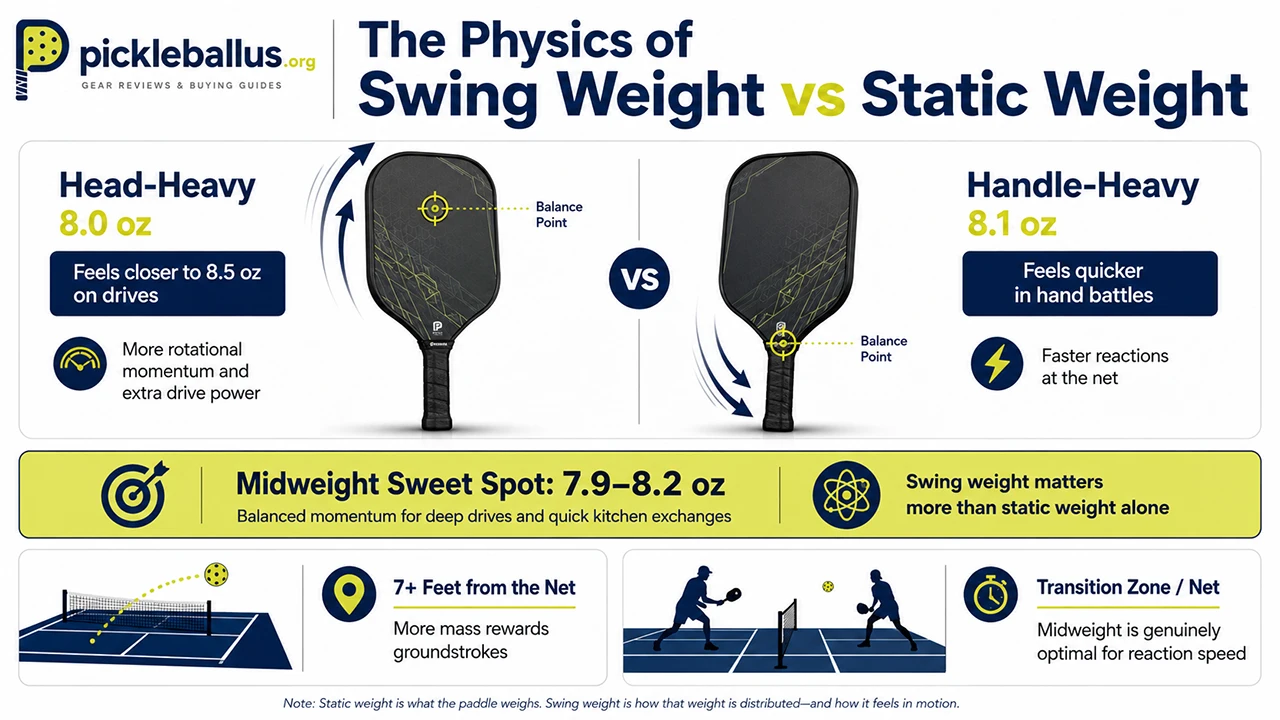
Swing weight — how the paddle’s mass distribution affects rotational momentum — matters more than static weight alone. A 8.0 oz paddle with a head-heavy balance behaves more like an 8.5 oz paddle for drive power. Conversely, an 8.1 oz paddle with a handle-heavy balance feels quicker in hand battles than the label suggests.
Midweight paddles in the 7.9–8.2 oz range typically distribute mass evenly enough that this effect stays moderate. The paddle generates enough momentum for deep drives while remaining fast enough for quick kitchen exchanges. Most points decided at the net are won by reaction time — which is where head-heavy or true heavyweight paddles lose their edge against a well-prepared opponent.
For players hitting primarily from seven feet and beyond, additional mass provides a more rewarding response on groundstrokes. For players constructing most points inside the transition zone, the midweight range is genuinely optimal rather than a compromise.
When to Go Upper vs Lower Midweight Within the Range
Within the 7.8–8.4 oz window, upper midweight (8.2–8.4 oz) suits players who hit primarily from the baseline, play in windy outdoor conditions, or come from a tennis background where heavier hitting tools are the norm. Lower midweight (7.8–8.0 oz) suits players who spend more time at the net, play a two-handed reset game, or manage existing elbow or shoulder concerns.
If you play a genuinely mixed style — baseline and net, offense and defense — the 7.9–8.1 oz center range gives maximum flexibility. Most of the paddles in this list land in this zone deliberately.
How to Choose the Right Midweight Paddle for Your Game
Among all the best pickleball paddles reviewed across weight classes, the midweight category demands three clear decisions: matching paddle weight to your playing style, selecting the right core thickness and face material combination, and confirming grip dimensions fit your hand.
Net Player vs Baseline Player Weight Preferences
Net-dominant players — those who rush the kitchen, rely on soft drops, and win points through placement at seven feet — benefit most from the lower end of midweight (7.8–8.1 oz). Quicker hand speed and faster swing recovery between contacts matter more than maximum drive power at this court position.
Baseline-dominant players — those who stay back, hit driving groundstrokes, and create put-away opportunities from distance — benefit from upper midweight (8.1–8.4 oz). The additional mass provides free momentum behind each strike, reducing swing effort for the same ball speed.
All-court players who move between both zones regularly are the natural midweight target audience. The 7.9–8.2 oz range serves this profile best, and most of the recommendations in this list land there for that reason.
Core Thickness (13mm vs 16mm) and Face Material Tradeoffs
Core thickness primarily controls touch and pop. A 16mm core produces more dwell time and control. A 13mm or 14mm core produces a livelier, faster response with more natural power but less feel on soft shots. For midweight paddles, most high-performance options now ship with 16mm cores as the default.
Face material controls spin potential and ball response. Raw carbon fiber (T700 or T800) provides the highest friction and spin ceiling. Fiberglass or composite provides a softer, more forgiving response. Graphite sits between the two in firmness and spin potential.
For a full breakdown of how these material choices behave differently at different weights, the lightweight vs midweight pickleball paddle comparison guide covers the tradeoffs in detail.
Grip Size and Handle Length Considerations
Grip circumference is the most commonly neglected paddle spec. A grip too large prevents proper wrist snap, reducing both spin and control. A grip too small creates forearm tension that accelerates fatigue. The standard test: wrap your grip hand around the paddle; you should have roughly a finger-width gap between fingertips and palm.
Handle length matters most for players developing or using a two-handed backhand. A minimum of 5.25 inches is generally recommended for comfortable two-handed technique. Paddles with handles under 4.75 inches effectively limit you to a one-handed game, regardless of what your preference or development goals may be.
By now you have a clear picture of which midweight paddles deliver the best power-control balance across different playing styles, skill levels, and budgets. Choosing the right paddle is only half the equation — how you evaluate weight before purchasing, whether midweight suits your specific physical situation, and how construction technology differences translate to real on-court performance are the details that separate confident buyers from regretful ones. The next section covers the finer points experienced players know before committing to a midweight purchase.
What Else Should You Know Before Buying a Midweight Paddle?
How to Test Paddle Weight Without Buying It
The most reliable test before purchasing is a 30-minute demo session if a local retailer or club offers demo paddles. Within that window, run through kitchen drills, third-shot drop practice, and a few games. Fatigue signals too much weight; slow reaction times signal too little.
If no demo is available, a useful proxy is testing your existing paddle with lead tape added to specific positions. Adding 0.5 oz of tape to the face of a lighter paddle simulates a heavier midweight. Removing the tape tells you whether the lighter version performs better in your hands. This is an imperfect test, but it narrows the decision before committing budget to a new paddle.
Will a Midweight Paddle Help Tennis Elbow?
Not automatically, and this deserves a direct answer. Paddle weight is one of several factors in elbow stress, not the primary one. A 7.5 oz paddle with a stiff graphite face can cause more arm stress than an 8.1 oz paddle with a vibration-dampening polymer core, because impact shock — not swing weight — is the dominant variable in lateral epicondylitis.
If elbow health is a concern, prioritize core construction (thick polymer with vibration dampening) and face material (softer fiberglass or foam-blend rather than stiff graphite) over the weight spec. Many players have found that switching to a purpose-built best pickleball paddles for tennis elbow within the midweight range resolved symptoms better than dropping to a lighter paddle alone.
Thermoformed vs Standard Midweight Paddles: Does Construction Matter?
Yes, increasingly so. Thermoformed paddles — where the face material bonds to the core under heat and pressure — produce a more consistent and durable playing surface than standard glued construction. The face is less likely to delaminate, and energy transfer from ball contact to the core is more uniform across the paddle’s lifespan.
At the midweight performance level, most paddles above a mid-range price point now use thermoformed construction. For budget options like the Vatic Pro Prism Flash, the construction process is less consistent, contributing to the faster edge wear noted in the review. For competitive players, thermoformed construction is worth the premium if your game demands sustained performance over hundreds of sessions.

Write Your Review
No reviews yet. Be the first to share your experience!