

The best core for your pickleball paddle depends on what you value most: foam cores deliver superior durability, vibration dampening, and soft touch at the kitchen line, while polymer honeycomb cores return energy more efficiently for crisp pop and aggressive baseline play. Neither is universally better — they solve different problems for different players.
Choosing between them gets muddier because the market has blurred the lines. Some paddles called “polymer” now include foam edge walls. Others labeled “foam core” vary wildly depending on whether the foam is EPP, MPP, or a hybrid construction with internal voids. And with over 51% of surveyed competitive players now using full foam cores, this is clearly more than a passing trend.
The core of your paddle — literally the material sandwiched between its two face layers — controls how much power you generate, how long the ball sits on the face, whether your arm aches after two hours of play, and whether the paddle feels the same six months from now as it did on day one. For a sport played at close range with fast reaction times, those differences compound fast.
Below, this guide breaks down foam vs polymer cores across every performance dimension that matters, tells you exactly which player profile suits each type, and reviews six paddles — three foam, three polymer — currently worth your attention.
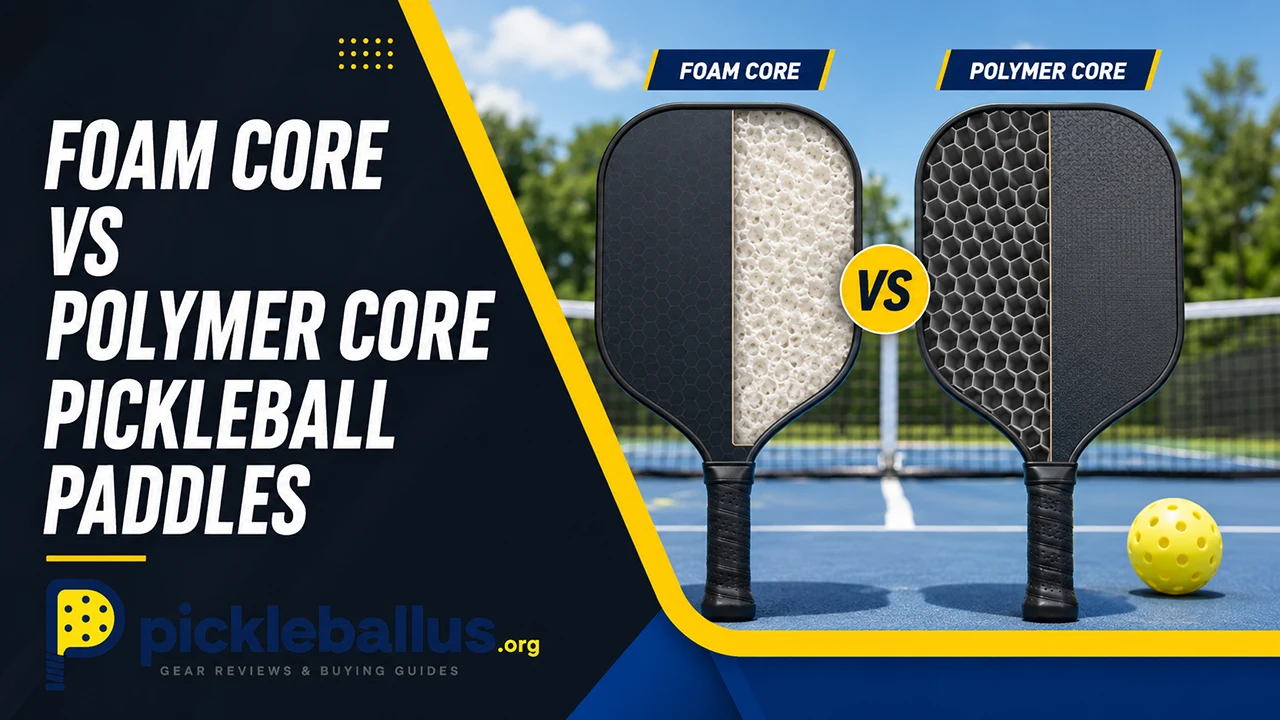
What Are Foam Core and Polymer Core Pickleball Paddles?
Polymer honeycomb and full foam are the two dominant internal core structures on the market today, and understanding what’s actually inside your paddle is the foundation of any smart buying decision. The pickleball paddle materials landscape has changed significantly since 2022, with foam going from a perimeter add-on to the main event.
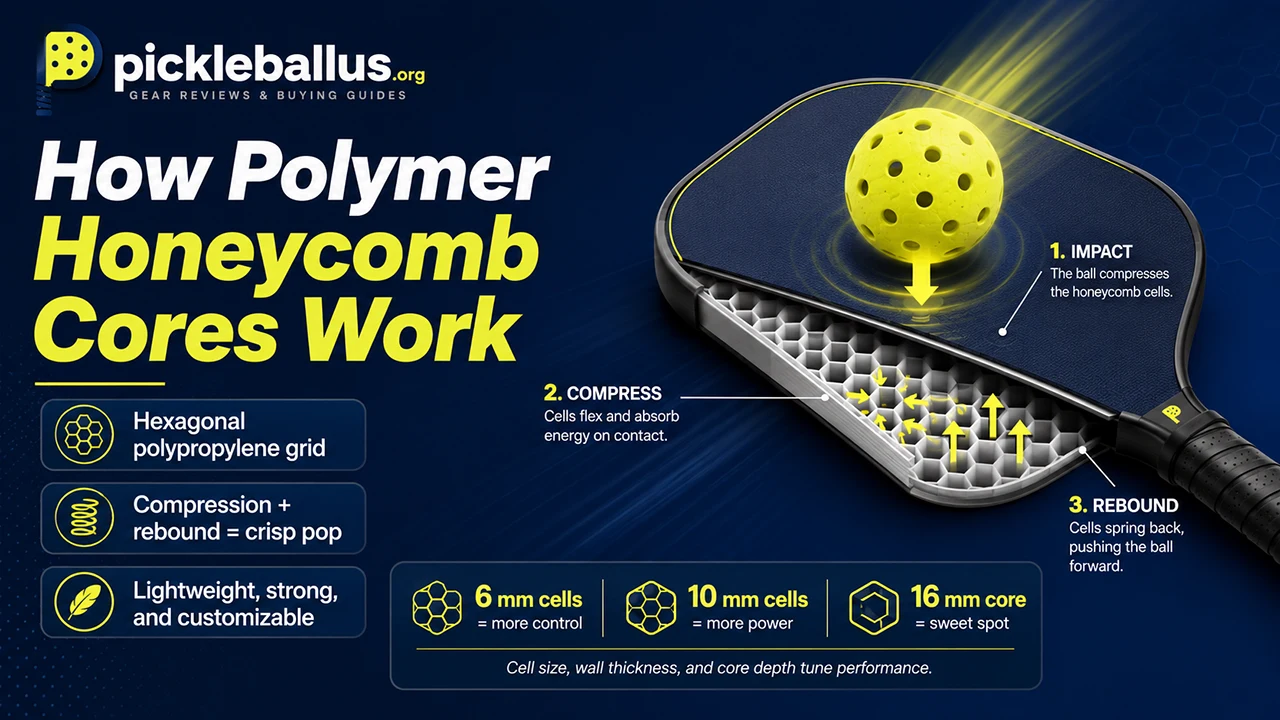
How Polymer Honeycomb Cores Work
Polymer cores use a polypropylene plastic grid arranged in tight hexagonal cells — the same honeycomb geometry used in aerospace panels for its strength-to-weight ratio. The cells compress slightly when the ball strikes the paddle face, then spring back to push the ball forward. That compression-rebound cycle is what gives polymer paddles their characteristic crisp pop and efficient energy return.
Manufacturers tune performance by adjusting three variables: cell size (6mm cells = more control, denser feel; 10mm cells = more power, slightly less consistency), cell wall thickness (thinner walls = more pop), and overall core depth (16mm is the current sweet spot for most players, balancing dwell time and forgiveness). This flexibility made polymer honeycomb the dominant core for three decades — lightweight, strong, and customizable to a degree that wood and aluminum cores never were.
How Foam Cores Work — and Why They’re Different
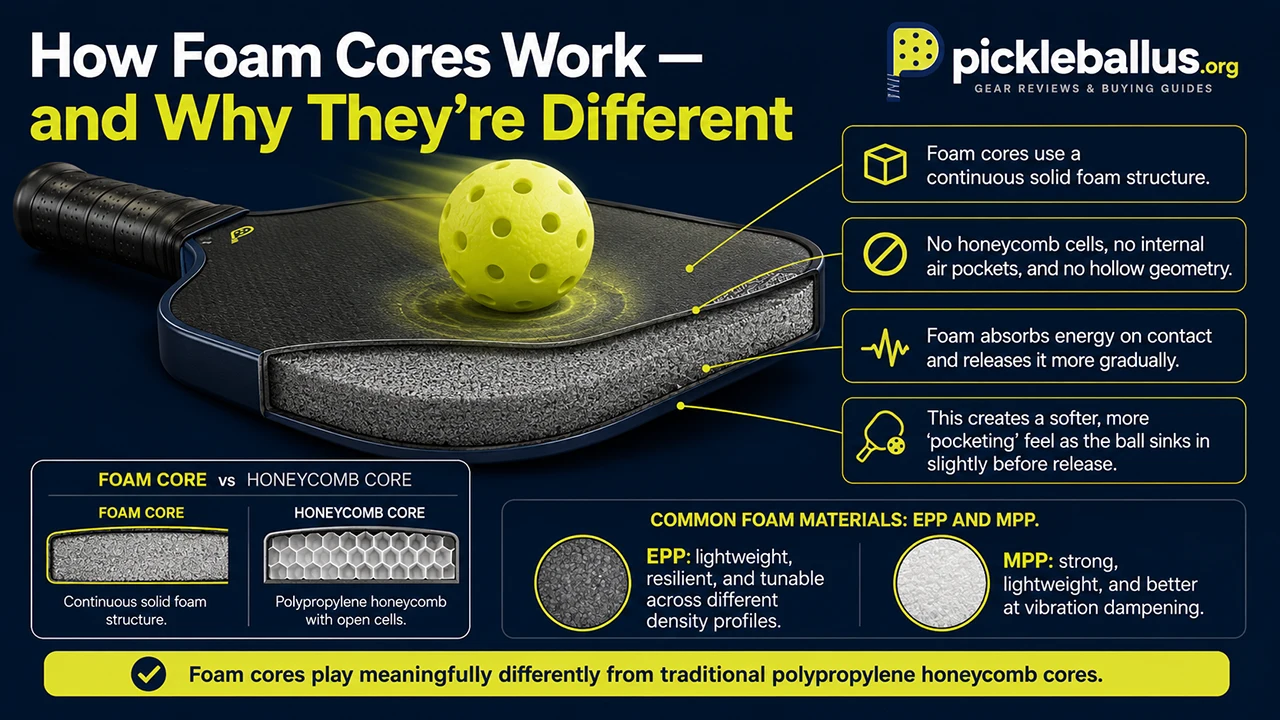
Foam cores replace the honeycomb grid with a continuous solid foam structure. There are no internal air pockets, no cells that can buckle, and no hollow geometry to collapse under repeated impact. Instead, the foam absorbs energy on contact and releases it more gradually, creating the softer, more “pocketing” sensation that foam core players describe — the feeling of the ball sinking slightly into the paddle face before releasing.
The two most common foam materials are EPP (expanded polypropylene) and MPP (micro-porous polymer). EPP has become the backbone of the foam movement: it’s lightweight, resilient, and can be engineered into different density profiles across the paddle face. MPP adds strength-to-weight advantages with better vibration dampening. Both are meaningfully different from the polypropylene honeycomb that dominated for decades, and the gap in how they play is larger than marketing copy suggests.
Foam Core vs Polymer Core: Head-to-Head Comparison
The following table gives a quick overview before the section dives into each dimension:
| Dimension | Foam Core | Polymer Core |
|---|---|---|
| Power output | Moderate — absorbs impact | High — rebounds energy efficiently |
| Control & dwell time | Higher dwell, softer touch | Crisper response, faster release |
| Durability | Resists core crush | Vulnerable to cell collapse over time |
| Vibration | Dampened, arm-friendly | More vibration transmitted to hand |
| Weight | Typically mid to heavy | Lighter options available |
| Price range | Mid to premium | Budget through premium |
Power and Energy Return
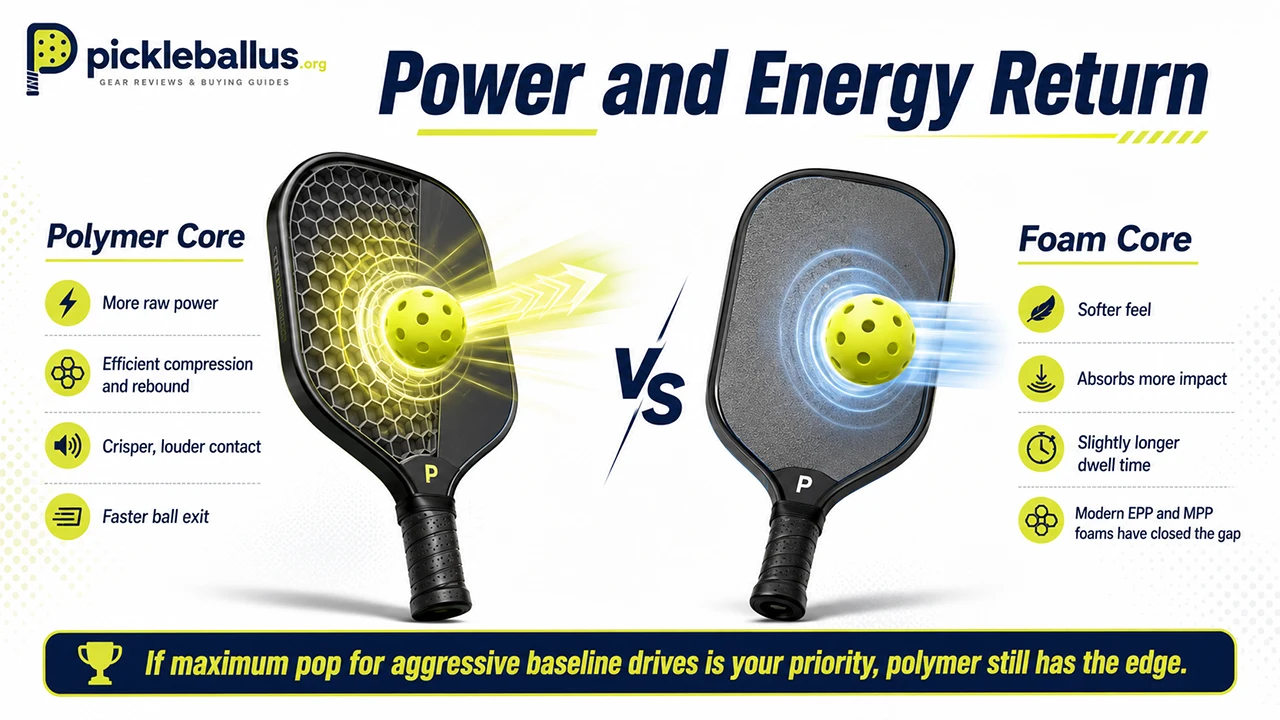
Polymer cores generate more raw power because the honeycomb structure compresses and rebounds efficiently, returning a higher percentage of the ball’s impact energy back to the shot. The result is a crisper, louder sound on contact and a ball that leaves the paddle face faster.
Foam cores absorb more of that energy. The ball spends slightly more time in contact with the surface, and some of the impact is dissipated into the foam rather than returned. Early foam paddles from 2022–2023 were noticeably underpowered for this reason, which fed the skepticism. Modern EPP and MPP foams have closed the gap considerably — but if maximum pop for aggressive baseline drives is your priority, polymer still has the edge.
Control, Feel, and Dwell Time
Foam cores produce longer dwell time, meaning the ball stays in contact with the paddle face a fraction longer per shot. For soft game players — anyone who prioritizes third-shot drops, dinks, and reset shots at the non-volley zone — that extra dwell translates directly to better placement on touch shots. Players describe the feel as “connected” or “pocketed.”
Polymer cores feel crisper and more responsive. The feedback is faster and more immediate, which some players prefer for volleys and speed-ups where reaction time matters more than touch. Ben Johns, who plays the JOOLA Perseus Pro IV, has cited this sensation of direct connection between paddle and ball as a key reason he sticks with polymer construction. His preference is meaningful data — though not the only data point that matters.
Durability and Long-Term Performance
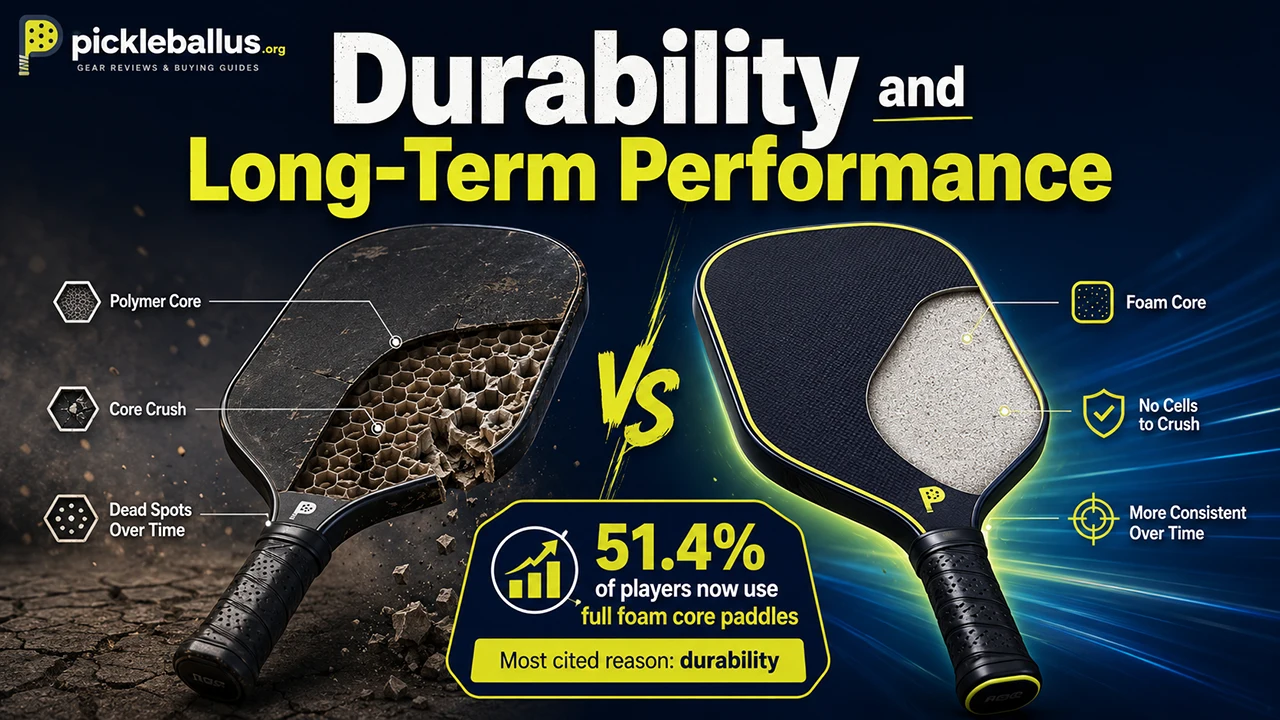
This is where foam cores make their strongest argument. Polymer cores fail through core crush — the gradual collapse of the hexagonal cells under repeated impact and the heat stress of thermoforming during manufacture. Dead spots develop slowly, often without players noticing, until the paddle suddenly feels flat and unresponsive. By that point, the paddle is effectively done.
Foam cores don’t have cells to crush. The continuous structure maintains its playing characteristics over months of regular use. Pickleball Effect’s Main Paddle Monitor found that 51.4% of players surveyed now report using a full foam core paddle — and the most cited reason isn’t performance, it’s durability. For anyone who plays three or more times per week, the extended lifespan alone can justify the cost difference.
Weight, Sound, and Vibration Dampening
Foam cores tend to run slightly heavier than equivalent polymer builds, which is a trade-off worth knowing before you buy. A polymer paddle at the same face dimensions may come in noticeably lighter, which matters for players who rely on quick hands at the net.
On vibration, foam wins cleanly. The continuous foam structure absorbs shock on off-center hits, reducing the harsh feedback that travels up the arm with polymer paddles. If you’ve dealt with arm fatigue, golfer’s elbow, or early-stage tennis elbow, a foam core paddle can make a real difference in how you feel after two hours of play. Players looking for the best pickleball paddles for tennis elbow will find foam core options consistently recommended by coaches and physical therapists for this reason.
Which Core Type Fits Your Playing Style?
Choose a Foam Core Paddle If You…
- Play frequently (3+ sessions per week) and need a paddle that holds its performance for a season or more
- Prioritize soft game and kitchen control — third-shot drops, dinks, and resets where dwell time improves placement
- Experience arm discomfort or fatigue with stiffer polymer builds; foam’s vibration dampening is a meaningful physical benefit
- Are upgrading from a dead polymer paddle and want to avoid going through the same experience in another 6–8 months
- Play at 3.5 or higher where consistency over hundreds of shots matters as much as peak power
Choose a Polymer Core Paddle If You…
- Play casually (1–2 times per week) and don’t need premium durability; a quality polymer paddle serves you well without the foam price premium
- Prioritize maximum power output for aggressive baseline rallies; polymer’s energy return still outperforms foam in raw pop
- Are a beginner focused on developing technique; the additional cost of foam cores doesn’t pay off until your game is consistent enough to feel the difference
- Prefer crisp, immediate feedback on every shot; some competitive players find foam’s softer feel disconnecting rather than helpful
- Modify your paddle weight regularly with lead tape; polymer construction gives more predictable response when adding mass
Best Foam Core Pickleball Paddles to Try
#1 CRBN TruFoam Genesis 4 — Best Overall Foam Core
The CRBN TruFoam Genesis 4 was the first full foam paddle to generate serious competitive attention, and it remains the clearest proof that foam technology can compete with the best polymer builds. CRBN replaced the traditional honeycomb interior with a proprietary single-piece foam block featuring engineered cutouts that shape the paddle’s power profile and sound signature.
Key specs: T700 raw carbon fiber face, full EPP foam core with internal voids, 16mm core depth, standard grip length, thermoformed construction.
Performance: The Genesis 4 plays with surprising pop for a foam core paddle — the internal void geometry channels energy return in ways that a solid foam block doesn’t. On touch shots, the dwell time is noticeably longer than any polymer paddle in its class, making kitchen exchanges feel more deliberate and controlled. Spin generation through the raw carbon face is excellent. The biggest adjustment for polymer veterans is the muted sound on contact; the Genesis 4 plays quieter, which reads as “dead” to some players in the first session but reveals itself as controlled feel over time.
Pros:
- Best-in-class durability — no core crush risk
- Superior vibration dampening for arm comfort
- Raw carbon face generates strong topspin
- Longer dwell time benefits soft game specialists
Cons:
- Learning curve for players used to crisp polymer pop
- Heavier than lightweight polymer options
- Premium price point
Best For: Frequent players at 3.5+ who play a balanced or control-heavy game and want a paddle that performs consistently across a full season.
My Verdict: The CRBN TruFoam Genesis 4 isn’t trying to imitate a polymer paddle — it’s making a case for a different performance philosophy. If you’ve been replacing polymer paddles every 8–10 months, the switch pays for itself.
#2 Vatic Pro V-Core Power — Best Budget Foam Core
The Vatic Pro V-Core Power is the affordable entry point into full foam construction without the compromises you’d expect at this tier. Vatic Pro built a following on aggressive pricing and solid construction, and the V-Core extends that reputation into the foam era.
Key specs: Carbon fiber face, full foam core, 16mm core depth, elongated shape option available, standard or elongated handle.
Performance: The V-Core Power delivers a noticeably softer feel than any polymer paddle in the same price range, with enough pop for competitive play at the recreational and 3.0–3.5 level. The elongated shape extends reach and shifts the sweet spot toward the top of the paddle, which suits baseline players who take most shots in the mid-court. Dwell time is solid but not as nuanced as the Genesis 4 — the foam density is slightly less refined, so the “pocketing” sensation is present but subtle.
Pros:
- Foam core durability at a mid-range price
- Reduced vibration compared to polymer competition
- Elongated shape option adds reach
- Good spin texture on the face
Cons:
- Less refined power profile than premium foam builds
- Foam density not as fine-tuned for tournament-level play
- Sound and feel may still feel unfamiliar to polymer veterans
Best For: Budget-conscious players at 2.5–3.5 who want to experience foam core benefits without committing to a premium price, or players testing foam technology before investing in a flagship paddle.
My Verdict: For the price, the Vatic Pro V-Core Power punches well above its weight. It’s the easiest recommendation for players curious about foam cores but not ready to spend on a flagship.
#3 Selkirk LABS Boomstik — Best for Kitchen Control
The Selkirk LABS Boomstik (Project 008) takes a different approach to foam engineering than CRBN. Rather than using internal void cutouts, the Boomstik features a single uninterrupted foam structure — no cuts, no channels — which produces one of the softest, most touch-oriented feels currently available in competitive pickleball.
Key specs: T700 carbon fiber face, full uninterrupted foam core, elongated blade shape, extended handle for two-handed backhand players.
Performance: The Boomstik plays like a kitchen specialist’s dream and a power player’s frustration. The fully continuous foam dampens energy transfer to a degree that pushes the power ceiling lower than the Genesis 4, but rewards it with the longest dwell time in this comparison. Drops, dinks, and roll volleys feel surgically precise. The elongated handle makes it an excellent choice for two-handed backhand players who want reach at the baseline without giving up control at the net. For aggressive baseliners, this paddle will feel restrictive.
Pros:
- Longest dwell time — best touch for kitchen-heavy players
- Premium build quality from a proven manufacturer
- Extended handle suits two-handed backhand style
- Elite durability with no core crush risk
Cons:
- Power ceiling is lower than comparable polymer and hybrid paddles
- Not suited to players who rely on power drives at the baseline
- Premium price with limited availability
Best For: Advanced players (4.0+) with a control-dominant game who spend most points working the kitchen and want a paddle that rewards deliberate shot-making.
My Verdict: The Boomstik is a specialized tool. If your game is built around the non-volley zone and third-shot drops, there isn’t a better foam core option. If you play power pickleball, look elsewhere.
Polymer and Hybrid Core Paddles That Still Compete
#4 JOOLA Ben Johns Perseus Pro IV 16mm — Best Foam-Enhanced Polymer
The JOOLA Perseus Pro IV 16mm is the most popular competitive paddle of the past two years — and it isn’t a pure polymer build. JOOLA’s “Hyper-Foam Edge Wall” injects EVA foam into the perimeter of a polypropylene honeycomb core, creating a foam-enhanced hybrid that preserves polymer’s crisp energy return while adding modern sweet spot stability. For the best 16mm pickleball paddles across all core types, the Perseus Pro IV consistently appears at or near the top of every ranking.
Key specs: Carbon friction surface, polypropylene honeycomb core with Hyper-Foam Edge Wall, 16mm core depth, standard or elongated handle, Gen 3 thermoformed construction.
Performance: The Perseus Pro IV plays with exceptional power and a noticeably expanded sweet spot compared to basic polymer builds. The foam perimeter absorbs off-center hits and widens the paddle’s effective hitting zone without softening the central honeycomb response. The result is a paddle that rewards aggressive play while forgiving mishits more than a pure honeycomb build would. Ben Johns’ endorsement is genuine — the crisp, connected feel at the face is the Perseus Pro IV’s defining quality.
Pros:
- Best-in-class power output for hybrid construction
- Expanded sweet spot from foam edge wall
- Crisp, responsive feel preferred by power players
- One of the most-tested paddles on the market
Cons:
- Honeycomb core remains susceptible to core crush over time
- Less vibration dampening than full foam builds
- Not the best choice for arm-sensitive players
Best For: Intermediate to advanced players (3.5–5.0) who prioritize power and a crisp, connected feel and are willing to manage the long-term durability trade-off.
My Verdict: The Perseus Pro IV defines the foam-enhanced polymer category. If you’re not ready to go full foam and want the best polymer-based paddle available, start here.
#5 Engage Pursuit MX 6.0 — Best Pure Polymer for Spin
The Engage Pursuit MX 6.0 is a pure polymer honeycomb build that earns its place on this list through excellent spin generation and a finely tuned core that most foam-enhanced paddles can’t replicate. Engage uses a proprietary polymer blend that produces a softer, more responsive honeycomb feel than standard polypropylene — which gives the Pursuit MX a playing characteristic closer to the “connected” side of the polymer spectrum.
Key specs: Textured fiberglass face, Engage Polymer Core, 6.0mm honeycomb cell configuration, 15mm core depth, standard shape.
Performance: The textured fiberglass face generates impressive spin for a non-carbon-fiber build, and Engage’s polymer formulation produces a softer rebound than competitors at this price point. The 15mm core runs thinner than 16mm builds, which adds a bit more pop and slightly reduces the sweet spot — a trade-off that suits players who generate their own power and prefer a responsive feel. Against foam cores, the Pursuit MX loses on durability but wins on immediate feedback and overall responsiveness.
Pros:
- Excellent spin generation from textured face
- Softer polymer blend than standard polypropylene
- Competitive price for the performance level
- Responsive feel for fast hands at the net
Cons:
- Core crush risk is real at high-frequency play
- No foam perimeter enhancement
- Sweet spot slightly smaller than 16mm builds
Best For: 3.0–4.0 players who play moderately (2–3x/week) and prioritize spin and immediate paddle feedback over durability.
My Verdict: The Engage Pursuit MX 6.0 is one of the better pure polymer paddles still worth buying in 2026. Just know the durability clock starts the day you unbox it.
#6 Paddletek Bantam EX-L Pro — Best Polymer for Recreational Players
The Paddletek Bantam EX-L Pro is the reliable choice for recreational players who don’t need foam technology and don’t want to pay foam prices. Paddletek builds consistently, and the Bantam EX-L Pro’s graphite face and polymer core combination produces a forgiving, balanced paddle that suits a wide range of playing styles without asking anything unusual of the player.
Key specs: Graphite face, Bantam polymer core, standard length, mid-weight build, available in multiple grip sizes.
Performance: The Bantam EX-L Pro plays with good balance between power and control, neither excelling nor failing in any one dimension. The graphite face provides a smooth, consistent feel without the aggressive texture of raw carbon or fiberglass. For beginners and recreational players, that consistency is valuable — the paddle behaves predictably across different shots, which helps developing players read their own output better. Against foam builds, it lacks durability and vibration dampening, but against the Engage Pursuit MX 6.0, the Bantam’s softer feel and forgiving sweet spot make it the better choice for casual players.
Pros:
- Balanced power-control profile suits all-around players
- Forgiving sweet spot for developing players
- Multiple grip sizes available
- Competitive price point for the build quality
Cons:
- Not optimized for any single performance dimension
- Graphite face generates less spin than carbon or fiberglass
- Core crush risk still applies at regular use
Best For: Beginners through 3.0 players who play 1–2 times per week and want a reliable, versatile paddle without a steep learning curve or premium price.
My Verdict: The Paddletek Bantam EX-L Pro doesn’t try to be the best at anything — it tries to let you play without your gear getting in the way. For recreational players, that’s the right philosophy.
By now you have a clear picture of which core type delivers the right balance of power, control, and durability for your game, and which specific paddles represent the best of each construction approach. Choosing between foam and polymer is the primary decision — but how each core fails over time, how manufacturers are engineering around those limits, and where hybrid builds sit between the two extremes will save you from expensive surprises down the road. The next section covers the finer technical details that separate informed buyers from players who pick up whatever’s on sale.
What Serious Players Know Before Switching Cores
Core Crush Explained — Why Polymer Paddles Fail Over Time
Core crush is the slow structural failure of polymer honeycomb cells under repeated impact. During thermoforming — the manufacturing process that bonds paddle layers using heat and pressure — the small 10–12mm hexagonal cells are already stressed before the paddle leaves the factory. Every hard drive and speed-up after that compounds the stress. Over weeks and months, individual cells begin to buckle and collapse internally. The paddle doesn’t snap or crack; it just gradually loses its pop, develops dead spots on the face, and stops playing the way it did when new.
Most players don’t catch this happening because the decline is gradual. By the time the paddle feels noticeably flat, the core is already compromised. Foam cores sidestep this entirely — there are no cells to crush, and the continuous structure handles repeated impact without the same failure mode.
Gen 4 Technology and Where It’s Heading
The current generation of full foam paddles — sometimes called Gen 4 — arrived in earnest in 2025. CRBN’s TruFoam Genesis was the first Gen 4 paddle to reach the market, followed by Selkirk’s Project 008. What’s changed in the two years since is the engineering sophistication of the foam itself. Early EPP foam cores played noticeably soft and underpowered. The current generation uses engineered void cutouts, density gradients, and layering techniques that allow manufacturers to tune power, feel, and sound in ways that polymer honeycomb construction couldn’t accommodate. The best carbon fiber pickleball paddle options are now regularly paired with foam cores, combining the spin and texture of raw carbon faces with the durability of engineered foam interiors — a combination that wasn’t commercially viable three years ago.
Foam-Enhanced Polymer Hybrids — The Middle Ground
Between pure polymer and full foam sit foam-enhanced polymer paddles — builds that keep a polypropylene honeycomb core but inject or insert foam at strategic points, most commonly around the perimeter. The JOOLA Perseus Pro IV, reviewed above, is the market-defining example. These hybrids retain the crisp, responsive energy return that polymer players prefer while adding foam’s benefits where they matter most: sweet spot stability and off-center feel.
The durability trade-off is partially resolved — the foam perimeter absorbs some of the stress that would otherwise reach the honeycomb cells — but the core itself still follows polymer’s failure timeline. If you’re exploring the full range of pickleball paddle materials before committing to a purchase, foam-enhanced hybrids are the natural bridge for players who know polymer construction and want to transition gradually. Choosing among foam core, foam-enhanced polymer, and best polymer pickleball paddles comes down to how often you play, how long you want your paddle to last, and which side of the power-vs-control spectrum your game lives on.
Write Your Review
No reviews yet. Be the first to share your experience!