

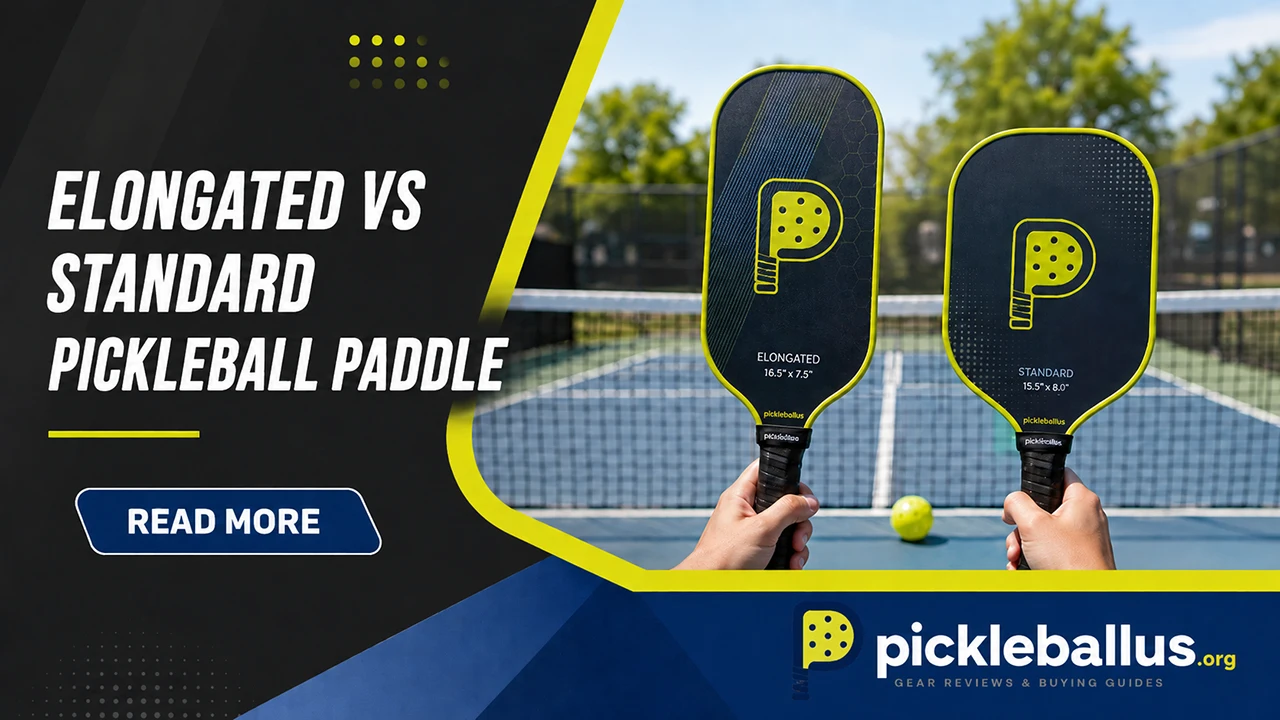
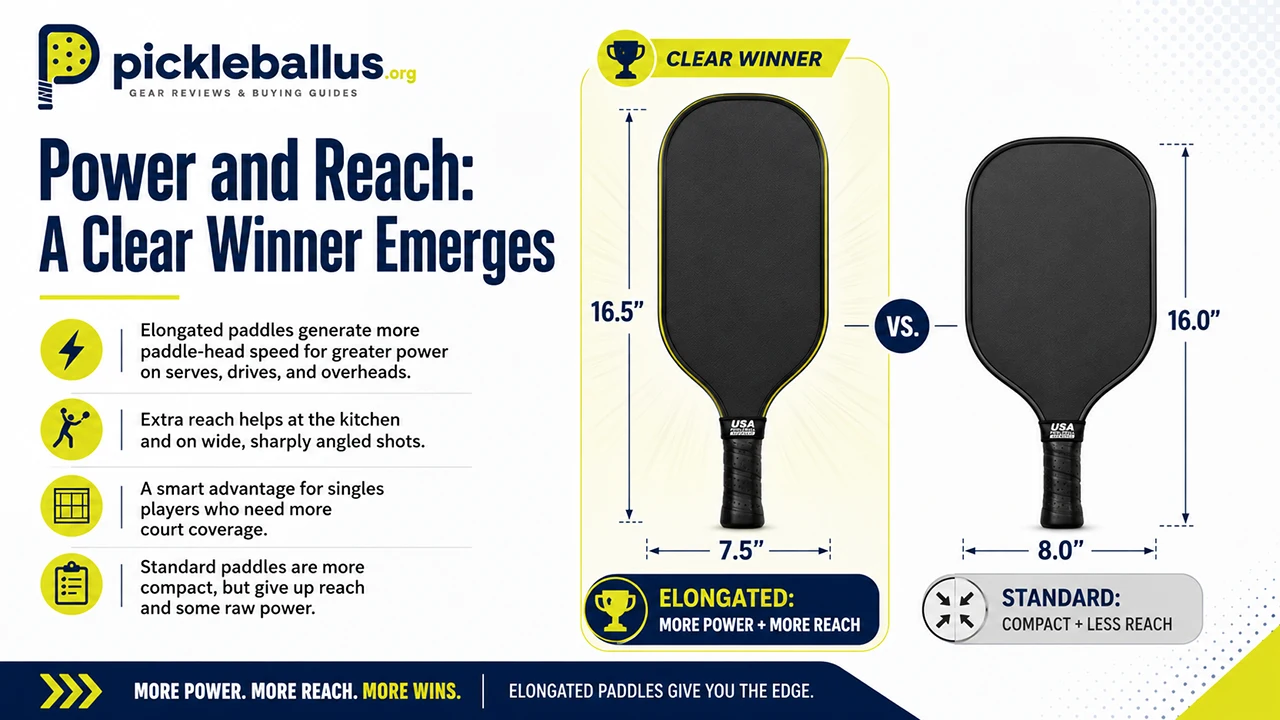
Elongated and standard pickleball paddles differ primarily in how they split the 24-inch combined length-width limit set by USA Pickleball rules. Standard paddles sit around 16 inches long × 8 inches wide, centering the sweet spot in the middle of the face for maximum forgiveness. Elongated paddles push to roughly 16.5 inches long × 7.5 inches wide, shifting the sweet spot higher on the face and adding leverage for more powerful groundstrokes and overhead shots.
The shape you choose directly determines three performance outcomes: where on the paddle face you’ll make the most consistent contact, how much reach you have at the kitchen and baseline, and how quickly your hand can recover between exchanges at the net. These aren’t marginal differences — players who switch shapes often report that it changes how their entire game feels within the first session.
Many players gravitate toward elongated paddles because they see professionals using them on tour. But shape preference is highly skill-dependent, and the narrower face of an elongated paddle shrinks the margin of error on off-center hits — an unforgiving property that frustrates players who haven’t yet built repeatable swing mechanics.
Below is a full breakdown of both shapes across every performance category that matters, with guidance on who should reach for each and specific paddles worth testing in both camps. If you’re still figuring out what separates good best pickleball paddles from the rest, understanding shape is the single most important variable to nail first.
What Are Standard and Elongated Pickleball Paddle Shapes?
The shape of a pickleball paddle describes how its total dimensions are distributed between length and width. USA Pickleball regulations cap combined length plus width at 24 inches, with a maximum individual length of 17 inches. Within those boundaries, manufacturers have settled on two dominant proportions — standard and elongated — each with a distinct feel and performance profile.
Standard Shape — Dimensions and Design
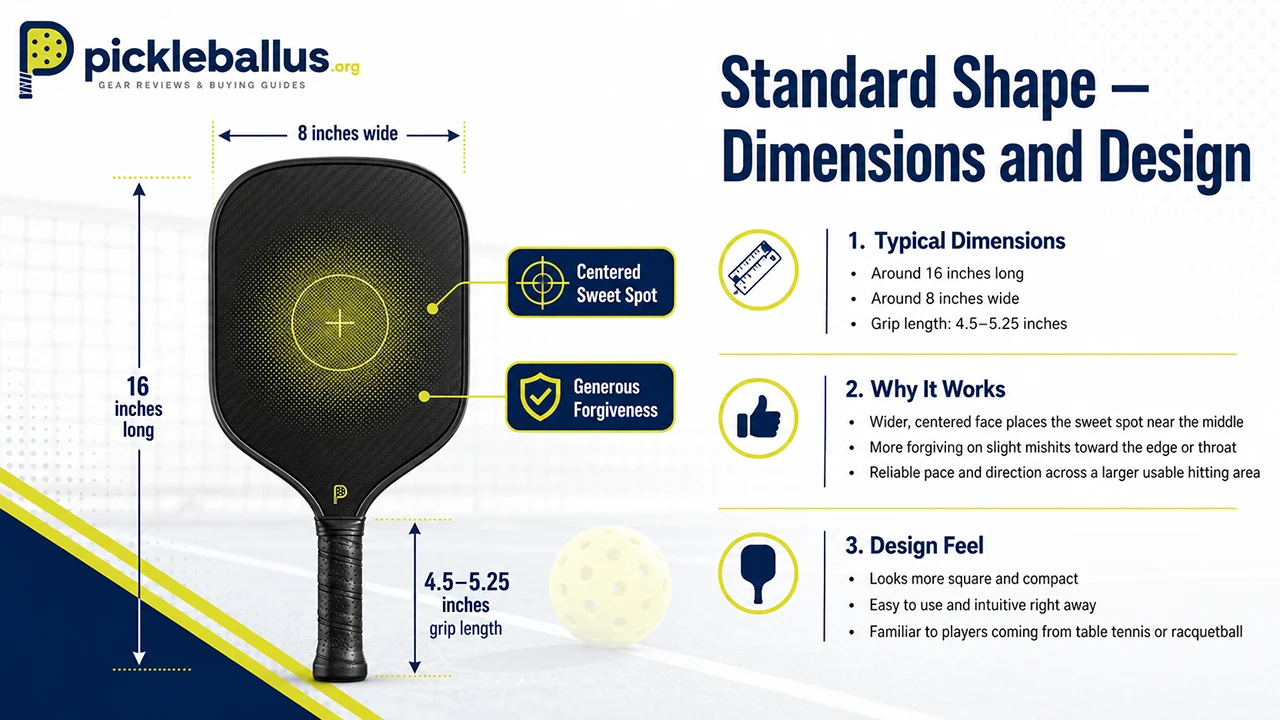
Standard paddles typically measure around 16 inches long by 8 inches wide, and this proportion places the paddle’s widest point near the center of the face — which also happens to be where the sweet spot lives. Grip lengths on standard paddles usually land between 4.5 and 5.25 inches, leaving the bulk of the surface as hitting area.
The centered, wider face creates a generous margin for error across both the vertical and horizontal planes of the paddle face. When you mis-hit slightly toward a side edge or toward the throat, the ball still travels with respectable pace and direction. This property — commonly called forgiveness — is why standard shapes dominated the sport for its first several decades and why they remain a staple at every skill tier, not just for beginners.
From a visual standpoint, standard paddles look more square and compact. The proportions feel intuitive to players coming from table tennis or racquetball, where centered sweet spots and compact frames were the norm. This familiarity makes standard paddles genuinely easy to pick up and start playing well with immediately.
Elongated Shape — Dimensions and Design
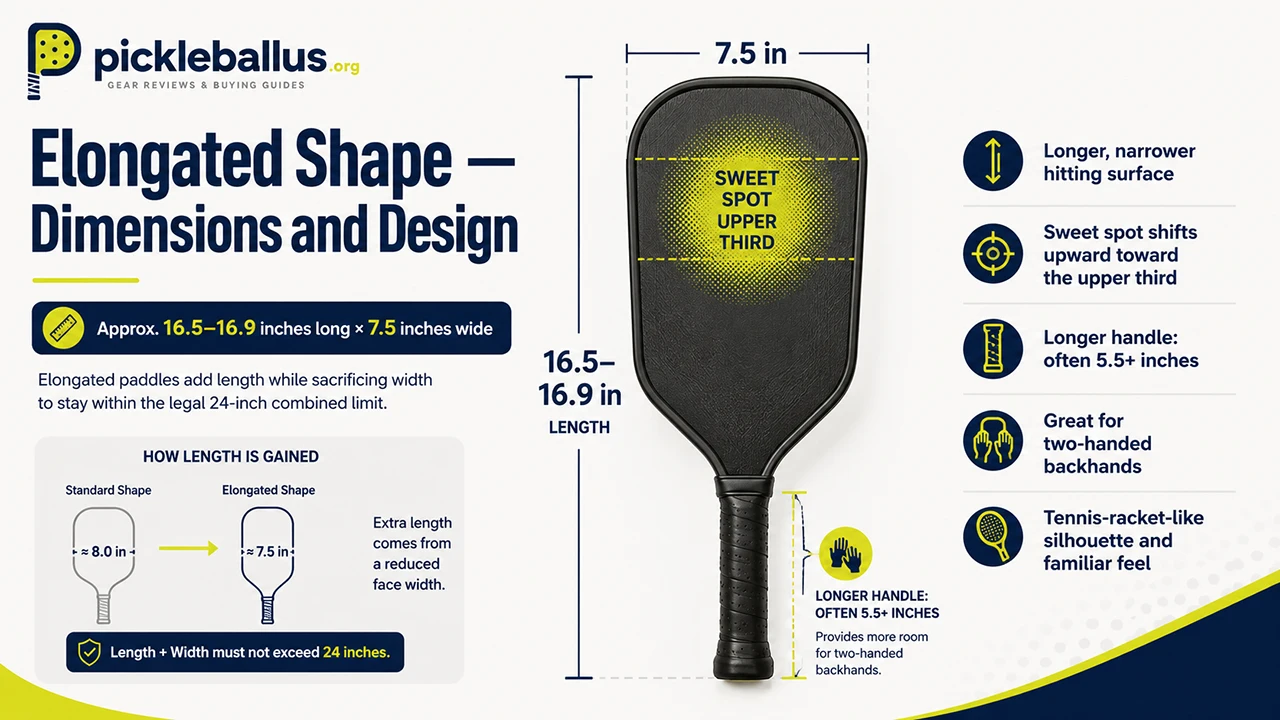
Elongated paddles run approximately 16.5 inches long by 7.5 inches wide, sometimes reaching 16.9 inches in length while staying legal under the combined 24-inch limit. That half-inch gain in length comes directly from shaving width off the face — the total dimension budget stays fixed, so every millimeter gained in length costs a millimeter of width.
The result is a paddle that looks notably taller and narrower. The hitting surface is longer, which shifts the sweet spot upward toward the tip of the paddle, typically in the upper third of the face. Handle lengths on elongated paddles often run longer as well — frequently 5.5 inches or more — because the longer shaft allows players to generate additional torque on full swings. Players with a two-handed backhand benefit considerably here, since there’s enough handle real estate to accommodate both hands without feeling cramped.
The silhouette of an elongated paddle closely resembles a tennis racket frame without strings, which is no coincidence — the shape was designed partly to attract tennis converts who wanted a familiar feel in hand. That said, modern elongated paddles have evolved well past imitation and now offer specific performance advantages that even career pickleball players seek out.
How Each Shape Affects Your Game
Shape is not just aesthetics. The elongated paddle delivers more reach and power; the standard paddle delivers more forgiveness and faster net reactions. Understanding exactly where those trade-offs appear in live play — and when they matter to your specific game — is the core of this decision.
Sweet Spot: Bigger vs Higher
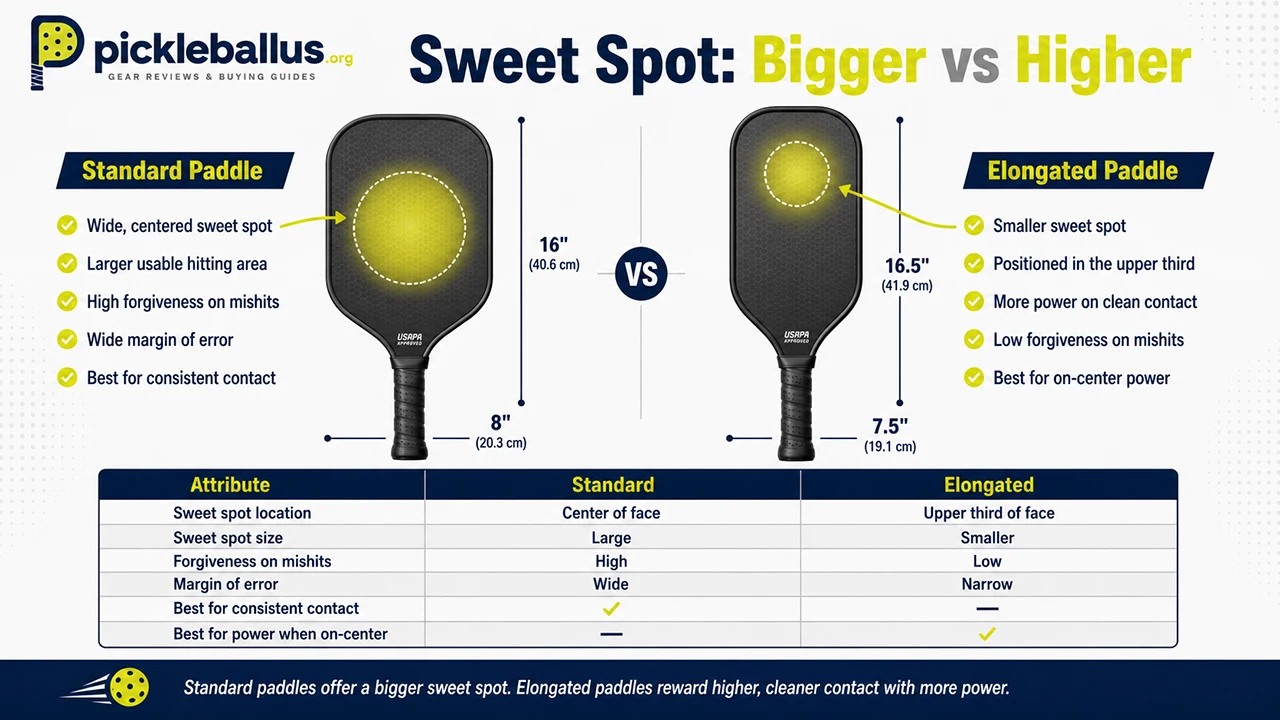
The sweet spot on a standard paddle is wide and centered, covering a larger percentage of the face area relative to elongated models. Because the face is 8 inches across, even contacts toward the side edges land within an acceptable zone, and the feedback on mishits is forgiving enough that the ball still clears the net with useful pace.
The sweet spot on an elongated paddle is smaller and positioned higher on the face — roughly in the upper third of the hitting surface. This location rewards players who consistently strike the ball at the top of their swing arc, generating natural topspin through contact. When you catch the ball squarely in that zone, the power output is noticeably higher than what the same swing would produce on a standard paddle face.
The flip side is that mishits on elongated paddles feel immediately punishing. Contacts near the throat or far toward a side edge produce pop-ups, weak replies, or outright errors that a standard paddle would have absorbed and redirected cleanly. Players still dialing in their contact point will find this unforgiving, particularly in fast net exchanges where the ball arrives sooner than expected.
Here’s how the two shapes stack up on the sweet spot dimension:
| Attribute | Standard | Elongated |
|---|---|---|
| Sweet spot location | Center of face | Upper third of face |
| Sweet spot size | Large | Smaller |
| Forgiveness on mishits | High | Low |
| Margin of error | Wide | Narrow |
| Best for consistent contact | ✓ | — |
| Best for power when on-center | — | ✓ |
Power and Reach: A Clear Winner Emerges
Elongated paddles win on reach and raw power — this is the primary reason players make the switch. The longer lever arm of an elongated paddle generates more paddle head speed when swung at equivalent effort. More head speed translates directly into more pace on groundstrokes, serves, and overhead smashes.
Reach is the other meaningful benefit. At the kitchen line, an elongated paddle extends your effective range by roughly half an inch — enough to dig sharply angled shots that a standard paddle simply cannot get to without a full-stretch lunge. In singles play, where court coverage is paramount and the attacking game is dominant, that extra reach is a genuine difference-maker. Players who focus on best pickleball paddles for singles consistently report that elongated shapes give them a tangible advantage in court coverage during long baseline exchanges.
Standard paddles sacrifice reach for compactness. Their shorter face means your arm does more of the work on groundstrokes, and sharply angled shots just beyond your natural reach demand a full extension that elongated paddle users often avoid. For power-oriented players, this feels like leaving something on the table. For control-oriented players who work closer to the kitchen anyway, the reach difference rarely comes up.
Control and Maneuverability: Speed at the Kitchen
Standard paddles maneuver faster, particularly in close-range exchanges at the non-volley zone. Because the face is shorter and more compact, the rotational inertia is lower — your hand redirects the paddle more quickly from backhand to forehand and back again during fast-hands battles. In speed-up rallies at the net, where reactions happen in tenths of a second, that responsiveness is a meaningful advantage.
Elongated paddles feel slightly more head-heavy. That extra mass at the tip adds plow-through on full swings, but in close exchanges where snap volleys and block returns determine the outcome, the additional weight slows recovery between shots. Players whose games are built around soft resets, defensive counters, and quick block volleys consistently find standard shapes easier to control under pressure.
The control vs power pickleball paddles trade-off that runs through most paddle buying discussions is, at its root, often a shape trade-off in disguise. Standard = more control capacity. Elongated = more power capacity. Every other variable — core thickness, surface material, swing weight — operates within the performance ceiling that shape creates.
Which Shape Should You Choose?
This isn’t a question of which paddle shape is objectively superior. The right shape depends on your game style, your skill level, and which court situations you encounter most often. The breakdown below maps each shape to the player profiles where it genuinely performs best.
Choose a Standard Paddle If…
Standard shapes work best for players who prioritize consistency and net-play speed. You are a strong candidate for a standard paddle if any of these describe your game:
- You’re new to pickleball and still developing reliable swing mechanics
- You play doubles most of the time and spend significant time at the kitchen
- Your game is built around placement, dinking, and defensive resets rather than power drives
- You struggle with mishits and need a forgiving face to keep the ball in play
- You’re coming from table tennis or racquetball, where compact paddles feel natural in hand
- You want quick hands at the non-volley zone without the head-heavy feel of an elongated paddle
The best pickleball paddles for beginners are almost universally standard shape for these reasons — the generous sweet spot reduces the skill barrier and lets new players focus on footwork and shot selection rather than fighting a narrow hitting surface.
Intermediate and advanced doubles players are also returning to standard shapes in significant numbers. Modern high-level doubles play is increasingly about net dominance, and the speed and control advantages of a compact paddle translate directly into better performance in fast kitchen exchanges.
Choose an Elongated Paddle If…
Elongated shapes reward players with consistent mechanics who want to add reach and power to an already-solid game. You are a strong candidate for an elongated paddle if:
- You play singles frequently and need extended court coverage
- You’re transitioning from tennis and want a racket-like feel in hand
- Your game is built around attacking drives, aggressive serves, and power overheads
- You use a two-handed backhand and need handle length to accommodate both hands
- You’ve developed reliable swing mechanics and consistently strike the ball in the upper third of a standard paddle face
- You’re willing to accept a smaller margin of error in exchange for more leverage on every shot
Experienced players who move to elongated paddles typically go through a short adjustment period — about two to four weeks — before their contact timing adapts to the higher sweet spot. The transition requires deliberate repetition: specifically practicing groundstrokes and serves at the correct contact height until muscle memory locks in. Most players who put in that adjustment work report it’s worth it once their mechanics catch up.
What About the Hybrid Shape?
Hybrid paddles land around 16.25 inches long by 7.5–7.7 inches wide, splitting the difference between standard and elongated. They’re the fastest-growing segment of the paddle market — attractive to players who want additional reach without sacrificing all of the standard shape’s forgiveness. For a deeper look at how hybrids compare to elongated models specifically, the widebody vs elongated pickleball paddle breakdown covers the full shape spectrum.
The practical trade-off with hybrids: they don’t fully deliver either benefit. For maximum forgiveness, a standard paddle is still wider. For maximum reach and power, a true elongated is longer. But for players caught genuinely between both worlds — particularly those transitioning from standard toward elongated — a hybrid is a useful stepping stone rather than a permanent home.
Best Standard and Elongated Paddles Worth Considering
The paddles below receive consistent recommendations across playing communities and are actively sold through major retailers, including Amazon. All have strong review counts and established track records among players at multiple skill levels.
Top Standard Shape Paddles
#1 Paddletek Bantam EX-L Pro — Best for Kitchen-First Players
The Bantam EX-L Pro is a benchmark in the standard shape category. Its fiberglass face delivers a consistent, controlled response across the full hitting surface, and the sweet spot is noticeably forgiving for a performance-grade paddle.
Key specs and design: Fiberglass hitting surface, polymer honeycomb core, compact 16″ × 8″ face, grip length in the 4.5–5″ range.
Performance: The Bantam EX-L Pro rewards players who value soft-game finesse. Dinks land exactly where directed, and the paddle absorbs pace on hard drives without deflecting unpredictably. Power shots are solid rather than explosive — this is a control-first tool.
Pros:
- Large, centered sweet spot reduces mishit penalty
- Lightweight swing weight aids quick net reactions
- Fiberglass face generates useful touch at soft-game speeds
Cons:
- Limited power ceiling compared to elongated or raw carbon models
- Shorter handle rules out two-handed backhands
Best For: Doubles players who spend most of their time at the kitchen and prioritize consistency over raw power.
My Verdict: One of the most dependable standard paddles available. If your game lives at the net and you’re tired of paying a steep penalty for off-center hits, the Bantam EX-L Pro removes that frustration reliably.
#2 Selkirk Epic — Best for Beginners Building Confidence
The Epic is Selkirk’s traditional square-shaped paddle, offering one of the widest face profiles in the modern market at 15.75 inches long and 8 inches wide.
Key specs and design: Fiberglass face, polymer core, 15.75″ × 8″ face, 5.25″ handle.
Performance: The Epic’s wide face creates an unusually large sweet spot that makes consistent ball-striking achievable for players still developing timing and mechanics. The 8-inch width means side-edge contacts — common in beginners still tracking the ball — still produce playable returns.
Pros:
- Maximum face width creates widest sweet spot in the standard category
- Balanced feel that doesn’t feel head-heavy or awkward to swing
- Reliable control response across all shot types
Cons:
- Less power than carbon fiber alternatives
- Wide shape prioritizes forgiveness over leverage
Best For: New players or recreational players who want dependable, consistent performance without a steep learning curve.
My Verdict: If you’re buying your first performance paddle or returning after a break, the Epic is genuinely hard to outgrow at the recreational level. The wide-body face is confidence-building in a way that narrower paddles simply aren’t.
#3 Engage Pursuit MX 6.0 — Best for Intermediate Players Wanting Performance
The Pursuit MX 6.0 brings Engage’s raw polymer honeycomb core into a standard shape, targeting the intermediate player who wants a performance paddle without committing to the precision demands of an elongated model.
Key specs and design: Composite face, Engage polymer core, standard shape (~16″ × 8″), mid-range grip length.
Performance: The Pursuit MX 6.0 punches above its weight in power relative to typical standard paddles, thanks to Engage’s dense core construction that generates solid ball speed without relying on surface roughness for pace. Control remains strong, and the paddle handles soft game shots with natural touch.
Pros:
- More power than most standard paddles at comparable price
- Strong core construction provides plow-through on drives
- Versatile performance across all court positions
Cons:
- Core feel is slightly firmer than fiberglass-only alternatives
- Not the top choice for dedicated soft-game players who want maximum touch
Best For: Intermediate players (3.0–4.0 skill range) who want a competitive edge in power without switching to an elongated shape.
My Verdict: A smart choice for players who have outgrown beginner paddles and want real performance improvement without changing their mechanics to match a narrower sweet spot.
Top Elongated Shape Paddles
#4 JOOLA Ben Johns Perseus Pro IV 16mm — Best Overall Elongated
The Perseus Pro IV 16mm is the most prominent elongated option in the current market. At 16.5 inches long with a raw carbon fiber face, it delivers elite-level reach and spin performance through a paddle shape refined for professional play.
Key specs and design: Raw carbon fiber face, 16mm polymer core, 16.5″ × 7.45″ face, 5.5″ handle, mid-to-high swing weight.
Performance: The raw carbon surface generates exceptional ball bite for topspin shots — groundstrokes with deliberate topspin grip the face briefly before launching with heavy forward rotation. The 16mm core provides additional control depth, softening the power ceiling slightly compared to thinner cores while making the paddle more manageable in dinking situations. Full-swing groundstrokes and serves feel authoritative.
Pros:
- Raw carbon face maximizes spin generation on topspin shots
- 16mm core balances power with soft-game control
- Elongated face gives genuine reach advantage at the kitchen and baseline
- Long handle accommodates two-handed backhands
Cons:
- Smaller sweet spot punishes off-center hits meaningfully
- Requires established swing mechanics to exploit consistently
- Head-heavy balance demands adjustment period for players moving from standard
Best For: Advanced and competitive players (4.0+) who want maximum performance from the best elongated pickleball paddles currently available.
My Verdict: The Perseus Pro IV 16mm is the benchmark elongated paddle for good reason. If your mechanics are sound and you want to maximize what an elongated shape can deliver, this is the paddle that most players end up at after testing everything else.
#5 Selkirk LUXX Control Air Invikta — Best Elongated for Control-Oriented Players
The LUXX Control Air Invikta is a rare elongated paddle that leads with control rather than raw power — an unusual proposition in a shape category usually defined by aggressive performance.
Key specs and design: Air-Foam core construction, elongated face (16.5″ × 7.375″), standard handle (5.25″), lighter swing weight.
Performance: The air-core construction dampens vibration significantly, which makes soft game shots feel more natural on an elongated frame than almost any other paddle in this shape. Dinks and drops land with predictable touch rather than the stiff, overpowered response common to many elongated models. Power is still above what a standard paddle provides, but this paddle is built for players who want reach without sacrificing nuance in the soft game.
Pros:
- Air-foam core delivers unusually soft touch for an elongated shape
- Standard handle length makes it accessible to players not ready for long-handle models
- Lighter swing weight aids quicker net recovery than typical elongated paddles
Cons:
- Power ceiling is lower than raw carbon elongated models
- Standard handle rules out two-handed backhands needing full grip length
Best For: Intermediate-to-advanced players who want elongated reach but play a finesse-heavy game and can’t sacrifice soft-game touch.
My Verdict: The LUXX Control Air Invikta solves a specific problem: players who want the reach advantage of an elongated shape but keep losing the soft-game nuance that standard paddles provide naturally. If that’s your situation, this is the paddle to try.
#6 Vatic Pro V7 — Best Elongated at Mid-Range
The Vatic Pro V7 delivers performance that consistently exceeds expectations for its position in the market. Raw carbon fiber surface, elongated shape, and a competitive price make it a top choice for players wanting high-end shape performance without premium pricing.
Key specs and design: Raw carbon fiber face, elongated shape (~16.5″ × 7.5″), polymer core, longer handle.
Performance: The V7’s raw carbon surface generates the spin rates you’d expect from a premium elongated paddle — topspin shots bite and kick forward aggressively, and flat drives have genuine weight behind them. The elongated shape delivers reach and leverage comparable to more expensive options at this shape tier. For players stepping up from a standard paddle, the V7 provides an accessible entry point into elongated performance.
Pros:
- Raw carbon face at a mid-range price delivers high spin potential
- Elongated shape provides full reach and power advantages of the category
- Good balance between head weight and maneuverability for an elongated paddle
Cons:
- Sweet spot is narrow, consistent with the elongated shape category
- Requires an adjustment period for players moving from standard
Best For: Advanced recreational players (3.5–4.5 skill range) who want raw elongated performance without paying the premium price of top-tier models.
My Verdict: The V7 is arguably the best value proposition in the elongated category. Players who can’t justify the top-tier spend but want the same shape performance will find the V7 delivers the core experience at a meaningful discount.
By now, you have a clear picture of what separates standard from elongated paddle shapes — where their sweet spots live, how each handles power and net play, and which player profiles align most naturally with each design. Choosing between them, however, is only part of the equation. How paddle shape interacts with other specifications — core thickness, handle length, and official size rules — determines whether a paddle fits your game or just fits your hand. The next section covers the finer mechanical details that experienced players track when making a final decision.
What Else Changes When You Switch Paddle Shapes?
Shape is the most visible variable when comparing paddles, but it doesn’t operate in isolation. Three factors tend to shift alongside shape in ways many players don’t anticipate before making a purchase.
Official Size Rules and Tournament Legality
All competitive pickleball paddles must comply with USA Pickleball’s size regulations. The combined length and width cannot exceed 24 inches, and no paddle may be longer than 17 inches. Most paddles sold by reputable manufacturers sit comfortably within these limits — standard paddles at roughly 24 combined inches, elongated paddles at exactly 24 combined inches — so tournament legality is rarely an issue with name-brand equipment.
Where players occasionally run into problems is with ultra-elongated “blade” style paddles that approach the 17-inch length ceiling, or with paddles purchased from generic manufacturers without USA Pickleball approval. Before using any paddle in sanctioned play, confirming it appears on USA Pickleball’s approved equipment list is worth the two-minute check. The list updates regularly as new models receive certification.
Handle Length Differences That Come With Shape
Elongated paddles often come with longer handles, and this is a structural consequence of the shape design rather than a deliberate feature add. When manufacturers extend total paddle length to 16.5 inches, some of that gain goes into handle length rather than purely into the face — which is why many elongated models feature 5.5-inch or longer handles compared to the 4.5–5.25 inches typical of standard paddles.
This side effect matters more than players initially expect. A longer handle changes where your hand naturally contacts the grip, which affects swing mechanics, leverage on full swings, and comfort during extended sessions. Players who use a two-handed backhand almost universally report that elongated paddles with longer handles feel more accommodating than standard paddles. Conversely, players with smaller hands sometimes find that oversized handles on elongated models create grip tension in the wrist and forearm that accumulates over the course of a long game.
If you’re evaluating a specific elongated paddle, checking handle length alongside face dimensions is worthwhile before purchasing. The spec matters for fit in ways the shape alone doesn’t communicate.
Does Your Shape Preference Change as You Improve?
For most players, yes — shape preference shifts with skill development. The pattern is consistent: recreational players gravitate toward standard shapes for forgiveness, while players crossing into competitive play at the 4.0+ level increasingly experiment with elongated shapes for the reach and power advantage.
This isn’t universal. Some elite doubles specialists actively prefer standard shapes throughout their competitive careers, valuing the control and net speed that a compact paddle provides in fast exchanges. But the general trend at higher skill levels — particularly among singles-heavy players — runs toward elongated shapes once ball-striking mechanics are reliable enough to exploit a high sweet spot rather than be punished by missing it.
The practical takeaway: don’t buy an elongated paddle early in your development expecting it to accelerate your improvement. The narrower sweet spot is more likely to expose mechanical inconsistencies with erratic, demoralizing results than to push your game forward. Build consistent contact habits with a standard shape first, then revisit elongated options once your mechanics can exploit — rather than fight — the trade-offs that shape brings.
Write Your Review
No reviews yet. Be the first to share your experience!