

The best widebody pickleball paddles in 2026 are the Onix Graphite Z5 (best for beginners and recreational play), the Paddletek Bantam TS-5 Pro (best for touch and soft-game specialists), and the Prince Response Pro (best all-around widebody for doubles). The best elongated pickleball paddles are the JOOLA Ben Johns Perseus Pro IV 16mm (best for advanced and power players), the Selkirk LUXX Control Air Invikta (best elongated for control-oriented play), and the Engage Pursuit MX 6.0 (best elongated for spin and versatility).
Widebody paddles expand the hitting surface horizontally, giving you a larger sweet spot and faster hand recovery for net battles. Elongated paddles stretch vertically toward the 17-inch USA Pickleball maximum, generating more leverage and reach for baseline drives and overhead shots. As two opposing design philosophies, they suit two distinct playing identities — and most players fall clearly into one camp once they understand what each shape actually changes about their game.
The real question isn’t which shape is better. It’s which shape matches how you currently play and where you want your game to go. Shape affects sweet spot size, power ceiling, hand speed at the kitchen line, and how much a mishit costs you during a rally. Getting this decision right early saves you from buying the wrong paddle twice.
Below is a full breakdown of both shapes, a direct comparison, and six paddle reviews — three widebody, three elongated — to help you narrow the choice and shop with confidence. For a broader view of the market, the best pickleball paddles guide covers every shape and category in one place.
What Is a Widebody Pickleball Paddle?
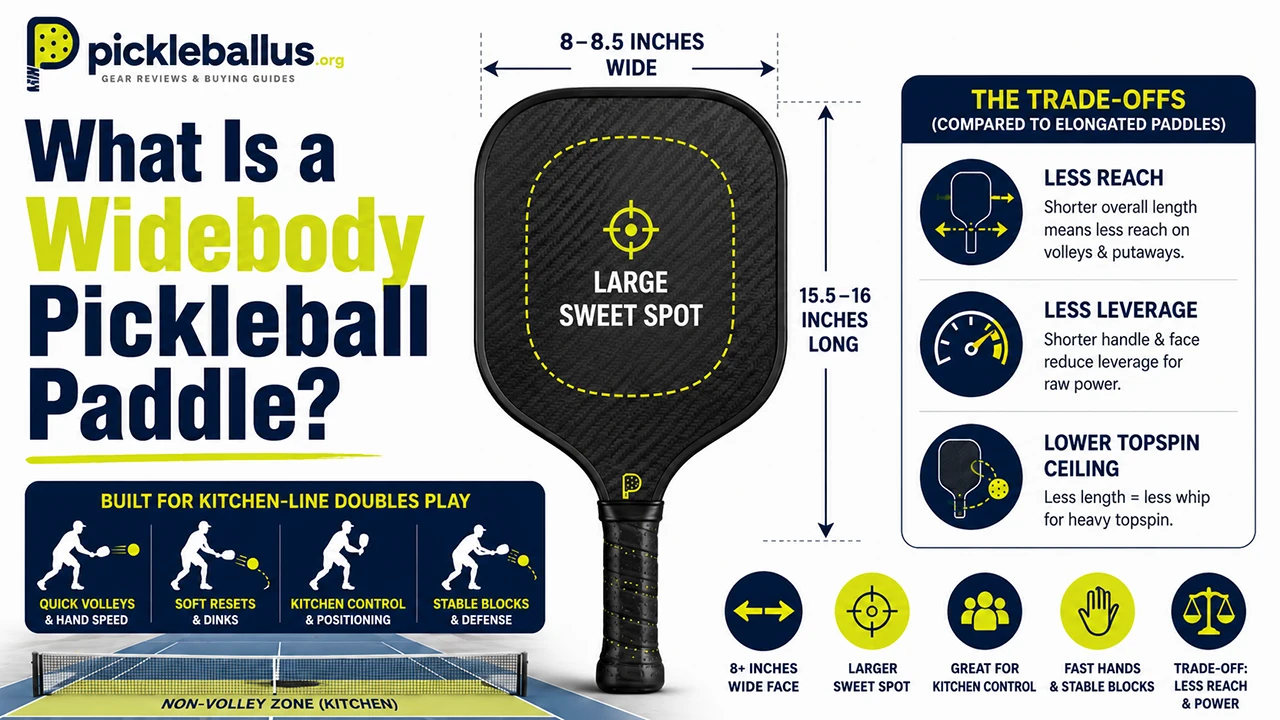
Widebody pickleball paddles measure 8 inches or wider at their broadest point, giving the hitting face more horizontal coverage than any other paddle shape. That extra width translates directly into a larger sweet spot — the central zone where contact produces the most consistent, predictable response. Players who prioritize soft-game consistency, defensive resets, and quick reflex volleys at the kitchen line tend to gravitate toward widebody shapes.
Widebody Dimensions and Sweet Spot
A widebody paddle typically sits between 15.5 and 16 inches in total length while extending 8 to 8.5 inches across the face. The horizontal expansion keeps the sweet spot wide and positioned lower on the paddle, meaning off-center hits toward the edges still produce usable shots rather than dead pops or errant sprays.
For players with developing mechanics — or anyone newer to the sport — that forgiveness level alone keeps them competitive. A mis-hit on a widebody paddle often lands in the kitchen; the same contact on a narrow elongated face can drift six inches wide or drop short into the net. If you’re still building consistent contact habits, that gap in forgiveness matters more than any power advantage.
How Widebody Design Helps at the Kitchen Line
Doubles pickleball is largely decided at the non-volley zone, where rallies turn into rapid-fire hand exchanges lasting two to five shots. Widebody paddles shine in this context. The shorter overall length keeps the swing arc compact, letting you reset and redirect the ball faster than a longer paddle. The extra face width also improves stability on off-center blocks — the type of shot that would rattle a thinner paddle and sail out of bounds instead lands softly in the kitchen.
Control players who build points through consistent dinking, well-placed drops, and patient fourth-shot resets find that a widebody rewards their strategy in a way that elongated shapes don’t. The best pickleball paddles for control in this category tend to cluster around widebody and standard shapes for exactly this reason.
Widebody Trade-Offs: What You Give Up
Every design choice has a cost. Widebody paddles have a shorter overall length, which reduces your extension on wide dinks, overhead volleys, and baseline coverage. Balls that clip the sideline or arc above your shoulder require more footwork to compensate for the lost reach. Additionally, because the face is wider rather than longer, the lever arm is shorter — generating raw power on drives takes more effort, and the topspin ceiling sits lower than what an elongated shape produces. Players who rely on heavy third-shot drives or aggressive attacking from mid-court will notice this limitation quickly.
What Is an Elongated Pickleball Paddle?
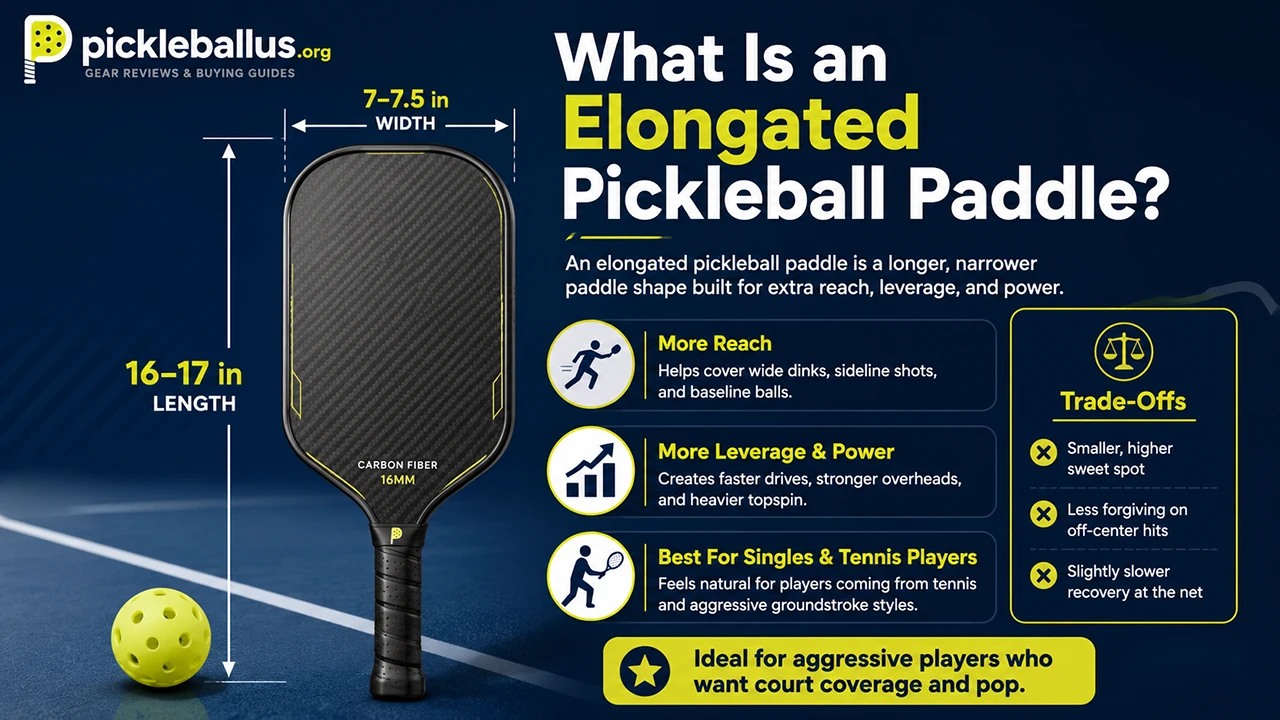
An elongated pickleball paddle prioritizes length over width, typically measuring 16 to 17 inches from handle base to tip while narrowing the face to roughly 7 to 7.5 inches across. That geometry — long and lean — is engineered for two things: reach and leverage. More than any other paddle shape, elongated paddles attract players who came from tennis, players focused on singles, and anyone whose game centers on aggressive groundstrokes and extended court coverage.
Elongated Dimensions and Reach Advantage
USA Pickleball’s maximum combined paddle length is 17 inches. Most elongated paddles push close to that ceiling, typically landing at 16.5 to 17 inches total. The added inches mean you reach balls that would require a widebody player to sprint an extra step for — a real edge during wide dinks, lob returns, and sideline defense in singles. That reach also improves coverage at the baseline when transitioning from the backcourt, reducing the pressure to sprint for every shot hit away from your body.
For players who regularly find themselves stretching for out-of-reach balls or losing points at the baseline, the best elongated pickleball paddles deserve a serious look before assuming more footwork is the only solution.
How Elongated Shape Boosts Power and Coverage
The longer paddle face creates a longer lever arm, which generates more head speed through the swing arc. More head speed at contact means more pace on drives, faster overhead shots, and heavier topspin when you brush the ball with a topspin stroke. Professionals favor elongated shapes for exactly this reason — the extra pop on third-shot drives and around-the-post attempts is measurable, not marginal.
Players coming from tennis backgrounds often find elongated shapes feel natural immediately. The length-to-width ratio echoes the geometry of a tennis racket enough to shorten the adjustment period, while the lighter swing weight (compared to a tennis frame) feels liberating rather than foreign. The best pickleball paddles for power are almost entirely elongated or near-elongated shapes for this reason.
Elongated Trade-Offs: The Skills It Demands
The smaller, higher sweet spot demands cleaner contact. Mis-hits on an elongated paddle don’t self-correct the way they do on a widebody — an off-center strike drifts unpredictably, and the narrower face leaves less margin for error during fast exchanges. Swing recovery at the net also suffers slightly; the longer paddle takes a fraction longer to reset between volleys, which can expose you during prolonged dinking battles against a disciplined opponent who targets your body repeatedly.
Widebody vs Elongated Pickleball Paddle: Head-to-Head
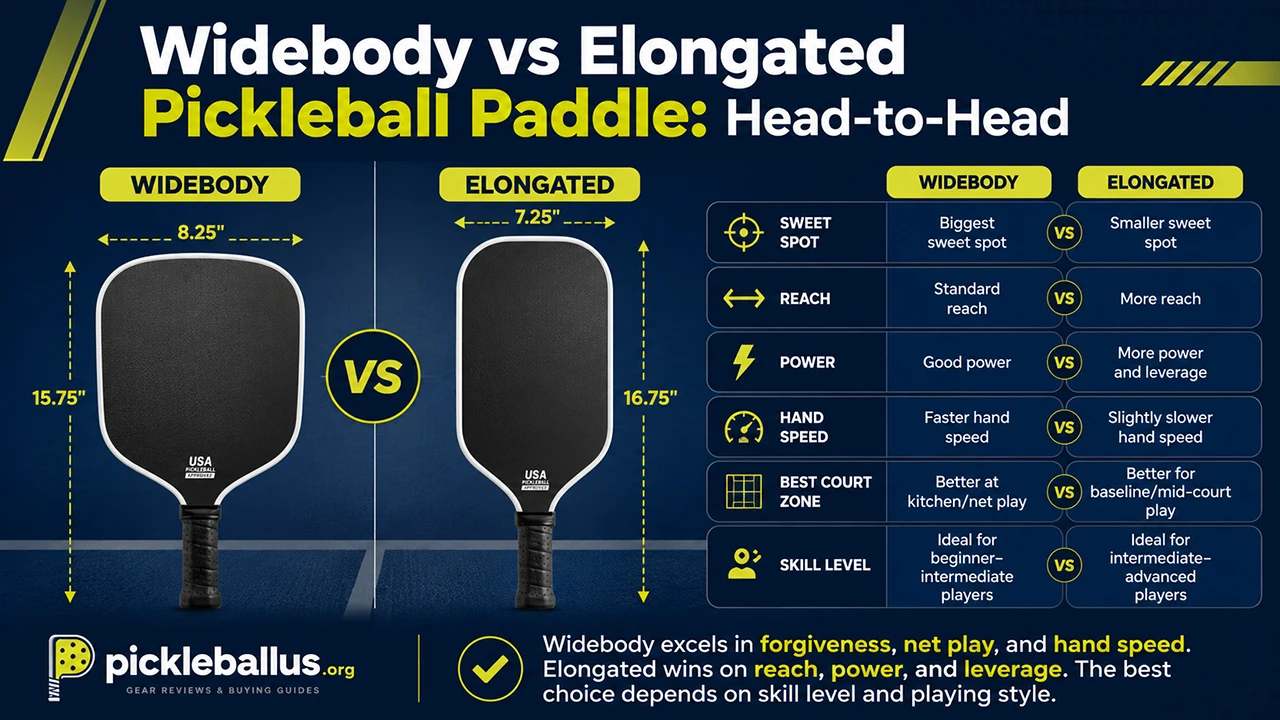
Widebody paddles lead in forgiveness, net play, and hand speed. Elongated paddles win on reach, power, and leverage. Neither shape is universally superior — the better choice depends on your skill level, preferred court zone, and playing style. The table below maps the key performance differences:
| Category | Widebody | Elongated |
|---|---|---|
| Face width | 8–8.5 inches | 7–7.5 inches |
| Total length | 15.5–16 inches | 16.5–17 inches |
| Sweet spot size | Largest | Smallest |
| Forgiveness on mishits | High | Low |
| Reach on wide balls | Lower | Higher |
| Power/leverage on drives | Moderate | High |
| Hand speed at net | Faster | Slightly slower |
| Topspin ceiling | Moderate | High |
| Best court zone | Kitchen/net | Baseline/mid-court |
| Skill level match | Beginner–Intermediate | Intermediate–Advanced |
Sweet Spot and Forgiveness
Widebody paddles carry the largest sweet spot of any paddle shape. The wider face distributes the hitting zone across more surface area, making it forgiving on blocks, resets, and quick dink exchanges. Off-center contact reads consistently rather than erratically — a huge advantage during the fast-twitch exchanges that decide kitchen battles. Elongated paddles concentrate the sweet spot in a smaller, higher zone. For players with reliable mechanics, that’s a non-issue; for developing players, it’s a constant source of frustrating errors. If minimizing mishits is a priority, the pickleball paddle with the largest sweet spot tends to come from widebody or standard shapes.
Reach, Power, and Leverage
Elongated paddles win this category outright. The longer face creates a longer lever arm, generating more swing momentum on drives and overhead shots. A well-struck drive from an elongated paddle carries noticeably more pace than the same swing with a widebody paddle. Widebody paddles sacrifice this leverage for the stability and forgiveness advantages described above — a deliberate trade-off, not a design flaw.
Hand Speed and Net Play
Widebody paddles are quicker through the air at the kitchen line. Their shorter overall length reduces rotational inertia, letting you recover between shots faster during rapid-fire exchanges. Against opponents who attack the body with speed-ups, a widebody paddle recovers into a defensive position sooner than an elongated paddle of the same weight. If doubles dinking and fast hands are the core of your game, widebody’s compact profile responds better under pressure.
Who Benefits Most From Each Shape
Beginners and recreational players who want fewer mishits and more consistency gain the most from a widebody. Intermediate-to-advanced players with solid mechanics — especially those focused on power, spin, or singles play — typically find elongated shapes reward their skill level. Players new to the sport benefit from starting widebody and upgrading to elongated as their mechanics develop. The best pickleball paddles for beginners are dominated by widebody and standard shapes for this reason.
Widebody or Elongated — Which Should You Choose?
Choose Widebody If You Fit This Profile
- You’re newer to pickleball and want maximum forgiveness while building consistent contact habits
- Your game centers on doubles, kitchen battles, and soft-game consistency
- You rely on fast hands at the net rather than raw driving power
- You’re managing arm sensitivity, tennis elbow, or wrist concerns and need a stable, shock-absorbing paddle feel
- You’ve been consistently struggling with mishits and want to tighten contact reliability before adding power
Choose Elongated If You Fit This Profile
- You’re an intermediate or advanced player with reliable mechanics and a consistent swing path
- You play singles or frequently defend from the backcourt against aggressive opponents
- You came from a tennis background and prefer the feel of a longer hitting surface
- Your game revolves around third-shot drives, topspin drops, and aggressive mid-court coverage
- You play both singles and doubles and prioritize power output and reach over kitchen hand speed
Best Widebody Pickleball Paddles in 2026
The best widebody pickleball paddles combine a forgiving face with predictable response across the entire hitting surface. These three paddles represent the category’s strongest options at different price points and play styles.
#1 Onix Graphite Z5 Widebody Pickleball Paddle — Best For Beginners and Recreational Players
The Onix Graphite Z5 is the paddle that introduced a generation of players to the widebody format. It’s a dependable, straightforward option built around one core principle: when you’re still developing your game, hitting more balls cleanly matters more than squeezing out extra power.
Key Specs and Features:
- Graphite carbon face for a responsive, consistent feel
- Nomex honeycomb core for a firm, predictable response
- Widebody face delivers one of the largest sweet spots in the category
- Available in standard and thin grip sizes
Performance Analysis:
The Z5 rewards consistent form without punishing imperfect swings. The Nomex core produces a slightly firmer feel than polymer alternatives, which translates to a satisfying pop on well-struck balls. At the kitchen line, the widebody face adds stability on off-center blocks. The reach limitation becomes noticeable when stretching for wide sideline shots, but most recreational players compensate with footwork rather than equipment. This paddle doesn’t try to do everything — it focuses on doing one thing exceptionally well: making it easy to hit the ball cleanly and consistently.
Pros:
- Exceptional sweet spot forgiveness at a budget-friendly price
- Trusted brand with years of proven court performance
- Predictable response across the entire face — no dead spots
- Easy adjustment for players coming from tennis or ping-pong
Cons:
- Nomex core feels stiffer than polymer paddles — less ideal for touch shots
- Limited spin generation compared to raw carbon or textured surfaces
- Less suitable for advanced players who need a higher power ceiling
Best For: Beginning players, seniors, recreational doubles players, and anyone transitioning from another racket sport.
My Verdict: Few paddles have introduced more players to the widebody format than the Z5. It delivers exactly what it promises — consistency, forgiveness, and a low learning curve — without breaking the bank. Start here if you’re new to the shape.
#2 Paddletek Bantam TS-5 Pro Pickleball Paddle — Best Widebody for Touch and Soft-Game Specialists
The Bantam TS-5 Pro sits at the premium end of the widebody market, built around a polymer core that softens the response and rewards a dink-first, placement-based playing style. If the Z5 is built for beginners, the TS-5 Pro is designed for players who’ve committed to a soft-game strategy and want a tool that fully supports it.
Key Specs and Features:
- Smart Response Technology (SRT) polymer core for vibration dampening
- Fiberglass hitting surface for added texture and spin assist
- Widebody shape with a generous sweet spot
- Standard 4.25″ grip, thin grip variant available
Performance Analysis:
Paddletek’s SRT polymer core absorbs vibration more than Nomex, which players with arm sensitivity particularly appreciate. The fiberglass face adds slight grit to the hitting surface, aiding spin on dinks and angled drops without requiring a raw carbon face. At the kitchen, the paddle feels planted and forgiving — off-center shots land predictably rather than darting at odd angles. Driving power is moderate, which suits players whose game is built around placement rather than pace. Players who have fully committed to the soft game will find the TS-5 Pro supports their style at every turn.
Pros:
- Softer SRT polymer core reduces arm fatigue and vibration
- Fiberglass face assists spin on touch shots
- Wide sweet spot rewards placement-based play
- Good choice for players managing elbow or wrist sensitivity
Cons:
- Limited power output for aggressive drivers
- Premium price point requires a clear commitment to the soft game
- Not ideal for players who want to mix power and touch equally
Best For: Intermediate doubles players, kitchen-first strategists, players with arm sensitivity or injury history.
My Verdict: The Bantam TS-5 Pro earns its premium price tag for players who have decided the kitchen is where they win points. If soft game and placement are your weapons, this paddle supports that identity as well as anything in the widebody category.
#3 Prince Response Pro Widebody Pickleball Paddle — Best All-Around Widebody for Doubles
Prince brings decades of racket sport engineering into pickleball with the Response Pro — a widebody paddle that balances forgiveness with enough pop to handle mid-court attacking without feeling underpowered. It’s the widebody pick for players who don’t want to specialize entirely in touch play.
Key Specs and Features:
- Medium-density polymer core for a balanced power-control feel
- Textured graphite hitting surface for spin assist
- Traditional widebody shape with edge guard
- Textured grip for sweat management during long sessions
Performance Analysis:
The Response Pro lands between the firm Nomex feel of the Z5 and the soft dampening of the TS-5 Pro, hitting a middle ground that works across multiple play styles. The textured graphite face generates more spin than plain graphite surfaces, helping on angled dinks and drop serves without requiring a premium raw carbon face. At the kitchen, the paddle is quick and stable. For players who occasionally attack from mid-court, the power output is sufficient without feeling like the paddle is working against you on drives.
Pros:
- Balanced feel handles power and touch equally
- Textured face aids spin generation on soft shots
- Proven Prince racket sport engineering background
- Manageable swing weight for sustained doubles play
Cons:
- Less specialized than the Z5 (pure forgiveness) or TS-5 Pro (pure touch)
- Some players find the grip circumference slightly larger than preferred
- Mid-range price point competes against strong alternatives
Best For: All-around doubles players, players who mix a soft game with occasional mid-court attacks, players coming from tennis or squash.
My Verdict: If you want one widebody paddle that handles every situation adequately without forcing you to specialize in a single play style, the Response Pro covers that ground with a dependable, balanced feel across the full court.
Best Elongated Pickleball Paddles in 2026
The best elongated pickleball paddles reward clean mechanics with reach, power, and topspin potential that widebody paddles can’t match. These three paddles represent the category at its best across different playing priorities.
#4 JOOLA Ben Johns Perseus Pro IV 16mm — Best Elongated for Advanced and Power Players
The Perseus Pro IV 16mm is Ben Johns’s signature paddle, developed alongside the world’s top-ranked pickleball player. It brings the elongated format to its highest expression — maximum reach, heavy topspin potential, and precision core engineering that few paddles at any price point can match.
Key Specs and Features:
- Raw carbon fiber hitting surface for exceptional ball grip and spin generation
- 16mm Charged Carbon³ foam core for a controlled, dampened response
- Elongated shape pushing toward the upper end of legal dimensions
- Extended handle accommodates two-handed backhands comfortably
Performance Analysis:
The raw carbon face grabs the ball better than any standard fiberglass or plain carbon surface, producing heavy topspin on third-shot drives and roll dinks with relatively little additional effort. The 16mm core softens the response enough to enable controlled resets despite the elongated shape’s naturally smaller sweet spot — a balance that typically requires compromise from most paddles. Veterans of the Perseus line will notice the Gen IV’s refined touch over predecessors; this paddle rewards players who already have their mechanics dialed in and want a tool that pays dividends on precision.
Pros:
- Raw carbon face produces exceptional spin with minimal wrist effort
- 16mm core softens the response for better kitchen control
- Extended handle supports two-handed backhands naturally
- Top-tier craftsmanship and engineering throughout
Cons:
- Premium price — a significant investment
- Small sweet spot punishes mishits — requires clean mechanics
- Not the right paddle for players still developing consistent contact
Best For: Advanced and competitive players, power-oriented play styles, singles specialists, and players working two-handed backhands into their game.
My Verdict: The Perseus Pro IV 16mm sits at the top of the elongated category for a reason — it’s the paddle Ben Johns uses against the world’s best. If your skills match its demands, there’s no better elongated paddle at its tier.
#5 Selkirk LUXX Control Air Invikta — Best Elongated for Control-Oriented Players
Selkirk’s LUXX Control Air Invikta reframes what elongated paddles can do. Most elongated designs chase power; the LUXX trades some of that power ceiling for a softer, more responsive touch that rewards control-first players who want reach without sacrificing kitchen accuracy.
Key Specs and Features:
- LUXX Control Air face technology — air channels reduce ball dwell time variation across the face
- T700 Raw Carbon Fiber hitting surface for spin and grip
- Invikta elongated shape (Selkirk’s classic elongated profile)
- Open-throat Aero-S design reduces swing drag at the net
Performance Analysis:
The LUXX’s air-channel face technology is unconventional, but the result is a consistent feel across the entire paddle surface — a problem-solving feature that eliminates the dead-spot issue some elongated paddles develop toward the edges. Topspin generation is excellent thanks to the raw carbon face, and the paddle handles dinks with more precision than most elongated designs. The Aero-S throat design increases swing speed slightly, which partially compensates for elongated shapes’ traditional net recovery disadvantage. Players who tried elongated paddles in the past and found them too unpredictable at the kitchen will find the LUXX addresses that problem directly.
Pros:
- LUXX air-channel face delivers consistent response across the whole surface
- Raw carbon excels at spin generation on touch shots and drives
- Aero-S design improves swing speed recovery at the net
- Better kitchen control than most elongated paddles
Cons:
- Premium price point
- Air-channel face technology has a short break-in period before feeling natural
- Slightly less raw power than pure-power elongated paddles
Best For: Intermediate-to-advanced players, control-oriented players transitioning to elongated shapes, players who want reach without sacrificing soft-game accuracy.
My Verdict: The LUXX Control Air Invikta is the elongated paddle for players who’ve tried the shape and felt they lost too much touch at the net. It splits the difference between reach and kitchen control more effectively than almost anything else in its class.
#6 Engage Pursuit MX 6.0 — Best Elongated for Spin and Versatility
The Engage Pursuit MX 6.0 targets players who want the elongated shape’s reach and power but need a paddle that performs across multiple play styles without forcing specialization. Its mid-density core sits between soft touch and firm response, making it one of the most versatile picks in the elongated category.
Key Specs and Features:
- ControlPro surface technology for enhanced grip and spin on all shot types
- Polymer composite core at mid-density
- Elongated shape with standard edge guard
- Available in the 6.1 (power-tuned) variant for players who want more pop
Performance Analysis:
The ControlPro surface generates noticeable topspin and sidespin on touch shots — roll dinks and angled drop serves repeat accurately, giving players who invested in spin technique a paddle that rewards it. The mid-density polymer core delivers enough dampening for controlled resets without feeling soft or sluggish. Power output sits at a solid mid-range level; this isn’t a maximum-power elongated paddle, but it handles third-shot drive attempts with enough pace to keep opponents honest. The result is an elongated paddle that doubles players can trust at the kitchen without abandoning the reach and power advantages of the shape.
Pros:
- ControlPro surface excels at spin generation across all shot types
- Mid-density core balances drives and dinks equally
- Versatile feel works across multiple playing styles and court positions
- Strong value for a premium elongated paddle
Cons:
- Not the highest power ceiling in the elongated category
- Edge guard adds slight weight compared to edgeless alternatives
- Less specialized than paddles built purely for power or control
Best For: Intermediate players, all-around players switching from widebody to elongated, doubles players who want elongated reach without abandoning kitchen playability.
My Verdict: The Pursuit MX 6.0 is the elongated paddle to start with if you’re transitioning from widebody and don’t want to sacrifice too much kitchen reliability in the process. It bridges the gap more smoothly than most elongated options at this price tier.
By now you have a clear picture of how widebody and elongated paddles differ in shape, performance, and fit — and which specific paddles earn their place in 2026. Choosing the right shape, however, only accounts for part of the paddle equation. Core thickness, handle length, and swing mechanics interact with shape in ways that can amplify or undercut the advantages you’re counting on. The next section covers the finer details experienced players use to squeeze out the last bit of edge from their equipment.
Fine-Tuning Your Paddle Choice Beyond Shape
Core Thickness and How It Pairs With Shape
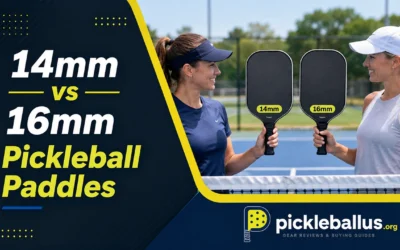
Core thickness — typically 13mm, 14mm, or 16mm — interacts directly with paddle shape in ways most buyers overlook. A 16mm widebody maximizes both forgiveness and touch, creating the softest and most forgiving combination the market offers. A 14mm elongated produces a sharper ball response and more pop, but narrows the margin for error further. A 14mm widebody gives you slightly more pop without sacrificing much sweet spot — useful for recreational players who want widebody forgiveness with a bit more firepower on clear overhead opportunities. A 16mm elongated softens the response enough to make net play more manageable without abandoning reach and power. Matching core thickness deliberately to your shape amplifies the advantages you already chose rather than creating new trade-offs.
Handle Length Considerations for Widebody vs Elongated
Paddle handles run from roughly 4.5 inches to 5.5 inches. Elongated paddles often pair naturally with longer handles, since the extra grip length supports two-handed backhands without sacrificing paddle length. Widebody paddles — shorter overall — can use a longer handle to recover some of the lost reach, a strategy underrated by most buyers focused purely on face dimensions. If a two-handed backhand is part of your game or something you want to develop, check handle length alongside paddle shape before committing to either. A 5.25″ handle on a widebody paddle changes the feel and reach calculation meaningfully.
Should Shape Influence Your Swing Mechanics?
Paddle shape doesn’t require reinventing your stroke — but it does reward different habits. Widebody paddles are forgiving enough that a compact, efficient swing works well without adjustment. Elongated paddles benefit from a longer, cleaner swing path that fully exploits the lever arm advantage. Players who try elongated paddles and feel out of control often find that a few sessions focused on cleaner contact — not shorter swings — resolves most of the mishit problem. The shape accommodates your mechanics; you don’t need to accommodate the shape.
The Hybrid Option — When Neither Shape Feels Right
If widebody paddles feel too limiting on reach but elongated paddles leave you struggling at the kitchen, hybrid shapes exist for exactly this scenario. Hybrid paddles split the difference — wider than elongated, longer than widebody — and have become the dominant category in modern paddle design for this reason. They’re not a compromise for indecisive players; they’re a legitimate choice for players who regularly cycle between the baseline and the kitchen within the same rally. Many intermediate players eventually settle on hybrid shapes as their game becomes more complete and they stop needing either extreme.
Write Your Review
No reviews yet. Be the first to share your experience!