

Thermoformed paddles beat non-thermoformed ones in raw power, sweet spot size, and edge-to-edge consistency — while non-thermoformed (traditional) paddles win on touch, natural control, and price. Thermoformed construction uses heat and pressure to fuse the face, core, and perimeter foam into a single unibody structure. Non-thermoformed (also called cold-press or sandwich) paddles bond those same layers with adhesive at room temperature, then wrap the edge in a protective guard. The process sounds like a small manufacturing detail, but it changes how the paddle transmits energy at contact, how forgiving it feels off-center, and how long it holds up under heavy play.
Most players encounter the word “thermoformed” and assume it automatically means better. That assumption holds for some players. For others — particularly those still developing their mechanics, playing a touch-heavy kitchen game, or managing joint issues — a traditional build remains the smarter tool on the court.
The debate also carries a practical angle that gets missed: the performance gap between the two construction types narrows considerably for players at or below the 3.5 skill level, where fundamentals matter more than equipment ceiling. At 4.0 and above, the difference becomes real and repeatable. Understanding where you sit in that range is as important as understanding the construction itself.
Below is a full breakdown of both methods, where they diverge across five performance axes, and a clear guide to which construction matches your game and budget.
What Is a Thermoformed Pickleball Paddle?
Thermoformed pickleball paddles are built through a hot-press molding process that bonds the face sheets, polymer honeycomb core, and foam-injected perimeter into one continuous, integrated structure. The result is a unibody paddle — no separate edge guard, no adhesive seams at the face-core junction, just a single fused shell that behaves uniformly across the entire hitting surface.
The process distinguishes itself from older manufacturing methods at a chemical level. In a thermoformed build, heat activates the epoxy resin while all components are compressed inside the mold simultaneously. Every layer cures as part of the same structure. The paddle you receive is not an assembly of parts — it is one piece of engineered material.
The Hot-Press Molding Process Step by Step
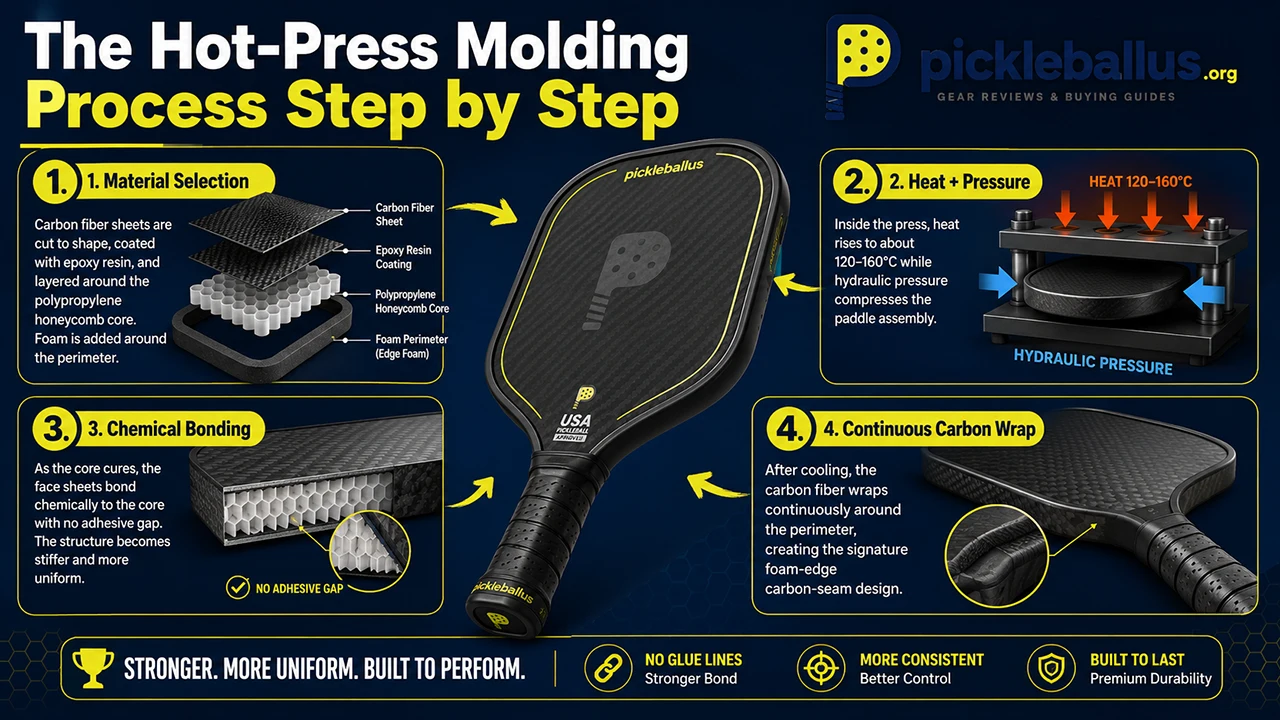
Construction begins with material selection. Carbon fiber sheets — most often 12K or 18K weave — are cut to paddle dimensions and coated with epoxy resin. A polypropylene honeycomb core is centered between the face sheets, and foam is packed or injected along the perimeter to fill the edge cavity before the mold closes.
Inside the press, temperatures rise to the resin’s activation point — typically between 120°C and 160°C depending on the formulation — while hydraulic pressure compresses the assembly. As the core cures under those conditions, its cell walls stiffen and align more uniformly than they would at room temperature. The face sheets do not simply sit on the core; they bond chemically to it, surface to surface, with no adhesive gap between them.
When the mold opens and the paddle cools, the carbon fiber wraps continuously around the perimeter rather than terminating at a separately glued edge guard. This is the origin of the foam-edge, carbon-seam design that defines current thermoformed paddles.
Foam Edge, Carbon Seam, and Why They Change Performance
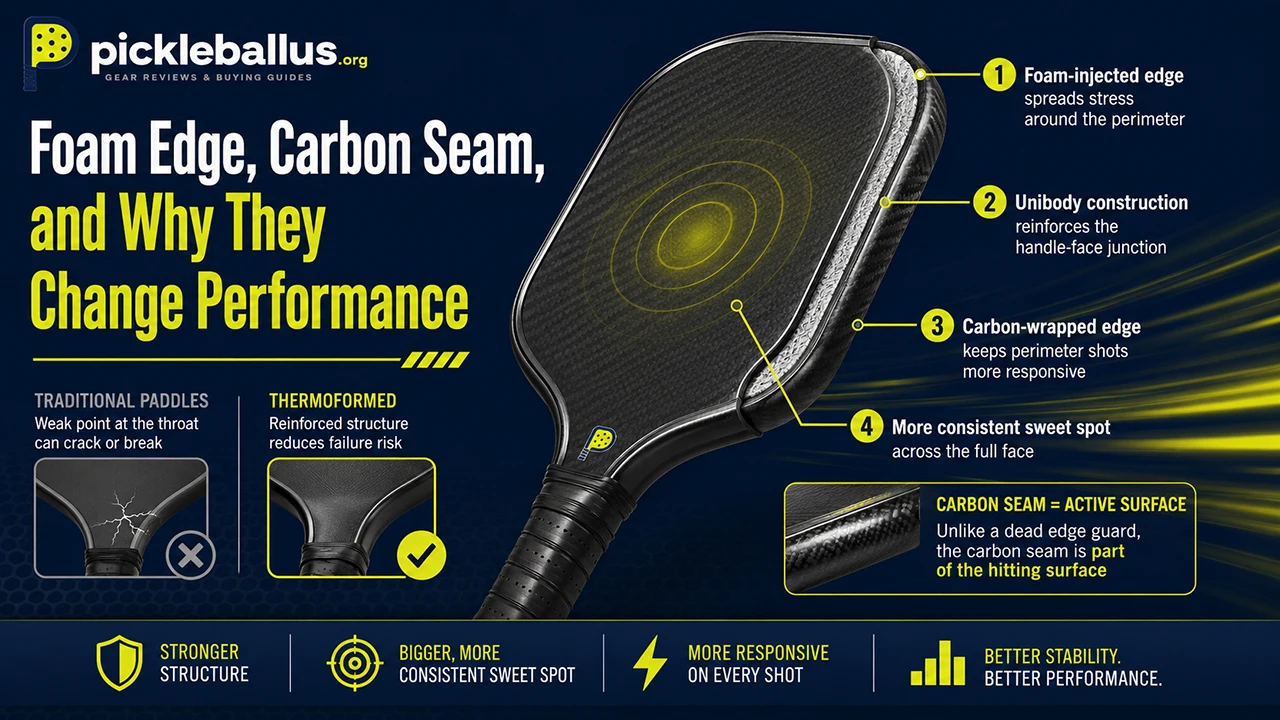
The foam-injected edge addresses one of the most consistent failure points in traditional paddle construction. In a cold-press build, the junction where the handle meets the paddle face concentrates stress over thousands of impacts. That weak point is a known failure site — players who have snapped a traditional paddle at the throat know exactly where it broke. Thermoformed paddles eliminate that vulnerability because the foam edge distributes stress continuously around the perimeter, and the unibody structure reinforces the handle-face junction from the inside.
The carbon seam along the edge also changes the sweet spot equation. Traditional paddles add dead weight at the perimeter through the edge guard, which contributes mass but not responsiveness. In a thermoformed paddle, the carbon-wrapped edge is part of the active hitting surface. Shots struck near the perimeter respond more like shots hit in the center — which is why thermoformed players report a more consistent response across the full face rather than a “hot” center and “dead” edges.
What Is a Non-Thermoformed (Traditional) Pickleball Paddle?
Non-thermoformed paddles — also called cold-press, sandwich, or traditional paddles — are built by bonding carbon fiber or fiberglass face sheets to a honeycomb core using adhesive, then wrapping the perimeter with a plastic or nylon edge guard. This entire process happens at room temperature, preserving the original mechanical properties of each material.
Cold-press construction has defined the pickleball paddle industry since the sport began gaining mainstream traction. Some of the most trusted paddles ever produced — and many currently favored by competitive players who prioritize feel — use this method. Non-thermoformed does not mean outdated or inferior; it means different in ways that matter depending on how you play.
Cold-Press Sandwich Construction Explained
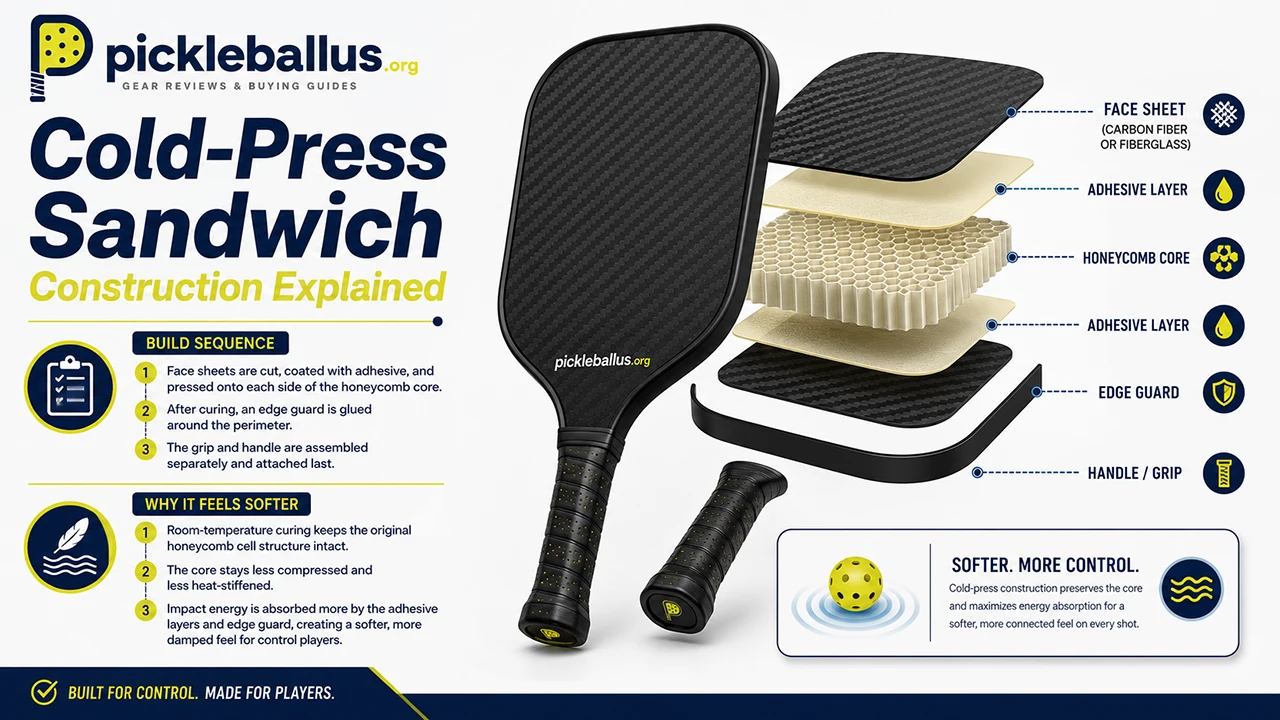
The build sequence in cold-press construction starts with face fabrication. Carbon fiber or fiberglass sheets are cut, coated with adhesive, and pressed against each side of the honeycomb core under controlled pressure. After curing, an edge guard is applied around the perimeter, seated in adhesive, and allowed to set. The grip and handle are assembled separately and attached as a final step.
Because the materials cure at room temperature, the core retains its original cell structure. The honeycomb cells do not compress or stiffen under heat — they maintain the geometry they came with. This produces a softer, more damped feel at contact. Energy from the ball impact absorbs into the adhesive layers and the edge guard rather than bouncing back immediately, which is exactly why control-oriented players choose this construction deliberately.
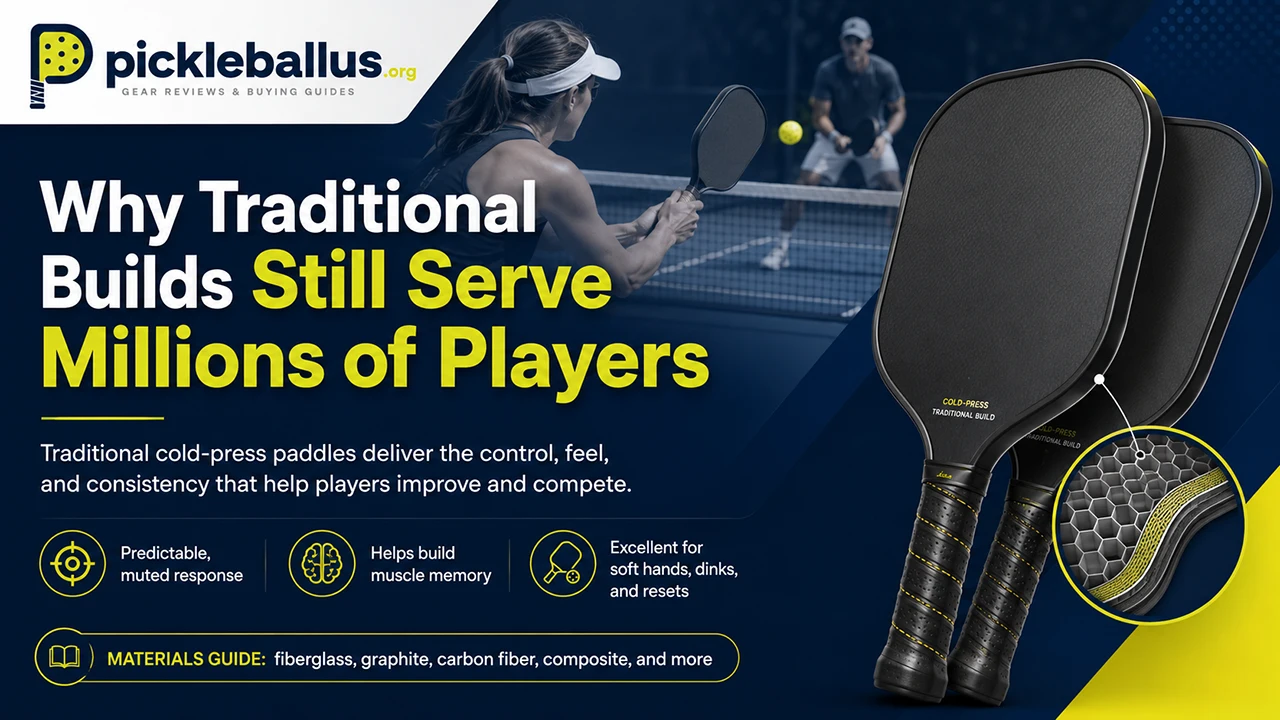
Why Traditional Builds Still Serve Millions of Players
Traditional cold-press paddles dominate the entry and mid-range market, and the performance reasons behind that are legitimate. The predictable, muted response gives developing players clear feedback on where the ball hit and how their mechanics contributed to the shot. That clarity is difficult to overstate for anyone still building muscle memory.
At the advanced level, players who base their game on soft hands, sharp dinks, and a precise two-handed reset actively choose traditional builds. The natural dampening of a cold-press face requires no compensating adjustment at the kitchen — what you put into the shot is what comes out, without the trampoline amplification that forces thermoformed users to shorten their swing on finesse shots.
The pickleball paddle materials guide covers the full material spectrum — fiberglass, graphite, carbon fiber, composite, and beyond — with performance trade-offs that apply to both thermoformed and traditional builds.
Thermoformed vs Non-Thermoformed: 5 Key Performance Differences
Thermoformed paddles win in power, sweet spot consistency, and spin potential; non-thermoformed paddles win in touch, predictability, and value. The breakdown below covers each performance axis honestly, including where the marketing around thermoforming overstates the reality.
The following comparison covers the five axes that matter most for on-court decision-making:
| Performance Axis | Thermoformed | Non-Thermoformed |
|---|---|---|
| Power / Pop | Higher — trampoline effect adds rebound | Moderate — energy absorbs at contact |
| Touch / Control | Requires adjustment; rewarding long-term | Natural and muted from first use |
| Sweet spot size | Larger, edge-to-edge consistency | Smaller center; variable near edges |
| Durability | High — resists edge cracking | Lower edge durability, no delamination risk |
| Price point | Premium range and above | Budget through mid-range |
Power and Pop — The Trampoline Effect
The stiffness of a thermoformed unibody creates what players consistently describe as the trampoline effect: the ball compresses slightly into the face on contact and rebounds with more energy than a softer-faced paddle would return. The foam edge reinforces this by keeping the perimeter rigid rather than absorbing impact passively, channeling more energy back into the ball.
For players with efficient mechanics, this amplification is a genuine tool. A compact, controlled swing generates more pace than the same swing on a traditional paddle. The problem is that amplification is not selective — mishits come off hotter, timing errors produce more erratic results, and players transitioning from traditional builds often overcook drives for several weeks before their mechanics adjust. The power advantage of thermoformed paddles is real, but it comes with an adaptation period that not every player accounts for when making the switch.
Control and Touch — Which Feels More Predictable?
Non-thermoformed paddles deliver a softer, more damped response. When the ball contacts the face, energy disperses into the adhesive layers and the edge guard, producing what many experienced players describe as a “connected” feeling — you sense exactly where the ball hit and how the contact registered. That feedback is especially valuable at the non-volley zone, where shot placement matters more than shot power.
Thermoformed paddles can match this control level, but it requires deliberate adjustment. The lively response means players need to shorten their swing on dinks and reset shots to avoid sending the ball too deep. Players who commit to that adjustment — typically four to six weeks of consistent practice — often find that the thermoformed paddle’s larger sweet spot makes their kitchen game more consistent over time. The challenge is surviving the adjustment period without losing confidence in a shot they previously owned.
Sweet Spot Size and Consistency
Traditional cold-press paddles have distinct “hot” and “dead” zones across the face. The center of the paddle — where the core is thickest relative to the edge guard — responds most lively, while contact near the edge guard feels softer and less responsive. Players who develop their game on traditional paddles learn intuitively to find the center, which is itself a useful skill.
Thermoformed paddles distribute stiffness more uniformly because the foam edge and carbon seam maintain consistent rigidity from the center to the perimeter. An off-center hit near the edge of a thermoformed paddle responds much closer to a center hit than the same contact on a traditional build. This characteristic particularly benefits players with large, fast swings — when you are moving quickly and striking at pace, hitting the sweet spot precisely on every shot is not always possible, and a forgiving edge changes the error cost significantly.
Durability and Delamination Risk
Thermoformed paddles resist edge chipping and the handle-face junction cracking that limits the lifespan of traditional builds. The foam-injected edge makes the perimeter nearly impervious to the impact damage that slowly destroys cold-press edge guards. Under regular use, a well-made thermoformed paddle outlasts a comparable traditional model — an important factor if you play four or more days per week.
The durability trade-off is delamination: when the carbon face separates partially from the core, creating a pocket effect that generates extreme, unrepeatable power well beyond legal limits. Early thermoformed models produced between 2022 and 2023 had documented delamination issues related to manufacturing variances in epoxy distribution and curing time. Most established manufacturers refined their production tolerances significantly, and current builds from reputable brands have much lower delamination rates. The risk is not zero, however. For a full breakdown of how delamination occurs, how to detect it, and whether a suspect paddle is still legal, the delaminated pickleball paddle guide covers the topic in detail.
Which Players Should Choose Thermoformed Paddles?
Thermoformed paddles suit competitive, frequent players who play aggressively and have the mechanics to use the extra power intentionally. The right fit breaks down by four player profiles:
Advanced and competitive players (4.0+): At this skill level, the consistent edge-to-edge sweet spot and reliable power output of thermoformed paddles compound over hundreds of matches. The learning curve is manageable for players with established mechanics, and the performance ceiling is meaningfully higher than a traditional build.
Power and baseline players: If your game is built around hard drives, overhead smashes, and pace-heavy transition volleys, thermoformed construction amplifies your strengths. The trampoline effect rewards aggressive, full-swing play styles in a way that cold-press paddles structurally cannot match.
Frequent players (4+ sessions per week): Thermoformed paddles’ greater durability means fewer replacements. A player at that usage rate will likely get 18 to 24 months of reliable performance from a quality thermoformed paddle versus 10 to 14 months from a mid-range traditional build. The cost-per-session advantage narrows the price gap over time.
Raw carbon spin seekers: Most thermoformed paddles use a raw carbon fiber surface, which grips the ball at contact and extends dwell time, producing more topspin and underspin bite than smooth fiberglass faces. Spin-oriented players — particularly those who rely on a heavy topspin third-shot drop — will find thermoformed construction’s raw carbon texture a genuine advantage.
For models sorted by play style, budget range, and skill level, the best pickleball paddles roundup covers the current market comprehensively.
Which Players Should Stick with Non-Thermoformed Paddles?
Non-thermoformed paddles remain the right choice for developing players, touch-dominant players, and anyone managing arm or joint issues. The performance case for each group holds up under scrutiny.
Beginners and recreational players: The forgiving, predictable response of a traditional paddle makes it easier to build technique from scratch. You feel your mechanics clearly in the feedback from every shot, which accelerates correction. Spending premium-range money on a thermoformed paddle before your fundamentals are solid means investing in an equipment ceiling you cannot yet reach.
Control and kitchen-dominant players (3.5 and below): If your game lives at the non-volley zone and relies on soft hands and precise placement, a traditional paddle’s natural dampening gives you the touch you need without the compensation that thermoformed builds require. Many 3.5 players who switch to thermoformed paddles report temporarily losing their reliable drop shot — a trade not worth making at that stage.
Players with tennis elbow or wrist pain: The stiffness of thermoformed paddles transmits more vibration on off-center hits, which can aggravate existing joint issues. A softer, traditional fiberglass face cushions impact better and reduces the shock transmitted to the elbow and wrist. If you are managing arm pain, a traditional build is the recommended starting point before stepping up to a thermoformed model.
Budget-conscious players: Non-thermoformed paddles at the mid-range price point deliver strong performance for casual and recreational play. The value proposition is hard to beat for players who play one to two sessions per week — the marginal performance gains of a premium thermoformed model do not justify the cost difference at that usage level.
Core thickness is another variable that interacts with construction type when affecting power and control. The 14mm vs 16mm pickleball paddle comparison covers that decision directly.
Are Thermoformed Paddles Worth the Price?
For serious, frequent players — yes. For developing or casual players — not necessarily. The honest answer depends on how often you play, what level you have reached, and whether you can commit to the adaptation period.
The performance advantages of thermoformed paddles are real: a larger sweet spot, amplified power from efficient swings, raw carbon spin potential, and better long-term durability. But those advantages require a player skill level and practice commitment that unlocks them. A thermoformed paddle in the hands of a beginner who plays once a week delivers less value than a well-fitted mid-range traditional paddle in the hands of someone playing three times a week who can feel and use the feedback.
The clearest signal that you are ready for a thermoformed paddle is when you have hit a performance ceiling with your current equipment — where your mechanics are sound and your shot consistency is limited by the paddle’s response, not by your own execution. That moment is different for every player, but it is rarely before the 4.0 skill threshold.
The pickleball paddle comparison hub covers additional head-to-head breakdowns — construction, materials, shapes, and core thickness — for players who want to cross-reference multiple variables before deciding. For a broader framework on how to match paddle specs to your game, the how to choose a pickleball paddle guide walks through every variable in sequence.
By now you have a clear picture of how thermoformed and non-thermoformed paddles differ at the construction level — and how those differences play out in real court performance across power, touch, sweet spot, and durability. Choosing between them is a structural decision, not a prestige one, and the factors above give you the framework to make it honestly. What remains are two considerations that sit just below the surface of most buying decisions but can change your calculus: whether your paddle meets the approval standards for competitive play, and what to watch for in thermoformed builds over time so you are not playing with equipment that has quietly degraded.
What Else Should You Know Before You Buy?
USAP Approval and Legal Play
Both thermoformed and non-thermoformed paddles can meet USA Pickleball (USAP) approval standards. The approval process evaluates the finished paddle — not the construction method. A thermoformed paddle earns approval if its surface texture, deflection response, and dimensions comply with the relevant specifications. A traditional paddle fails if those same parameters fall outside limits, regardless of how simple its construction is.
The controversy around delaminated thermoformed paddles affected USAP approval decisions significantly in 2023 and 2024. Paddles with core crushing or face separation that produced excessive power were removed from the approved equipment list. Most manufacturers corrected their production tolerances in response, and current thermoformed models from established brands pass USAP testing without issue. If tournament play is on your radar, verify that your specific paddle model appears on the current USAP approved equipment list before purchasing — the list updates regularly and what passed a year ago may have been rescinded.
The Delamination Controversy in Thermoformed Paddles
Delamination became a high-profile topic in competitive pickleball when players and coaches noticed that certain thermoformed paddles were generating measurably more power after extended use. A delaminated paddle produces a pocket effect at contact that amplifies the trampoline response well beyond what the paddle was approved for — often so significantly that the player using it gains an illegal performance advantage without knowing it.
The root causes in early production runs were manufacturing variances: uneven epoxy distribution across the face, inconsistent foam-edge density at the perimeter, and insufficient curing time under the press. High-quality thermoformed paddles from the 2024 production cycle onward have largely addressed these variables. The risk is now low with reputable brands, but it is not zero.
Players who want to use thermoformed paddles in competitive settings should inspect their paddle periodically after six to twelve months of heavy play. The early signs of delamination are a change in impact sound — from a crisp, solid strike to a hollow, slightly echoed “ping” — and a perceived increase in power on drives without any change in swing mechanics. If either signal appears, retire the paddle before your next sanctioned match.
Thermoformed vs Standard — The Budget Verdict
The construction method you choose should follow an honest assessment of your game, not the current marketing cycle. Thermoformed technology has advanced quickly and the price gap has narrowed as manufacturing has scaled up, but traditional cold-press paddles have not become worse in the process. They remain the smarter entry point for developing players and the deliberately preferred tool for touch-oriented advanced players who have chosen feel over the power amplification that thermoformed builds provide.
For players at the decision point: choose thermoformed if you play competitively and frequently, you have mechanics to support the adaptation period, and you are willing to invest in equipment that matches your performance ceiling. Choose traditional if you are still developing, play recreationally, manage joint issues, or rely on a soft-touch kitchen game as your primary competitive weapon. The best equipment is the one that fits your game today — not the one that fits the game you plan to have in two years.
Write Your Review
No reviews yet. Be the first to share your experience!