

Choosing between kevlar and carbon fiber comes down to five performance attributes — and each material wins a different set of them. Carbon fiber paddles dominate on power, spin, and crisp responsiveness, making them the preferred choice for aggressive 3.5–5.0 players. Kevlar paddles (and kevlar-carbon hybrids) hold the edge on feel, durability, arm comfort, and forgiveness — a better fit for control-oriented players, anyone dealing with joint sensitivity, and competitors who grind through hundreds of hours of play per year.
The key differences between kevlar and carbon fiber center on how each material behaves at the moment of ball contact. Carbon fiber’s stiffness transfers energy efficiently, producing fast ball exit speeds and gritty spin generation. Kevlar’s slight flexibility extends dwell time — the fraction of a second the ball stays on the face — which improves placement precision on dinks, drops, and resets. That one property shifts how the entire game feels in your hand.
Most players worry about choosing the wrong material and losing performance. The truth is that both materials are used by pros and recreational players alike, and the right choice depends entirely on what you want from your game. The performance gap between premium versions of each material runs in single-digit percentages, not categorical differences — which means getting the right material for your style matters more than chasing the “objectively better” one.
Below, we break down every meaningful difference between kevlar and carbon fiber paddle faces, test them head-to-head across four performance categories, and match each material to the paddles worth buying right now. For a broader look at how these materials fit into the full spectrum of pickleball paddle materials, that guide covers all face types side by side.
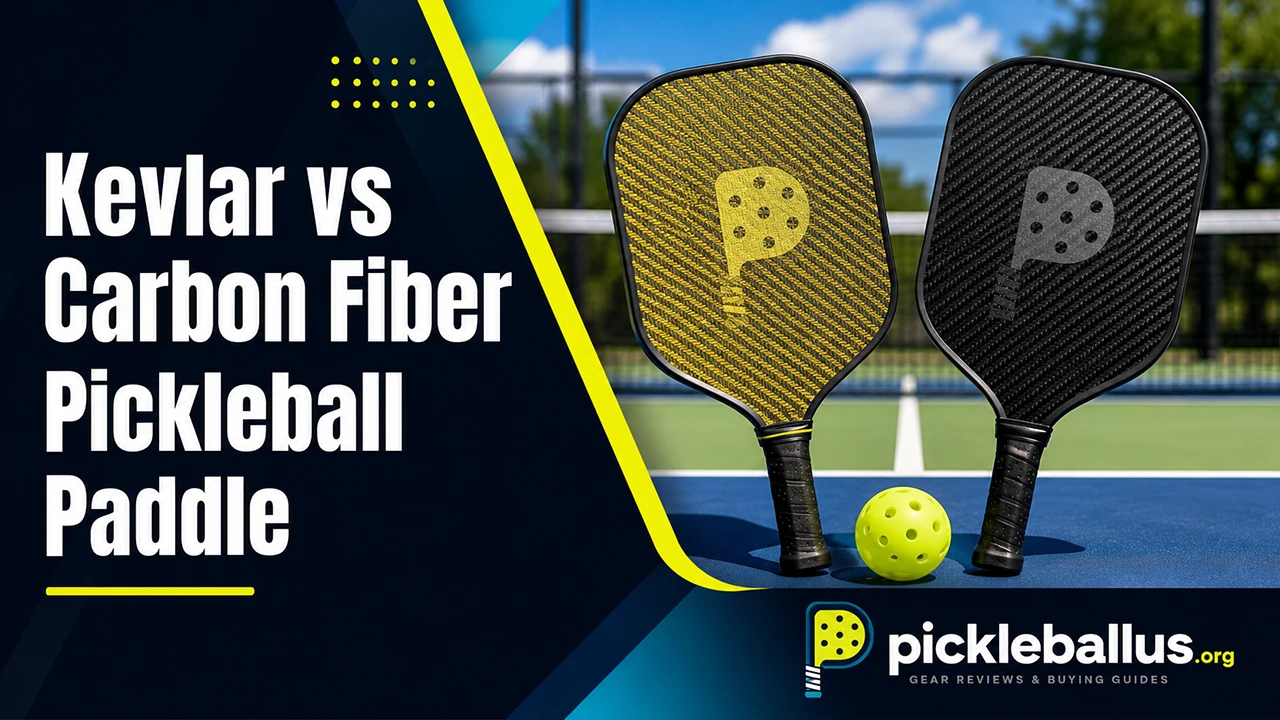
What Are Kevlar and Carbon Fiber Pickleball Paddle Faces?
Carbon fiber and kevlar are the two most discussed face materials in modern pickleball paddle design — and they produce measurably different on-court experiences. Carbon fiber became the industry standard in high-performance paddles starting around 2021 and now accounts for the majority of mid-to-premium releases. Kevlar, meanwhile, has built a loyal following among players who want durability, feel, and arm comfort above raw pop.
What Makes Carbon Fiber a Dominant Paddle Face
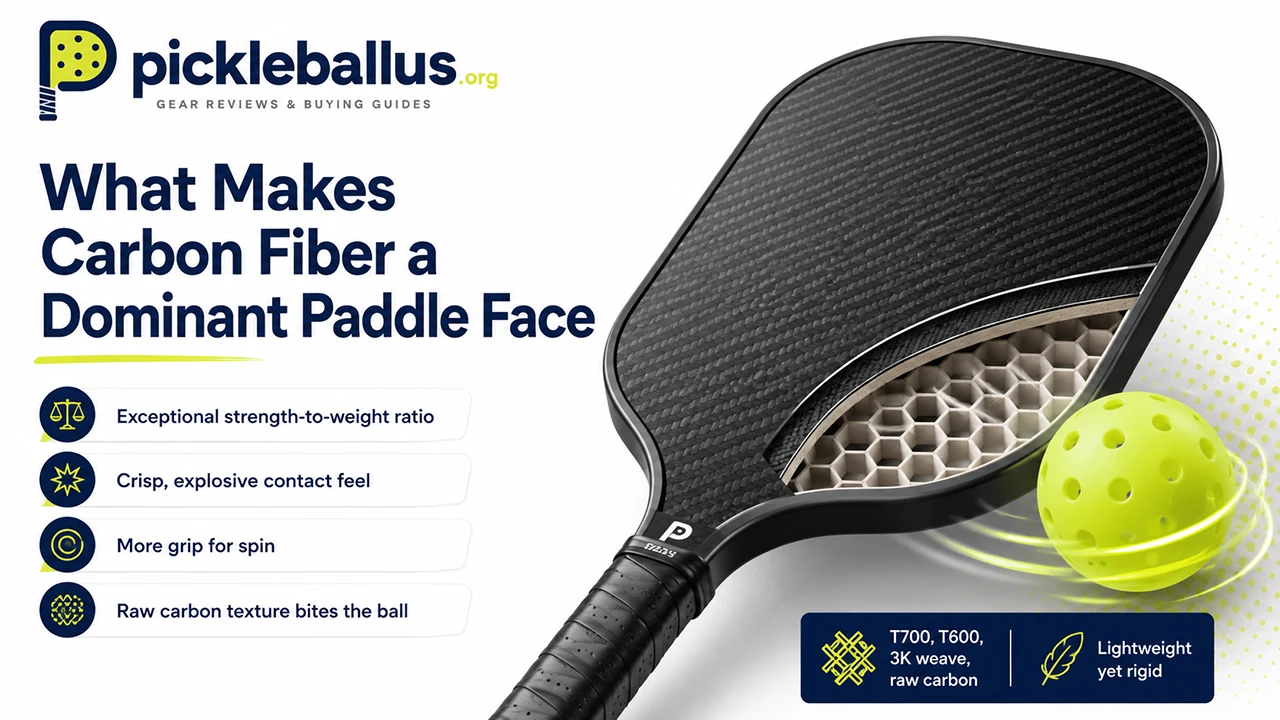
Carbon fiber paddle faces consist of tightly woven strands of carbon arranged in layered sheets over a polymer honeycomb core. The defining property is its exceptional strength-to-weight ratio — carbon fiber paddles are lightweight yet rigid, which means energy from your swing transfers directly into the ball with minimal loss at impact. The result is that crisp, explosive contact feel competitive players describe as the ball “popping” off the face.
Most top-selling paddles from JOOLA, Selkirk, HEAD, and Paddletek use carbon fiber face variants — T700, T600, 3K weave, or raw carbon. The stiffness also creates high surface tension, which amplifies the texture’s grip on the ball and maximizes spin generation. Raw carbon fiber faces in particular carry an almost sandpaper-like grit that bites into the ball for heavy topspin drives and aggressive slice shots. See the full breakdown at best carbon fiber pickleball paddle for top options by carbon grade.
What Kevlar Brings to the Paddle Face
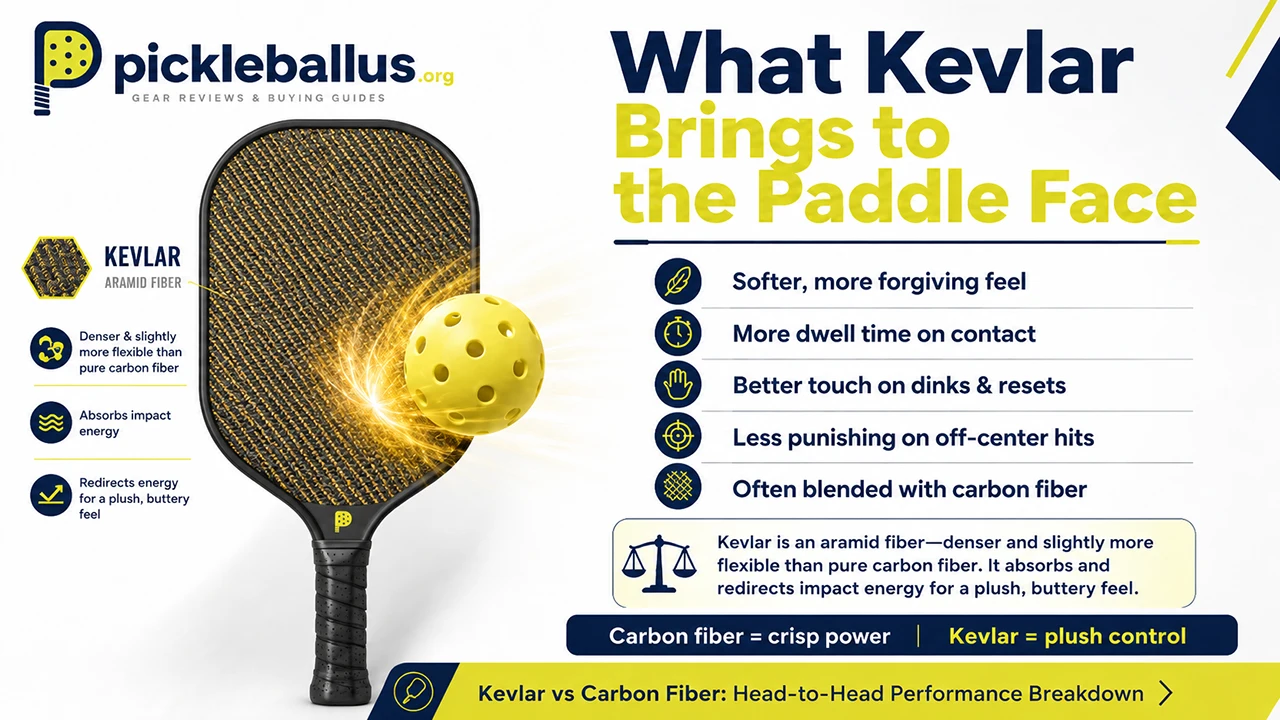
Kevlar is a synthetic aramid fiber originally developed by DuPont — the same material used in bulletproof vests and body armor. In pickleball paddles, it’s woven into the face surface alone or blended with carbon fiber in a hybrid composite weave. Kevlar is denser and slightly more flexible than pure carbon fiber, which changes the contact feel at impact entirely.
Where carbon fiber bounces the ball away with precision and force, kevlar absorbs and redirects impact energy. This creates a softer, more forgiving contact feel — often described as “plush,” “buttery,” or having more “dwell time.” That extra moment of ball-face contact translates into better placement on soft shots like dinks and resets, and makes off-center hits feel far less punishing. For the full list of top best kevlar pickleball paddles, see our dedicated roundup.
Kevlar vs Carbon Fiber: Head-to-Head Performance Breakdown
Four categories define how each material performs in actual play. Here’s how they compare across the metrics that matter most.
Power and Shot Energy Transfer
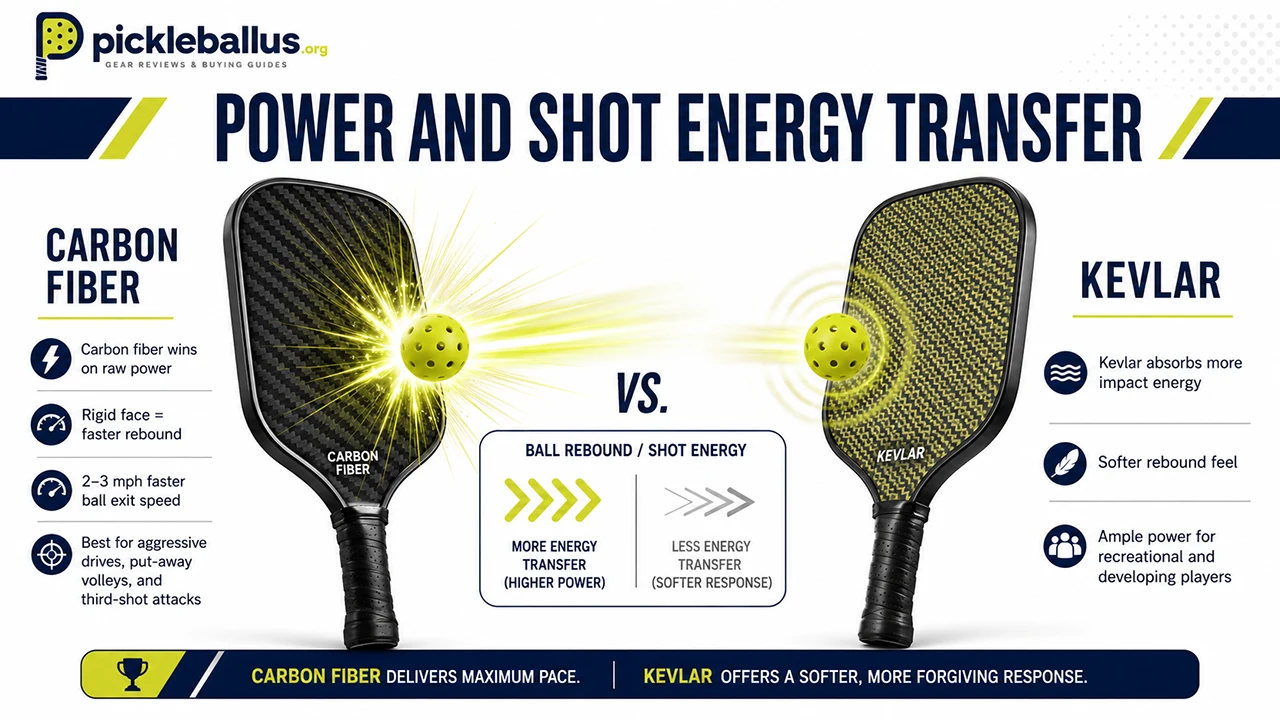
Carbon fiber wins on raw power. Its rigid face wastes almost no energy on impact — the ball rebounds hard and fast. This is why most 4.0+ competitive players default to carbon fiber: it rewards aggressive baseline drives, put-away volleys, and third-shot attacks. Independent testing consistently shows carbon fiber paddles producing 2–3 mph faster ball exit velocities than kevlar counterparts with identical swing mechanics and core construction.
Kevlar’s slight flexibility absorbs a fraction of that energy before returning it to the ball. The rebound still feels powerful — especially on hybrid carbon-kevlar faces — but the exit speed is softer. That difference matters most at 4.0+ levels where pace off the paddle determines whether an attack ball stays in or skies past the baseline. For recreational and developing players, kevlar’s “trampoline-like” rebound still produces ample power for every shot in the game.
Control, Touch, and Dink Game
Here the dynamic flips. Kevlar’s longer dwell time gives it a genuine edge in the soft game. Dinks, resets, and third-shot drops require feel and precise pace modulation — and kevlar’s slight give lets players communicate more intuitively with the ball through hand feel. The face essentially transmits the ball’s weight and angle back through the grip, making micro-adjustments easier on delicate net exchanges.
Carbon fiber’s precision is not to be underestimated — its immediate responsiveness makes it excellent for controlled dinks in technically sound players. But it rewards clean, centered contact. Off-center hits deliver sharper, less predictable feedback than kevlar. Intermediate players in the 3.0–3.5 range consistently find kevlar more forgiving while they develop consistent swing mechanics and footwork.
Spin Generation and Surface Texture
Carbon fiber, and especially raw carbon fiber, generates more spin. The open-weave texture grips the ball during contact, and the stiff face maintains that texture under impact pressure. Raw carbon fiber faces carry peak grit for topspin generation — the JOOLA Perseus Pro and similar paddles exploit this to deliver heavy ball rotation that pushes opponents back from the baseline.
Kevlar’s woven texture also produces solid spin, and one underrated advantage emerges over time: kevlar faces hold their surface texture longer than carbon fiber. Carbon fiber sweet spots can develop polished patches after 6–12 months of heavy daily play as the face texture compresses under repeated impact. Kevlar’s abrasion resistance slows that process, which means consistent spin production across a longer paddle lifespan. For players who compete frequently and value consistency over peak spin output, that longevity matters.
Vibration Dampening and Arm Comfort
Kevlar wins this category clearly, and by a meaningful margin. Its natural shock-absorbing properties reduce vibration transfer up the kinetic chain — wrist, elbow, shoulder — making it noticeably gentler during long play sessions. Players managing pickleball elbow, tennis elbow, or early-stage wrist inflammation consistently report carbon-kevlar and pure kevlar paddles producing less discomfort than equivalent carbon fiber paddles.
Carbon fiber paddles are not harsh by design. Paired with a 16mm polypropylene core, most carbon fiber paddles deliver respectable vibration dampening. But kevlar’s inherent flexibility adds a second layer of absorption that stiff carbon fiber cannot replicate. For players who log 10+ hours per week, the arm health difference between the two materials compounds significantly over a full season.
Which Lasts Longer: Carbon Fiber or Kevlar?
Durability separates the two materials in ways that don’t show up in short-term testing but become obvious after sustained heavy use.
How Carbon Fiber Ages Over Time
Carbon fiber faces are strong but develop dead spots after concentrated impact in the sweet spot. As the face absorbs thousands of contact repetitions, the polypropylene core beneath compresses and the face surface loses its live, responsive feel in the center. Players who hit consistently in the same spot — advanced players almost always do — notice this degradation most acutely.
Surface texture also wears down over time. The grit that drives spin generation gradually smooths under ball impact, reducing spin performance. High-grade T700 and 3K weave faces hold up longer than budget carbon fiber variants, but even premium paddles from elite brands typically see measurable performance degradation after 12–18 months of daily competitive play. Carbon fiber faces are also more susceptible to chipping and cracking on hard drops or paddle collisions.
Why Kevlar Holds Up Better Under Wear
Kevlar’s impact resistance gives it a clear durability advantage. The same properties that make it suitable for ballistic protection — puncture resistance, tear resistance, and abrasion resistance — translate directly to pickleball’s repetitive impact stress. Kevlar faces are less prone to developing dead spots, and their surface texture maintains consistency longer than carbon fiber under equivalent use.
For players who compete outdoors on abrasive court surfaces, or for facilities and recreational players who share paddles across multiple users, kevlar-composite faces represent a meaningful upgrade in long-term value. A kevlar paddle that maintains its performance for 24 months justifies a higher initial cost compared to a carbon fiber paddle requiring replacement at 12–18 months.
Best Carbon Fiber Pickleball Paddles to Buy Right Now
The three carbon fiber paddles below are active Amazon sellers with strong review counts, proven performance profiles, and broad player adoption across skill levels.
#1 JOOLA Ben Johns Perseus Pro 16mm — Best Overall Carbon Fiber
The JOOLA Ben Johns Perseus Pro 16mm is the benchmark for carbon fiber paddle performance heading into 2026. Developed with the world’s top-ranked player, it pairs a high-grit carbon fiber face with a 16mm polypropylene core — striking the ideal balance between power and control for players from 3.5 to 5.0.
Key specs: Carbon fiber face, 16mm PP honeycomb core, elongated shape, ~7.9 oz
Performance: The carbon face delivers exceptional surface grit for topspin, and the 16mm core softens the contact feel enough to handle kitchen play without sacrificing drive power. Fast exchanges at the net are where the Perseus Pro excels — the face provides immediate, predictable feedback that advanced players can trust on instinct.
Pros: Top-tier spin generation, excellent pop for power-oriented play, consistent response across the face, USA Pickleball approved, endorsed by the world’s top player
Cons: Stiffer contact feel may not suit players with arm sensitivity, premium price point
Best For: Intermediate to advanced players (3.5–5.0) who play aggressively from the baseline and want maximum spin paired with reliable control
My Verdict: The Perseus Pro 16mm is the gold standard for carbon fiber paddles. If you want one paddle that delivers everything a carbon fiber face should — spin, power, precision, and longevity — this is the unambiguous recommendation.
#2 Selkirk SLK Halo Control XL — Best Carbon Fiber for Control Players
The Selkirk SLK Halo Control XL targets the growing segment of players who want carbon fiber responsiveness without sacrificing softness. Its carbon fiber face is tuned for dink precision and kitchen control rather than maximum drive power — a conscious choice that shows immediately in play.
Key specs: Carbon fiber face, 16mm polypropylene core, XL elongated shape, ~8.0 oz
Performance: The paddle excels in the kitchen. Dinks feel planted and intentional; the face doesn’t over-amplify pace on reset shots. The elongated XL shape extends reach at the net without making the paddle feel unmanageable. Players transitioning from recreational to competitive play consistently cite the Halo Control XL as the paddle that accelerated their soft-game development.
Pros: Excellent feel for soft shots, large sweet spot, control-oriented construction, versatile across all court positions
Cons: Less raw pop than the Perseus Pro, elongated shape requires a brief adjustment for players coming from widebody paddles
Best For: Intermediate players (3.0–4.0) building their soft game, players who favor control and placement over power, anyone upgrading from entry-level paddles
My Verdict: The Halo Control XL proves carbon fiber doesn’t have to feel aggressive. It’s the right carbon fiber choice if you want precision and touch without the jarring crispness of stiffer carbon faces.
#3 HEAD Radical Pro — Best Value Carbon Fiber
The HEAD Radical Pro delivers carbon fiber performance at a mid-range price, making it one of the most-recommended upgrades for players moving on from beginner fiberglass paddles. HEAD’s Ergo grip system reduces fatigue during extended play sessions.
Key specs: Carbon fiber face, polypropylene core, classic widebody shape, ~8.0 oz
Performance: Solid all-around performance — reliable spin generation, consistent pop, and predictable feel across the entire face. It doesn’t match the technical sophistication of the Perseus Pro or Halo, but it handles every shot without surprises. The widebody shape is particularly forgiving for players still developing consistent contact positioning.
Pros: Strong value for genuine carbon fiber quality, comfortable Ergo grip system, dependable pop for the price, widely available on Amazon
Cons: Less surface grit than raw carbon alternatives, core thickness not optimized for elite-level performance differentiation
Best For: Players upgrading from entry-level paddles, beginners committing to their first carbon fiber paddle, recreational players who want meaningful quality at a reasonable investment
My Verdict: The Radical Pro is the easiest carbon fiber recommendation for players who aren’t ready to spend premium prices but want a real performance upgrade. It delivers on every core promise of carbon fiber without the cost of flagship models.
Best Kevlar Pickleball Paddles to Buy Right Now
Pure kevlar paddles are less common on mainstream shelves than carbon fiber, but the paddles below stand out for arm-friendly feel, impact durability, and control-oriented performance.
#4 Engage Encore MX 6.0 — Best for Feel and Forgiveness
The Engage Encore MX 6.0 uses Engage’s proprietary composite face incorporating kevlar fibers in a formulation engineered for vibration dampening and a distinctively soft contact feel. It consistently ranks among the most arm-friendly paddles in independent reviews and player feedback.
Key specs: Kevlar-composite face (Engage Skin technology), polypropylene core, widebody shape, ~8.0–8.5 oz
Performance: Contact feels noticeably different from pure carbon fiber — softer, more cushioned, with the dwell time that aids dinking and touch-shot placement. Power remains ample for driving, but this paddle earns its reputation in the soft game. Players with elbow or wrist sensitivity consistently report less discomfort with the Encore MX 6.0 compared to carbon fiber alternatives in the same price tier.
Pros: Outstanding vibration dampening, forgiving on off-center contact, natural feel for dinks and resets, strong long-term durability
Cons: Slightly heavier than comparable carbon fiber paddles, less peak spin generation than raw carbon faces
Best For: Players managing elbow or wrist discomfort, intermediate players focused on developing the soft game, recreational players transitioning from wood or basic fiberglass paddles
My Verdict: The Encore MX 6.0 is the first paddle I’d recommend to any player dealing with arm pain. The kevlar composite face makes a real, noticeable difference — not marketing language, actual physical relief during play.
#5 FLiK Body Helix Nitro — Best Kevlar-Carbon Hybrid
The FLiK Body Helix Nitro uses a kevlar-carbon fiber woven composite face that blends both materials’ strengths into a single surface. It occupies the performance middle ground between full carbon power and full kevlar comfort — a genuinely balanced option that competitive players increasingly favor.
Key specs: Kevlar-carbon woven face, polymer core, standard shape, ~7.8–8.0 oz
Performance: The hybrid face delivers a slightly softer version of carbon fiber’s crisp response. Spin is strong, power is high, but vibration off the face is noticeably reduced compared to a pure carbon fiber paddle. Players who appreciate carbon fiber’s performance but deal with fatigue during multi-hour sessions will feel the difference immediately. The woven surface also shows strong texture durability over time — a benefit of the kevlar component.
Pros: Genuine best-of-both-worlds feel, strong spin generation, reduced arm fatigue compared to pure carbon, durable woven surface
Cons: Less widely distributed than major brands, hybrid feel takes one or two sessions to calibrate to
Best For: Players at 3.5–4.5 who want carbon fiber performance with kevlar’s arm-friendly comfort, anyone who has experienced fatigue or minor discomfort on pure carbon fiber paddles and doesn’t want to sacrifice competitive performance
My Verdict: The FLiK Nitro is the strongest argument for hybrid faces. You don’t have to fully commit to one material — this paddle demonstrates that the middle ground is a legitimate, performance-justified choice. For players considering best composite pickleball paddles in this hybrid category, the Nitro belongs at the top of that list.
Kevlar or Carbon Fiber — Which Paddle Is Right for Your Game?
The right material depends on three variables: your playing style, your physical needs, and how you prioritize the performance attributes above.
Choose Carbon Fiber If You…
Prioritize power, spin, and crisp responsiveness. Carbon fiber rewards aggressive players — baseline drives, heavy topspin, fast exchange volleys. It’s the competitive standard for good reason: precision, pop, and spin generation are all elite-caliber, and the responsive feedback trains better mechanics over time. Players at 3.5 and above who play frequently and want to push their offensive game will find carbon fiber’s ceiling worth the trade-off in feel softness. Among the full range of best pickleball paddles on the market, the majority of top-10 picks use carbon fiber faces precisely because competitive players consistently choose responsiveness over forgiveness.
Choose Kevlar If You…
Prioritize durability, arm comfort, and feel in the soft game. Kevlar is the better material for players managing joint sensitivity, logging long multi-hour sessions, or playing control-oriented styles that emphasize dinking and placement over pace. The forgiving contact feel also makes kevlar paddles better choices for developing players who are still building consistent swing mechanics — fewer harsh mishits means fewer early discouragements that slow skill development.
When a Hybrid Carbon-Kevlar Face Makes Sense
Hybrid faces eliminate the need to choose. If your game shifts between aggressive baseline drives and delicate kitchen exchanges — which describes most competitive play above 3.5 — a kevlar-carbon composite paddle gives you access to both material profiles in one surface. Most paddle manufacturers are moving toward hybrid face constructions for their mid-range and premium lines, and that trend reflects a real performance insight: few players are so stylistically one-dimensional that a single-material face optimizes every shot they need to hit.
By now you have a complete picture of what separates carbon fiber from kevlar at the performance level — from pop and spin to feel, durability, and arm health. Choosing between them is no longer a coin flip but a deliberate match between material properties and your game. That said, face material is only one layer of paddle selection, and even the best face material underperforms when paired with the wrong core thickness or weight distribution. The next section goes beneath the surface to the structural and regulatory details that quietly shape how every shot feels — and why two paddles with identical face materials can feel completely different in your hand.
What Else Shapes Paddle Performance Beyond Face Material?
Face material is the most visible variable in paddle design, but several structural and regulatory factors work underneath it to determine how a paddle actually plays.
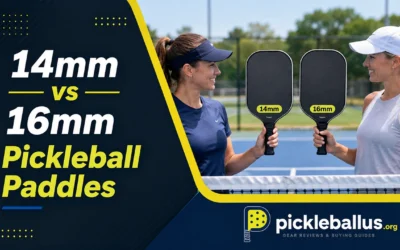
Core Thickness — 14mm vs 16mm and How It Interacts With Face Material
Core thickness changes the feel profile more than most players expect — and it interacts directly with face material. A 16mm polypropylene core produces a softer, more controlled contact feel, absorbing ball energy slightly before returning it. This setup benefits control-oriented play and reduces vibration. A 14mm core is stiffer and bouncier, amplifying pop and rewarding power-oriented swings.
Both carbon fiber and kevlar faces can be paired with either core thickness, but the combination changes the result significantly. A carbon fiber paddle on a 16mm core feels very different from the same face on a 14mm core. When comparing paddles across materials, always check core thickness alongside face material — it’s the second most important spec on the label.
USA Pickleball’s 40-Micron Roughness Rule
All approved paddles must comply with USA Pickleball’s surface roughness limit of 40 microns. This rule standardizes the playing field — no face material can legally carry so much grit that it delivers an unfair spin advantage over the competition. In practice, it means the performance differences between carbon fiber and kevlar faces are genuine but not as dramatic as manufacturer marketing sometimes implies.
Independent testing has confirmed that performance gaps between approved face materials run in single-digit percentage differences rather than separate performance categories. Core construction, thickness, and weight distribution collectively influence performance as much as face material. Choosing between carbon fiber and kevlar should be a feel preference and playing-style decision — not a search for a materially superior choice that doesn’t exist within legal specifications.
Carbon Fiber Subtypes: T700, 3K, and Raw Carbon Explained
Not all carbon fiber faces are identical. Three types appear most often in performance paddles:
- T700 carbon fiber — the most common grade in mid-to-high-end paddles; reliable balance of stiffness, weight, and surface grit
- 3K weave — lighter and slightly more flexible than T700; preferred by control-focused players who want carbon fiber responsiveness with a touch more feel
- Raw carbon fiber — open-weave construction with maximum surface grit for spin; standard in elite competitive paddles
Understanding which carbon subtype a paddle uses clarifies why two “carbon fiber” paddles can feel completely different from each other. For a full comparison of paddles organized by carbon weave type, best raw carbon fiber pickleball paddles breaks down top options by surface grade and performance profile.
Write Your Review
No reviews yet. Be the first to share your experience!