

The best heavyweight pickleball paddles of 2026 are the JOOLA Perseus Pro IV 16mm (best overall), the Selkirk VANGUARD Power Air Invikta (best for baseline dominators), the Engage Pursuit MX 6.0 (best for spin-forward power), the Paddletek Bantam ALW-C (best for durability), the ONIX Malice DB (best control-oriented heavy), the Gearbox GX6 CS 8.5oz (best budget heavy), and the HEAD Radical Pro (best for tennis converts going heavy).
What separates a great heavyweight paddle from one that just reads “8.5oz” on the label is how that weight is engineered. A sloppy mass of dense material will make your arm scream by set three. A well-balanced heavy paddle channels extra ounces into drive penetration, blocking stability, and baseline depth — without sacrificing your ability to reset.
Most players who pick up a heavy paddle for the first time make the same mistake: they chose it because they want more power, but they never asked whether their swing speed can leverage that weight. A heavy paddle does not add power on its own — it amplifies the power you already generate. If your swing mechanics are strong, a heavyweight paddle is a force multiplier. If they’re inconsistent, it’s just extra stress on your elbow.
Below, you’ll find the seven best heavyweight pickleball paddles currently available on Amazon, reviewed for power output, feel, arm-friendliness, and the specific types of players each one suits best.
What Is a Heavyweight Pickleball Paddle?
A heavyweight pickleball paddle weighs 8.3 ounces or more, with most models in this category falling between 8.3 and 8.8 oz. Understanding where heavyweight sits relative to the full weight spectrum is worth a moment before diving into product reviews — because the right weight category depends entirely on your game, not on what sounds impressive.
To better understand how pickleball paddle weight affects your performance across all categories, it helps to see the full spectrum first.
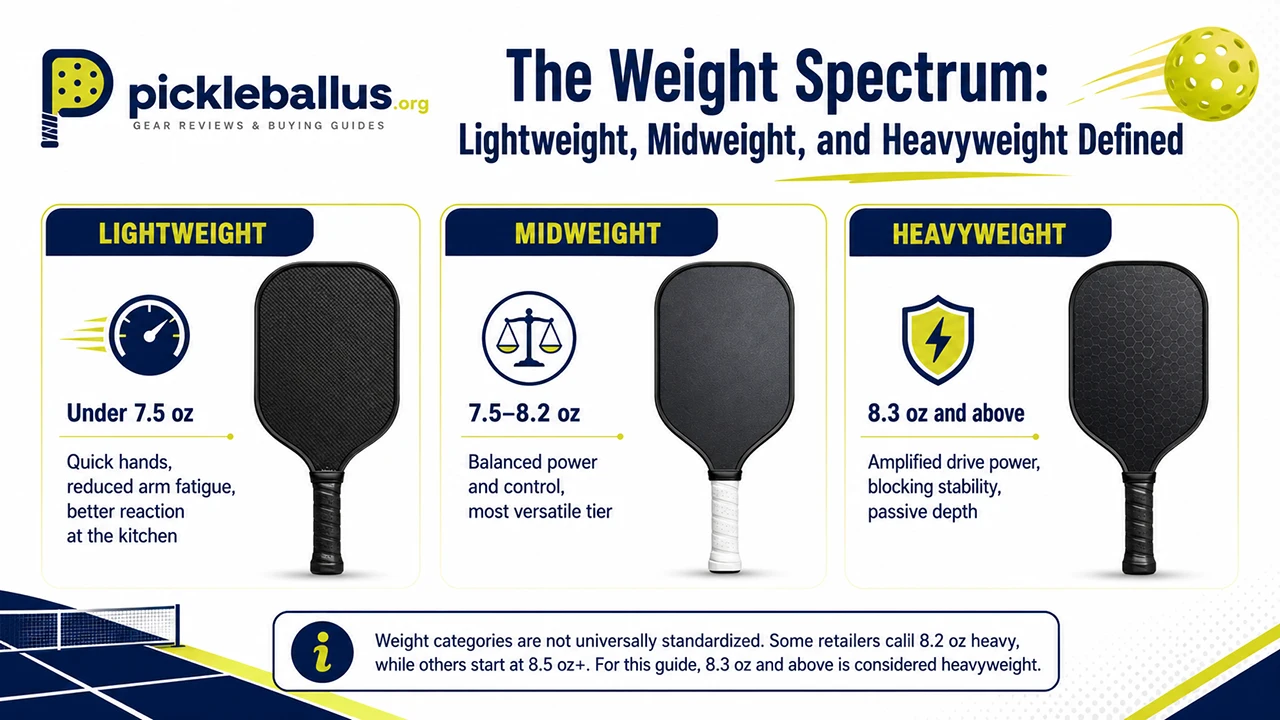
The Weight Spectrum: Lightweight, Midweight, and Heavyweight Defined
Pickleball paddles fall into three broadly accepted weight tiers:
| Weight Category | Range | Primary Benefit |
|---|---|---|
| Lightweight | Under 7.5 oz | Quick hands, reduced arm fatigue, better reaction at the kitchen |
| Midweight | 7.5–8.2 oz | Balanced power and control, most versatile tier |
| Heavyweight | 8.3 oz and above | Amplified drive power, blocking stability, passive depth |
The numbers are not universally standardized — some retailers define “heavyweight” as 8.5oz+, while others start the category at 8.2oz. For this guide, anything above 8.3 oz qualifies, since that’s where players reliably begin to notice the trade-off between swing speed and power output.
Static Weight vs. Swing Weight — Why the Label Doesn’t Tell the Whole Story
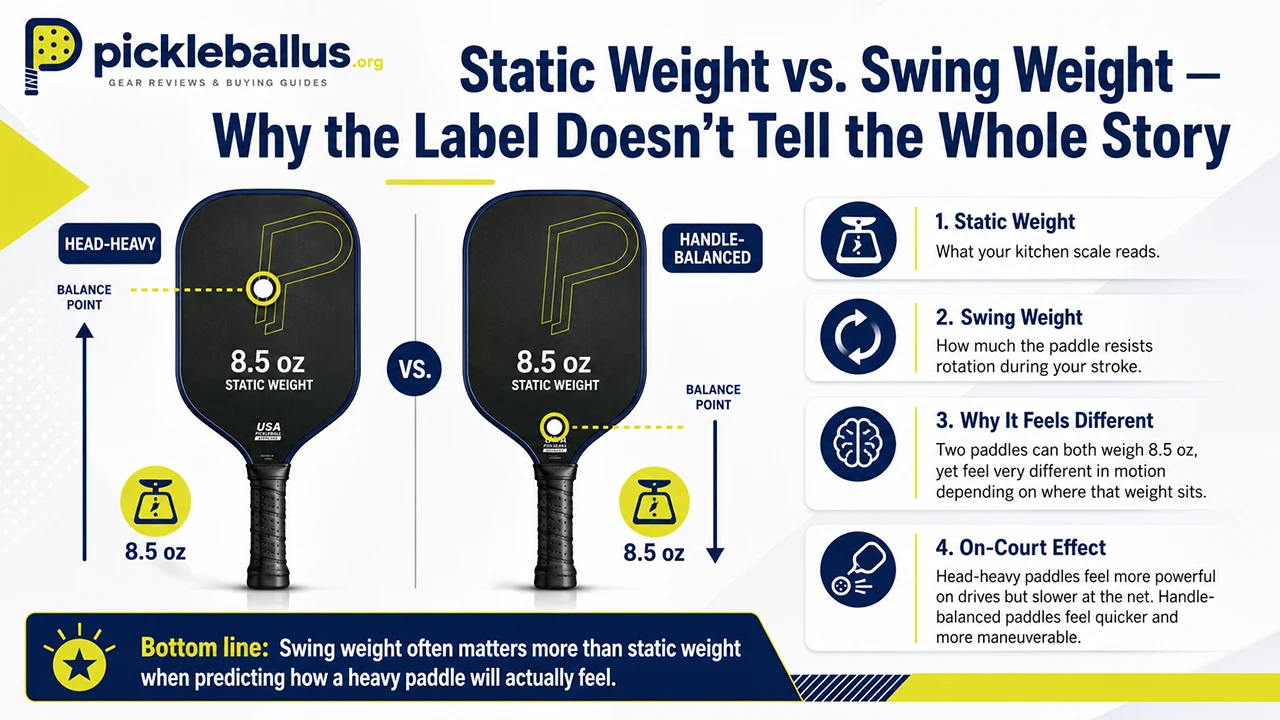
Swing weight matters more than static weight when predicting how a heavy paddle actually feels on court. Static weight is what your kitchen scale reads. Swing weight measures how the paddle resists rotation during your stroke — it depends on how that weight is distributed along the paddle’s length and where the balance point sits.
Two paddles that both weigh 8.5 oz can feel different in your hand. If one is head-heavy (balance point closer to the hitting surface), it will feel heavier in motion — it generates more power on drives but becomes sluggish for net exchanges. If the other is handle-balanced, it will feel more maneuverable despite carrying the same static weight. Reading swing weight data, not just oz ratings, gives you a more accurate picture before you buy.
Who Should Actually Use a Heavyweight Paddle?
Heavyweight paddles reward players who generate their own pace and prefer to win through court presence rather than speed. They are not for everyone, and being honest about your game before buying one saves you a lot of frustration — and a sore elbow.
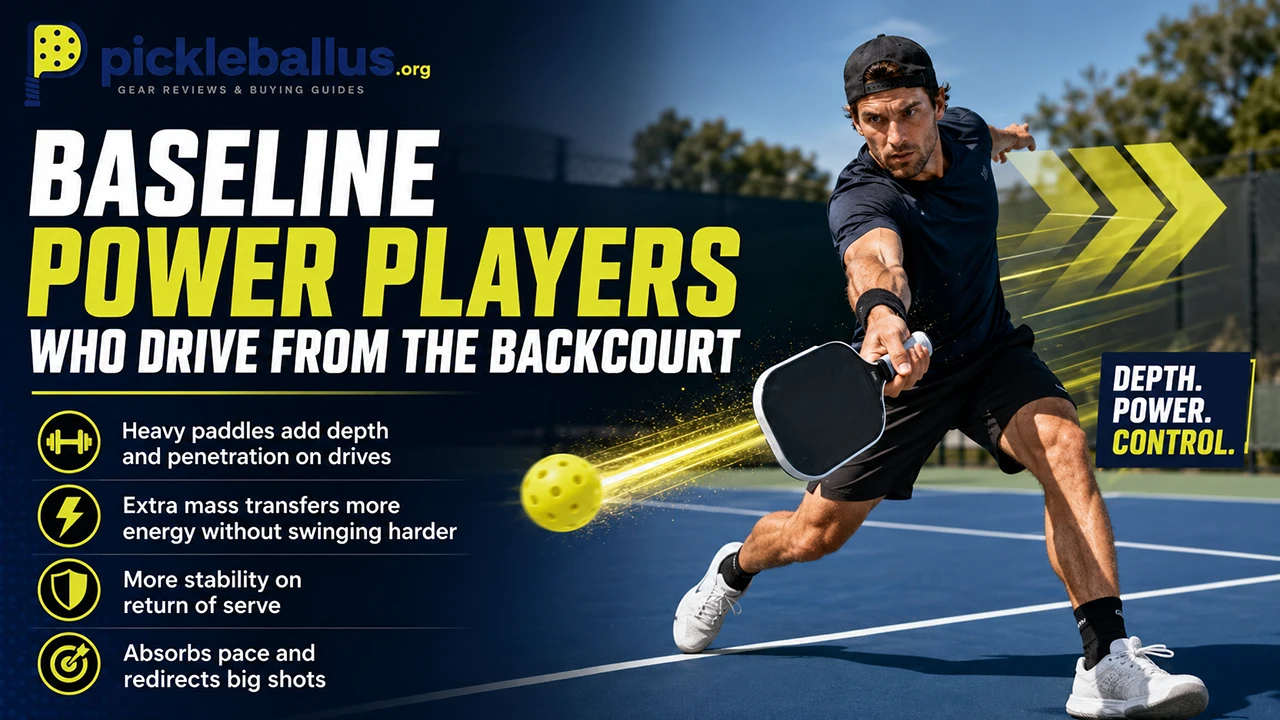
Baseline Power Players Who Drive from the Backcourt
If your best shots are cross-court drives and groundstroke putaways from deep in the court, a heavy paddle extends the depth and penetration of every ball you hit. Baseline players who already generate a natural, full stroke benefit immediately — the extra mass transfers more energy into the ball without requiring you to swing harder.
Heavy paddles also absorb pace better on the return of serve, giving baseline players a steadier platform when absorbing big shots and redirecting them.
Singles Competitors Who Need Penetrating Depth
Singles pickleball rewards players who can keep their opponents pinned back with heavy, low-trajectory drives. A heavyweight paddle in singles produces a ball that sits lower and travels deeper, reducing your opponent’s ability to counter-attack. The extra mass also helps neutralize pace — when your opponent drives a ball back hard, a heavier paddle absorbs that energy more cleanly than a lighter frame.
Singles play naturally involves fewer rapid-fire exchanges at the kitchen than doubles, which makes the reduced maneuverability of a heavy paddle less of a liability.
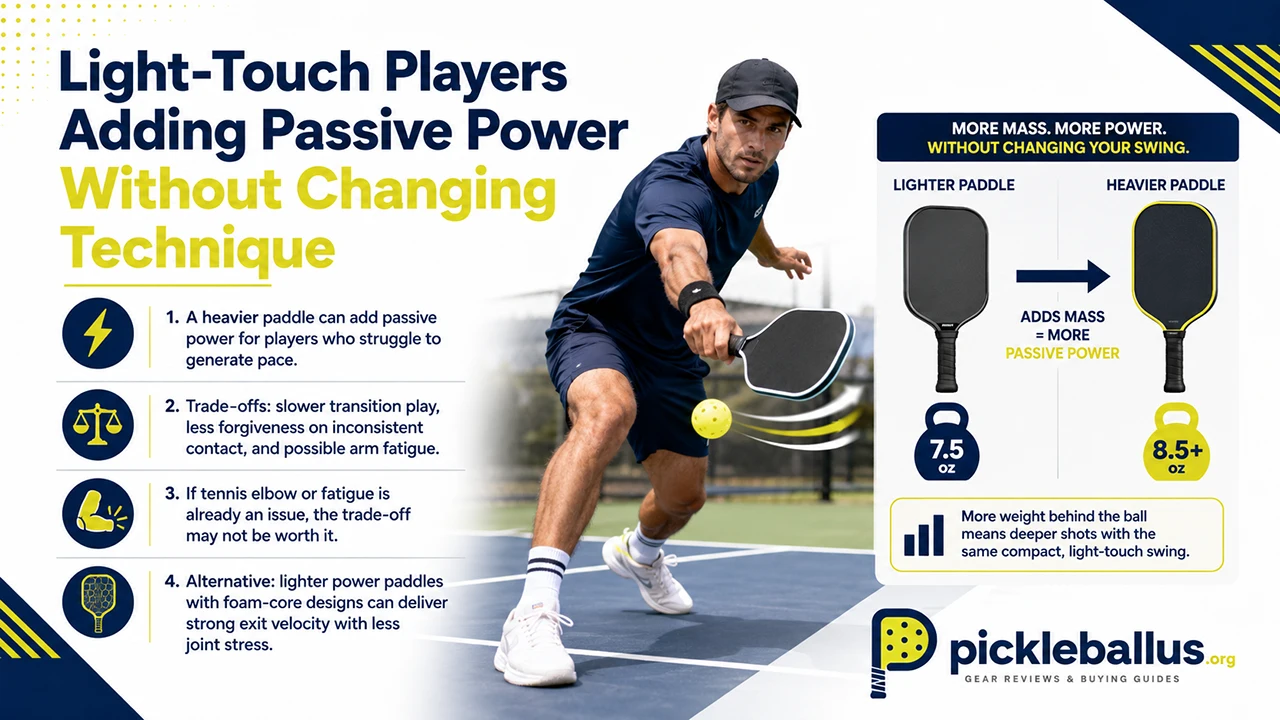
Light-Touch Players Adding Passive Power Without Changing Technique
Some players switch to a heavier paddle specifically because they struggle to generate pace with their current swing — not because they have a big stroke, but because they want a shortcut to more power. This can work, but with caveats. Going heavy adds passive drive power, but it will also slow down your transition game and punish inconsistent contact more harshly. If arm fatigue or tennis elbow is already a factor, this trade-off often isn’t worth it.
Players who want extra power without the weight penalty should also explore the best pickleball paddles for power — some foam-core, lighter paddles now generate comparable exit velocity to heavy frames without the joint stress.
7 Best Heavyweight Pickleball Paddles in 2026
The seven paddles below were selected based on widespread Amazon availability, consistent sales history, and strong community feedback from competitive and recreational players in the 8.3–8.8 oz range.
#1 JOOLA Perseus Pro IV 16mm — Best Overall Heavyweight Paddle
The JOOLA Perseus Pro IV 16mm has become the go-to heavy paddle for competitive players who want tour-level feel in a frame that doesn’t punish your arm after a long session. At approximately 8.0–8.4 oz (depending on the variant), the Perseus Pro IV runs on the heavier end of the midweight-to-heavy boundary, and its engineering is why it earns the top spot here.
Key Specs:
- Core: 16mm polypropylene honeycomb with TechFlex Power foam infusion
- Face: Friction carbon fiber (gritty surface for spin)
- Shape: Elongated
- Handle: 5.5 inches
Performance Analysis: The TechFlex Power foam core is what separates the Perseus Pro IV from older heavy paddles. Traditional heavy paddles were dense and stiff — powerful but often dead-feeling on softer shots. The Perseus Pro IV bends slightly on contact, creating dwell time that lets you shape balls at the kitchen while still punching through drives at the baseline. The foam-injected edge wall extends the effective sweet spot closer to the frame’s perimeter, which rewards off-center hits — an important feature when you’re swinging a heavier frame that is less forgiving of poor positioning.
The gritty carbon fiber face generates genuine topspin, allowing baseline drivers to add shape to their power shots. Many heavy paddles sacrifice spin for raw pop — the Perseus Pro IV gives you both.
Pros:
- Exceptional drive power with better-than-expected soft game feel
- Foam core reduces vibration and arm stress compared to older heavy frames
- Enlarged sweet spot forgives off-center contact on wide balls
- Long handle suits two-handed backhand players
Cons:
- Premium price point puts it in the “investment” tier
- The elongated shape narrows the sweet spot width — less forgiving on mishits away from center vertically
Best For: Competitive intermediate and advanced players who want a true power paddle with enough nuance for kitchen exchanges.
My Verdict: The Perseus Pro IV is the benchmark in the heavy paddle category. If you’re going heavy in 2026, this is the frame to beat.
#2 Selkirk VANGUARD Power Air Invikta — Best for Baseline Dominators
The Selkirk VANGUARD Power Air Invikta is the choice for players whose entire game plan revolves around deep, heavy groundstrokes. At around 8.1–8.4 oz, it is engineered specifically for power generation, and Selkirk’s Power Air technology sets it apart from every other frame at this weight.
Key Specs:
- Core: Polymer Air Dynamic Core (hollow chambers for enhanced energy return)
- Face: Carbon fiber MAX spin texture
- Shape: Invikta (elongated with widened midsection)
- Handle: 5.25 inches
Performance Analysis: The Air Dynamic Core uses hollow air chambers within the polypropylene structure to generate a trampoline effect that traditional dense cores cannot replicate. Drive shots off the VANGUARD Power Air feel noticeably more effortless — the paddle seems to catapult the ball rather than simply deflecting it. For baseline players who take full swings from deep in the court, this translates to drives that punch through with more pace than you’d expect from standard heavy paddles.
The Invikta shape provides a wider midsection than a fully elongated paddle, which means the sweet spot is usable despite the extra length. This is an important design choice — many elongated heavy paddles produce a narrow, punishing sweet spot that makes them feel inconsistent outside lab conditions.
Pros:
- Air Dynamic Core produces industry-leading passive power output
- Invikta shape balances reach and sweet spot width better than pure elongated frames
- Carbon MAX texture generates strong topspin for dipping baseline drives
- Vibration dampening protects the arm on off-center hits
Cons:
- Not the first choice for players who spend a lot of time at the kitchen
- Higher swing weight can reduce reaction time in fast-paced doubles exchanges
Best For: Aggressive baseline players in singles and doubles who want to dictate pace from deep.
My Verdict: If you win points by forcing errors with deep penetrating drives, the VANGUARD Power Air Invikta deserves a serious look. This is a specialist tool for a specialist game plan.
#3 Engage Pursuit MX 6.0 — Best for Spin-Forward Power
The Engage Pursuit MX 6.0 occupies the rare intersection of heavy weight and spin-focused performance, a combination that most paddle manufacturers still can’t get right. At around 8.3–8.5 oz, the MX 6.0 produces not just raw pace, but heavy, spinning balls that sink after crossing the net.
Key Specs:
- Core: Engage’s proprietary ControlPro polymer core (thicker cell walls for energy retention)
- Face: Textured fiberglass-composite surface
- Shape: Standard widebody
- Handle: 4.75 inches
Performance Analysis: Engage has built its reputation on paddles that produce a “heavy ball” — shots that players on the other side describe as feeling like they’re hitting through the ball rather than deflecting it. The MX 6.0 does this at a heavier weight class, meaning the already-heavy feel of an Engage paddle gets amplified by the extra mass. Third-shot drops feel like they dig into the court on landing, and cross-court drives stay low and penetrate rather than rising into attackable zones.
The ControlPro core gives the MX 6.0 better feel than most paddles in the power-heavy category. You can actually dink with it, which is not something that can be said about every paddle on this list.
Pros:
- Produces genuinely “heavy” spin-infused balls that are difficult to attack
- Better kitchen feel than most power-oriented heavy paddles
- Standard widebody shape maintains a generous sweet spot
- Trusted brand with long track record in competitive play
Cons:
- Fiberglass composite face does not produce as much spin as raw carbon fiber
- Slightly less drive pace than the JOOLA and Selkirk options above
Best For: Intermediate and advanced players who prefer to win through heavy spin and court positioning rather than pure pace.
My Verdict: The Pursue MX 6.0 is the heavy paddle for players who play the ball, not just hit it. The spin-power combination is rare and effective.
#4 Paddletek Bantam ALW-C — Best for Durability Under Daily Use
The Paddletek Bantam ALW-C is for players who play every day and need a heavy paddle that holds up. At 8.5 oz exactly, it’s firmly in heavyweight territory, and Paddletek’s manufacturing reputation for longevity makes it a practical choice for frequent players who don’t want to replace their gear every six months.
Key Specs:
- Core: Smart Response Technology (SRT) polymer core
- Face: Textured graphite-composite
- Shape: Standard
- Handle: 4.25 inches
Performance Analysis: The Smart Response Technology core is engineered to resist deforming over time. Many heavy paddles lose their pop within a few months of daily use as the core compresses — the ALW-C is notably resistant to this degradation. Players who have used it report consistent performance from month one through month twelve, which is a meaningful advantage for anyone who logs serious court hours.
Drive power is strong and consistent, though not as explosive as foam-core options like the Perseus Pro IV. The graphite face generates moderate spin and a clean, predictable feel. It lacks the gritty texture of raw carbon fiber, but it compensates with shot-to-shot consistency that players who’ve switched from unpredictable foam cores genuinely appreciate.
Pros:
- Excellent durability — maintains performance longer than most paddles at this weight
- Consistent, predictable feel that rewards mechanical players
- Compact grip suits players with smaller hands
- Mid-range price makes it a realistic choice for regular replacement cycles
Cons:
- Drive power is solid but not class-leading compared to modern foam-core competitors
- Shorter handle limits two-handed backhand utility
Best For: Daily players, coaches, and serious recreational players who prioritize longevity and consistency over bleeding-edge performance.
My Verdict: If you’re on the court four or five days a week and you’re tired of paddles that go dead after three months, the Bantam ALW-C is the heavy paddle that earns its price over time.
#5 ONIX Malice DB — Best Control-Oriented Heavyweight
The ONIX Malice DB challenges the assumption that heavy paddles sacrifice control. At 8.5–8.8 oz, it is one of the heavier paddles on this list, but its dual-bridge construction creates a paddle that feels more connected and precise than its weight would suggest.
Key Specs:
- Core: Nomex honeycomb
- Face: Graphite
- Shape: Elongated with dual-bridge edge design
- Handle: 5.25 inches
Performance Analysis: Nomex cores are among the hardest materials used in pickleball paddle construction — they produce a fast, crisp feel that transfers energy efficiently without the softness of polymer or foam. At 8.5–8.8 oz, the ONIX Malice DB has enough mass to generate genuine power, but the nomex stiffness means every shot feels precise and intentional rather than mushy or vague.
The dual-bridge design connects the two faces of the paddle internally, stiffening the structure and creating a uniformly responsive surface. Off-center shots still produce useful results, and the paddle rewards players who prioritize placement over raw pace — it’s a heavy paddle for surgical players, not sluggers.
Pros:
- Nomex core produces a fast, precise response unlike any foam or polymer competitor
- Dual-bridge construction creates exceptional shot-to-shot consistency
- Elongated shape provides extra reach for wide balls
- Works well in both singles and doubles due to its responsive feel
Cons:
- Nomex core is stiffer and can transmit more vibration to the arm than foam alternatives
- Budget-conscious choice, but nomex paddles can feel “dead” as the face wears
Best For: Control-first players who want the stability advantages of extra weight without sacrificing placement precision.
My Verdict: If you’re an advanced player who believes power without precision is a liability, the Malice DB gives you heavyweight stability with a scalpel’s precision.
#6 Gearbox GX6 CS 8.5oz — Best Budget Heavyweight Paddle
The Gearbox GX6 CS is the rare heavyweight paddle that delivers legitimate performance at a budget-friendly price. At exactly 8.5 oz, it’s a full-spec heavy paddle, and Gearbox’s solid-core construction philosophy makes it one of the most durable options in the category.
Key Specs:
- Core: Solid composite construction (no hollow honeycomb)
- Face: Textured carbon composite
- Shape: Standard
- Handle: 4.5 inches
Performance Analysis: Gearbox builds paddles differently from almost everyone else on this list — their solid-core construction eliminates the honeycomb structure entirely. This makes the paddle extremely durable and produces a firm, punchy feel that players transitioning from traditional racquet sports often love immediately. Drive shots feel direct and authoritative.
The solid core does dampen feel slightly compared to modern foam-core paddles, but for budget-conscious players or those new to the heavyweight category who want to test whether heavier suits their game, the GX6 CS is an ideal entry point. You get real heavyweight performance without committing to a premium price.
Pros:
- Budget-friendly price for genuine 8.5oz heavyweight performance
- Exceptional durability — solid core construction does not compress or degrade
- Punchy, direct drive feel that rewards contact players
- Good weight distribution for a stable swing
Cons:
- Solid core sacrifices the nuanced feel of foam-core alternatives
- Less spin potential than textured carbon fiber paddles
- Touch shots and dinks require adjustment from players used to softer cores
Best For: Players trying heavyweight paddles for the first time, budget-conscious power players, and those coming from racquet sports where solid racquet construction is familiar.
My Verdict: For players stepping into the heavyweight category without wanting to spend premium, the Gearbox GX6 CS is the honest entry point. It won’t disappoint at the baseline.
#7 HEAD Radical Pro — Best for Tennis Converts Going Heavy
The HEAD Radical Pro is purpose-built for tennis players making the transition to pickleball who want familiar weight in their hand. At 8.4–8.6 oz, it sits firmly in heavyweight territory, and HEAD’s decades of racquet engineering experience shows in the paddle’s balance and swing characteristics.
Key Specs:
- Core: High-density polymer honeycomb
- Face: Fiberglass composite
- Shape: Standard
- Handle: 5.0 inches
Performance Analysis: The Radical Pro swings like a dense tennis racquet — there is a familiar heft and stability that former tennis players recognize immediately. The high-density polymer core delivers consistent power on groundstrokes and neutralizes pace well on return shots, which mirrors how tennis players use their racquets to absorb and redirect rather than purely deflect.
The longer 5.0-inch handle accommodates a full two-handed backhand grip, a decisive advantage for tennis converts whose first instinct is to extend with two hands on that wing. Many pickleball paddles designed for this transition have handles that are simply too short — the Radical Pro doesn’t share that problem.
Pros:
- Handle length and weight profile familiar to tennis players
- Stable, dense feel that neutralizes pace and rewards full swings
- Two-handed backhand friendly
- HEAD brand reliability and widely available spare parts/grips
Cons:
- Fiberglass face produces less spin than carbon fiber alternatives
- Not the cutting-edge choice for native pickleball players who don’t need the tennis-crossover ergonomics
Best For: Former tennis players transitioning to pickleball who want heavyweight stability and a two-handed backhand-friendly build.
My Verdict: For the tennis player picking up a pickleball paddle for the first time and wanting familiar ground, the HEAD Radical Pro removes the biggest friction points of the transition.
Carbon Fiber vs. Fiberglass Face on a Heavy Paddle — Which Wins?
Carbon fiber outperforms fiberglass on a heavyweight paddle for players prioritizing spin and sharp drive response, while fiberglass remains the better option for players who want a softer touch and lower arm stress at that weight.
Here’s how the comparison shakes out specifically in the context of heavy paddles:
| Factor | Carbon Fiber Face | Fiberglass Face |
|---|---|---|
| Spin generation | Higher — gritty texture grips the ball longer | Moderate — smoother surface reduces RPM |
| Drive response | Crisper, more explosive energy transfer | Softer, more forgiving feel |
| Arm stress at 8.5oz | Slightly higher — stiffer construction | Lower — absorbs more vibration |
| Durability of texture | Longer-lasting grit on most premium models | Face texture wears faster under daily play |
| Best for | Power players with strong mechanics | Heavy hitters who need arm protection |
The verdict for most competitive players: carbon fiber is the better face material on a heavy paddle — the grit adds a spin dimension that justifies going heavy in the first place. However, players with a history of tennis elbow or wrist issues should seriously consider fiberglass at this weight to manage cumulative vibration stress.
You can also explore the best pickleball paddles across all weight categories if you want to compare how carbon fiber and fiberglass perform on lighter frames where arm stress is less of a concern.
Will a Heavyweight Paddle Cause Arm Pain?
Yes, a heavyweight paddle can cause or worsen arm pain — but only under specific conditions, not universally. The risk is real, and dismissing it leads to preventable injuries. Understanding exactly when heavy paddles become a liability protects your playing longevity.
Three conditions significantly raise the injury risk from heavy paddles:
1. Pre-existing arm conditions. If you already deal with tennis elbow, golfer’s elbow, or wrist inflammation, adding 0.5–1.0 oz to your paddle increases the stress on those joints. Stiff nomex or graphite cores amplify this further by transmitting impact vibration rather than absorbing it. Players in this group should consider best lightweight pickleball paddles or paddles with foam-core vibration dampening before committing to heavyweight.
2. Slower swing speeds. A heavy paddle generates its power advantage when swung at sufficient speed. Players with slower swing speeds end up muscling the paddle through the contact zone rather than generating natural momentum — the muscling creates repetitive strain over hundreds of swings per session.
3. Poor mechanics. A heavy paddle magnifies whatever is already wrong with your technique. Wrist flicking, overly stiff arms, and early contact all become more damaging at heavier weights because the mass amplifies the torque delivered to your joints on mishits.
Mitigating strategies that work: use paddles with foam-injected edge walls (dramatically reduces vibration), stretch and warm up specifically the forearm flexors and extensors before play, and give yourself a proper break-in period of two to three weeks before judging whether the weight is sustainable.
Players who want to compare options before fully committing to the heaviest tier should review the best midweight pickleball paddles — several midweight options now generate power output comparable to true heavyweight paddles without the joint-stress trade-off.
By now you have a complete picture of which heavyweight paddles deliver power, which suit your player profile, and where the arm-safety boundaries lie. Choosing the right frame, however, is only half the decision — how you customize, maintain, and eventually retire your heavy paddle determines whether it keeps performing the same way at month six as it did on day one. The section below covers the finer points that separate players who simply own a heavy paddle from those who truly get the most out of one.
Getting the Most Out of Your Heavyweight Paddle
Adding Lead Tape to Shift Weight Distribution
Lead tape is one of the most cost-effective tools for customizing how a heavy paddle feels, and it works differently depending on where you apply it. Adding tape to the 3 and 9 o’clock positions (both sides of the paddle face, near the top) increases swing weight and shifts the balance toward the head — this adds drive power but makes the paddle feel heavier in motion. Adding tape to the throat (below the face, above the handle) adds mass without significantly changing swing weight, which gives you more stability on blocks and returns without slowing down your hand speed as much.
Lead tape customization is especially useful for players who purchase a paddle in the lighter end of the heavyweight range (8.3 oz) and want to push it into truer heavyweight territory incrementally before committing to a heavier model.
Protecting the Face: Cleaning Grit and Avoiding Edge Chips
The textured face on carbon fiber heavy paddles degrades faster when contaminated with sweat, oils, and court dust. A clean, lightly damp microfiber cloth wiped across the face after every session preserves the grit texture that generates your spin. Never use abrasive cleaners or anything that scratches the surface — this removes the texture unevenly and creates dead spots.
Edge guard chips are the most common structural damage on heavy paddles. At 8.5 oz, the additional mass increases the momentum when a paddle hits the court, which makes chips more likely during digs and scooping shots. An aftermarket edge tape guard reduces chip frequency significantly and adds almost no perceptible weight.
Heavyweight vs. Top-Heavy — Knowing the Real Difference
A heavyweight paddle carries more static mass distributed across its entire frame. A top-heavy paddle places the balance point closer to the hitting surface, increasing swing weight without necessarily increasing static weight. These are distinct properties, and conflating them leads to wrong buying decisions.
Some 7.8 oz paddles have a high balance point that makes them feel heavier in motion than an 8.5 oz paddle with a handle-biased balance point. If you want raw drive power with less fatigue, look for a heavy paddle with a neutral or slightly handle-biased balance point — you get the mass benefits without the sluggish swing characteristics of a pure top-heavy design.
Signs Your Heavy Paddle Has Lost Its Pop and Needs Replacing
Heavy paddles tend to give clear performance signals when the core is dead: drives that once penetrated at shoulder height now sit up and invite attackable responses, third-shot drops that used to die on landing now bounce up, and there’s a hollow thudding sound on contact rather than the crisp pop of a healthy core.
Most polymer and foam-core heavy paddles maintain peak performance for six to twelve months under regular weekly use. Nomex cores typically last longer but provide less vibration absorption as they age. If you notice any of the above signs, no amount of re-gripping or face cleaning will restore core performance — it is time to replace the paddle.

Write Your Review
No reviews yet. Be the first to share your experience!