

The best lightweight pickleball paddles of 2026 are the Paddletek Bantam EX-L Pro (best overall), the Engage Pursuit Pro EX LITE (best for control), the Selkirk SLK Latitude 2.0 (best for beginners and intermediates), the HEAD Radical Pro (best for net play), the Franklin FS Tour Featherweight (best ultra-light option), the Gamma Dart (best budget lightweight), the JOOLA Essentials (best entry-level lightweight), and the Wilson Blaze Edgeless (best edgeless lightweight).
Among the many variables that shape your game — core thickness, surface texture, grip circumference — paddle weight is the one that affects your arm health and reaction speed most directly. Every ounce matters when you’re trading dinks at the kitchen line for two hours straight.
The paddles in this guide all weigh under 8 ounces. Some dip as low as 7.2 oz, qualifying as true featherweights. Others sit in the 7.6–7.9 oz range, light enough to feel nimble without sacrificing the stability needed to absorb hard shots. What connects them is a design philosophy that prioritizes faster hands over raw power — and in today’s dink-heavy, reset-driven game, that’s often the smarter trade.
Below, you’ll find detailed reviews of all eight paddles, a breakdown of what separates lightweight from midweight, and a buying guide that tells you exactly what specs to look at before spending money on a new paddle.
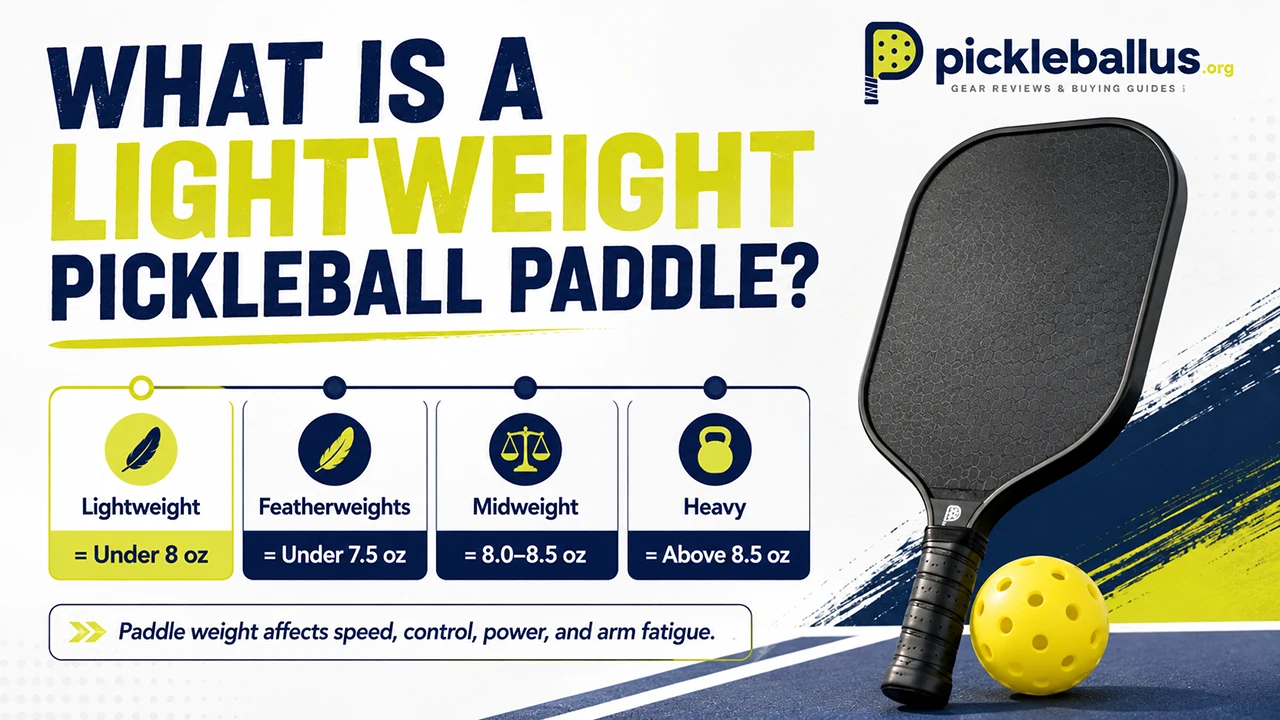
What Is a Lightweight Pickleball Paddle?
A lightweight pickleball paddle is any paddle weighing under 8 ounces, with the lightest models — often called featherweights — coming in under 7.5 oz. Most paddle manufacturers divide the weight spectrum into three tiers: lightweight (under 8 oz), midweight (8.0–8.5 oz), and heavy (above 8.5 oz). Understanding where your paddle falls within that spectrum matters more than most players realize, because weight shapes how the paddle performs in your hand — not just how tired your arm feels after a long match.
If you’re still deciding between different weight categories, the pickleball paddle weight guide covers the full breakdown of how each tier affects swing mechanics, power generation, and injury risk.
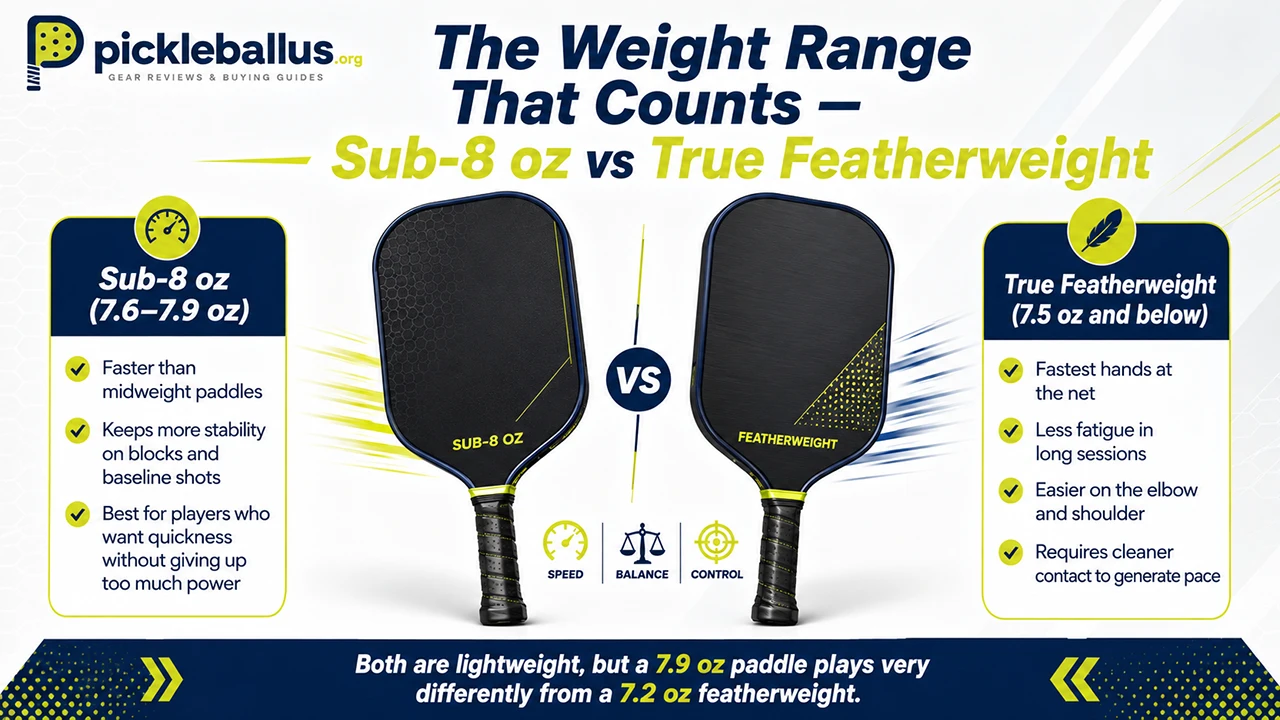
The Weight Range That Counts — Sub-8 oz vs True Featherweight
Not all “lightweight” paddles are created equal. A paddle labeled lightweight at 7.9 oz plays very differently from a 7.2 oz featherweight, even though both technically fall under the 8 oz threshold.
Sub-8 oz paddles (7.6–7.9 oz) offer a noticeable reduction in swing resistance compared to midweight models, but they retain enough mass to stay stable when you’re blocking hard drives or hitting from the baseline. These are the paddles most intermediate and advanced players reach for when they want a touch of added quickness without fully sacrificing power ceiling.
Featherweight paddles (7.5 oz and below) amplify every benefit of going light: faster hands at the net, reduced fatigue during multi-hour sessions, and less stress on vulnerable joints like the elbow and shoulder. The trade-off is that you’ll need cleaner contact to generate pace, because the paddle can’t supply as much momentum on its own. For players with strong technique — or those managing arm injuries — this trade is worth it.
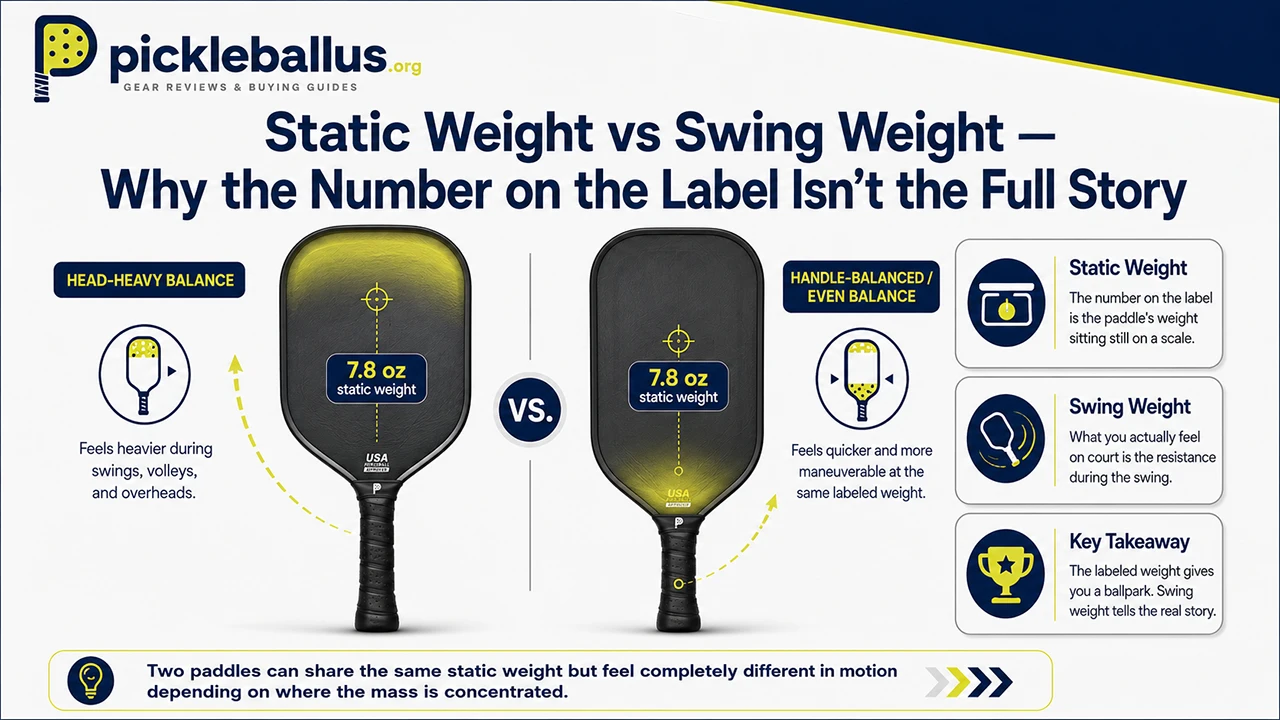
Static Weight vs Swing Weight — Why the Number on the Label Isn’t the Full Story
The weight printed on a paddle’s packaging is its static weight — what it registers sitting still on a scale. But when you’re playing pickleball, you’re not holding the paddle still. You’re swinging it, which means swing weight (the resistance you feel during a stroke) is what you actually experience on the court.
Two paddles can share the same static weight yet feel completely different in motion. A paddle with mass concentrated toward the head will feel heavier during volleys and overhead smashes. A paddle with weight distributed toward the handle or evenly across the frame will feel much quicker and more maneuverable, even at the same labeled ounce count.
When reading lightweight paddle reviews — including the ones below — keep this distinction in mind. The labeled weight gives you a ballpark; the swing weight (when listed) tells you the real story.
The 8 Best Lightweight Pickleball Paddles for 2026
These eight paddles represent the strongest lightweight options available on Amazon right now. Each was selected for consistent customer feedback, brand reputation, and genuine on-court performance at its respective weight class and price point.
#1 Paddletek Bantam EX-L Pro — Best Lightweight Overall
The Paddletek Bantam EX-L Pro is one of the most trusted lightweight paddles in pickleball, and it has held that reputation for years because it delivers where it counts: reliable control, a forgiving sweet spot, and a sub-8 oz weight that lets you play fast without burning out your arm.
Key specs: Static weight ~7.4–7.6 oz | 14 mm polypropylene honeycomb core | fiberglass hitting surface | standard elongated shape | 4.25″ grip
Performance: The EX-L Pro’s fiberglass face gives the ball a slightly softer, more cushioned response compared to raw carbon fiber — a characteristic that translates into exceptional touch during dink rallies and reset shots. You won’t get the same ceiling for topspin as a textured carbon surface, but you’ll find it much easier to place the ball exactly where you want it. The 14 mm core sits at a sweet spot between the softer 16 mm (more control, less pop) and the firmer 12 mm (more pop, less dwell), making this an honest all-court paddle that doesn’t ask you to sacrifice one dimension of your game for another.
Pros:
- Consistently low swing weight, fast at the net
- Forgiving on off-center hits — larger effective sweet spot than many competitors
- Paddletek’s build quality is among the most durable in the category
Cons:
- Fiberglass surface limits spin potential compared to raw carbon options
- Not the most pop-heavy choice for baseline power players
Best For: Intermediate to advanced players who want an all-court lightweight workhorse they can rely on game after game.
My Verdict: If you want a lightweight paddle that does everything competently and nothing embarrassingly, the Bantam EX-L Pro is the safest pick in the category. It’s the paddle you’ll still trust in year two.
#2 Engage Pursuit Pro EX LITE — Best for Control Players
The Engage Pursuit Pro EX LITE is purpose-built for players who value placement, touch, and soft game precision over power. At approximately 7.2 oz in its lightest version, it’s one of the genuine featherweights in this roundup.
Key specs: Static weight ~7.2 oz | 16 mm polypropylene core | textured composite surface | elongated shape | 4.125″–4.25″ grip
Performance: The 16 mm core is the defining feature here. Thicker cores absorb more energy on contact, meaning the ball doesn’t spring off the face — it settles into it, giving you far more time to direct placement. At kitchen exchanges, this produces a soft, almost pillowy feel that lets you attack the angles without overhitting. The elongated shape adds reach and extends the sweet spot toward the top edge, which is useful for volleys struck outside the center zone. The LITE designation means Engage has intentionally kept mass down across the frame, keeping swing resistance low even at 16 mm core thickness.
Pros:
- Exceptional dink and reset feel — one of the softest responses in the lightweight category
- Elongated shape improves reach without significantly changing swing mechanics
- Textured surface generates meaningful spin at low-power swing speeds
Cons:
- Limited power ceiling — pace players will find this paddle frustrating from the baseline
- At the featherweight end, can feel slightly unstable against hard-driven balls
Best For: Control-focused players, 3.5–4.5 rated players who live at the kitchen line, and anyone recovering from a soft-tissue arm injury.
My Verdict: The EX LITE is the right paddle if your game is built on placement and patience rather than power. It rewards good technique with an exceptionally responsive feel.
#3 Selkirk SLK Latitude 2.0 — Best for Beginners & Intermediates
The Selkirk SLK Latitude 2.0 sits at the intersection of accessibility and genuine performance. Selkirk’s SLK sub-brand was created specifically to deliver pro-level paddle technology at a mid-range price, and the Latitude 2.0 delivers on that promise with a lightweight design beginners can actually grow with.
Key specs: Static weight ~7.3–7.5 oz | 14 mm polypropylene core | fiberglass hitting surface | standard shape | 4.25″ grip
Performance: What makes the Latitude 2.0 a standout for newer players is its forgiveness at the edges. The slightly oversized face creates a wider hitting window, reducing the penalty for imperfect contact — a characteristic that matters enormously for players still ingraining their stroke mechanics. The 14 mm core produces a lively, responsive feel without overwhelming a beginner’s arm with vibration. Weight distribution is balanced, so volleys feel stable even when you’re still figuring out proper hand positioning.
Intermediate players get value here too. The fiberglass face limits spin generation, but it provides consistent feedback across all shot types, making it easier to diagnose and correct form errors during practice.
Pros:
- Oversized sweet spot — unusually forgiving for a paddle this light
- Mid-range price for genuine Selkirk build quality
- Balanced weight distribution keeps volleys stable
Cons:
- Fiberglass limits spin potential for experienced players
- Won’t grow with players beyond the 4.0 skill level
Best For: Beginners to intermediate players (2.5–3.5 rating) who want a lightweight paddle they can improve with, not just grow out of.
My Verdict: For the price, the Latitude 2.0 is one of the smartest buys in the lightweight category. It doesn’t punch above its weight on a spec sheet, but it plays better than it looks on paper.
#4 HEAD Radical Pro — Best for Net Play & Quick Volleys
The HEAD Radical Pro brings a tennis-brand pedigree to pickleball with a paddle built specifically for fast-twitch, net-dominating play. Its lightweight frame and extended reach make it a go-to for players who want to control the kitchen with aggressive hands.
Key specs: Static weight ~7.5–7.8 oz | polypropylene honeycomb core | graphite hitting surface | elongated shape | 4.25″ grip
Performance: The graphite hitting surface is the headline feature. Graphite is stiffer than fiberglass, producing a crisper, more immediate response on contact — the ball comes off the face cleanly and quickly, which suits the fast exchanges at the net that modern pickleball demands. Reaction volleys feel sharper, and third-shot drops have a satisfying precision that fiberglass paddles sometimes muffle. The elongated shape extends reach by roughly half an inch compared to standard-length paddles, improving coverage at the kitchen line without requiring you to lunge as aggressively.
Where the Radical Pro is less impressive is off the baseline. The graphite face amplifies mishits slightly more than fiberglass, and the lighter weight means you’ll need to generate your own pace on groundstrokes rather than leaning on the paddle’s momentum.
Pros:
- Graphite surface delivers fast, crisp ball response ideal for net play
- Elongated shape provides added reach without changing swing feel
- HEAD’s quality control is consistently reliable
Cons:
- Graphite face amplifies off-center hits more than fiberglass
- Limited power for players who rely on pace from the baseline
Best For: Players who dominate from the kitchen line, intermediate net-rushers, and anyone moving from tennis who prefers the crisp feel of a graphite face.
My Verdict: The Radical Pro is a net player’s paddle, and it’s excellent at that job. If you’re a dink-and-volley player who prizes quick hands over baseline power, this is worth the look.
#5 Franklin FS Tour Featherweight — Best Ultra-Lightweight Option
The Franklin FS Tour Featherweight takes lightness seriously. At 7.3–7.7 oz depending on the shape variant, it’s one of the lightest high-performance paddles you’ll find at a competitive price point — and it doesn’t sacrifice much to get there.
Key specs: Static weight ~7.3–7.7 oz | 12 mm polypropylene core | raw carbon fiber hitting surface | available in elongated (Dynasty) and compact (Tempo) shapes | 4.25″ grip
Performance: The raw carbon fiber surface is the standout spec. Raw carbon generates the highest spin of any hitting surface material, because the uncoated fiber weave grabs the ball and imparts heavy topspin with minimal effort. For players who use spin as a weapon — curving drops into the kitchen, adding kick to topspin drives — this surface elevates your game in ways that fiberglass and standard graphite simply cannot match.
The unibody construction compensates for what the sub-8 oz weight might otherwise cost in power. By forming the paddle’s face and frame as a single unit, Franklin maximizes energy transfer through the hitting surface, meaning this featherweight generates more pace than its mass would suggest.
Two shape options serve different play styles: the elongated Dynasty paddle extends reach at the cost of a slightly narrower sweet spot, while the compact Tempo trades reach for a wider face and a more connected, centered feel at contact.
Pros:
- Raw carbon fiber surface delivers elite-level spin potential
- Unibody construction generates surprising power for the weight
- Two shape options cover different court styles
Cons:
- 12 mm core is thinner than many comparable paddles, so dink feel is firmer and less forgiving
- Raw carbon can “break in” unevenly — spin output may vary early in the paddle’s life
Best For: Spin-heavy players, advanced players who want featherweight speed without sacrificing surface technology, and anyone who wants the lightest paddle that still plays like a serious tool.
My Verdict: The Franklin FS Tour Featherweight is the best choice in this roundup for players who rely on spin. The raw carbon fiber and unibody construction together produce a paddle that performs like a heavier option without the arm load.
#6 Gamma Dart — Best Budget Lightweight Paddle
The Gamma Dart proves that you don’t need a premium price tag to get a well-built, lightweight paddle. It’s a budget-friendly option that covers all the fundamentals without cutting corners where it matters.
Key specs: Static weight ~7.4–7.6 oz | polypropylene honeycomb core | composite hitting surface | standard shape | 4.25″ grip
Performance: Gamma has been a reliable pickleball paddle manufacturer since the sport’s early growth years, and the Dart reflects that accumulated experience. The composite surface strikes a balance between fiberglass’s softness and graphite’s crispness, producing an all-purpose response that serves most recreational and developing players well. The weight lands in the lightweight range, and the paddle doesn’t feel like it was stripped down to hit a price point — the swing weight is honest, and the frame stays stable under hard contact.
Players accustomed to premium paddles will notice less precision in the touch shots compared to the Bantam EX-L Pro or Engage EX LITE, but for the price, the Dart delivers honest value and a clean lightweight feel.
Pros:
- Budget-friendly without feeling like a beginner paddle
- Composite surface is versatile across all shot types
- Gamma’s track record in pickleball builds trust in the build quality
Cons:
- Less precise on dinks and resets than premium lightweight options
- Composite surface doesn’t specialize in spin the way raw carbon does
Best For: Budget-conscious players, recreational players upgrading from a basic set paddle, and newcomers who want a real lightweight paddle without the premium commitment.
My Verdict: The Gamma Dart is the paddle to recommend when budget matters. It doesn’t outperform its price, but it fully delivers at it.
#7 JOOLA Essentials — Best Entry-Level Lightweight
JOOLA has become one of pickleball’s fastest-growing brands, and the Essentials paddle distills the brand’s engineering knowledge into an accessible entry-level package that happens to qualify as lightweight.
Key specs: Static weight ~7.5–7.8 oz | polypropylene core | fiberglass hitting surface | standard shape | 4.25″ grip
Performance: The JOOLA Essentials is direct and uncomplicated in the best sense. The fiberglass face is forgiving, the core produces a soft, consistent response, and the weight distribution makes the paddle easy to maneuver for newer players. It lacks the raw carbon spin capability of the Franklin FS Tour or the refined touch of the Bantam EX-L Pro, but those are premium-tier comparisons — within the entry-level category, the Essentials plays above its class.
One underappreciated advantage is JOOLA’s brand support. Replacement grips, paddle accessories, and customer service are all well-established, which matters when you’re buying a first serious paddle and might need guidance along the way.
Pros:
- Forgiving feel makes it easy to learn proper technique
- JOOLA brand backing and wide accessory availability
- Straightforward, predictable response — no surprises on the court
Cons:
- Less spin potential than carbon fiber options
- Performance ceiling is reached quickly by improving players
Best For: Beginners buying their first standalone paddle, casual recreational players, and anyone returning to the sport after a break who wants a simple, reliable tool.
My Verdict: The JOOLA Essentials won’t win a point through paddle technology, but it won’t get in the way of your development either. A clean, honest entry-level lightweight.
#8 Wilson Blaze Edgeless — Best Lightweight Edgeless Paddle
The Wilson Blaze Edgeless stands out from every other paddle on this list by removing the traditional edge guard entirely. At an average of 7.6 oz, it’s the lightest edgeless paddle Wilson makes — and for players who want maximum surface area without paying for it in weight, this is a compelling option.
Key specs: Static weight ~7.6 oz | 13 mm polypropylene core | composite hitting surface | unibody edgeless construction | 4.25″ grip
Performance: Removing the edge guard does two things simultaneously. First, it extends the hitting surface to the very edge of the frame, creating a larger effective sweet spot than comparably sized paddles with traditional edge guards. Second, it slightly reduces the paddle’s total weight by eliminating a strip of rubber and adhesive from the frame. The result is a paddle that feels more agile than its dimensions suggest.
The unibody construction that makes the edgeless design possible also improves power transfer. Wilson’s engineers compensate for the removed edge guard by bonding the face and frame as a single unit, channeling contact energy more efficiently through the hitting surface. Maneuverability is excellent — the combination of true lightweight mass, low swing weight, and easy access to spin at the outer edges makes this one of the most fun paddles to volley with in the roundup.
Pros:
- Extended hitting surface all the way to the frame edge
- Low swing weight makes it extremely maneuverable at the net
- Unibody construction delivers surprising power for the weight
Cons:
- Edge of the paddle is vulnerable to chipping without the protective guard
- Not for players who drag their paddle on the court surface during play
Best For: Intermediate to advanced players who want maximum sweet spot in a lightweight build, and players comfortable protecting a premium paddle from frame dings.
My Verdict: The Blaze Edgeless is the most distinctive paddle in this roundup and one of the best for aggressive net play. If the lack of an edge guard doesn’t concern you, it’s worth serious consideration.
Lightweight vs. Midweight Pickleball Paddles — Which One Fits Your Game?
Lightweight paddles (under 8 oz) favor speed, touch, and arm health. Midweight paddles (8.0–8.5 oz) favor stability, power, and forgiving contact on aggressive shots. Neither category is universally superior — the right choice depends on your play style, physical condition, and skill level.
For a detailed comparison of the full weight spectrum, including heavier options and their tradeoffs, see the best midweight pickleball paddles and best heavyweight pickleball paddles guides.
When a Lightweight Paddle Is the Right Call
A lightweight paddle gives you the edge when speed and arm preservation are your priorities. The list of players who legitimately benefit from going under 8 oz is longer than most people expect:
- Net-dominant players who live at the kitchen line profit directly from faster hands. A lighter paddle means quicker transitions between forehand and backhand volleys — and in fast exchanges, tenths of a second determine winners from errors.
- Players managing arm issues — tennis elbow, wrist tendinitis, shoulder impingement — get meaningful relief from a lighter paddle. Less mass means less shock transmission into the joint on every contact. Many players who developed their injuries using midweight paddles report a significant reduction in pain after switching to the sub-8 oz category. If this sounds familiar, the best pickleball paddles for tennis elbow guide covers additional design factors that reduce arm stress beyond raw weight.
- Seniors who want to maintain their game without grinding down their joints find lightweight paddles extend their playing longevity. See the best pickleball paddles for seniors for recommendations tuned to this group.
- Beginners who are still ingraining their stroke mechanics benefit from a paddle they can move freely. The extra weight of a midweight paddle can mask technique errors in the short term but builds bad compensation habits over time.
When Midweight Gives You the Edge
A lightweight paddle isn’t always the answer. A midweight paddle is the smarter pick for power-focused players, wind-condition play, and anyone transitioning from tennis.
Heavier paddles carry more momentum through the hitting zone, which means they contribute more force to groundstrokes and overhead smashes without requiring you to swing harder. In outdoor play with wind, a lighter paddle can be deflected by gusts mid-swing — a problem midweight paddles handle better. Players who’ve spent years with a tennis racket (typically 10–12 oz) often find that sub-8 oz paddles feel almost too reactive until they’ve recalibrated.
What to Look for When Buying a Lightweight Pickleball Paddle
Core Thickness and Its Effect on Feel
Core thickness is the single biggest variable in how a lightweight paddle feels on contact. Thinner cores (10–12 mm) produce a harder, more immediate response — the ball comes off the face quickly, which benefits power players but demands better timing. Thicker cores (14–16 mm) absorb more energy on contact, producing a softer, more forgiving feel that suits control players and kitchen-focused game styles.
For lightweight paddles specifically, 14–16 mm cores are generally the safer choice. The paddle’s reduced mass already limits its power ceiling — pairing it with a thin core that emphasizes snap over control compounds that limitation. A 14–16 mm core softens the trade-off by preserving dwell time and touch even at featherweight mass levels.
Hitting Surface: Graphite vs Carbon Fiber vs Fiberglass
The hitting surface material is the second major variable to evaluate. Each has a distinct character:
Fiberglass surfaces are the most forgiving and consistent. They produce a softer response with a slightly larger effective sweet spot, making them well-suited to beginners, intermediates, and control-oriented players. The trade-off is limited spin potential — fiberglass doesn’t grip the ball’s surface as aggressively as textured carbon.
Graphite surfaces are stiffer, producing a crisper, more immediate ball response. They suit net players who want clean, fast volleys. The firmness means that off-center hits are slightly less forgiving than fiberglass.
Raw carbon fiber delivers the highest spin potential of any surface material. The uncoated fiber weave grabs the ball and imparts heavy topspin with relatively little swing effort. Raw carbon is increasingly found on premium lightweight paddles because it compensates for reduced mass by adding spin-based shot variety. The trade-off is a firmer feel on contact and a break-in period during which spin output can vary.
When shopping for a lightweight paddle, match the surface material to your most pressing need: forgiveness → fiberglass; net crispness → graphite; spin → raw carbon fiber.
Grip Size and Handle Length
Grip size affects both comfort and swing mechanics. Most lightweight paddles come in 4.125″–4.25″ grip circumference. Smaller grips allow more wrist action — useful for spin generation but harder to maintain over long sessions. Larger grips reduce wrist snap but improve stability, especially important when a lightweight paddle already limits momentum on contact.
Handle length matters more than many players realize. Standard handles (~5″) suit most grips. Elongated handles (~5.5″+) allow a two-handed backhand, extending the paddle’s reach and giving two-handed players more leverage. However, longer handles shift the balance point slightly toward the hand, reducing head-heaviness — which further reduces effective swing weight in paddles already in the lightweight category.
By now you have a clear picture of which lightweight paddles deliver the best combination of speed, control, and arm comfort — from budget featherweights to pro-level sub-8 oz options across eight different use cases. Choosing the right paddle, however, only solves half the problem. How you maintain it, when you know it’s time to add weight, and what tournament regulations say about paddle setup will determine whether that choice holds up over a full season. The next section covers the finer details that separate casual players from those who consistently get the most out of a lightweight setup.
What Else Should You Know Before Going Lightweight?
How to Add Weight to a Lightweight Paddle with Lead Tape
One of the most overlooked tools in a pickleball player’s kit is lead tape — strips of dense adhesive tape applied to the paddle frame to adjust its weight and balance characteristics. Lead tape lets you fine-tune a lightweight paddle without buying a new one.
Why this matters for lightweight paddles specifically: A featherweight paddle’s greatest weakness is instability on hard-driven shots struck slightly off-center. Adding a small amount of lead tape (2–4 grams) to the 3 and 9 o’clock positions on the paddle head increases stability and widens the effective sweet spot without dramatically changing swing weight. Adding tape at the handle end shifts the balance point down, making the paddle feel even more head-light and maneuverable.
Lead tape is inexpensive, widely available on Amazon, and reversible — you can remove strips if the modification doesn’t suit your play style. For any player on this list’s paddles who wants to experiment with a slightly different balance profile, this is the first modification to try before committing to a different paddle entirely.
Are Lightweight Paddles USAPA-Legal for Tournament Play?
Yes — all paddles in this roundup are, or have versions that are, approved for USA Pickleball (USAPA) tournament play, provided the specific model bears the USAPA approval stamp. The governing body does not place restrictions on minimum or maximum paddle weight in its current rulebook. Its regulations focus on paddle dimensions, surface texture limitations, and prohibited materials (no rubber surfaces, for example) — not on how heavy or light a paddle must be.
When buying for tournament play, check the specific model you’re purchasing for the USAPA approval mark rather than assuming an entire brand’s lineup qualifies. Some limited-edition or modified-grip versions may not carry the certification even when the standard model does. The approval mark is typically printed directly on the paddle face or listed on the manufacturer’s product page.
When You Should NOT Use a Lightweight Paddle
Lightweight paddles are not the right tool for every player or every situation. Three specific player profiles are better served by a midweight or heavier option:
Power-baseline players who generate most of their pace through groundstrokes will find that featherweight paddles require more physical effort to maintain pace. The paddle’s low mass doesn’t carry momentum through the ball the way a heavier paddle does — every powerful shot demands more from your swing, which increases fatigue over time rather than reducing it.
Players with wrist instability may actually find a heavier paddle more comfortable. A paddle with more mass stabilizes itself through contact, reducing the micro-corrections the wrist must make on every volley. For a small subset of players with wrist-specific issues (as distinct from elbow or shoulder injuries), a best pickleball paddles for women guide or a midweight consultation with a paddle fitter is worth the time.
Wind-condition outdoor players should consider that a featherweight paddle can be pulled fractionally off its intended path by a strong lateral gust mid-swing. In indoor-only settings this is a non-issue. For regular outdoor tournament players in exposed courts, the marginal stability advantage of a midweight option may outweigh the speed benefit of going light.
For a look at how all of these best pickleball paddles categories fit together into a complete buying framework — covering weight, shape, material, and player level — the main paddle guide covers it in full.

Write Your Review
No reviews yet. Be the first to share your experience!