

The best widebody pickleball paddles of 2026 are the 11SIX24 Pegasus Jelly Bean (best for beginners), the Vatic Pro V-Sol Bloom Power (best budget power), the JOOLA Pro IV Scorpeus 14mm (best for aggressive players), the Proton Project Peacock 13mm Widebody (best for doubles), the Selkirk SLK Halo Control (best for control-first players), the Engage Pursuit MX 6.0 (best for spin), the HEAD Radical Pro Widebody (best for intermediate players), and the Ronbus Quanta R5 (best lightweight option).
What sets widebody paddles apart is their trade-off: a shorter, wider hitting surface gives you a larger sweet spot at the cost of reach and raw power. For players who want consistency over everything else — especially in doubles and dinking exchanges at the kitchen line — that trade-off pays off every time.
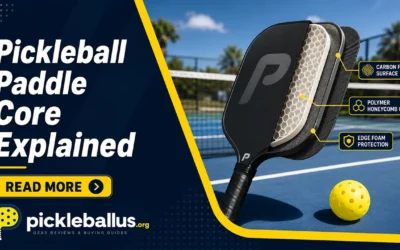
The choice within widebody paddles is anything but simple. Core thickness, face material, and swing weight all interact differently in a wider frame than they do in an elongated shape. A 14mm widebody plays nothing like a 16mm widebody from the same brand, and a foam-core widebody feels like a different tool than a standard polypropylene model at the same price.
Below, you’ll find full reviews of all eight paddles, a comparison of widebody versus elongated versus hybrid shapes, and a buying guide covering the three technical specs that matter most before you buy.
What Is a Widebody Pickleball Paddle?
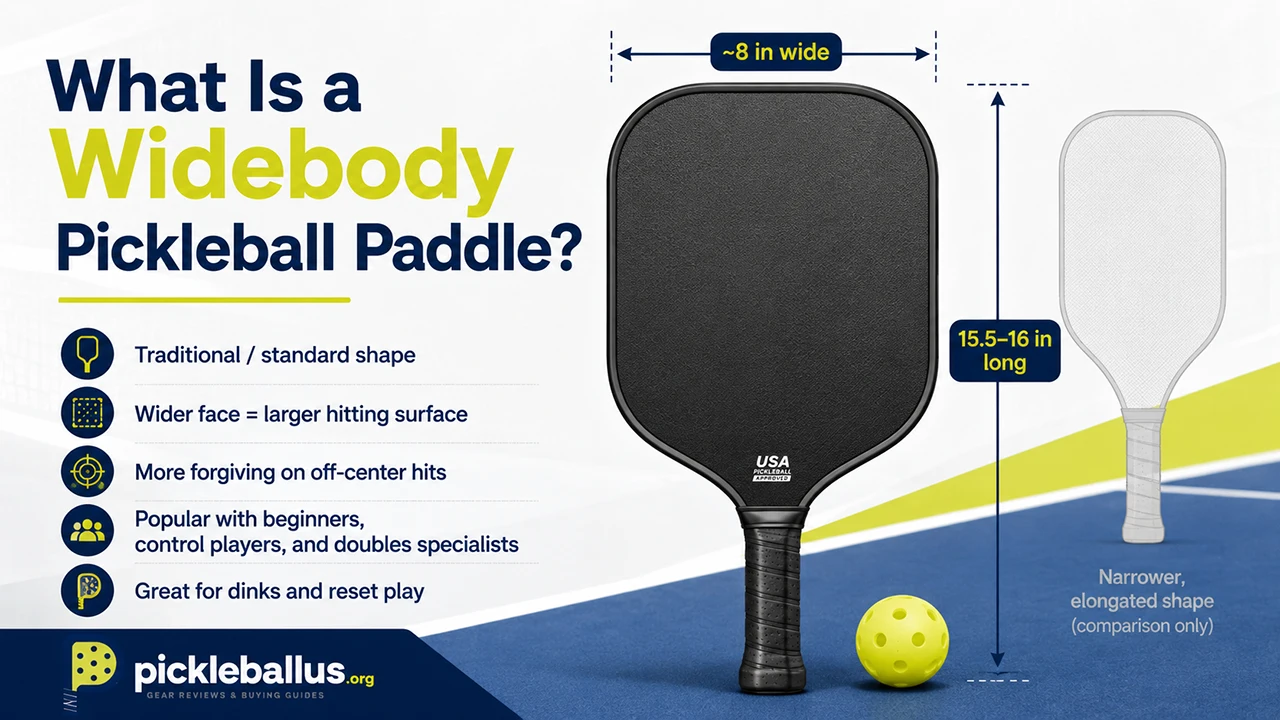
Widebody pickleball paddles — also called traditional-shape or standard-shape paddles — measure roughly 8 inches wide and 15.5 to 16 inches long, keeping the total length within the USAPA’s 24-inch combined limit (length + width). That extra width compared to elongated paddles isn’t just cosmetic. It directly expands the hitting surface and shifts where the sweet spot sits on the face.
The result is a paddle that forgives off-center hits far better than narrower shapes, making it the go-to choice among beginners, control-oriented players, and doubles specialists who spend most of their time in dinking rallies rather than swinging full drives from the baseline.
Widebody Dimensions vs. Elongated — What Changes
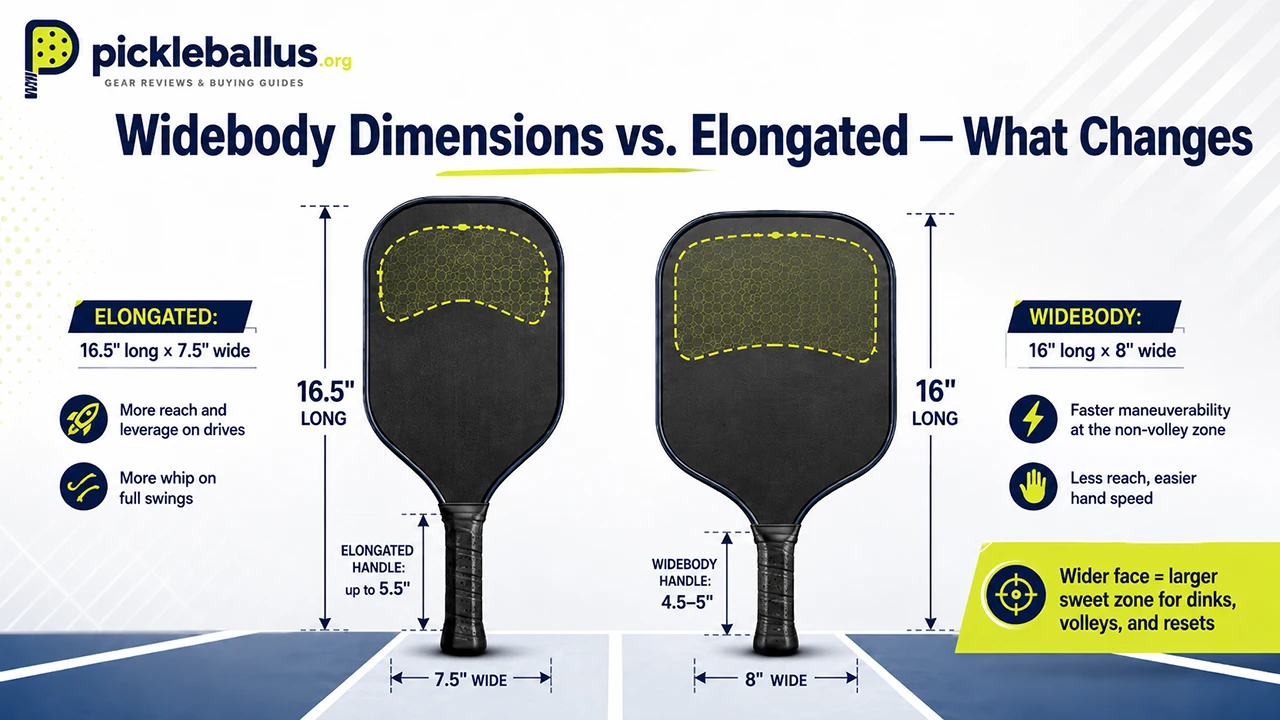
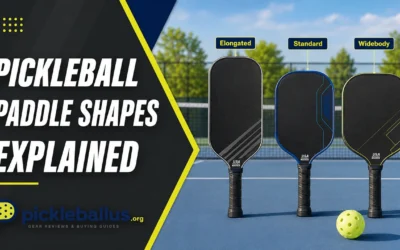
Elongated paddles typically run 16.5 inches long and 7.5 inches wide, while widebody paddles flip those proportions to roughly 16 inches long and 8 inches wide. That half-inch difference in width sounds minor but translates into a meaningfully larger sweet zone across the upper third of the face — exactly where most dinks, volleys, and resets make contact.
The shorter handle that often comes with widebody paddles (usually 4.5 to 5 inches versus 5.5 inches on elongated models) also changes how much leverage you generate on drives. You’ll notice less whip and reach on wide-open swings, but you’ll also find the paddle easier to maneuver quickly at the non-volley zone. For best pickleball paddles that balance reach and forgiveness, widebody sits firmly at the forgiving end of the spectrum.
Who Actually Benefits from a Wider Paddle Face
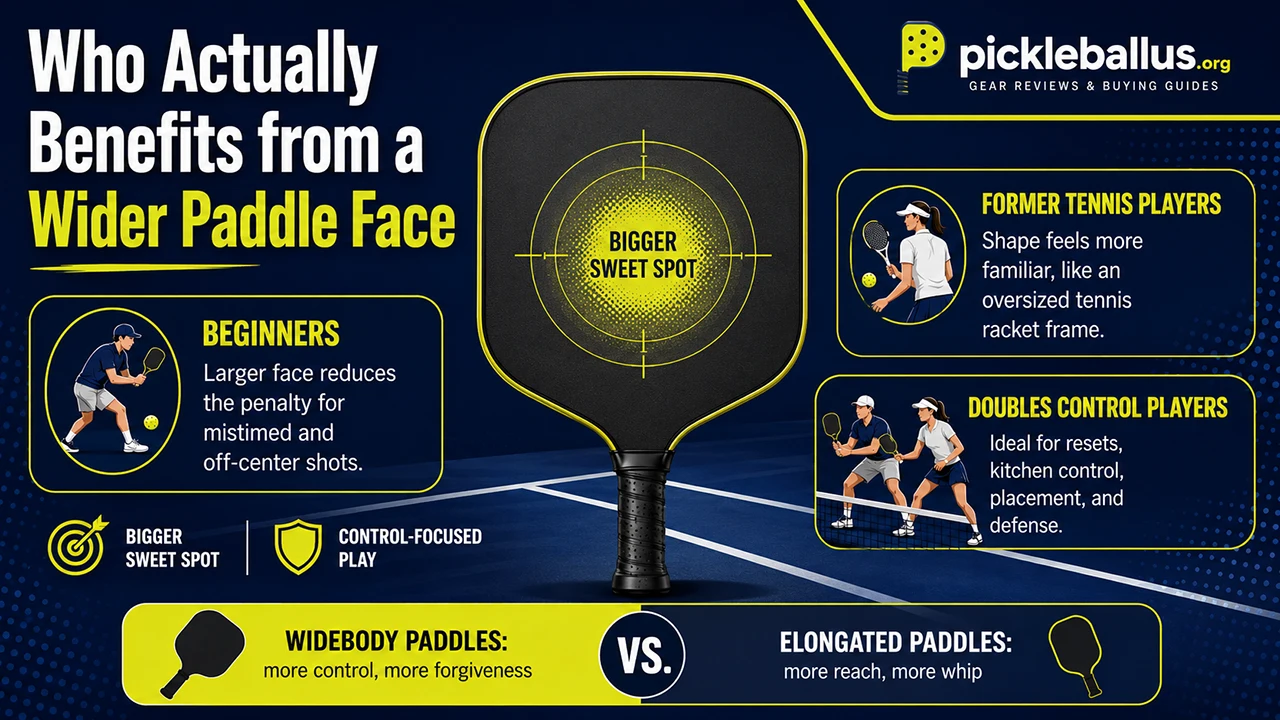
Beginners benefit most from widebody paddles because the larger face reduces the penalty for mistimed or off-center shots while players are still developing consistent swing mechanics. Experienced players who have transitioned from tennis also tend to find widebody shapes familiar — the proportions resemble a slightly oversized tennis racket frame more closely than an elongated pickleball paddle does.
At the intermediate and advanced level, widebody paddles thrive in doubles play, particularly for players whose strength lies in patience, reset shots, and controlling the kitchen line rather than driving balls from deep in the court. If your game is built on placement and defense more than pace and reach, a widebody paddle is worth considering over its elongated counterpart.
8 Best Widebody Pickleball Paddles in 2026
The eight paddles below were selected based on Amazon availability, verified sales history, user review volume, and court-tested performance data from the 2026 paddle landscape. Every paddle reviewed here has strong enough market presence to guarantee consistent supply and return/warranty support.
#1 11SIX24 Pegasus Jelly Bean — Best for Beginners
The Pegasus Jelly Bean from 11SIX24 has earned its reputation as one of the best budget-friendly widebody paddles on the market right now — and one of the few under-$100 paddles that genuinely plays like it costs more.
Key specs: widebody shape, 16mm polypropylene core, carbon fiber face, ~7.9 oz, USAPA approved.
Performance: The Jelly Bean’s 16mm core absorbs pace well, which means you’re not fighting the ball on fast exchanges at the kitchen line. The carbon fiber face produces solid spin generation for this price point — not elite-tier, but enough to put shape on third-shot drops and keep opponents honest on your serve. The sweet spot is generous across the entire upper face, and mishits stay in the court far more consistently than with thinner or narrower alternatives.
Where it shines most is in dink rallies and soft reset shots. The combination of the widebody shape and the 16mm core creates a dwell time that gives newer players a bit of extra time to feel the ball before it leaves the face — a quality that disappears quickly in thinner power-oriented paddles.
Pros:
- Outstanding value for a carbon fiber face widebody
- Large, forgiving sweet spot across the upper face
- Controlled pop — not dead, but not aggressive
- Lightweight enough for extended play without arm fatigue
Cons:
- Not the choice if you’re looking to generate pace on full drives
- The grit on the face wears faster than on premium-tier paddles
- Limited edge protection compared to thermoformed options
Best For: New players, players returning to the sport after a break, and anyone who wants a reliable widebody paddle without committing to a premium price.
My Verdict: For under $100, the Jelly Bean is hard to beat as a widebody starter. It won’t hold you back through the beginner and early intermediate stages, and when you’re ready to upgrade, you’ll know exactly which performance gaps to look for.
#2 Vatic Pro V-Sol Bloom Power — Best Budget Power Widebody
The V-Sol Bloom Power is Vatic Pro’s widebody entry in their V-Sol series, and it’s doing something unusual: delivering genuine offensive capability in a traditionally forgiving shape.
Key specs: widebody shape, 14mm polypropylene core, raw carbon fiber face, ~8.0–8.2 oz, USAPA approved.
Performance: The thinner 14mm core gives this paddle a noticeably livelier feel compared to 16mm widebody competitors. Ball speed off the face is higher, serves pick up more pace, and drives carry real authority. The raw carbon fiber face also adds meaningful spin texture — this is one of the grittier surfaces in the under-$150 category, and you’ll feel it immediately on topspin groundstrokes.
The widebody shape keeps the sweet spot large enough that the power never feels risky — you’re not sacrificing margin for pace the way you might on a 14mm elongated paddle. Swing weight sits in the mid-range for widebody paddles, making it fast enough through the air without feeling whippy or hard to control on touch shots.
Pros:
- Strong pop for a widebody paddle — genuinely offensive
- Raw carbon fiber face delivers real spin production
- 14mm core keeps maneuverability high for a heavier-feeling paddle
- Competitive pricing for the performance tier
Cons:
- Less control margin than 16mm widebody options — not ideal for pure control players
- Raw carbon faces require care and lose grit faster with heavy use
- The Bloom series comes in widebody, hybrid, and elongated; confirm the widebody SKU at purchase
Best For: Intermediate players who want more offense than a standard 16mm control paddle provides but still want the sweet spot safety net of a widebody shape.
My Verdict: The V-Sol Bloom Power is the best answer to “can a widebody paddle be genuinely powerful?” Yes, it can — and Vatic Pro proved it here.
#3 JOOLA Pro IV Scorpeus 14mm — Best for Aggressive Players
JOOLA’s Pro IV Scorpeus 14mm is one of the few widebody paddles built without any concessions to beginners. It’s designed for players who have already chosen their style — aggressive, fast, and offensive — and simply want the sweet spot insurance that comes with a wider face.
Key specs: widebody shape, 14mm foam-adjacent core (aero-curve construction), carbon fiber face, ~7.8–8.0 oz, USAPA approved.
Performance: The Scorpeus 14mm is the widebody option in JOOLA’s Pro IV lineup, sitting alongside the elongated Hyperion. JOOLA’s aero-curve top geometry reduces swing weight without narrowing the face, which means this paddle moves through the air faster than most widebody paddles of similar weight. At the NVZ, it’s genuinely quick — you won’t feel the paddle fighting your hand speed.
The carbon fiber surface produces spin numbers that compete with the best paddles at any price. Combined with the wider face, spin on serves and drops holds reliable direction even when contact isn’t perfectly centered. On drives and overhead put-aways, the 14mm core creates a crisp, satisfying pop that more forgiving 16mm paddles simply can’t replicate.
Pros:
- Excellent spin production for a widebody paddle
- Aero-curve top reduces swing weight without sacrificing face area
- Responsive and fast at the NVZ despite wider frame
- Strong brand support and Amazon availability
Cons:
- The thin 14mm core demands more precise soft-shot technique
- Premium price — not a beginner investment
- Louder than most 16mm options; check noise restrictions on your court
Best For: Intermediate-to-advanced players who already use an elongated power paddle and want to experiment with widebody forgiveness without sacrificing their offensive game.
My Verdict: The Scorpeus 14mm fills a gap most paddle lines ignore — the aggressive widebody. JOOLA executed it cleanly, and players who feel occasional frustration with elongated paddles on off-center drives will immediately appreciate what this shape change does for consistency.
#4 Proton Project Peacock 13mm Widebody — Best for Doubles
The Project Peacock from Proton is one of the more interesting paddles released in 2025 and 2026, partly because its 100% foam core construction sets it apart from the polypropylene norm in widebody paddles.
Key specs: widebody shape, 13mm foam core, raw carbon fiber face, ~7.7 oz, USAPA approved.
Performance: Foam core paddles have a softer, more dampened feel than honeycomb polypropylene cores, and in a widebody shape, that combination creates something particularly well-suited to doubles play and kitchen-line exchanges. The 13mm thickness gives it enough pop to finish points on put-aways, while the foam absorbs pace on resets better than you’d expect for a 13mm core.
What reviewers consistently note is how well the Peacock handles dink consistency under pressure. The wider face reduces lateral errors, the foam core reduces vibration feedback on mishits, and the raw carbon surface provides enough grip to place drops with spin rather than just blocking them back. At 7.7 oz, it’s also light enough for extended doubles sessions without the arm fatigue that heavier paddles create.
The Kitchen, one of the more respected equipment review sites in pickleball, noted the 13mm widebody as their preferred Peacock option for doubles — a specific endorsement that reflects real court testing rather than spec-sheet analysis.
Pros:
- Foam core creates a plush, controlled feel unlike most widebody options
- 13mm provides pop without the harshness of typical thin cores
- Lightweight and easy to maneuver at 7.7 oz
- Raw carbon face offers reliable spin production
Cons:
- Foam core paddles may feel “dead” to players used to lively polypropylene cores
- 13mm is thinner than control-focused players typically prefer
- Less widely stocked than JOOLA or Selkirk products on Amazon
Best For: 3.5 to 4.5 doubles players who prioritize feel and reset quality over raw power, and who want a foam-core widebody that doesn’t sacrifice spin capability.
My Verdict: The Peacock 13mm Widebody is the most technically interesting paddle on this list. It’s not for everyone, but for doubles players who care about feel above all else, it’s one of the most rewarding paddles in the 2026 widebody category.
#5 Selkirk SLK Halo Control — Best for Control-First Players
Selkirk’s SLK Halo Control is the widebody (Epic-shape equivalent) option in their accessible SLK line, and it represents everything that made Selkirk’s traditional shape popular: solid construction, consistent feel, and a forgiving hitting surface at a mid-range price.
Key specs: widebody/Epic shape, 16mm polypropylene core, carbon fiber face, ~7.7–8.0 oz, USAPA approved.
Performance: The 16mm core here prioritizes dwell time and control over explosive power, and the results show in dinking performance. Shots feel predictable. There’s no unexpected pop or deadness — just consistent, reliable response across the entire face. For players who rely on placement and patience rather than pace, that consistency is worth more than the pop a thinner core provides.
The Halo Control is Selkirk’s answer to players who like the SLK line’s accessibility but want more placement precision than the power-tuned models provide. The wider face ensures that even when technique breaks down slightly under pressure — which happens to everyone at rec play level — balls find the court rather than flying wide. For best pickleball paddles for control, the Halo Control sits comfortably in the top tier of its price range.
Pros:
- Excellent control and dwell time from 16mm polypropylene core
- Consistent, predictable feel across the face — no surprises
- Selkirk brand reliability and solid warranty support
- Comfortable grip sizing options
Cons:
- Not the paddle for players wanting offensive pop or heavy spin production
- Carbon fiber face grit is modest compared to raw carbon options
- Handle length is shorter than some players coming from tennis prefer
Best For: Beginner to intermediate players who know their game is built on control, consistency, and placement, and who want a widebody paddle that won’t fight that approach.
My Verdict: The SLK Halo Control does exactly what it promises. No drama, no tradeoffs that sneak up on you mid-game — just a solid widebody paddle that makes control-oriented play easier and more consistent.
#6 Engage Pursuit MX 6.0 — Best for Spin
The Engage Pursuit MX 6.0 is Engage’s widebody offering in their Pursuit series, and it earns its spot here through one standout characteristic: spin generation that outperforms most paddles in the widebody category.
Key specs: widebody shape, 16mm polypropylene core, textured carbon fiber face, ~7.8 oz, USAPA approved.
Performance: Engage built the Pursuit MX line around a textured face that creates higher ball RPM without sacrificing the soft feel their core design is known for. In widebody configuration, that spin potential pairs with the forgiveness of a wider face to create a paddle that punishes sitters and lets you load topspin on drops without the anxiety of mishitting on a narrow sweet spot.
The 16mm core keeps this paddle firmly in control territory for feel, but the face texture adds a dimension that control paddles rarely offer. Topspin dinks, angled drive returns, and heavy serves all respond well to the surface. For players who have been stuck using an elongated paddle to generate spin, the Pursuit MX shows that widebody paddles can keep up without the added reach.
Pros:
- Strong spin production for a 16mm control-oriented widebody
- Soft, comfortable feel with good vibration dampening
- Well-balanced weight distribution for maneuverability
- Consistent performance across dinks, resets, and topspin shots
Cons:
- Not the most powerful paddle — drives lack pace compared to 14mm alternatives
- Textured face requires regular cleaning to maintain spin performance
- Price sits above entry-level; more investment than the Jelly Bean
Best For: Intermediate players who want to develop topspin as a weapon without switching to an elongated paddle, and experienced players who want widebody forgiveness with something extra on their spin game.
My Verdict: The Pursuit MX 6.0 earns its place as the go-to spin-focused widebody paddle. Among all the paddles reviewed here, it’s the one that opens up the most variety in your shot selection while keeping the safety net of a wide face underneath every swing.
#7 HEAD Radical Pro Widebody — Best for Intermediate Players
The HEAD Radical Pro brings one of tennis’s most storied equipment lineages into pickleball with a widebody paddle that targets the growing pool of intermediate players who want performance without the steepest learning curve.
Key specs: widebody shape, 16mm Ergo-Foam core, composite/carbon fiber face, ~7.8–8.1 oz, USAPA approved.
Performance: HEAD’s Ergo-Foam core is their proprietary enhanced polypropylene technology, and it creates a comfortable feel on impact — valuable for players who pick up arm fatigue or tennis elbow symptoms after long sessions. The wider face distributes impact energy across more surface area, and combined with the foam-blend core, the result is one of the most arm-friendly widebody paddles on this list.
Performance is strong without being specialist. The Radical Pro isn’t trying to be the most powerful or most spin-heavy paddle — it’s built to be reliable across all shot types for a player still developing game-to-game consistency. Serves, third-shot drops, dinks, and volleys all perform predictably. Nothing surprises you, and nothing lets you down.
HEAD’s brand infrastructure also means Amazon stocking is reliable, returns are straightforward, and replacement availability is consistent — practical factors that matter more than they get credit for when a paddle is your primary equipment.
Pros:
- Ergo-Foam core is noticeably comfortable for extended play
- Strong all-round performance without demanding specialist technique
- Reliable Amazon availability and HEAD brand support
- Good sweet spot distribution for a mid-weight widebody
Cons:
- Not specialized enough for players who know exactly what they want (spin, power, or elite control)
- Face texture produces modest spin compared to raw carbon alternatives
- Heavier side of the widebody weight range for some players
Best For: Intermediate players (3.0–3.5 rating) who want a dependable widebody paddle that performs well across all shots and doesn’t punish them for technique gaps.
My Verdict: The Radical Pro is the most “all-purpose” paddle on this list in the best sense of the phrase — it makes intermediate play easier without forcing you to sacrifice one quality to gain another.
#8 Ronbus Quanta R5 — Best Lightweight Widebody
The Ronbus Quanta R5 earns the final spot for doing something most widebody paddles avoid: keeping weight genuinely low without hollowing out performance.
Key specs: widebody shape, 16mm polypropylene core, carbon fiber face, ~7.4–7.6 oz, USAPA approved.
Performance: At under 7.6 oz for a widebody paddle, the Quanta R5 is meaningfully lighter than the rest of this list. That matters for two specific groups: players managing arm or shoulder issues who need reduced swing-weight fatigue, and players who want to customize their paddle’s weight distribution with lead tape to fine-tune where balance sits.
Tickle My Pickleball’s testing measured the Quanta R5 at a swing weight of 102 and twist weight of 6.13 — the lowest maneuverability figures in their $100 widebody comparison, which means the paddle is fast and easy to redirect in hands battles even if it needs tape to add stability on drives. Out of the box, the lighter weight does mean slightly less punch on pace shots and modest stability on off-center contact at the paddle’s edges.
The sweet spot is good for the weight class, and the carbon fiber face gives it solid spin potential. For players willing to add a few grams of lead tape to the sides, the Quanta R5 becomes a genuinely customizable platform — something few paddles at this price point offer. Among paddles designed around a pickleball paddle with largest sweet spot concept, the Quanta R5 is the lightest path to a forgiving face.
Pros:
- Lightest widebody option on this list — reduces fatigue significantly
- Great foundation for tape customization
- Solid carbon fiber face spin production
- Competitive pricing in the mid-range bracket
Cons:
- Lighter weight sacrifices some stability on hard drives and off-center contact
- Adding tape is necessary for most players to get the most from it — an extra step vs. ready-to-play alternatives
- Less brand recognition than Selkirk or JOOLA, which may affect resale value
Best For: Players managing arm fatigue or shoulder discomfort who still want a high-performing widebody, and technically curious players who enjoy dialing in paddle weight through customization.
My Verdict: The Quanta R5 is the most customizable widebody paddle reviewed here. Buy it light, add tape methodically, and you can build a performance profile that’s genuinely tailored to how you play — something the heavier, fixed-weight paddles on this list can’t offer.
Widebody vs. Elongated vs. Hybrid: Which Shape Fits Your Game?
Widebody paddles win on sweet spot size and maneuverability. Elongated paddles win on reach and raw power. Hybrid paddles fall between the two, offering a compromise that works well for all-court players but masters neither extreme.
The table below summarizes how the three shapes compare across the qualities that matter most in game situations:
| Quality | Widebody | Hybrid | Elongated |
|---|---|---|---|
| Sweet spot size | Largest | Medium | Smallest |
| Reach from baseline | Shortest | Medium | Longest |
| Power potential | Moderate | High | Highest |
| Maneuverability at NVZ | Fastest | Medium | Slower |
| Best skill level fit | Beginner–Intermediate | Intermediate–Advanced | Intermediate–Advanced |
| Best play style fit | Control / Doubles | All-court | Power / Singles |
If you spend most of your time at the non-volley zone in doubles play, a widebody gives you genuine, measurable advantages — more forgiveness on fast hands exchanges, less penalty for rushed technique, and a sweet spot that makes consistent dinking far easier to maintain over a long game.
If you play singles frequently or rely on baseline driving to win points, an best elongated pickleball paddles may suit your game better despite the narrower hitting window. The extra reach and leverage on drives add up over a match.
For players who aren’t sure which shape fits them, hybrid paddles are worth trying, but in practice, most players eventually identify more strongly with either the control-and-forgiveness camp (widebody) or the power-and-reach camp (elongated).
How to Choose the Right Widebody Paddle
The three specs below matter more than brand name or marketing language when selecting among widebody paddles. Get these right, and the paddle will feel like it was built for your game within the first few sessions.
Core Thickness — 13mm, 14mm, or 16mm?
16mm cores are the default widebody recommendation for most players because the extra thickness softens impact, extends dwell time, and produces a controlled, predictable feel that matches the widebody shape’s natural strengths. Players prioritizing dinking, resets, and placement at the kitchen line will find 16mm the most consistent option. For best 16mm pickleball paddles, the widebody shape is one of the most natural fits in the category.
14mm cores give widebody paddles a second personality entirely. Less dwell time, more ball speed, better serve punch — but at the cost of some control margin that beginner and intermediate players will notice immediately. The JOOLA Scorpeus 14mm reviewed above is the best example of a 14mm widebody done right; it adds offensive capability without punishing the player for choosing a wider shape.
13mm cores in widebody paddles are rare for a reason — they’re a specialist configuration. The Proton Peacock 13mm is the strongest example on this list, and it works because the foam core compensates for the thinner profile with a softer, more dampened feel. For most players, 16mm remains the safer starting point.
Face Material — Carbon Fiber vs. Fiberglass in Widebody Paddles
Carbon fiber faces dominate the 2026 performance paddle market, including widebody options, for two reasons: higher spin potential and a crisper feel that most intermediate and advanced players prefer. Raw carbon fiber faces, in particular, produce the highest spin RPM figures in the category. The trade-off is that raw carbon loses its surface grit faster under heavy use and requires more care.
Fiberglass faces are softer, dampen the ball more on impact, and produce a slightly livelier “pop” despite the softer feel — a counterintuitive quality that some beginners find natural. Fiberglass widebody paddles are typically more affordable and still USAPA approved for all forms of play. Reviewing the pickleball paddle materials guide helps clarify the full range of options available across both shapes.
For widebody paddles specifically, most players who purchase for control will be better served by a carbon fiber face — the added spin control helps compensate for the reduced reach that comes with the shorter frame.
Weight — Lightweight vs. Midweight and Why It Matters More in Widebody
Midweight widebody paddles (7.8–8.2 oz) are stable on drives, maintain punch through the ball on volleys, and don’t require tape to perform out of the box. For most players, this range is the sweet spot.
Lightweight widebody paddles (7.3–7.7 oz) like the Ronbus Quanta R5 offer faster hands at the net and meaningfully less arm fatigue over long sessions, but they sacrifice some stability on off-center contact — which the wider face helps compensate for, to a point.
One physics note specific to widebody: the wider face increases a paddle’s twist weight (resistance to rotation on off-center hits) regardless of total mass. That means a 7.5 oz widebody may feel more stable on edge-contact shots than a 7.5 oz elongated paddle of the same swing weight. Weight alone doesn’t tell the complete story here — always check twist weight data when available.
By now you have a clear picture of which widebody paddles excel across different price points, skill levels, and play styles — from the forgiving Jelly Bean for new players to the Proton Peacock’s foam-core precision for dedicated doubles specialists. Choosing the paddle, however, is only half the equation; what you do in the first few sessions and how you manage wear over time determines whether that investment earns you better scores for two seasons or starts holding you back in six months. The next section covers the finer details that only experienced widebody players think to ask about.
What Every Widebody Paddle Owner Should Know Before Playing
How to Break In a New Widebody Paddle
Most widebody paddles with foam or polypropylene cores benefit from a break-in period of 5–10 hours of play before they settle into their final feel. During this window, the core compresses slightly at its most-used contact zones, and the face texture produces its most consistent spin output before any grit begins to wear.
In practice, a break-in period for a widebody paddle means using it in lower-stakes rec sessions first rather than your most competitive games. Drive at medium pace, dink for full sessions, and run through serve practice. By the end of the first week of regular play, the paddle will have found its character — and you’ll know far better whether its feel suits your game than you could from a 15-minute session.
Signs It’s Time to Replace Your Widebody Paddle
A dead zone on the face, edge guard separation, or delamination are the clearest signs that a widebody paddle has reached end-of-life. Dead zones — areas where the ball response is noticeably flatter than the rest of the face — develop when the core compresses beyond its functional range, usually after 1–2 years of regular play. On foam-core widebody paddles, this timeline can be slightly shorter under heavy use.
Edge guard separation deserves attention early because it indicates that the paddle’s internal structure near the rim is compromised. Left unaddressed, a loose edge guard catches on court surfaces, and the gap lets moisture affect the core — accelerating decline faster than normal wear would.
Does a Widebody Paddle Improve Your Third-Shot Drop?
Yes — widebody paddles provide a measurable advantage on third-shot drops, primarily through two mechanisms: the wider face offers more margin for the precise downward-angled contact that drops require, and the 16mm core (most common in widebody paddles) extends dwell time long enough for players to feel the shot developing and adjust hand pressure accordingly. Among all the tools that improve soft-shot consistency, paddle shape is one of the most underrated, and the widebody’s advantage is most pronounced on drops hit from mid-court under pressure.
Widebody Paddles on Fast Hands vs. Patience-Based Games
Widebody paddles reward patience; they punish reckless aggression. In fast hands exchanges at the non-volley zone, the wider face is a clear asset — more surface area means fewer handcuff errors on speed-up attacks. The paddle gets out of the way faster than a heavier elongated model, and the sweet spot catch zone on deflections is noticeably more forgiving.
Where widebody paddles become a liability is in transition zone drives — balls hit while moving from mid-court to the baseline, or on aggressive drives that need maximum leverage to generate pace. The shorter handle reduces the lever arm for full swings, and the lower power ceiling (compared to a 14mm elongated) means some pace is simply not available. Players whose game depends on ending points with pace-heavy groundstrokes from deep court will eventually outgrow the widebody’s ceiling, regardless of how well-built the paddle is.
Write Your Review
No reviews yet. Be the first to share your experience!