

The best thin pickleball paddles in 2026 are the JOOLA Ben Johns Perseus Pro IV 14mm (best overall), the Selkirk LABS 008 Invikta 13mm (best premium), the Engage Pursuit MX 6.0 (best for power players), the ProKennex Black Ace 14mm (best for arm health), the HEAD Radical Pro 13mm (best for intermediates), the Vatic Pro Prism Flash 13mm (best budget pick), and the Six Zero Double Black Diamond 14mm (best for spin). Every paddle on this list has a core thickness at or below 14mm — the threshold that defines the “thin” category — and each delivers the pop and fast ball exit speed that aggressive players look for.
Choosing among them comes down to a few key questions: Are you a singles player who needs fast ball exits on drives? An aggressive doubles player who wants to speed up at the kitchen line? Thin paddles reward players who generate their own power and have the technical accuracy to work with a tighter, livelier sweet spot. They are not for everyone — which is exactly why picking the right one matters.
The tradeoff you need to understand going in: thinner cores (roughly 10–13mm) produce more pop and faster ball speed, but they sacrifice some of the soft, forgiving feel that thicker 16mm+ paddles are known for. If you’ve been playing with a thick control paddle and want to switch, the transition takes a few sessions to settle. The paddles on this list were selected because they balance that lively thin-core feel with enough face quality and build precision to stay competitive in 2026.
Below, you’ll find detailed reviews for all seven paddles, followed by a buying guide and a comparison of thin vs. thick cores to help you decide whether this paddle style fits your game.
What Is a Thin Pickleball Paddle?
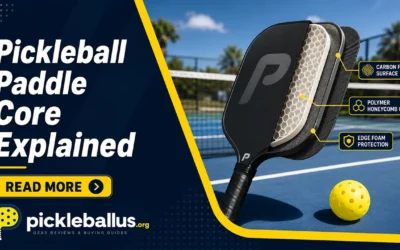
Thin pickleball paddles are paddles with a core thickness of 10–14mm, setting them apart from the thicker 16mm and 17–19mm paddles that dominate most modern best-of lists. The core is the honeycomb or layered material sandwiched between the two paddle faces, and its depth directly shapes how the ball feels and reacts on contact.
How Thin Is “Thin”? Core Thickness Explained
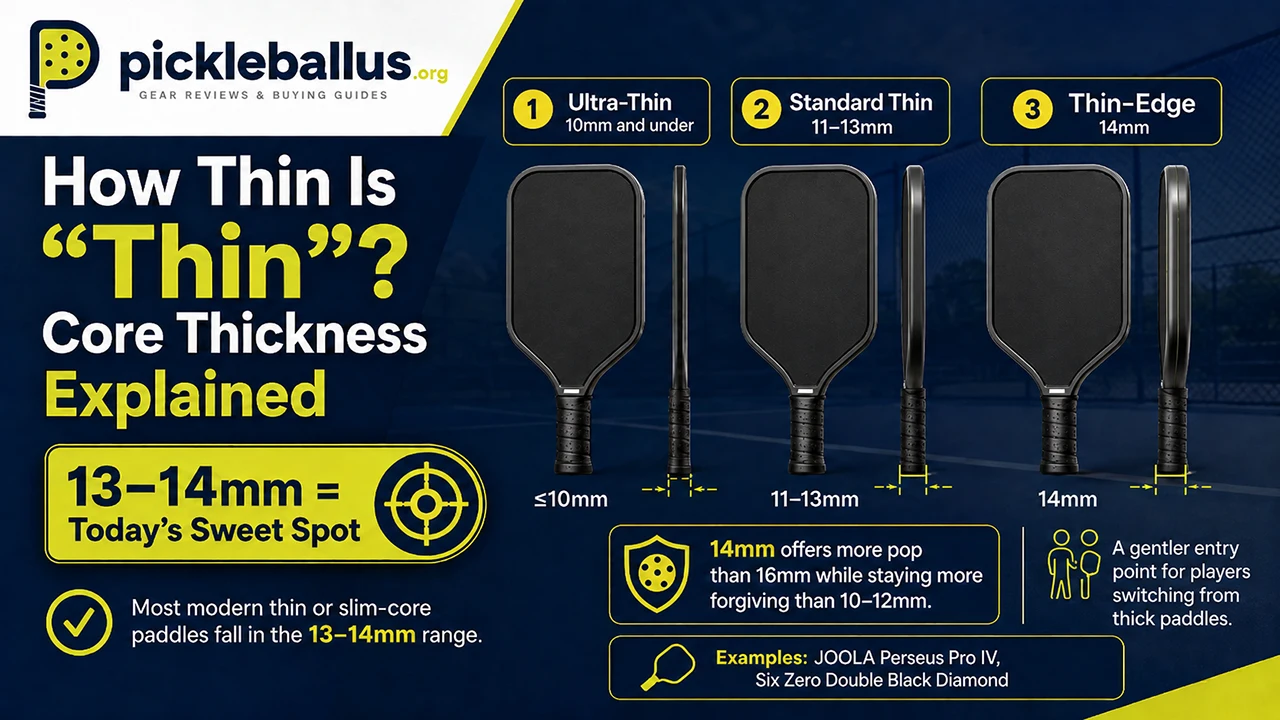
Three thickness tiers define thin paddles: ultra-thin (10mm and under), standard thin (11–13mm), and thin-edge (14mm). Most paddles marketed as “thin” or “slim-core” fall in the 13–14mm range — the current sweet spot for balancing pop and manageable control. Older budget models still appear with 10–11mm cores, but modern tour-level thin paddles have settled at 13–14mm as the preferred benchmark.
The 14mm tier deserves a specific callout. Several top-performing paddles — including the JOOLA Perseus Pro IV and Six Zero Double Black Diamond — use exactly 14mm cores, offering more pop than a 16mm paddle while remaining more forgiving than an ultra-thin 10–12mm build. For players switching from a thick paddle, 14mm is the gentler entry point into thin-core territory.
Thin Paddle vs Thick Paddle — Key Differences
Thin paddles generate more power and pop; thick paddles give more control and stability. In practice:
| Attribute | Thin (10–14mm) | Thick (16–19mm) |
|---|---|---|
| Ball speed off face | Higher | Lower |
| Sweet spot size | Smaller | Larger |
| Forgiveness on mishits | Less | More |
| Ideal play style | Singles, power, drives | Doubles, dinking, resets |
| Feel on soft shots | Lively, firm | Soft, dampened |
| Arm stress on hard shots | Slightly higher | Slightly lower |
Thin paddles are not “worse” — they’re a different tool. Check out the best thick pickleball paddles if the softer, more forgiving feel is a better match for your style.
7 Best Thin Pickleball Paddles in 2026
The reviews below cover every paddle on this list with full detail on specs, performance, pros, cons, and ideal player profile. All paddles are actively sold on Amazon.com and were selected based on sales volume, verified buyer reviews, brand reputation, and core thickness specifications.
#1 JOOLA Ben Johns Perseus Pro IV 14mm — Best Overall
The Perseus Pro IV 14mm delivers the best overall performance in the thin paddle category for 2026, combining the same tournament-grade construction as the standard Perseus Pro IV line in a thinner, faster-reacting format. Ben Johns — widely considered the top-ranked player in the world — uses the standard-thickness version as his tour paddle. The 14mm variant channels that same engineering into a livelier, more power-forward build suited to singles and offensive doubles play.
Key Specs:
- Core: 14mm Propulsion Honeycomb Polymer
- Face: T700-Grade Carbon Fiber (Carbon Friction Surface)
- Weight: ~8.0 oz
- Shape: Standard
Performance Analysis: The Perseus Pro IV 14mm’s biggest strength is consistency across different shot types. The foam-loaded edge wall — one of JOOLA’s signature Pro IV construction features — adds forgiveness at the edges, partially offsetting the smaller sweet spot typical of thin builds. On drives and speedups, the ball exits fast with a controlled, satisfying pop. Dinks feel tighter than on a 16mm paddle but remain accurate once you’ve adjusted. Spin generation from the carbon friction face ranks among the highest in its category.
Pros:
- Tour-grade construction in a thin-core format
- Foam-loaded edges reduce the sweet spot penalty common in thin paddles
- Strong spin from carbon friction surface
- Consistent across both offensive and defensive shots
Cons:
- Pricier than most thin-paddle alternatives
- Adjustment period required for players coming from thick builds
Best For: Competitive players at the 4.0–5.0 level who want thin-paddle power without sacrificing build quality.
My Verdict: No thin paddle in 2026 does more things well than the Perseus Pro IV 14mm. The foam-edge construction is what separates it from the rest — it’s a rare thin paddle that doesn’t punish you severely for off-center contact. If you’re testing one thin paddle this year, start here.
#2 Selkirk LABS 008 Invikta 13mm — Best Premium Thin Paddle
The Selkirk LABS 008 Invikta represents the highest build quality available in a 13mm thin paddle, featuring the InfiniGrit carbon fiber face that produces some of the strongest spin numbers in the category. This paddle suits players who want maximum pop from their core and have the technical skill to work with a smaller sweet spot.
Key Specs:
- Core: 13mm Polymer Honeycomb
- Face: T700 Carbon Fiber with InfiniGrit texture
- Weight: ~7.9 oz
- Shape: Invikta (elongated)
Performance Analysis: The 13mm core places the LABS 008 firmly in power-first territory. Ball exit speed on drives and overheads is explosive, and the elongated Invikta shape gives players extra reach on wide balls and passing shots. The InfiniGrit face texture holds topspin exceptionally well, adding an offensive edge on third-shot drops and kitchen-line speedups. The tradeoff — as always with a 13mm core — is feel. Soft dinks require deliberate touch, and control-first players will find the feedback too firm.
Pros:
- Elite spin generation from InfiniGrit surface
- Elongated shape adds reach for singles and baseline play
- Premium build quality and long-term consistency
- Fast, explosive feel on drives and overheads
Cons:
- Demands technical skill to manage the lively response
- Not forgiving on mishits
- Premium price point
Best For: Advanced players (4.5+) who prioritize spin and power and play an attacking singles or mixed doubles style.
My Verdict: The LABS 008 is a specialist tool. In the right hands — especially players who drive aggressively and roll topspin — it’s one of the most effective thin paddles on the market. Not a beginner paddle, not a compromise. A weapon.
#3 Engage Pursuit MX 6.0 — Best for Power Players
The Engage Pursuit MX 6.0 is built for players who prioritize raw power above everything else, using a 13mm polymer core paired with Engage’s Control Pro carbon fiber face to produce fast ball exit speed while keeping shots from spraying wide.
Key Specs:
- Core: 13mm Polymer Honeycomb
- Face: Carbon Fiber (Control Pro Face)
- Weight: ~8.1 oz
- Shape: Standard elongated
Performance Analysis: Engage designed the Pursuit MX 6.0 around power-forward play, and the 13mm core delivers on that promise. Ball speed off drives is among the fastest on this list, and the control pro face surface provides enough texture to prevent unwanted launch angle variance. What distinguishes this paddle from other power-first thin builds is how it handles transition zone play — reset blocks feel firmer than on a thick paddle, but they remain accurate enough to hold position in a point. Players who dictate pace from the baseline will feel at home here.
Pros:
- Maximum power output for aggressive hitters
- Control Pro face reduces erratic ball direction on hard contact
- Strong consistency on drives and overheads
- Made in the USA
Cons:
- Firm feel on soft shots requires deliberate adjustment
- Not recommended for control-first players
Best For: Singles players, aggressive doubles attackers, and 3.5–5.0 players who generate strong swing speed and want to finish points faster.
My Verdict: If your game involves ending points at the first opportunity rather than waiting through long rallies, the Pursuit MX 6.0 is made for you. The best pickleball paddles for power list covers options across all thicknesses — in the thin-core category, this paddle leads.
#4 ProKennex Black Ace 14mm — Best for Arm Health
The ProKennex Black Ace 14mm is the best thin paddle for players managing elbow or arm stress, incorporating ProKennex’s proprietary Kinetic technology — small ball bearings embedded in the handle — that reduces vibration on hard contact without sacrificing the pop of a thin core.
Key Specs:
- Core: 14mm Polymer Honeycomb
- Face: Carbon Fiber
- Weight: ~7.8 oz (lightweight)
- Shape: Standard
Performance Analysis: Most thin paddles produce sharper vibrations on hard contact than thick builds do, because the livelier core returns more energy directly to the player’s hand. ProKennex addresses this directly. The Kinetic handle dampens vibrations through mass displacement in the handle chamber, protecting the wrist, elbow, and shoulder from cumulative impact stress while preserving the lively pop of a 14mm core. Players recovering from pickleball elbow or managing soft tissue issues will notice the difference within a few sessions. The 7.8 oz weight keeps hand speed quick at the net.
Pros:
- Kinetic vibration-dampening system reduces arm stress without muffling pop
- Lightweight build for fast reactions at the kitchen
- 14mm core balances pop and control better than ultra-thin alternatives
- Strong option for players managing chronic elbow or shoulder issues
Cons:
- Kinetic handle adds slight complexity to grip customization
- Pop ceiling is high but not at the absolute top of this category
Best For: Players with a history of elbow, shoulder, or wrist problems who still want thin-paddle performance. Particularly well-suited for seniors and players over 40.
My Verdict: The Black Ace 14mm is underrated in the thin-core category. For any player where arm health is a genuine concern, no other thin paddle competes with it. Thoughtfully engineered and built for the long game.
#5 HEAD Radical Pro 13mm — Best for Intermediate Players
The HEAD Radical Pro 13mm is the best thin paddle for intermediate players stepping up from beginner equipment, offering a 13mm power profile in a widebody build that’s priced accessibly and doesn’t require advanced technique to use effectively.
Key Specs:
- Core: 13mm Polymer Honeycomb
- Face: Carbon Fiber
- Weight: ~8.0 oz
- Shape: Standard widebody
Performance Analysis: HEAD’s Radical Pro has consistently ranked among the most popular intermediate paddles on Amazon, and the 13mm version makes its power profile approachable for players not yet at the 4.0–4.5 skill level. The widebody shape gives a larger contact zone than an elongated model, partially offsetting the smaller sweet spot of a thin core. That combination — thin-core pop with a wider face — makes the paddle more forgiving than many 13mm alternatives. It’s not the specialist weapon the Selkirk LABS 008 is, but that’s exactly the point: it’s a thin paddle you can grow into.
Pros:
- Widebody shape reduces the forgiveness penalty of a 13mm core
- Mid-range price for a carbon fiber thin build
- Good pop without requiring advanced swing technique
- Familiar HEAD build quality and reliability
Cons:
- Spin ceiling is lower than T700 raw carbon surfaces
- Won’t satisfy advanced players looking for elite-level pop
Best For: Players at the 3.0–4.0 skill level who want to experience thin-paddle ball speed without committing to a specialist premium build.
My Verdict: For the intermediate player curious about thin paddles, the Radical Pro 13mm is the lowest-risk entry point. Compare it against thicker builds with the best pickleball paddles for intermediate players list to see how it stacks up across core thicknesses.
#6 Vatic Pro Prism Flash 13mm — Best Budget Pick
The Vatic Pro Prism Flash 13mm is the best budget thin pickleball paddle available on Amazon, delivering T700 raw carbon fiber face performance — a surface typically found on paddles costing twice as much — at a mid-range price that makes it exceptional value.
Key Specs:
- Core: 13mm Polymer Honeycomb
- Face: T700 Raw Carbon Fiber
- Weight: ~8.1 oz
- Shape: Standard
Performance Analysis: Vatic Pro built its reputation on bringing tour-grade face materials to players who can’t justify premium prices. The Prism Flash 13mm carries a T700 raw carbon surface that generates high spin and holds its grit texture longer than many comparable paddles. The 13mm core produces strong pop on drives and serves. The main concession at this price point is edge guard durability — the build is not thermoformed, so heavy court contact can cause edge damage over time. For casual-to-competitive rec players, this is rarely an issue.
Pros:
- T700 raw carbon face at a mid-range price
- Strong spin generation for the price bracket
- Good ball speed on drives
- Best value for players testing thin-core paddles for the first time
Cons:
- Non-thermoformed build is less durable than premium options
- Noticeably smaller sweet spot compared to thicker paddles
- Not recommended for players prone to dropping equipment
Best For: Budget-conscious players (3.0–4.0) who want thin-paddle performance without paying premium prices.
My Verdict: At this price, no better thin-core paddle exists on Amazon. The T700 face is a tour-level surface material — you’d pay significantly more for the same construction on most premium builds. Outstanding value for the right player.
#7 Six Zero Double Black Diamond 14mm — Best for Spin
The Six Zero Double Black Diamond 14mm is the best thin paddle for spin-focused players, pairing a 14mm core with a double-layer raw carbon fiber face that generates tour-level spin rates in a power-forward build.
Key Specs:
- Core: 14mm Carbon Honeycomb
- Face: Double Carbon Fiber (raw textured, two-layer construction)
- Weight: ~8.3 oz
- Shape: Hybrid (slightly elongated)
Performance Analysis: The “Double Black Diamond” designation refers to the double-carbon face — two layers of textured raw carbon fiber laminated together to create a surface that grabs the ball aggressively on brushed contact. On topspin drives, looping dinks, and spin serves, this paddle produces exceptional ball rotation that makes trajectory difficult for opponents to read. The 14mm core keeps ball speed high while the heavier build (8.3 oz) adds plow-through on groundstrokes. One note: the double-carbon face is firm under soft hands, so resetting into the kitchen from the transition zone takes deliberate practice.
Pros:
- Exceptional spin generation from double-carbon face construction
- 14mm core balances spin physics with power output
- Hybrid shape adds versatility across net play and baseline drives
- Strong build quality for a non-ultra-premium price
Cons:
- Heavier than most thin paddles, which slightly reduces hand speed
- Double-carbon face is firm — resets and dinks require deliberate touch adjustment
- Not suitable for control-focused players
Best For: Spin-first players at the 3.5–5.0 level who want heavy topspin on drives and drops while maintaining the power advantages of a thin core.
My Verdict: The Double Black Diamond is a standout in the spin category for thin paddles. The usual tradeoff between spin and pop doesn’t apply here — this paddle delivers both. Highly recommended for anyone playing a heavy topspin style.
Thin vs Thick Pickleball Paddles: Which Should You Choose?
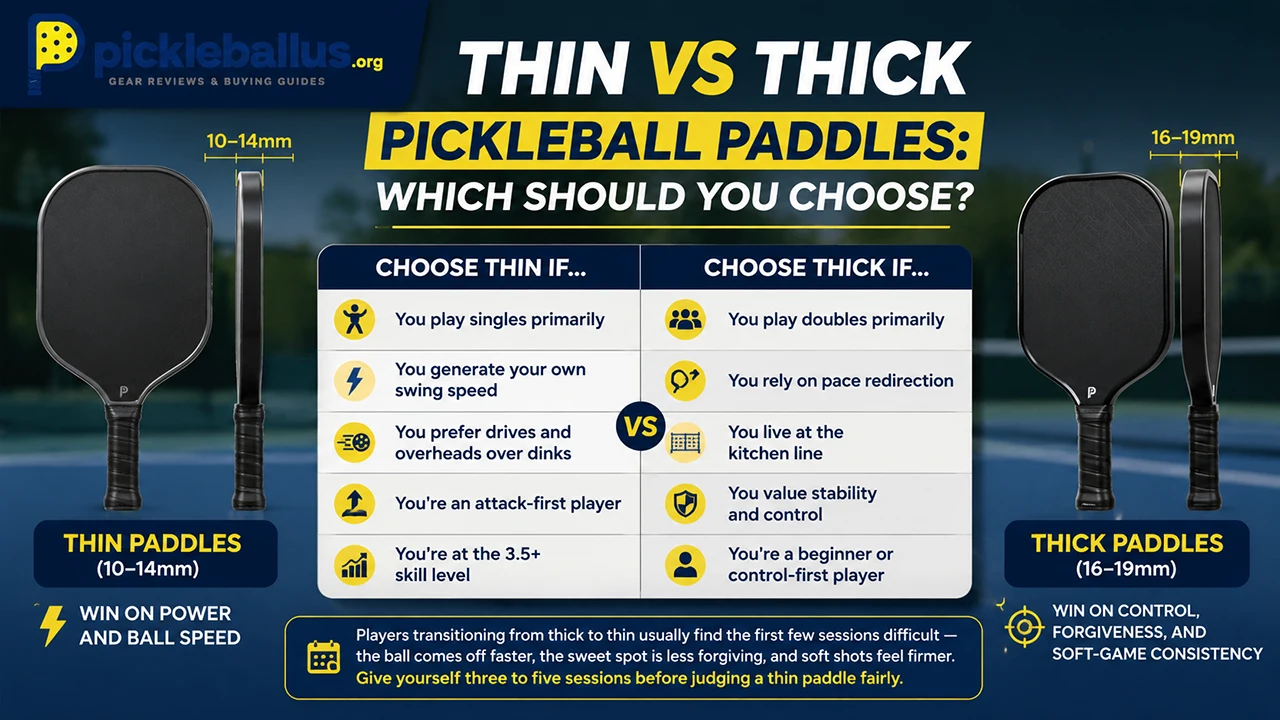
Thin paddles (10–14mm) win on power and ball speed; thick paddles (16–19mm) win on control, forgiveness, and soft-game consistency. Neither is superior — the right choice depends on how you play.
Here’s the practical decision framework:
| Choose thin if… | Choose thick if… |
|---|---|
| You play singles primarily | You play doubles primarily |
| You generate your own swing speed | You rely on pace redirection |
| You prefer drives and overheads over dinks | You live at the kitchen line |
| You’re an attack-first player | You value stability and control |
| You’re at the 3.5+ skill level | You’re a beginner or control-first player |
Players transitioning from thick to thin usually find the first few sessions difficult — the ball comes off faster, the sweet spot is less forgiving, and soft shots feel firmer. Give yourself three to five sessions before judging a thin paddle fairly.
To compare options across all core thicknesses, the best pickleball paddles overview covers every thickness tier. The best 14mm pickleball paddles and best 16mm pickleball paddles comparison pages are useful for narrowing the decision by specific core depth.
Who Should Use a Thin Pickleball Paddle?
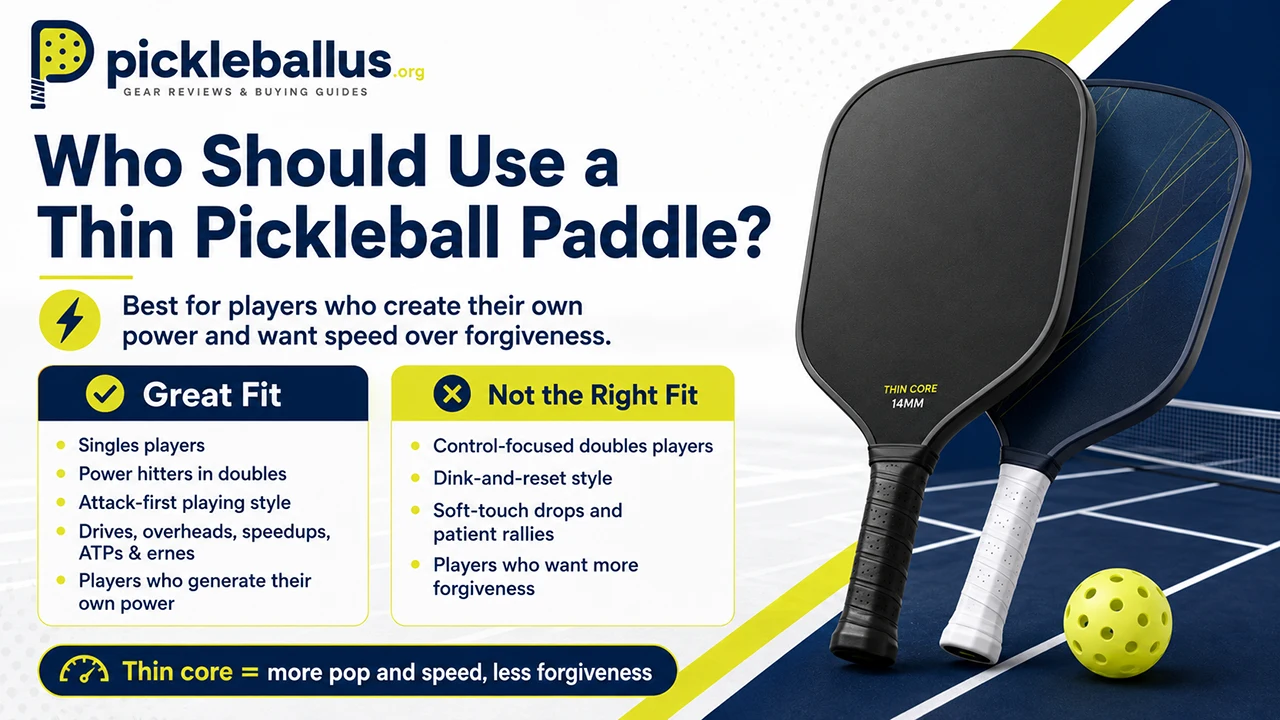
Thin pickleball paddles suit players who generate their own power and value speed over forgiveness — specifically, those who prefer an attacking, pace-setting style over a reactive, defensive one.
Great Fit: Singles Players and Power Hitters
Singles play rewards players who drive balls past opponents and finish points quickly. The extra ball speed from a thin core is directly useful in those situations. Players who hit hard overheads, strong third-shot drives, and aggressive transition zone speedups will feel the benefit of that lively pop on almost every swing.
Power hitters in doubles play also benefit, particularly those who prefer to end rallies at the net rather than reset and wait. If your game involves a lot of ATP shots, erne attempts, and off-speed speedups from the kitchen, a thin paddle rewards that aggressive style.
Not the Right Fit: Control-Focused Doubles Players
If your doubles game centers on dinking patience, consistent resets from the transition zone, and soft-touch drops off the bounce, a thin paddle will work against you. The firmer response off soft contact makes it harder to keep the ball low over the net, and the smaller sweet spot punishes the lateral dinks and reset blocks that control-first doubles players hit constantly.
By now, you have a clear picture of which thin pickleball paddles perform best across seven different use cases, and how to match core thickness to your style of play. Choosing the right thin paddle, however, is only half the decision — the other half is knowing how to get the most out of one, and how to recognize when the construction details under the spec sheet actually matter for your specific game. The next section covers the finer points that separate players who thrive with thin paddles from those who plateau after switching.
What Experienced Thin-Paddle Players Know That Beginners Don’t
Thin paddles have a steeper learning curve than thick ones, and players who perform well with them tend to know a few things that don’t appear in spec sheets.
Surface Texture: Raw Carbon vs Standard Fiber on Thin Cores
Raw carbon fiber surfaces generate more spin than standard fiber or graphite on thin cores, and the combination of a lively 13mm core with a raw carbon face creates a paddle that can be genuinely difficult for opponents to read. The T700 raw carbon surfaces on paddles like the Vatic Pro Prism Flash and Six Zero Double Black Diamond maintain their grit texture longer than painted or coated alternatives — but they do wear over time. If your spin numbers drop noticeably after 40–60 hours of court time, the surface is likely worn and it may be time to rotate paddles or consider a replacement.
How USAPA/UPA Compliance Affects Thin Paddle Selection
USAPA and UPA approval matters if you play in sanctioned tournaments, and some thin paddles — particularly older or heavily modified builds — fall outside current compliance standards. Since 2025, the UPA-A’s Power Evaluation Factor (PEF) standard has become more relevant for competitive play. Every paddle on this list meets current approval standards, but always verify against the USAPA approved paddle list before purchasing for tournament use, as approvals can change when manufacturers update surface treatments.
When to Upgrade from a Thin Paddle
Thin paddles are not beginner equipment. If you find yourself consistently shanking balls off the edge, spraying drives wide, or losing control of dinks at the kitchen, your paddle isn’t the problem — your fundamentals still need development. Thick paddles are forgiving by design; thin paddles demand technical accuracy and reward those who have it. A useful rule: if you’re not placing the ball consistently at the 3.0 or 3.5 skill level, spend more time with a thick paddle before making the switch.
Write Your Review
No reviews yet. Be the first to share your experience!