

The 8 best pickleball paddles for tennis players in 2026 are the Engage Pursuit Pro1 Innovation (best overall), the JOOLA Agassi Pro 16mm (best tennis-inspired feel), the JOOLA Perseus Pro IV 16mm (best for competitive play), the Selkirk LUXX Control Air Invikta (best for control-first players), the HEAD Radical Pro (best for former HEAD racket players), the Gearbox GX6 (best for power-oriented players), the Paddletek Bantam EX-L Pro (best elongated pick for two-handers), and the Franklin Ben Johns Signature (best budget option for tennis converts).





What sets these eight apart isn’t just marketing — they share a cluster of features that map directly onto what your body already knows: longer heandles that accommodate a two-handed backhand, elongated paddle faces that feel closer to a racket’s hitting area, and raw carbon fiber or textured surfaces that reward the topspin and slice you’ve spent years developing. None of them will make pickleball feel exactly like tennis — and that’s actually the point. The goal is a paddle that shortens the adjustment curve without fighting your muscle memory.
The main challenge for tennis converts isn’t power or spin. It’s control. Tennis players tend to overhit in pickleball, and the paddle you start with can either accelerate that bad habit or help you dial it in. A paddle that’s too stiff and explosive can make the kitchen game feel chaotic; one that’s too soft might feel dead on drives. These eight sit in the right range — controlled enough for the soft game, alive enough for your groundstrokes.
Below, you’ll find full reviews of all eight paddles, followed by a buying guide that matches paddle type to tennis playing style.
What Makes a Pickleball Paddle Right for Tennis Players?
The single most important feature for a tennis player choosing a pickleball paddle is shape — specifically, whether it’s elongated. Elongated paddles run 16.5″ or longer and are narrower (typically 7.5″ wide), mimicking the proportional feel of a racket face far better than standard widebody paddles. The sweet spot sits higher on the face, which suits players whose groundstroke contact point is naturally out in front and slightly elevated. In terms of pickleball paddle materials and construction philosophy, elongated paddles dominate the upper tiers of the pickleball market for a reason — they offer leverage, reach, and a swing arc that feels familiar to anyone who’s ever hit a crosscourt forehand.
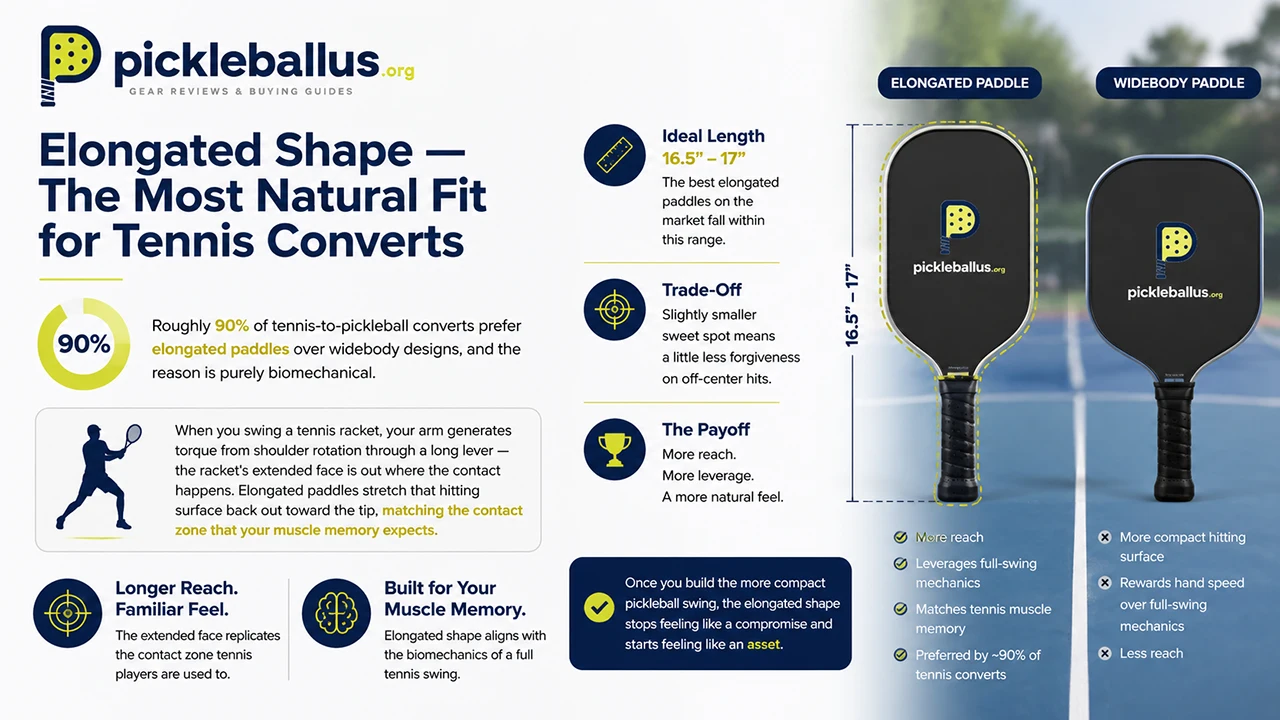
Elongated Shape — The Most Natural Fit for Tennis Converts
Roughly 90% of tennis-to-pickleball converts prefer elongated paddles over widebody designs, and the reason is purely biomechanical. When you swing a tennis racket, your arm generates torque from shoulder rotation through a long lever — the racket’s extended face is out where the contact happens. Widebody pickleball paddles concentrate most of the hitting surface in a compact, wide area that rewards hand speed over full-swing mechanics. Elongated paddles stretch that hitting surface back out toward the tip, matching the contact zone that your muscle memory expects.
The best elongated pickleball paddles in the current market sit between 16.5″ and 17″ in total length. They typically sacrifice a little forgiveness on off-center hits compared to widebody paddles — the sweet spot is slightly smaller — but that’s a trade-off most tennis players happily make in exchange for the reach advantage and familiar feel. Once you build the more compact pickleball swing, the elongated shape stops feeling like a compromise and starts feeling like an asset.
Handle Length and Two-Handed Backhand Compatibility
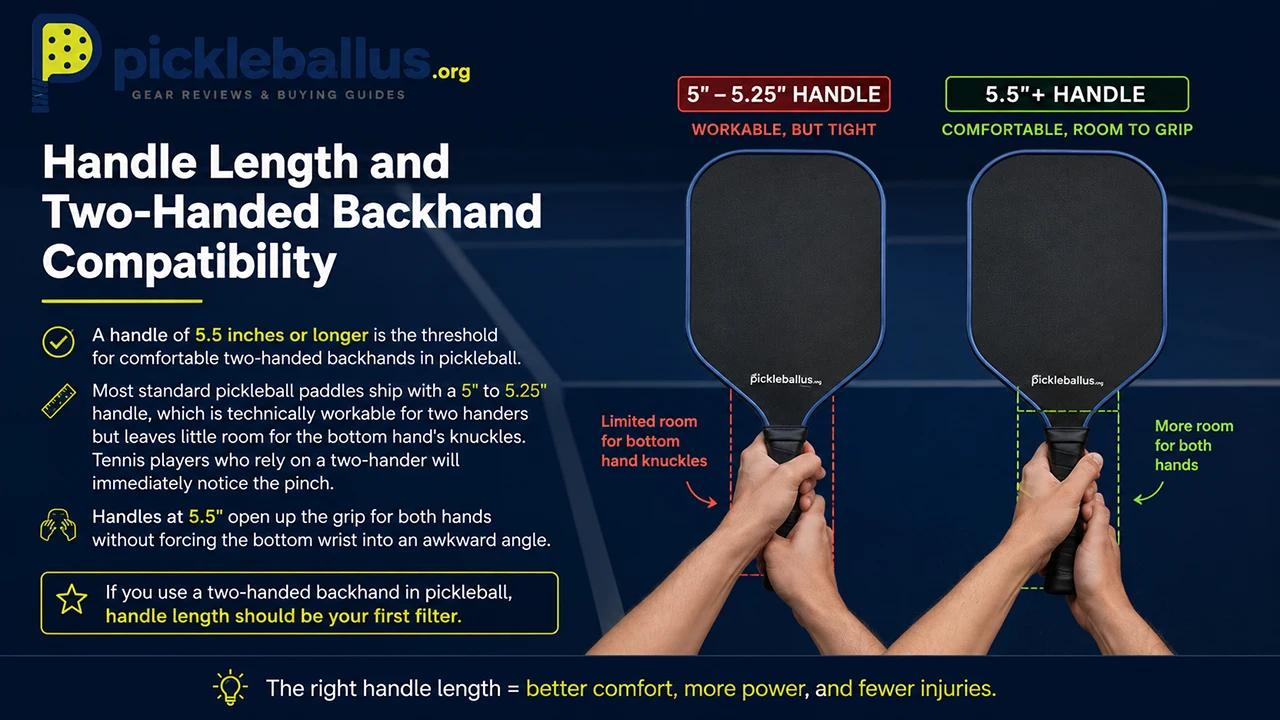
A handle of 5.5 inches or longer is the threshold for comfortable two-handed backhands in pickleball. Most standard pickleball paddles ship with a 5″ to 5.25″ handle, which is technically workable for two handers but leaves little room for the bottom hand’s knuckles. Tennis players who rely on a two-hander will immediately notice the pinch.
Handles at 5.5″ open up the grip for both hands without forcing the bottom wrist into an awkward angle. Several paddles on this list — notably the Engage Pursuit Pro1 (6″), the JOOLA Perseus Pro IV (5.5″), and the Paddletek Bantam EX-L Pro (5.5″) — are built specifically with that length. If you use a two-handed backhand in pickleball, handle length should be your first filter before you look at anything else.
Core Thickness and What It Replaces String Feel With
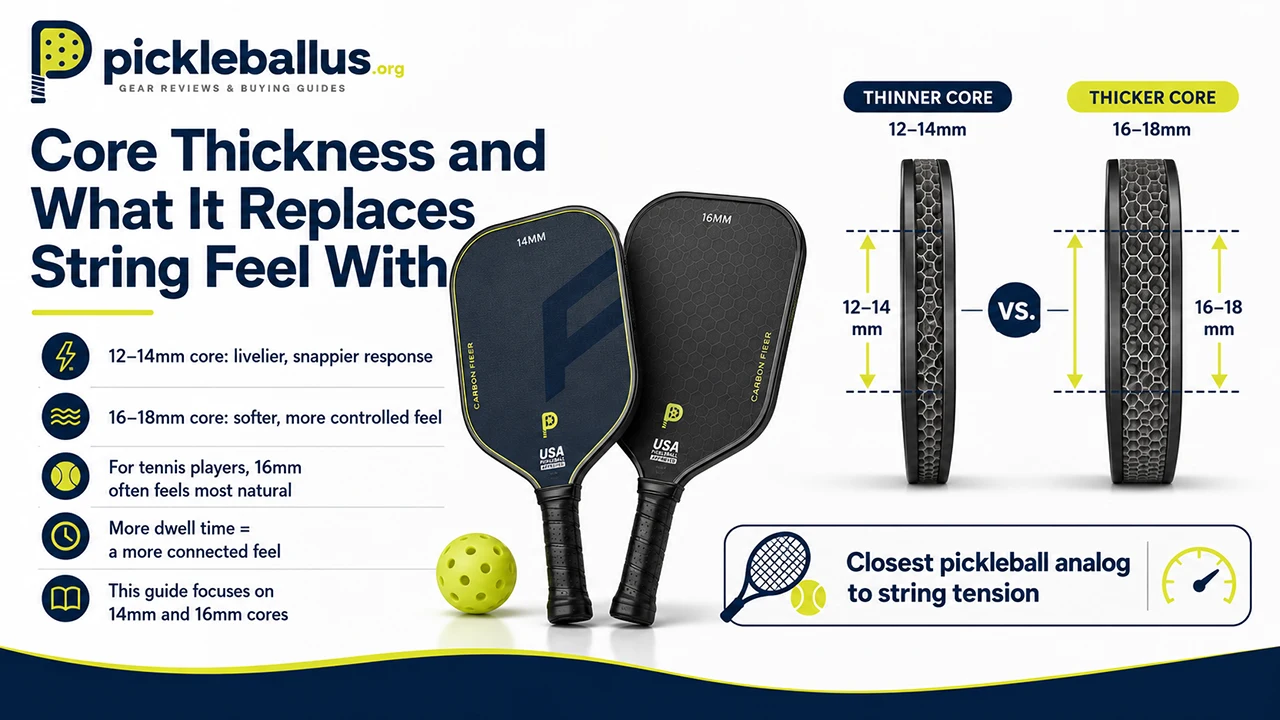
In pickleball, core thickness is the closest analog to string tension — and the relationship runs in the opposite direction from what you’d expect. A thinner core (12–14mm) gives a livelier, snappier response off the face, similar to a stiff, high-tension setup on a racket. A thicker core (16–18mm) absorbs more energy on contact, giving a softer, more controlled feel — closer to a lower-tension setup with a thicker string gauge.
Most tennis players making the switch gravitate toward 16mm cores because the extra dwell time (the fraction of a second the ball stays on the face) feels closest to the “connected” sensation they associate with good ball-striking. Thinner cores can feel harsh and unpredictable until your swing mechanics are fully calibrated for pickleball’s shorter movements. All eight paddles in this guide use a 14mm or 16mm core to keep that feel in an accessible range.
8 Best Pickleball Paddles for Tennis Players in 2026
The following reviews cover every paddle on this list in full. Each pick is actively sold on Amazon, has a strong reviews history, and has been selected for clear tennis-player-specific advantages.
#1 Engage Pursuit Pro1 Innovation — Best Overall for Tennis Players
The Engage Pursuit Pro1 Innovation is the most purpose-built pickleball paddle for tennis players on the market, designed from the ground up by Engage’s founder — a former Division I tennis player who trained at one of Nick Bollettieri’s academies. That pedigree shows up everywhere: in the elongated 16.6″ body, in the 6.0″ handle that makes two-handers effortless, and in the octagonal grip with a tennis-style butt cap that feels like a Wilson or Babolat the moment you pick it up.
Key Specs:
- Dimensions: 16.6″ × 7.4″
- Handle: 6.0″ (longest on this list)
- Core: Power Flex Polymer, 12.7mm
- Face: Raw carbon fiber with next-gen inner layer
- Weight: ~8.0 oz average
Performance Analysis:
The raw carbon fiber face grabs the ball in a way that rewards topspin mechanics — if your forehand still has that full-swing brushing motion from your tennis days, this surface channels it into serious spin production. The Power Flex core offers a slight flexibility compared to rigid thermoformed paddles, which translates into better vibration damping and a softer feel on contact. This is important: many tennis converts find standard rigid-face paddles jarring until they recalibrate their swing compact. The Pursuit Pro1 forgives the first few full-swing habits more graciously than most.
The elongated shape extends reach on groundstrokes and serves exactly as it would on a racket, and the long 6.0″ handle makes quick grip changes between forehand and backhand feel natural — which matters during hand-battle exchanges at the net as your game develops.
Pros:
- Longest handle on this list — ideal for committed two-handers
- Raw carbon face rewards heavy topspin
- Power Flex core softens the adjustment period
- Tennis-style octagonal grip and butt cap feel immediately familiar
- Certified for both USAP and UPA-A pro tour play
Cons:
- 12.7mm core is on the thinner side — more lively than soft
- Higher learning curve for the kitchen game than thicker-core paddles
- Premium price point
Best For: Tennis players who use a two-handed backhand, generate heavy topspin, and want a paddle designed specifically for their background.
My Verdict: If you’re a tennis player who wants the shortest possible transition path and the most familiar feel in your hand, the Pursuit Pro1 is the starting point. It was built for you.
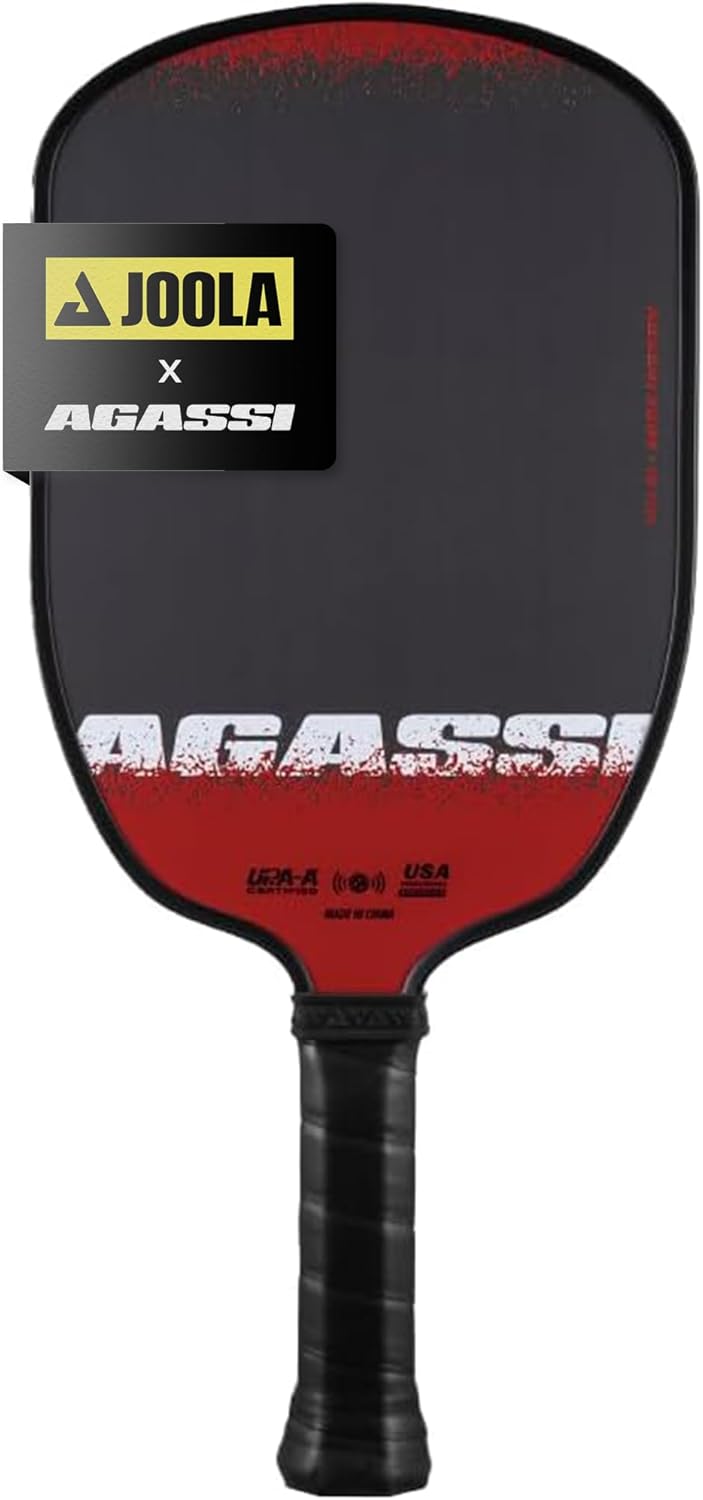
#2 JOOLA Agassi Pro 16mm — Best Tennis-Inspired Feel
The JOOLA Agassi Pro 16mm carries the DNA of Andre Agassi’s baseline game in a pickleball paddle — and if you grew up watching Agassi demolish opponents from the back of the court, that’s not a bad starting point. The paddle’s most distinctive feature is the throat weighting, which adds mass low on the paddle face (just above the handle) to stabilize the paddle during fast swings and blocking situations that would destabilize lighter paddles.
Key Specs:
- Core: 16mm JOOLA Tech-Flex Power
- Face: Textured carbon fiber
- Handle: 5.5″
- Additional tech: Hyperfoam Edge Wall (expanded sweet spot)
- Weight: ~8.1 oz
Performance Analysis:
The 16mm core delivers a soft, connected feel with strong dwell time — this is the paddle on this list most likely to feel like what tennis players describe as “a well-strung racket.” The Hyperfoam Edge Wall technology expands the effective sweet spot by adding foam inside the edge guard frame, which means off-center hits near the rail feel cleaner than they would on most paddles. That’s a genuine benefit for tennis converts who are still calibrating the smaller swing mechanics.
The 5.5″ handle is long enough for two-handed backhands without feeling excessive, and the textured carbon fiber face generates strong spin while staying controllable during soft game exchanges. JOOLA’s Agassi Pro is one of the few paddles where the “designed in partnership with a tennis legend” marketing claim actually informs the on-court performance.
Pros:
- 16mm core gives the most racket-like feel on this list
- Throat weighting stabilizes fast exchanges and blocks
- Hyperfoam Edge Wall forgives off-center contact
- Strong topspin capability from textured carbon
- 5.5″ handle suits two-handers
Cons:
- Slightly heavier — 8.1 oz requires adjustment after light rackets
- Less pop than thinner-core alternatives on drives
Best For: Tennis baseliners who want maximum dwell time and a familiar, planted feel — especially players coming from a heavy topspin background.
My Verdict: The Agassi Pro is the best paddle on this list for replicating the “connected” sensation of a well-strung tennis racket. If soft feel and string-bed imitation matter to you, start here.
#3 JOOLA Perseus Pro IV 16mm — Best for Competitive Tennis Players
The JOOLA Perseus Pro IV 16mm is a tour-level all-court paddle that happens to check every box for a tennis player who wants to compete seriously in pickleball rather than just play recreationally. This is Ben Johns’ pro paddle — which means it’s tuned for someone who generates elite spin on drives, can execute two-handed counters at speed, and plays an aggressive all-court game that cycles rapidly between offense and soft game.
Key Specs:
- Dimensions: 16.5″ × 7.5″
- Handle: 5.5″
- Core: 16mm JOOLA Propulsion Core
- Face: Textured carbon fiber (Tech Flex – Power design)
- Weight: ~8.1 oz
- Additional tech: Foam outside frame (expanded sweet spot + pop)
Performance Analysis:
The Perseus Pro IV sits at the more explosive end of the 16mm core spectrum — it has genuine pop on drives while the 16mm thickness keeps the kitchen game manageable. The extra foam under the edge guard extends the sweet spot outward so that shots hit near the rail still travel true. Tennis players who hit with pace off both wings will find this paddle matches their natural stroke velocity without sending every ball long.
The elongated 16.5″ body and 5.5″ handle are well-proportioned for two-handed backhands, and the paddle’s weight distribution leans slightly head-heavy — which gives drives good momentum but requires your net reflexes to be sharp during hand exchanges. As your pickleball skill grows, the Perseus Pro IV rewards rather than limits you.
Pros:
- Tour-pedigree construction at a competitive price point
- 16mm core balances power and control well
- Extra foam in edge guard maximizes sweet spot
- Ideal length and handle for two-handed backhands
- Strong topspin ceiling for aggressive groundstroke games
Cons:
- Slight head-heavy feel can slow hands during fast net exchanges
- Premium price bracket
- Best utilized once you have basic pickleball mechanics down
Best For: Competitive tennis players (3.5+ equivalent) who want a paddle that keeps pace with their skill development and won’t need replacing in 6 months.
My Verdict: If you’re playing pickleball seriously and want the same paddle that tournament-level players use, the Perseus Pro IV is the pick. Don’t let the Ben Johns branding mislead you — this paddle earns its reputation on court.
#4 Selkirk LUXX Control Air Invikta — Best for Control-First Tennis Players
The Selkirk LUXX Control Air Invikta is for the tennis player whose game was built on placement, not power — the counter-puncher, the slice specialist, the player who won matches at 4.0 in tennis by keeping the ball deep and forcing errors. The Invikta shape is Selkirk’s elongated body, longer than standard, and the Air Dynamic Core reduces weight at the paddle face while maintaining structural stability — which means faster hand speed with less arm fatigue.
Key Specs:
- Shape: Invikta (elongated)
- Core: Air Dynamic (lightweight + control-oriented)
- Face: T700 carbon fiber
- Handle: 5.5″
- Weight: ~7.6–7.9 oz
Performance Analysis:
The Invikta’s lighter feel makes it one of the more maneuverable elongated paddles in this class. Where the Perseus Pro IV rewards power and the Agassi Pro rewards dwell time, the LUXX Control Air is optimized for touch — for the dinks, resets, and half-volleys that make up a large percentage of high-level pickleball. Tennis players who underestimate how much the soft game matters in pickleball will find this paddle accelerates their learning curve at the net.
Selkirk’s T700 carbon fiber face still generates solid spin — you won’t be giving anything up on groundstrokes — but the paddle’s identity is control first. For best pickleball paddles for spin production at a tour level, the Engage or Perseus edges it out; for touch and placement, the Invikta is ahead.
Pros:
- Lighter weight improves maneuverability and reduces fatigue
- Invikta shape delivers elongated reach with a forgiving face
- Control-optimized construction accelerates the soft game
- Solid spin from T700 carbon face
- Selkirk’s build quality is among the best in the industry
Cons:
- Less raw power than the Perseus Pro IV or Engage Pursuit Pro1
- Lighter feel may not satisfy players who want racket-like heft
Best For: Tennis players who won rallies through control and consistency rather than pace — or any player who wants to fast-track their dinking and reset game.
My Verdict: The LUXX Control Air Invikta is the right pick if your tennis identity was “never miss” rather than “big forehand.” The soft game in pickleball rewards your instincts more than any other paddle on this list.
#5 HEAD Radical Pro — Best for Former HEAD Racket Players
The HEAD Radical Pro is the most accessible choice on this list for tennis players who aren’t sure how seriously they’ll take pickleball — and for anyone who’s played with a Radical or Extreme racket, the brand familiarity alone eliminates one adjustment variable from the transition. HEAD applies its tennis racket engineering knowledge directly to this paddle, and the result is a well-balanced, forgiving option that won’t punish imperfect mechanics.
Key Specs:
- Face: Fiberglass composite
- Core: Polymer honeycomb
- Handle: 5.0″
- Weight: ~8.0–8.5 oz
- Shape: Elongated
Performance Analysis:
The fiberglass face gives a slightly softer, more forgiving contact feel than carbon fiber — less spin ceiling, but more margin for error on off-center hits. This is the best characteristic of the HEAD Radical Pro for tennis converts who are still finding the pickleball contact point: shots that miss the sweet spot by half an inch don’t punish you the way they would on a stiffer carbon face.
The 5.0″ handle is on the shorter side for committed two-handers but works well for one-handed players or those who grip down slightly. The polymer core sits in a standard range that produces consistent dwell time without extreme softness or explosive stiffness. HEAD’s build quality is reliable, and the paddle sits at a mid-range price point that makes it easy to justify as a first serious paddle before committing to premium alternatives.
Pros:
- Fiberglass face is more forgiving than carbon on off-center hits
- Familiar HEAD branding reduces psychological adjustment
- Balanced weight suits both baseliners and net players
- Accessible price point for uncertain converts
- Durable build quality
Cons:
- Lower spin ceiling than raw carbon fiber alternatives
- 5.0″ handle limits two-handed backhand comfort
- Less differentiated at higher skill levels
Best For: Former HEAD racket players or tennis converts who want a reliable, no-drama first paddle before deciding how deeply to invest in pickleball.
My Verdict: The HEAD Radical Pro is the logical entry point if you want something that feels familiar without committing to a premium price. Upgrade when your pickleball game catches up to the paddle’s ceiling.
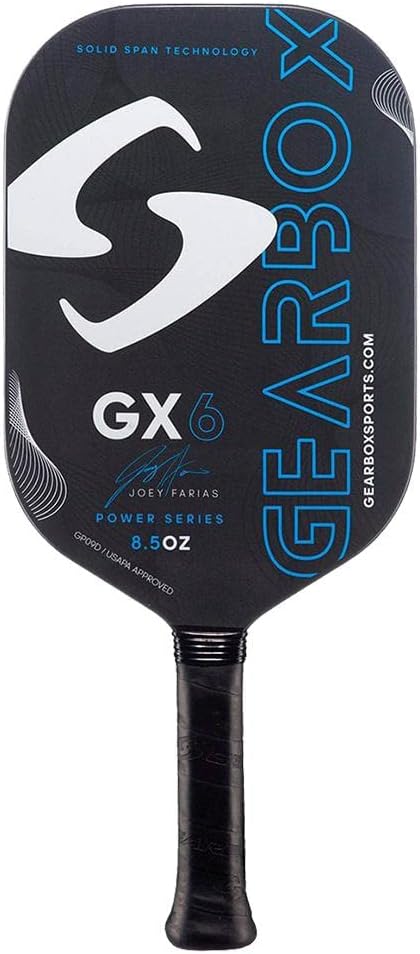
#6 Gearbox GX6 — Best for Power-Oriented Tennis Players
The Gearbox GX6 is the power option on this list — built for the tennis player whose game was built on heavy drives and aggressive counterattacks from the baseline. Gearbox’s patented SST (Solid Span Technology) core and PowerBand technology create a fast, lively rebound off the face that pushes right up against the legal power limits, which translates directly to the type of forceful groundstrokes that felt natural on a tennis court.
Key Specs:
- Core: Gearbox SST Core (proprietary suspended solid-span design)
- Face: Carbon fiber
- Tech: PowerBand frame technology
- Shape: Elongated
- Edgeless design
Performance Analysis:
The SST core’s suspended construction isolates the paddle face from the frame at specific contact points, which concentrates rebound energy more efficiently than conventional cores. The practical result: drives jump off the face with more pace for the same swing speed. For tennis players still calibrating to pickleball’s shorter swing arc, this means you can generate your normal pace with a slightly more compact motion — which is exactly what you need in the transition period.
The edgeless design eliminates the hard plastic edge guard that causes most frame chip-outs on mishits near the rail. For best pickleball paddles for power with durability, the edgeless construction gives the GX6 an advantage over paddles where the edge guard is the first casualty of aggressive play.
Pros:
- SST core + PowerBand produces maximum legal power
- Edgeless frame improves durability on off-center rim shots
- Elongated shape extends reach for groundstrokes
- Fast rebound helps aggressive tennis-style attackers
- Gearbox has strong customer support and warranty
Cons:
- High power can make the kitchen game and resets more difficult
- Less dwell time than 16mm soft-core alternatives
- Higher learning curve for players new to edgeless paddles
Best For: Baseline-heavy tennis players who drive the ball hard and want a paddle that matches their natural aggression without feeling like it’s working against them.
My Verdict: The Gearbox GX6 is for the player who still wants to hit through the ball. If your tennis game was built on pace and your pickleball instinct is to punish every short ball, this paddle backs you up.
#7 Paddletek Bantam EX-L Pro — Best Elongated Pick for Two-Handers
The Paddletek Bantam EX-L Pro is a long-standing benchmark for tennis players who use a two-handed backhand and need both handle length and a stable elongated body to execute it comfortably in pickleball. “EX-L” stands for Extra-Long — the paddle face extends further than most elongated paddles, giving maximum reach and a contact zone that maps better onto two-handed backhand mechanics than any short-handle alternative.
Key Specs:
- Shape: Extra-Long Elongated (16.5″+ body)
- Core: Bantam polymer (textured)
- Handle: 5.5″
- Face: Textured composite
- Weight: ~7.7–8.0 oz
- Low vibration design
Performance Analysis:
Paddletek’s approach to vibration reduction gives the Bantam EX-L Pro a distinctly smooth feel on contact — the kind that reduces arm fatigue on a long session and keeps your elbow happy during the wrist-snapping exchanges that happen at the kitchen line. Tennis players who are arriving on the pickleball court already nursing some nagging arm issues from years of tennis will appreciate this design choice significantly.
The elongated body and 5.5″ handle work together to support natural two-hander mechanics, and the polymer core sits in a controlled range — not explosive, not dead. The best pickleball paddles in the mid-power, high-stability category often get compared to the Bantam EX-L Pro as a benchmark, which tells you something about its durability in a market that refreshes rapidly.
Pros:
- Extra-long body maximizes reach and two-handed backhand mechanics
- Low vibration design reduces arm fatigue on long sessions
- 5.5″ handle is generous for two-handers
- Polymer core is consistent and predictable across sessions
- Paddletek’s quality control is among the most consistent in the industry
Cons:
- Less raw spin than raw carbon fiber face alternatives
- Extra length reduces quick maneuverability during fast hand battles
- Not the best choice if you play an aggressive net game
Best For: Tennis players with a strong two-handed backhand who want stability, reach, and low vibration over maximum spin or power.
My Verdict: If the two-handed backhand is a core part of your identity on court, the Bantam EX-L Pro gives you the architecture to maintain that shot in pickleball without compromise.
#8 Franklin Ben Johns Signature — Best Budget Pick for Tennis Converts
The Franklin Ben Johns Signature is the best entry-level paddle on this list for tennis converts who aren’t ready to commit to a premium price — and at a mid-range price point, it punches above its category with a raw carbon fiber face that was rare at this price even two years ago. Ben Johns has pushed Franklin’s construction specs upward with each signature iteration, and the current version is a legitimate performer rather than a branding exercise.
Key Specs:
- Face: Raw carbon fiber (textured)
- Core: Polymer honeycomb
- Handle: 5.0″
- Shape: Standard-to-hybrid (slightly elongated)
- Weight: ~7.5–8.0 oz
Performance Analysis:
The raw carbon fiber face is the headline feature — it generates more spin than fiberglass or standard graphite alternatives at this price, which is a direct benefit for tennis players whose groundstroke mechanics rely on brushing up the ball. The polymer core is soft enough to provide decent dwell time without feeling muted, and the overall weight sits in a comfortable range for extended sessions.
The 5.0″ handle is the main limitation for dedicated two-handers, but players who use a one-handed backhand or are transitioning from a continental grip game will find it workable. As a first paddle for a tennis player entering pickleball without a large gear budget, the Franklin Ben Johns Signature delivers genuine performance that won’t hold back a 3.0–3.5 player.
Pros:
- Raw carbon fiber face at an accessible price point
- Good spin for the money
- Light enough for long sessions
- Ben Johns-tuned construction standards
- Available widely on Amazon with strong buyer reviews
Cons:
- 5.0″ handle limits two-handed backhand comfort
- Less power ceiling than premium alternatives
- Not a long-term paddle for players above 4.0
Best For: Tennis converts on a budget who want a raw carbon face and genuine playability without the premium price commitment.
My Verdict: Start here if budget matters and upgrade once you know exactly which premium paddle characteristics your pickleball game needs.
Power Paddle vs. Control Paddle — Which Suits Your Tennis Style?
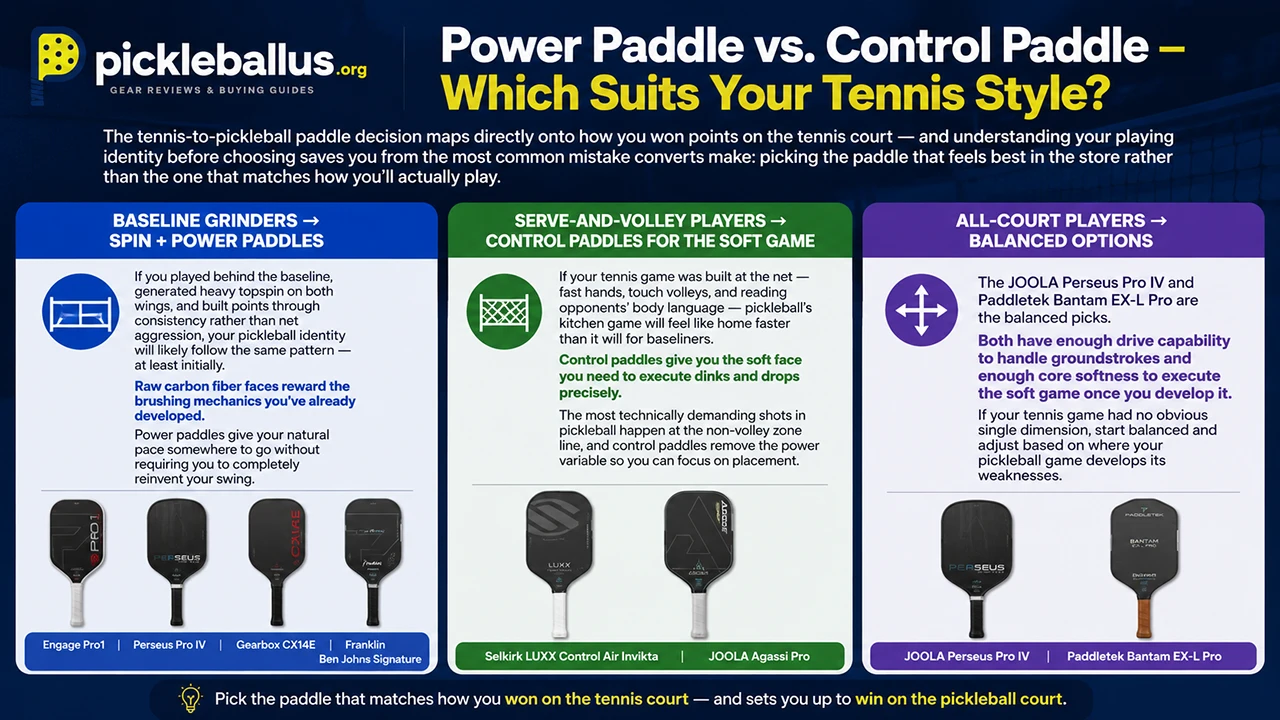
The tennis-to-pickleball paddle decision maps directly onto how you won points on the tennis court — and understanding your playing identity before choosing saves you from the most common mistake converts make: picking the paddle that feels best in the store rather than the one that matches how you’ll actually play.
Baseline Grinders → Spin + Power Paddles
If you played behind the baseline, generated heavy topspin on both wings, and built points through consistency rather than net aggression, your pickleball identity will likely follow the same pattern — at least initially. Raw carbon fiber faces (Engage Pro1, Perseus Pro IV, Gearbox GX6, Franklin Ben Johns Signature) reward the brushing mechanics you’ve already developed. Power paddles give your natural pace somewhere to go without requiring you to completely reinvent your swing.
Serve-and-Volley Players → Control Paddles for the Soft Game
If your tennis game was built at the net — fast hands, touch volleys, and reading opponents’ body language — pickleball’s kitchen game will feel like home faster than it will for baseliners. Control paddles (Selkirk LUXX Control Air Invikta, JOOLA Agassi Pro) give you the soft face you need to execute dinks and drops precisely. The most technically demanding shots in pickleball happen at the non-volley zone line, and control paddles remove the power variable so you can focus on placement.
All-Court Players → Balanced Options
The JOOLA Perseus Pro IV and Paddletek Bantam EX-L Pro are the balanced picks. Both have enough drive capability to handle groundstrokes and enough core softness to execute the soft game once you develop it. If your tennis game had no obvious single dimension, start balanced and adjust based on where your pickleball game develops its weaknesses.
Do Your Tennis Skills Transfer Directly to Pickleball?
Yes — more than most people tell you, but not as completely as you might hope. Tennis skills provide a significant head start in pickleball, and the research on motor learning supports the idea that similar biomechanical patterns from one sport transfer meaningfully to another. The details, however, matter.
What Transfers Right Away — Spin, Footwork, Reaction Speed
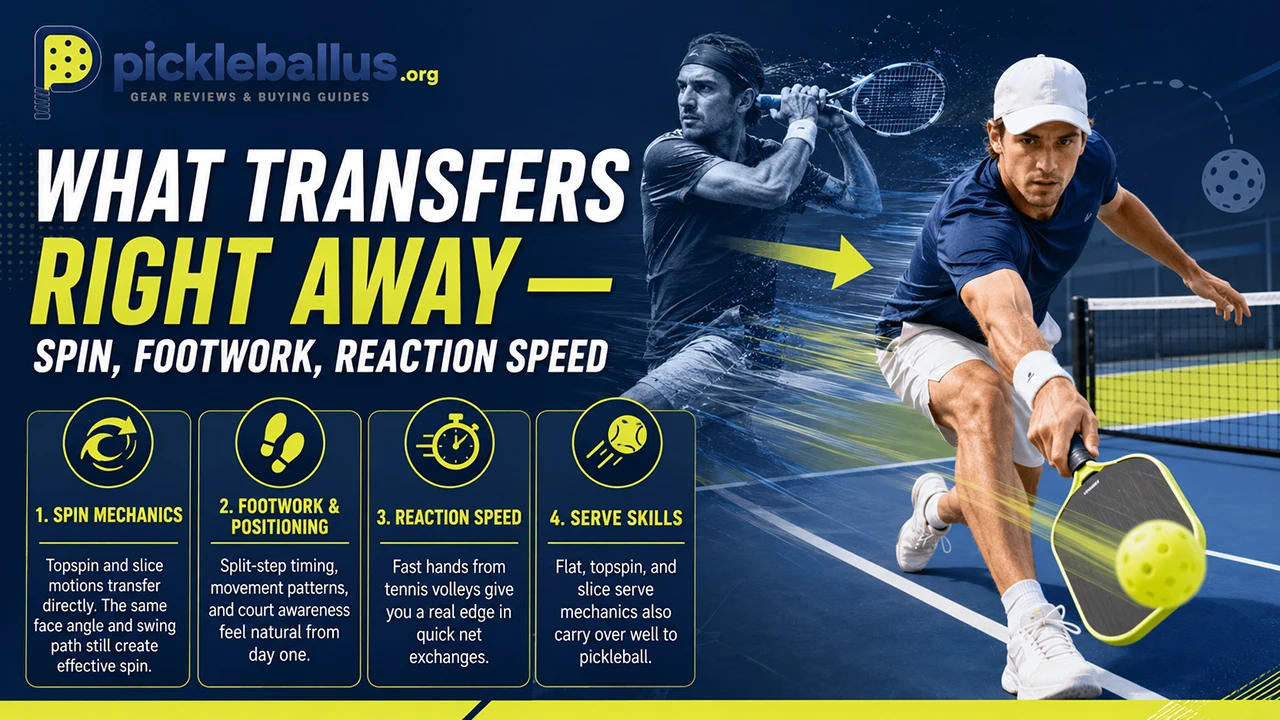
Topspin mechanics, slice instincts, footwork patterns, court positioning awareness, and reaction time all transfer directly from tennis to pickleball. The brushing motion of a topspin forehand or the chopping action of a backhand slice are essentially the same biomechanical movements — the paddle face angle and swing path work on the same physical principles. Your pickleball vs tennis footwork instincts will feel natural from day one, and your reaction speed at the net — developed over years of reflex volleys — gives you a substantial advantage in hand-battle exchanges.
Serve mechanics also translate well. The same swing path that generates kick serve topspin on a tennis court produces effective topspin serves in pickleball, and the variety of your serve (flat, kick, slice) gives you more options than most beginners who arrive without a racket background.
The Hardest Unlearn: Taking Full Swings Near the Net
The kitchen game is where tennis players struggle most, and it happens because of muscle memory, not lack of skill. In tennis, a ball rising above the net at close range is an opportunity to attack — put away a high volley, drive a short ball, close the net and finish. In pickleball, the same ball near the non-volley zone demands a dink or a reset, not a drive. Your body has been trained for decades to attack that ball. Suppressing that instinct takes deliberate practice.
The dink — a soft shot that barely clears the net and drops into the kitchen — has no real equivalent in tennis. Developing the touch and patience to sustain dink rallies at the kitchen line is the single biggest adjustment for every tennis convert, regardless of their skill level. Start practicing it in your first session, and consider it the core of your pickleball development work.
By this point, you have a clear map of which paddle shapes, handle lengths, and core specs align with your tennis background — and which of these eight picks best matches your style on court. Choosing the right paddle is only the first step of the transition, though; understanding how tennis habits can work against you in specific pickleball situations will save you weeks of frustration. The next section covers the less obvious details that separate tennis converts who plateau at 3.5 from those who climb to 4.0 and beyond.
Beyond the Paddle — What Tennis Players Need to Know
Tennis Elbow in Pickleball — Paddle Specs That Protect Your Arm
Tennis elbow is more common in pickleball than most converts expect, and the reason is counterintuitive: pickleball’s shorter swing arc concentrates the impact stress of repetitive hitting into a smaller range of wrist and forearm motion. Tennis players who are accustomed to distributing that stress across a full-swing arc find themselves hitting three times as many shots per hour in a pickleball session, all with a more compact motion.
Paddle specs directly influence this. Thicker cores (16–18mm) absorb more vibration than thin cores, and edgeless designs reduce the jarring sensation of off-center rim hits. If you start noticing lateral forearm discomfort early in your pickleball career, consider one of the best pickleball paddles for tennis elbow before the issue compounds. The Paddletek Bantam EX-L Pro’s low-vibration construction and the JOOLA Agassi Pro’s 16mm core are both worth prioritizing if arm health is already on your radar.
The Soft Game: Dinking, Drops, and Third-Shot Resets
No part of pickleball is less intuitive for tennis players than the soft game. A dink is a shot hit from near the kitchen line that arcs barely above the net and lands in the opponent’s non-volley zone — ideally at their feet. It has no counterpart in tennis. A third-shot drop neutralizes an opponent’s advantage after their return by sending the ball on a high arc into the kitchen, forcing them to lift rather than drive. Again, no tennis equivalent.
The fastest way to improve these shots is to start drilling them before you try playing full games. Tennis converts who jump straight into competitive play spend the first several months getting punished at the kitchen line for hitting attackable balls. Practice your drops and dinks as standalone drills — 20 minutes before your first match session — and your climb through the rating tiers will be measurably faster.
Pickleball vs Tennis: Courts, Scoring, and Strategy Differences
The structural differences between the two sports affect strategy more than most converts anticipate. Pickleball courts are roughly a quarter of a doubles tennis court in total area, which compresses the game into far shorter exchanges. Scoring runs to 11 (win by 2) rather than the game/set/match structure in tennis, and you can only score points on your own serve. For a full breakdown of how the two sports compare structurally and tactically, see our guide on pickleball vs tennis.
One practical implication: in tennis, aggressive positioning wins points through pace and angles across a large court. In pickleball, aggressive positioning at the kitchen line wins points through hand speed and placement over a short court. Your net instincts will serve you well once you recalibrate the distance — the adjustment is smaller than it looks from the baseline.
Write Your Review
No reviews yet. Be the first to share your experience!