

The best pickleball paddles for tennis elbow are the Engage Pursuit Pro1 Hybrid (best overall for elbow relief), the JOOLA Agassi Pro (best for aggressive bangers), the Vatic Pro PRISM Flash (best budget pick), the PROKENNEX Ovation Speed II (best kinetic vibration absorption), the Selkirk SLK Halo Control XL (best lightweight option), the Paddletek Bantam EX-L PRO (best for soft game players), and the HEAD Radical Series (best for former tennis players transitioning to pickleball).



Every paddle on this list was selected with three criteria in mind: vibration dampening, swing weight, and grip comfort — the trio of specs most directly linked to lateral epicondylitis flare-ups. Getting any one of these wrong can turn a manageable elbow into a six-week recovery. Getting all three right keeps you on the court.
The condition most players call “pickleball elbow” sits on the outside of your arm, where the extensor tendons attach to the bone. It shows up as a burning ache that starts mid-session and gets sharper every time you drive a ball or load a backhand. The frustrating part: the pain is often from your paddle as much as your technique.
Below, you’ll find a breakdown of why tennis elbow develops in pickleball, the paddle specs that make the biggest difference, and a full review of each of the seven arm-friendly paddles worth your money in 2026.
What Causes Tennis Elbow in Pickleball?
Tennis elbow, or lateral epicondylitis, develops when repetitive stress inflames the extensor tendons that attach to the outside of your elbow — and pickleball’s fast, wrist-intensive rallies are one of the most efficient ways to load those tendons. Three mechanics drive the condition in pickleball players specifically.
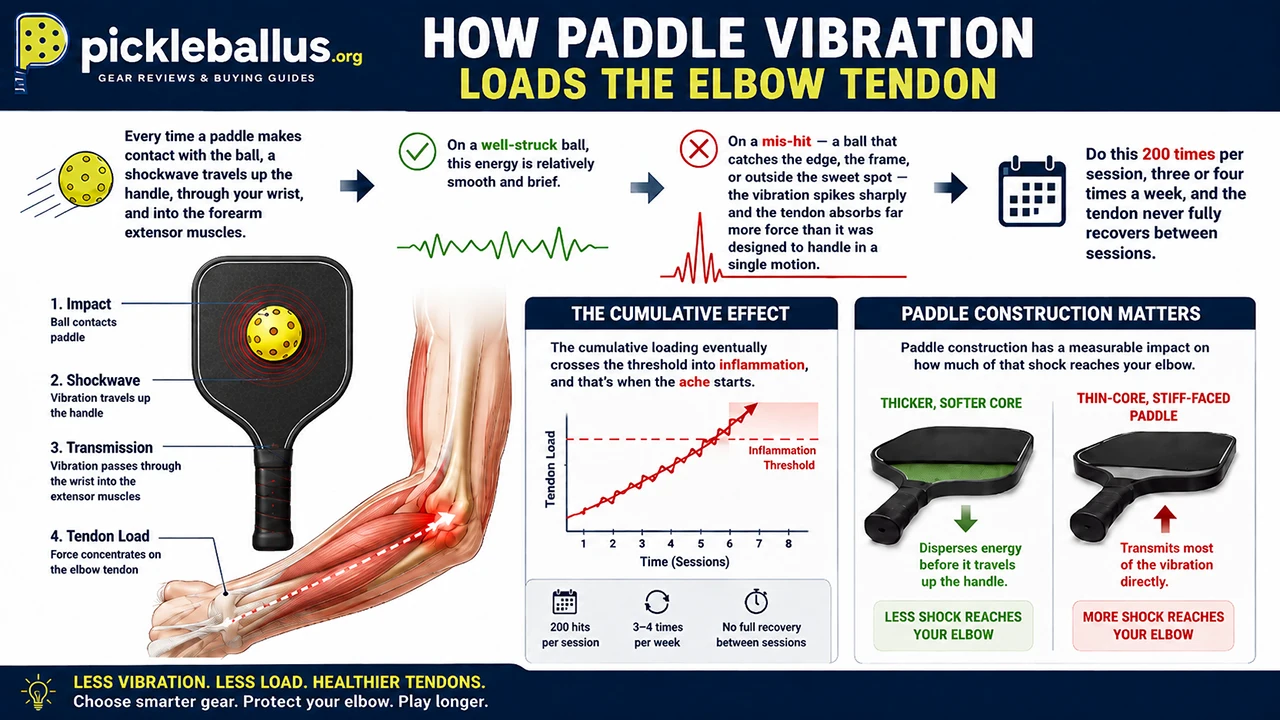
How Paddle Vibration Loads the Elbow Tendon
Every time a paddle makes contact with the ball, a shockwave travels up the handle, through your wrist, and into the forearm extensor muscles. On a well-struck ball, this energy is relatively smooth and brief. On a mis-hit — a ball that catches the edge, the frame, or outside the sweet spot — the vibration spikes sharply and the tendon absorbs far more force than it was designed to handle in a single motion.
Do this 200 times per session, three or four times a week, and the tendon never fully recovers between sessions. The cumulative loading eventually crosses the threshold into inflammation, and that’s when the ache starts. Paddle construction has a measurable impact on how much of that shock reaches your elbow. A paddle with a thicker, softer core disperses the energy before it travels up the handle. A thin-core, stiff-faced paddle transmits most of it directly.
Three Playing Habits That Make It Worse
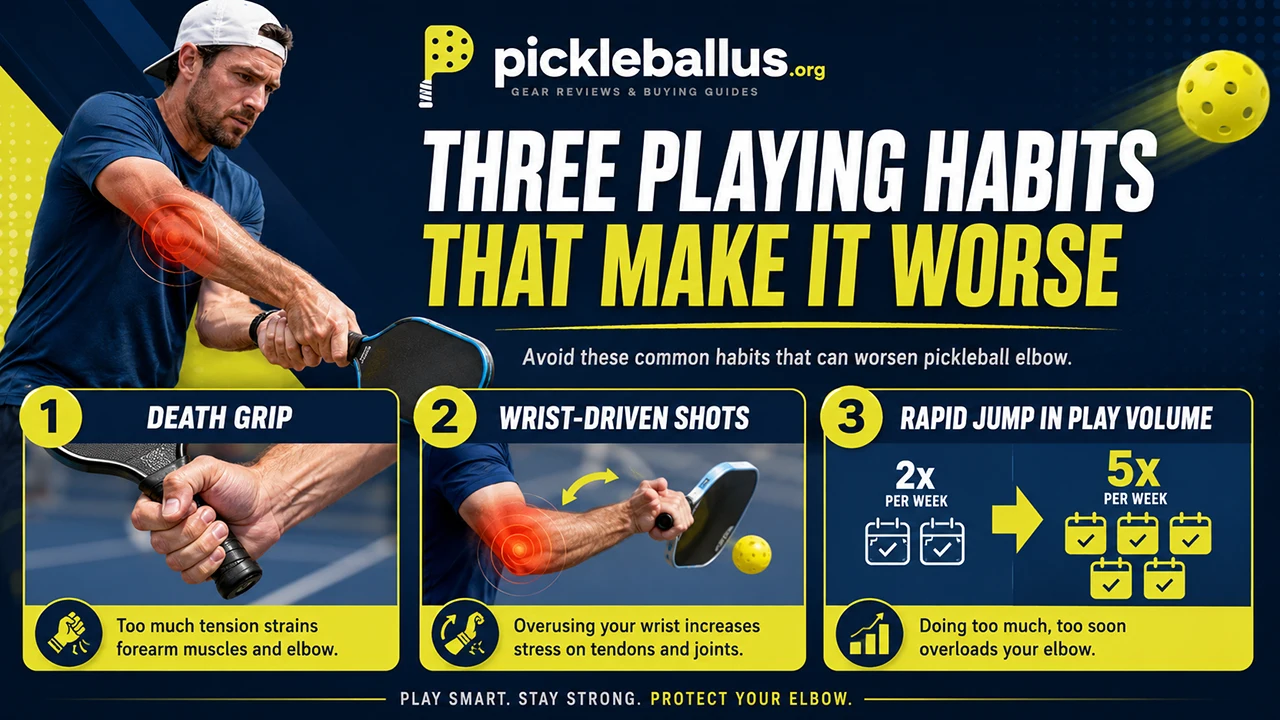
The paddle is a significant variable, but habit compounds the problem faster than any gear choice. Three playing patterns account for most pickleball elbow cases that aren’t purely overuse:
First, the death grip — squeezing the paddle at a tension of 8 or 9 out of 10 instead of a relaxed 4. A tight grip pre-loads the extensor muscles so that every shot fires them from a position of tension. The vibration then travels through a taut muscle-tendon system instead of a relaxed one. Second, wrist-driven shots: using the wrist as the primary power source rather than the shoulder and torso. The wrist can generate pace, but it places extensor tendons under load at the most vulnerable part of the swing arc. Third, a rapid jump in play volume — going from twice a week to five sessions a week in a month gives the tendons no time to adapt, regardless of which paddle you use.
What to Look for in a Paddle When You Have Tennis Elbow
Four paddle specs directly reduce elbow strain: core thickness, paddle weight, grip size, and face material. Optimizing these four doesn’t guarantee a pain-free experience, but getting them wrong almost certainly guarantees one.
Core Thickness — 16mm or Thicker Is the Safe Zone
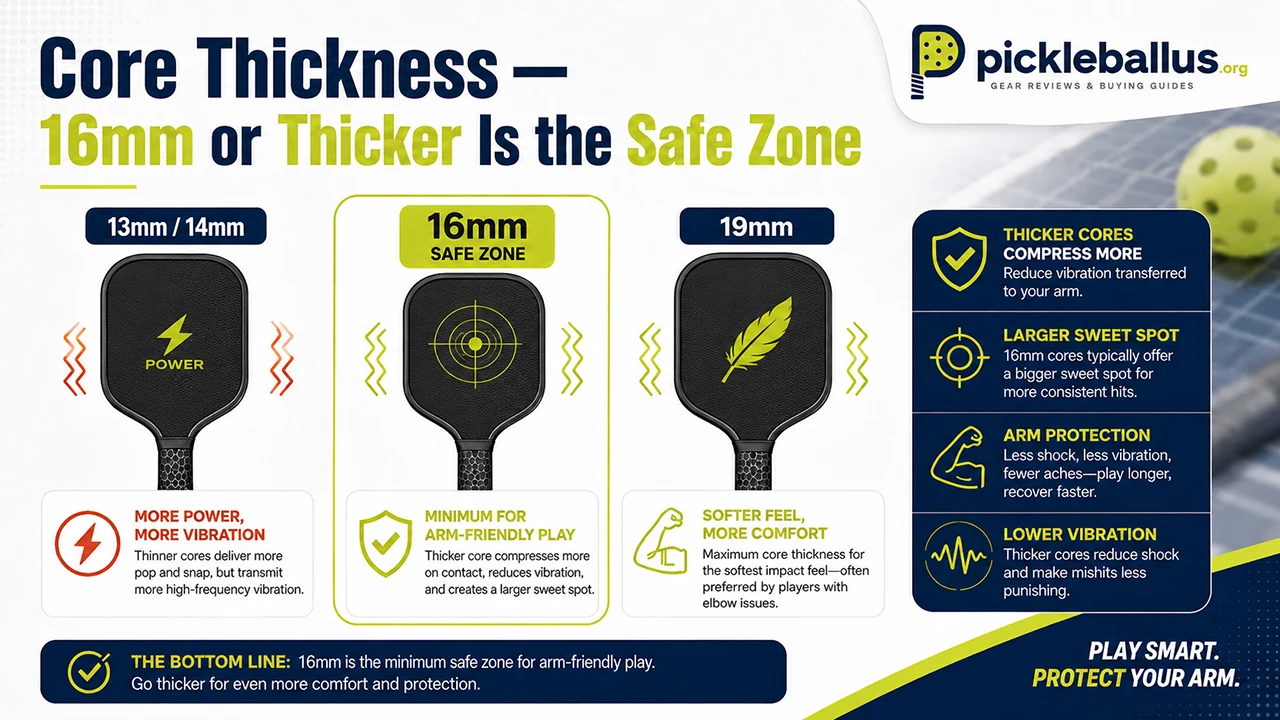
The thicker the core, the more the paddle can compress on contact — and the less vibration transfers to your arm. The industry has largely converged on 16mm as the minimum for arm-friendly play, and a growing number of players with elbow issues prefer 19mm paddles for an even softer impact feel.
A 13mm or 14mm core gives you more power and snap, which is why competitive players often prefer it. But for someone managing elbow pain, that extra snap comes at a real cost: higher-frequency vibration on every drive and every mis-hit. If you’re coming off a tennis background and used to a thin-faced racquet, this will feel like a significant trade-off — but your tendons will thank you for it. A 16mm core also tends to produce a larger sweet spot, so the penalty for off-center hits is lower, which reduces vibration spikes from mishits in the first place.
Weight — The 7.5–7.8 oz Sweet Spot
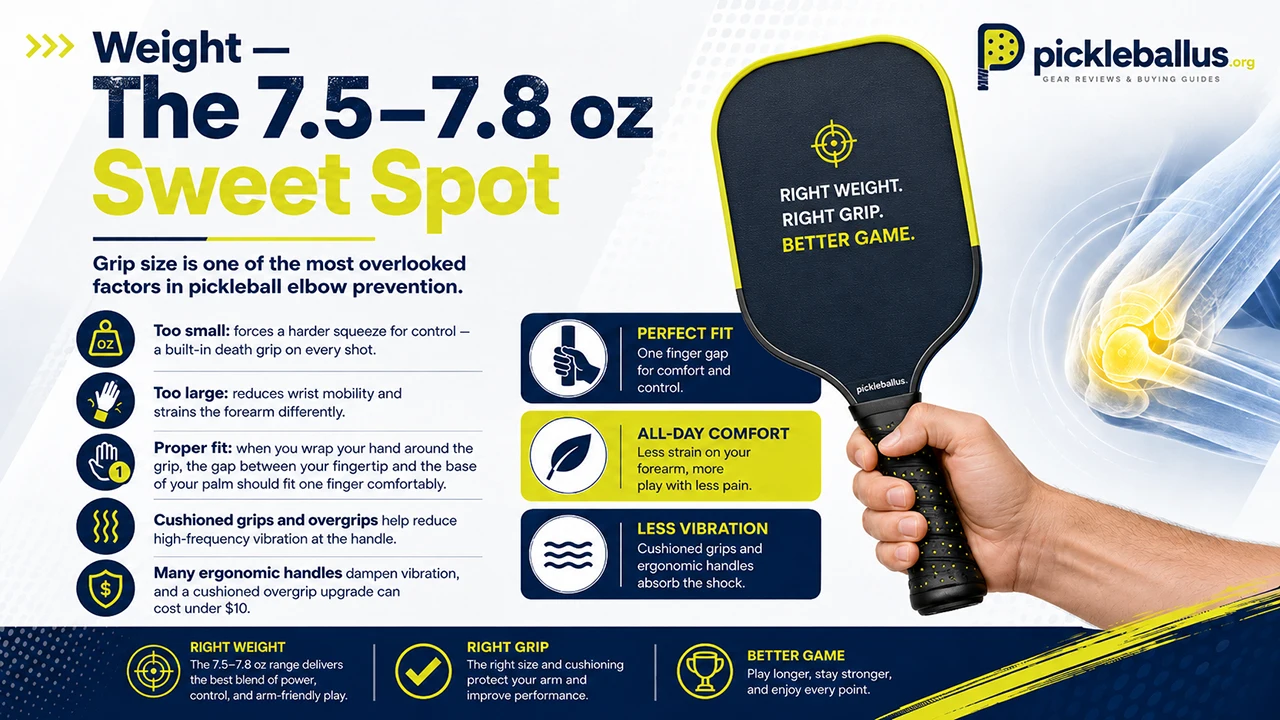
Mid-weight paddles in the 7.5–7.8 oz range represent the safest starting point for elbow-sensitive players. The logic cuts both ways: a paddle that’s too heavy (8.0 oz and above) requires more stabilizing force from the forearm muscles on every shot, which loads the extensor tendons continuously throughout a session. A paddle that’s too light (under 7.4 oz) lacks “plow-through” — the ball pushes the face back on impact, forcing your forearm to do extra stabilizing work to hold the paddle steady.
The 7.5–7.8 oz band hits a balance where the paddle’s own mass handles the ball’s momentum without demanding extra effort from your arm. You can find best lightweight pickleball paddles in this range that work well for arm health, but go too light and you’ll create a different set of problems.
Grip Size and Cushioning
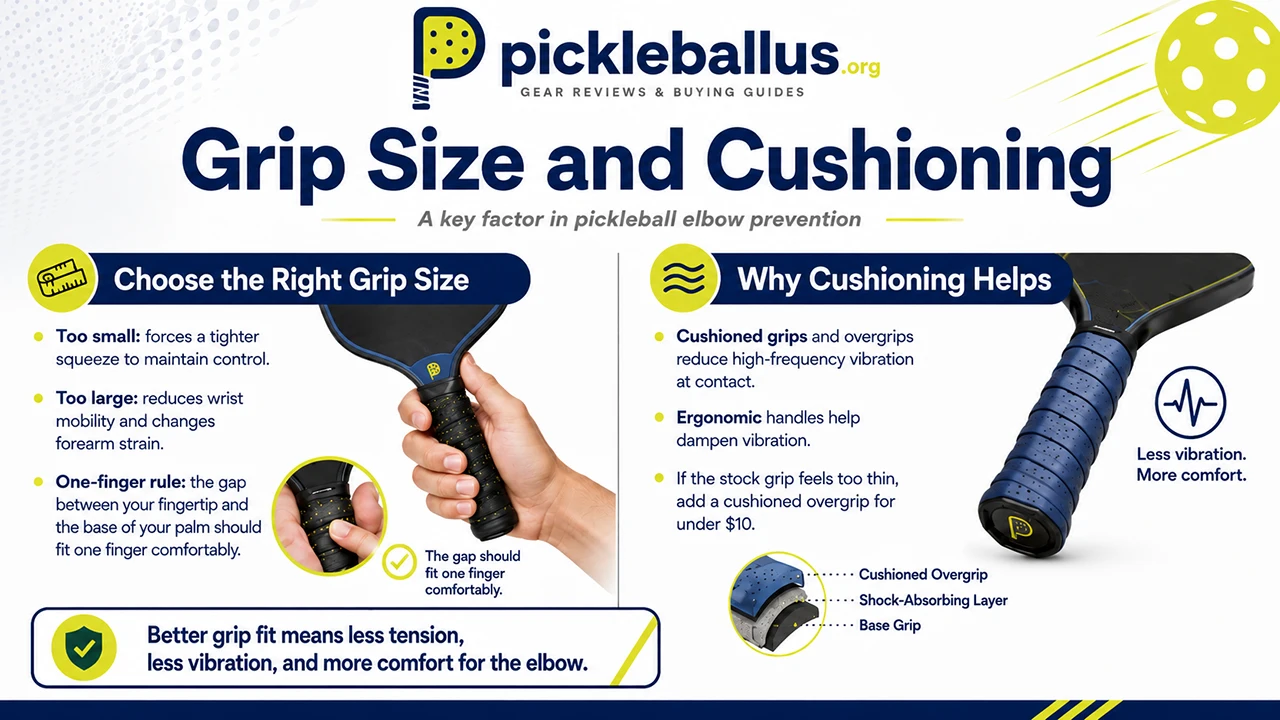
Grip size is the most overlooked factor in pickleball elbow prevention. A grip that’s too small forces you to squeeze harder to maintain control — which is essentially a forced death grip on every shot. A grip that’s too large reduces wrist mobility and strains the forearm differently. The standard recommendation: wrap a finger around the grip; the gap between your fingertip and the base of your palm should fit one finger comfortably.
Beyond size, cushioned grips or overgrips reduce high-frequency vibration at the point of contact between your hand and the handle. Several of the paddles below ship with ergonomic handles designed to dampen vibration — and all of them can be upgraded with a cushioned overgrip for under $10 if the stock grip is too thin.
Face Material and Vibration Profile
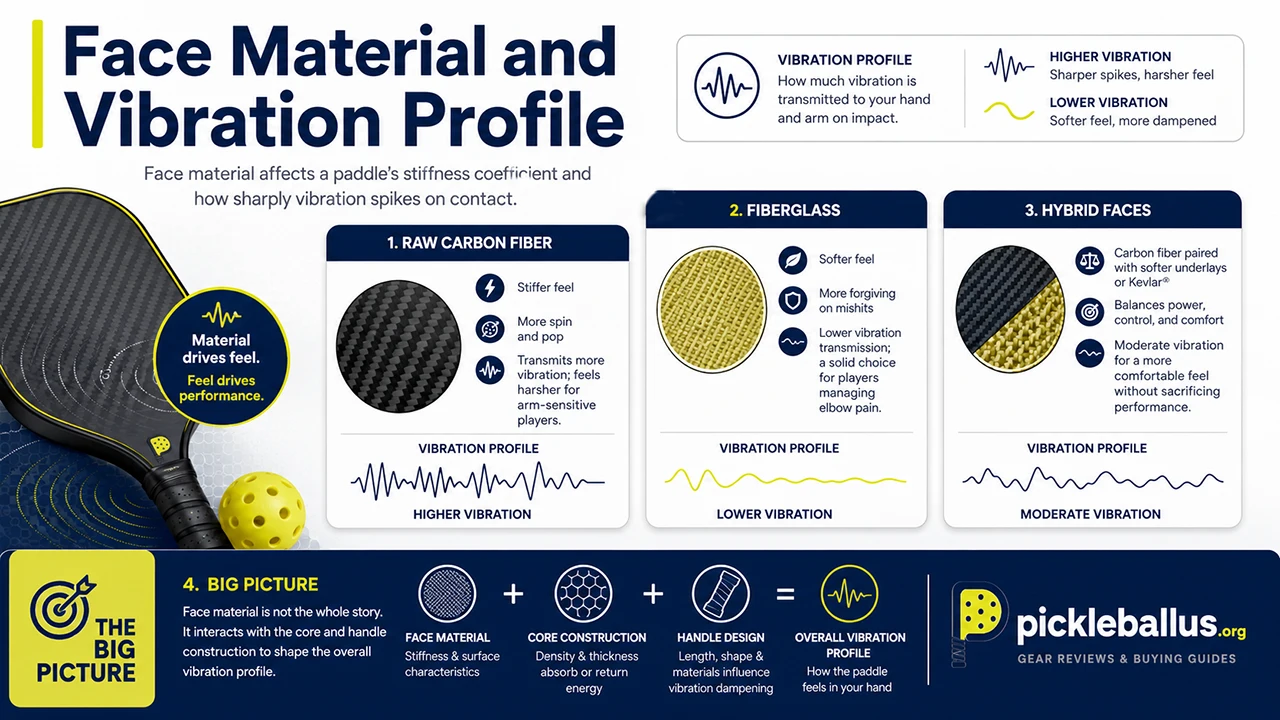
Face material affects the “stiffness coefficient” of the paddle — how sharply vibration spikes on contact. Raw carbon fiber faces, especially on thermoformed paddles, tend to be stiffer and transmit more vibration than fiberglass or hybrid carbon faces. That stiffness gives raw carbon its characteristic spin and pop, but it comes with a harsher feel on arm-sensitive players.
Fiberglass faces are softer and more forgiving, making them a solid choice for someone actively managing elbow pain. Hybrid faces — carbon fiber layers paired with softer underlays or Kevlar — split the difference between performance and comfort. If you explore pickleball paddle materials in depth, you’ll find that the face isn’t the whole story — it interacts with the core and handle construction to produce the overall vibration profile.
7 Best Pickleball Paddles for Tennis Elbow
The following paddles were selected for their vibration absorption, arm-friendly weight range, and consistent positive feedback from players who play through or are recovering from elbow issues. Each has a strong presence on Amazon with meaningful review volume. Here is what they each do well, where they fall short, and who they’re built for.
#1 Engage Pursuit Pro1 Hybrid — Best Overall for Elbow Relief
Engage designed the Pursuit Pro1 Hybrid around one goal: minimal arm fatigue — and it delivers on that better than anything else in this roundup. The paddle carries one of the lowest recorded swing weights in the market, which means your arm does less work on every swing. For a player dealing with elbow inflammation, lower swing weight translates directly into less tendon loading throughout a session.
Key specs:
- Shape: Hybrid (16.25 x 7.75 inches)
- Handle length: 5.375 inches
- Core: Polypropylene honeycomb
- Face: Vortex Barrier Edge (composite injected into outer cells)
- Approximate weight: 7.5–7.7 oz
Performance analysis: The Vortex Barrier Edge technology is Engage’s most interesting engineering choice. By injecting a composite material into the outer cells of the paddle, they balance weight distribution across the face while simultaneously dampening vibration at the perimeter — the zone where mis-hits happen most often. In play, this translates to a noticeably softer impact feel even on off-center shots. The octagonal, tennis-style grip also reduces grip strain by giving your hand natural rotation points rather than forcing a fixed hold position.
Pop and speed are high, making this ideal for aggressive players who like to drive. If you prefer a soft touch and dink-heavy game, the pop can feel excessive at the kitchen. But for anyone who likes to attack and needs their elbow to survive the session, this is the most complete arm-friendly paddle on the market.
Pros:
- Ultra-low swing weight reduces tendon loading per shot
- Vortex Barrier Edge cuts vibration at the perimeter
- Octagonal grip reduces hand tension naturally
- Hybrid shape gives enough handle for two-handed backhands
Cons:
- Too poppy for players who want a pure soft game
- Intermediate to advanced level — beginners may find the pop hard to control
Best For: Aggressive players managing tennis elbow who drive frequently and need elbow protection without sacrificing pace.
My Verdict: The Engage Pursuit Pro1 Hybrid is the clearest answer in this roundup for anyone who’s lost time on the court to elbow pain. The swing weight advantage is real, the Vortex tech works as advertised, and the octagonal grip is a small but meaningful design detail. If you play hard and your elbow can’t keep up, start here.
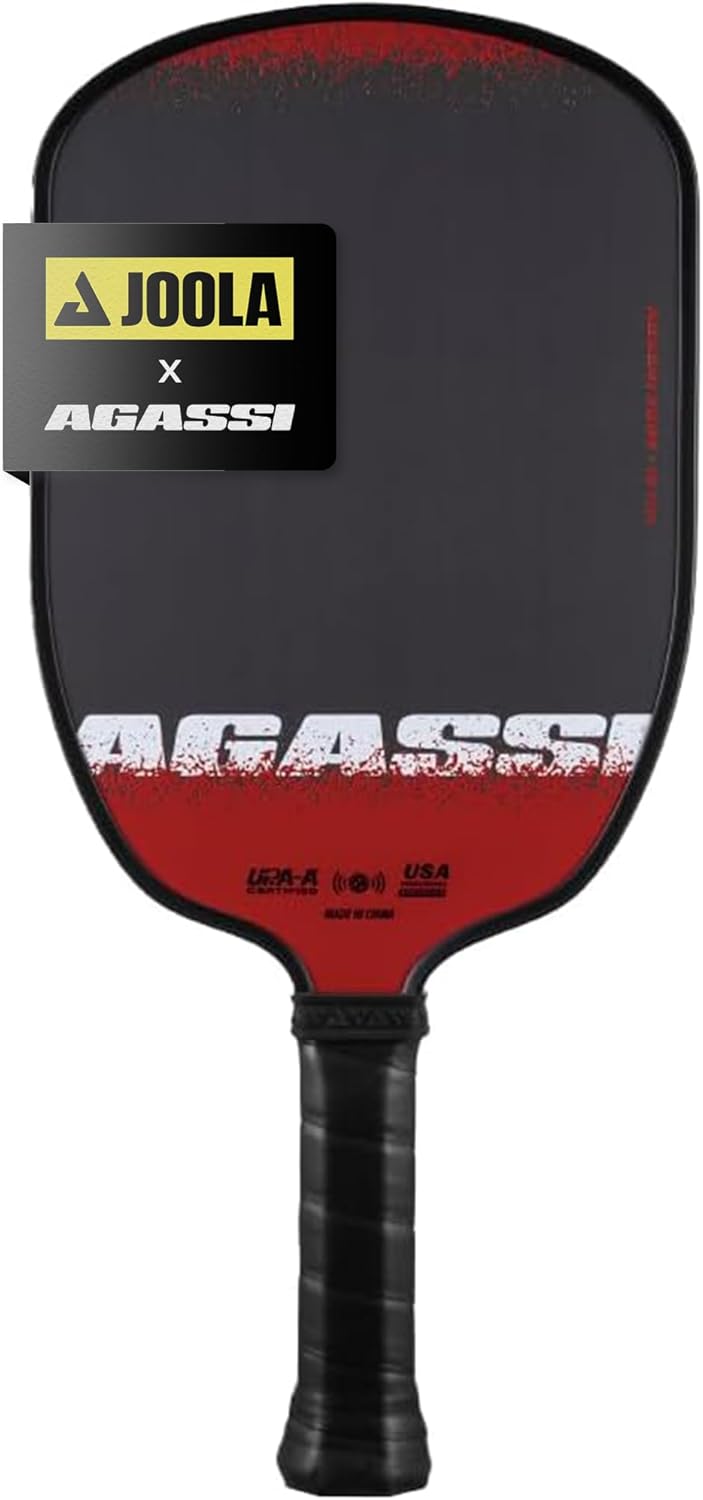
#2 JOOLA Agassi Pro — Best for Aggressive Bangers
The JOOLA Agassi Pro brings a 16mm polypropylene core and minimal drag profile built for players who don’t want to slow down their game to protect their elbow. Named in collaboration with Andre Agassi, this paddle leans into the aggressive player archetype with a design that keeps vibration low without sacrificing the pop that bangers depend on.
Key specs:
- Core: 16mm polypropylene honeycomb
- Handle length: 5.5 inches (longest on this list)
- Face: Carbon fiber (raw texture)
- Approximate weight: 7.8–8.0 oz
Performance analysis: The 5.5-inch handle is the standout feature for tennis elbow management. A longer handle allows a two-handed backhand, which distributes the load across both arms and reduces the single-arm extensor strain that drives most elbow injuries. Players coming from a tennis background will find this transition natural. The 16mm core keeps vibration in a comfortable range — not as muted as a 19mm paddle, but significantly softer than thin-core alternatives. Drag is noticeably low on fast drives, which means less forearm bracing work to push through the air resistance.
The slightly heavier weight sits at the upper edge of the elbow-safe range. Players who are highly sensitive to arm fatigue may want to look at the Engage Pursuit Pro1 or Selkirk SLK Halo Control XL for a lighter option. But for a player who hit two-handed backhands in tennis and wants to continue doing so in pickleball, the Agassi Pro is the most elbow-intelligent choice.
Pros:
- 5.5-inch handle enables two-handed backhands (major elbow relief)
- 16mm core keeps vibration manageable
- Low drag reduces forearm bracing effort
- Premium build quality
Cons:
- Weight approaches the upper limit of elbow-safe range
- Higher price point (premium category)
- Raw carbon face can feel harsh on mis-hits for sensitive elbows
Best For: Former tennis players and aggressive bangers who want a long-handle paddle that lets them distribute backhand load across two arms.
My Verdict: If you came from tennis and your two-handed backhand is a weapon you don’t want to abandon, the JOOLA Agassi Pro is the most sensible elbow-friendly solution. The 5.5-inch handle alone justifies considering it — the two-handed backhand is one of the most effective ways to reduce single-arm elbow loading in pickleball.
#3 Vatic Pro PRISM Flash — Best Budget Pick
The Vatic Pro PRISM Flash delivers serious arm-friendly performance at a mid-range price, making it the most accessible entry point on this list. Its shock-absorbing handle design sets it apart from other budget-bracket paddles, which typically cut corners on exactly the component that matters most for elbow health.
Key specs:
- Core: 16mm polypropylene honeycomb
- Face: T700 carbon fiber
- Handle: Shock-absorbing construction
- Approximate weight: 7.4–7.6 oz
Performance analysis: Most paddles in this price range use a standard fiberglass or carbon handle that transmits vibration directly from the core to the grip. The PRISM Flash uses a handle with built-in shock absorption — the construction distributes vibration across the handle structure before it reaches your palm. The difference is noticeable, especially on hard drives and defensive resets where the ball arrives fast.
The 16mm core keeps the impact feel soft, and the weight sits well within the arm-safe sweet spot. Control is excellent for a paddle in this range — the T700 carbon face provides enough texture for spin without the harsh feedback of higher-grit raw carbon. For players who are new to the arm-friendly category or want a second paddle specifically for recovery days, the PRISM Flash is a smart buy.
Pros:
- Shock-absorbing handle is rare at this price point
- 16mm core for soft impact
- Excellent control for its price bracket
- Lightweight and easy to swing for long sessions
Cons:
- Not as much pop as thermoformed premium paddles
- T700 carbon face generates slightly less spin than raw carbon alternatives
Best For: Budget-conscious players and anyone who wants an arm-friendly paddle without committing to a premium price — also a great recovery paddle to rotate with a more aggressive main paddle.
My Verdict: For under $100, the Vatic Pro PRISM Flash is the best arm-friendly pickleball paddle available. The shock-absorbing handle feature alone puts it ahead of competitors at the same price, and the 16mm core ensures the impact feel stays soft even during faster exchanges.
#4 PROKENNEX Ovation Speed II — Best Kinetic Vibration Absorption
The PROKENNEX Ovation Speed II uses patented Kinetic Technology — tiny tungsten balls housed inside the frame that absorb and redistribute impact energy before it travels into the handle. No other paddle on this list uses active vibration management of this type, and for players whose elbow is highly sensitive to any vibration at all, it’s worth considering as a primary option.
Key specs:
- Core: Polypropylene honeycomb
- Face: Carbon fiber composite
- Technology: Kinetic System (tungsten micro-masses in frame)
- Approximate weight: 7.6–7.8 oz
Performance analysis: The Kinetic System works by converting kinetic energy from ball impact into movement of the tungsten masses inside the frame. The masses absorb the energy and convert it to heat rather than allowing it to transmit as vibration up the handle. Players who switch to ProKennex paddles often report an immediate reduction in the “sting” they feel after a hard drive — and that sting is the subjective experience of vibration loading the elbow tendon.
The trade-off is that the system adds a small amount of weight to the frame, and the paddle feel is distinctly different from a standard paddle — some players describe it as unusually quiet and “dead” at first, which takes a few sessions to adjust to. But for anyone who has tried every other fix and still feels elbow pain within 15 minutes of starting play, the ProKennex Kinetic system addresses the problem at the physics level rather than just the spec level.
Pros:
- Kinetic Technology actively absorbs vibration — not just spec optimization
- Measurably reduces “sting” on hard drives and mis-hits
- Lightweight enough to stay in the arm-safe weight range
- Unique solution for players who haven’t responded to standard arm-friendly specs
Cons:
- Paddle feel takes adjustment — quieter and more muted than standard paddles
- Smaller brand presence than JOOLA or Selkirk, fewer model options
- Kinetic system adds slight frame weight
Best For: Players whose elbow pain hasn’t responded to standard thick-core, lightweight paddles — and those who want active vibration management rather than passive core dampening.
My Verdict: The PROKENNEX Ovation Speed II is the most technically differentiated paddle on this list. If you’ve already tried 16mm paddles and still feel elbow pain, the Kinetic system is the next logical step. It doesn’t play quite like anything else, but it solves the vibration problem at a mechanical level that no other paddle attempts.
#5 Selkirk SLK Halo Control XL — Best Lightweight Option
The Selkirk SLK Halo Control XL prioritizes low swing weight and a wide face, delivering arm-friendly play with a larger sweet spot that reduces the frequency of mis-hit vibration spikes. At the lighter end of the arm-safe weight range, it’s the best option for players who are particularly sensitive to arm fatigue over long sessions.
Key specs:
- Shape: Widebody (elongated)
- Core: 16mm polypropylene
- Face: Carbon fiber (smooth texture, less aggressive than raw carbon)
- Approximate weight: 7.4–7.6 oz
Performance analysis: The wide face geometry is an underrated arm health feature. A larger sweet spot means more shots land in the central zone where vibration is most controlled, and fewer shots catch the edge or frame where vibration spikes sharply. For a player who has been struggling with elbow pain, reducing the frequency of high-vibration mis-hits has a compound effect across a full session — fewer spikes means less cumulative tendon loading.
Control is the primary performance attribute, and it delivers. Dinks, resets, and third-shot drops are easy to execute with precision. Power is moderate — this paddle favors placement over pace, which also happens to be the softer playing style that gives your elbow the most recovery time between shots. For players rebuilding after an injury, the SLK Halo Control XL is an excellent rehabilitation paddle that doesn’t require you to give up competitive play.
Pros:
- Wide face maximizes sweet spot, reducing mis-hit vibration spikes
- Lightweight reduces arm fatigue across long sessions
- Excellent control for soft game players
- 16mm core for consistent, soft impact feel
Cons:
- Lower power ceiling than aggressive paddles
- Not ideal for players who rely on hard drives as a primary shot
- Smooth carbon face generates less spin than raw carbon
Best For: Control players, seniors managing arm fatigue, and players actively rehabilitating from elbow pain who need a paddle that minimizes stress in every direction.
My Verdict: The SLK Halo Control XL is the most forgiving paddle on this list in every sense. The wide face, light weight, and 16mm core combine to create the lowest-stress playing experience available. If your elbow is at its worst and you still want to play, this is the paddle that gives you the best shot at getting through a session without aggravating it.
#6 Paddletek Bantam EX-L PRO — Best for Soft Game Players
The Paddletek Bantam EX-L PRO targets kitchen-focused players who win with dinks, resets, and precision rather than power — and its construction reflects that philosophy in ways that also make it exceptionally arm-friendly. The paddle was specifically designed with input from players managing repetitive strain injuries.
Key specs:
- Core: Polypropylene honeycomb (16mm range)
- Face: Fiberglass composite
- Grip: Paddletek’s cushioned Bantam grip system
- Approximate weight: 7.4–7.6 oz
Performance analysis: Fiberglass faces are inherently softer than carbon fiber — they flex slightly on contact rather than staying rigid, which disperses vibration before it enters the handle. This is the opposite philosophy from raw carbon paddles, which prioritize stiffness and spin at the cost of arm comfort. The Bantam EX-L PRO’s fiberglass face, combined with the 16mm polypropylene core, gives it one of the softest impact profiles on this list.
The Bantam grip system is worth highlighting. It ships with a cushioned grip that’s thicker than standard pickleball grips, which distributes pressure across a larger palm surface area and naturally reduces the squeezing force needed to maintain control. Players who have tried the Bantam EX-L PRO frequently note how much more relaxed their grip is after the first few rallies — and a relaxed grip is one of the most effective ways to cut extensor tendon load. For the soft game player who wants to keep dinking without dreading the ache on the drive home, this paddle earns its place on the court.
Pros:
- Fiberglass face provides a softer impact profile than carbon
- Cushioned grip system encourages relaxed hand tension
- 16mm core for consistent vibration absorption
- Lightweight in arm-safe range
Cons:
- Less spin potential than carbon fiber paddles
- Power is limited — not suitable for bangers
- Less pop on fast exchanges at the kitchen
Best For: Soft game players, dink-heavy tacticians, and anyone who wants the absolute softest impact feel available in a performance paddle.
My Verdict: The Paddletek Bantam EX-L PRO solves elbow pain from two directions simultaneously: the fiberglass face reduces vibration from the outside, and the cushioned grip reduces the grip tension that transmits vibration from the inside. If you play a finesse game and your elbow has been limiting your kitchen time, this is the paddle designed specifically for you.
#7 HEAD Radical Series — Best for Former Tennis Players
The HEAD Radical Series brings tennis-informed paddle design into pickleball, with an ergonomic grip and a construction philosophy borrowed from HEAD’s tennis racquet line. For former tennis players whose elbow developed issues during the transition to pickleball, the familiar feel and arm-conscious design make it a natural first stop.
Key specs:
- Core: Polypropylene honeycomb (16mm)
- Face: Graphite composite
- Grip: HEAD Ergo-Grip (ergonomic shape)
- Approximate weight: 7.6–7.8 oz
Performance analysis: HEAD’s Ergo-Grip departs from the standard cylindrical pickleball handle by shaping the grip to follow the natural contours of the hand at rest. The result is a grip position that feels closer to a tennis racquet than most pickleball paddles — familiar for former tennis players and, more importantly, one that reduces the unconscious death-grip tendency that many players develop when a handle doesn’t feel secure. The graphite face produces a softer sound than raw carbon, which also matters: quieter impact tones discourage the reflex tightening that stiff, clacky paddles produce.
The 16mm core keeps vibration in check, and the weight sits mid-range at 7.6–7.8 oz — enough mass to plow through the ball without demanding excessive bracing force from the forearm. Control is solid, power is moderate, and the overall experience feels familiar to anyone who spent years with a HEAD tennis racquet. You can also explore the broader best pickleball paddles for tennis players category if you want to compare how other brands handle the tennis-to-pickleball transition.
Pros:
- Ergo-Grip design reduces unconscious grip tension
- Graphite face produces softer sound, reducing reflex grip tightening
- Familiar feel for former tennis players
- 16mm core for consistent vibration management
Cons:
- Less aggressive spin than raw carbon paddles
- Power ceiling lower than thermoformed premium options
- Brand may be less recognized in pickleball-specific communities than JOOLA or Selkirk
Best For: Former tennis players who are experiencing elbow pain during the pickleball transition and want a paddle that feels like familiar territory while protecting their arm.
My Verdict: The HEAD Radical Series is the most psychologically comfortable entry point for a tennis player moving into pickleball with elbow concerns. The grip design alone reduces a major cause of elbow strain, and the 16mm graphite construction handles vibration without asking you to radically change how you hold a racquet-style implement.
Does Switching Paddles Actually Fix Tennis Elbow?
Switching to an arm-friendly paddle helps significantly, but it does not cure active elbow inflammation on its own. The right paddle can cut vibration transmission by 30–50% compared to a thin-core, stiff-faced alternative — that reduction is meaningful and measurable. But if your tendons are currently inflamed, no paddle specification eliminates the problem completely.
The honest answer is: yes for prevention and recovery, no as a standalone cure. For a player who has not yet developed elbow pain but is playing frequently with a stiff, thin-core paddle, switching to a 16mm arm-friendly option is one of the most effective preventive measures available. For a player already in pain, the paddle switch needs to accompany rest and — in persistent cases — physical therapy with eccentric tendon loading exercises.
The research and clinical guidance consistently point to the same three factors: paddle construction, technique, and recovery time. This article addresses the first one. The next section covers the other two.
By now you have a clear picture of which paddles absorb the most shock, which specs matter most for elbow health, and which model fits your playing style and budget. Choosing the right paddle is the structural fix — but tennis elbow recovers faster and stays away longer when you pair better gear with a few technique adjustments and smart recovery habits. The next section covers what to do between sessions and on the court itself to keep your elbow pain-free long after you’ve made the switch.
How to Stay on the Court Without Aggravating Your Elbow
Technique Adjustments That Cut Elbow Load Immediately
Three technique changes reduce elbow loading faster than any equipment purchase. First, loosen your grip to a 4 out of 10 squeeze — most players hold at 8 or 9. A tight grip pre-loads the extensors so that every shot fires them from tension. Second, drive your dinks and resets from your shoulder and torso, not your wrist. The wrist adds spin and touch; it should not be the primary power source on any shot that travels more than a few feet. Third, bend your knees on low balls and absorb the shot through your legs rather than reaching down with a stiff arm. A straight-arm reach to a low ball forces the elbow into an extended, vulnerable position under load.
None of these changes require a coach or weeks of training. You can practice grip pressure awareness in your next warmup by consciously releasing tension between every shot. If you’re managing pain while building these habits, reviewing pickleball injuries for sport-specific recovery guidance can help you understand the full picture.
Accessories That Help: Overgrips, Elbow Sleeves, and Lead Tape
A cushioned overgrip is the cheapest arm-health upgrade available. Stock grips on most paddles are thin and transmit vibration readily. Adding a $7–10 cushioned overgrip — similar to what tennis players use — adds a vibration-absorbing layer at the point of contact between your hand and the handle. The trade-off is a slightly larger grip circumference, which may require dropping one size in your base grip.
Elbow sleeves provide compression around the lateral epicondyle and can reduce inflammation during play. They don’t fix the underlying issue, but they can extend a comfortable session by 15–20 minutes and reduce post-play soreness during the recovery phase. Lead tape applied to the throat of the paddle — the point where the head meets the handle — increases twist weight (resistance to off-axis rotation) without meaningfully raising swing weight. A more stable paddle face means fewer off-center vibration spikes on mis-hits.
The “Death Grip” Problem — Why Most Players Never Fix It
There is a documented link between paddle sound profile and grip tension that most players are completely unaware of. High-pitched, stiff paddles produce a sharp “crack” on contact. When the brain hears that sound repeatedly, it triggers a subconscious reflex: the hand tightens in anticipation of the next impact. Players grip harder, which loads the extensor tendons continuously throughout the session — and they never realize it’s happening because the behavior is below conscious awareness.
This is why the muted sound profile of paddles like the Paddletek Bantam EX-L RO and the PROKENNEX Ovation Speed II matters beyond just impact feel. A quieter, deeper tone suppresses the grip-tightening reflex, which reduces the continuous background load on the tendon between shots. Switching to a muted paddle often produces a feeling of general arm relaxation that players attribute vaguely to the paddle being “more comfortable” — the actual mechanism is the sound-grip reflex chain being interrupted.
When to Rest vs. When to Keep Playing
Active inflammation means rest — not playing through it with a better paddle. If the outside of your elbow hurts during the first 15 minutes of play, burns during backhands, and aches at rest the following morning, your tendon is inflamed and needs time off the court. Playing through active inflammation extends recovery from weeks to months.
Recovering (pain subsides during play, minimal post-play ache) allows modified play: shorter sessions under 45 minutes, arm-friendly paddle, loosened grip, and no hard drives until the session finishes without pain. This is the phase where the paddles in this roundup make the largest difference — they let you stay competitive during recovery without loading the healing tendon past its tolerance. Once you’ve had two consecutive sessions with no elbow pain during or after, you’re back to normal play volume, one session at a time.
Write Your Review
No reviews yet. Be the first to share your experience!