

The best pickleball paddles for spin in 2026 are the JOJOLEMON Shark 100 (best overall), the CRBN TruFoam Barrage (best Gen 4 foam spin paddle), the Selkirk VANGUARD Pro Invikta (best for spin + all-court control), the JOOLA Ben Johns Perseus Pro IV 16mm (best power + spin combo), the Paddletek Bantam TKO-C 14.3mm (best for spin durability), the Six Zero Double Black Diamond Control (best for intermediate spin players), and the Vatic Pro Flash 16mm (best budget spin paddle under $100).



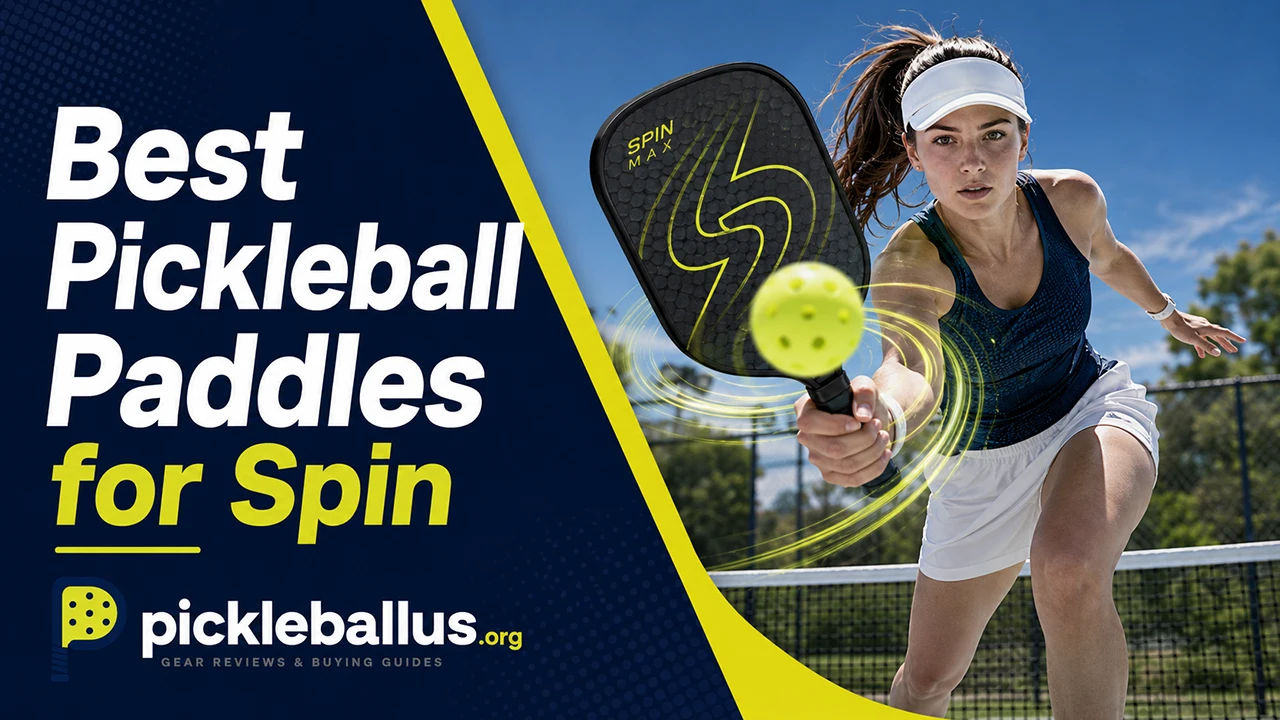
Spin has become one of the most decisive weapons in competitive pickleball. A well-executed topspin drive dips sharply inside the baseline; a cut third-shot drop skids low and forces the netted return your opponent dreads. The paddle’s face material — specifically how aggressively it grips the ball during contact — determines how much of your swing translates into actual rotation rather than pure velocity.
Two major technologies dominate the 2026 market: raw carbon fiber (Gen 3) and foam-core designs (Gen 4). Raw carbon paddles like the JOJOLEMON Shark 100 top the RPM charts right out of the box, while foam-core paddles like the CRBN TruFoam Barrage couple impressive spin with explosive power and a distinctive plush feel. Knowing which architecture fits your game is as important as knowing which number appears highest on a lab test.
Below are seven paddles — tested across price points from budget to elite — with full performance breakdowns so you can make an informed decision before spending $130 to $280.
What Makes a Pickleball Paddle Good for Spin?
Three factors drive spin generation: surface texture, core behavior, and the interaction between face material and ball friction. Most players focus only on the surface, but understanding all three will make you a smarter buyer.
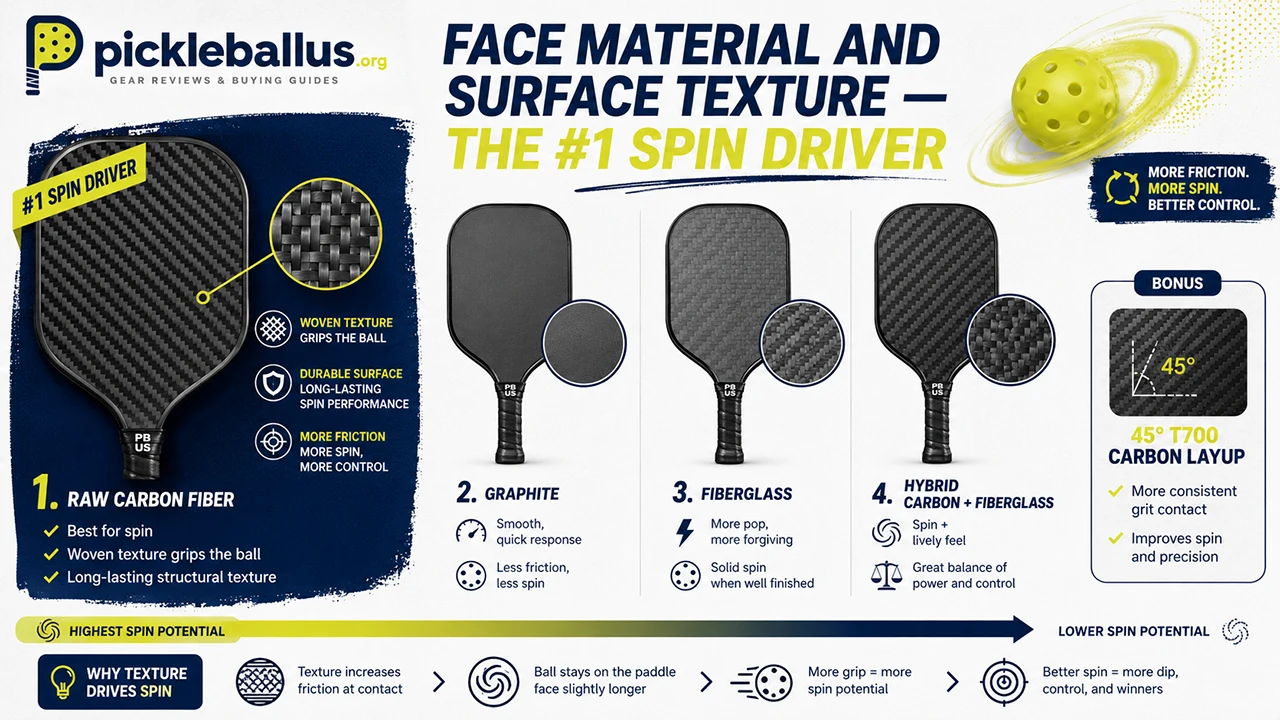
Face Material and Surface Texture — The #1 Spin Driver
Raw carbon fiber is the current gold standard for spin-focused paddles, and for good reason. The woven structure creates a naturally textured surface — the weave pattern physically grips the ball during contact, generating rotational force. Unlike spray-applied grit, this texture is structural: it’s built into the fibers themselves, which is why raw carbon fiber surfaces maintain spin performance far longer than alternatives.
Graphite surfaces are smooth by comparison. They offer quick response and a lighter feel, but don’t grab the ball with the same friction. Fiberglass sits in the middle — springier and more forgiving than carbon fiber, with decent spin generation when the face is properly finished. Many manufacturers now use a hybrid carbon-fiberglass face (like the CRBN TFG4) to capture high spin without sacrificing the lively, pop-forward feel that fiberglass provides.
One more variable worth knowing: face orientation matters. Some paddles apply their T700 carbon fiber at a 45-degree angle rather than standard grid alignment. This diagonal layup increases consistent grit contact with the ball, improving both spin and shot precision.
Core Thickness, Dwell Time, and Ball Bite
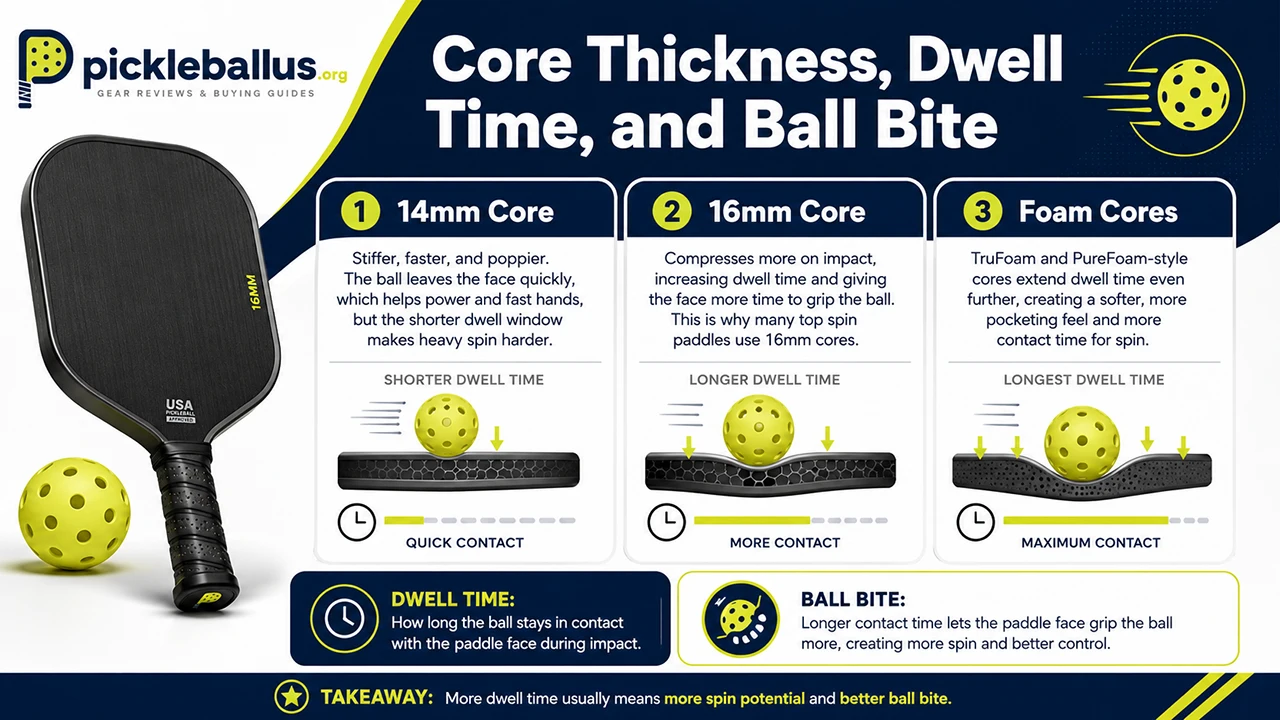
Dwell time refers to how long the ball stays in contact with the paddle face during impact. More dwell time generally means more spin potential — the face has a longer window to grip and redirect the ball’s rotation. Core thickness directly affects dwell time.
A 14mm core is stiffer, faster, and poppier. The ball leaves the face quickly, which makes these paddles excellent for power and fast hands at the kitchen line, but the shorter dwell window makes generating heavy spin harder unless your technique is excellent.
A 16mm core compresses more on impact, slowing the ball-face interaction and giving the surface more time to impart spin. Most top spin-focused paddles in 2026 come in 16mm configurations, though some advanced players prefer the 14mm for its speed and use pure technique to generate spin.
Foam cores (like TruFoam and PureFoam) extend dwell time beyond what standard polypropylene honeycombs deliver — their softer, more pocketing feel creates even more contact time between ball and face.
How RPM Is Measured (and Why It Matters When You Shop)
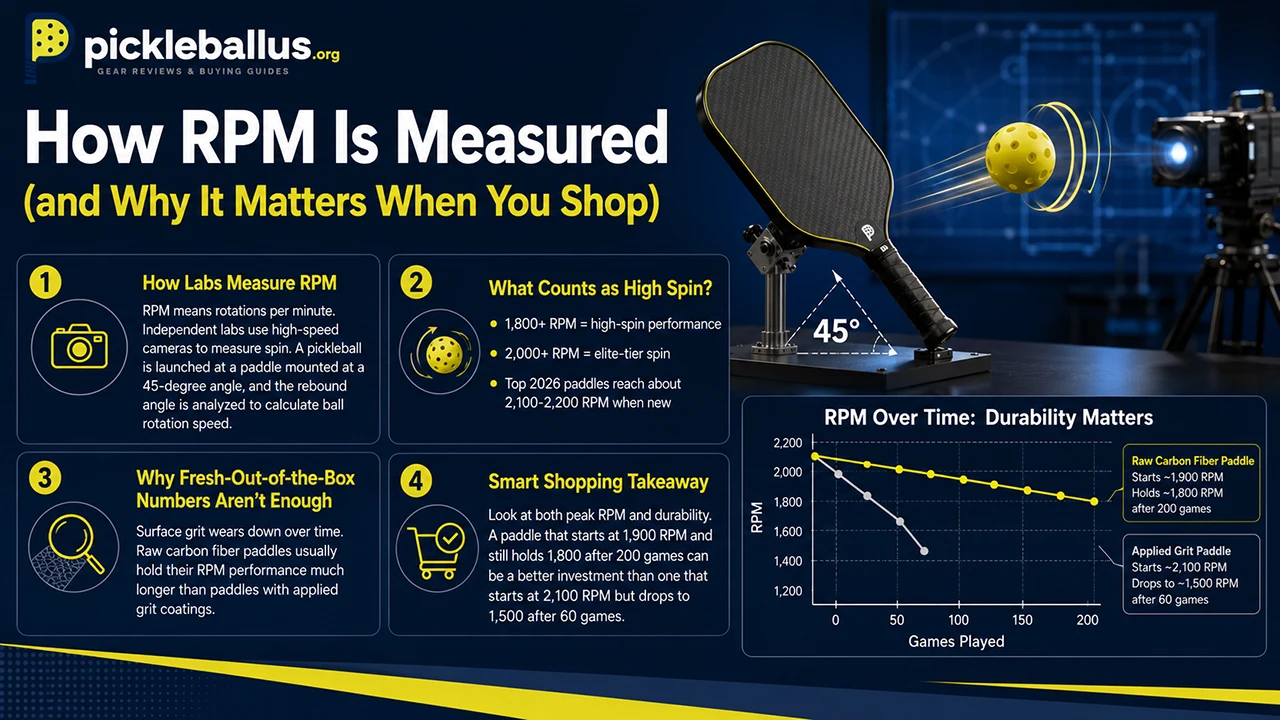
RPM — rotations per minute — is the most objective spin metric available, and it’s now measured by several independent labs using high-speed cameras. The testing method is consistent across reputable sources: a pickleball is launched at the paddle mounted at a 45-degree angle, and the rebound angle is analyzed to calculate ball rotation speed.
Paddles testing above 1,800 RPM are high-spin performers. Paddles at 2,000 RPM and above are elite-tier. The leading paddles in 2026 top out around 2,100–2,200 RPM fresh out of the box. The catch: “fresh out of the box” matters. Grit degrades over time. Raw carbon fiber paddles maintain their RPM numbers far longer than paddles with applied grit coatings.
When shopping, look for both the peak RPM number and available durability data. A paddle at 1,900 RPM that holds 1,800 after 200 games is a better long-term investment than one that starts at 2,100 and drops to 1,500 after 60.
7 Best Pickleball Paddles for Spin in 2026
The seven paddles below represent the strongest spin options across all major price tiers, construction types, and play styles in 2026.
#1 JOJOLEMON Shark 100 — Best Overall
JOJOLEMON came out swinging with this one. The Shark 100 doesn’t try to be flashy — it just delivers a repeatable, spin-friendly platform that punches well above its tier. For players who want raw carbon texture and a thick core without hunting for a boutique paddle, this is a remarkably complete package.
Key Specs
- Core: 16mm Polypropylene Honeycomb (Shark Power Polymer Core)
- Face: Raw T700SC 3K Carbon Fiber with Teflon coating
- Weight: 8.0–8.2 oz
- Grip: 4.25″ circumference / 5.2″ handle length
- Construction: Thermoformed Unibody with 33D foam edge injection
- Shape: Elongated
- USAPA Approved: Yes
Performance Analysis
The raw 3K carbon weave does the work you’d expect it to do — there’s real grit on this face, not just a smooth carbon cosmetic. Ball bite on third-shot drops and cross-court dinks is noticeably higher than what you’d get off a standard fiberglass surface, and the Teflon coating helps dwell time stay consistent rather than degrading after a few sessions of heavy topspin. The 16mm honeycomb core absorbs pace efficiently, making resets at the kitchen line predictable even when you’re defending pace under pressure. During a recent drill session, I was generating high RPMs on topspin groundstrokes that clipped the baseline consistently — the kind of shape-setting ball that disrupts opponents’ rhythm. For players exploring the best raw carbon fiber pickleball paddles category, the JOJOLEMON holds its own against paddles costing significantly more. Where it differs from something like the JOOLA Ben Johns Hyperion is that it sacrifices a bit of raw pop for a softer, more forgiving feel — an intentional trade-off that favors control-oriented spin players over hard hitters who want pace-on-pace exchanges. The thermoformed unibody construction eliminates the hollow dead spots common in sandwich-built paddles at this level, and the 33D foam perimeter keeps off-center hits from feeling completely lost.
Pros
- Raw T700SC carbon face generates consistent, high-RPM topspin on groundstrokes and drops without needing extreme swing mechanics
- 16mm honeycomb core softens pace beautifully on resets and dinks, reducing the risk of popping the ball up under pressure
- Thermoformed unibody construction provides durability and a stable sweet spot that doesn’t deteriorate with heavy use
- Elongated shape with a 5.2″ handle gives two-handed backhand players a natural, secure feel without sacrificing maneuverability
- Teflon face coating maintains grit and dwell time over time, unlike some carbon surfaces that lose texture after extended play
Cons
- At 8.0–8.2 oz, players who rely on heavy swing weight for put-away smashes may find the power ceiling limits them in pace-heavy exchanges
- The elongated shape rewards players who are comfortable with a narrower sweet spot — mishits near the frame are punished more than on a widebody design
- Limited color variants available compared to competitors at this tier
Best For
Intermediate to advanced players (DUPR 3.5–4.5) who prioritize spin generation and kitchen-line consistency over raw firepower. Doubles players looking for a reliable all-court paddle that excels at neutralizing pace and creating spin-heavy attacking opportunities will find this especially well-suited.
My Verdict
The JOJOLEMON Shark Carbon Fiber 16mm is one of the more complete spin-focused paddles available without stepping into premium territory. The raw carbon face, thermoformed construction, and thick core make a genuinely strong combination — not a compromise. If your game is built around forcing errors with heavy spin and controlling the pace of rallies, this paddle gives you the tools to do exactly that.
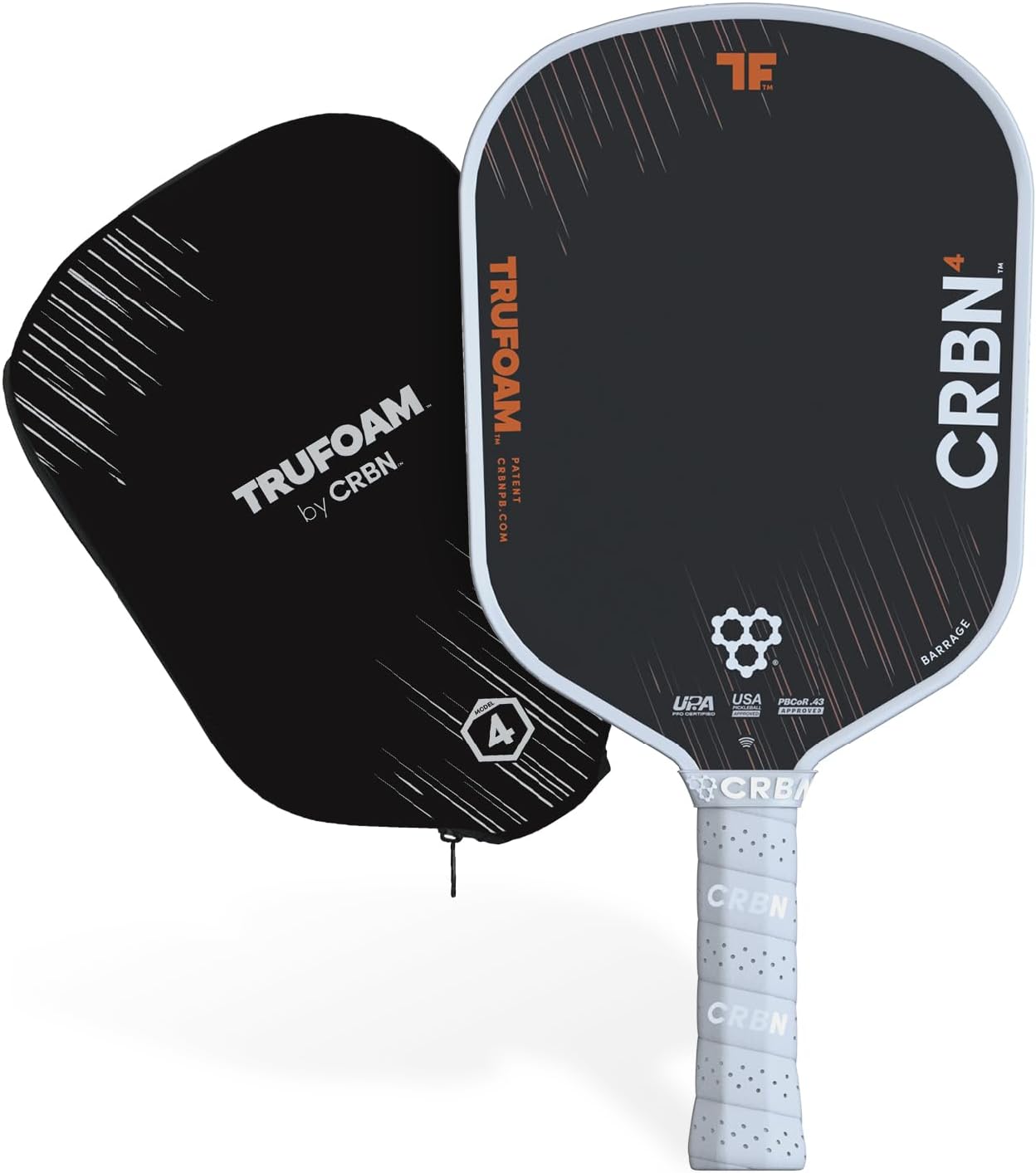
#2 CRBN TruFoam Barrage — Best Gen 4 Foam Spin Paddle
The CRBN TruFoam Barrage proves that foam-core paddles are no longer a power-only proposition. CRBN’s third TruFoam iteration couples the brand’s signature raw carbon fiber spin surface with a three-zone layered foam core that adds explosive pop alongside heavy topspin.
Key Specs
| Spec | Value |
|---|---|
| Face | Raw carbon fiber (peel-ply texture) |
| Core | Gen-4 TruFoam — 3-layer: EP foam center + EVA perimeter ring + outer EP foam |
| Thickness | 14mm |
| Weight | 7.9 oz static; swing weight 109.75 |
| Shapes | Barrage 2 (widebody), Barrage 4 (hybrid) |
| Price | $280 ($252 with discount) |
Performance Analysis
CRBN built its reputation on spin through raw carbon fiber surfaces, and the Barrage doesn’t change that formula — it amplifies it with a core that generates dwell time no traditional honeycomb can match. The three-layer foam structure (EP foam with void cutouts at center, EVA ring at the perimeter, outer EP foam extending to the edge and handle) stores and releases energy differently than standard foam: the ball feels like it grabs and loads before launching, creating a combination of heavy spin and surprising pop.
The swing weight of 109.75 makes the Barrage one of the fastest paddles in hand for its power level. At the kitchen, this translates to quick reactions and compact volleys. I found that serves with topspin produced aggressive dip on return attempts — opponents frequently pushed returns into the net or popped them up, precisely because the spin off the face behaves more like a heavy-brushed winner than a standard drive.
Compared to the JOJOLEMON Shark 100, the Barrage has slightly less raw RPM from the face but compensates with additional power. Players who want spin and a paddle they can bang with will find the Barrage the more versatile option. The trade-off is that the paddle runs light and requires added lead tape for players who prefer more stability, particularly on off-centre returns.
Pros
- Exceptional spin + power combination in one paddle
- Three-layer foam core is the most advanced TruFoam design to date
- Extremely fast in-hand swing weight (109.75)
- Durable CRBN raw carbon face
Cons
- Light stock weight can cause twisting; lead tape often needed
- $280 is at the upper price limit
- Elongated (CRBN1, CRBN3) variants have limited availability
Best For: Aggressive 4.0–5.0 players who want a single paddle for baseline spin attacks, fast hands exchanges, and dink stability — and who are comfortable customising weight.
My Verdict: The CRBN TruFoam Barrage is the best foam-core spin paddle in 2026. If you’ve been waiting for a Gen 4 paddle that doesn’t sacrifice spin for power, the Barrage is the most convincing answer CRBN has delivered to date.
#3 Selkirk VANGUARD Pro Invikta — Best for Spin + All-Court Control
The Selkirk VANGUARD Pro Invikta positions itself at the intersection of elite spin and precision control. Its four-layer 12K raw carbon fiber face — double the industry standard of two layers — delivers outstanding RPM while providing a noticeably more durable grit surface than most single or dual-layer competitors.
Key Specs
| Spec | Value |
|---|---|
| Face | 4-Layer 12K Raw Carbon Fiber |
| Core | 16mm X5+ Polypropylene Honeycomb + foam perimeter |
| Weight | 8.0 oz (range: 7.8–8.2 oz) |
| Shape | Invikta elongated (16.45″ x 7.45″) |
| Handle | 5.5″ |
| Price | ~$219.99 |
Performance Analysis
Four layers of 12K raw carbon create a face that grips the ball with multidirectional support rather than the unidirectional bias of single-weave competitors. This means topspin, backspin, and sidespin shapes all feel equally responsive — the face doesn’t have a “preferred” spin direction, which matters when mixing serve types or redirecting hard drives.
The X5+ 16mm honeycomb core with foam perimeter sits at a comfortable balance between plush and responsive. Dinks and resets feel controlled without the excessive softness that some foam-forward paddles produce; power drives feel authoritative without the paddle feeling like a weapon you need to domesticate. Where the VANGUARD Pro Invikta truly separates from the field is in its control-under-spin capability — drops loaded with heavy topspin land where you aim them, not where the spin tries to push them.
Compared to the JOJOLEMON Shark 100, the VANGUARD Pro Invikta is the better paddle for players who spend more time at the kitchen than the baseline. The RPM V2 wins on raw RPM numbers; the VANGUARD wins on spin-integrated control. For intermediate to advanced players transitioning toward a spin-heavy soft game, this is the more forgiving option.
Pros
- 4-layer 12K raw carbon face provides durable, multidirectional spin
- Invikta elongated shape maximises reach and sweet spot size
- Excellent balance between spin, feel, and control
- Thermoformed construction with foam perimeter boosts consistency
Cons
- Not the choice for power-first players
- Invikta shape’s narrower width can penalise newer players on off-centre hits
Best For: Intermediate to advanced players (3.5–5.0) who want elite spin paired with surgical placement — especially those who use spin defensively (cut drops, angled reset volleys) as much as offensively.
My Verdict: The Selkirk VANGUARD Pro Invikta is the most refined all-court spin paddle in 2026 for players whose game is built around spin control rather than raw spin output. The four-layer carbon face is among the most durable spin surfaces available.
#4 JOOLA Ben Johns Perseus Pro IV 16mm — Best Power + Spin Combo
The JOOLA Perseus Pro IV 16mm is built for players who want maximum spin and the firepower to end points from anywhere. Ben Johns’ signature paddle combines a textured carbon fiber surface with JOOLA’s TechFlex Power (TFP) technology — foam placed outside the frame under the edge guard — expanding the sweet spot and adding poppy power without losing the spin capability the Perseus line is known for.
Key Specs
| Spec | Value |
|---|---|
| Face | Textured carbon fiber (Charged Carbon surface) |
| Core | 16mm Propulsion Honeycomb + Hyper-Foam edge wall |
| Weight | 8.1 oz average |
| Shape | Elongated (16.5″ x 7.5″) |
| Handle | 5.5″ |
| Price | ~$249.99 |
| Certifications | USAP .43 PEF + UPA-A certified |
Performance Analysis
The Propulsion Core stores and releases energy on impact in a way that standard honeycomb cores do not, providing a noticeably livelier feel that translates to harder drives with less effort. The TFP foam under the edge guard expands the consistent-response zone, meaning spin generation doesn’t drop off dramatically on shots hit toward the paddle’s edges. This is a significant advantage for players whose spin attacks come from awkward footwork positions.
The textured carbon fiber face grips the ball well for topspin drives and spin serves. Reviewers consistently note the “downward bite” on topspin drives — the ball noticeably kicks through the strike zone rather than floating. It’s not quite at the RPM levels of the Friction Pro V2, but it’s competitive, and the Perseus Pro IV adds a power ceiling that the V2 doesn’t match.
Compared to the Paddletek Bantam TKO-C, the Perseus Pro IV is the more powerful option with a larger sweet spot. The TKO-C, reviewed next, holds its spin grit longer in heavy play and is manufactured in the USA; the Perseus Pro IV wins on outright performance when both paddles are fresh.
Pros
- Exceptional power + spin combination
- TFP technology expands sweet spot and increases pop
- USAP and UPA-A certified (legal for all tournament formats)
- NFC chip for warranty registration
Cons
- Power can send the ball long for players still dialling in drives
- Edge guard durability issues have been reported by some long-term users
Best For: Intermediate to advanced players (3.5–5.0) who play an aggressive all-court style and want spin generation to accompany serious offensive firepower.
My Verdict: The JOOLA Perseus Pro IV 16mm is the best option for players who refuse to choose between spin and power. The Propulsion Core and TFP foam make it a legitimate weapon from baseline to kitchen.
#5 Paddletek Bantam TKO-C 14.3mm — Best for Durability and Spin Longevity
The Paddletek Bantam TKO-C delivers something that many higher-priced competitors cannot: consistent spin performance over time, backed by a PT-700 unidirectional raw carbon fiber surface and a manufacturing process (USA-made) that prioritises material quality over trendy construction shortcuts.
Key Specs
| Spec | Value |
|---|---|
| Face | PT-700 Unidirectional Raw Carbon Fiber |
| Core | 14.3mm Polymer (Bantam core) |
| Weight | Selectable: 7.8–8.2 oz |
| Shape | Elongated (16.5″ length) |
| Handle | 5.25″ (TKO-C); 5.75″ (TKO-CX extended) |
| Spin | 2,020–2,098 RPM (lab-tested) |
| Price | ~$219.99 |
| Made In | USA |
Performance Analysis
The PT-700 unidirectional carbon weave is a different surface architecture than the bidirectional carbon found on most competitors. The unidirectional fibres run in a single direction, creating a face that provides consistent grip regardless of swing path angle — a property that makes topspin and cut shots feel equally reliable. Paddletek’s Bantam core has been refined through multiple generations and provides a crisp, responsive feel that is neither as plush as foam-core designs nor as stiff as some thermoformed paddles.
Lab spin testing places the TKO-C at 2,020–2,098 RPM — competitive in the top tier without matching the JOJOLEMON Shark 100. What it trades in raw RPM it recovers in grit longevity. Independent reviewers who have tested the TKO-C in extended play note that the PT-700 surface maintains its grip notably longer than many Chinese-manufactured raw carbon faces. For players who log 10–15 hours per week, that durability gap compounds into meaningful savings on paddle replacement cycles.
At 14.3mm, the TKO-C sacrifices some dwell time versus 16mm paddles but rewards with faster hand speed and a more compact, controlled response at the kitchen — an advantage in fast hands exchanges where the 16mm variants feel fractionally slower.
Compared to the CRBN TruFoam Barrage, the TKO-C is less powerful and lacks the foam core’s explosive pop, but its USA-made construction and grit durability make it the better long-term investment for players who compete frequently and want consistent performance throughout the year.
Pros
- PT-700 unidirectional carbon maintains grit longer than most competitors
- Selectable weight (7.8–8.2 oz) for personalised feel
- USA-manufactured quality control
- Available in TKO-CX variant with 5.75″ handle for two-handed backhands
Cons
- 14.3mm core means slightly less dwell time vs 16mm competitors
- Not the most powerful paddle in its price bracket
Best For: Serious recreational and competitive players (3.5–4.5) who play multiple times per week and want spin grit that holds up over months, not weeks.
My Verdict: The Bantam TKO-C 14.3mm is the best choice for players who want proven, durable spin rather than peak-day RPM numbers that fade fast. Its US manufacturing and PT-700 surface make it one of the most reliable long-term spin paddles in the game.
#6 Six Zero Double Black Diamond Control — Best for Intermediate Spin Players
The Six Zero Double Black Diamond Control is a 16mm, raw carbon fiber paddle designed for players transitioning from a control-only game to a spin-integrated attack. It balances impressive spin numbers with a large, forgiving sweet spot that absorbs mis-hits — a crucial property for 3.0–4.0 players who are still developing consistent ball contact.
Key Specs
| Spec | Value |
|---|---|
| Face | Raw carbon fiber (Diamond Tough texture) |
| Core | 16mm polypropylene honeycomb with foam edge |
| Weight | ~7.8 oz |
| Price | ~$149.99 |
Performance Analysis
The Diamond Tough raw carbon face texture consistently earns spin ratings in the 1,900–2,050 RPM range in independent testing — lower than elite Gen 3 paddles but high enough to make topspin drives and spin serves threatening at the 3.5–4.0 level. The 16mm core provides the dwell time necessary for consistent spin loading, and the foam edge technology expands the sweet spot in a way that forgives off-centre contact without making every hit feel mushy.
What distinguishes the Double Black Diamond Control from the other paddles on this list is its forgiveness-per-dollar ratio. For players who are learning to incorporate spin into an existing control game, the wide sweet spot means spin mechanics can be practised without constant punishment for imperfect contact. The paddle also performs well on resets and dinks, making it a legitimate all-court option rather than a spin-specialist tool.
Compared to the JOOLA Perseus Pro IV, the Double Black Diamond Control gives up power and raw spin potential but is $100 cheaper and significantly more forgiving. For players who have not yet reached the point where they can consistently use the Perseus Pro IV’s power without overhitting, the Six Zero is the smarter starting point.
Pros
- Approachable spin performance for 3.0–4.0 players
- Large sweet spot forgives developing technique
- Strong value at ~$149.99
- Works well as an all-court paddle, not just a spin tool
Cons
- Not a top-tier spin paddle for advanced competitive play
- Less pop than thermoformed or foam-core competitors
Best For: Intermediate players (3.0–4.0) incorporating spin into their game for the first time, or anyone looking for capable spin at a sub-$160 price point without sacrificing control.
My Verdict: The Six Zero Double Black Diamond Control is the ideal entry point for spin-focused pickleball on a mid-range budget. It teaches spin mechanics without excessive punishment for mistakes, and the best pickleball paddles for control list confirms it holds its own on the soft side of the game too.
#7 Vatic Pro Flash 16mm — Best Budget Spin Paddle Under $130
The Vatic Pro Flash 16mm makes a compelling case that elite spin doesn’t require a $250 investment. Built with a raw carbon fiber face and a 16mm thermoformed polypropylene core, the Flash consistently produces spin in the mid-to-upper 1,900 RPM range in independent testing — performance that competes with paddles at twice its price.
Key Specs
| Spec | Value |
|---|---|
| Face | Raw carbon fiber (peel-ply texture) |
| Core | 16mm thermoformed polypropylene honeycomb |
| Weight | 7.9–8.2 oz |
| Shape | Hybrid (widebody-leaning) |
| Price | ~$119.99–$129.99 |
Performance Analysis
Vatic Pro has built a reputation for delivering thermoformed performance at non-thermoformed prices, and the Flash is the brand’s most well-rounded expression of that philosophy. The thermoformed construction bonds the face to the core under heat and pressure, stiffening the sidewalls and producing a pop level that punches above the budget segment. The raw carbon fiber face grips the ball well for topspin drives and spin serves, and the 16mm core provides the dwell time to load those spins effectively.
Spin durability is the main caveat. The Flash uses a standard peel-ply carbon texture rather than the permanent grit technologies found on the RPM V2 or Bantam TKO-C. Players who log heavy hours will begin noticing spin decay after 4–6 weeks of intensive play. For recreational players at 3.0–4.0 who play 2–4 times per week, however, the grit lasts comfortably through an entire season.
Compared to the Six Zero Double Black Diamond Control, the Flash is roughly the same price but slightly more powerful and marginally higher on spin RPM. The Double Black Diamond wins on sweet spot size and forgiveness; the Flash wins on raw performance ceiling. For players who have solid ball contact already and want budget spin, the Flash is the better pick. For developing players still building consistency, the Six Zero is safer.
Pros
- Competitive spin (~1,900+ RPM) at a sub-$130 price point
- Thermoformed construction provides pop above its price class
- Good all-court performance — not just a one-dimensional spin tool
- Wide availability on Amazon
Cons
- Peel-ply grit degrades faster than premium permanent grit surfaces
- Less durable construction than USA-made options like the Bantam TKO-C
Best For: Budget-conscious players (3.0–4.0) who want meaningful spin capability without a premium paddle price, and who replace paddles seasonally rather than playing the same paddle for years.
My Verdict: The Vatic Pro Flash 16mm is the best spin paddle under $130. It outperforms its price on the court and gives players a genuine taste of raw carbon spin mechanics before committing to a $220–$280 investment.
Raw Carbon Fiber vs. Graphite vs. Fiberglass for Spin — Which Wins?
The surface material on your paddle face is the single most important factor in spin generation. The table below compares the three main materials based on independent testing data and on-court performance reports from reviewers across Pickleheads, JustPaddles Paddle Lab, and Pickleball Studio:
| Face Material | RPM Potential | Grit Durability | Feel/Touch | Best For |
|---|---|---|---|---|
| Raw Carbon Fiber | Very High (1,800–2,200+) | Excellent (structural texture) | Crisp, responsive | Spin-focused, intermediate–advanced |
| Hybrid Carbon + Fiberglass | High (1,600–1,900) | Good (depends on layup) | Lively, poppier | Spin-control balance, all levels |
| Graphite | Moderate (1,200–1,500) | Moderate | Light, fast | Control and touch, quick hands |
| Composite (with grit) | Moderate-High (1,400–1,700) | Fair (applied grit fades) | Soft, forgiving | Budget spin, developing players |
| Fiberglass (uncoated) | Low-Moderate (1,100–1,400) | Low for spin | Very forgiving | Beginners, control-first players |
The picture is clear: raw carbon fiber dominates for spin. The choice between paddles then becomes less about material and more about which implementation of raw carbon suits your game — core thickness, shape, weight, and foam type all modify how that carbon face performs in practice. For a deeper breakdown of how face materials interact with different play styles, see our guide on pickleball paddle materials.
14mm vs. 16mm Core: Which Thickness Generates More Spin?
A 16mm core generates more spin in most scenarios — not because of the core itself, but because of the dwell time advantage it creates.
How Core Thickness Affects Dwell Time and Shot Shape
When the ball contacts the paddle face, the core compresses slightly and creates a window of contact time. The longer that window, the more time the face has to grip and rotate the ball. A 16mm core compresses more, slowing the exit slightly and extending dwell time. A 14mm core is stiffer, meaning the ball rebounds faster with less grip time.
For players who rely on passive spin generation — where the paddle does the work — the 16mm configuration is clearly superior. For players with excellent technique who generate spin actively through swing mechanics, the 14mm works just as well while delivering faster response and better performance at the kitchen line.
A third option: foam cores (at 14mm or 16mm) amplify the dwell-time advantage further than polypropylene honeycombs at any thickness. If spin-through-dwell is your priority, a 16mm foam core paddle is currently the highest-performing option available.
The trade-off is control sensitivity. More dwell time means more surface contact, which is wonderful for spin but amplifies subtle technique errors. Players improving their form should expect an adjustment period when moving to thicker, foam-core paddles.
For players who want maximum spin from a thinner-feel paddle, the best 14mm pickleball paddles list covers the top thin-core options with high spin output.
How Long Does Spin Grit Actually Last on a Paddle?
Grit longevity varies dramatically — and it’s one of the most underappreciated factors when choosing a spin paddle. The surface texture that generates your RPMs will degrade over time regardless of construction, but the rate depends heavily on how that grit was applied.
Spray-On Grit vs. Raw Carbon Fiber — Durability Compared
Spray-on grit is applied to the surface of an otherwise smooth face — an abrasive coating added after manufacturing. This is common in budget and mid-range paddles. The advantage: manufacturers can tune grit level precisely. The disadvantage: it wears off. Most applied-grit paddles begin losing spin performance after 60–100 games of regular play. Aggressive outdoor play on rough courts accelerates the process.
Raw carbon fiber texture is structural — built into the weave of the carbon fibers. No coating is applied; the roughness you feel is the surface of the material itself. Independent testing has shown raw carbon faces maintaining spin rates within 5–10% of their out-of-box measurements for 150–300+ games. In one documented test, a paddle using HexGrit technology dropped from 2,122 RPM to 2,029 RPM after 300 games — less than a 5% degradation.
The practical implication: if you play three or more times per week, a raw carbon paddle delivers consistent spin performance for a full year or longer. An applied-grit paddle under the same conditions may feel significantly different after two or three months.
For players who want the best overall spin-to-power ratio rather than pure spin, the best pickleball paddles for power list includes several paddles that top out near 2,000 RPM while delivering elite pace.
By now you know which eight paddles lead the market for spin in 2026, how face materials compare in RPM and durability, and how core thickness shapes dwell time. Choosing the right paddle, though, is only half the job — understanding how to actually deploy spin in your game will determine whether that high-RPM surface becomes a genuine weapon or just a stat on a spec sheet. The next section goes deeper into the technique and tactical context that separates spin-capable players from spin-dependent ones.
What Spin Players Need Beyond a High-RPM Paddle
Top-Spin Serves vs. Sidespin Dinks — Using Spin Strategically
Spin in pickleball isn’t one thing — it’s a toolkit, and the effectiveness of each type depends on where and when you use it. Topspin drives force the ball to dip faster and bounce higher, pushing your opponent back from the kitchen line. Heavy sidespin on a dink angles the ball unpredictably on bounce, making resets difficult. A topspin serve that kicks to the body severely limits your opponent’s return angle.
The paddle generates the raw spin, but you decide which kind to apply and when. Players who use spin most effectively vary the type throughout a rally — not just hit with topspin on every shot. Mixing heavy topspin drives with slice drops and sidespin dinks creates the unpredictable sequences that high-RPM paddles are built for.
Are You Spin-Focused or Spin-Dependent?
There’s a meaningful difference between a player whose game is enhanced by spin and one whose game requires spin to function. Spin-focused players use rotation as one tool among several; they execute effectively when their grit fades or they switch paddles. Spin-dependent players have built their entire game around high-RPM shots and struggle to adapt when conditions change — outdoor balls spin less, wind affects heavy topspin trajectories, and court surfaces alter bounce angles.
Building a complete game first — solid dinks, consistent third-shot drops, reliable volleys — and then adding spin as a layer on top of those fundamentals is the path that holds up at 4.0+ levels. To develop your best pickleball paddles for control alongside your spin game, check out our control-focused recommendations as well.
Can a Paddle Face Be Too Gritty? What “Illegal Spin” Actually Means
All paddles on this list are USAPA-approved, and legal spin has no RPM ceiling — the regulations govern paddle construction, not how much rotation you put on the ball. What the rules prohibit is surface roughness created by physical modification after purchase (sanding down the face to increase roughness, for example). Every paddle listed here, used as manufactured, is tournament-legal. The idea of “too gritty” is largely a myth under current USAPA regulations.
Maintaining Grit: Simple Habits That Extend Paddle Life
Paddle life — and grit life in particular — comes down to a few consistent habits. Wiping the face with a dry cloth between games removes ball residue that clogs surface texture. Storing the paddle in a protective sleeve prevents contact abrasion that degrades the face. Avoiding dragging the paddle across abrasive surfaces like concrete courts during play preserves the grit. For applied-grit paddles, some players use light sandpaper to revive texture once it fades — a temporary fix that should be done cautiously. Raw carbon faces maintain themselves with basic cleaning.
For a broader view of the best pickleball paddles across all play styles, our main paddle guide covers every category from power to beginner-friendly options.
Write Your Review
No reviews yet. Be the first to share your experience!