

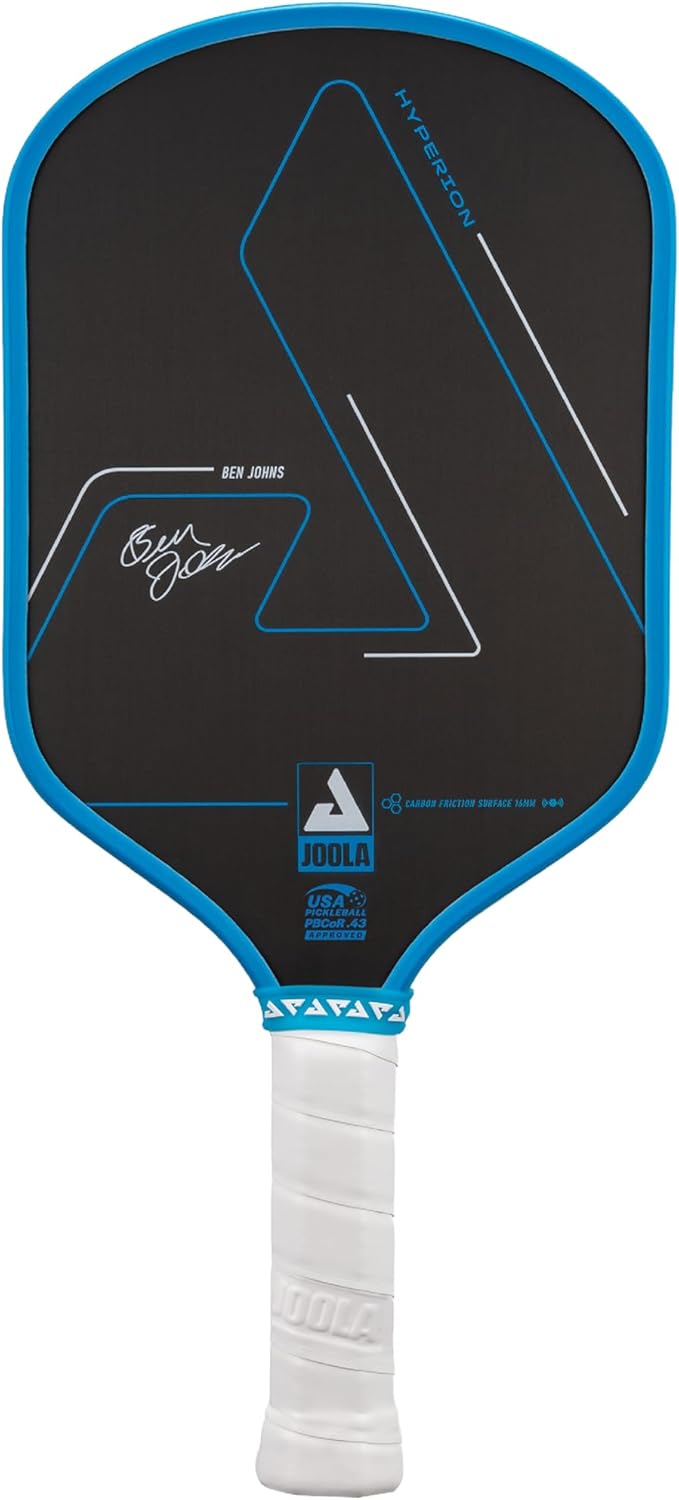
The 8 best pickleball paddles for seniors in 2026 are the JOOLA Ben Johns Hyperion CFS 16mm (best overall), the Selkirk SLK Halo Power XL (best for control), the Paddletek Bantam EX-L Pro (best for consistent senior players), the HEAD Radical Elite (best budget pick), the Engage Pursuit Pro MX 6.0 (best for soft touch and placement), the Franklin Sports Ben Johns Signature (best entry-level), the Onix Graphite Z5 Widebody (best lightweight classic), and the Gamma Hellbender 16mm (best mid-range all-rounder).


Seniors need different things from a paddle than younger, faster players. Lower grip strength, reduced joint cushioning, and longer recovery time between sessions mean that the wrong paddle — one that’s too heavy, too stiff, or too narrow — causes cumulative damage that shows up as elbow soreness, shoulder fatigue, or wrist inflammation weeks into a new season. Paddle selection for older players is, first and foremost, an injury-prevention decision, and then a performance one.
The core tension every senior faces is this: power requires a heavier, stiffer paddle, but control and joint safety require the opposite. Most competitive seniors over 55 benefit from shifting that tradeoff firmly toward control, leaving raw pace to technique rather than equipment. A paddle that absorbs vibration, fits the hand comfortably, and forgives off-center contact will keep you on the court far longer than one that adds three extra feet of drive on your best shots.
The eight paddles below represent the range of options across budget and skill tiers. Each was selected for available Amazon sales history, review volume, and fitness to the specific physiological demands of senior play. Here is how each one performs.

What Makes a Pickleball Paddle Senior-Friendly?
A senior-friendly pickleball paddle prioritizes vibration absorption, ergonomic weight distribution, and a forgiving sweet spot over raw power output. Those three characteristics map directly to the three most common senior pickleball injuries: tennis elbow (from vibration), rotator cuff strain (from swing weight), and wrist inflammation (from grip mismatch).
Among the best pickleball paddles across all categories, senior-specific picks consistently cluster around a well-defined spec profile. Understanding that profile helps you evaluate any paddle, not just the eight on this list.
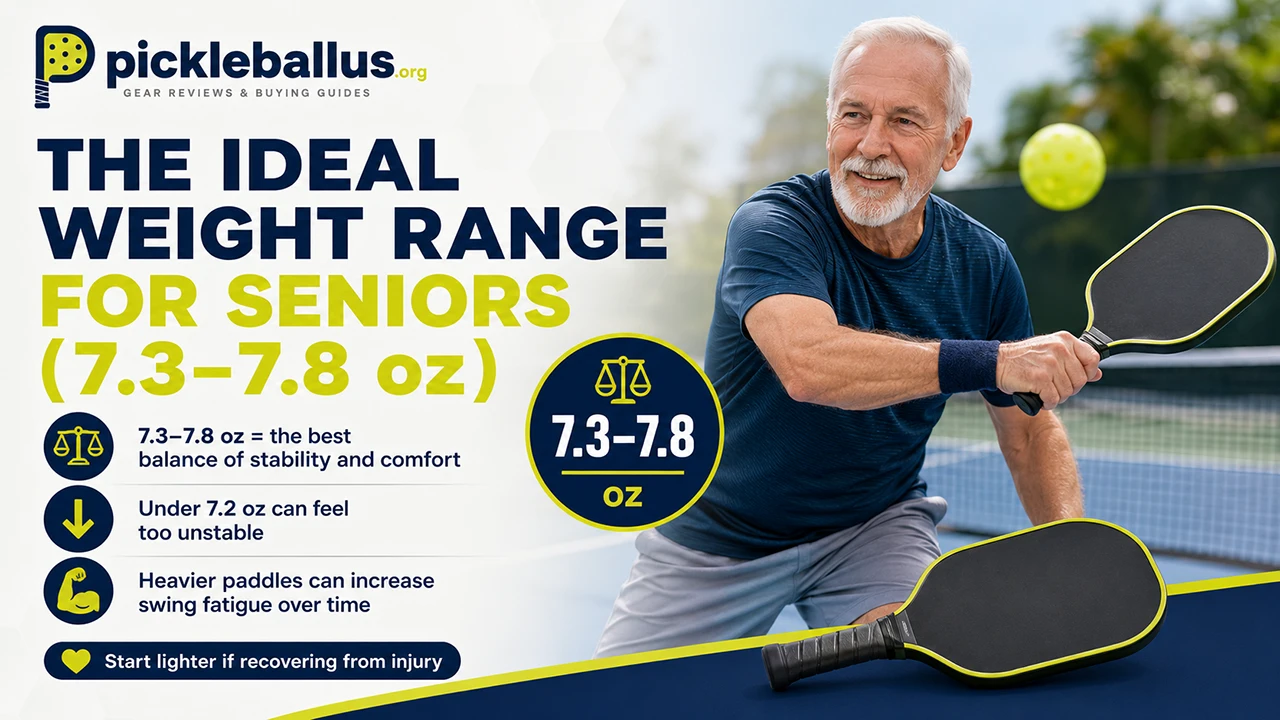
The Ideal Weight Range for Seniors (7.3–7.8 oz)
Paddles between 7.3 and 7.8 ounces hit the balance point where seniors retain enough stability for confident groundstrokes without accumulating swing fatigue. Every extra ounce a paddle weighs adds resistance on every contact — over a two-hour session, the difference between a 7.5 oz and an 8.5 oz paddle is thousands of additional micro-loads on the forearm tendons.
Ultra-light paddles under 7.2 oz go too far in the opposite direction. The paddle face lacks the momentum to absorb ball impact, so the arm ends up doing compensating work that still strains the elbow. The 7.3–7.8 oz window is where most senior players find sustainable performance. If you are recovering from an existing shoulder or elbow injury, start at the lower end; if you come from a tennis background with strong shoulder muscles, you can push toward 7.8 oz without much risk. Check the pickleball paddle weight guide for a deeper breakdown of how swing weight differs from static weight.
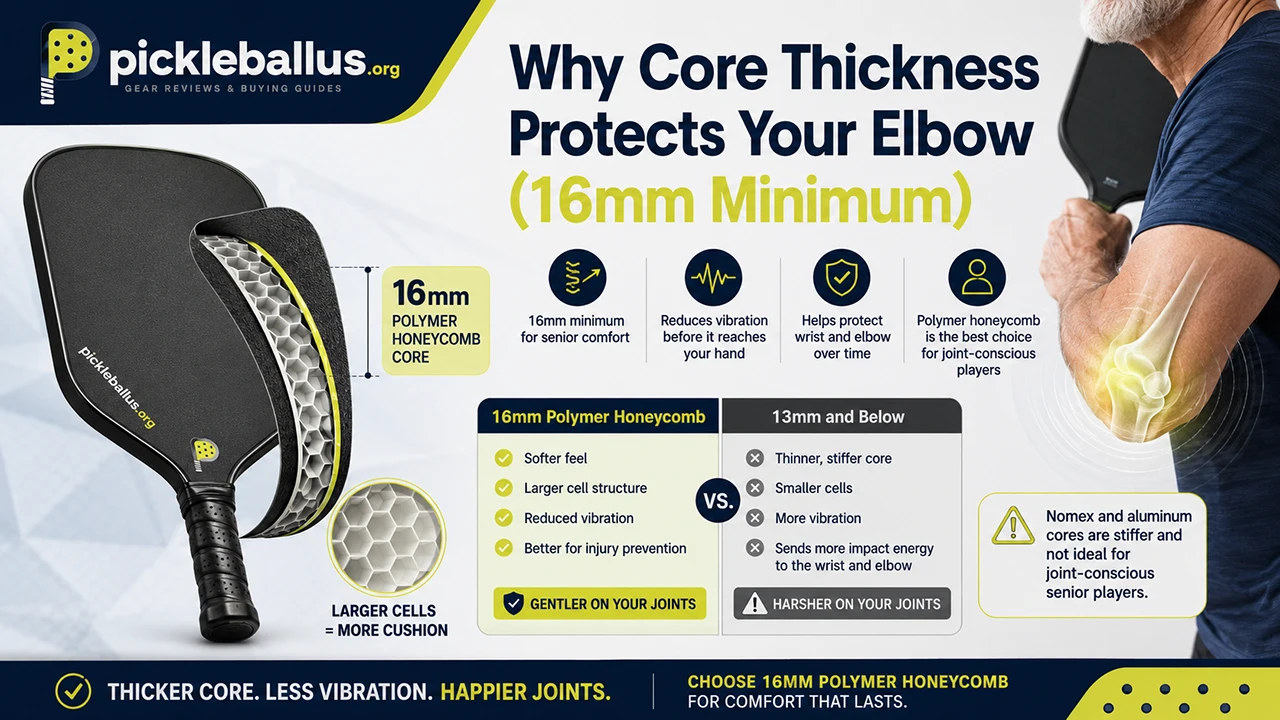
Why Core Thickness Protects Your Elbow (16mm Minimum)
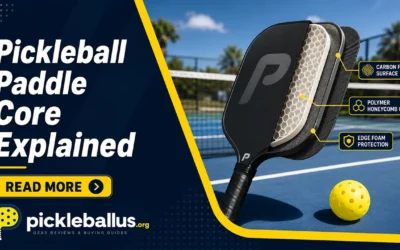
A 16mm polymer honeycomb core is the single most important injury-prevention spec for senior players. Core thickness determines how much vibration travels from the paddle face into your grip after contact. Thinner cores — 13mm and below — transmit impact energy more directly to the wrist and elbow. At recreational pace, the difference feels mild. Over a season of three or four sessions per week, it accumulates into tendinopathy.
The best 16mm pickleball paddles distribute impact energy across a larger cell structure, slowing the vibration wave before it reaches your hand. Polymer (polypropylene) honeycomb is the dominant core material for this purpose. Nomex and aluminum cores run stiffer and harder — they were standard a decade ago but are not the right choice for joint-conscious senior players.
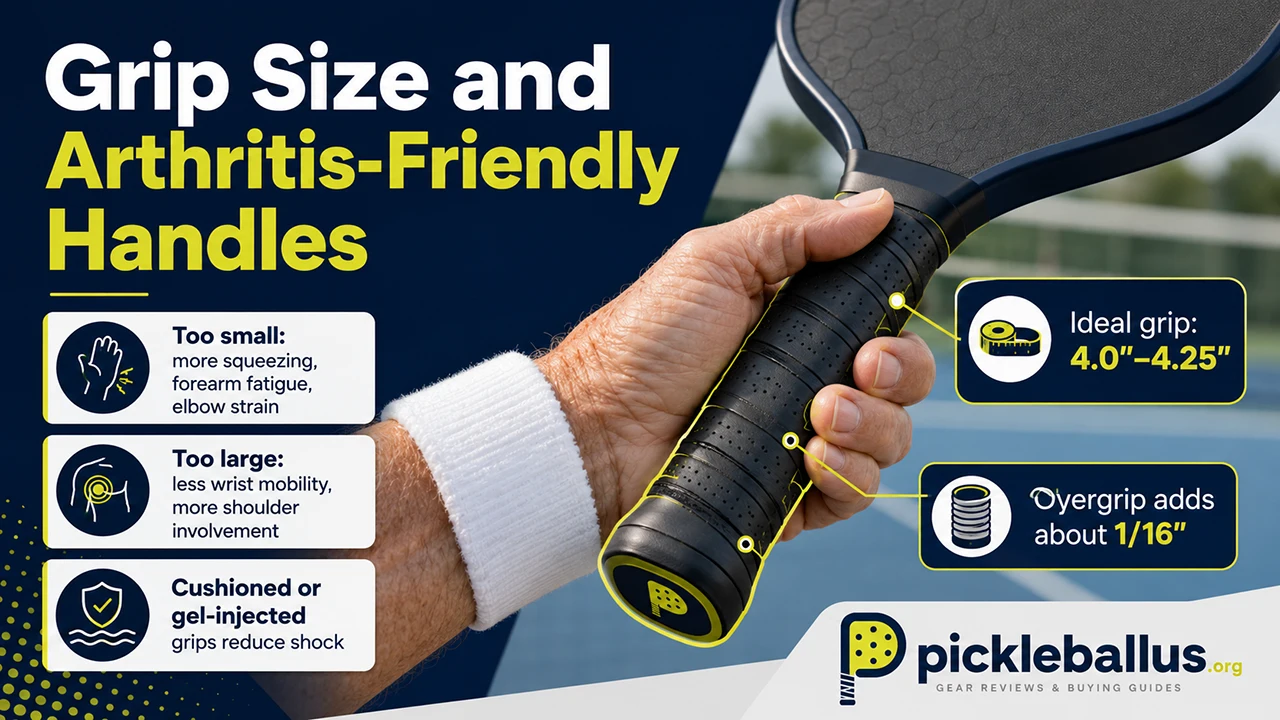
Grip Size and Arthritis-Friendly Handles
A grip circumference between 4.0″ and 4.25″ suits most senior hands. A grip that is too small forces you to squeeze harder to keep control, accelerating forearm fatigue and elbow strain. A grip that is too large limits wrist mobility, making net volleys stiff and increasing shoulder involvement on routine exchanges.
For players with arthritis or finger stiffness, a cushioned or gel-injected grip reduces the shock transferred on every contact. Adding an overgrip wrap — which adds roughly 1/16″ in diameter — is a legitimate adjustment if your current paddle’s grip runs slightly small. The grip is the one component of any paddle you can modify without replacing the paddle itself.
8 Best Pickleball Paddles for Seniors in 2026
The paddles below are ordered by overall suitability for senior players, starting with the strongest all-around performer and moving through specific-use cases. Every paddle listed is available on Amazon with established review counts.
#1 JOOLA Ben Johns Hyperion CFS 16mm — Best Overall
The JOOLA Ben Johns Hyperion CFS 16mm is the most widely purchased senior-appropriate performance paddle on the market, and three years after its launch it remains at the top of the category for good reason. The Hyperfoam Edge Wall extends the paddle’s effective sweet spot into the perimeter — the zone where most recreational and club-level players make off-center contact. That forgiveness is precisely what senior players need. Mis-hits that would send vibration straight into the elbow on a conventional paddle instead meet a foam-backed wall that absorbs and disperses the impact.
Key specs: Carbon fiber face (raw texture), Hyperfoam Edge Wall, 16mm polypropylene core, ~7.8 oz, 4.125″ grip, widebody shape available.
Performance: The raw carbon face provides strong spin potential without requiring aggressive wrist snap, which matters when keeping the forearm relaxed is a priority. Power output sits in the upper-mid range — enough to play from the baseline without excessive arm effort. Dink control at the kitchen line is precise, and the thick core keeps touch shots predictable.
Pros:
- Hyperfoam Edge Wall absorbs off-center vibration better than any paddle at this price
- 16mm core meets the minimum joint-protection standard
- Widely available with thousands of verified reviews
- Raw carbon face adds spin with moderate grip texture
Cons:
- At ~7.8 oz, sits at the upper end of the senior-recommended weight range
- Players with existing elbow conditions may prefer something lighter
Best For: Senior players at intermediate to advanced skill levels who play three or more sessions per week and want a single paddle that handles every situation well.
My Verdict: The Hyperion CFS 16 is the benchmark for good reason. If you can only pick one paddle and you play regularly, this is it.
#2 Selkirk SLK Halo Power XL — Best for Control
The Selkirk SLK Halo Power XL delivers exceptional control at a weight that protects senior joints, landing around 7.5 oz with a longer face and wider body that maximizes sweet spot coverage. Selkirk’s engineering on the Halo series centered on dwell time — how long the ball stays on the paddle face during contact. Longer dwell means more predictable placement, which is the cornerstone of senior strategy: winning with consistency rather than pace.
Key specs: Fiberglass face, SuperCore polymer honeycomb (16mm), ~7.5 oz, XL face shape, 4.25″ grip.
Performance: The fiberglass face produces a softer, more cushioned response compared to raw carbon — less spin ceiling, but noticeably less vibration on hard contact. That tradeoff favors seniors who play doubles and rely on dink exchanges and soft resets near the kitchen. The XL body shape adds reach and forgiveness on lateral shots, reducing compensating movements that strain the shoulder.
Pros:
- Soft fiberglass face reduces vibration on hard contact
- Large sweet spot on the XL face body
- 7.5 oz sits comfortably within senior-recommended range
- Strong record on Amazon with verified reviews
Cons:
- Lower spin ceiling than raw carbon alternatives
- Power players may find it too touch-oriented
Best For: Senior doubles players focused on best pickleball paddles for control who prioritize kitchen consistency and dink accuracy over aggressive groundstrokes.
My Verdict: The best choice if you rely on placement over power and want a paddle that protects your arm across long sessions.
#3 Paddletek Bantam EX-L Pro — Best for Consistent Senior Players
The Paddletek Bantam EX-L Pro is a reliable all-conditions paddle for senior players who have been in the game for years and want a proven, stable performer. Paddletek builds its paddles around a smooth polymer honeycomb core that runs slightly firmer than some competitors — but the EX-L Pro compensates with a textured graphite face and a grip that ranks among the most comfortable in its class.
Key specs: Graphite face (textured), ProKennex Smart Response Technology polymer core, ~7.6 oz, 4.25″ grip, standard shape.
Performance: The textured graphite face offers dependable spin without the roughness of raw carbon, which gives it a more forgiving feel on volleys. The smart response core absorbs vibration effectively, and the paddle’s weight distribution keeps swing fatigue low even in longer sessions. It rewards technical players who place the ball rather than hitting through it.
Pros:
- Graphite face offers spin with a forgiving feel
- Smart Response core reduces vibration at impact
- Comfortable grip with good cushion out of the box
- 7.6 oz in the ideal senior weight window
Cons:
- Less suited to aggressive power hitting
- Standard shape offers less surface area than widebody designs
Best For: Experienced senior players who want a technically capable paddle with a proven injury-reduction record.
My Verdict: A dependable mid-range pick that won’t let you down match after match.
#4 HEAD Radical Elite — Best Budget Pick
The HEAD Radical Elite punches far above its price point for senior players entering the sport or looking for a quality second paddle for casual outdoor use. At under half the cost of premium options, it delivers a fiberglass face and polymer core combination that protects joints better than the wooden or composite paddles typically found at this price.
Key specs: Fiberglass face, polymer honeycomb core, ~7.4 oz, 4.25″ grip, standard shape.
Performance: Weight at 7.4 oz makes it one of the lightest options on this list, which is a genuine advantage for seniors who want maximum maneuverability or who are managing shoulder fatigue. The fiberglass face absorbs impact and gives soft, forgiving touch on dinks and drops. Power is limited compared to carbon fiber paddles, but at recreational and social play levels, that limitation rarely matters.
Pros:
- Lightest paddle on this list at ~7.4 oz
- Fiberglass face provides excellent vibration absorption
- Very accessible pricing — one of the best introductory options on Amazon
- Comfortable 4.25″ grip suits most senior hand sizes
Cons:
- Polymer core runs thinner than 16mm on some versions — confirm spec before purchasing
- Not suited to competitive 4.0+ play
Best For: Seniors just starting pickleball, those new to the sport after a tennis background, or players who want a durable casual paddle without premium investment. See also the best pickleball paddles for beginners for more entry-level options across brands.
My Verdict: The best budget choice for senior beginners — accessible, forgiving, and gentle on the arm.
#5 Engage Pursuit Pro MX 6.0 — Best for Soft Touch and Placement
Seniors who’ve felt beat up by stiff thermoformed paddles will notice something different immediately with the Pursuit Pro MX 6.0 — the ball just sits on the face for a split second longer, giving you time to actually feel the shot. That dwell time isn’t an accident. It’s the result of Engage’s proprietary 16mm Control Pro Black Polymer core working with a Raw T700 Carbon Fiber face, a non-thermoformed construction that delivers a plush, arm-friendly response without sacrificing pop when you want to attack. For seniors prioritizing touch, ball placement, and long-term joint comfort, this paddle deserves serious attention.
Key Specs
- Core: 16mm Control Pro Black Polymer Honeycomb
- Face: Raw T700 Carbon Fiber (peel-ply grit)
- Weight: 7.6–7.9 oz (Lite) / 8.0–8.4 oz (Standard)
- Grip: 4.375″ circumference
- Handle: 5.75″
- Shape: Elongated (16.5″ x 7.5″)
- USAPA Approved: Yes
- Made in: USA
Performance Analysis
The 16mm core is the defining feature here. Where many power paddles transmit harsh vibration into the wrist and elbow, the Control Pro Black Polymer absorbs pace on contact — resets feel predictable, dinks land where you aimed, and the ball doesn’t jump off the face unexpectedly on soft shots. On the kitchen line during a third-shot drop sequence, I found I could commit fully to the stroke rather than babying the shot, because the core handled the deceleration for me. The Raw T700 surface adds meaningful grit for spin generation without the aggressive launch angle of stiffer thermoformed faces. Compared to the Selkirk Invikta Vanguard — a well-regarded control paddle — the Pursuit Pro MX 6.0 carries noticeably more power, meaning seniors who’ve lost some arm speed can still drive the ball effectively without muscling every shot. Vortex Barrier Edge Technology extends the sweet spot toward the frame, reducing the penalty for off-center contact — a genuine quality-of-life feature for players whose reaction time has slowed even slightly. Jessie Irvine has been known to play with a Pursuit paddle, and her style of precision-over-power play reflects exactly what this paddle does best. Vibration dampening is above average, making it a smart call for anyone managing elbow or shoulder inflammation.
Pros
- The 16mm soft polymer core absorbs pace and dampens vibration, reducing stress on joints during long sessions
- Lite weight option (7.6–7.9 oz) keeps swing weight manageable without sacrificing stability
- Extended 5.75″ handle supports two-handed backhand players and offers flexibility for grip adjustments mid-rally
- Expanded sweet spot via Vortex Barrier Edge tech is forgiving on slightly mis-hit balls
- Non-thermoformed construction delivers a plush, responsive feel that’s easier on the arm than most comparably powerful paddles
Cons
- The higher launch angle on drives takes adjustment — early sessions may produce shots flying longer than intended
- Standard grip circumference (4.375″) is the only option, with no thinner sizing available for smaller hands
- The learning curve from a traditional graphite or composite paddle can be steep; the carbon face rewards developed touch
Best For
Senior players at the 3.5–4.5 DUPR range who prioritize precise placement, kitchen control, and elbow comfort over raw power. Also a strong fit for players using best pickleball paddles for tennis elbow as their primary buying criterion — the vibration management here is among the best in its class.
My Verdict
The Pursuit Pro MX 6.0 is the rare paddle that lets seniors play an aggressive, placement-driven game without paying for it physically the next morning. The soft core, extended reach, and vibration-dampening construction make it purpose-built for anyone who wants to keep playing at a high level for years to come. If soft touch and shot placement are your top priorities, this is the one.
#6 Franklin Sports Ben Johns Signature — Best Entry-Level
The Franklin Sports Ben Johns Signature paddle brings respectable performance to the entry-level tier, making it a strong option for seniors who want a branded, recognizable paddle without committing to premium pricing. Franklin’s pickleball line benefits from Ben Johns’ involvement in design — the result is better balance and edge guard quality than you’d typically expect at this price point.
Key specs: Composite polymer face, polypropylene honeycomb core, ~7.6 oz, 4.25″ grip, standard shape.
Performance: The composite face absorbs contact softly, which reduces vibration on off-center hits. Core thickness varies by version — verify you are purchasing the thicker-core variant for maximum joint protection. The paddle plays with a balanced, predictable feel that makes it easier for newer players to develop technique without fighting unpredictable response. Weight at ~7.6 oz is comfortable for sustained play.
Pros:
- Accessible price with reliable build quality
- Soft composite face reduces vibration
- Balanced weight for arm-friendly play
- Well-recognized brand with strong Amazon review count
Cons:
- Core thickness inconsistent across product versions — check spec carefully
- Less specialized for serious competitive seniors
Best For: Seniors who are new to the game or playing recreationally and want a well-built paddle from a trusted brand.
My Verdict: A solid starting point. When you’re ready to upgrade, the spec knowledge you build on this paddle transfers directly to choosing a premium replacement.
#7 Onix Graphite Z5 Widebody — Best Lightweight Classic
The Onix Graphite Z5 Widebody is a proven, long-standing choice for senior players who prioritize maneuverability and sweet spot coverage over modern material technology. It has been consistently available on Amazon with a high review volume across years, making it one of the most verified performers in the senior category.
Key specs: Graphite face, Nomex honeycomb core, ~7.5–7.7 oz, 4.25″ grip, widebody shape.
Performance: The widebody shape is the Z5’s defining feature — the broader paddle face creates a large effective hitting zone that compensates for slightly slower reaction times. The graphite face provides a clean, consistent response with good touch sensitivity. One note: the Nomex core runs stiffer than polymer, which means slightly more vibration on hard contact than a 16mm polymer alternative. For seniors at recreational pace, this difference is manageable, but players with existing elbow issues should compare it against polymer-core options first.
Pros:
- Large widebody sweet spot ideal for seniors with slower reactions
- Lightweight at 7.5–7.7 oz
- Graphite face offers reliable, consistent touch
- One of the highest verified review counts in the category on Amazon
Cons:
- Nomex core is stiffer than polymer — higher vibration on hard contact
- Not the most advanced material stack available today
Best For: Senior recreational players who want a proven, widely-reviewed widebody paddle at a mid-range price point. Also worth comparing to the best widebody pickleball paddles if face area is your top priority.
My Verdict: A trusted classic. Not the newest technology, but the Z5 Widebody has stood the test of time for good reason.
#8 Gamma Hellbender 16mm — Best Mid-Range All-Rounder
The Gamma Hellbender 16mm earns its place with a raw carbon face plus a Sensa Poly Core 16mm configuration at a price point significantly below what comparable raw-carbon paddles cost from premium brands. For senior players who want modern spin capability without overcommitting budget, it fills a genuine gap.
Key specs: Raw carbon fiber face (grit), Sensa Poly Core 16mm, ~7.6–7.8 oz, 4.125″ grip, standard shape.
Performance: The raw carbon face generates spin comparable to paddles at twice the price, which allows seniors to use topspin and slice more effectively — a significant tactical advantage when physical speed declines. The 16mm Sensa Poly Core absorbs vibration well and gives the paddle a soft feel on dinks and soft shots. Weight runs toward the upper end of the senior-recommended range, so players near the 55–60 age bracket will want to play a session with it before committing.
Pros:
- Raw carbon face provides high spin at a mid-range price
- 16mm Sensa Poly Core meets joint-protection standard
- Competitive price vs. comparable carbon-face paddles
- Strong Amazon availability with verified reviews
Cons:
- Weight at ~7.6–7.8 oz is upper range for senior play
- Grit texture wears down faster than smoother faces
Best For: Senior intermediate players who want raw carbon spin performance without premium pricing.
My Verdict: The best value proposition in the carbon-face category for senior players. If spin is part of your game, this paddle delivers it at a fair cost.
Heavy Paddle vs. Arm-Friendly — Does the Difference Really Matter for Seniors?
Yes — the weight and stiffness difference between a standard adult paddle and a senior-appropriate one has measurable impact on joint health over a full season of play. This is not marketing language. It reflects how tendon elasticity, recovery speed, and arm muscle strength change with age.
The argument for heavier paddles — more power, more stability — assumes a body that can handle the swing load across multiple sessions per week. Past age 55, tendons lose elasticity and recover more slowly between sessions. A paddle weighing 8.5 oz instead of 7.5 oz means every forehand drive, every overhead, every defensive reach requires the arm to stabilize an extra ounce of momentum on contact. That stress accumulates.
The practical risk is pickleball elbow — a repetitive strain injury that affects a large proportion of senior players. If you are already managing elbow sensitivity, the best pickleball paddles for tennis elbow guide covers the specific features and brands most recommended for that condition. For healthy players looking to stay that way, staying within the 7.3–7.8 oz range and prioritizing a 16mm polymer core is the most effective preventive approach available through equipment selection.
The other side of the argument: paddles under 7.2 oz create their own problem. Without sufficient momentum, the player has to accelerate harder to generate pace, which adds its own arm strain. The sweet spot is not “as light as possible” — it is “light enough to swing without effort, heavy enough to absorb contact.” That window is 7.3–7.8 oz for most seniors.
How to Choose the Right Senior Paddle: Quick-Match Guide
The following table summarizes which paddle on this list matches common senior player profiles. Use it as a starting point and confirm with hands-on play when possible.
| Player Profile | Recommended Paddle | Why |
|---|---|---|
| New to pickleball, 60+ | HEAD Radical Elite | Lightest, most forgiving, accessible |
| Casual doubles, 2x/week | Franklin Sports Ben Johns Signature | Balanced performance, proven comfort |
| Competitive doubles, 3.5 rating | Selkirk SLK Halo Power XL | Control-first, large sweet spot |
| Intermediate, enjoys spin | Gamma Hellbender 16mm | Raw carbon at fair price |
| Advanced, plays 4+ sessions/week | JOOLA Ben Johns Hyperion CFS 16mm | Best all-around senior performer |
| Precision dink player | Engage Pursuit Pro MX 6.0 | Exceptional dwell time, placement focus |
| Recovering from elbow strain | Selkirk SLK Halo Power XL | Softest contact on off-center hits |
| Former tennis player | Paddletek Bantam EX-L Pro | Familiar feel, graphite face, clean response |
The right paddle is ultimately personal. Weight feels different between players of different arm strength, and grip size preferences vary significantly. If possible, demo two paddles at a local club before purchasing. Most serious pickleball retailers offer trial programs.
By now, you have a clear picture of which paddles deliver the best balance of weight, vibration control, and value for senior players at every skill level. Choosing the right paddle, however, is only half the equation — how you maintain it and adapt your technique will determine whether your investment protects your joints for one season or many years. The next section covers the details that separate players who stay healthy and competitive from those who quietly leave the sport due to avoidable strain.
What Seniors Should Know After Choosing Their Paddle
How to Avoid Pickleball Elbow with the Right Grip Technique
Grip pressure is the most underrated variable in senior elbow health. Most pickleball elbow cases do not originate in the paddle — they originate in how the player holds it. A death grip (squeezing at 8–10 out of 10 pressure) transmits every vibration from contact directly into the forearm tendons. A relaxed grip (4–5 out of 10) allows the wrist and elbow to absorb and disperse that same energy.
Practice holding your paddle with a loose, relaxed grip during warm-up drills. If you are transitioning from tennis, where firmer grips are more common, this adjustment takes deliberate repetition. The payoff is significant: players who reduce grip pressure consistently report less post-session soreness within two to three weeks.
Beyond grip pressure, shoulder rotation beats wrist flicking on power shots. Using the larger shoulder muscles to drive the swing rather than the small forearm muscles reduces the cumulative load on tendons. Bend your knees on low balls rather than stiff-arming down to meet them — the legs absorb impact that would otherwise load the elbow in an awkward position.
When to Replace a Worn Senior Paddle
Paddles do not fail catastrophically — they degrade gradually, and most players replace them too late. The warning signs are subtle: shots feel slightly deader than usual, the sweet spot seems to have shrunk, or off-center hits produce noticeably more vibration than they did six months ago. These are signs the polymer core has begun to compress or the face texture has worn smooth.
A rough estimate: a paddle used three sessions per week at recreational pace has a practical lifespan of 18–24 months before core degradation affects performance and joint protection. Players who compete regularly should reassess at 12–18 months. Inspect the face texture under direct light — if it looks polished and uniform rather than gritty, the spin and vibration-absorption benefits have worn down.
Can an Overgrip Save a Paddle That’s Too Small?
Yes — an overgrip is a legitimate and inexpensive fix when a paddle’s grip runs small for your hand. A standard overgrip adds approximately 1/16″ to grip circumference, which is often enough to move from uncomfortable to correct. For seniors with arthritis or finger stiffness, a cushioned overgrip (thicker, softer material) provides additional shock absorption beyond the grip size adjustment.
One overgrip is usually the right approach. Stacking two overgrips adds enough diameter that it can restrict wrist mobility — the opposite problem from what you were solving. If the base grip is two full sizes too small, no overgrip stack corrects it adequately; in that case, replacing the paddle or selecting one with a larger base grip is the right path.
Write Your Review
No reviews yet. Be the first to share your experience!