

The best hybrid pickleball paddles of 2026 are the Honolulu J2CR Crystal Blue (best overall), the Six Zero Double Black Diamond Control 16mm (best for control), the CRBN TruFoam Genesis 3 (best for advanced players), the 11SIX24 Vapor (best hybrid shape innovation), the Bread & Butter Loco Hybrid (best all-court value), the Selkirk SLK Omega Max (best mid-range), the Vatic Pro V-Sol Pro Hybrid (best budget pick), and the Spartus P1 Hybrid (best for long-lasting grit).
Picking a hybrid paddle sounds simple until you realize the word “hybrid” means two different things in pickleball. It can describe a paddle’s shape — sitting between the longer elongated and the wider widebody — or it can describe blended face and core materials. Most players searching for a hybrid paddle care about both, but the confusion between the two definitions sends a lot of buyers in the wrong direction. This guide cuts through that noise and focuses on what actually matters: on-court performance, durability, and how each paddle fits a real playing style.
Whether you play recreational doubles three times a week or you’re grinding toward a 4.5 rating, the hybrid shape has become the most popular paddle category in 2026. It gives you more reach than a widebody without the reduced maneuverability of a pure elongated stick. That balance is why hybrid paddles now account for over a third of all research traffic among competitive players.
Below is a breakdown of eight hybrid paddles worth serious consideration, followed by a practical guide on how to choose between them based on your game.
What Is a Hybrid Pickleball Paddle?
A hybrid pickleball paddle refers to either a mid-length paddle shape that sits between elongated and widebody dimensions, or a paddle built from a combination of face and core materials — and in 2026, the best options tend to be both at once.
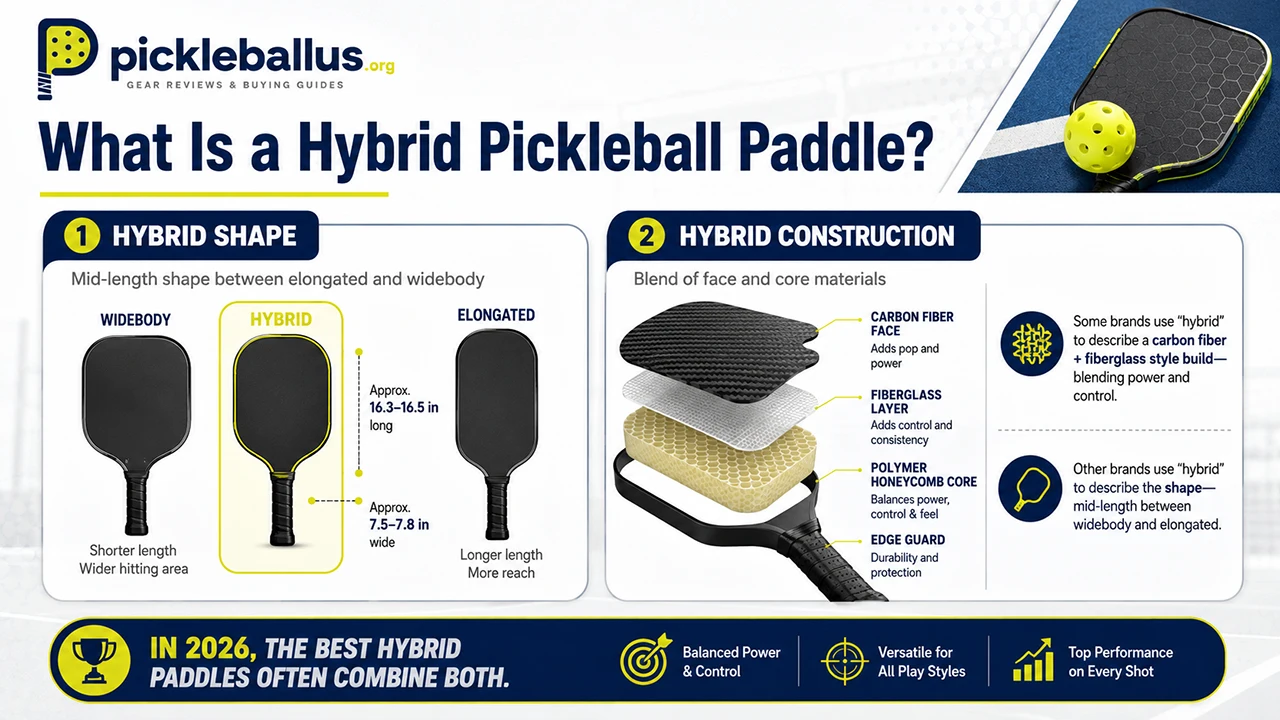
Understanding the distinction matters because manufacturers use the term loosely. Some brands market a paddle as “hybrid” purely based on its face being a blend of carbon fiber and fiberglass, even if the shape is a standard widebody. Others use “hybrid” exclusively to describe a paddle that measures around 16.3–16.5 inches in length with a face width of roughly 7.5–7.8 inches — longer than a widebody but shorter and wider than a traditional elongated.
Hybrid Shape — Between Elongated and Widebody
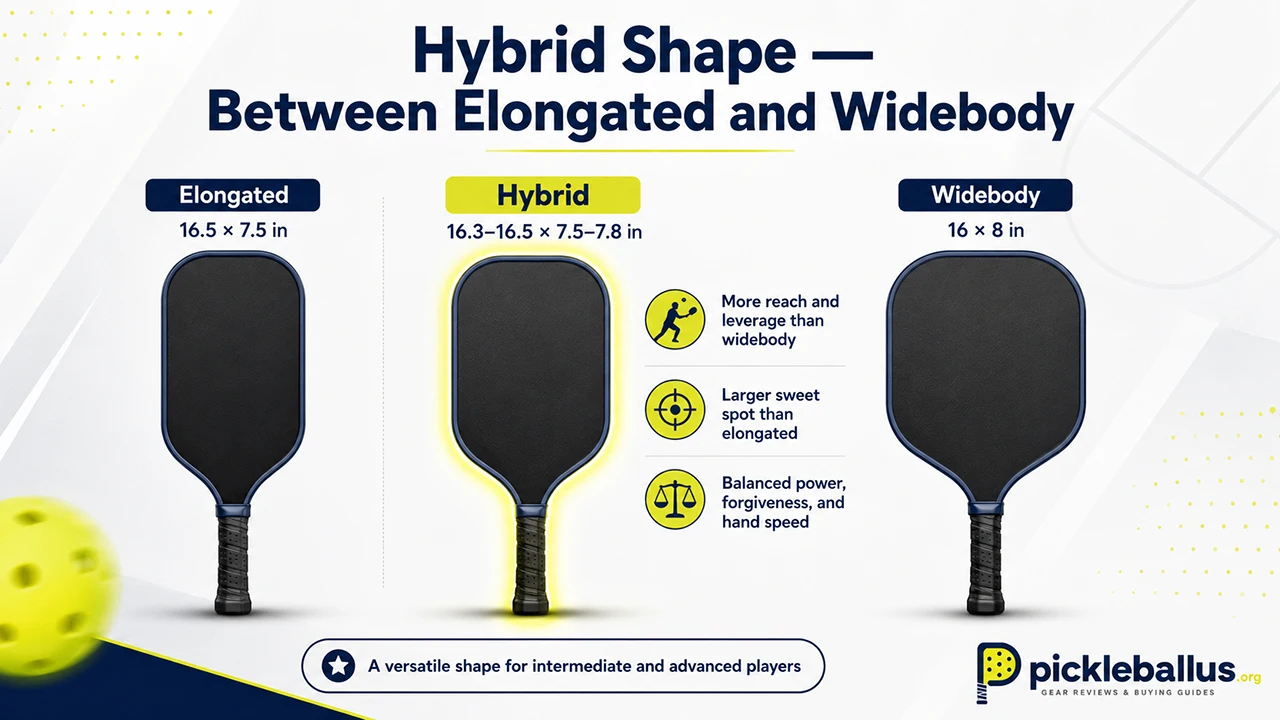
A hybrid-shaped paddle typically measures 16.3–16.5 inches long and 7.5–7.8 inches wide, landing between the classic elongated (16.5″ × 7.5″) and widebody (16″ × 8″) formats. That extra half-inch of length over a widebody gives you more leverage on drives and a slightly longer reach at the baseline. The added width over a pure elongated paddle enlarges the sweet spot, which means off-center hits stay in play more often.
The result is a paddle shape that rewards players who want some of the power of an elongated stick without sacrificing the forgiveness and hand-speed of a wider body. It is no accident that the hybrid shape now leads intermediate and advanced player searches for the first time in 2026, overtaking the widebody format in several major review rankings.
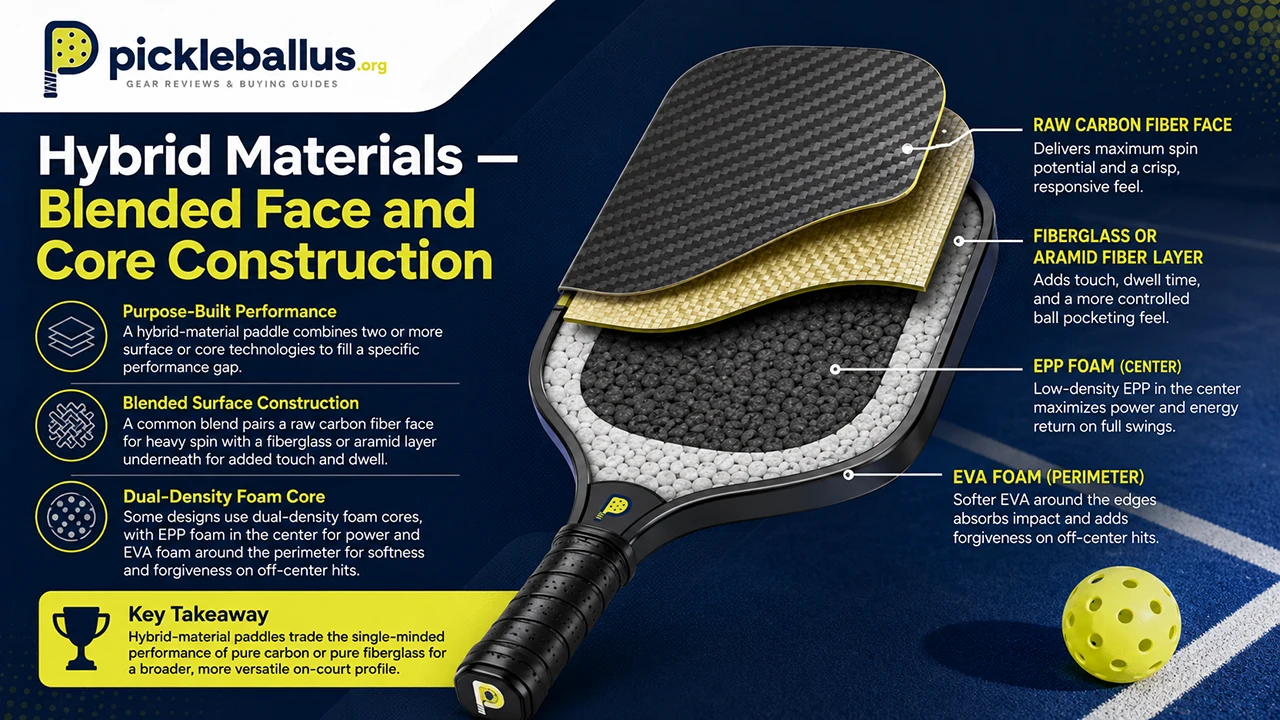
Beyond shape, a hybrid-material paddle combines two or more surface or core technologies to target a specific performance gap. The most common blend pairs a raw carbon fiber face — which generates heavy spin — with a fiberglass or aramid fiber layer underneath for added touch and dwell. Some manufacturers go further and build dual-density foam cores, stacking EPP foam at the center for power and EVA foam around the perimeter for softness and forgiveness on off-center hits.
For most buyers, the relevant takeaway is this: a hybrid-material paddle trades the single-minded performance of a pure carbon or pure fiberglass paddle for a broader, more versatile on-court profile. That versatility is exactly why the pickleball paddle materials category has seen the most growth among recreational and competitive players over the past 18 months.
8 Best Hybrid Pickleball Paddles of 2026
The eight paddles below were selected based on active Amazon availability, review volume, verified on-court testing data from multiple independent sources, and consistent performance across skill levels. They cover the full range from budget-friendly to pro-tier, with a clear “best for” case for each.
#1 Honolulu J2CR Crystal Blue — Best Overall
The Honolulu J2CR Crystal Blue earns the top spot because it is the rare paddle that performs at a near-professional level while remaining accessible to intermediate players who are ready to step up their game.
Key Specs:
- Shape: Hybrid
- Core: Dual-density EPP/EVA foam (Core Reactor construction)
- Face: Raw carbon fiber with Crystal Blue long-lasting grit texture
- Core thickness: 16mm
- Weight: ~8.0–8.2 oz
Performance Analysis:
The Core Reactor construction is what sets the J2CR apart from paddles using a standard polymer honeycomb. The EPP foam at the center generates a surprising level of pop for a control-oriented paddle, while the EVA perimeter foam softens the feel on touch shots at the kitchen. That combination gives the paddle a split personality in the best possible way — it drives hard when you swing through the ball and absorbs contact cleanly when you need to reset.
The Crystal Blue surface grit addresses one of the most persistent frustrations with premium carbon fiber paddles: grit wear. Most raw carbon faces lose their texture within a few months of heavy play, which degrades spin generation significantly. Honolulu’s Crystal Blue material is engineered for durability, and early testing reports show no meaningful grit degradation after 16+ hours of on-court use. For a player who relies on topspin drives and heavy kitchen dinks, that longevity alone justifies the price.
Swing weight sits below average for a foam-core paddle, which means the J2CR moves fast through hand battles despite packing real power. That is a rare combination — most foam paddles sacrifice speed for pop.
Pros:
- Crystal Blue grit texture lasts significantly longer than standard raw carbon
- Dual-density foam core delivers power and control without compromise
- Below-average swing weight keeps hand speed high
Cons:
- Higher price point than many midweight polymer paddles
- EPP/EVA foam feel takes a short break-in period to appreciate fully
Best For: 3.5–4.5 players who want an all-court paddle that stays competitive for multiple seasons without grit reapplication.
My Verdict: The J2CR Crystal Blue is the best hybrid pickleball paddle on the market in 2026 for players who want performance they can feel from the first hit and trust over the long term.
#2 Six Zero Double Black Diamond Control 16mm — Best for Control
The Six Zero Double Black Diamond Control 16mm is the benchmark for kitchen-first players who build their game around placement, resets, and clean dink sequences.
Key Specs:
- Shape: Hybrid
- Core: Polymer honeycomb, 16mm
- Face: Japanese Toray 700K raw carbon fiber
- Weight: 8.0–8.2 oz
- Swing weight: 110 | Twist weight: 6.4
Performance Analysis:
The Double Black Diamond’s published swing weight of 110 is notably low for a premium paddle at this price tier. Lower swing weight means the paddle moves faster through the air, which directly benefits hand exchanges at the net and recovery shots in fast-forward exchanges. The 16mm core adds cushion and extends dwell time — the brief moment the ball stays in contact with the paddle face — which is what makes drops and resets feel dialed in rather than unpredictable.
Six Zero uses a Japanese Toray 700K raw carbon face, which is among the more refined carbon fiber materials on the market. It generates consistent spin without requiring an aggressive swing to activate the grit. Combined with the wider hybrid body (7.5–7.7 inches), the sweet spot is forgiving enough to handle realistic off-center contact during high-speed rallies.
The trade-off is firepower. This paddle is built for controlled, patient play — it will not help a player looking to bully opponents with pace. If your winning shots are third-ball drops, cross-court dinks, and well-placed resets, this is the paddle that rewards that style most consistently.
Pros:
- Best-in-class dwell time for soft-game precision
- Low twist weight adds stability on wide hits
- One of the most recognizable control-first paddles on the competitive circuit
Cons:
- Limited offensive ceiling for power-oriented players
- Premium pricing places it out of reach for recreational buyers
Best For: Doubles players at 4.0+ who win with consistency, kitchen control, and patient rally management.
My Verdict: The Double Black Diamond remains the gold standard for control-focused hybrid paddles. If soft-game mastery is your competitive edge, nothing in this list touches it.
#3 CRBN TruFoam Genesis 3 — Best for Advanced Players
The CRBN TruFoam Genesis 3 represents the most technologically refined foam-core paddle in CRBN’s lineup, designed for experienced players who want to shape every shot on the court.
Key Specs:
- Shape: Hybrid (also available in elongated)
- Core: 100% foam (proprietary TruFoam construction)
- Face: High-grit carbon fiber
- Core thickness: 14mm
- Weight: ~8.0–8.1 oz
- Swing weight: ~118–120 | Balance point: ~245–246mm
Performance Analysis:
CRBN’s TruFoam technology replaces the standard polymer honeycomb with a full foam core, producing a distinctly plush, stable feel that experienced players describe as “controlled power.” The foam absorbs vibration differently than honeycomb — there is less of the sharp, hollow pop and more of a dense, loaded feel at contact. That texture at the hitting surface means advanced players can apply more precise pressure on the ball, shaping topspin and slice shots with finer margins than most paddles allow.
The high-grit carbon face is a CRBN hallmark. It consistently ranks among the highest spin-generation surfaces tested by independent reviewers, and the face holds its grit texture better than many competitors at similar price points. The Genesis 3 is an upgrade over its predecessors specifically in forgiveness and weighting — the balance point sits slightly more toward the head than the Genesis 2, adding stability on counters and speedups without sacrificing hand speed.
This paddle requires real skill to maximize. For players below the 4.0 rating, the nuanced feel of a foam core can feel overwhelming rather than empowering.
Pros:
- Foam core delivers one of the highest dwell times in the category
- Exceptional spin generation with durable grit texture
- Handles touch shots and aggressive drives from the same swing
Cons:
- High price point — among the most expensive in this roundup
- Best appreciated by advanced players; less rewarding for recreational buyers
Best For: 4.0–5.0 players who compete regularly and want a paddle that grows with their skill ceiling.
My Verdict: The TruFoam Genesis 3 is built for players who think about their paddle as a precision instrument. If you are at that level, this is one of the best investments in the category.
#4 11SIX24 Vapor — Best Hybrid Shape Innovation
The 11SIX24 Vapor takes the most distinctive approach to hybrid shape in this roundup, treating the paddle’s dimensions as the primary performance variable rather than treating shape as an afterthought to material choices.
Key Specs:
- Shape: Proprietary Vapor hybrid shape
- Core: Polymer honeycomb
- Face: HexGrit textured carbon fiber
- Weight: Mid-range (7.8–8.2 oz range)
Performance Analysis:
11SIX24’s Vapor shape is intentionally different from the standard hybrid format. Where most hybrid paddles are simply proportional compromises between elongated and widebody templates, the Vapor redistributes weight and width across the face in a way that places the sweet spot higher on the paddle — closer to the top edge than a conventional hybrid. That positioning rewards players who make contact slightly above center, which aligns with how most players naturally strike the ball on drives and overhead shots.
The HexGrit surface is a long-lasting spin texture that 11SIX24 developed to outlast conventional raw carbon. Independent testing has noted that the Vapor’s grit holds up well through extended play, reducing the maintenance concern that comes with most high-performance carbon faces.
The paddle is well-suited to players who have tried both elongated and widebody formats and felt limited by both — too narrow with elongated, too slow with widebody. The Vapor resolves that dilemma in a way that feels purpose-built rather than a compromise.
Pros:
- Innovative sweet-spot placement rewards natural contact zones
- HexGrit texture provides durable, consistent spin
- Distinctive shape makes it a strong option for players stuck between formats
Cons:
- The unconventional shape takes adjustment time to trust
- Fewer size and thickness options than established brands
Best For: Intermediate-to-advanced players who have outgrown widebody paddles but find pure elongated shapes too demanding.
My Verdict: The 11SIX24 Vapor is the most forward-thinking hybrid-shape paddle in this list. It solves a real problem for a specific type of player, and it does it well.
#5 Bread & Butter Loco Hybrid — Best All-Court Value
The Bread & Butter Loco Hybrid delivers pro-tier performance at a price point that makes it one of the most compelling value stories in the 2026 paddle market.
Key Specs:
- Shape: Hybrid
- Core: Polymer honeycomb (hollow, stiff construction)
- Face: Raw carbon fiber
- Available thicknesses: 14mm and 16mm
- Weight: ~7.8–8.2 oz
Performance Analysis:
The Loco is a loud, lively paddle with a stiff and hollow feel at contact. That construction produces a high level of pop and power that sits well above what most players expect from a mid-range all-court paddle. On serve returns and drives, the Loco generates significant pace without requiring an aggressive swing — the face does most of the work.
The Loco Hybrid shape sits comfortably between the elongated and standard Loco variants, offering a generous sweet spot with some of the reach advantage of the longer format. Bread & Butter also offers exceptional sweet spot size across all three Loco shapes, which makes the hybrid version particularly forgiving during high-pressure rallies.
The main limitation is grit longevity. Unlike the Crystal Blue or HexGrit technologies found on higher-end paddles, the Loco’s standard raw carbon face wears down faster under heavy use. Players who practice daily or compete frequently should factor grit replacement or paddle rotation into their buying decision.
Pros:
- Among the highest power-to-price ratios in the hybrid paddle market
- Exceptional sweet spot for a paddle at this dimension
- Available in two thicknesses to match play style preference
Cons:
- Surface grit wears faster than paddles with long-lasting texture technology
- Stiff, hollow feel is not ideal for players who prioritize touch over power
Best For: 3.0–4.0 players who want high-end power and a best carbon fiber pickleball paddle experience without paying premium-tier pricing.
My Verdict: For the money, the Loco Hybrid is difficult to beat. If grit longevity is not your top priority and you want raw performance at a mid-range investment, this is the pick.
#6 Selkirk SLK Omega Max — Best Mid-Range
The Selkirk SLK Omega Max brings Selkirk’s engineering credibility to a price point that mid-range buyers can access without compromise on build quality.
Key Specs:
- Shape: Hybrid
- Core: Rev-Control polymer honeycomb
- Face: Raw carbon fiber
- Weight: ~7.5–8.0 oz
- Price tier: Mid-range
Performance Analysis:
Selkirk built the SLK Omega Max as the intersection between the brand’s consumer-accessible SLK line and the performance standards of its pro-level LABS range. The Rev-Control honeycomb core creates a large sweet spot and softens off-center impacts — particularly valuable for players who are working on placement consistency rather than raw power.
The raw carbon face delivers strong spin generation at a price that significantly undercuts most pure carbon paddles from Selkirk’s premium lineup. For players comparing this against best composite pickleball paddles at a similar price, the Omega Max’s carbon face gives it a measurable edge in spin and surface texture durability.
The midweight build (approximately 7.5–8.0 oz) keeps the paddle fast through hand battles without feeling underpowered on aggressive third-ball attacks. Selkirk’s warranty support and retail presence also make this paddle a low-risk buy compared to smaller brands with limited service infrastructure.
Pros:
- Selkirk build quality and warranty at an accessible price
- Large sweet spot rewards consistent, high-contact play
- Strong spin from raw carbon face
Cons:
- Not the most powerful paddle at this price tier
- Swing weight is conservative, which some power players may find limiting
Best For: Recreational to intermediate players (2.5–3.5) who want a dependable, well-rounded paddle backed by a trusted brand.
My Verdict: The SLK Omega Max is the safest buy in this list for players who want quality assurance alongside competitive performance. Selkirk’s production consistency means the paddle you receive matches what reviewers tested.
#7 Vatic Pro V-Sol Pro Hybrid — Best Budget Pick
The Vatic Pro V-Sol Pro Hybrid proves that budget-friendly and high-performance are no longer mutually exclusive in the 2026 pickleball paddle market.
Key Specs:
- Shape: Hybrid (also available in widebody and elongated)
- Core: Polymer honeycomb
- Face: Thermoformed carbon fiber
- Weight: Lightweight (7.5–8.0 oz range)
- Price tier: Budget-friendly
Performance Analysis:
Vatic Pro has built its reputation on delivering thermoformed carbon construction at a price point that larger brands struggle to match. The V-Sol Pro Hybrid benefits from that same manufacturing approach — the thermoformed carbon face bonds more uniformly to the core than non-thermoformed alternatives, which produces a livelier, more consistent response across the hitting surface.
The hybrid shape strikes a clean balance between the power of Vatic’s elongated V-Sol format and the forgiveness of the widebody. For a player moving up from a beginner composite paddle, the V-Sol Pro Hybrid represents a significant step in spin generation and pop without the learning curve that comes with premium-tier foam-core paddles.
Weight sits in the lighter range of this list, which benefits players who prioritize reaction speed at the kitchen and quick resets over sheer power. The lightweight build is particularly well-suited to players working on net-play consistency — a skill area where reaction time matters more than paddle mass.
Pros:
- Thermoformed carbon face at a price that most budget paddles do not offer
- Lightweight build rewards quick hands and net-play improvement
- Shape options allow players to test hybrid format before upgrading
Cons:
- Less power ceiling than foam-core competitors at higher price points
- Not designed for tournament-level play, where premium construction details matter
Best For: Beginners to 3.0 players making their first investment in a performance paddle, or experienced players seeking an affordable training backup.
My Verdict: The V-Sol Pro Hybrid delivers the best performance per dollar in this roundup. It will not win in a spec comparison against the J2CR or the TruFoam Genesis, but it will absolutely improve your game over a standard beginner paddle.
#8 Spartus P1 Hybrid — Best for Long-Lasting Grit
The Spartus P1 Hybrid enters the conversation as a direct answer to grit degradation — the most common performance complaint among carbon fiber paddle owners.
Key Specs:
- Shape: Hybrid
- Core: Polymer honeycomb
- Face: Raw carbon fiber with PermaGrit long-lasting texture
- Weight: Mid-range (7.8–8.2 oz range)
Performance Analysis:
Spartus developed PermaGrit as a proprietary surface treatment applied over raw carbon fiber to dramatically slow down grit wear. Where most raw carbon faces lose meaningful texture within 40–60 hours of play, PermaGrit is engineered to maintain consistent spin generation well beyond that threshold. For players who compete frequently or practice daily, that durability directly translates into a longer period of peak performance per paddle.
The trade-off is feel. Applying the PermaGrit layer over the carbon fiber slightly dampens the paddle’s natural pop, producing a softer feel at contact compared to the Loco Hybrid or a standard thermoformed carbon. Some players prefer this softer texture because it adds forgiveness on dinks and touch shots; players who like a lively, hollow response may find it less satisfying on drives.
The P1 Hybrid currently has limited stock availability compared to the other paddles on this list, and early production runs showed some edge guard adhesion issues that Spartus has acknowledged and is actively addressing. Checking for an updated production batch before purchasing is advisable.
Pros:
- PermaGrit surface texture outlasts standard raw carbon by a significant margin
- Consistent spin generation remains reliable over extended ownership periods
- Hybrid shape delivers balanced reach and forgiveness
Cons:
- PermaGrit coating softens the paddle feel relative to standard carbon
- Limited stock availability; edge guard adhesion issues reported in early batches
Best For: Competitive 3.5–4.5 players who rotate paddles frequently and want to reduce per-game grit maintenance costs.
My Verdict: The P1 Hybrid is the right call for any player who has grown frustrated with replacing paddles after the grit wears down. If durability is your primary concern, PermaGrit delivers on its promise.
Hybrid vs. Elongated vs. Widebody — How Do They Compare?
Hybrid paddles outperform elongated shapes in maneuverability and forgiveness, and outperform widebody shapes in reach and leverage — making the hybrid format the strongest general-purpose choice for most competitive players.
The table below summarizes the practical on-court differences between the three primary pickleball paddle shapes:
| Feature | Hybrid | Elongated | Widebody |
|---|---|---|---|
| Typical length | 16.3–16.5″ | 16.5–17.0″ | 15.5–16.0″ |
| Typical width | 7.5–7.8″ | 7.3–7.5″ | 8.0–8.5″ |
| Sweet spot size | Medium-large | Medium | Largest |
| Reach at baseline | Good | Best | Moderate |
| Maneuverability | High | Moderate | Highest |
| Best for | All-court versatility | Power-first / singles | Beginners / net play |
For players transitioning off widebody paddles, the hybrid shape typically requires a short adjustment period (1–2 weeks of regular play) before the sweet spot feels natural. Players coming from elongated paddles generally adapt faster because the hybrid is more forgiving, not less.
The best elongated pickleball paddles offer the most reach and put-away power, but they demand precise footwork and good timing to use consistently. The best widebody pickleball paddles maximize forgiveness for beginners and defensive players. Hybrid shapes split the difference, and in 2026, most competitive players have landed there.
How to Choose the Right Hybrid Pickleball Paddle
The three variables that most directly determine whether a hybrid paddle fits your game are core thickness, face material, and swing weight — in that order of importance for most players.
Core Thickness: 14mm vs. 16mm
A 16mm core produces more cushion, more dwell time, and a softer feel at contact. That translates to better kitchen control, more reliable resets, and a forgiving response on off-center hits. Most of the paddles in this list use 16mm cores for those reasons.
A 14mm core is firmer and generates more pop and power — the ball leaves the face faster. The CRBN TruFoam Genesis 3 at 14mm is a good example: the foam core compensates for the thinner profile by adding its own type of dwell through material density rather than core depth. For players prioritizing best pickleball paddles for control and soft-game precision, 16mm is the safer starting point.
Face Material and Spin Performance
Raw carbon fiber faces generate more best pickleball paddles for spin than fiberglass or graphite alternatives because of their textured, abrasive surface. The downside is grit wear — that texture degrades with use, and most raw carbon faces need replacement or rotation after several months of heavy play.
Fiberglass faces offer more power and a livelier feel but generate less spin. Composite and hybrid-material faces blend the two, targeting players who want both spin capability and a slight power boost without committing fully to either material profile.
Weight Class and Swing Weight Explained
Standard weight classification in pickleball ranges from lightweight (below 7.5 oz) to midweight (7.5–8.5 oz) to heavyweight (above 8.5 oz). Most of the paddles in this roundup fall in the midweight range.
Swing weight — a measure of how heavy the paddle feels in motion rather than in your hand — is a more useful metric than static weight for predicting on-court feel. A paddle with a higher swing weight feels more stable on hard shots but slower through hand battles. Lower swing weight means faster hands at the kitchen but less mass behind groundstrokes. The Six Zero Double Black Diamond’s swing weight of 110 is notably low, which explains why control players favor it for net-play speed.
Reviewing the full best pickleball paddles database sorted by swing weight is one of the most efficient ways to narrow a purchase decision before committing.
By now you have a clear picture of which hybrid paddles perform at every price tier and how to match shape and specs to your game style. Choosing the right paddle, however, is only half of the investment — knowing how to maintain surface grit, customize the balance, and recognize when a paddle has run its course will determine whether that paddle earns its keep for one season or several years. The next section covers the finer details that only players who have owned multiple paddles tend to learn the hard way.
Getting the Most Out of Your Hybrid Paddle
Breaking In and Maintaining Surface Grit
New raw carbon fiber paddles benefit from a short break-in period of 2–4 hours of on-court play before the face fully activates its grit texture. Many players find that spin performance improves noticeably during this window as the surface settles under real contact conditions.
To extend grit life, avoid cleaning the paddle face with abrasive materials or solvents. A soft cloth dampened with water removes ball marks without degrading the carbon texture. Paddles with long-lasting grit technologies — like Honolulu’s Crystal Blue or Spartus’s PermaGrit — require less maintenance by design, but even these benefit from consistent care.
Customizing Balance with Lead Tape
Adding lead tape to a hybrid paddle is one of the most cost-effective ways to adjust feel without buying a new paddle. Placing small strips at 3 and 9 o’clock on the paddle face increases swing weight and stability on counters. Tape at 12 o’clock shifts the balance point toward the head for more put-away power on overheads. Tape at the handle end reduces swing weight and restores hand speed.
Start with 2 grams per placement and play several sessions before adding more. The goal is to modify the paddle’s behavior in one specific area without disrupting what already works.
When to Replace Your Hybrid Paddle
Most pickleball paddle materials have a useful performance window before degradation becomes meaningful. For raw carbon fiber faces without long-lasting grit technology, that window is roughly 40–80 hours of active play, depending on conditions and storage habits. Core delamination — a hollow, dead sound on contact distinct from the paddle’s normal pop — is the clearest signal that the core has compressed and the paddle has lost structural integrity.
If you notice significantly reduced spin despite a clean surface, or if the face feels noticeably smoother than it did when new, the paddle has reached the end of its optimal performance life. Continuing to play with a dead paddle makes it harder to build consistent shot mechanics.
The “Hybrid” Label — Useful Spec or Marketing Blur?
Not every paddle marketed as “hybrid” offers a meaningful performance distinction from a standard carbon or composite option. Some brands apply the label to any paddle that combines two materials in any part of its construction — which, by that definition, describes the majority of paddles on the market.
The paddles worth your attention are those where the hybrid construction produces a specific, documented on-court outcome: a wider sweet spot than an elongated at the same length, a more forgiving response at the kitchen than a pure power paddle, or a spin-plus-touch combination that a single-material face cannot replicate. When evaluating a “hybrid” paddle, look for those specific claims backed by test data or reviewer experience rather than taking the label at face value.
Write Your Review
No reviews yet. Be the first to share your experience!